

ASTM F1504-21e1
(Specification)Standard Specification for Folded Poly(Vinyl Chloride) (PVC) Pipe for Existing Sewer and Conduit Rehabilitation
General Information
- Abstract
ABSTRACT
This specification covers the material, dimensional, and requirements and corresponding test methods for folded poly(vinyl chloride) (PVC) pipes suitable for the rehabilitation of existing nonpressure sewers and conduits, wherein the folded PVC pipe is inserted into, and then expanded to conform to the wall of, the original conduit forming a new pipe-within-a-pipe structure. This specification does not include pipes manufactured from reprocessed, recycled, or reclaimed PVC. Appropriately sampled specimens shall be tested, and shall thereby conform accordingly to specified requirements for flattening resistance, impact strength, stiffness, extrusion quality by acetone immersion and heat reversion, flexural modulus of elasticity, and rounded pipe diameter and wall thickness.
SCOPE
1.1 This specification covers requirements and test methods for materials, dimensions, workmanship, flattening resistance, impact resistance, pipe stiffness, extrusion quality, and a form of marking for folded poly(vinyl chloride) (PVC) pipe for existing sewer and conduit rehabilitation.
1.2 Folded PVC pipe produced to this specification is for use in non-pressure sewer and conduit rehabilitation where the folded PVC pipe is inserted into and then expanded to conform to the wall of the original conduit forming a new pipe-within-a-pipe.
Note 1: For installation procedures and engineering design considerations refer to Practice F1947.
1.3 This specification includes folded PVC pipe made only from materials specified in Section 6. This specification does not include folded pipe manufactured from reprocessed, recycled, or reclaimed PVC.
1.4 The values stated in inch-pound units are to be regarded as standard. The values given in parentheses are mathematical conversions to SI units that are provided for information only and are not considered standard.
1.5 The following precautionary statement pertains to the test method portion only, Section 11, of this specification: This standard does not purport to address all of the safety concerns, if any, associated with its use. It is the responsibility of the user of this standard to establish appropriate safety, health, and environmental practices and determine the applicability of regulatory limitations prior to use.
1.6 This international standard was developed in accordance with internationally recognized principles on standardization established in the Decision on Principles for the Development of International Standards, Guides and Recommendations issued by the World Trade Organization Technical Barriers to Trade (TBT) Committee.
- Status
- Published
- Publication Date
- 31-Jul-2021
- Technical Committee
- F17 - Plastic Piping Systems
- Drafting Committee
- F17.67 - Trenchless Plastic Pipeline Technology
Overview
ASTM F1504-21e1 is an international standard specification developed by ASTM for folded poly(vinyl chloride) (PVC) pipe used in the rehabilitation of existing non-pressure sewers and conduit systems. This specification establishes the requirements and appropriate test methods necessary to ensure that folded PVC pipes are suitable for creating a pipe-within-a-pipe structure, restoring the functionality and integrity of aging pipelines without complete replacement. The scope focuses on dimensional criteria, material properties, mechanical resistance, and quality control measures, strictly limiting pipe composition to virgin PVC compounds.
Key Topics
Material Requirements
Only virgin PVC materials that meet certain cell classifications are permitted. The standard does not allow use of reprocessed, recycled, or reclaimed PVC, except for clean rework material generated from the manufacturer's own production, provided it meets the required specifications.Dimensional Specifications
Requirements for outside diameter and wall thickness ensure a precise fit and long-term performance. Strict tolerances are set for dimensional verification.Mechanical and Physical Properties
Folded pipe must meet rigorous standards for flattening resistance, impact strength, pipe stiffness, and flexural properties. Tests such as flattening, impact resistance, and flexural modulus of elasticity are conducted on rounded pipe samples to verify durability.Quality of Extrusion
Extrusion quality is assessed using acetone immersion and heat reversion techniques. Pipes must remain homogeneous and free from cracks, holes, or inclusions.Testing and Sampling
The standard outlines procedures for preparing test samples, laboratory testing conditions, and acceptable pass/fail criteria to validate product conformity.Product Marking and Packaging
Clear product marking, including manufacturer’s identification and pipe classification, is required at regular intervals. Coiling and packaging must ensure safe delivery and storage.
Applications
Sewer and Conduit Rehabilitation
ASTM F1504-21e1 is specifically written for the rehabilitation of existing non-pressure sewer and conduit systems. The process involves inserting folded PVC pipe into deteriorated pipelines and expanding it to create a new, structurally independent liner. This trenchless rehabilitation method minimizes disruption and extends the life of sewer infrastructure.Infrastructure Renewal
Municipalities and utilities use this standard to guide specification, procurement, and acceptance of rehabilitation piping materials in projects aimed at renewing wastewater collection systems.Industrial and Commercial Settings
Applicable where non-pressure drained liquids require reliable long-term performance and minimal maintenance in both municipal and industrial conduit contexts.Quality Assurance for Procurement
Government and military procurement may reference supplementary requirements for inspection, packaging, and marking, ensuring compliance with federal and military standards.
Related Standards
- ASTM D618 – Conditioning Plastics for Testing
- ASTM D790 – Flexural Properties of Plastics
- ASTM D1784 – Classification of Rigid PVC Compounds
- ASTM D2122 – Dimensions of Thermoplastic Pipes and Fittings
- ASTM D2152 – Fusion Adequacy of Extruded PVC by Acetone Immersion
- ASTM D2412 – External Loading Characteristics of Plastic Pipe
- ASTM D2444 – Impact Resistance of Thermoplastic Pipe
- ASTM F412 – Terminology Relating to Plastic Piping Systems
- ASTM F1057 – Extruded PVC Pipe Heat Reversion Test
- ASTM F1947 – Practice for Installation of Folded PVC Pipe in Existing Sewers
These related standards complement ASTM F1504-21e1 by detailing test methodologies and installation practices necessary for ensuring effective sewer and conduit rehabilitation using folded PVC pipe systems.
By adhering to ASTM F1504-21e1, project owners, engineers, and manufacturers ensure that folded PVC pipe products meet stringent international requirements for material performance, dimensional stability, and installation in sewer and non-pressure conduit rehabilitation projects. This delivers increased infrastructure longevity, reduced downtime, and cost-effective renewal solutions.
Relations
- Effective Date
- 01-Nov-2023
- Effective Date
- 01-Apr-2020
- Effective Date
- 15-Jan-2020
- Effective Date
- 01-Jan-2019
- Refers
ASTM D1600-18 - Standard Terminology for Abbreviated Terms Relating to Plastics (Withdrawn 2024) - Effective Date
- 01-Jan-2018
- Effective Date
- 15-Nov-2017
- Effective Date
- 01-Nov-2017
- Effective Date
- 01-Aug-2017
- Effective Date
- 01-Jul-2017
- Effective Date
- 15-Feb-2017
- Effective Date
- 01-Feb-2017
- Effective Date
- 15-Nov-2016
- Effective Date
- 01-Aug-2016
- Effective Date
- 01-Dec-2015
- Effective Date
- 01-Dec-2015
Get Certified
Connect with accredited certification bodies for this standard

DIN CERTCO
DIN Group product certification.
Institut za varilstvo d.o.o. (Welding Institute)
Slovenia's leading welding institute since 1952. ISO 3834, EN 1090, pressure equipment certification, NDT personnel, welder qualification. Only IIW Au

Smithers Quality Assessments
US management systems and product certification.
Sponsored listings
Frequently Asked Questions
ASTM F1504-21e1 is a technical specification published by ASTM International. Its full title is "Standard Specification for Folded Poly(Vinyl Chloride) (PVC) Pipe for Existing Sewer and Conduit Rehabilitation". This standard covers: ABSTRACT This specification covers the material, dimensional, and requirements and corresponding test methods for folded poly(vinyl chloride) (PVC) pipes suitable for the rehabilitation of existing nonpressure sewers and conduits, wherein the folded PVC pipe is inserted into, and then expanded to conform to the wall of, the original conduit forming a new pipe-within-a-pipe structure. This specification does not include pipes manufactured from reprocessed, recycled, or reclaimed PVC. Appropriately sampled specimens shall be tested, and shall thereby conform accordingly to specified requirements for flattening resistance, impact strength, stiffness, extrusion quality by acetone immersion and heat reversion, flexural modulus of elasticity, and rounded pipe diameter and wall thickness. SCOPE 1.1 This specification covers requirements and test methods for materials, dimensions, workmanship, flattening resistance, impact resistance, pipe stiffness, extrusion quality, and a form of marking for folded poly(vinyl chloride) (PVC) pipe for existing sewer and conduit rehabilitation. 1.2 Folded PVC pipe produced to this specification is for use in non-pressure sewer and conduit rehabilitation where the folded PVC pipe is inserted into and then expanded to conform to the wall of the original conduit forming a new pipe-within-a-pipe. Note 1: For installation procedures and engineering design considerations refer to Practice F1947. 1.3 This specification includes folded PVC pipe made only from materials specified in Section 6. This specification does not include folded pipe manufactured from reprocessed, recycled, or reclaimed PVC. 1.4 The values stated in inch-pound units are to be regarded as standard. The values given in parentheses are mathematical conversions to SI units that are provided for information only and are not considered standard. 1.5 The following precautionary statement pertains to the test method portion only, Section 11, of this specification: This standard does not purport to address all of the safety concerns, if any, associated with its use. It is the responsibility of the user of this standard to establish appropriate safety, health, and environmental practices and determine the applicability of regulatory limitations prior to use. 1.6 This international standard was developed in accordance with internationally recognized principles on standardization established in the Decision on Principles for the Development of International Standards, Guides and Recommendations issued by the World Trade Organization Technical Barriers to Trade (TBT) Committee.
ABSTRACT This specification covers the material, dimensional, and requirements and corresponding test methods for folded poly(vinyl chloride) (PVC) pipes suitable for the rehabilitation of existing nonpressure sewers and conduits, wherein the folded PVC pipe is inserted into, and then expanded to conform to the wall of, the original conduit forming a new pipe-within-a-pipe structure. This specification does not include pipes manufactured from reprocessed, recycled, or reclaimed PVC. Appropriately sampled specimens shall be tested, and shall thereby conform accordingly to specified requirements for flattening resistance, impact strength, stiffness, extrusion quality by acetone immersion and heat reversion, flexural modulus of elasticity, and rounded pipe diameter and wall thickness. SCOPE 1.1 This specification covers requirements and test methods for materials, dimensions, workmanship, flattening resistance, impact resistance, pipe stiffness, extrusion quality, and a form of marking for folded poly(vinyl chloride) (PVC) pipe for existing sewer and conduit rehabilitation. 1.2 Folded PVC pipe produced to this specification is for use in non-pressure sewer and conduit rehabilitation where the folded PVC pipe is inserted into and then expanded to conform to the wall of the original conduit forming a new pipe-within-a-pipe. Note 1: For installation procedures and engineering design considerations refer to Practice F1947. 1.3 This specification includes folded PVC pipe made only from materials specified in Section 6. This specification does not include folded pipe manufactured from reprocessed, recycled, or reclaimed PVC. 1.4 The values stated in inch-pound units are to be regarded as standard. The values given in parentheses are mathematical conversions to SI units that are provided for information only and are not considered standard. 1.5 The following precautionary statement pertains to the test method portion only, Section 11, of this specification: This standard does not purport to address all of the safety concerns, if any, associated with its use. It is the responsibility of the user of this standard to establish appropriate safety, health, and environmental practices and determine the applicability of regulatory limitations prior to use. 1.6 This international standard was developed in accordance with internationally recognized principles on standardization established in the Decision on Principles for the Development of International Standards, Guides and Recommendations issued by the World Trade Organization Technical Barriers to Trade (TBT) Committee.
ASTM F1504-21e1 is classified under the following ICS (International Classification for Standards) categories: 23.040.20 - Plastics pipes; 83.080.20 - Thermoplastic materials. The ICS classification helps identify the subject area and facilitates finding related standards.
ASTM F1504-21e1 has the following relationships with other standards: It is inter standard links to ASTM D2152-23, ASTM F412-20, ASTM D1784-20, ASTM F412-19, ASTM D1600-18, ASTM D2444-17, ASTM D2152-17, ASTM F412-17a, ASTM D790-17, ASTM F1057-17, ASTM F412-17, ASTM F412-16a, ASTM F412-16, ASTM D790-15e1, ASTM D790-15. Understanding these relationships helps ensure you are using the most current and applicable version of the standard.
ASTM F1504-21e1 is available in PDF format for immediate download after purchase. The document can be added to your cart and obtained through the secure checkout process. Digital delivery ensures instant access to the complete standard document.
Standards Content (Sample)
This international standard was developed in accordance with internationally recognized principles on standardization established in the Decision on Principles for the
Development of International Standards, Guides and Recommendations issued by the World Trade Organization Technical Barriers to Trade (TBT) Committee.
´1
Designation:F1504 −21
Standard Specification for
Folded Poly(Vinyl Chloride) (PVC) Pipe for Existing Sewer
and Conduit Rehabilitation
This standard is issued under the fixed designation F1504; the number immediately following the designation indicates the year of
original adoption or, in the case of revision, the year of last revision. A number in parentheses indicates the year of last reapproval. A
superscript epsilon (´) indicates an editorial change since the last revision or reapproval.
ε NOTE—Table 3 was editorially corrected in August 2022.
1. Scope* mendations issued by the World Trade Organization Technical
Barriers to Trade (TBT) Committee.
1.1 This specification covers requirements and test methods
for materials, dimensions, workmanship, flattening resistance,
2. Referenced Documents
impact resistance, pipe stiffness, extrusion quality, and a form
2.1 ASTM Standards:
of marking for folded poly(vinyl chloride) (PVC) pipe for
D618 Practice for Conditioning Plastics for Testing
existing sewer and conduit rehabilitation.
D790 Test Methods for Flexural Properties of Unreinforced
1.2 Folded PVC pipe produced to this specification is for
and Reinforced Plastics and Electrical Insulating Materi-
use in non-pressure sewer and conduit rehabilitation where the
als
folded PVC pipe is inserted into and then expanded to conform
D1600 Terminology forAbbreviatedTerms Relating to Plas-
to the wall of the original conduit forming a new pipe-within-
tics
a-pipe.
D1784 Classification System and Basis for Specification for
NOTE 1—For installation procedures and engineering design consider-
Rigid Poly(Vinyl Chloride) (PVC) Compounds and Chlo-
ations refer to Practice F1947.
rinated Poly(Vinyl Chloride) (CPVC) Compounds
F1947 Practice for Installation of Folded Poly(Vinyl Chlo-
1.3 This specification includes folded PVC pipe made only
ride) (PVC) Pipe into Existing Sewers and Conduits
from materials specified in Section 6. This specification does
not include folded pipe manufactured from reprocessed, D2122 Test Method for Determining Dimensions of Ther-
moplastic Pipe and Fittings
recycled, or reclaimed PVC.
D2152 Test Method for Adequacy of Fusion of Extruded
1.4 The values stated in inch-pound units are to be regarded
Poly(Vinyl Chloride) (PVC) Pipe and Molded Fittings by
as standard. The values given in parentheses are mathematical
Acetone Immersion
conversions to SI units that are provided for information only
D2412 Test Method for Determination of External Loading
and are not considered standard.
Characteristics of Plastic Pipe by Parallel-Plate Loading
1.5 The following precautionary statement pertains to the
D2444 Practice for Determination of the Impact Resistance
test method portion only, Section 11, of this specification: This
of Thermoplastic Pipe and Fittings by Means of a Tup
standard does not purport to address all of the safety concerns,
(Falling Weight)
if any, associated with its use. It is the responsibility of the user
F412 Terminology Relating to Plastic Piping Systems
of this standard to establish appropriate safety, health, and
F1057 Practice for Estimating the Quality of Extruded Poly
environmental practices and determine the applicability of
(Vinyl Chloride) (PVC) Pipe by the Heat Reversion
regulatory limitations prior to use.
Technique
1.6 This international standard was developed in accor-
2.2 Federal Standard:
dance with internationally recognized principles on standard-
Fed. Std. No. 123 Marking for Shipment (Civil Agencies)
ization established in the Decision on Principles for the
2.3 Military Standard:
Development of International Standards, Guides and Recom-
MIL-STD-129 Marking for Shipment and Storage
1 2
This specification is under the jurisdiction ofASTM Committee F17 on Plastic For referenced ASTM standards, visit the ASTM website, www.astm.org, or
Piping Systems and is the direct responsibility of Subcommittee F17.67 on contact ASTM Customer Service at service@astm.org. For Annual Book of ASTM
Trenchless Plastic Pipeline Technology. Standards volume information, refer to the standard’s Document Summary page on
Current edition approved Aug. 1, 2021. Published August 2021. Originally the ASTM website.
ɛ1 3
approved in 1994. Last previous edition approved in 2021 as F1504 –14(2021) . Available from DLA Document Services Building 4/D 700 Robbins Avenue
DOI: 10.1520/F1504-21E01. Philadelphia, PA 19111-5094 http://quicksearch.dla.mil/
*A Summary of Changes section appears at the end of this standard
Copyright © ASTM International, 100 Barr Harbor Drive, PO Box C700, West Conshohocken, PA 19428-2959. United States
´1
F1504−21
140 °F (60 °C) can be encountered.
3. Terminology
3.1 General—Abbreviations used in this specification are in
5. Application of Materials
accordance with Terminology D1600 and definitions are in
5.1 The nominal folded pipe sizes specified in Section 8 are
accordancewithTerminologyF412unlessotherwiseindicated.
applicable for a range of pipe inside diameters.
3.2 Definitions of Terms Specific to This Standard:
6. Materials and Manufacture
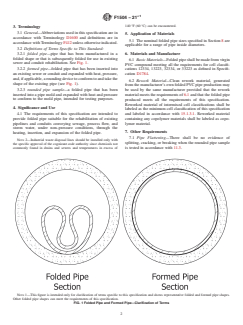
3.2.1 folded pipe—pipe that has been manufactured in a
folded shape or that is subsequently folded for use in existing
6.1 Basic Materials—Folded pipe shall be made from virgin
sewer and conduit rehabilitation. See Fig. 1.
PVC compound meeting all the requirements for cell classifi-
3.2.2 formed pipe—folded pipe that has been inserted into cations 12334, 13223, 32334, or 33223 as defined in Specifi-
an existing sewer or conduit and expanded with heat, pressure, cation D1784.
and,ifapplicable,aroundingdevicetoconformtoandtakethe
6.2 Rework Material—Clean rework material, generated
shape of the existing pipe (see Fig. 1).
from the manufacturer’s own folded PVC pipe production may
3.2.3 rounded pipe sample—a folded pipe that has been
be used by the same manufacturer provided that the rework
inserted into a pipe mold and expanded with heat and pressure
material meets the requirements of 6.1 and that the folded pipe
to conform to the mold pipe, intended for testing purposes.
produced meets all the requirements of this specification.
Reworked material of intermixed cell classifications shall be
4. Significance and Use
labeled as the minimum cell classification of this specification
4.1 The requirements of this specification are intended to and labeled in accordance with 15.1.3.1. Reworked material
provide folded pipe suitable for the rehabilitation of existing containing any copolymer materials shall be labeled as copo-
pipelines and conduits conveying sewage, process flow, and lymer material.
storm water, under non–pressure conditions, through the
7. Other Requirements
heating, insertion, and expansion of the folded pipe.
7.1 Pipe Flattening—There shall be no evidence of
NOTE 2—Industrial waste disposal lines should be installed only with
splitting, cracking, or breaking when the rounded pipe sample
the specific approval of the cognizant code authority since chemicals not
commonly found in drains and sewers and temperatures in excess of is tested in accordance with 11.3.
NOTE 1—This figure is intended only for clarification of terms specific to this specification and shows representative folded and formed pipe shapes.
Other folded pipe shapes can meet the requirements of this specification.
FIG. 1Folded Pipe and Formed Pipe—Clarification of Terms
´1
F1504−21
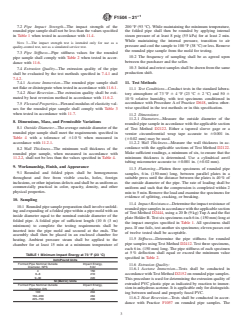
7.2 Pipe Impact Strength—The impact strength of the 200 °F (93 °C). While maintaining the minimum temperature,
rounded pipe sample shall not be less than the values specified the folded pipe shall then be rounded by applying internal
in Table 1 when tested in accordance with 11.4. steam pressure of at least 8 psig (55 kPa) for at least 2 min.
While maintaining the internal pressure, transition to air
NOTE 3—The impact strength test is intended only for use as a
pressureandcoolthesampleto100 °F(38 °C)orless.Remove
quality-control test, not as a simulated service test.
the rounded pipe sample from the mold for testing.
7.3 Pipe Stiffness—Pipe stiffness values for the rounded
10.2 The frequency of sampling shall be as agreed upon
pipe sample shall comply with Table 2 when tested in accor-
between the purchaser and the seller.
dance with 11.6.
10.3 Initial and retest samples shall be drawn from the same
7.4 Extrusion Quality—The extrusion quality of the pipe
production shift.
shall be evaluated by the test methods specified in 7.4.1 and
7.4.2.
11. Test Methods
7.4.1 Acetone Immersion—The rounded pipe sample shall
not flake or disintegrate when tested in accordance with 11.6.1.
11.1 Test Conditions—Conduct tests in the standard labora-
7.4.2 Heat Reversion—The extrusion quality shall be esti-
tory atmosphere of 73 °F 6 4 °F (23 °C 6 2 °C) and 50 6
mated by heat reversion method in accordance with 11.6.2.
10 % relative humidity, with test specimens conditioned in
accordance with Procedure A of Practice D618, unless other-
7.5 Flexural Properties—Flexural modulus of elasticity val-
wise specified in the test methods or in this specification.
ues for the rounded pipe sample shall comply with Table 3
when tested in accordance with 11.7.
11.2 Dimensions:
11.2.1 Diameters—Measure the outside diameter of the
8. Dimensions, Mass, and Permissible Variations
rounded pipe sample in accordance with the applicable section
8.1 Outside Diameter—The average outside diameter of the
of Test Method D2122. Either a tapered sleeve gage or a
rounded pipe sample shall meet the requirements specified in
vernier circumferential wrap tape accurate to 60.001 in.
Table 4 with a tolerance of 61.0 % when measured in
(60.02 mm) may be used.
accordance with 11.2.1.
11.2.2 Wall Thickness—Measure the wall thickness in ac-
cordance with the applicable sections of Test Method D2122.
8.2 Wall Thickness—The minimum wall thickness of the
Make sufficient readings, a minimum of six, to ensure that the
rounded pipe sample, when measured in accordance with
minimum thickness is determined. Use a cylindrical anvil
11.2.2, shall not be less than the values specified in Table 4.
tubing micrometer accurate to 60.001 in. (60.02 mm).
9. Workmanship, Finish, and Appearance
11.3 Flattening—Flatten three specimens of rounded pipe
9.1 Rounded and folded pipes shall be homogeneous
samples, 6 in. (150 mm) long, between parallel plates in a
throughout and free from visible cracks, holes, foreign
suitable press until the distance between the plates is 40 % of
inclusions, or other injurious defects and shall be as uniform as
the outside diameter of the pipe. The rate of loading shall be
commercially practical in color, opacity, density, and other
uniform and such that the compression is completed within 2
physical properties.
min to 5 min. Remove the load and examine the specimens for
evidence of splitting, cracking, or breaking.
10. Sampling
11.4 Impact Resistance—Determinetheimpactresistanceof
10.1 Rounded pipe sample preparation shall involve unfold-
roundedpipes
...