

ASTM F1867-22
(Practice)Standard Practice for Installation of Folded/Formed Poly (Vinyl Chloride) (PVC) Pipe Type A for Existing Sewer and Conduit Rehabilitation
General Information
- Abstract
SIGNIFICANCE AND USE
4.1 This practice is for use by designers, and specifies regulatory agencies, owners, and inspection organizations involved in the rehabilitation of non-pressure sewers and conduits. Modifications may be required, depending on specific job conditions, to establish a project specification. The manufacturer of the product should be consulted for design and installation information. Industrial waste disposal lines should be installed only with the specific approval of the cognizant code authority, since chemicals not commonly found in drains and sewers and temperatures in excess of 140 °F (60 °C) may be encountered.
SCOPE
1.1 This practice covers the procedures for the rehabilitation of sewer lines and conduits 4 in. (102 mm) to 18 in. (457 mm) in diameter by the insertion of a folded/formed PVC pipe that is heated, pressurized, and expanded to conform to the wall of the original conduit forming a new structural pipe-within-a-pipe. This rehabilitation process can be used in a variety of gravity applications such as sanitary sewers, storm sewers, and process piping.
1.2 This practice is to be used with the material specified in Section 6 of Specification F1871.
1.3 The values stated in inch-pound units are to be regarded as standard. The values given in parentheses are mathematical conversions to SI units that are provided for information only and are not considered standard.
1.4 There is no similar or equivalent ISO Standard.
1.5 This standard does not purport to address all of the safety concerns, if any, associated with its use. It is the responsibility of the user of this standard to establish appropriate safety, health, and environmental practices and determine the applicability of regulatory limitations prior to use.
1.6 This international standard was developed in accordance with internationally recognized principles on standardization established in the Decision on Principles for the Development of International Standards, Guides and Recommendations issued by the World Trade Organization Technical Barriers to Trade (TBT) Committee.
- Status
- Published
- Publication Date
- 14-Nov-2022
- Technical Committee
- F17 - Plastic Piping Systems
- Drafting Committee
- F17.67 - Trenchless Plastic Pipeline Technology
Buy Documents
ASTM F1867-22 - Standard Practice for Installation of Folded/Formed Poly (Vinyl Chloride) (PVC) Pipe Type A for Existing Sewer and Conduit Rehabilitation
REDLINE ASTM F1867-22 - Standard Practice for Installation of Folded/Formed Poly (Vinyl Chloride) (PVC) Pipe Type A for Existing Sewer and Conduit Rehabilitation
Overview
ASTM F1867-22 is the internationally recognized standard for the installation of folded or formed Poly (Vinyl Chloride) (PVC) Type A pipe in the rehabilitation of existing non-pressure sewer lines and conduits. Developed by ASTM International, this practice provides comprehensive guidance for designers, regulatory agencies, owners, and inspection bodies engaged in trenchless technology methods for restoring gravity sewer and process piping systems. With its focus on non-destructive rehabilitation, ASTM F1867 supports extending service life while minimizing environmental and societal disruption. This standard is widely referenced for projects involving the renewal of pipe infrastructure without full replacement.
Key Topics
Material Suitability
- Specifies using folded/formed PVC pipe conforming to Section 6 of ASTM F1871.
- Material classification must meet the physical properties per ASTM D1784 and D638.
Pipe Installation Process
- Covers pipe sizes ranging from 4 inches (102 mm) to 18 inches (457 mm) in diameter.
- Describes the insertion of a pre-flattened PVC pipe, which is then expanded using heat and pressure to form a tight-fitting liner within the host pipe.
Preparation and Inspection
- Outlines procedures for cleaning, inspecting, and clearing obstructions from existing pipelines, referencing practices such as ASTM C1920 and F1417.
Bypass Procedures and Public Notice
- Details the need for bypass systems to maintain service continuity during installation.
- Highlights communication requirements with affected service users.
Quality Control and Testing
- Recommends field sampling and laboratory testing to ensure mechanical properties are retained post-installation.
- Leak testing should be performed following water exfiltration methods or air testing per ASTM F1417.
Design Considerations
- Includes technical guidance for both partially and fully deteriorated pipe conditions.
- Provides equations and factors for structural analysis, including soil support and safety factors.
Applications
ASTM F1867-22 is applicable in multiple scenarios of sewer and conduit rehabilitation where pipe replacement would be impractical or costly. Its primary uses include:
- Sanitary Sewer Renewal: Restores pipes prone to infiltration, root intrusion, or structural issues without open-cut excavation.
- Storm Sewer Rehabilitation: Ideal for renewing gravity flow stormwater pipes located under critical infrastructure or developed areas.
- Industrial Process Piping: When approved by relevant code authorities, the method may be applied to process lines, though careful consideration must be given to chemical compatibility and temperature limitations.
- Trenchless Technology Projects: Facilitates minimal surface disturbance, faster schedules, and lower environmental impact compared to traditional methods.
Adoption of ASTM F1867 enhances asset management strategies and extends the serviceability of pipeline networks while adhering to consistent quality and safety protocols.
Related Standards
For comprehensive compliance and best practice alignment, ASTM F1867-22 should be used in conjunction with the following related standards:
- ASTM F1871 - Specification for Folded/Formed PVC Pipe Type A for Existing Sewer and Conduit Rehabilitation
- ASTM C1920 - Practice for Cleaning of Vitrified Clay Sanitary Sewer Pipelines
- ASTM F1417 - Practice for Installation Acceptance of Plastic Non-pressure Sewer Lines Using Low-Pressure Air
- ASTM D1784 - Classification of Rigid PVC Compounds and CPVC Compounds
- ASTM D638 / D790 / D648 / D2122 - Test methods for various mechanical properties of plastics and thermoplastic pipes
By referencing these standards, engineers and project managers ensure installation quality, safety, and regulatory compliance in all phases of PVC pipe rehabilitation projects.
Relations
- Effective Date
- 01-Feb-2024
- Effective Date
- 01-Oct-2023
- Effective Date
- 01-Apr-2020
- Effective Date
- 15-Jan-2020
- Effective Date
- 01-Aug-2019
- Effective Date
- 01-Aug-2019
- Effective Date
- 01-Jan-2019
- Effective Date
- 01-Apr-2018
- Refers
ASTM D1600-18 - Standard Terminology for Abbreviated Terms Relating to Plastics (Withdrawn 2024) - Effective Date
- 01-Jan-2018
- Effective Date
- 01-Aug-2017
- Effective Date
- 01-Jul-2017
- Effective Date
- 01-Feb-2017
- Effective Date
- 15-Nov-2016
- Effective Date
- 01-Aug-2016
- Effective Date
- 01-Dec-2015
Buy Documents
ASTM F1867-22 - Standard Practice for Installation of Folded/Formed Poly (Vinyl Chloride) (PVC) Pipe Type A for Existing Sewer and Conduit Rehabilitation
REDLINE ASTM F1867-22 - Standard Practice for Installation of Folded/Formed Poly (Vinyl Chloride) (PVC) Pipe Type A for Existing Sewer and Conduit Rehabilitation
Get Certified
Connect with accredited certification bodies for this standard

DIN CERTCO
DIN Group product certification.
Institut za varilstvo d.o.o. (Welding Institute)
Slovenia's leading welding institute since 1952. ISO 3834, EN 1090, pressure equipment certification, NDT personnel, welder qualification. Only IIW Au

Smithers Quality Assessments
US management systems and product certification.
Sponsored listings
Frequently Asked Questions
ASTM F1867-22 is a standard published by ASTM International. Its full title is "Standard Practice for Installation of Folded/Formed Poly (Vinyl Chloride) (PVC) Pipe Type A for Existing Sewer and Conduit Rehabilitation". This standard covers: SIGNIFICANCE AND USE 4.1 This practice is for use by designers, and specifies regulatory agencies, owners, and inspection organizations involved in the rehabilitation of non-pressure sewers and conduits. Modifications may be required, depending on specific job conditions, to establish a project specification. The manufacturer of the product should be consulted for design and installation information. Industrial waste disposal lines should be installed only with the specific approval of the cognizant code authority, since chemicals not commonly found in drains and sewers and temperatures in excess of 140 °F (60 °C) may be encountered. SCOPE 1.1 This practice covers the procedures for the rehabilitation of sewer lines and conduits 4 in. (102 mm) to 18 in. (457 mm) in diameter by the insertion of a folded/formed PVC pipe that is heated, pressurized, and expanded to conform to the wall of the original conduit forming a new structural pipe-within-a-pipe. This rehabilitation process can be used in a variety of gravity applications such as sanitary sewers, storm sewers, and process piping. 1.2 This practice is to be used with the material specified in Section 6 of Specification F1871. 1.3 The values stated in inch-pound units are to be regarded as standard. The values given in parentheses are mathematical conversions to SI units that are provided for information only and are not considered standard. 1.4 There is no similar or equivalent ISO Standard. 1.5 This standard does not purport to address all of the safety concerns, if any, associated with its use. It is the responsibility of the user of this standard to establish appropriate safety, health, and environmental practices and determine the applicability of regulatory limitations prior to use. 1.6 This international standard was developed in accordance with internationally recognized principles on standardization established in the Decision on Principles for the Development of International Standards, Guides and Recommendations issued by the World Trade Organization Technical Barriers to Trade (TBT) Committee.
SIGNIFICANCE AND USE 4.1 This practice is for use by designers, and specifies regulatory agencies, owners, and inspection organizations involved in the rehabilitation of non-pressure sewers and conduits. Modifications may be required, depending on specific job conditions, to establish a project specification. The manufacturer of the product should be consulted for design and installation information. Industrial waste disposal lines should be installed only with the specific approval of the cognizant code authority, since chemicals not commonly found in drains and sewers and temperatures in excess of 140 °F (60 °C) may be encountered. SCOPE 1.1 This practice covers the procedures for the rehabilitation of sewer lines and conduits 4 in. (102 mm) to 18 in. (457 mm) in diameter by the insertion of a folded/formed PVC pipe that is heated, pressurized, and expanded to conform to the wall of the original conduit forming a new structural pipe-within-a-pipe. This rehabilitation process can be used in a variety of gravity applications such as sanitary sewers, storm sewers, and process piping. 1.2 This practice is to be used with the material specified in Section 6 of Specification F1871. 1.3 The values stated in inch-pound units are to be regarded as standard. The values given in parentheses are mathematical conversions to SI units that are provided for information only and are not considered standard. 1.4 There is no similar or equivalent ISO Standard. 1.5 This standard does not purport to address all of the safety concerns, if any, associated with its use. It is the responsibility of the user of this standard to establish appropriate safety, health, and environmental practices and determine the applicability of regulatory limitations prior to use. 1.6 This international standard was developed in accordance with internationally recognized principles on standardization established in the Decision on Principles for the Development of International Standards, Guides and Recommendations issued by the World Trade Organization Technical Barriers to Trade (TBT) Committee.
ASTM F1867-22 is classified under the following ICS (International Classification for Standards) categories: 23.040.20 - Plastics pipes; 83.080.20 - Thermoplastic materials. The ICS classification helps identify the subject area and facilitates finding related standards.
ASTM F1867-22 has the following relationships with other standards: It is inter standard links to ASTM F1871-24, ASTM C1920-23, ASTM F412-20, ASTM D1784-20, ASTM F1417-11a(2019), ASTM F1417-11A(2019)e1, ASTM F412-19, ASTM D648-18, ASTM D1600-18, ASTM F412-17a, ASTM D790-17, ASTM F412-17, ASTM F412-16a, ASTM F412-16, ASTM D790-15e1. Understanding these relationships helps ensure you are using the most current and applicable version of the standard.
ASTM F1867-22 is available in PDF format for immediate download after purchase. The document can be added to your cart and obtained through the secure checkout process. Digital delivery ensures instant access to the complete standard document.
Standards Content (Sample)
This international standard was developed in accordance with internationally recognized principles on standardization established in the Decision on Principles for the
Development of International Standards, Guides and Recommendations issued by the World Trade Organization Technical Barriers to Trade (TBT) Committee.
Designation: F1867 − 22
Standard Practice for
Installation of Folded/Formed Poly (Vinyl Chloride) (PVC)
Pipe Type A for Existing Sewer and Conduit Rehabilitation
This standard is issued under the fixed designation F1867; the number immediately following the designation indicates the year of
original adoption or, in the case of revision, the year of last revision. A number in parentheses indicates the year of last reapproval. A
superscript epsilon (´) indicates an editorial change since the last revision or reapproval.
1. Scope* D638 Test Method for Tensile Properties of Plastics
D648 Test Method for Deflection Temperature of Plastics
1.1 Thispracticecoverstheproceduresfortherehabilitation
Under Flexural Load in the Edgewise Position
of sewer lines and conduits 4 in. (102 mm) to 18 in. (457 mm)
D790 Test Methods for Flexural Properties of Unreinforced
in diameter by the insertion of a folded/formed PVC pipe that
and Reinforced Plastics and Electrical Insulating Materi-
is heated, pressurized, and expanded to conform to the wall of
als
the original conduit forming a new structural pipe-within-a-
D1600 Terminology forAbbreviatedTerms Relating to Plas-
pipe. This rehabilitation process can be used in a variety of
tics
gravity applications such as sanitary sewers, storm sewers, and
D1784 Classification System and Basis for Specification for
process piping.
Rigid Poly(Vinyl Chloride) (PVC) Compounds and Chlo-
1.2 This practice is to be used with the material specified in
rinated Poly(Vinyl Chloride) (CPVC) Compounds
Section 6 of Specification F1871.
D2122 Test Method for Determining Dimensions of Ther-
1.3 The values stated in inch-pound units are to be regarded moplastic Pipe and Fittings
F412 Terminology Relating to Plastic Piping Systems
as standard. The values given in parentheses are mathematical
conversions to SI units that are provided for information only F1417 Practice for Installation Acceptance of Plastic Non-
pressure Sewer Lines Using Low-Pressure Air
and are not considered standard.
F1871 Specification for Folded/Formed Poly (Vinyl Chlo-
1.4 There is no similar or equivalent ISO Standard.
ride) Pipe Type A for Existing Sewer and Conduit Reha-
1.5 This standard does not purport to address all of the
bilitation
safety concerns, if any, associated with its use. It is the
2.2 Uni-Bell Standard:
responsibility of the user of this standard to establish appro-
UNI-B-5-89 Recommended Practice for the Installation of
priate safety, health, and environmental practices and deter-
Polyvinyl Chloride (PVC) Sewer Pipe
mine the applicability of regulatory limitations prior to use.
1.6 This international standard was developed in accor-
3. Terminology
dance with internationally recognized principles on standard-
3.1 Definitions—Definitions are in accordance with Termi-
ization established in the Decision on Principles for the
nology F412, and abbreviations are in accordance with Termi-
Development of International Standards, Guides and Recom-
nology D1600, unless otherwise indicated. The abbreviation
mendations issued by the World Trade Organization Technical
for poly(vinyl chloride) plastics is PVC.
Barriers to Trade (TBT) Committee.
3.1.1 The term TYPEAis not an abbreviation but rather an
arbitrary designation for PVC compounds with a minimum
2. Referenced Documents
2 value for modulus in tension as listed in 6.1 and a maximum
2.1 ASTM Standards:
value as defined by cell limit 1 of Specification D1784.
C1920 Practice for Cleaning of Vitrified Clay Sanitary
3.2 Definitions of Terms Specific to This Standard:
Sewer Pipelines
3.2.1 dimples(dimpling),n—Whereasideconnectionmeets
the existing conduit, there is no support for the PVC pipe
This standard is under the jurisdiction of Committee F17 on Plastic Piping
during forming, causing a point of thermoplastic pipe expan-
Systems and is the direct responsibility of Subcommittee F17.67 on Trenchless
Plastic Pipeline Technology.
sion slightly beyond the existing pipe wall. This formation of
Current edition approved Nov. 15, 2022. Published December 2022. Originally
an external departure from the formed pipe wall is termed
approved in 1998. Last previous edition approved in 2020 as F1867 – 06(2020).
dimpling.
DOI: 10.1520/F1867-06R20.
For referenced ASTM standards, visit the ASTM website, www.astm.org, or
contact ASTM Customer Service at service@astm.org. For Annual Book of ASTM
Standards volume information, refer to the standard’s Document Summary page on Available from Uni-Bell PVC Pipe Association, 201 E. John Carpenter
the ASTM website. Freeway, Suite 750 Irving, TX 75062, http://www.uni-bell.org.
*A Summary of Changes section appears at the end of this standard
Copyright © ASTM International, 100 Barr Harbor Drive, PO Box C700, West Conshohocken, PA 19428-2959. United States
F1867 − 22
3.2.2 flattened pipe, n—a flattened pipe has been manufac- 3.2.8 termination point, n—An existing manhole, existing
tured and calibrated round, then subsequently cooled and access shaft, or an excavated pit that serves as the point of exit
deformed into a flattened shape for coiling purposes. Later, at of the folded pipe from the existing pipe.
thetimeofinstallationattheprojectsite,theflattenedpipewill
be formed into the folded shape when inserted into the existing 4. Significance and Use
sewer and conduit rehabilitation.
4.1 This practice is for use by designers, and specifies
regulatory agencies, owners, and inspection organizations in-
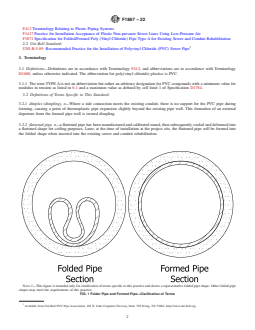
3.2.3 folded pipe, n—pipe that has been manufactured and
volved in the rehabilitation of non-pressure sewers and con-
calibrated round, then subsequently cooled and deformed into
duits. Modifications may be required, depending on specific
a folded shape for use in existing sewer and conduit rehabili-
job conditions, to establish a project specification. The manu-
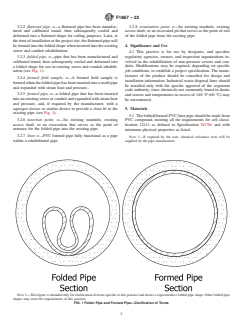
tation (see Fig. 1).
facturer of the product should be consulted for design and
3.2.4 formed field sample, n—A formed field sample is
installation information. Industrial waste disposal lines should
formedwhenthefoldedpipehasbeeninsertedintoamoldpipe
be installed only with the specific approval of the cognizant
and expanded with steam heat and pressure.
code authority, since chemicals not commonly found in drains
3.2.5 formed pipe, n—a folded pipe that has been inserted
and sewers and temperatures in excess of 140 °F (60 °C) may
intoanexistingsewerorconduitandexpandedwithsteamheat
be encountered.
and pressure, and, if required by the manufacturer, with a
squeegee device or similar device to provide a close fit to the
5. Materials
existing pipe (see Fig. 1).
5.1 The folded/formed PVC liner pipe should be made from
3.2.6 insertion point, n—An existing manhole, existing
PVC compound, meeting all the requirements for cell classi-
access shaft, or an excavation that serves as the point of
fication 12111 as defined in Specification D1784 and with
entrance for the folded pipe into the existing pipe.
minimum physical properties as listed.
3.2.7 liner, n—PVC formed pipe fully functional as a pipe
NOTE 1—If required by the user, chemical resistance tests will be
within a rehabilitated pipe. supplied by the pipe manufacturer.
NOTE 1—This figure is intended only for clarification of terms specific to this practice and shows a representative folded pipe shape. Other folded pipe
shapes may meet the requirements of this practice.
FIG. 1 Folder Pipe and Formed Pipe—Clarification of Terms
F1867 − 22
should be made to uncover and remove or repair the obstruc-
Tensile Strength Test Method 3600 PSI (25 MPa)
D638
tion. Typically, with bends along the pipe length in excess of
Tensile Modulus Test Method 155 000 PSI (1069 MPa)
30°, the manufacturer shall be consulted.
D638
Flexural Strength Test Method 4100 PSI (28 MPa)
6.1.5 Bypassing—If flow cannot be interrupted for the
D790
necessary duration, bypassing of flow is required around the
Flexural Modulus Test Method 145 000 PSI (1000 MPa)
sections of the existing pipeline designated for rehabilitation.
D790
Heat Deflection Test Method 115 °F (46 °C)
The pump and bypass lines should be of adequate capacity and
D648
size to handle any flows during the installation period. The
Temperature Tested at 264 (2 MPa)
bypass should be made by plugging the line at the point
psi
upstream of the pipe to be reconstructed and pumping the flow
5.1.1 Compounds meeting the above minimum properties
to a downstream point or adjacent system. Services within this
that have different cell classifications because one or more
work area will be temporarily out of service.
properties are greater to those of the specified compounds are
6.1.6 Public advisory services will be required to notify all
also acceptable, except modulus in tension shall not exceed
parties whose service lateral will be out of commission and to
280 000 psi.
advise against water usage until the main line is back in
5.2 Rework Material—Clean rework material from this type
service.
of pipe, generated from the manufacturer’s own pipe produc-
tion may be used by the same manufacturer provided that the 6.2 Insertion:
rework material meets all the requirements of 5.1.
6.2.1 Thereelofflattenedpipeshouldbepositionednearthe
insertion point. The end of the reel of flattened pipe should be
6. Installation Recommendations
tapered and have holes drilled for the attachment of a pulling
6.1 Cleaning and Inspection:
head. If recommended by the manufacturer, the coil of flat-
6.1.1 Access Safety—Prior to entering access areas such as
tened pipe may be heated to approximately 180 °F prior to
manholes, and performing inspection or cleaning operations,
insertion. An enclosure should be designed so that hot air is
an evaluation of the atmosphere to determine the presence of
continually exiting from it and not allowing ambient air to be
toxicorflammablevaporsorlackofoxygenmustbeconducted
drawn in.
in accordance with local, state, or federal safety regulations.
6.2.2 A steel cable should be strung through the existing
6.1.2 Cleaning of Pipeline—Internal debris shall be re-
conduit and attached to the beveled cut end of the folded pipe.
moved from the existing pipeline. Non-pressure gravity pipes
The folded pipe should be pulled with a power winch unit and
shall be cleaned with one or more of the following: hydrauli-
cable directly from the reel, through the insertion point, and
cally powered equipment, high velocity jet cleaners, or me-
through the existing pipe to the termination point and extend-
chanically powered equipment in accordance with manufactur-
ing 4 ft (1.2 mm) beyond. The pulling force should be
ers guidelines or Practice C1920 as applicable.
monitored and limited to the allowable tensile stress of the
6.1.3 Inspection of Pipelines—The interior of the pipeline
folded pipe (50 % of yield at 212 °F) times the pipe wall
should be carefully inspected to determine the location of any
cross-sectional area.
condition that may prevent proper installation of the folded
6.2.3 After insertion is completed, the pipe should be
pipe, such as protruding service taps, collapsed or crushed
secured at the termination end.
pipe, out-of-roundness, significant line sags, and deflected
6.3 Expansion:
joints. These conditions should be noted, and, if deemed
necessary by the end-user, corrected prior to installation. 6.3.1 Through the use of heat, pressure, and, , the folded
Inspection of pipelines should be performed by experienced pipe should be fully expanded. The liner pipe shall be fully
personnel trained in locating breaks, obstacles, and service expanded through the use of time, heat and pressure. Time,
connections by closed circuit television. temperature and pressure must be sufficient to overcome the
6.1.4 Line Obstructions—The existing pipeline should be extrusion memory of the thermoplastic material. The manufac-
clear of obstructions that will prevent the proper insertion and
turer must be consulted as to the suggested times, temperatures
expansion of the folded pipe. Such conditions require access at and pressure. Expansion pressures must be sufficient to press
these points for termination and start of a new insertion.
the PVC liner pipe against the wall of the existing conduit so
Changes in pipe size may be accommodated, if the wall as to neatly and tightly fit the internal circumference of the
thickness of the liner pipe has been designed for expansion.
existing line and to form dimples at the service connections.
Obstructions could include dropped or offset joints of more
NOTE 2—Fo
...
This document is not an ASTM standard and is intended only to provide the user of an ASTM standard an indication of what changes have been made to the previous version. Because
it may not be technically possible to adequately depict all changes accurately, ASTM recommends that users consult prior editions as appropriate. In all cases only the current version
of the standard as published by ASTM is to be considered the official document.
Designation: F1867 − 06 (Reapproved 2020) F1867 − 22
Standard Practice for
Installation of Folded/Formed Poly (Vinyl Chloride) (PVC)
Pipe Type A for Existing Sewer and Conduit Rehabilitation
This standard is issued under the fixed designation F1867; the number immediately following the designation indicates the year of
original adoption or, in the case of revision, the year of last revision. A number in parentheses indicates the year of last reapproval. A
superscript epsilon (´) indicates an editorial change since the last revision or reapproval.
1. Scope Scope*
1.1 This practice covers the procedures for the rehabilitation of sewer lines and conduits 4 in. (102 mm) to 18 in. (457 mm) in
diameter by the insertion of a folded/formed PVC pipe that is heated, pressurized, and expanded to conform to the wall of the
original conduit forming a new structural pipe-within-a-pipe. This rehabilitation process can be used in a variety of gravity
applications such as sanitary sewers, storm sewers, and process piping.
1.2 This practice is to be used with the material specified in Section 6 of Specification F1871.
1.3 The values stated in inch-pound units are to be regarded as standard. The values given in parentheses are mathematical
conversions to SI units that are provided for information only and are not considered standard.
1.4 There is no similar or equivalent ISO Standard.
1.5 This standard does not purport to address all of the safety concerns, if any, associated with its use. It is the responsibility
of the user of this standard to establish appropriate safety, health, and environmental practices and determine the applicability of
regulatory limitations prior to use.
1.6 This international standard was developed in accordance with internationally recognized principles on standardization
established in the Decision on Principles for the Development of International Standards, Guides and Recommendations issued
by the World Trade Organization Technical Barriers to Trade (TBT) Committee.
2. Referenced Documents
2.1 ASTM Standards:
C1920 Practice for Cleaning of Vitrified Clay Sanitary Sewer Pipelines
D638 Test Method for Tensile Properties of Plastics
D648 Test Method for Deflection Temperature of Plastics Under Flexural Load in the Edgewise Position
D790 Test Methods for Flexural Properties of Unreinforced and Reinforced Plastics and Electrical Insulating Materials
D1600 Terminology for Abbreviated Terms Relating to Plastics
D1784 Classification System and Basis for Specification for Rigid Poly(Vinyl Chloride) (PVC) Compounds and Chlorinated
Poly(Vinyl Chloride) (CPVC) Compounds
D2122 Test Method for Determining Dimensions of Thermoplastic Pipe and Fittings
This standard is under the jurisdiction of Committee F17 on Plastic Piping Systems and is the direct responsibility of Subcommittee F17.67 on Trenchless Plastic Pipeline
Technology.
Current edition approved Nov. 15, 2020Nov. 15, 2022. Published November 2020December 2022. Originally approved in 1998. Last previous edition approved in
20122020 as F1867 – 06(2012).(2020). DOI: 10.1520/F1867-06R20.
For referenced ASTM standards, visit the ASTM website, www.astm.org, or contact ASTM Customer Service at service@astm.org. For Annual Book of ASTM Standards
volume information, refer to the standard’s Document Summary page on the ASTM website.
*A Summary of Changes section appears at the end of this standard
Copyright © ASTM International, 100 Barr Harbor Drive, PO Box C700, West Conshohocken, PA 19428-2959. United States
F1867 − 22
F412 Terminology Relating to Plastic Piping Systems
F1417 Practice for Installation Acceptance of Plastic Non-pressure Sewer Lines Using Low-Pressure Air
F1871 Specification for Folded/Formed Poly (Vinyl Chloride) Pipe Type A for Existing Sewer and Conduit Rehabilitation
2.2 Uni-Bell Standard:
UNI-B-5-89 Recommended Practice for the Installation of Polyvinyl Chloride (PVC) Sewer Pipe
3. Terminology
3.1 Definitions—Definitions are in accordance with Terminology F412, and abbreviations are in accordance with Terminology
D1600, unless otherwise indicated. The abbreviation for poly(vinyl chloride) plastics is PVC.
3.1.1 The term TYPE A is not an abbreviation but rather an arbitrary designation for PVC compounds with a minimum value for
modulus in tension as listed in 6.1 and a maximum value as defined by cell limit 1 of Specification D1784.
3.2 Definitions of Terms Specific to This Standard:
3.2.1 dimples (dimpling), n—Where a side connection meets the existing conduit, there is no support for the PVC pipe during
forming, causing a point of thermoplastic pipe expansion slightly beyond the existing pipe wall. This formation of an external
departure from the formed pipe wall is termed dimpling.
3.2.2 flattened pipe, n—a flattened pipe has been manufactured and calibrated round, then subsequently cooled and deformed into
a flattened shape for coiling purposes. Later, at the time of installation at the project site, the flattened pipe will be formed into
the folded shape when inserted into the existing sewer and conduit rehabilitation.
NOTE 1—This figure is intended only for clarification of terms specific to this practice and shows a representative folded pipe shape. Other folded pipe
shapes may meet the requirements of this practice.
FIG. 1 Folder Pipe and Formed Pipe—Clarification of Terms
Available from Uni-Bell PVC Pipe Association, 201 E. John Carpenter Freeway, Suite 750 Irving, TX 75062, http://www.uni-bell.org.
F1867 − 22
3.2.3 folded pipe, n—pipe that has been manufactured and calibrated round, then subsequently cooled and deformed into a folded
shape for use in existing sewer and conduit rehabilitation (see Fig. 1).
3.2.4 formed field sample, n—A formed field sample is formed when the folded pipe has been inserted into a mold pipe and
expanded with steam heat and pressure.
3.2.5 formed pipe, n—a folded pipe that has been inserted into an existing sewer or conduit and expanded with steam heat and
pressure, and, if required by the manufacturer, with a squeegee device or similar device to provide a close fit to the existing pipe
(see Fig. 1).
3.2.6 insertion point, n—An existing manhole, existing access shaft, or an excavation that serves as the point of entrance for the
folded pipe into the existing pipe.
3.2.7 liner, n—PVC formed pipe fully functional as a pipe within a rehabilitated pipe.
3.2.8 termination point, n—An existing manhole, existing access shaft, or an excavated pit that serves as the point of exit of the
folded pipe from the existing pipe.
4. Significance and Use
4.1 This practice is for use by designers, and specifies regulatory agencies, owners, and inspection organizations involved in the
rehabilitation of non-pressure sewers and conduits. Modifications may be required, depending on specific job conditions, to
establish a project specification. The manufacturer of the product should be consulted for design and installation information.
Industrial waste disposal lines should be installed only with the specific approval of the cognizant code authority, since chemicals
not commonly found in drains and sewers and temperatures in excess of 140 °F (60 °C) may be encountered.
5. Materials
5.1 The folded/formed PVC liner pipe should be made from PVC compound, meeting all the requirements for cell classification
12111 as defined in Specification D1784 and with minimum physical properties as listed.
NOTE 1—If required by the user, chemical resistance tests will be supplied by the pipe manufacturer.
Tensile Strength Test Method 3600 PSI (25 MPa)
D638
Tensile Modulus Test Method 155 000 PSI (1069 MPa)
D638
Flexural Strength Test Method 4100 PSI (28 MPa)
D790
Flexural Modulus Test Method 145 000 PSI (1000 MPa)
D790
Heat Deflection Test Method 115 °F (46 °C)
D648
Temperature Tested at 264 (2 MPa)
psi
5.1.1 Compounds meeting the above minimum properties that have different cell classifications because one or more properties
are greater to those of the specified compounds are also acceptable, except modulus in tension shall not exceed 280 000 psi.
5.2 Rework Material—Clean rework material from this type of pipe, generated from the manufacturer’s own pipe production may
be used by the same manufacturer provided that the rework material meets all the requirements of 5.1.
6. Installation Recommendations
6.1 Cleaning and Inspection:
6.1.1 Access Safety—Prior to entering access areas such as manholes, and performing inspection or cleaning operations, an
F1867 − 22
evaluation of the atmosphere to determine the presence of toxic or flammable vapors or lack of oxygen must be conducted in
accordance with local, state, or federal safety regulations.
6.1.2 Cleaning of Pipeline—Internal debris shouldshall be removed from the existing pipeline. Gravity Non-pressure gravity pipes
shouldshall be cleaned with one or more of the following: hydraulically powered equipment, high velocity jet cleaners, or
mechanically powered equipment.equipment in accordance with manufacturers guidelines or Practice C1920 as applicable.
6.1.3 Inspection of Pipelines—The interior of the pipeline should be carefully inspected to determine the location of any condition
that may prevent proper installation of the folded pipe, such as protruding service taps, collapsed or crushed pipe, out-of-roundness,
significant line sags, and deflected joints. These conditions should be noted, and, if deemed necessary by the end-user, corrected
prior to installation. Inspection of pipelines should be performed by experienced personnel trained in locating breaks, obstacles,
and service connections by closed circuit television.
6.1.4 Line Obstructions—The existing pipeline should be clear of obstructions that will prevent the proper insertion and expansion
of the folded pipe. Such conditions require access at these points for termination and start of a new insertion. Changes in pipe size
may be accommodated, if the wall thickness of the liner pipe has been designed for expansion. Obstructions could include dropped
or offset joints of more than 12.5 % of inside pipe diameter and service connections that protrude into the pipe more than 12.5 %
of the inside diameter of 1 in. (25 mm), whichever is greater. Other obstructions may be reduction of the cross-sectional area of
more than 14 % (based on the inside diameter of the existing pipe), which may be the result of point repairs or patches, and would
prevent the folded pipe from totally and properly forming. If inspection reveals an obstruction that cannot be removed by cleaning
or rodding, then a point repair excavation should be made to uncover and remove or repair the obstruction. Typically, with bends
along the pipe length in excess of 30°, the manufacturer shall be consulted.
6.1.5 Bypassing—If flow cannot be interrupted for the necessary duration, bypassing of flow is required around the sections of the
existing pipeline designated for rehabilitation. The pump and bypass lines should be of adequate capacity and size to handle any
flows during the installation period. The bypass should be made by plugging the line at the point upstream of the pipe to be
reconstructed and pumping the flow to a downstream point or adjacent system. Services within this work area will be temporarily
out of service.
6.1.6 Public advisory services will be required to notify all parties whose service lateral will be out of commission and to advise
against water usage until the main line is back in service.
6.2 Insertion:
6.2.1 The reel of flattened pipe should be positioned near the insertion point. The end of the reel of flattened pipe should be tapered
and have holes drilled for the attachment of a pulling head. If recommended by the manufacturer, the coil of flattened pipe may
be heated to approximately 180 °F prior to insertion. An enclosure should be designed so that hot air is continually exiting from
it and not allowing ambient air to be drawn in.
6.2.2 A steel cable should be strung through the existing conduit and attached to the beveled cut end of the folded pipe. The folded
pipe should be pulled with a power winch unit and cable directly from the reel, through the insertion point, and through the existing
pipe to the termination point and extending 4 ft (1.2 mm) beyond. The pulling force should be monitored and limited to the
allowable tensile stress of the folded pipe (50 % of yield at 212 °F) times the pipe wall cross-sectional area.
6.2.3 After insertion is completed, the pipe should be secured at the termination end.
6.3 Expansion:
...