

ASTM F1741-22
(Practice)Standard Practice for Installation of Machine Spiral Wound Poly (Vinyl Chloride) (PVC) Liner Pipe for Rehabilitation of Existing Sewers and Conduits
General Information
- Abstract
SIGNIFICANCE AND USE
4.1 This practice is for use by designers and specifiers, regulatory agencies, owners, and inspection organizations who are involved in the rehabilitation of non-pressure sewers and conduits. Modifications may be required for specific job conditions.
SCOPE
1.1 This practice describes the procedures for the rehabilitation of sewer lines and conduits for existing pipelines 6 to 180 in. in diameter by the insertion of a machine-made field-fabricated spiral wound liner pipe into the existing pipeline using a winding machine which remains stationary in the insertion pit or, alternatively, which travels along the interior of the existing pipeline. These rehabilitation processes can be used in a variety of gravity applications such as sanitary sewers, storm sewers, culverts, and process piping.
1.1.1 When using stationary installation equipment for existing pipelines 6 to 48 in., after insertion, the spiral wound liner pipe is expanded until it presses against the interior surface of the existing pipeline. Alternatively, for existing pipelines 6 to 108 in. in diameter, the spiral wound liner pipe is inserted as a fixed diameter into the existing pipeline and is not expanded, and the annular space between the spiral wound liner pipe and the existing pipe is grouted.
1.1.2 When using the traveling installation equipment for existing pipelines 6 to 180 in. the spiral wound liner pipe is installed in contact with the interior surface of the existing pipeline to form a close fit liner, except in the corners of rectangular pipes or where obstructions or offsets occur. Alternatively, for existing pipelines 6 to 180 in. in diameter and for similar sized existing non circular pipelines such as arched or oval or rectangular shapes, the spiral wound liner is installed as a fixed diameter into the exiting pipeline to form a non-close fit liner and the annular space between the spiral wound liner pipe and the existing pipe is grouted.
1.2 The values stated in inch-pound units are to be regarded as standard. The values given in parentheses are mathematical conversions to SI units that are provided for information only and are not considered standard.
1.3 This standard does not purport to address all of the safety concerns, if any, associated with its use. It is the responsibility of the user of this standard to establish appropriate safety, health, and environmental practices and determine the applicability of regulatory limitations prior to use.
1.3.1 Particular attention is drawn to those safety regulations and requirements involving entering into and working in confined spaces.
1.4 This international standard was developed in accordance with internationally recognized principles on standardization established in the Decision on Principles for the Development of International Standards, Guides and Recommendations issued by the World Trade Organization Technical Barriers to Trade (TBT) Committee.
- Status
- Published
- Publication Date
- 14-Nov-2022
- Technical Committee
- F17 - Plastic Piping Systems
- Drafting Committee
- F17.67 - Trenchless Plastic Pipeline Technology
Buy Documents
ASTM F1741-22 - Standard Practice for Installation of Machine Spiral Wound Poly (Vinyl Chloride) (PVC) Liner Pipe for Rehabilitation of Existing Sewers and Conduits
REDLINE ASTM F1741-22 - Standard Practice for Installation of Machine Spiral Wound Poly (Vinyl Chloride) (PVC) Liner Pipe for Rehabilitation of Existing Sewers and Conduits
Overview
ASTM F1741-22 outlines the standard practice for installing machine spiral wound poly (vinyl chloride) (PVC) liner pipe for rehabilitation of existing non-pressure sewers and conduits. This standard, maintained by ASTM Committee F17 on Plastic Piping Systems, details the procedures and requirements for using spiral wound PVC liner pipe to restore the function and structural integrity of existing pipelines. The standard is primarily intended for use in gravity-based applications such as sanitary sewers, storm sewers, culverts, and process piping for pipelines ranging from 6 to 180 inches in diameter.
This document serves as a comprehensive guide for engineers, designers, utility owners, contractors, and regulatory agencies involved in pipeline rehabilitation, providing significant guidance in ensuring safe, effective, and long-lasting pipeline repairs using trenchless technology.
Key Topics
Scope of Application
- Rehabilitation of non-pressure pipelines 6 to 180 inches in diameter.
- Suitable for round, arched, oval, and rectangular shaped pipelines.
- Installation may employ stationary or traveling winding machines.
Installation Methods
- Stationary equipment: used for pipelines 6 to 48 inches (expandable liner) and 6 to 108 inches (fixed diameter with grouting).
- Traveling equipment: suitable for pipelines 6 to 180 inches, enabling a close-fit or non-close-fit liner with optional grouting of the annular space.
Material Requirements
- Use of extruded PVC profile strips as per ASTM F1697.
- Optional steel reinforcement for additional stiffness, particularly in non-circular pipes.
- Compatible sealants and adhesives for secure liner joints.
Pipeline Preparation
- Thorough cleaning and inspection prior to liner installation.
- Removal of obstructions and repair of structural defects as needed.
- Execution of safety protocols for confined space entry.
Grouting
- Procedures for properly sealing and injecting grout to fill the annular space, ensuring structural integrity and preventing water infiltration.
Quality Control and Inspection
- Visual and CCTV inspection of completed installations.
- Leakage and compressive strength testing when required to verify performance.
Applications
ASTM F1741-22 is valuable for the rehabilitation of a wide range of existing sewer and conduit pipelines without the need for extensive excavation, minimizing disruption and cost. The spiral wound PVC liner provides a durable, corrosion-resistant solution to restore hydraulic capacity and extend the service life of:
- Sanitary and combined sewer systems
- Storm water drainage pipes
- Culverts under roads or railways
- Industrial process piping carrying non-pressurized flow
This trenchless rehabilitation technique is especially suitable where access is limited, ground disturbance must be minimized, or urban infrastructure cannot be easily disrupted. The method supports multiple liner insertion and fitting approaches, accommodating varying site conditions and pipeline geometries.
Related Standards
For a robust pipeline rehabilitation program, the following related ASTM and industry standards may also be considered:
- ASTM F1697: Specification for PVC Profile Strip for Machine Spiral-Wound Liner Pipe
- ASTM F1216: Practice for Rehabilitation of Existing Pipelines by Inversion and Curing of Resin-Impregnated Tubes
- ASTM F1417: Practice for Installation Acceptance of Plastic Non-Pressure Sewer Lines Using Low-Pressure Air
- ASTM C1920: Practice for Cleaning of Vitrified Clay Sanitary Sewer Pipelines
- UNI-B-5-89: Uni-Bell Recommended Practice for the Installation of PVC Sewer Pipe
Utilizing ASTM F1741-22 in conjunction with these standards helps ensure that the installation of spiral wound PVC liners for sewer and conduit rehabilitation meets established best practices for safety, quality, and long-term structural performance.
Keywords: ASTM F1741-22, spiral wound PVC liner, trenchless pipe rehabilitation, sewer relining, pipeline restoration, gravity pipe repair, PVC profile strip, non-pressure conduit rehabilitation, grout injection, pipe inspection.
Relations
- Effective Date
- 01-Apr-2024
- Effective Date
- 01-Feb-2024
- Effective Date
- 15-Dec-2023
- Refers
ASTM C39/C39M-23 - Standard Test Method for Compressive Strength of Cylindrical Concrete Specimens - Effective Date
- 01-Dec-2023
- Effective Date
- 01-Nov-2023
- Effective Date
- 01-Oct-2023
- Effective Date
- 01-Apr-2020
- Effective Date
- 01-Jan-2020
- Effective Date
- 01-Aug-2019
- Effective Date
- 01-Aug-2019
- Effective Date
- 01-Aug-2019
- Effective Date
- 15-Apr-2019
- Effective Date
- 01-Feb-2019
- Effective Date
- 01-Jan-2019
- Effective Date
- 01-Dec-2018
Buy Documents
ASTM F1741-22 - Standard Practice for Installation of Machine Spiral Wound Poly (Vinyl Chloride) (PVC) Liner Pipe for Rehabilitation of Existing Sewers and Conduits
REDLINE ASTM F1741-22 - Standard Practice for Installation of Machine Spiral Wound Poly (Vinyl Chloride) (PVC) Liner Pipe for Rehabilitation of Existing Sewers and Conduits
Get Certified
Connect with accredited certification bodies for this standard

DIN CERTCO
DIN Group product certification.
Institut za varilstvo d.o.o. (Welding Institute)
Slovenia's leading welding institute since 1952. ISO 3834, EN 1090, pressure equipment certification, NDT personnel, welder qualification. Only IIW Au

Smithers Quality Assessments
US management systems and product certification.
Sponsored listings
Frequently Asked Questions
ASTM F1741-22 is a standard published by ASTM International. Its full title is "Standard Practice for Installation of Machine Spiral Wound Poly (Vinyl Chloride) (PVC) Liner Pipe for Rehabilitation of Existing Sewers and Conduits". This standard covers: SIGNIFICANCE AND USE 4.1 This practice is for use by designers and specifiers, regulatory agencies, owners, and inspection organizations who are involved in the rehabilitation of non-pressure sewers and conduits. Modifications may be required for specific job conditions. SCOPE 1.1 This practice describes the procedures for the rehabilitation of sewer lines and conduits for existing pipelines 6 to 180 in. in diameter by the insertion of a machine-made field-fabricated spiral wound liner pipe into the existing pipeline using a winding machine which remains stationary in the insertion pit or, alternatively, which travels along the interior of the existing pipeline. These rehabilitation processes can be used in a variety of gravity applications such as sanitary sewers, storm sewers, culverts, and process piping. 1.1.1 When using stationary installation equipment for existing pipelines 6 to 48 in., after insertion, the spiral wound liner pipe is expanded until it presses against the interior surface of the existing pipeline. Alternatively, for existing pipelines 6 to 108 in. in diameter, the spiral wound liner pipe is inserted as a fixed diameter into the existing pipeline and is not expanded, and the annular space between the spiral wound liner pipe and the existing pipe is grouted. 1.1.2 When using the traveling installation equipment for existing pipelines 6 to 180 in. the spiral wound liner pipe is installed in contact with the interior surface of the existing pipeline to form a close fit liner, except in the corners of rectangular pipes or where obstructions or offsets occur. Alternatively, for existing pipelines 6 to 180 in. in diameter and for similar sized existing non circular pipelines such as arched or oval or rectangular shapes, the spiral wound liner is installed as a fixed diameter into the exiting pipeline to form a non-close fit liner and the annular space between the spiral wound liner pipe and the existing pipe is grouted. 1.2 The values stated in inch-pound units are to be regarded as standard. The values given in parentheses are mathematical conversions to SI units that are provided for information only and are not considered standard. 1.3 This standard does not purport to address all of the safety concerns, if any, associated with its use. It is the responsibility of the user of this standard to establish appropriate safety, health, and environmental practices and determine the applicability of regulatory limitations prior to use. 1.3.1 Particular attention is drawn to those safety regulations and requirements involving entering into and working in confined spaces. 1.4 This international standard was developed in accordance with internationally recognized principles on standardization established in the Decision on Principles for the Development of International Standards, Guides and Recommendations issued by the World Trade Organization Technical Barriers to Trade (TBT) Committee.
SIGNIFICANCE AND USE 4.1 This practice is for use by designers and specifiers, regulatory agencies, owners, and inspection organizations who are involved in the rehabilitation of non-pressure sewers and conduits. Modifications may be required for specific job conditions. SCOPE 1.1 This practice describes the procedures for the rehabilitation of sewer lines and conduits for existing pipelines 6 to 180 in. in diameter by the insertion of a machine-made field-fabricated spiral wound liner pipe into the existing pipeline using a winding machine which remains stationary in the insertion pit or, alternatively, which travels along the interior of the existing pipeline. These rehabilitation processes can be used in a variety of gravity applications such as sanitary sewers, storm sewers, culverts, and process piping. 1.1.1 When using stationary installation equipment for existing pipelines 6 to 48 in., after insertion, the spiral wound liner pipe is expanded until it presses against the interior surface of the existing pipeline. Alternatively, for existing pipelines 6 to 108 in. in diameter, the spiral wound liner pipe is inserted as a fixed diameter into the existing pipeline and is not expanded, and the annular space between the spiral wound liner pipe and the existing pipe is grouted. 1.1.2 When using the traveling installation equipment for existing pipelines 6 to 180 in. the spiral wound liner pipe is installed in contact with the interior surface of the existing pipeline to form a close fit liner, except in the corners of rectangular pipes or where obstructions or offsets occur. Alternatively, for existing pipelines 6 to 180 in. in diameter and for similar sized existing non circular pipelines such as arched or oval or rectangular shapes, the spiral wound liner is installed as a fixed diameter into the exiting pipeline to form a non-close fit liner and the annular space between the spiral wound liner pipe and the existing pipe is grouted. 1.2 The values stated in inch-pound units are to be regarded as standard. The values given in parentheses are mathematical conversions to SI units that are provided for information only and are not considered standard. 1.3 This standard does not purport to address all of the safety concerns, if any, associated with its use. It is the responsibility of the user of this standard to establish appropriate safety, health, and environmental practices and determine the applicability of regulatory limitations prior to use. 1.3.1 Particular attention is drawn to those safety regulations and requirements involving entering into and working in confined spaces. 1.4 This international standard was developed in accordance with internationally recognized principles on standardization established in the Decision on Principles for the Development of International Standards, Guides and Recommendations issued by the World Trade Organization Technical Barriers to Trade (TBT) Committee.
ASTM F1741-22 is classified under the following ICS (International Classification for Standards) categories: 23.040.20 - Plastics pipes; 83.080.20 - Thermoplastic materials. The ICS classification helps identify the subject area and facilitates finding related standards.
ASTM F1741-22 has the following relationships with other standards: It is inter standard links to ASTM F1697-24, ASTM D883-24, ASTM C109/C109M-23, ASTM C39/C39M-23, ASTM D883-23, ASTM C1920-23, ASTM F412-20, ASTM D883-20, ASTM D883-19c, ASTM F1417-11A(2019)e1, ASTM F1417-11a(2019), ASTM D883-19a, ASTM D883-19, ASTM F412-19, ASTM D883-18a. Understanding these relationships helps ensure you are using the most current and applicable version of the standard.
ASTM F1741-22 is available in PDF format for immediate download after purchase. The document can be added to your cart and obtained through the secure checkout process. Digital delivery ensures instant access to the complete standard document.
Standards Content (Sample)
This international standard was developed in accordance with internationally recognized principles on standardization established in the Decision on Principles for the
Development of International Standards, Guides and Recommendations issued by the World Trade Organization Technical Barriers to Trade (TBT) Committee.
Designation: F1741 − 22
Standard Practice for
Installation of Machine Spiral Wound Poly (Vinyl Chloride)
(PVC) Liner Pipe for Rehabilitation of Existing Sewers and
Conduits
This standard is issued under the fixed designation F1741; the number immediately following the designation indicates the year of
original adoption or, in the case of revision, the year of last revision. A number in parentheses indicates the year of last reapproval. A
superscript epsilon (´) indicates an editorial change since the last revision or reapproval.
1. Scope* 1.3 This standard does not purport to address all of the
safety concerns, if any, associated with its use. It is the
1.1 This practice describes the procedures for the rehabili-
responsibility of the user of this standard to establish appro-
tation of sewer lines and conduits for existing pipelines 6 to
priate safety, health, and environmental practices and deter-
180 in. in diameter by the insertion of a machine-made
mine the applicability of regulatory limitations prior to use.
field-fabricated spiral wound liner pipe into the existing
Particular attention is drawn to those safety regulations and
pipeline using a winding machine which remains stationary in
requirements involving entering into and working in confined
the insertion pit or, alternatively, which travels along the
spaces.
interior of the existing pipeline. These rehabilitation processes
1.4 This international standard was developed in accor-
can be used in a variety of gravity applications such as sanitary
dance with internationally recognized principles on standard-
sewers, storm sewers, culverts, and process piping.
ization established in the Decision on Principles for the
1.1.1 When using stationary installation equipment for ex-
Development of International Standards, Guides and Recom-
isting pipelines 6 to 48 in., after insertion, the spiral wound
mendations issued by the World Trade Organization Technical
liner pipe is expanded until it presses against the interior
Barriers to Trade (TBT) Committee.
surface of the existing pipeline. Alternatively, for existing
pipelines 6 to 108 in. in diameter, the spiral wound liner pipe
2. Referenced Documents
is inserted as a fixed diameter into the existing pipeline and is
not expanded, and the annular space between the spiral wound
2.1 ASTM Standards:
liner pipe and the existing pipe is grouted.
C39/C39M Test Method for Compressive Strength of Cylin-
1.1.2 When using the traveling installation equipment for
drical Concrete Specimens
existing pipelines 6 to 180 in. the spiral wound liner pipe is C109/C109M Test Method for Compressive Strength of
installed in contact with the interior surface of the existing
Hydraulic Cement Mortars (Using 2-in. or [50 mm] Cube
pipeline to form a close fit liner, except in the corners of Specimens)
rectangular pipes or where obstructions or offsets occur.
C495 Test Method for Compressive Strength of Lightweight
Alternatively, for existing pipelines 6 to 180 in. in diameter and Insulating Concrete
for similar sized existing non circular pipelines such as arched
C1920 Practice for Cleaning of Vitrified Clay Sanitary
or oval or rectangular shapes, the spiral wound liner is installed
Sewer Pipelines
as a fixed diameter into the exiting pipeline to form a non-close
D883 Terminology Relating to Plastics
fit liner and the annular space between the spiral wound liner
D1600 Terminology for Abbreviated Terms Relating to Plas-
pipe and the existing pipe is grouted. tics
F412 Terminology Relating to Plastic Piping Systems
1.2 The values stated in inch-pound units are to be regarded
F1417 Practice for Installation Acceptance of Plastic Non-
as standard. The values given in parentheses are mathematical
pressure Sewer Lines Using Low-Pressure Air
conversions to SI units that are provided for information only
F1697 Specification for Poly(Vinyl Chloride) (PVC) Profile
and are not considered standard.
Strip for Machine Spiral-Wound Liner Pipe Rehabilitation
of Existing Sewers and Conduit
This practice is under the jurisdiction of ASTM Committee F17 on Plastic
Piping Systems and is the direct responsibility of Subcommittee F17.67 on
Trenchless Plastic Pipeline Technology. For referenced ASTM standards, visit the ASTM website, www.astm.org, or
Current edition approved Nov. 15, 2022. Published December 2022. Originally contact ASTM Customer Service at service@astm.org. For Annual Book of ASTM
approved in 1996. Last previous edition approved in 2018 as F1741–18. DOI: Standards volume information, refer to the standard’s Document Summary page on
10.1520/F1741-22. the ASTM website.
*A Summary of Changes section appears at the end of this standard
Copyright © ASTM International, 100 Barr Harbor Drive, PO Box C700, West Conshohocken, PA 19428-2959. United States
F1741 − 22
2.2 Uni-Bell Standard: 4. Significance and Use
UNI-B-5-89 Recommended Practice for the Installation of
4.1 This practice is for use by designers and specifiers,
PVC Sewer Pipe
regulatory agencies, owners, and inspection organizations who
are involved in the rehabilitation of non-pressure sewers and
3. Terminology
conduits. Modifications may be required for specific job
3.1 General—Definitions are in accordance with Terminolo-
conditions.
gies D883 and F412. Abbreviations are in accordance with
Terminology D1600, unless otherwise indicated.
5. Materials
3.2 Definitions of Terms Specific to This Standard:
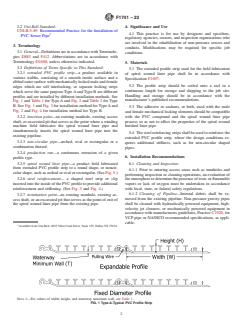
5.1 The extruded profile strip used for the field fabrication
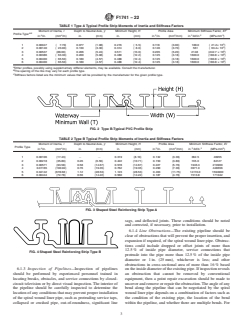
3.2.1 extruded PVC profile strip—a product available in
of spiral wound liner pipe shall be in accordance with
various widths, consisting of a smooth inside surface and a
Specification F1697.
ribbed outer surface with mechanically locked male and female
5.2 The profile strip should be coiled onto a reel in a
edges which are self interlocking, or separate locking strips
continuous length for storage and shipping to the job site.
which serve the same purpose Type A and Type B are different
Handling and storage should be in accordance with the
profiles and are installed by different installation methods. See
manufacturer’s published recommendations.
Fig. 1 and Table 1 for Type A and Fig. 2 and Table 2 for Type
B. See Fig. 1 and Fig. 3 for installation method for Type A and
5.3 The adhesive or sealants, or both, used with the male
Fig. 2 and Fig. 4 for installation method for Type B.
and female mechanical locking elements should be compatible
3.2.2 insertion point—an existing manhole, existing access with the PVC compound and the spiral wound liner pipe
process so as not to affect the properties of the spiral wound
shaft, or excavated pit that serves as the point where a winding
machine field fabricates the spiral wound liner pipe and finished liner pipe.
simultaneously inserts the spiral wound liner pipe into the
5.4 The steel reinforcing strips shall be used to reinforce the
existing pipeline.
extruded PVC profile strip, where the design conditions re-
3.2.3 non-circular pipe—arched, oval or rectangular or a
quires additional stiffness, such as for non-circular shaped
combination thereof.
pipes.
3.2.4 production run—a continuous extrusion of a given
profile type. 6. Installation Recommendations
3.2.5 spiral wound liner pipe—a product field fabricated
6.1 Cleaning and Inspection:
from extruded PVC profile strip to a round shape, or noncir-
6.1.1 Prior to entering access areas such as manholes and
cular shape, such as arched or oval or rectangular. (See Fig. 5.)
performing inspection or cleaning operations, an evaluation of
3.2.6 steel reinforcement— a shaped steel strip or clip the atmosphere to determine the presence of toxic or flammable
inserted into the inside of the PVC profile to provide additional
vapors or lack of oxygen must be undertaken in accordance
reinforcement and stiffening. (See Fig. 3 and Fig. 4.) with local, state, or federal safety regulations.
6.1.2 Cleaning of Pipeline—Internal debris shall be re-
3.2.7 termination point—an existing manhole, existing ac-
moved from the existing pipeline. Non-pressure gravity pipes
cess shaft, or an excavated pit that serves as the point of exit of
shall be cleaned with hydraulically powered equipment, high-
the spiral wound liner pipe from the existing pipe.
velocity jet cleaners, or mechanically powered equipment in
accordance with manufacturers guidelines, Practice C1920, for
VCP pipe or NASSCO recommended specifications, as appli-
cable.
Available from Uni-Bell, 2655 Villa Creek Drive, Suite 155, Dallas TX 75234.
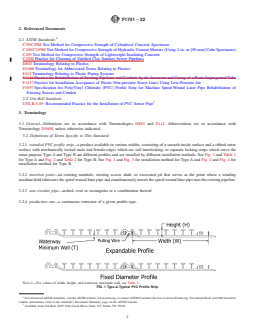
NOTE 1—For values of width, height, and waterway minimum wall, see Table 1.
FIG. 1 Type A-Typical PVC Profile Strip
F1741 − 22
TABLE 1 Type A Typical Profile Strip Moments of Inertia and Stiffness Factors
C
Moment of Inertia, I Depth to Neutral Axis, y¯ Minimum Height, H Profile Area Minimum Stiffness Factor, EI
AB
Profile Type
4 4 2 2 3 2 3
in. /in. (mm /m) in. (mm) in. (mm) in. /in. (mm /mm) in. ·lbf/in. (MPa·mm )
1 0.00047 ( 7.70) 0.077 (1.98) 0.216 ( 5.5) 0.118 (3.00) 188.0 ( 21.2× 10 )
2 0.00140 ( 23.00) 0.130 (3.30) 0.314 ( 8.0) 0.146 (3.70) 561 ( 63.4× 10 )
3 0.00537 (88.00) 0.206 (5.24) 0.511 (13.0) 0.205 (5.20) 2148 (242.7 × 10 )
4 0.00386 ( 63.30) 0.200 (5.08) 0.480 (12.2) 0.125 (3.18) 1600.0 (180.8 × 10 )
5 0.00400 ( 65.50) 0.180 (4.57) 0.488 (12.4) 0.125 (3.18) 1600.0 (180.8 × 10 )
6 0.00400 ( 65.50) 0.180 (4.57) 0.488 (12.4) 0.125 (3.18) 1600.0 (180.8 × 10 )
A
Other profiles, possibly using supplementary stiffener elements, may be available. Consult the manufacturer.
B
The spacing of the ribs may vary for each profile type.
C
Stiffness factors listed are the minimum values that will be provided by the manufacturer for the given profile type.
FIG. 2 Type B-Typical PVC Profile Strip
TABLE 2 Type B Typical Profile Strip Moments of Inertia and Stiffness Factors
Moment of Inertia, I Depth to Neutral Axis, y¯ Minimum Height, H Profile Area Minimum Stiffness Factor, EI
Profile Type
4 4 2 2 3 2 3
in. /in. (mm /m) in. (mm) in. (mm) in. /in. (mm /mm) in. ·lbf/in. (MPa·mm )
1 0.00106 (17.43) . . 0.319 (8.10) 0.132 (3.36) 362.5 40955
2 0.00218 (35.80) 0.26 (6.56) 0.422 (10.71) 0.150 (3.80) 745.0 84127
3 0.00571 (93.58) 0.58 (14.67) 0.578 (14.67) 0.227 (5.76) 1946.3 219900
4 0.01165 (190.92) 0.76 (19.35) 0.762 (19.35) 0.290 (7.36) 3971.0 448656
5 0.04142 (678.68 ) 1.12 (28.53) 1.123 (28.53) 0.463 (11.75) 14116.0 1594900
6 0.00444 (72.78) 0.56 (14.22) 0.560 (14.22) 0.187 (4.76) 1513.8 171042
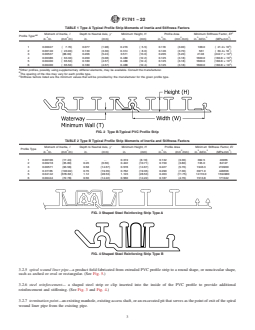
FIG. 3 Shaped Steel Reinforcing Strip Type A
sags, and deflected joints. These conditions should be noted
and corrected, if necessary, prior to installation.
6.1.4 Line Obstructions—The existing pipeline should be
clear of obstructions that will prevent the proper insertion, and
expansion if required, of the spiral wound liner pipe. Obstruc-
tions could include dropped or offset joints of more than
12.5 % of inside pipe diameter, service connections that
FIG. 4 Shaped Steel Reinforcing Strip Type B
protrude into the pipe more than 12.5 % of the inside pipe
diameter or 1 in. (25 mm), whichever is less; and other
obstructions in cross-sectional area of more than 16 % based
6.1.3 Inspection of Pipelines—Inspection of pipelines on the inside diameter of the existing pipe. If inspection reveals
should be performed by experienced personnel trained in an obstruction that cannot be removed by conventional
locating breaks, obstacles, and service connections by closed- equipment, then a point repair excavation should be made to
circuit television or by direct visual inspection. The interior of uncover and remove or repair the obstruction. The angle of any
the pipeline should be carefully inspected to determine the bend along the pipeline that can be negotiated by the spiral
location of any conditions that may prevent proper installation wound liner pipe depends on a combination of factors such as
of the spiral wound liner pipe, such as protruding service taps, the condition of the existing pipe, the location of the bend
collapsed or crushed pipe, out-of-roundness, significant line within the pipeline, and whether there are multiple bends. For
F1741 − 22
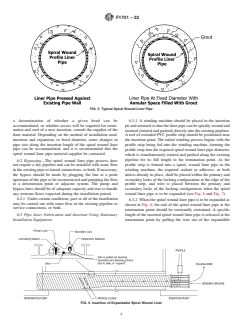
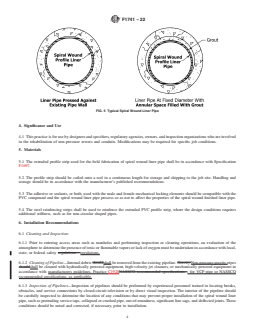
FIG. 5 Typical Spiral Wound Liner Pipe
a determination of whether a given bend can be 6.3.1 A winding machine should be placed in the insertion
accommodated, or whether access will be required for termi- pit and oriented so that the liner pipe can be spirally wound and
nation and start of a new insertion, consult the supplier of the
inserted (rotated and pushed) directly into the existing pipeline.
liner material. Depending on the method of installation used,
A reel of extruded PVC profile strip should be positioned near
insertion and expansion, or fixed diameter, some changes in
the insertion point. The initial winding process begins with the
pipe size along the insertion length of the spiral wound liner
profile strip being fed into the winding machine, forming the
pipe can be accommodated, and it is recommended that the
profile strip into the required spiral wound liner pipe diameter,
spiral wound liner pipe material supplier be contacted.
which is simultaneously rotated and pushed along the existing
pipeline for its full length to the termination point. As the
6.2 Bypassing—The spiral wound liner pipe process does
profile strip is formed into a spiral, wound liner pipe in the
not require a dry pipeline and can be installed with some flow
winding machine, the required sealant or adhesive, or both
in the existing pipe or lateral connections, or both. If necessary,
unless already in place, shall be placed within the primary and
the bypass should be made by plugging the line at a point
upstream of the pipe to be reconstructed and pumping the flow secondary locks of the locking configuration at the edge of the
profile strip, and wire is placed between the primary and
to a downstream point or adjacent system. The pump and
bypass lines should be of adequate capacity and size to handle secondary locks of the locking configuration when the spiral
any extreme flows expected during the installation period.
wound liner pipe is to be expanded (see Fig. 6 and Fig. 7).
6.2.1 Under certain conditions, part or all of the installation
6.3.2 When the spiral wound liner pipe is to be expanded as
may be carried out with some flow in the existing pipeline or
shown in Fig. 6, the end of the spiral wound liner pipe at the
service connections, or both.
termination point should be torsionally restrained. A specific
6.3 Pipe Liner Fabrication and Insertion Using Stationary length of the inserted spiral wound liner pipe is released at the
Installation Equipment: termination point by pulling the wire out of the expandable
FIG. 6 Insertion of Expandable Spiral Wound Liner
F1741 − 22
FIG. 7 Insertion of Fixed-Diameter Spiral Wound Liner
interlocked joint, thereby severing the secondary lock (see Fig. strip into the required spiral wound liner pipe diameter or
6), thus releasing the profile strip to slide freely along the rectangular or non-circular pipeline shape, such as arched or
primary rock when a torque is applied to the inserted spiral oval. As the profile strip is formed into a spiral wound liner
wound liner pipe. The winding operation should be pipe in the winding machine, the sealant or adhesive, or both
recommenced, thereby creating a torque which is applied to the unless already in place, shall be placed within the primary lock
released end, thus causing a radial growth or expansion over of the locking configuration at the edge of the profile strip. (See
the released length of the spiral wound liner pipe. The initial Fig. 8 and Fig. 9)
radial growth should be permitted to continue until the released 6.4.2 When the spiral wound liner pipe is to be pressed
end of the spiral wound liner pipe is pressed against the against the existing pipe wall the traveling winding machine
existing pipeline (see Fig. 6), thus halting radially growth and should be adjusted to apply the spiral wound liner pipe directly
torsionally restraining the spiral wound liner pipe. Subsequent against the existing pipe wall. As the profile strip is formed into
secondary lock release and winding should continue until the a spiral wound liner pipe in the winding machine, the sealant or
spiral wound liner pipe is pressed against the full length of the adhesive, or both unless already in place, shall be placed within
existing pipe. The annular space between the expanded spiral the primary lock of the locking configuration at the edge of the
wound liner pipe and the existing pipeline should be sealed at profile strip. The space between the spiral wound liner pipe and
the ends with a sealing material that is compatible with the the existing pipeline should be sealed at the ends with a sealing
spiral wound liner pipe material. material that is compatible with the spiral wound liner pipe
material.
6.4 Pipe Liner Fabrication Using Traveling Installation
Equipment: 6.5 Grouting:
6.4.1 A traveling winding machine should be placed in the 6.5.1 When the spiral wound liner pipe is inserted into the
insertion point and oriented so that the winding machine can existing pipeline and grouted, the following procedure should
travel directly into the existing pipeline. A reel of extruded be followed. The annular space between the expanded spiral
PVC profile strip should be positioned near the insertion point. wound liner pipe and the existing pipeline should be sealed at
The winding process begins with the profile strip being fed into the ends with a sealing material that is compatible with the
the winding machine. The traveling winding machine then spiral wound liner pipe material. Grout is then injected
simultaneously rotates and moves along the existing pipeline throughout the annular space in a variety of ways such as
for its full length to the termination point, forming the profile through openings in the end seals, at reconnected service
FIG. 8 Insertion of Fixed-Diameter Spiral Wound Liner Using T
...
This document is not an ASTM standard and is intended only to provide the user of an ASTM standard an indication of what changes have been made to the previous version. Because
it may not be technically possible to adequately depict all changes accurately, ASTM recommends that users consult prior editions as appropriate. In all cases only the current version
of the standard as published by ASTM is to be considered the official document.
Designation: F1741 − 18 F1741 − 22
Standard Practice for
Installation of Machine Spiral Wound Poly (Vinyl Chloride)
(PVC) Liner Pipe for Rehabilitation of Existing Sewers and
Conduits
This standard is issued under the fixed designation F1741; the number immediately following the designation indicates the year of
original adoption or, in the case of revision, the year of last revision. A number in parentheses indicates the year of last reapproval. A
superscript epsilon (´) indicates an editorial change since the last revision or reapproval.
1. Scope*
1.1 This practice describes the procedures for the rehabilitation of sewer lines and conduits for existing pipelines 6 to 180 in. in
diameter by the insertion of a machine-made field-fabricated spiral wound liner pipe into the existing pipeline using a winding
machine which remains stationary in the insertion pit or, alternatively, which travels along the interior of the existing pipeline.
These rehabilitation processes can be used in a variety of gravity applications such as sanitary sewers, storm sewers, culverts, and
process piping.
1.1.1 When using stationary installation equipment for existing pipelines 6 to 48 in., after insertion, the spiral wound liner pipe
is expanded until it presses against the interior surface of the existing pipeline. Alternatively, for existing pipelines 6 to 108 in. in
diameter, the spiral wound liner pipe is inserted as a fixed diameter into the existing pipeline and is not expanded, and the annular
space between the spiral wound liner pipe and the existing pipe is grouted.
1.1.2 When using the traveling installation equipment for existing pipelines 6 to 180 in. the spiral wound liner pipe is installed
in contact with the interior surface of the existing pipeline to form a close fit liner, except in the corners of rectangular pipes or
where obstructions or offsets occur. Alternatively, for existing pipelines 6 to 180 in. in diameter and for similar sized existing non
circular pipelines such as arched or oval or rectangular shapes, the spiral wound liner is installed as a fixed diameter into the exiting
pipeline to form a non-close fit liner and the annular space between the spiral wound liner pipe and the existing pipe is grouted.
1.2 The values stated in inch-pound units are to be regarded as standard. The values given in parentheses are mathematical
conversions to SI units that are provided for information only and are not considered standard.
1.3 This standard does not purport to address all of the safety concerns, if any, associated with its use. It is the responsibility of
the user of this standard to establish appropriate safety, health, and environmental practices and determine the applicability of
regulatory limitations prior to use.
1.3.1 Particular attention is drawn to those safety regulations and requirements involving entering into and working in confined
spaces.
1.4 This international standard was developed in accordance with internationally recognized principles on standardization
established in the Decision on Principles for the Development of International Standards, Guides and Recommendations issued
by the World Trade Organization Technical Barriers to Trade (TBT) Committee.
This practice is under the jurisdiction of ASTM Committee F17 on Plastic Piping Systems and is the direct responsibility of Subcommittee F17.67 on Trenchless Plastic
Pipeline Technology.
Current edition approved April 1, 2018Nov. 15, 2022. Published July 2018December 2022. Originally approved in 1996. Last previous edition approved in 20162018 as
F1741–08(2016).F1741–18. DOI: 10.1520/F1741-18.10.1520/F1741-22.
*A Summary of Changes section appears at the end of this standard
Copyright © ASTM International, 100 Barr Harbor Drive, PO Box C700, West Conshohocken, PA 19428-2959. United States
F1741 − 22
2. Referenced Documents
2.1 ASTM Standards:
C39/C39M Test Method for Compressive Strength of Cylindrical Concrete Specimens
C109/C109M Test Method for Compressive Strength of Hydraulic Cement Mortars (Using 2-in. or [50 mm] Cube Specimens)
C495 Test Method for Compressive Strength of Lightweight Insulating Concrete
C1920 Practice for Cleaning of Vitrified Clay Sanitary Sewer Pipelines
D883 Terminology Relating to Plastics
D1600 Terminology for Abbreviated Terms Relating to Plastics
F412 Terminology Relating to Plastic Piping Systems
F1216 Practice for Rehabilitation of Existing Pipelines and Conduits by the Inversion and Curing of a Resin-Impregnated Tube
F1417 Practice for Installation Acceptance of Plastic Non-pressure Sewer Lines Using Low-Pressure Air
F1697 Specification for Poly(Vinyl Chloride) (PVC) Profile Strip for Machine Spiral-Wound Liner Pipe Rehabilitation of
Existing Sewers and Conduit
2.2 Uni-Bell Standard:
UNI-B-5-89 Recommended Practice for the Installation of PVC Sewer Pipe
3. Terminology
3.1 General—Definitions are in accordance with Terminologies D883 and F412. Abbreviations are in accordance with
Terminology D1600, unless otherwise indicated.
3.2 Definitions of Terms Specific to This Standard:
3.2.1 extruded PVC profile strip—a product available in various widths, consisting of a smooth inside surface and a ribbed outer
surface with mechanically locked male and female edges which are self interlocking, or separate locking strips which serve the
same purpose Type A and Type B are different profiles and are installed by different installation methods. See Fig. 1 and Table 1
for Type A and Fig. 2 and Table 2 for Type B. See Fig. 1 and Fig. 3 for installation method for Type A and Fig. 2 and Fig. 4 for
installation method for Type B.
3.2.2 insertion point—an existing manhole, existing access shaft, or excavated pit that serves as the point where a winding
machine field fabricates the spiral wound liner pipe and simultaneously inserts the spiral wound liner pipe into the existing pipeline.
3.2.3 non-circular pipe—arched, oval or rectangular or a combination thereof.
3.2.4 production run—a continuous extrusion of a given profile type.
NOTE 1—For values of width, height, and waterway minimum wall, see Table 1.
FIG. 1 Type A-Typical PVC Profile Strip
For referenced ASTM standards, visit the ASTM website, www.astm.org, or contact ASTM Customer Service at service@astm.org. For Annual Book of ASTM Standards
volume information, refer to the standard’s Document Summary page on the ASTM website.
Available from Uni-Bell, 2655 Villa Creek Drive, Suite 155, Dallas TX 75234.
F1741 − 22
TABLE 1 Type A Typical Profile Strip Moments of Inertia and Stiffness Factors
C
Moment of Inertia, I Depth to Neutral Axis, y¯ Minimum Height, H Profile Area Minimum Stiffness Factor, EI
AB
Profile Type
4 4 2 2 3 2 3
in. /in. (mm /m) in. (mm) in. (mm) in. /in. (mm /mm) in. ·lbf/in. (MPa·mm )
1 0.00047 ( 7.70) 0.077 (1.98) 0.216 ( 5.5) 0.118 (3.00) 188.0 ( 21.2× 10 )
2 0.00140 ( 23.00) 0.130 (3.30) 0.314 ( 8.0) 0.146 (3.70) 561 ( 63.4× 10 )
3 0.00537 (88.00) 0.206 (5.24) 0.511 (13.0) 0.205 (5.20) 2148 (242.7 × 10 )
4 0.00386 ( 63.30) 0.200 (5.08) 0.480 (12.2) 0.125 (3.18) 1600.0 (180.8 × 10 )
5 0.00400 ( 65.50) 0.180 (4.57) 0.488 (12.4) 0.125 (3.18) 1600.0 (180.8 × 10 )
6 0.00400 ( 65.50) 0.180 (4.57) 0.488 (12.4) 0.125 (3.18) 1600.0 (180.8 × 10 )
A
Other profiles, possibly using supplementary stiffener elements, may be available. Consult the manufacturer.
B
The spacing of the ribs may vary for each profile type.
C
Stiffness factors listed are the minimum values that will be provided by the manufacturer for the given profile type.
FIG. 2 Type B-Typical PVC Profile Strip
TABLE 2 Type B Typical Profile Strip Moments of Inertia and Stiffness Factors
Moment of Inertia, I Depth to Neutral Axis, y¯ Minimum Height, H Profile Area Minimum Stiffness Factor, EI
Profile Type
4 4 2 2 3 2 3
in. /in. (mm /m) in. (mm) in. (mm) in. /in. (mm /mm) in. ·lbf/in. (MPa·mm )
1 0.00106 (17.43) . . 0.319 (8.10) 0.132 (3.36) 362.5 40955
2 0.00218 (35.80) 0.26 (6.56) 0.422 (10.71) 0.150 (3.80) 745.0 84127
3 0.00571 (93.58) 0.58 (14.67) 0.578 (14.67) 0.227 (5.76) 1946.3 219900
4 0.01165 (190.92) 0.76 (19.35) 0.762 (19.35) 0.290 (7.36) 3971.0 448656
5 0.04142 (678.68 ) 1.12 (28.53) 1.123 (28.53) 0.463 (11.75) 14116.0 1594900
6 0.00444 (72.78) 0.56 (14.22) 0.560 (14.22) 0.187 (4.76) 1513.8 171042
FIG. 3 Shaped Steel Reinforcing Strip Type A
FIG. 4 Shaped Steel Reinforcing Strip Type B
3.2.5 spiral wound liner pipe—a product field fabricated from extruded PVC profile strip to a round shape, or noncircular shape,
such as arched or oval or rectangular. (See Fig. 5.)
3.2.6 steel reinforcement— a shaped steel strip or clip inserted into the inside of the PVC profile to provide additional
reinforcement and stiffening. (See Fig. 3 and Fig. 4.)
3.2.7 termination point—an existing manhole, existing access shaft, or an excavated pit that serves as the point of exit of the spiral
wound liner pipe from the existing pipe.
F1741 − 22
FIG. 5 Typical Spiral Wound Liner Pipe
4. Significance and Use
4.1 This practice is for use by designers and specifiers, regulatory agencies, owners, and inspection organizations who are involved
in the rehabilitation of non-pressure sewers and conduits. Modifications may be required for specific job conditions.
5. Materials
5.1 The extruded profile strip used for the field fabrication of spiral wound liner pipe shall be in accordance with Specification
F1697.
5.2 The profile strip should be coiled onto a reel in a continuous length for storage and shipping to the job site. Handling and
storage should be in accordance with the manufacturer’s published recommendations.
5.3 The adhesive or sealants, or both, used with the male and female mechanical locking elements should be compatible with the
PVC compound and the spiral wound liner pipe process so as not to affect the properties of the spiral wound finished liner pipe.
5.4 The steel reinforcing strips shall be used to reinforce the extruded PVC profile strip, where the design conditions requires
additional stiffness, such as for non-circular shaped pipes.
6. Installation Recommendations
6.1 Cleaning and Inspection:
6.1.1 Prior to entering access areas such as manholes and performing inspection or cleaning operations, an evaluation of the
atmosphere to determine the presence of toxic or flammable vapors or lack of oxygen must be undertaken in accordance with local,
state, or federal safety regulations . regulations.
6.1.2 Cleaning of Pipeline—Internal debris shouldshall be removed from the existing pipeline. Gravity Non-pressure gravity pipes
shouldshall be cleaned with hydraulically powered equipment, high-velocity jet cleaners, or mechanically powered equipment in
accordance with manufacturers guidelines, Practice C1920NASSCO recommended specifications. , for VCP pipe or NASSCO
recommended specifications, as applicable.
6.1.3 Inspection of Pipelines—Inspection of pipelines should be performed by experienced personnel trained in locating breaks,
obstacles, and service connections by closed-circuit television or by direct visual inspection. The interior of the pipeline should
be carefully inspected to determine the location of any conditions that may prevent proper installation of the spiral wound liner
pipe, such as protruding service taps, collapsed or crushed pipe, out-of-roundness, significant line sags, and deflected joints. These
conditions should be noted and corrected, if necessary, prior to installation.
F1741 − 22
6.1.4 Line Obstructions—The existing pipeline should be clear of obstructions that will prevent the proper insertion, and expansion
if required, of the spiral wound liner pipe. Obstructions could include dropped or offset joints of more than 12.5 % of inside pipe
diameter, service connections that protrude into the pipe more than 12.5 % of the inside pipe diameter or 1-in. (25-mm),1 in.
(25 mm), whichever is less; and other obstructions in cross-sectional area of more than 16 % based on the inside diameter of the
existing pipe. If inspection reveals an obstruction that cannot be removed by conventional equipment, then a point repair
excavation should be made to uncover and remove or repair the obstruction. The angle of any bend along the pipeline that can be
negotiated by the spiral wound liner pipe depends on a combination of factors such as the condition of the existing pipe, the
location of the bend within the pipeline, and whether there are multiple bends. For a determination of whether a given bend can
be accommodated, or whether access will be required for termination and start of a new insertion, consult the supplier of the liner
material. Depending on the method of installation used, insertion and expansion, or fixed diameter, some changes in pipe size along
the insertion length of the spiral wound liner pipe can be accommodated, and it is recommended that the spiral wound liner pipe
material supplier be contacted.
6.2 Bypassing—The spiral wound liner pipe process does not require a dry pipeline and can be installed with some flow in the
existing pipe or lateral connections, or both. If necessary, the bypass should be made by plugging the line at a point upstream of
the pipe to be reconstructed and pumping the flow to a downstream point or adjacent system. The pump and bypass lines should
be of adequate capacity and size to handle any extreme flows expected during the installation period.
6.2.1 Under certain conditions, part or all of the installation may be carried out with some flow in the existing pipeline or service
connections, or both.
6.3 Pipe Liner Fabrication and Insertion Using Stationary Installation Equipment:
6.3.1 A winding machine should be placed in the insertion pit and oriented so that the liner pipe can be spirally wound and inserted
(rotated and pushed) directly into the existing pipeline. A reel of extruded PVC profile strip should be positioned near the insertion
point. The initial winding process begins with the profile strip being fed into the winding machine, forming the profile strip into
the required spiral wound liner pipe diameter, which is simultaneously rotated and pushed along the existing pipeline for its full
length to the termination point. As the profile strip is formed into a spiral, wound liner pipe in the winding machine, the required
sealant or adhesive, or both unless already in place, shall be placed within the primary and secondary locks of the locking
configuration at the edge of the profile strip, and wire is placed between the primary and secondary locks of the locking
configuration when the spiral wound liner pipe is to be expanded (see Fig. 6 and Fig. 7).
6.3.2 When the spiral wound liner pipe is to be expanded as shown in Fig. 6, the end of the spiral wound liner pipe at the
termination point should be torsionally restrained. A specific length of the inserted spiral wound liner pipe is released at the
termination point by pulling the wire out of the expandable interlocked joint, thereby severing the secondary lock (see Fig. 6), thus
releasing the profile strip to slide freely along the primary rock when a torque is applied to the inserted spiral wound liner pipe.
The winding operation should be recommenced, thereby creating a torque which is applied to the released end, thus causing a radial
growth or expansion over the released length of the spiral wound liner pipe. The initial radial growth should be permitted to
continue until the released end of the spiral wound liner pipe is pressed against the existing pipeline (see Fig. 6), thus halting
radially growth and torsionally restraining the spiral wound liner pipe. Subsequent secondary lock release and winding should
FIG. 6 Insertion of Expandable Spiral Wound Liner
F1741 − 22
FIG. 7 Insertion of Fixed-Diameter Spiral Wound Liner
continue until the spiral wound liner pipe is pressed against the full length of the existing pipe. The annular space between the
expanded spiral wound liner pipe and the existing pipeline should be sealed at the ends with a sealing material that is compatible
with the spiral wound liner pipe material.
6.4 Pipe Liner Fabrication Using Traveling Installation Equipment:
6.4.1 A traveling winding machine should be placed in the insertion point and oriented so that the winding machine can travel
directly into the existing pipeline. A reel of extruded PVC profile strip should be positioned near the insertion point. The winding
process begins with the profile strip being fed into the winding machine. The traveling winding machine then simultaneously
rotates and moves along the existing pipeline for its full length to the termination point, forming the profile strip into the required
spiral wound liner pipe diameter or rectangular or non-circular pipeline shape, such as arched or oval. As the profile strip is formed
into a spiral wound liner pipe in the winding machine, the sealant or adhesive, or both unless already in place, shall be placed
within the primary lock of the locking configuration at the edge of the profile strip. (See Fig. 8 and Fig. 9)
6.4.2 When the spiral wound liner pipe is to be pressed against the existing pipe wall the traveling winding machine should be
adjusted to apply the spiral wound liner pipe directly against the existing pipe wall. As the profile strip is formed into a spiral
wound liner pipe in the winding machine, the sealant or adhesive, or both unless already in place, shall be placed within the primary
lock of the locking configuration at the edge of the profile strip. The space between the spiral wound liner pipe and the existing
pipeline should be sealed at the ends with a sealing material that is compatible with the spiral wound liner pipe material.
6.5 Grouting:
6.5.1 When the spiral wound liner pipe is inserted into the existing pipeline and grouted, the following procedure should be
followed. The annular space between the expanded spiral wound liner pipe and the existing pipeline should be sealed at the ends
with a sealing material that is compatible with the spiral wound liner pipe material. Grout is then injected throughout the annular
space in a variety of ways such as through openings in the end seals, at reconnected service connections, or through grout holes
FIG. 8 Insertion of Fixed-Diameter Spiral Wound Liner Using Traveling Installation Equipment
F1741 − 22
FIG. 9 Insertion of Close Fit Spiral Wound Liner Using Traveling Installation Equipment
drilled in the spiral wound liner pipe at appropriate points, or combination thereof. Prior to commencing the grouting operation,
all service openings must be opened and measures taken to prevent the grout from entering the service connections or the spiral
wound liner pipe. In addition, any holes drilled in the spiral wound liner pipe for the grouting operation should be sealed.
6.5.2 When the spiral wound liner pipe is inserted into the existing pipeline as a fixed diameter and grouted, the following
procedure should be followed. The annular space between the fixed-diameter spiral wound liner pipe and the existing pipeline
should be sealed at the ends with a sealing material that is compatible with the spiral wound liner pipe material. A series of tubes
which act as grout injection tubes or breather tubes,
...