

ASTM E2611-19
(Test Method)Standard Test Method for Normal Incidence Determination of Porous Material Acoustical Properties Based on the Transfer Matrix Method
General Information
- Abstract
SIGNIFICANCE AND USE
5.1 There are several purposes of this test:
5.1.1 For transmission loss: (a) to characterize the sound insulation characteristics of materials in a less expensive and less time consuming approach than Test Method E90 and ISO 140-3 (“reverberant room methods”), (b) to allow small samples tested when larger samples are impossible to construct or to transport, (c) to allow a rapid technique that does not require an experienced professional to run.
5.1.2 For transfer matrix: (a) to determine additional acoustic properties of the material; (b) to allow calculation of acoustic properties of built-up or composite materials by the combination of their individual transfer matrices.
5.2 There are significant differences between this method and that of the more traditional reverberant room method. Specifically, in this approach the sound impinges on the specimen in a perpendicular direction (“normal incidence”) only, compared to the random incidence of traditional methods. Additionally, revereration room methods specify certain minimum sizes for test specimens which may not be practical for all materials. At present the correlation, if any, between the two methods is not known. Even though this method may not replicate the reverberant room methods for measuring the transmission loss of materials, it can provide comparison data for small specimens, something that cannot be done in the reverberant room method. Normal incidence transmission loss may also be useful in certain situations where the material is placed within a small acoustical cavity close to a sound source, for example, a closely-fitted machine enclosure or portable electronic device.
5.3 Transmission loss is not only a property of a material, but is also strongly dependent on boundary conditions inherent in the method and details of the way the material is mounted. This must be considered in the interpretation of the results obtained by this test method.
5.4 The quantities are measured as a functio...
SCOPE
1.1 This test method covers the use of a tube, four microphones, and a digital frequency analysis system for the measurement of normal incident transmission loss and other important acoustic properties of materials by determination of the acoustic transfer matrix.
1.2 The values stated in SI units are to be regarded as standard. No other units of measurement are included in this standard.
1.3 This standard does not purport to address all of the safety concerns, if any, associated with its use. It is the responsibility of the user of this standard to establish appropriate safety, health, and environmental practices and determine the applicability of regulatory limitations prior to use.
1.4 This international standard was developed in accordance with internationally recognized principles on standardization established in the Decision on Principles for the Development of International Standards, Guides and Recommendations issued by the World Trade Organization Technical Barriers to Trade (TBT) Committee.
- Status
- Published
- Publication Date
- 30-Sep-2019
- Technical Committee
- E33 - Building and Environmental Acoustics
- Drafting Committee
- E33.01 - Sound Absorption
Buy Documents
ASTM E2611-19 - Standard Test Method for Normal Incidence Determination of Porous Material Acoustical Properties Based on the Transfer Matrix Method
REDLINE ASTM E2611-19 - Standard Test Method for Normal Incidence Determination of Porous Material Acoustical Properties Based on the Transfer Matrix Method
Overview
ASTM E2611-19 is an international standard developed by ASTM International for the normal incidence determination of acoustical properties of porous materials using the Transfer Matrix Method (TMM). This standard provides a test method that utilizes a tube, four microphones, and a digital frequency analysis system to measure the normal incidence sound transmission loss and other key acoustic properties of materials. The method is especially valuable for characterizing the sound insulation properties of small or difficult-to-handle samples that cannot be tested using traditional reverberant room techniques, such as ASTM E90 or ISO 140-3.
This acoustical testing standard is designed to deliver efficient, cost-effective, and reproducible results, enhancing the ability to assess the performance of porous materials and composites in various applications.
Key Topics
Normal Incidence Sound Transmission Loss: This method measures how much sound energy is blocked by a material when sound waves strike perpendicularly (at normal incidence). The results are expressed in decibels (dB).
Transfer Matrix Method (TMM): By measuring sound pressure and phase at four points around the specimen, the method computes the transfer matrix, which describes how sound waves propagate through the material. This enables calculation of transmission loss, acoustic impedance, and absorption coefficients.
Small Sample Capability: Unlike traditional reverberant room methods, ASTM E2611-19 allows for testing small samples. This is critical for research and product development when large samples are impractical.
Rapid and Accessible Testing: The apparatus is relatively simple and does not require specialized training, making it an accessible tool for both laboratory and field use.
Frequency-Dependent Analysis: Acoustic properties are measured as a function of frequency, providing valuable data across the sound spectrum relevant to the intended use of the material.
Boundary and Mounting Considerations: Results can be affected by how the sample is mounted and the specific test setup, highlighting the need for careful sample preparation and documentation.
Applications
Product Development: Manufacturers of acoustic panels, insulation, foams, and other sound-absorbing or sound-insulating materials employ ASTM E2611-19 to validate and refine their products.
Quality Control: The method provides a reliable means for ongoing quality assessment of acoustic materials in production, ensuring materials meet specified performance requirements.
Research and Development: Laboratories use the test to study the fundamental acoustical properties of new porous materials and composites, or to optimize existing products.
Specialty Applications: The normal incidence method is ideal for evaluating materials used in small enclosures and devices, such as machine housings, automotive components, or portable electronics, where space constraints or sample size limit traditional testing.
Comparative Studies: Results can be used to compare the transmission loss characteristics of different materials or configurations, supporting material selection and engineering decisions.
Related Standards
ASTM E2611-19 is part of a broader family of acoustical testing standards:
- ASTM E90: Standard Test Method for Laboratory Measurement of Airborne Sound Transmission Loss of Building Partitions and Elements
- ASTM E1050: Test Method for Impedance and Absorption of Acoustical Materials Using a Tube, Two Microphones, and a Digital Frequency Analysis System
- ASTM C634: Terminology Relating to Building and Environmental Acoustics
- ISO 140-3: Laboratory Measurement of Airborne Sound Insulation of Building Elements
Adherence to ASTM E2611-19 and its related standards ensures consistency, comparability, and international recognition of test results in the field of building acoustics and porous material characterization.
Keywords: ASTM E2611-19, normal incidence, transmission loss, porous material acoustical properties, transfer matrix method, sound insulation, acoustic testing, acoustical standards, building acoustics, material testing
Relations
- Effective Date
- 01-Oct-2019
- Effective Date
- 01-Dec-2023
- Effective Date
- 01-Oct-2019
- Effective Date
- 01-Dec-2016
- Effective Date
- 01-Sep-2013
- Effective Date
- 01-Apr-2012
- Effective Date
- 01-Dec-2011
- Effective Date
- 01-Sep-2010
- Effective Date
- 01-Sep-2010
- Effective Date
- 01-Jun-2010
- Effective Date
- 01-Jul-2009
- Effective Date
- 01-Apr-2009
- Effective Date
- 01-Sep-2008
- Effective Date
- 15-Mar-2008
- Effective Date
- 15-Jan-2008
Buy Documents
ASTM E2611-19 - Standard Test Method for Normal Incidence Determination of Porous Material Acoustical Properties Based on the Transfer Matrix Method
REDLINE ASTM E2611-19 - Standard Test Method for Normal Incidence Determination of Porous Material Acoustical Properties Based on the Transfer Matrix Method
Get Certified
Connect with accredited certification bodies for this standard

BSMI (Bureau of Standards, Metrology and Inspection)
Taiwan's standards and inspection authority.
Sponsored listings
Frequently Asked Questions
ASTM E2611-19 is a standard published by ASTM International. Its full title is "Standard Test Method for Normal Incidence Determination of Porous Material Acoustical Properties Based on the Transfer Matrix Method". This standard covers: SIGNIFICANCE AND USE 5.1 There are several purposes of this test: 5.1.1 For transmission loss: (a) to characterize the sound insulation characteristics of materials in a less expensive and less time consuming approach than Test Method E90 and ISO 140-3 (“reverberant room methods”), (b) to allow small samples tested when larger samples are impossible to construct or to transport, (c) to allow a rapid technique that does not require an experienced professional to run. 5.1.2 For transfer matrix: (a) to determine additional acoustic properties of the material; (b) to allow calculation of acoustic properties of built-up or composite materials by the combination of their individual transfer matrices. 5.2 There are significant differences between this method and that of the more traditional reverberant room method. Specifically, in this approach the sound impinges on the specimen in a perpendicular direction (“normal incidence”) only, compared to the random incidence of traditional methods. Additionally, revereration room methods specify certain minimum sizes for test specimens which may not be practical for all materials. At present the correlation, if any, between the two methods is not known. Even though this method may not replicate the reverberant room methods for measuring the transmission loss of materials, it can provide comparison data for small specimens, something that cannot be done in the reverberant room method. Normal incidence transmission loss may also be useful in certain situations where the material is placed within a small acoustical cavity close to a sound source, for example, a closely-fitted machine enclosure or portable electronic device. 5.3 Transmission loss is not only a property of a material, but is also strongly dependent on boundary conditions inherent in the method and details of the way the material is mounted. This must be considered in the interpretation of the results obtained by this test method. 5.4 The quantities are measured as a functio... SCOPE 1.1 This test method covers the use of a tube, four microphones, and a digital frequency analysis system for the measurement of normal incident transmission loss and other important acoustic properties of materials by determination of the acoustic transfer matrix. 1.2 The values stated in SI units are to be regarded as standard. No other units of measurement are included in this standard. 1.3 This standard does not purport to address all of the safety concerns, if any, associated with its use. It is the responsibility of the user of this standard to establish appropriate safety, health, and environmental practices and determine the applicability of regulatory limitations prior to use. 1.4 This international standard was developed in accordance with internationally recognized principles on standardization established in the Decision on Principles for the Development of International Standards, Guides and Recommendations issued by the World Trade Organization Technical Barriers to Trade (TBT) Committee.
SIGNIFICANCE AND USE 5.1 There are several purposes of this test: 5.1.1 For transmission loss: (a) to characterize the sound insulation characteristics of materials in a less expensive and less time consuming approach than Test Method E90 and ISO 140-3 (“reverberant room methods”), (b) to allow small samples tested when larger samples are impossible to construct or to transport, (c) to allow a rapid technique that does not require an experienced professional to run. 5.1.2 For transfer matrix: (a) to determine additional acoustic properties of the material; (b) to allow calculation of acoustic properties of built-up or composite materials by the combination of their individual transfer matrices. 5.2 There are significant differences between this method and that of the more traditional reverberant room method. Specifically, in this approach the sound impinges on the specimen in a perpendicular direction (“normal incidence”) only, compared to the random incidence of traditional methods. Additionally, revereration room methods specify certain minimum sizes for test specimens which may not be practical for all materials. At present the correlation, if any, between the two methods is not known. Even though this method may not replicate the reverberant room methods for measuring the transmission loss of materials, it can provide comparison data for small specimens, something that cannot be done in the reverberant room method. Normal incidence transmission loss may also be useful in certain situations where the material is placed within a small acoustical cavity close to a sound source, for example, a closely-fitted machine enclosure or portable electronic device. 5.3 Transmission loss is not only a property of a material, but is also strongly dependent on boundary conditions inherent in the method and details of the way the material is mounted. This must be considered in the interpretation of the results obtained by this test method. 5.4 The quantities are measured as a functio... SCOPE 1.1 This test method covers the use of a tube, four microphones, and a digital frequency analysis system for the measurement of normal incident transmission loss and other important acoustic properties of materials by determination of the acoustic transfer matrix. 1.2 The values stated in SI units are to be regarded as standard. No other units of measurement are included in this standard. 1.3 This standard does not purport to address all of the safety concerns, if any, associated with its use. It is the responsibility of the user of this standard to establish appropriate safety, health, and environmental practices and determine the applicability of regulatory limitations prior to use. 1.4 This international standard was developed in accordance with internationally recognized principles on standardization established in the Decision on Principles for the Development of International Standards, Guides and Recommendations issued by the World Trade Organization Technical Barriers to Trade (TBT) Committee.
ASTM E2611-19 is classified under the following ICS (International Classification for Standards) categories: 17.140.01 - Acoustic measurements and noise abatement in general. The ICS classification helps identify the subject area and facilitates finding related standards.
ASTM E2611-19 has the following relationships with other standards: It is inter standard links to ASTM E2611-17, ASTM E90-23, ASTM E1050-19, ASTM E90-09(2016), ASTM C634-13, ASTM E1050-12, ASTM C634-11, ASTM C634-10a, ASTM E1050-10, ASTM C634-10, ASTM E90-09, ASTM C634-09, ASTM C634-08a, ASTM C634-08, ASTM E1050-08. Understanding these relationships helps ensure you are using the most current and applicable version of the standard.
ASTM E2611-19 is available in PDF format for immediate download after purchase. The document can be added to your cart and obtained through the secure checkout process. Digital delivery ensures instant access to the complete standard document.
Standards Content (Sample)
This international standard was developed in accordance with internationally recognized principles on standardization established in the Decision on Principles for the
Development of International Standards, Guides and Recommendations issued by the World Trade Organization Technical Barriers to Trade (TBT) Committee.
Designation: E2611 − 19
Standard Test Method for
Normal Incidence Determination of Porous Material
Acoustical Properties Based on the Transfer Matrix Method
This standard is issued under the fixed designation E2611; the number immediately following the designation indicates the year of
original adoption or, in the case of revision, the year of last revision. A number in parentheses indicates the year of last reapproval. A
superscript epsilon (´) indicates an editorial change since the last revision or reapproval.
1. Scope 2.2 ISO Standards:
ISO 140-3 Acoustics—Measurement of Sound Insulation in
1.1 This test method covers the use of a tube, four
Buildings and of Building Elements—Part 3: Laboratory
microphones, and a digital frequency analysis system for the
Measurement of Airborne Sound Insulation of Building
measurement of normal incident transmission loss and other
Elements
important acoustic properties of materials by determination of
the acoustic transfer matrix.
3. Terminology
1.2 The values stated in SI units are to be regarded as
3.1 Definitions—Theacousticalterminologyusedinthistest
standard. No other units of measurement are included in this
method is intended to be consistent with the definitions in
standard.
Terminology C634.
1.3 This standard does not purport to address all of the
3.1.1 reference plane—an arbitrary section, perpendicular to
safety concerns, if any, associated with its use. It is the
the longitudinal axis of the tube that is used for the origin of
responsibility of the user of this standard to establish appro-
lineardimensions.Oftenitistheupstream(closesttothesound
priate safety, health, and environmental practices and deter-
source) face of the specimen but, when specimen surfaces are
mine the applicability of regulatory limitations prior to use.
irregular, it may be any convenient plane near the specimen.
1.4 This international standard was developed in accor-
3.1.2 sound transmission coeffıcient, τ—(dimensionless) of
dance with internationally recognized principles on standard-
a material in a specified frequency band, the fraction of
ization established in the Decision on Principles for the
airborne sound power incident on a material that is transmitted
Development of International Standards, Guides and Recom-
by the material and radiated on the other side.
mendations issued by the World Trade Organization Technical
W
t
Barriers to Trade (TBT) Committee.
τ 5
W
i
2. Referenced Documents
where:
W and W = the transmitted and incident sound power.
2.1 ASTM Standards:
t i
C634 Terminology Relating to Building and Environmental
3.1.3 normal incidence sound transmission loss, TLN—of a
Acoustics
material in a specified frequency band, ten times the common
E90 Test Method for Laboratory Measurement of Airborne
logarithm of the reciprocal of the normal incidence sound
Sound Transmission Loss of Building Partitions and
transmission coefficient. The quantity so obtained is expressed
Elements
in decibels.
E1050 Test Method for Impedance and Absorption of
W 1
i
Acoustical Materials Using aTube,Two Microphones and
TLN 5 10 log 5 10 log
S D S D
10 10
W τ
t
a Digital Frequency Analysis System
3.1.3.1 Discussion—Inthisstandardthesymbol TLNwillbe
applied to sound which impinges at an angle normal to the test
specimen, as opposed to an arbitrary or random angle of
ThistestmethodisunderthejurisdictionofASTMCommitteeE33onBuilding
incidence.
and Environmental Acoustics and is the direct responsibility of Subcommittee
3.2 Symbols:
E33.01 on Sound Absorption.
Current edition approved Oct. 1, 2019. Published October 2019. Originally
c = speed of sound, m/s.
approved in 2009. Last previous edition approved in 2017 as E2611 – 17. DOI: 3
ρ = density of air, kg/m .
10.1520/E2611-19.
For referenced ASTM standards, visit the ASTM website, www.astm.org, or
contact ASTM Customer Service at service@astm.org. For Annual Book of ASTM
Standards volume information, refer to the standard’s Document Summary page on Available from American National Standards Institute (ANSI), 25 W. 43rd St.,
the ASTM website. 4th Floor, New York, NY 10036, http://www.ansi.org.
Copyright © ASTM International, 100 Barr Harbor Drive, PO Box C700, West Conshohocken, PA 19428-2959. United States
E2611 − 19
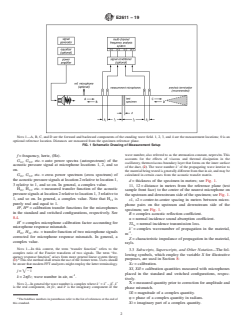
NOTE 1—A, B, C, and D are the forward and backward components of the standing wave field. 1, 2, 3, and 4 are the measurement locations; 0 is an
optional reference location. Distances are measured from the specimen reference plane.
FIG. 1 Schematic Drawing of Measurement Setup
wave number, also referred to as the attenuation constant, nepers/m. This
f = frequency, hertz, (Hz).
accounts for the effects of viscous and thermal dissipation in the
G , G , etc. = auto power spectra (autospectrum) of the
11 22
oscillatory, thermoviscous boundary layer that forms on the inner surface
acoustic pressure signal at microphone locations 1, 2, and so
of the duct, (2). The wave number k’ of the propagating wave interior to
on.
the material being tested is generally different from that in air, and may be
G , G , etc. = cross power spectrum (cross spectrum) of calculated in certain cases from the acoustic transfer matrix.
21 32
the acoustic pressure signals at location 2 relative to location 1,
d = thickness of the specimen in meters; see Fig. 1.
3 relative to 1, and so on. In general, a complex value.
11, 12 = distance in meters from the reference plane (test
¯ ¯
H ,H , etc. = measured transfer function of the acoustic
21 31
sample front face) to the center of the nearest microphone on
pressure signals at location 2 relative to location 1, 3 relative to
the upstream and downstream side of the specimen; see Fig. 1.
1, and so on. In general, a complex value. Note that H is
s1, s2 = center-to-center spacing in meters between micro-
purely real and equal to 1.
phone pairs on the upstream and downstream side of the
I II
H , H = calibration transfer functions for the microphones
specimen; see Fig. 1.
in the standard and switched configurations, respectively. See
R = complex acoustic reflection coefficient.
8.4.
α = normal incidence sound absorption coefficient.
c
H = complex microphone calibration factor accounting for
TL = normal incidence transmission loss.
n
microphone response mismatch.
k’ = complex wavenumber of propagation in the material,
H , H , etc. = transfer function of two microphone signals -1
21 31
m .
corrected for microphone response mismatch. In general, a
Z = characteristic impedance of propagation in the material,
complex value.
rayls.
NOTE 1—In this context, the term “transfer function” refers to the
3.3 Subscripts, Superscripts, and Other Notation—The fol-
complex ratio of the Fourier transform of two signals. The term “fre-
lowing symbols, which employ the variable X for illustrative
quency response function” arises from more general linear system theory
purposes, are used in Section 8:
(1). This test method shall retain the use of the former term. Users should
Xc = calibration.
be aware that modern FFT analyzers might employ the latter terminology.
XI, XII = calibration quantities measured with microphones
j = =21
placed in the standard and switched configurations, respec-
-1
k=2πf/c; wave number in air, m .
tively.
r i r
¯
NOTE 2—In general the wave number is complex wherek’=k –jk. k X = measured quantity prior to correction for amplitude and
i
is the real component, 2π f/c, and k is the imaginary component of the
phase mismatch.
|X| = magnitude of a complex quantity.
4 φ = phase of a complex quantity in radians.
The boldface numbers in parentheses refer to the list of references at the end of
this standard. Xi = imaginary part of a complex quantity.
E2611 − 19
Xr = real part of a complex quantity. placed within a small acoustical cavity close to a sound source,
for example, a closely-fitted machine enclosure or portable
3.4 Summary of Complex Arithmetic—The quantities in this
electronic device.
standard, especially the transfer function spectra, are complex-
5.3 Transmission loss is not only a property of a material,
valued in general. The following may be useful in evaluating
but is also strongly dependent on boundary conditions inherent
the defining equations:
in the method and details of the way the material is mounted.
jω
e 5 cos ω 1jsin ω
~ ! ~ !
This must be considered in the interpretation of the results
A1jB 3 C1jD 5 AC1BD 1j AD1BD
~ ! ~ ! ~ ! ~ !
obtained by this test method.
2 2 2 2
1/~A1jB! 5 A/~A 1B ! 2 jB/~A 1B !
5.4 The quantities are measured as a function of frequency
with a resolution determined by the sampling rate, transform
4. Summary of Test Method
size, and other parameters of a digital frequency analysis
system.Theusablefrequencyrangedependsonthediameterof
4.1 This test method is similar toTest Method E1050 in that
the tube and the spacing between the microphone positions.An
it also uses a tube with a sound source connected to one end
extended frequency range may be obtained by using tubes with
and the test sample mounted in the tube. For transmission loss,
various diameters and microphone spacings.
four microphones, at two locations on each side of the sample,
aremountedsothediaphragmsareflushwiththeinsidesurface
5.5 The application of materials into acoustical system
of the tube perimeter. Plane waves are generated in the tube
elements will probably not be similar to this test method and
using a broadband signal from a noise source. The resulting
therefore results obtained by this method may not correlate
standing wave pattern is decomposed into forward- and
with performance in-situ.
backward-traveling components by measuring sound pressure
simultaneously at the four locations and examining their
6. Apparatus
relative amplitude and phase. The acoustic transfer matrix is
6.1 The apparatus is a set of two tubes of equal internal area
calculated from the pressure and particle velocity, or equiva-
that can be connected to either end of a test sample holder.The
lently the acoustic impedance, of the traveling waves on either
number of sets of tubes depends on the frequency range to be
side of the specimen. The transmission loss, as well as several
tested.Awider frequency range may require multiple measure-
other important acoustic properties of the material, including
ments on a set of several tubes. At one end of one tube is a
the normal incidence sound absorption coefficient, is extracted
loudspeaker sound source. Microphone ports are mounted at
from the transfer matrix.
two locations along the wall of each tube. A two- or four-
channel digital frequency analysis system, or a computer that
5. Significance and Use
can effectively do the same calculations, is used for data
acquisition and processing.
5.1 There are several purposes of this test:
5.1.1 For transmission loss: (a) to characterize the sound
6.2 Tube:
insulation characteristics of materials in a less expensive and
6.2.1 Construction—The interior section of the tube may be
less time consuming approach than Test Method E90 and ISO
circularorrectangularandshallhaveaconstantcross-sectional
140-3 (“reverberant room methods”), (b) to allow small
dimension from end-to-end. The tube shall be straight and its
samples tested when larger samples are impossible to construct
inside surface shall be smooth, nonporous, and free of dust, in
or to transport, (c) to allow a rapid technique that does not
order to maintain low sound attenuation.The tube construction
require an experienced professional to run.
shall be sufficiently massive so sound transmission through the
5.1.2 For transfer matrix: (a) to determine additional acous-
tube wall is negligible compared with transmission though the
tic properties of the material; (b) to allow calculation of sample. See Note 3. Compliant feet or mounts must be used to
acoustic properties of built-up or composite materials by the
attenuate extraneous vibration entering the tube structure from
combination of their individual transfer matrices. the work surface.
5.2 There are significant differences between this method NOTE 3—The tube can be constructed from materials including metal,
plastic, concrete, or wood. It may be necessary to seal the interior walls
and that of the more traditional reverberant room method.
withasmoothcoatinginordertomaintainlowsoundattenuationforplane
Specifically, in this approach the sound impinges on the
waves.
specimen in a perpendicular direction (“normal incidence”)
6.2.2 Working Frequency Range—The working frequency
only,comparedtotherandomincidenceoftraditionalmethods.
range is:
Additionally, revereration room methods specify certain mini-
mumsizesfortestspecimenswhichmaynotbepracticalforall
f ,f,f (1)
l u
materials. At present the correlation, if any, between the two
where:
methods is not known. Even though this method may not
f = operating frequency, Hz,
replicate the reverberant room methods for measuring the
f = lower working frequency of the tube, Hz, and
l
transmission loss of materials, it can provide comparison data
f = upper working frequency of the tube, Hz.
u
for small specimens, something that cannot be done in the
reverberant room method. Normal incidence transmission loss
6.2.3 The lower frequency limit f is determined by the
l
may also be useful in certain situations where the material is spacing of the microphones and the accuracy of the analysis
E2611 − 19
system. The microphone spacing shall be greater than one 6.2.9 Tube Venting—Some tube designs cause large tempo-
percent of the wavelength corresponding to the lower fre- rary pressure variations to be generated during installation or
quency of interest. removal of the test specimen. This may induce microphone
6.2.4 The upper frequency limit f depends on the diameter diaphragmdeflection.Byincludingapressurereliefopeningof
u
of the tube, the microphone spacing, and the speed of sound. some type, the potential for damage to a microphone dia-
6.2.4.1 Diameter—In order to maintain plane wave phragm due to excessive deflection may be reduced. One way
propagation, the upper frequency limit (3) is defined as to accomplish this is by drilling a small vent, 1 to 2 mm in
follows: diameter, through the wall of the tube. It is recommended to
locate the tube vent near the sound source, away from
Kc Kc
f , or d, (2)
microphone locations, and to seal the vent during acoustic
u
d f
u
measurements.
where:
6.3 Test Specimen Holder:
f = upper frequency limit, Hz,
u
6.3.1 General Features—The specimen holder may either
c = speed of sound in the tube, m/s,
be integrated with the tube or may be a separate, detachable
d = diameter of the tube, m, and
extension of the tube.
K = 0.586.
6.3.2 Detachable Holder—As a detachable unit, the holder
6.2.5 For rectangular tubes, d is defined as the largest
must make an airtight fit with the end of the tube opposite the
section dimension of the tube and K is defined as 0.500.
sound source. The holder must conform to the interior shape
Extreme aspect ratios greater than 2:1 or less than 1:2 should
and dimensions of the main part of the tube. The connecting
be avoided. A square cross-section is recommended.
joint must be finished carefully and the use of a sealant, such
6.2.6 Conduct the plane wave measurements within these
as petroleum jelly or silicone grease, is recommended.
frequency limits established by Eq 1 in order to avoid
6.3.3 Integral Holder—If the sample holder is in an integral
cross-modes that occur at higher frequencies, when the acous-
part of the tube, it is recommended to make the installation
tical wave length approaches the sectional dimension of the
section of the tube accessible for mounting of the specimen by
tube.
a removable cover. The mating surfaces must be finished
6.2.7 Length—The tube should be sufficiently long for plane
carefully, and the use of a sealant is recommended.
waves to be fully developed before reaching the microphones
6.3.4 Circular Holder—For circular tubes, it is recom-
and test specimen.Aminimum of three tube diameters must be
mended to make the specimen accessible from both the front
allowed between sound source and the nearest microphone.
and back of the sample holder. It is then possible to check the
The sound source may generate non-plane waves along with
position and flatness of the front and back surface of the
desired plane waves.The non-plane waves usually will subside
specimen. Holders may be constructed from a rigid, clear
at a distance equivalent to three tube diameters from the
material, such as acrylic, to facilitate inspection.
source. If measurements are conducted over a wide frequency
6.3.5 Rectangular Holder—With rectangular tubes, it is
range, it may be desirable to use a tube, which provides
recommended to install the specimen from the side, making it
multiple microphone spacing, or to employ separate tubes.The
possible to check the fitting and the position of the specimen in
overall tube length also must be chosen to satisfy the require-
the tube and to check the position and flatness of the front
ments of 6.5.3 and 6.5.5.
surface.
6.2.8 Tube Termination—The termination of the tube is
6.4 Sound Source:
arbitrary in principle, but experience has found that the most
6.4.1 Kind and Placement—Thesoundsourceshouldhavea
usefulterminationisatleastweaklyanechoic,causingminimal
reflection of the sound wave back down the tube.Aconvenient uniformpowerresponseoverthefrequencyrangeofinterest.It
may either be coaxial with the main tube or joined to the main
way of providing this is to install a wedge or pyramidal shaped
section of some sound absorbing material such as glass fiber, tube by means of a transition having a straight, tapered, or
exponential section (Fig. 2).
about 30 cm long, in the open end of the tube.As the two-load
method requires a second measurement with a different tube 6.4.2 Isolation—The sound source and transition shall be
termimation, the wedge should be easily removable so that an sealed and isolated from the tube to minimize structure-borne
open or closed termination may be provided. sound excitation of the tube. If a direct radiator loudspeaker is
FIG. 2 Sound Source Configuration
E2611 − 19
utilized, it shall be contained in a sound-isolating enclosure in the protection grid should be sealed with silicone grease to
order to avoid airborne flanking transmission to the micro- prevent leakage between the tube interior and the back vent
phones (Fig. 2). (Fig. 3).
6.4.3 Termination—Resonances of the air column in the
6.5.2.2 Side-Vented Microphones—The side-venting path
tube may arise if the mechanical impedance of the loudspeaker
proceeds from the vent opening, which is located between the
membrane or diaphragm is high. In this case, it is recom-
protection grid threads and the diaphragm, to the front of the
mended to apply a porous absorber coating or lining inside
microphone, and therefore vent to the inside of the tube.
either the tube near the loudspeaker or inside the sound
Sealing may be established either against the rear of micro-
transition. Alternatively, the locations described above may be
phone cartridge barrel or against the protection grid. If the seal
lightly filled with a low density absorbing material.
is established against the latter, the threads of the protection
6.4.4 Equalization—When an absorptive medium is placed
should be sealed with silicone grease to prevent leakage (Fig.
near the sound source as described in 6.4.3, significant sound
3).
energy will be lost at higher frequencies. An electronic
6.5.2.3 Non-Vented Microphones—Microphones with non-
equalizer may then be required to shape the sound spectra
vented diaphragms may be used if appropriate.
measured at the microphone positions so that they are rela-
6.5.3 Spacing—A large spacing between microphones en-
tively flat. This will minimize the loss of signal-to-noise
hances the accuracy of the measurements, however, the micro-
capability at high frequencies.
phonespacingmustbelessthantheshortesthalfwavelengthof
6.5 Microphones:
interest (5).
6.5.1 Type, Diameter—Nominally identical microphones
c
shall be mounted according to 6.5.6. The microphone diameter s,, (3)
2f
u
must be small in comparison with the spacing between
where:
microphone ports and also to minimize spatial averaging at
higher frequencies across the diaphragm face. It is recom- s = microphone spacing, m,
mended that the microphone diameter be less than 20 % of the c = speed of sound, m/s, and
f = upper frequency limit, Hz.
wavelength of the highest frequency of interest. Table 1
u
provides maximum recommended frequency limits for several
6.5.4 The maximum microphone spacing s must be no
typical microphone sizes used at room temperature. Where
larger than 80 % of c/2f .
u
greater microphone sensitivity is required (e.g., on the trans-
6.5.5 Location—The minimum distance between the sound
mitted side of high loss samples), larger diameters may be
source and the closest microphone must follow the require-
selected for use with large tubes working at low frequencies.
ments of 6.2.7. The minimum distance between the specimen
6.5.2 Microphone Venting—Some microphones may be de-
and the closest microphone depends somewhat on the surface
signed with a vent to allow for static pressure equalization on
characteristics of the specimen. In order to maintain the
either side of the diaphragm. In general, venting may be
greatest signal-to-noise ratio, the minimum spacing between
accomplished either to the inside or to the outside of the tube.
Two alternate venting methods are available: back-vented the specimen and microphone can be modified as follows.
(preferred) and side-vented.Amicrophone pair of either design
6.5.5.1 Flat Surface—The closest microphone can be
may be used. Microphones must be sealed carefully when
moved to within one-half of the tube diameter, or one-half of
installed in the normal sound transmission tube to avoid leaks,
the largest section dimension in the case of a rectangular tube.
which may interfere with proper operation of the microphone
6.5.5.2 Nonhomogenous Surface—The closest microphone
vent, thus causing significant changes to the low frequency
should be at least one tube diameter, or the largest section
response. Blockage of a vent of an individual microphone will
dimension in the case of rectangular tube, to help suppress the
alter its phase response, resulting in large errors in the
influence of higher-order modes induced by the rough surface
measurements.
of the specimen.
6.5.2.1 Back-Vented Microphones—Back-vented micro-
6.5.5.3 Asymmetrical Surface—The closest microphone
phones are vented out through the back of the preamplifier
should be at least two tube diameters (two times the largest
barrel to the outside of the tube. Very low frequency accuracy
section dimension in the case of a rectangular tube) to facilitate
is improved when the static pressure equalization vent is
the dissipation of higher order modes generated from a rough
isolated from the sound field within the sound transmission
surface. The higher order modes will decay exponentially as
tube (4). Sealing may be accomplished either against the rear
they propagate along the tube.
of the microphone cartridge barrel or against the protection
6.5.6 Mounting—Both microphone diaphragms must be
grid. If the seal is established against the latter, the threads of
flush with the interior surface of the tube using port openings
through the side of the tube. If the microphones are switched,
TABLE 1 Recommended Frequency Limits for Microphones
care must be taken when the microphones are removed from
Nominal Diameter Diaphragm Diameter Maximum Frequency their port so that the original mounting geometry is maintained
(in.) (mm) (Hz)
when they are replaced. A small stop may be employed to
1 22.70 3000
control the depth of each microphone in the port as shown in
⁄2 12.20 5600
Fig. 4. The lip should be kept small and identical for both
⁄4 5.95 11500
microphone ports.
E2611 − 19
FIG. 3 Microphone Venting and Sealing
FIG. 4 Typical Microphone Mounting and Alternate Mounting
6.5.6.1 Alternate Mounting—In order to avoid the small 6.6.2 Signal-to-Noise Ratio—The sound source shall gener-
recesscausedbymountingthemicrophonesaccordingto6.5.6, ate sufficient signal at all microphone locations so that the
an alternative pinch block mounting technique may used as measured signal in each test frequency band is at least 10 dB
shown in Fig. 4. This method has the advantage of positioning greater than the background noise.
the microphone diaphragm flush with the inside of the normal
6.7 Test Measuring Equipment:
sound transmission tube (the protection grid will protrude
6.7.1 Measuring Apparatus—The signal processing equip-
slightly) and the pinch block provides lateral support for the
ment shall consist of one, two, or preferably four similar
microphone within the port.The pinch block must not interfere
microphones, a similar number of analog signal conditioners
with venting provided by the microphone preamplifier.
(optional) and a multi-channel Fast Fourier Transform (FFT)
6.5.6.2 Microphone Acoustic Center—In order to help con-
analyzer, or equivalent. The signal from each microphone
trol measurement uncertainties in this test method, the lateral
system is connected to an individual channel of the analyzer.
separation between the microphone axes needs to be precisely
See Figs. 5 and 6.
known. Unfortunately, the acoustical separation between mi-
6.7.2 Computing Device—A computer or other digital
crophones axes may be slightly different from their physical
processsor, either separate from or part of the digital frequency
separation. This uncertainty becomes more pronounced as the
analysis system, is necessary in order to calculate TL and
n
ratio between microphone diameter and separation distance
other material properties. A complete set of mathematical
increases.Sincethereisnoprocedureavailablefordetermining
expressions is given in 8.5.4.
the acoustical separation, it is recommended that the physical
6.7.3 Temperature Sensor—Athermometer or other ambient
separation be controlled throughout the test series. If the
temperature sensing device shall be installed so the air tem-
microphones are switched to reduce phase mismatch errors, as
perature is known to within 61°C.
discussed in 8.4.5, the physical separation should be main-
6.7.4 Barometric Pressure Indicator—A barometer or other
tained carefully with the aid of a jig, such as a rotating circular
equivalent indicating device shall be located in the vicinity of
plate mounted in the sidewall of the tube. It is recommended
the sound transmission tube.The atmospheric pressure shall be
the individual microphones be identified positively to monitor
measured with a tolerance 60.5 kPa.
their relative positions during switching.
6.7.5 Relative Humidity Indicator—A device capable of
6.6 Test Signal:
determining the relative humidity of the air shall be located in
6.6.1 Signal Characteristic—It is recommended that the test
the vicinity of the sound transmission tube. The relative
signal be random noise having a uniform spectral density
humidity shall be measured to within a tolerance of 5 %.
acrossthefrequencyrangeofinterest.Thespectrallinespacing
of the test signal should be compatible with the analysis
7. Test Specimen
bandwidth. Alternative test signals may also be used if they
7.1 Mounting—Each specimen must have the same shape
have an equivalent spectral density. These alternative signals
andareaasthetubecross-sectionThemountingconditionswill
include pseudo-random noise and swept or stepped sine
strongly affect the measured transmission loss. The specimen
generation.
may be rigidly mounted or clamped to the wall of the tube,
NOTE 4—A signal generator capable of producing a compatible test
freely suspended with a dense flexible seal, or some other
signal often is incorporated within a digital frequency analysis system.
method of mounting. Care must be taken to mount multiple
When employing alternative signals, it is recommended that each time
samples in a consistant manner, and to report details of the
block used in the frequency analysis be synchronized with individual
repetitions of the test signal pattern. mounting method sufficient to reproduce the mount. Any
E2611 − 19
NOTE 1—I: direct transfer function; II: switched transfer function.
FIG. 5 Apparatus and Instrumentation for Microphone Calibration in the Longitudinal Direction
FIG. 6 Apparatus and Instrumentation for Microphone Calibration in the Same Transverse Plane
flexible mounting material must be previously shown to have a petroleum jelly, modeling clay, or putty. It is desirable to have
TL greater than the specimen material.Asmall opening around the specimen possess a relatively flat surface for reasons stated
the edge will have a dramatic impact on the transmission loss
in 6.5.5.
calculations.Anyperipheralcracksorgapsmustbesealedwith
E2611 − 19
7.2 Alignment—The front surface of test specimens shall be of the microphone locations relative to the reference plane, and
mounted normal to the tube axis unless the surface specifically the thickness of the specimen. These parameters are illustrated
is designed otherwise. in Fig. 1.
8.2 Speed of Sound—Thespeedofsoundinairchangeswith
7.3 Containment—With porous materials of low bulk
density, it may be helpful to define the front surface by a thin temperature. The value of the speed of sound shall be com-
puted from the measured temperature according to:
wire grid with wide mesh if it is representative of the
a
...
This document is not an ASTM standard and is intended only to provide the user of an ASTM standard an indication of what changes have been made to the previous version. Because
it may not be technically possible to adequately depict all changes accurately, ASTM recommends that users consult prior editions as appropriate. In all cases only the current version
of the standard as published by ASTM is to be considered the official document.
Designation: E2611 − 17 E2611 − 19
Standard Test Method for
Normal Incidence Determination of Porous Material
Acoustical Properties Based on the Transfer Matrix Method
This standard is issued under the fixed designation E2611; the number immediately following the designation indicates the year of
original adoption or, in the case of revision, the year of last revision. A number in parentheses indicates the year of last reapproval. A
superscript epsilon (´) indicates an editorial change since the last revision or reapproval.
1. Scope
1.1 This test method covers the use of a tube, four microphones, and a digital frequency analysis system for the measurement
of normal incident transmission loss and other important acoustic properties of materials by determination of the acoustic transfer
matrix.
1.2 The values stated in SI units are to be regarded as standard. No other units of measurement are included in this standard.
1.3 This standard does not purport to address all of the safety concerns, if any, associated with its use. It is the responsibility
of the user of this standard to establish appropriate safety safety, health, and healthenvironmental practices and determine the
applicability of regulatory limitations prior to use.
1.4 This international standard was developed in accordance with internationally recognized principles on standardization
established in the Decision on Principles for the Development of International Standards, Guides and Recommendations issued
by the World Trade Organization Technical Barriers to Trade (TBT) Committee.
2. Referenced Documents
2.1 ASTM Standards:
C634 Terminology Relating to Building and Environmental Acoustics
E90 Test Method for Laboratory Measurement of Airborne Sound Transmission Loss of Building Partitions and Elements
E1050 Test Method for Impedance and Absorption of Acoustical Materials Using a Tube, Two Microphones and a Digital
Frequency Analysis System
2.2 ISO Standards:
ISO 140-3 Acoustics—Measurement of Sound Insulation in Buildings and of Building Elements—Part 3: Laboratory
Measurement of Airborne Sound Insulation of Building Elements
3. Terminology
3.1 Definitions—The acoustical terminology used in this test method is intended to be consistent with the definitions in
Terminology C634.
3.1.1 reference plane—an arbitrary section, perpendicular to the longitudinal axis of the tube that is used for the origin of linear
dimensions. Often it is the upstream (closest to the sound source) face of the specimen but, when specimen surfaces are irregular,
it may be any convenient plane near the specimen.
3.1.2 sound transmission coeffıcient, τ—(dimensionless) of a material in a specified frequency band, the fraction of airborne
sound power incident on a material that is transmitted by the material and radiated on the other side.
W
t
τ5
W
i
where:
W and W = the transmitted and incident sound power.
t i
This test method is under the jurisdiction of ASTM Committee E33 on Building and Environmental Acoustics and is the direct responsibility of Subcommittee E33.01
on Sound Absorption.
Current edition approved April 1, 2017Oct. 1, 2019. Published July 2017October 2019. Originally approved in 2009. Last previous edition approved in 20092017 as
E2611 – 09.E2611 – 17. DOI: 10.1520/E2611-17.10.1520/E2611-19.
For referenced ASTM standards, visit the ASTM website, www.astm.org, or contact ASTM Customer Service at service@astm.org. For Annual Book of ASTM Standards
volume information, refer to the standard’s Document Summary page on the ASTM website.
Available from American National Standards Institute (ANSI), 25 W. 43rd St., 4th Floor, New York, NY 10036, http://www.ansi.org.
Copyright © ASTM International, 100 Barr Harbor Drive, PO Box C700, West Conshohocken, PA 19428-2959. United States
E2611 − 19
3.1.3 normal incidence sound transmission loss, TL—TLN—of a material in a specified frequency band, ten times the common
logarithm of the reciprocal of the normal incidence sound transmission coefficient. The quantity so obtained is expressed in
decibels.
W 1
i
TL 5 10 log 5 10 log
S D S D
10 10
W τ
t
W 1
i
TLN 5 10 log 5 10 log
S D S D
10 10
W τ
t
3.1.3.1 Discussion—
In this standard the symbol TLTLN will be applied to sound which impinges at an angle normal to the test specimen, as opposed
n
to an arbitrary or random angle of incidence.
3.2 Symbols:
c = speed of sound, m/s.
ρ = density of air, kg/m .
f = frequency, hertz, (Hz).
G , G , etc. = auto power spectra (autospectrum) of the acoustic pressure signal at microphone locations 1, 2, and so on.
11 22
G , G , etc. = cross power spectrum (cross spectrum) of the acoustic pressure signals at location 2 relative to location 1, 3
21 32
relative to 1, and so on. In general, a complex value.
H¯ , H¯ , etc. = measured transfer function of the acoustic pressure signals at location 2 relative to location 1, 3 relative to 1,
21 31
and so on. In general, a complex value. Note that H is purely real and equal to 1.
I II
H ,H = calibration transfer functions for the microphones in the standard and switched configurations, respectively. See 8.4.
c
H = complex microphone calibration factor accounting for microphone response mismatch.
H , H , etc. = transfer function of two microphone signals corrected for microphone response mismatch. In general, a complex
21 31
value.
NOTE 1—In this context, the term “transfer function” refers to the complex ratio of the Fourier transform of two signals. The term “frequency response
function” arises from more general linear system theory (1). This test method shall retain the use of the former term. Users should be aware that modern
FFT analyzers might employ the latter terminology.
NOTE 1—A, B, C, and D are the forward and backward components of the standing wave field. 1, 2, 3, and 4 are the measurement locations; 0 is an
optional reference location. Distances are measured from the specimen reference plane.
FIG. 1 Schematic Drawing of Measurement Setup
The boldface numbers in parentheses refer to the list of references at the end of this standard.
E2611 − 19
j = =21
-1
k = 2πf/c; wave number in air, m .
r i r i
NOTE 2—In general the wave number is complex where k’ = k – jk .k is the real component, 2π f/c, and k is the imaginary component of the wave
number, also referred to as the attenuation constant, nepers/m. This accounts for the effects of viscous and thermal dissipation in the oscillatory,
thermoviscous boundary layer that forms on the inner surface of the duct, (2). The wave number k’ of the propagating wave interior to the material being
tested is generally different from that in air, and may be calculated in certain cases from the acoustic transfer matrix.
d = thickness of the specimen in meters; see Fig. 1.
11, 12 = distance in meters from the reference plane (test sample front face) to the center of the nearest microphone on the
upstream and downstream side of the specimen; see Fig. 1.
s1, s2 = center-to-center spacing in meters between microphone pairs on the upstream and downstream side of the specimen; see
Fig. 1.
R = complex acoustic reflection coefficient.
α = normal incidence sound absorption coefficient.
TL = normal incidence transmission loss.
n
-1
k’ = complex wavenumber of propagation in the material, m .
Z = characteristic impedance of propagation in the material, rayls.
3.3 Subscripts, Superscripts, and Other Notation—The following symbols, which employ the variable X for illustrative
purposes, are used in Section 8:
Xc = calibration.
XI,XII = calibration quantities measured with microphones placed in the standard and switched configurations, respectively.
X¯ = measured quantity prior to correction for amplitude and phase mismatch.
|X| = magnitude of a complex quantity.
φ = phase of a complex quantity in radians.
Xi = imaginary part of a complex quantity.
Xr = real part of a complex quantity.
3.4 Summary of Complex Arithmetic—The quantities in this standard, especially the transfer function spectra, are complex-
valued in general. The following may be useful in evaluating the defining equations:
jω
e 5 cos ω 1jsin ω
~ ! ~ !
A1jB 3 C1jD 5 AC1BD 1j AD1BD
~ ! ~ ! ~ ! ~ !
2 2 2 2
1/~A1jB! 5 A/~A 1B !2 jB/~A 1B !
4. Summary of Test Method
4.1 This test method is similar to Test Method E1050 in that it also uses a tube with a sound source connected to one end and
the test sample mounted in the tube. For transmission loss, four microphones, at two locations on each side of the sample, are
mounted so the diaphragms are flush with the inside surface of the tube perimeter. Plane waves are generated in the tube using
a broadband signal from a noise source. The resulting standing wave pattern is decomposed into forward- and backward-traveling
components by measuring sound pressure simultaneously at the four locations and examining their relative amplitude and phase.
The acoustic transfer matrix is calculated from the pressure and particle velocity, or equivalently the acoustic impedance, of the
traveling waves on either side of the specimen. The transmission loss, as well as several other important acoustic properties of the
material, including the normal incidence sound absorption coefficient, is extracted from the transfer matrix.
5. Significance and Use
5.1 There are several purposes of this test:
5.1.1 For transmission loss: (a) to characterize the sound insulation characteristics of materials in a less expensive and less time
consuming approach than Test Method E90 and ISO 140-3 (“reverberant room methods”), (b) to allow small samples tested when
larger samples are impossible to construct or to transport, (c) to allow a rapid technique that does not require an experienced
professional to run.
5.1.2 For transfer matrix: (a) to determine additional acoustic properties of the material; (b) to allow calculation of acoustic
properties of built-up or composite materials by the combination of their individual transfer matrices.
5.2 There are significant differences between this method and that of the more traditional reverberant room method. Specifically,
in this approach the sound impinges on the specimen in a perpendicular direction (“normal incidence”) only, compared to the
random incidence of traditional methods. Additionally, revereration room methods specify certain minimum sizes for test
specimens which may not be practical for all materials. At present the correlation, if any, between the two methods is not known.
Even though this method may not replicate the reverberant room methods for measuring the transmission loss of materials, it can
provide comparison data for small specimens, something that cannot be done in the reverberant room method. Normal incidence
E2611 − 19
transmission loss may also be useful in certain situations where the material is placed within a small acoustical cavity close to a
sound source, for example, a closely-fitted machine enclosure or portable electronic device.
5.3 Transmission loss is not only a property of a material, but is also strongly dependent on boundary conditions inherent in
the method and details of the way the material is mounted. This must be considered in the interpretation of the results obtained
by this test method.
5.4 The quantities are measured as a function of frequency with a resolution determined by the sampling rate, transform size,
and other parameters of a digital frequency analysis system. The usable frequency range depends on the diameter of the tube and
the spacing between the microphone positions. An extended frequency range may be obtained by using tubes with various
diameters and microphone spacings.
5.5 The application of materials into acoustical system elements will probably not be similar to this test method and therefore
results obtained by this method may not correlate with performance in-situ.
6. Apparatus
6.1 The apparatus is a set of two tubes of equal internal area that can be connected to either end of a test sample holder. The
number of sets of tubes depends on the frequency range to be tested. A wider frequency range may require multiple measurements
on a set of several tubes. At one end of one tube is a loudspeaker sound source. Microphone ports are mounted at two locations
along the wall of each tube. A two- or four-channel digital frequency analysis system, or a computer that can effectively do the
same calculations, is used for data acquisition and processing.
6.2 Tube:
6.2.1 Construction—The interior section of the tube may be circular or rectangular and shall have a constant cross-sectional
dimension from end-to-end. The tube shall be straight and its inside surface shall be smooth, nonporous, and free of dust, in order
to maintain low sound attenuation. The tube construction shall be sufficiently massive so sound transmission through the tube wall
is negligible compared with transmission though the sample. See Note 3. Compliant feet or mounts must be used to attenuate
extraneous vibration entering the tube structure from the work surface.
NOTE 3—The tube can be constructed from materials including metal, plastic, concrete, or wood. It may be necessary to seal the interior walls with
a smooth coating in order to maintain low sound attenuation for plane waves.
6.2.2 Working Frequency Range—The working frequency range is:
f ,f,f (1)
l u
where:
f = operating frequency, Hz,
f = lower working frequency of the tube, Hz, and
l
f = upper working frequency of the tube, Hz.
u
6.2.3 The lower frequency limit f is determined by the spacing of the microphones and the accuracy of the analysis system. The
l
microphone spacing shall be greater than one percent of the wavelength corresponding to the lower frequency of interest.
6.2.4 The upper frequency limit f depends on the diameter of the tube, the microphone spacing, and the speed of sound.
u
6.2.4.1 Diameter—In order to maintain plane wave propagation, the upper frequency limit (3) is defined as follows:
Kc Kc
f , or d, (2)
u
d f
u
where:
f = upper frequency limit, Hz,
u
c = speed of sound in the tube, m/s,
d = diameter of the tube, m, and
K = 0.586.
6.2.5 For rectangular tubes, d is defined as the largest section dimension of the tube and K is defined as 0.500. Extreme aspect
ratios greater than 2:1 or less than 1:2 should be avoided. A square cross-section is recommended.
6.2.6 Conduct the plane wave measurements within these frequency limits established by Eq 1 in order to avoid cross-modes
that occur at higher frequencies, when the acoustical wave length approaches the sectional dimension of the tube.
6.2.7 Length—The tube should be sufficiently long for plane waves to be fully developed before reaching the microphones and
test specimen. A minimum of three tube diameters must be allowed between sound source and the nearest microphone. The sound
source may generate non-plane waves along with desired plane waves. The non-plane waves usually will subside at a distance
equivalent to three tube diameters from the source. If measurements are conducted over a wide frequency range, it may be desirable
to use a tube, which provides multiple microphone spacing, or to employ separate tubes. The overall tube length also must be
chosen to satisfy the requirements of 6.5.3 and 6.5.5.
E2611 − 19
6.2.8 Tube Termination—The termination of the tube is arbitrary in principle, but experience has found that the most useful
termination is at least weakly anechoic, causing minimal reflection of the sound wave back down the tube. A convenient way of
providing this is to install a wedge or pyramidal shaped section of some sound absorbing material such as glass fiber, about 30
cm long, in the open end of the tube. As the two-load method requires a second measurement with a different tube termimation,
the wedge should be easily removable so that an open or closed termination may be provided.
6.2.9 Tube Venting—Some tube designs cause large temporary pressure variations to be generated during installation or removal
of the test specimen. This may induce microphone diaphragm deflection. By including a pressure relief opening of some type, the
potential for damage to a microphone diaphragm due to excessive deflection may be reduced. One way to accomplish this is by
drilling a small vent, 1 to 2 mm in diameter, through the wall of the tube. It is recommended to locate the tube vent near the sound
source, away from microphone locations, and to seal the vent during acoustic measurements.
6.3 Test Specimen Holder:
6.3.1 General Features—The specimen holder may either be integrated with the tube or may be a separate, detachable extension
of the tube.
6.3.2 Detachable Holder—As a detachable unit, the holder must make an airtight fit with the end of the tube opposite the sound
source. The holder must conform to the interior shape and dimensions of the main part of the tube. The connecting joint must be
finished carefully and the use of a sealant, such as petroleum jelly or silicone grease, is recommended.
6.3.3 Integral Holder—If the sample holder is in an integral part of the tube, it is recommended to make the installation section
of the tube accessible for mounting of the specimen by a removable cover. The mating surfaces must be finished carefully, and
the use of a sealant is recommended.
6.3.4 Circular Holder—For circular tubes, it is recommended to make the specimen accessible from both the front and back of
the sample holder. It is then possible to check the position and flatness of the front and back surface of the specimen. Holders may
be constructed from a rigid, clear material, such as acrylic, to facilitate inspection.
6.3.5 Rectangular Holder—With rectangular tubes, it is recommended to install the specimen from the side, making it possible
to check the fitting and the position of the specimen in the tube and to check the position and flatness of the front surface.
6.4 Sound Source:
6.4.1 Kind and Placement—The sound source should have a uniform power response over the frequency range of interest. It
may either be coaxial with the main tube or joined to the main tube by means of a transition having a straight, tapered, or
exponential section (Fig. 2).
6.4.2 Isolation—The sound source and transition shall be sealed and isolated from the tube to minimize structure-borne sound
excitation of the tube. If a direct radiator loudspeaker is utilized, it shall be contained in a sound-isolating enclosure in order to
avoid airborne flanking transmission to the microphones (Fig. 2).
6.4.3 Termination—Resonances of the air column in the tube may arise if the mechanical impedance of the loudspeaker
membrane or diaphragm is high. In this case, it is recommended to apply a porous absorber coating or lining inside either the tube
near the loudspeaker or inside the sound transition. Alternatively, the locations described above may be lightly filled with a low
density absorbing material.
6.4.4 Equalization—When an absorptive medium is placed near the sound source as described in 6.4.3, significant sound energy
will be lost at higher frequencies. An electronic equalizer may then be required to shape the sound spectra measured at the
microphone positions so that they are relatively flat. This will minimize the loss of signal-to-noise capability at high frequencies.
6.5 Microphones:
6.5.1 Type, Diameter—Nominally identical microphones shall be mounted according to 6.5.6. The microphone diameter must
be small in comparison with the spacing between microphone ports and also to minimize spatial averaging at higher frequencies
across the diaphragm face. It is recommended that the microphone diameter be less than 20 % of the wavelength of the highest
frequency of interest. Table 1 provides maximum recommended frequency limits for several typical microphone sizes used at room
temperature. Where greater microphone sensitivity is required (e.g., on the transmitted side of high loss samples), larger diameters
may be selected for use with large tubes working at low frequencies.
6.5.2 Microphone Venting—Some microphones may be designed with a vent to allow for static pressure equalization on either
side of the diaphragm. In general, venting may be accomplished either to the inside or to the outside of the tube. Two alternate
FIG. 2 Sound Source Configuration
E2611 − 19
TABLE 1 Recommended Frequency Limits for Microphones
Nominal Diameter Diaphragm Diameter Maximum Frequency
(in.) (mm) (Hz)
1 22.70 3000
⁄2 12.20 5600
⁄4 5.95 11500
venting methods are available: back-vented (preferred) and side-vented. A microphone pair of either design may be used.
Microphones must be sealed carefully when installed in the normal sound transmission tube to avoid leaks, which may interfere
with proper operation of the microphone vent, thus causing significant changes to the low frequency response. Blockage of a vent
of an individual microphone will alter its phase response, resulting in large errors in the measurements.
6.5.2.1 Back-Vented Microphones—Back-vented microphones are vented out through the back of the preamplifier barrel to the
outside of the tube. Very low frequency accuracy is improved when the static pressure equalization vent is isolated from the sound
field within the sound transmission tube (4). Sealing may be accomplished either against the rear of the microphone cartridge barrel
or against the protection grid. If the seal is established against the latter, the threads of the protection grid should be sealed with
silicone grease to prevent leakage between the tube interior and the back vent (Fig. 3).
6.5.2.2 Side-Vented Microphones—The side-venting path proceeds from the vent opening, which is located between the
protection grid threads and the diaphragm, to the front of the microphone, and therefore vent to the inside of the tube. Sealing may
be established either against the rear of microphone cartridge barrel or against the protection grid. If the seal is established against
the latter, the threads of the protection should be sealed with silicone grease to prevent leakage (Fig. 3).
6.5.2.3 Non-Vented Microphones—Microphones with non-vented diaphragms may be used if appropriate.
6.5.3 Spacing—A large spacing between microphones enhances the accuracy of the measurements, however, the microphone
spacing must be less than the shortest half wavelength of interest (5).
c
s,, (3)
2f
u
where:
s = microphone spacing, m,
c = speed of sound, m/s, and
f = upper frequency limit, Hz.
u
6.5.4 The maximum microphone spacing s must be no larger than 80 % of c/2f .
u
6.5.5 Location—The minimum distance between the sound source and the closest microphone must follow the requirements of
6.2.7. The minimum distance between the specimen and the closest microphone depends somewhat on the surface characteristics
of the specimen. In order to maintain the greatest signal-to-noise ratio, the minimum spacing between the specimen and
microphone can be modified as follows.
6.5.5.1 Flat Surface—The closest microphone can be moved to within one-half of the tube diameter, or one-half of the largest
section dimension in the case of a rectangular tube.
6.5.5.2 Nonhomogenous Surface—The closest microphone should be at least one tube diameter, or the largest section dimension
in the case of rectangular tube, to help suppress the influence of higher-order modes induced by the rough surface of the specimen.
6.5.5.3 Asymmetrical Surface—The closest microphone should be at least two tube diameters (two times the largest section
dimension in the case of a rectangular tube) to facilitate the dissipation of higher order modes generated from a rough surface. The
higher order modes will decay exponentially as they propagate along the tube.
6.5.6 Mounting—Both microphone diaphragms must be flush with the interior surface of the tube using port openings through
the side of the tube. If the microphones are switched, care must be taken when the microphones are removed from their port so
that the original mounting geometry is maintained when they are replaced. A small stop may be employed to control the depth of
each microphone in the port as shown in Fig. 4. The lip should be kept small and identical for both microphone ports.
FIG. 3 Microphone Venting and Sealing
E2611 − 19
FIG. 4 Typical Microphone Mounting and Alternate Mounting
6.5.6.1 Alternate Mounting—In order to avoid the small recess caused by mounting the microphones according to 6.5.6, an
alternative pinch block mounting technique may used as shown in Fig. 4. This method has the advantage of positioning the
microphone diaphragm flush with the inside of the normal sound transmission tube (the protection grid will protrude slightly) and
the pinch block provides lateral support for the microphone within the port. The pinch block must not interfere with venting
provided by the microphone preamplifier.
6.5.6.2 Microphone Acoustic Center—In order to help control measurement uncertainties in this test method, the lateral
separation between the microphone axes needs to be precisely known. Unfortunately, the acoustical separation between
microphones axes may be slightly different from their physical separation. This uncertainty becomes more pronounced as the ratio
between microphone diameter and separation distance increases. Since there is no procedure available for determining the
acoustical separation, it is recommended that the physical separation be controlled throughout the test series. If the microphones
are switched to reduce phase mismatch errors, as discussed in 8.4.5, the physical separation should be maintained carefully with
the aid of a jig, such as a rotating circular plate mounted in the sidewall of the tube. It is recommended the individual microphones
be identified positively to monitor their relative positions during switching.
6.6 Test Signal:
6.6.1 Signal Characteristic—It is recommended that the test signal be random noise having a uniform spectral density across
the frequency range of interest. The spectral line spacing of the test signal should be compatible with the analysis bandwidth.
Alternative test signals may also be used if they have an equivalent spectral density. These alternative signals include
pseudo-random noise and swept or stepped sine generation.
NOTE 4—A signal generator capable of producing a compatible test signal often is incorporated within a digital frequency analysis system. When
employing alternative signals, it is recommended that each time block used in the frequency analysis be synchronized with individual repetitions of the
test signal pattern.
6.6.2 Signal-to-Noise Ratio—The sound source shall generate sufficient signal at all microphone locations so that the measured
signal in each test frequency band is at least 10 dB greater than the background noise.
6.7 Test Measuring Equipment:
6.7.1 Measuring Apparatus—The signal processing equipment shall consist of one, two, or preferably four similar microphones,
a similar number of analog signal conditioners (optional) and a multi-channel Fast Fourier Transform (FFT) analyzer, or
equivalent. The signal from each microphone system is connected to an individual channel of the analyzer. See Figs. 5 and 6.
6.7.2 Computing Device—A computer or other digital processsor, either separate from or part of the digital frequency analysis
system, is necessary in order to calculate TL and other material properties. A complete set of mathematical expressions is given
n
in 8.5.4.
6.7.3 Temperature Sensor—A thermometer or other ambient temperature sensing device shall be installed so the air temperature
is known to within 61°C.
6.7.4 Barometric Pressure Indicator—A barometer or other equivalent indicating device shall be located in the vicinity of the
sound transmission tube. The atmospheric pressure shall be measured with a tolerance 60.5 kPa.
6.7.5 Relative Humidity Indicator—A device capable of determining the relative humidity of the air shall be located in the
vicinity of the sound transmission tube. The relative humidity shall be measured to within a tolerance of 5 %.
7. Test Specimen
7.1 Mounting—Each specimen must have the same shape and area as the tube cross-section The mounting conditions will
strongly affect the measured transmission loss. The specimen may be rigidly mounted or clamped to the wall of the tube, freely
suspended with a dense flexible seal, or some other method of mounting. Care must be taken to mount multiple samples in a
consistant manner, and to report details of the mounting method sufficient to reproduce the mount. Any flexible mounting material
must be previously shown to have a TL greater than the specimen material. A small opening around the edge will have a dramatic
impact on the transmission loss calculations. Any peripheral cracks or gaps must be sealed with petroleum jelly, modeling clay,
or putty. It is desirable to have the specimen possess a relatively flat surface for reasons stated in 6.5.5.
7.2 Alignment—The front surface of test specimens shall be mounted normal to the tube axis unless the surface specifically is
designed otherwise.
E2611 − 19
NOTE 1—I: direct transfer function; II: switched transfer function.
FIG. 5 Apparatus and Instrumentation for Microphone Calibration in the Longitudinal Direction
FIG. 6 Apparatus and Instrumentation for Microphone Calibration in the Same Transverse Plane
7.3 Containment—With porous materials of low bulk density, it may be helpful to define the front surface by a thin wire grid
with wide mesh if it is representative of the application.
7.4 Number—A minimum of three specimens should be cut from the sample and tested with the same mounting conditions.
When the sample has a cross-section that is not uniform, for example, a fissured acoustical tile, additional specimens should be
selected in order to include representative regions of the surface. In any case, the results should be averaged.
E2611 − 19
8. Procedure
8.1 Procedure—The determination of the transfer matrix requires a measurement of the complex sound pressure (amplitude and
relative phase) at four locations, two on either side of the specimen. This is accomplished in
...