

ASTM D5242-21
(Test Method)Standard Test Method for Open-Channel Flow Measurement of Water with Thin-Plate Weirs
General Information
- Abstract
SIGNIFICANCE AND USE
5.1 Thin-plate weirs are reliable and simple devices that have the potential for highly accurate flow measurements. With proper selection of the shape of the overflow section a wide range of discharges can be covered; the recommendations in this test method are based on experiments with flow rates from about 0.008 ft 3/s (0.00023 m 3/s) to about 50 ft 3/s (1.4 m 3/s).
5.2 Thin-plate weirs are particularly suitable for use in water and wastewater without significant amounts of solids and in locations where a head loss is affordable.
SCOPE
1.1 This test method covers measurement of the volumetric flow rate of water and wastewater in channels with thin-plate weirs. Information related to this test method can be found in Rantz (1)2 and Ackers (2).
1.2 The values stated in inch-pound units are to be regarded as standard. The values given in parentheses are mathematical conversions to SI units that are provided for information only and are not considered standard.
1.3 This standard does not purport to address all of the safety concerns, if any, associated with its use. It is the responsibility of the user of this standard to establish appropriate safety, health, and environmental practices and determine the applicability of regulatory limitations prior to use.
1.4 This international standard was developed in accordance with internationally recognized principles on standardization established in the Decision on Principles for the Development of International Standards, Guides and Recommendations issued by the World Trade Organization Technical Barriers to Trade (TBT) Committee.
- Status
- Published
- Publication Date
- 14-Dec-2021
- Technical Committee
- D19 - Water
- Drafting Committee
- D19.07 - Sediments, Geomorphology, and Open-Channel Flow
Buy Documents
ASTM D5242-21 - Standard Test Method for Open-Channel Flow Measurement of Water with Thin-Plate Weirs
REDLINE ASTM D5242-21 - Standard Test Method for Open-Channel Flow Measurement of Water with Thin-Plate Weirs
Overview
ASTM D5242-21: Standard Test Method for Open-Channel Flow Measurement of Water with Thin-Plate Weirs establishes procedures for accurately measuring the volumetric flow rate of water and wastewater using thin-plate weirs in open channels. Thin-plate weirs are simple, reliable structures that, when properly designed and maintained, offer precise flow measurement across a wide range of discharge conditions, typically from 0.008 ft³/s (0.00023 m³/s) to 50 ft³/s (1.4 m³/s). This standard is primarily intended for applications involving cleaner water and wastewater streams where head loss is not a significant concern.
This test method is recognized internationally and ensures consistent, repeatable flow measurements in various operational environments. Its guidance covers definitions, apparatus requirements, configuration, calibration, and error assessment for thin-plate weir measurement systems.
Key Topics
- Applicability: Designed for use in both water and wastewater flows, provided the fluid contains minimal solids.
- Weir Types: Focuses on rectangular and triangular (V-notch) thin-plate weirs due to sufficient supporting data for these configurations.
- Measurement Range: Recommendations are based on flows from approximately 0.008 ft³/s to 50 ft³/s.
- Device Construction: Specifies material, geometry, and installation requirements for weir plates and related measurement apparatus to ensure highest accuracy.
- Calibration and Maintenance: Details on head (depth) measurement techniques, secondary instruments (e.g., floats, pressure sensors, electrical sensors), calibration procedures, and regular system checks.
- Sources of Error: Discusses error contributors such as plate condition, crest level, head measurement, and approach flow conditions, along with methods for estimating overall measurement uncertainty.
- Submergence and Aeration: Guidance for maintaining free-flow conditions and ensuring proper aeration of the weir nappe to avoid flow measurement errors.
Applications
ASTM D5242-21 is widely applicable across sectors requiring open-channel flow measurement:
- Water Resource Management: Accurate stream and canal flow measurement for water allocation and management.
- Wastewater Treatment: Flow monitoring in plant influent and effluent channels for regulatory compliance, process control, and system optimization.
- Irrigation: Distribution assessment in irrigation channels to ensure equitable and efficient water usage.
- Environmental Monitoring: Streamflow gauging for flood forecasting, drought assessment, or environmental impact studies.
- Industrial Operations: Flow tracking in utility water or process effluents, particularly where reliable, low-maintenance flow measurement is vital.
Proper implementation of thin-plate weirs according to ASTM D5242-21 enables reliable data collection, supports regulatory compliance, and informs operational decisions.
Related Standards
Organizations seeking comprehensive understanding or integration with other flow measurement methods should consult these related standards:
- ASTM D3858 – Test Method for Open-Channel Flow Measurement of Water by Velocity-Area Method
- ISO 1438 – Flow Measurement in Open Channels Using Weirs and Venturi Flumes - Part 1: Thin-Plate Weirs
- ISO 555 – Liquid Flow Measurement in Open Channels, Delusion Methods for Measurement of Steady Flow-Constant Rate Injection Method
- ASTM D1129 – Terminology Relating to Water
- ASTM D2777 – Practice for Determination of Precision and Bias of Applicable Test Methods of Committee D19 on Water
Using ASTM D5242-21 in conjunction with these international and national standards ensures consistency and reliability in open-channel flow measurement practices.
Keywords: open-channel flow measurement, thin-plate weirs, ASTM D5242-21, water discharge, wastewater flow, volumetric flow rate, weir calibration, flow monitoring, environmental compliance.
Relations
- Effective Date
- 01-May-2020
- Effective Date
- 15-Jun-2012
- Effective Date
- 01-Mar-2010
- Effective Date
- 01-Oct-2008
- Effective Date
- 15-Jan-2008
- Effective Date
- 01-Sep-2006
- Effective Date
- 01-Sep-2006
- Effective Date
- 15-Aug-2006
- Effective Date
- 15-Feb-2006
- Effective Date
- 01-Mar-2004
- Effective Date
- 01-Mar-2004
- Effective Date
- 10-Aug-2003
- Effective Date
- 10-Aug-2003
- Effective Date
- 10-Jun-2003
- Effective Date
- 10-Mar-2003
Buy Documents
ASTM D5242-21 - Standard Test Method for Open-Channel Flow Measurement of Water with Thin-Plate Weirs
REDLINE ASTM D5242-21 - Standard Test Method for Open-Channel Flow Measurement of Water with Thin-Plate Weirs
Get Certified
Connect with accredited certification bodies for this standard

BSMI (Bureau of Standards, Metrology and Inspection)
Taiwan's standards and inspection authority.
Sponsored listings
Frequently Asked Questions
ASTM D5242-21 is a standard published by ASTM International. Its full title is "Standard Test Method for Open-Channel Flow Measurement of Water with Thin-Plate Weirs". This standard covers: SIGNIFICANCE AND USE 5.1 Thin-plate weirs are reliable and simple devices that have the potential for highly accurate flow measurements. With proper selection of the shape of the overflow section a wide range of discharges can be covered; the recommendations in this test method are based on experiments with flow rates from about 0.008 ft 3/s (0.00023 m 3/s) to about 50 ft 3/s (1.4 m 3/s). 5.2 Thin-plate weirs are particularly suitable for use in water and wastewater without significant amounts of solids and in locations where a head loss is affordable. SCOPE 1.1 This test method covers measurement of the volumetric flow rate of water and wastewater in channels with thin-plate weirs. Information related to this test method can be found in Rantz (1)2 and Ackers (2). 1.2 The values stated in inch-pound units are to be regarded as standard. The values given in parentheses are mathematical conversions to SI units that are provided for information only and are not considered standard. 1.3 This standard does not purport to address all of the safety concerns, if any, associated with its use. It is the responsibility of the user of this standard to establish appropriate safety, health, and environmental practices and determine the applicability of regulatory limitations prior to use. 1.4 This international standard was developed in accordance with internationally recognized principles on standardization established in the Decision on Principles for the Development of International Standards, Guides and Recommendations issued by the World Trade Organization Technical Barriers to Trade (TBT) Committee.
SIGNIFICANCE AND USE 5.1 Thin-plate weirs are reliable and simple devices that have the potential for highly accurate flow measurements. With proper selection of the shape of the overflow section a wide range of discharges can be covered; the recommendations in this test method are based on experiments with flow rates from about 0.008 ft 3/s (0.00023 m 3/s) to about 50 ft 3/s (1.4 m 3/s). 5.2 Thin-plate weirs are particularly suitable for use in water and wastewater without significant amounts of solids and in locations where a head loss is affordable. SCOPE 1.1 This test method covers measurement of the volumetric flow rate of water and wastewater in channels with thin-plate weirs. Information related to this test method can be found in Rantz (1)2 and Ackers (2). 1.2 The values stated in inch-pound units are to be regarded as standard. The values given in parentheses are mathematical conversions to SI units that are provided for information only and are not considered standard. 1.3 This standard does not purport to address all of the safety concerns, if any, associated with its use. It is the responsibility of the user of this standard to establish appropriate safety, health, and environmental practices and determine the applicability of regulatory limitations prior to use. 1.4 This international standard was developed in accordance with internationally recognized principles on standardization established in the Decision on Principles for the Development of International Standards, Guides and Recommendations issued by the World Trade Organization Technical Barriers to Trade (TBT) Committee.
ASTM D5242-21 is classified under the following ICS (International Classification for Standards) categories: 17.120.20 - Flow in open channels. The ICS classification helps identify the subject area and facilitates finding related standards.
ASTM D5242-21 has the following relationships with other standards: It is inter standard links to ASTM D1129-13(2020)e2, ASTM D2777-12, ASTM D1129-10, ASTM D3858-95(2008), ASTM D2777-08, ASTM D1129-06a, ASTM D1129-06ae1, ASTM D2777-06, ASTM D1129-06, ASTM D1129-04, ASTM D1129-04e1, ASTM D2777-03, ASTM D1129-03a, ASTM D3858-95(2003), ASTM D1129-03. Understanding these relationships helps ensure you are using the most current and applicable version of the standard.
ASTM D5242-21 is available in PDF format for immediate download after purchase. The document can be added to your cart and obtained through the secure checkout process. Digital delivery ensures instant access to the complete standard document.
Standards Content (Sample)
This international standard was developed in accordance with internationally recognized principles on standardization established in the Decision on Principles for the
Development of International Standards, Guides and Recommendations issued by the World Trade Organization Technical Barriers to Trade (TBT) Committee.
Designation: D5242 − 21
Standard Test Method for
Open-Channel Flow Measurement of Water with Thin-Plate
Weirs
This standard is issued under the fixed designation D5242; the number immediately following the designation indicates the year of
original adoption or, in the case of revision, the year of last revision. A number in parentheses indicates the year of last reapproval. A
superscript epsilon (´) indicates an editorial change since the last revision or reapproval.
1. Scope 2.2 ISO Standards:
ISO1438 FlowMeasurementinOpenChannelsUsingWeirs
1.1 This test method covers measurement of the volumetric
and Venturi Flumes—Part 1: Thin-Plate Weirs
flow rate of water and wastewater in channels with thin-plate
ISO 555 Liquid Flow Measurement in Open Channels,
weirs. Information related to this test method can be found in
Delusion Methods for Measurement of Steady Flow-
Rantz (1) and Ackers (2).
Constant Rate Injection Method
1.2 The values stated in inch-pound units are to be regarded
3. Terminology
as standard. The values given in parentheses are mathematical
conversions to SI units that are provided for information only
3.1 Definitions:
and are not considered standard.
3.1.1 For definitions of terms used in this standard, refer to
Terminology D1129.
1.3 This standard does not purport to address all of the
3.2 Definitions of Terms Specific to This Standard:
safety concerns, if any, associated with its use. It is the
3.2.1 crest, n—the bottom of the overflow section or notch
responsibility of the user of this standard to establish appro-
of a rectangular weir.
priate safety, health, and environmental practices and deter-
3.2.2 head, n—theheight of aliquidaboveaspecifiedpoint,
mine the applicability of regulatory limitations prior to use.
for example, the weir crest.
1.4 This international standard was developed in accor-
3.2.3 hydraulic jump, n—an abrupt transition from super-
dance with internationally recognized principles on standard-
critical flow to subcritical or tranquil flow.
ization established in the Decision on Principles for the
Development of International Standards, Guides and Recom- 3.2.4 nappe, n—the curved sheet or jet of water overfalling
mendations issued by the World Trade Organization Technical the weir.
Barriers to Trade (TBT) Committee.
3.2.5 notch, n—the overflow section of a triangular weir or
of a rectangular weir with side contractions.
2. Referenced Documents
3.2.6 primary instrument, n—the device (in this case the
2.1 ASTM Standards:
weir) that creates a hydrodynamic condition that can be sensed
D1129 Terminology Relating to Water
by the secondary instrument.
D2777 Practice for Determination of Precision and Bias of
3.2.7 scow float, n—an in-stream float for depth sensing,
Applicable Test Methods of Committee D19 on Water
usually mounted on a hinged cantilever.
D3858 Test Method for Open-Channel Flow Measurement
3.2.8 secondary instrument, n—in this case, a device that
of Water by Velocity-Area Method
measures the depth of flow (referenced to the crest) at an
appropriate location upstream of the weir plate. The secondary
instrument may also convert the measured depth to an indi-
This test method is under the jurisdiction of ASTM Committee D19 on Water
cated flow rate.
and is the direct responsibility of Subcommittee D19.07 on Sediments,
3.2.9 stilling well, n—a small free-surface reservoir con-
Geomorphology, and Open-Channel Flow.
Current edition approved Dec. 15, 2021. Published January 2022. Originally
nected through a constricted channel to the approach channel
approved in 1992. Last previous edition approved in 2013 as D5242 – 92 (2013).
upstreamoftheweirsothatadepth(head)measurementcanbe
DOI: 10.1520/D5242-21.
made under quiescent conditions.
The boldface numbers in parentheses refer to a list of references at the end of
the text.
For referenced ASTM standards, visit the ASTM website, www.astm.org, or
contact ASTM Customer Service at service@astm.org. For Annual Book of ASTM
Standards volume information, refer to the standard’s Document Summary page on Available fromAmerican National Standards Institute (ANSI), 25 W. 43rd St.,
the ASTM website. 4th Floor, New York, NY 10036, http://www.ansi.org.
Copyright © ASTM International, 100 Barr Harbor Drive, PO Box C700, West Conshohocken, PA 19428-2959. United States
D5242 − 21
3.2.10 subcritical flow, n—open channel flow in which the
average velocity is less than the square root of the product of
the average depth and the acceleration due to gravity; some-
times called tranquil flow.
3.2.11 submergence, n—a condition where the water level
on the downstream side of the weir is at the same or at a higher
elevation than the weir crest; depending on the percent of
submergence the flow over the weir and hence the head-
discharge relation may be altered.
3.2.12 supercritical flow, n—open channel flow in which the
average velocity exceeds the square root of the product of the
average depth and the acceleration due to gravity.
3.2.13 tailwater, n—the water level immediately down-
stream of the weir.
4. Summary of Test Method
4.1 Thin-plate weirs are overflow structures of specified
geometries for which the volumetric flow rate is a unique
functionofasinglemeasureddepth(head)abovetheweircrest
or vertex, the other factors in the head-discharge relation
having been experimentally or analytically determined as
functions of the shape of the overflow section and approach
channel geometry.
5. Significance and Use
5.1 Thin-plate weirs are reliable and simple devices that
havethepotentialforhighlyaccurateflowmeasurements.With
proper selection of the shape of the overflow section a wide
range of discharges can be covered; the recommendations in
this test method are based on experiments with flow rates from
3 3 3 3
about 0.008 ft /s (0.00023 m /s) to about 50 ft /s (1.4 m /s).
5.2 Thin-plate weirs are particularly suitable for use in
waterandwastewaterwithoutsignificantamountsofsolidsand
in locations where a head loss is affordable.
6. Interferences
6.1 Because velocities are reduced in the backwater up-
stream of the weir, solids normally transported by the flow will
FIG. 1 Rectangular Weir
tend to deposit and ultimately affect the approach conditions.
6.2 Weirs are applicable only to open channel flow and
become inoperative under pressurized-conduit conditions.
7. Apparatus
7.1 A weir measuring system consists of the weir plate and
its immediate channel (the primary) and a depth (head)
measuring device (the secondary). The secondary device can
range from a simple scale for manual readings to an instrument
that continuously senses the depth, converts it to a flow rate,
and displays or transmits a readout or record of the instanta-
neous flow rate or totalized flow, or both.
7.2 Thin-Plate Weir:
7.2.1 Shapes—The thin-plate weir provides a precisely FIG. 2 Crest-Length Adjustment, ∆
L
shaped overflow section symmetrically located in a (usually)
rectangular approach section, as in Fig. 1 and Fig. 2.Although triangular, trapezoidal, circular) only the rectangular and trian-
information is available in the literature (3) on a variety of gular shapes are considered to have a data base sufficient for
overflow-section or notch shapes (for example, rectangular, promulgation as a standard method.
D5242 − 21
7.2.2 Weir Plate: 7.2.5.4 Weir Plate—The requirements of this section are in
addition to those of 7.2.2. If the plate is thicker than 0.08 in. (2
7.2.2.1 The plate thickness in the direction of flow must be
mm) the downstream excess at the edges of the overflow
from 0.03 in 0.08 in. (about 1 to 2 mm); the lower limit is
section must be beveled at an angle of at least 45° as shown in
prescribedtominimizepotentialdamage,andtheupperlimitis
Fig. 1. If there are side contractions, all of the edge require-
required to help avoid nappe clinging. See 7.2.5.4 and 7.2.6.3
ments of this test method pertain to the sides as well as the
for plates thicker than 0.08 in. (2 mm). The plate must be
crest. The sides must be exactly perpendicular to the crest; and
fabricated of smooth metal or other material of equivalent
the crest must be level, preferably to within a transverse slope
smoothness and sturdiness. Upstream corners of the overflow
of 0.001.
section must be sharp and burr-free, and the edges must be flat,
7.2.5.5 Discharge Relations—The flow rate, Q, over a
smooth, and perpendicular to the weir face.
rectangular weir that conforms to all requirements of 7.2 as
7.2.2.2 The plane of the weir plate must be vertical and
well as the approach conditions in 7.3 is determined from the
perpendicular to the channel walls. The overflow section must
Kindsvater-Carter equation (4):
be laterally symmetrical and its bisector must be vertical and
1/2 3/2
Q 5 2/3 2g C L H (1)
~ !~ ! ~ !
located at the lateral midpoint of the approach channel. If the e e e
metal plate containing the overfall section does not form the
where g is the acceleration due to gravity in compatible
entire weir, it must be mounted on the remainder of the
units, H and L aretheeffectiveheadandeffectivecrestlength
e e
bulkhead so that the upstream face of the weir is flush and
respectively, and C is a discharge coefficient. The effective
e
smooth. (This requirement may be relaxed if the metal plate is
head, H , is related to the measured head, H, by:
e
large enough in itself to form full contractions. See 7.2.3.) The
H 5 H1δH
e
weir structure must be firmly mounted in the channel so that
there is no leakage around it.
where δH is an experimentally determined adjustment for
7.2.2.3 Additional plate requirements specific to rectangular the effects of viscosity and surface tension valid for water at
and triangular weirs are given in 7.2.5.4 and 7.2.6.3. ordinarytemperatures(about4to30°C);itsvalueisconstantat
0.003 ft (0.001 m). The effective crest length, L , is related to
7.2.3 WeirContractions—Whenthesidewallsandbottomof
e
the measured length, L, by:
the approach channel are far enough from the edges of the
notch for the contraction of the nappe to be unaffected by those
L 5 L1δL
e
boundaries, the weir is termed “fully contracted.” With lesser
where the adjustment, δL, is a function of the crest length-
distances to the bottom or sidewalls, or both, the weir is
to-channel width ratio, L/B. Experimentally determined values
“partially contracted.” Contraction requirements specific to
of δL for water at ordinary temperatures are given in Fig. 3.
rectangular and triangular weirs are given in 7.2.5.3, 7.2.5.6,
The discharge coefficient, C , is given in Fig. 4 as a function
e
7.2.6.2, and 7.2.6.5.
of L/B and the head-to-crest height ratio, H/P.
7.2.4 Head Measurement Location—The head on the weir,
7.2.5.6 Limits ofApplication—Thedischargerelationsgiven
H, is measured as a depth above the elevation of the crest or
in 7.2.5.5 are applicable for these conditions:
vertex of the notch. This measurement should be made at a
H/P# 2
distance upstream of the weir equal to 4 H to 5H , where
max max
H$ 0.1 ft (0.03 m)
H is the maximum head on the weir. In some cases a stilling
L$ 0.5 ft (0.15 m)
max
P$ 0.3 ft (0.1 m)
well may be desirable or necessary. See 7.5.
7.2.5 Rectangular Weirs:
7.2.5.1 Therectangularoverflowsectioncanhaveeitherfull
or partial contractions (7.2.3) or the side contractions may be
suppressed (7.2.5.2).
7.2.5.2 Suppressed Weirs—When there are no side contrac-
tions and the weir crest extends across the channel, the weir is
termed “full width” or “suppressed.” In this case the approach
channel must be rectangular (see also 7.3.4) and the channel
walls must extend at least 0.3H downstream of the weir plate.
7.2.5.3 Contracted Rectangular Weirs—The conditions for
full contraction are as follows:
H/P# 0.5
H/L# 0.5
0.25 ft (0.08 m)# H# 2.0 ft (0.6 m)
L$ 1.0 ft (0.3 m)
P$ 1.0 ft (0.3 m)
( B − L )/2$2H
where Histhemeasuredhead, Pisthecrestheightabovethe
bottom of the channel, L is the crest length, and B is the
channel width. The partial contraction conditions covered by
this test method are given in 7.2.5.6. FIG. 3 Discharge Coefficient, C , for Rectangular Weirs
e
D5242 − 21
H/P# 0.4
H/B# 0.2
P$ 1.5 ft (0.45 m)
B$ 3.0 ft (0.9 m)
0.15 ft (0.05 m)# H# 1.25 ft (0.38 m)
The conditions for partial contraction covered by this test
method are listed in 7.2.6.5.
7.2.6.3 Weir Plate—If the plate is thicker than 0.08 in. (2
mm) the downstream excess at the notch must be beveled at an
angle of at least 60° (Fig. 2). This requirement is in addition to
those of 7.2.2.
7.2.6.4 Discharge Relations—The flow rate over a triangu-
larweirthatconformstoallrequirementsof7.2.3aswellasthe
approach conditions in 7.3 is determined from the following:
1/2 5/2
Q 5 8/15 2g C tan θ/2 H (2)
~ !~ ! ~ !
e ~ e !
t t
where C and H are the discharge coefficient and effective
e e
t t
head respectively. H is given by:
e
t
H 5 H1δ
e Ht
t
where δ is an adjustment for the combined effects of
H
t
viscosityandsurfacetensionforwateratordinarytemperatures
(4 to 30°C) and is given as a function of notch angle in Fig. 5.
The discharge coefficient is given in Fig. 6 as a function of the
notch angle for fully contracted weirs only. For partially
contracted weirs the data base is considered adequate for 90°
notches only and these discharge coefficients are shown in Fig.
7.
7.2.6.5 Limits of Application—For 90° notches only, the
discharge relations given in 7.2.6.4 are valid for these partially
contracted conditions:
H/P# 1.2
H/B# 0.4
P$ 0.3 ft (0.1 m)
FIG. 4 Triangular Weirs
B$ 2ft(0.6m)
0.15 ft (0.05 m)# H# 2ft(0.6m)
Forotheranglesbetween20and100°thedischargerelations
are valid only for full contractions (see 7.2.6.2).
7.2.6.6 Aeration Requirements—In order to avoid nappe
Although in principle Eq 1 could be applied to very large
clinging and maintain proper aeration of the nappe, the
weirs, the experiments on which it is based included crest
tailwater level should always be at least 0.2 ft (0.05 m) below
lengths up to about 4 ft (1.2 m) and heads up to about 2 ft (0.6
the vertex of the triangular notch.
m); it is recommended that these values not be significantly
exceeded. 7.3 Approach Channel:
7.2.5.7 Aeration Requirements—In order to avoid nappe 7.3.1 Weirs can be sensitive to the quality of the approach
clinging and maintain proper aeration of the nappe, the flow. Therefore this flow should be tranquil and uniformly
tailwater level should always be at least 0.2 ft (0.06 m) below distributed across the channel in order to closely approximate
the crest. In addition, in the case of suppressed weirs, aeration the conditions of the experiments from which the discharge
must be provided externally; this can be done with sidewall
vents, for example. The user must measure the pressure in the
airpockettoestablishthatitissufficientlyclosetoatmospheric
for the flow to be unaffected (see 11.7.2).
7.2.6 Triangular Weirs:
7.2.6.1 Shape—The overflow section of a triangular weir is
an isosceles triangle oriented with the vertex downward.
Experimental results are available for notch angles, θ,of20to
100°. However, the most commonly used weirs are 90° (tan
θ/2 = 1), 53.13°(tanθ/2 = 0.5) and 28.07° (tanθ/2 = 0.25). See
Fig. 2.
7.2.6.2 Contractions—The conditions for full contraction of
triangular weirs are as follows: FIG. 5 Head Correction,∆ , for Triangular Weirs
H
t
D5242 − 21
conditions is not adequate to provide the accuracy appropriate
for a standard test method. Further, submerged conditions
require that an additional head (relative to the crest or vertex)
be measured downstream of the weir so that the submergence
(ratio of downstream head to upstream head) can be deter-
mined; this measurement must be made in a manner that is
unaffected by the disturbances downstream of the overflow.
Estimates of the submerged-to-free flow rate ratio, Q / Q,
s
where Q is the free flow rate computed from the upstream
head, can be obtained from Table 1 for rectangular weirs and
FIG. 6 Discharge Coefficient, C , for Triangular Weirs, Fully
e
t
90° triangular weirs (the only triangular notches for which
Contracted Only
experiments are available). Table 1 indicates that the submer-
gence effect on triangular weirs is substantially less than that
on rectangular weirs.
7.4.1 It is emphasized that Table 1 is based on limited
experiments. For rectangular weirs the accuracy is probably no
better than 5 % for submergence ratios up to about 0.50 and
small values of H/P. The accuracy for 90° triangular weirs
cannot be quantified but it is expected to be superior to that for
rectangular weirs.
7.5 Stilling Well and Connector:
7.5.1 Stilling wells are recommended for accurate head
measurements; they are required when wire-supported cylin-
drical floats are used or when the water surface in the channel
FIG. 7 Discharge Coefficient, C , for Partially Contracted 90°
e
t
is wavy or ruffled.
Triangular Weirs
7.5.2 The lateral area of the stilling well is governed in part
by the requirements of the secondary instrument. For example,
the clearance between a float and the stilling-well wall should
relations were developed. For this purpose, uniform velocity
be at least 0.1 ft (3 cm) and should be increased to 0.25 ft (7.6
distribution can be defined as that
...
This document is not an ASTM standard and is intended only to provide the user of an ASTM standard an indication of what changes have been made to the previous version. Because
it may not be technically possible to adequately depict all changes accurately, ASTM recommends that users consult prior editions as appropriate. In all cases only the current version
of the standard as published by ASTM is to be considered the official document.
Designation: D5242 − 92 (Reapproved 2013) D5242 − 21
Standard Test Method for
Open-Channel Flow Measurement of Water with Thin-Plate
Weirs
This standard is issued under the fixed designation D5242; the number immediately following the designation indicates the year of
original adoption or, in the case of revision, the year of last revision. A number in parentheses indicates the year of last reapproval. A
superscript epsilon (´) indicates an editorial change since the last revision or reapproval.
1. Scope
1.1 This test method covers measurement of the volumetric flowrate flow rate of water and wastewater in channels with thin-plate
weirs. Information related to this test method can be found in Rantz (1) and Ackers (2).
1.2 The values stated in inch-pound units are to be regarded as the standard. The SI units values given in parentheses are for
information only.mathematical conversions to SI units that are provided for information only and are not considered standard.
1.3 This standard does not purport to address all of the safety concerns, if any, associated with its use. It is the responsibility
of the user of this standard to establish appropriate safety, health, and environmental practices and determine the applicability of
regulatory limitations prior to use.
1.4 This international standard was developed in accordance with internationally recognized principles on standardization
established in the Decision on Principles for the Development of International Standards, Guides and Recommendations issued
by the World Trade Organization Technical Barriers to Trade (TBT) Committee.
2. Referenced Documents
2.1 ASTM Standards:
D1129 Terminology Relating to Water
D2777 Practice for Determination of Precision and Bias of Applicable Test Methods of Committee D19 on Water
D3858 Test Method for Open-Channel Flow Measurement of Water by Velocity-Area Method
2.2 ISO Standards:
ISO 1438 Flow Measurement in Open Channels Using Weirs and Venturi Flumes—Part 1: Thin-Plate Weirs
ISO 555 Liquid Flow Measurement in Open Channels, Delusion Methods for Measurement of Steady Flow-Constant Rate
Injection Method
3. Terminology
3.1 Definitions:
3.1.1 For definitions of terms used in this test method, standard, refer to Terminology D1129.
3.2 Definitions of Terms Specific to This Standard:
This test method is under the jurisdiction of ASTM Committee D19 on Water and is the direct responsibility of Subcommittee D19.07 on Sediments, Geomorphology,
and Open-Channel Flow.
Current edition approved Jan. 1, 2013Dec. 15, 2021. Published January 2013January 2022. Originally approved in 1992. Last previous edition approved in 20072013 as
D5242 – 92 (2007).(2013). DOI: 10.1520/D5242-92R13.10.1520/D5242-21.
The boldface numbers in parentheses refer to a list of references at the end of the text.
For referenced ASTM standards, visit the ASTM website, www.astm.org, or contact ASTM Customer Service at service@astm.org. For Annual Book of ASTM Standards
volume information, refer to the standard’s Document Summary page on the ASTM website.
Available from American National Standards Institute (ANSI), 25 W. 43rd St., 4th Floor, New York, NY 10036, http://www.ansi.org.
Copyright © ASTM International, 100 Barr Harbor Drive, PO Box C700, West Conshohocken, PA 19428-2959. United States
D5242 − 21
3.2.1 crest—crest, n—the bottom of the overflow section or notch of a rectangular weir.
3.2.2 head—head, n—the height of a liquid above a specified point, for example, the weir crest.
3.2.3 hydraulic jump—jump, n—an abrupt transition from supercritical flow to subcritical or tranquil flow.
3.2.4 nappe—nappe, n—the curved sheet or jet of water overfalling the weir.
3.2.5 notch—notch, n—the overflow section of a triangular weir or of a rectangular weir with side contractions.
3.2.6 primary instrument—instrument, n—the device (in this case the weir) that creates a hydrodynamic condition that can be
sensed by the secondary instrument.
3.2.7 scow float—float, n—an in-stream float for depth sensing, usually mounted on a hinged cantilever.
3.2.8 secondary instrument—instrument, n—in this case, a device that measures the depth of flow (referenced to the crest) at an
appropriate location upstream of the weir plate. The secondary instrument may also convert the measured depth to an indicated
flowrate.flow rate.
3.2.9 stilling well—well, n—a small free-surface reservoir connected through a constricted channel to the approach channel
upstream of the weir so that a depth (head) measurement can be made under quiescent conditions.
3.2.10 subcritical flow—flow, n—open channel flow in which the average velocity is less than the square root of the product of
the average depth and the acceleration due to gravity; sometimes called tranquil flow.
3.2.11 submergence—submergence, n—a condition where the water level on the downstream side of the weir is at the same or at
a higher elevation than the weir crest; depending on the percent of submergence the flow over the weir and hence the
head-discharge relation may be altered.
3.2.12 supercritical flow—flow, n—open channel flow in which the average velocity exceeds the square root of the product of the
average depth and the acceleration due to gravity.
3.2.13 tailwater—tailwater, n—the water level immediately downstream of the weir.
4. Summary of Test Method
4.1 Thin-plate weirs are overflow structures of specified geometries for which the volumetric flowrate flow rate is a unique
function of a single measured depth (head) above the weir crest or vertex, the other factors in the head-discharge relation having
been experimentally or analytically determined as functions of the shape of the overflow section and approach channel geometry.
5. Significance and Use
5.1 Thin-plate weirs are reliable and simple devices that have the potential for highly accurate flow measurements. With proper
selection of the shape of the overflow section a wide range of discharges can be covered; the recommendations in this test method
3 3 3 3
are based on experiments with flowrates flow rates from about 0.008 ft /s (0.00023 m /s) to about 50 ft /s (1.4 m /s).
5.2 Thin-plate weirs are particularly suitable for use in water and wastewater without significant amounts of solids and in locations
where a head loss is affordable.
6. Interferences
6.1 Because of thevelocities are reduced velocities in the backwater upstream of the weir, solids normally transported by the flow
will tend to deposit and ultimately affect the approach conditions.
D5242 − 21
6.2 Weirs are applicable only to open channel flow and become inoperative under pressurized-conduit conditions.
7. Apparatus
7.1 A weir measuring system consists of the weir plate and its immediate channel (the primary) and a depth (head) measuring
device (the secondary). The secondary device can range from a simple scale for manual readings to an instrument that continuously
senses the depth, converts it to a flowrate, flow rate, and displays or transmits a readout or record of the instantaneous flowrate
flow rate or totalized flow, or both.
7.2 Thin-Plate Weir:
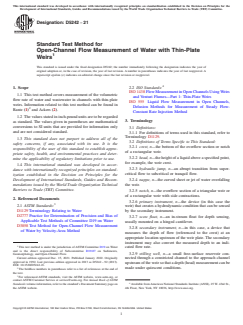
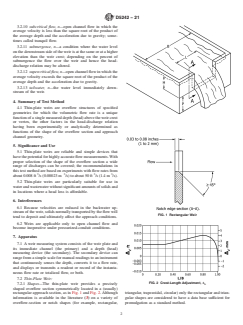
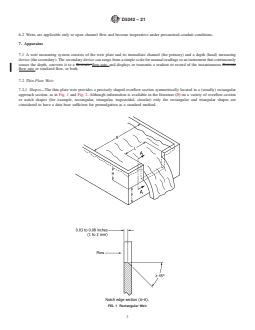
7.2.1 Shapes—The thin-plate weir provides a precisely shaped overflow section symmetrically located in a (usually) rectangular
approach section, as in Fig. 1 and Fig. 2. Although information is available in the literature (3) on a variety of overflow-section
or notch shapes (for example, rectangular, triangular, trapezoidal, circular) only the rectangular and triangular shapes are
considered to have a data base sufficient for promulgation as a standard method.
FIG. 1 Rectangular Weir
D5242 − 21
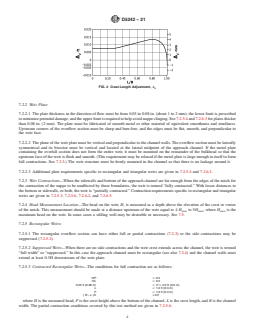
FIG. 2 Crest-Length Adjustment, Δ
L
7.2.2 Weir Plate:
7.2.2.1 The plate thickness in the direction of flow must be from 0.03 in 0.08 in. (about 1 to 2 mm); the lower limit is prescribed
to minimize potential damage, and the upper limit is required to help avoid nappe clinging. See 7.2.5.4 and 7.2.6.3 for plates thicker
than 0.08 in. (2 mm). The plate must be fabricated of smooth metal or other material of equivalent smoothness and sturdiness.
Upstream corners of the overflow section must be sharp and burr-free, and the edges must be flat, smooth, and perpendicular to
the weir face.
7.2.2.2 The plane of the weir plate must be vertical and perpendicular to the channel walls. The overflow section must be laterally
symmetrical and its bisector must be vertical and located at the lateral midpoint of the approach channel. If the metal plate
containing the overfall section does not form the entire weir, it must be mounted on the remainder of the bulkhead so that the
upstream face of the weir is flush and smooth. (This requirement may be relaxed if the metal plate is large enough in itself to form
full contractions. See 7.2.3.) The weir structure must be firmly mounted in the channel so that there is no leakage around it.
7.2.2.3 Additional plate requirements specific to rectangular and triangular weirs are given in 7.2.5.4 and 7.2.6.3.
7.2.3 Weir Contractions—When the sidewalls and bottom of the approach channel are far enough from the edges of the notch for
the contraction of the nappe to be unaffected by those boundaries, the weir is termed “fully contracted.” With lesser distances to
the bottom or sidewalls, or both, the weir is “partially contracted.” Contraction requirements specific to rectangular and triangular
weirs are given in 7.2.5.3, 7.2.5.6, 7.2.6.2, and 7.2.6.5.
7.2.4 Head Measurement Location—The head on the weir, H, is measured as a depth above the elevation of the crest or vertex
of the notch. This measurement should be made at a distance upstream of the weir equal to 4 H to 5H , where H is the
max max max
maximum head on the weir. In some cases a stilling well may be desirable or necessary. See 7.5.
7.2.5 Rectangular Weirs:
7.2.5.1 The rectangular overflow section can have either full or partial contractions (7.2.3) or the side contractions may be
suppressed (7.2.5.2).
7.2.5.2 Suppressed Weirs—When there are no side contractions and the weir crest extends across the channel, the weir is termed
“full width” or “suppressed.” In this case the approach channel must be rectangular (see also 7.3.4) and the channel walls must
extend at least 0.3H downstream of the weir plate.
7.2.5.3 Contracted Rectangular Weirs—The conditions for full contraction are as follows:
H/P # 0.5
H/L # 0.5
0.25 ft (0.08 m) # H # 2.0 ft (0.6 m)
L $ 1.0 ft (0.3 m)
P $ 1.0 ft (0.3 m)
( B − L )/2 $2H
where H is the measured head, P is the crest height above the bottom of the channel, L is the crest length, and B is the channel
width. The partial contraction conditions covered by this test method are given in 7.2.5.6.
D5242 − 21
7.2.5.4 Weir Plate—The requirements of this section are in addition to those of 7.2.2. If the plate is thicker than 0.08 in. (2 mm)
the downstream excess at the edges of the overflow section must be beveled at an angle of at least 45° as shown in Fig. 1. If there
are side contractions, all of the edge requirements of this test method pertain to the sides as well as the crest. The sides must be
exactly perpendicular to the crest; and the crest must be level, preferably to within a transverse slope of 0.001.
7.2.5.5 Discharge Relations—The flowrate, flow rate, Q, over a rectangular weir that conforms to all requirements of 7.2 as well
as the approach conditions in 7.3 is determined from the Kindsvater-Carter equation (4):
1/2 3/2
Q 5 2/3 2g C L H (1)
~ !~ ! ~ !
e e e
where g is the acceleration due to gravity in compatible units, H and L are the effective head and effective crest length
e e
respectively, and C is a discharge coefficient. The effective head, H , is related to the measured head, H, by:
e e
H 5 H1δH
e
where δH is an experimentally determined adjustment for the effects of viscosity and surface tension valid for water at ordinary
temperatures (about 4 to 30°C); its value is constant at 0.003 ft (0.001 m). The effective crest length, L , is related to the measured
e
length, L, by:
L 5 L1δL
e
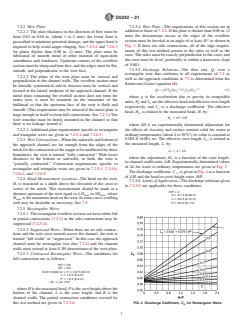
where the adjustment, δL, is a function of the crest length-to-channel width ratio, L/B. Experimentally determined values of δL
for water at ordinary temperatures are given in Fig. 3.
The discharge coefficient, C , is given in Fig. 4 as a function of L/B and the head-to-crest height ratio, H/P.
e
7.2.5.6 Limits of Application—The discharge relations given in 7.2.5.5 are applicable for these conditions:
H/P # 2
H $ 0.1 ft (0.03 m)
L $ 0.5 ft (0.15 m)
P $ 0.3 ft (0.1 m)
Although in principle Eq 1 could be applied to very large weirs, the experiments on which it is based included crest lengths up
to about 4 ft (1.2 m) and heads up to about 2 ft (0.6 m); it is recommended that these values not be significantly exceeded.
7.2.5.7 Aeration Requirements—In order to avoid nappe clinging and maintain proper aeration of the nappe, the tailwater level
should always be at least 0.2 ft (0.06 m) below the crest. In addition, in the case of suppressed weirs, aeration must be provided
externally; this can be done with sidewall vents, for example. The user must measure the pressure in the air pocket to establish
that it is sufficiently close to atmospheric for the flow to be unaffected (see 11.7.2).
7.2.6 Triangular Weirs:
FIG. 3 Discharge Coefficient, C , for Rectangular Weirs
e
D5242 − 21
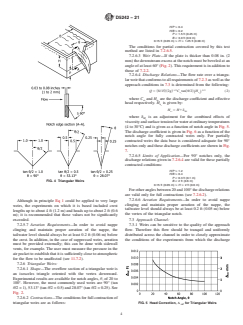
FIG. 4 Triangular Weirs
7.2.6.1 Shape—The overflow section of a triangular weir is an isosceles triangle oriented with the vertex downward. Experimental
results are available for notch angles, θ, of 20 to 100°. However, the most commonly used weirs are 90° (tan θ/2 = 1), 53.13° (tan
θ/2 = 0.5) and 28.07° (tan θ/2 = 0.25). See Fig. 2.
7.2.6.2 Contractions—The conditions for full contraction of triangular weirs are as follows:
H/P # 0.4
H/B # 0.2
P $ 1.5 ft (0.45 m)
B $ 3.0 ft (0.9 m)
0.15 ft (0.05 m) # H # 1.25 ft (0.38 m)
The conditions for partial contraction covered by this test method are listed in 7.2.6.5.
7.2.6.3 Weir Plate—If the plate is thicker than 0.08 in. (2 mm) the downstream excess at the notch must be beveled at an angle
of at least 60° (Fig. 2). This requirement is in addition to those of 7.2.2.
7.2.6.4 Discharge Relations—The flowrate flow rate over a triangular weir that conforms to all requirements of 7.2.3 as well as
the approach conditions in 7.3 is determined from the following:
1/2 5/2
Q 5 ~8/15!~2g! C tan~θ/2! H (2)
~ !
e e
t t
where C and H are the discharge coefficient and effective head respectively. H is given by:
e e e
t t t
H 5 H1δ
e Ht
t
D5242 − 21
where δ is an adjustment for the combined effects of viscosity and surface tension for water at ordinary temperatures (4 to
H
t
30°C) and is given as a function of notch angle in Fig. 5. The discharge coefficient is given in Fig. 6 as a function of the notch
angle for fully contracted weirs only. For partially contracted weirs the data base is considered adequate for 90° notches only and
these discharge coefficients are shown in Fig. 7.
7.2.6.5 Limits of Application—For 90° notches only, the discharge relations given in 7.2.6.4 are valid for these partially contracted
conditions:
H/P # 1.2
H/B # 0.4
P $ 0.3 ft (0.1 m)
B $ 2 ft (0.6 m)
0.15 ft (0.05 m) # H # 2 ft (0.6 m)
For other angles between 20 and 100° the discharge relations are valid only for full contractions (see 7.2.6.2).
7.2.6.6 Aeration Requirements—In order to avoid nappe clinging and maintain proper aeration of the nappe, the tailwater level
should always be at least 0.2 ft (0.05 m) below the vertex of the triangular notch.
7.3 Approach Channel:
7.3.1 Weirs can be sensitive to the quality of the approach flow. Therefore this flow should be tranquil and uniformly distributed
across the channel in order to closely approximate the conditions of the experiments from which the discharge relations were
developed. For this purpose, uniform velocity distribution can be defined as that associated with fully developed flow in a long,
straight, moderately smooth channel. Unfortunately there are no universally accepted quantitative guidelines for implementing
these recommendations. One standard (5) recommends a straight approach length of ten channel widths when the weir length is
greater than half the channel width. However, the presence of upstream channel bends or sudden enlargements would clearly
lengthen this approach requirement. Therefore the adequacy of the approach flow generally must be demonstrated on a
case-by-case basis using velocity traverses, experience with similar situations, or analytical approximations.
7.3.2 In some cases baffles can be used to improve the velocity distribution; they must be placed more than 10H upstream of the
head measurement location.
7.3.3 If the flow in the channel is supercritical, the installation should be designed so that the hydraulic jump is formed at least
30H upstream and the velocity distribution should be checked for uniformity.
7.3.4 Channel Shape—A rectangular approach channel is preferred in the immediate vicinity of the weir. However, a different
shape is acceptable provided the conditions for full contraction are met and the cross-sectional area of the channel is at least as
large as the smallest rectangular section that would have provided full contraction. Rectangular channels are required for
suppressed rectangular weirs.
7.4 Submerged Weirs—This section provides limited information on the performance of submerged weirs. However, it is strongly
recommended that weir installations be designed for free flow because the experimental data base for submerged conditions is not
adequate to provide the
...