


ASTM E825-98(2016)
(Specification)Standard Specification for Phase Change-Type Disposable Fever Thermometer for Intermittent Determination of Human Temperature
Standard Specification for Phase Change-Type Disposable Fever Thermometer for Intermittent Determination of Human Temperature
ABSTRACT
This specification covers the test methods and corresponding requirements for phase change-type disposable (for one time use only) clinical thermometers used for the intermittent determination of human temperature. When examined using the test methods suggested herein, sampled specimens shall comply with the specified requirements as to temperature range and graduation, accuracy, measurement retention, operating environment, storage environment, toxicity, workmanship, stability, and marking and labeling.
SCOPE
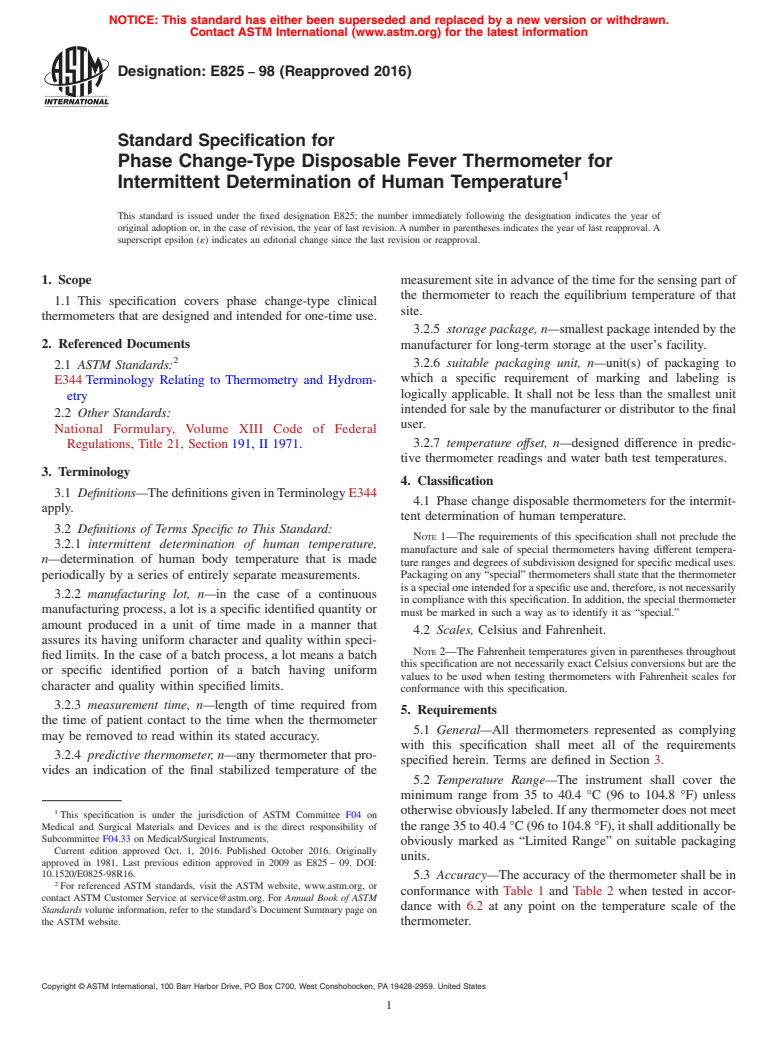
1.1 This specification covers phase change-type clinical thermometers that are designed and intended for one-time use.
General Information
Buy Standard
Standards Content (Sample)
NOTICE: This standard has either been superseded and replaced by a new version or withdrawn.
Contact ASTM International (www.astm.org) for the latest information
Designation: E825 − 98 (Reapproved 2016)
Standard Specification for
Phase Change-Type Disposable Fever Thermometer for
Intermittent Determination of Human Temperature
This standard is issued under the fixed designation E825; the number immediately following the designation indicates the year of
original adoption or, in the case of revision, the year of last revision. A number in parentheses indicates the year of last reapproval. A
superscript epsilon (´) indicates an editorial change since the last revision or reapproval.
1. Scope measurement site in advance of the time for the sensing part of
the thermometer to reach the equilibrium temperature of that
1.1 This specification covers phase change-type clinical
site.
thermometers that are designed and intended for one-time use.
3.2.5 storage package, n—smallest package intended by the
2. Referenced Documents manufacturer for long-term storage at the user’s facility.
3.2.6 suitable packaging unit, n—unit(s) of packaging to
2.1 ASTM Standards:
which a specific requirement of marking and labeling is
E344 Terminology Relating to Thermometry and Hydrom-
logically applicable. It shall not be less than the smallest unit
etry
intended for sale by the manufacturer or distributor to the final
2.2 Other Standards:
user.
National Formulary, Volume XIII Code of Federal
3.2.7 temperature offset, n—designed difference in predic-
Regulations, Title 21, Section 191, II 1971.
tive thermometer readings and water bath test temperatures.
3. Terminology
4. Classification
3.1 Definitions—The definitions given in Terminology E344
4.1 Phase change disposable thermometers for the intermit-
apply.
tent determination of human temperature.
3.2 Definitions of Terms Specific to This Standard:
NOTE 1—The requirements of this specification shall not preclude the
3.2.1 intermittent determination of human temperature,
manufacture and sale of special thermometers having different tempera-
n—determination of human body temperature that is made
ture ranges and degrees of subdivision designed for specific medical uses.
Packaging on any “special” thermometers shall state that the thermometer
periodically by a series of entirely separate measurements.
is a special one intended for a specific use and, therefore, is not necessarily
3.2.2 manufacturing lot, n—in the case of a continuous
in compliance with this specification. In addition, the special thermometer
manufacturing process, a lot is a specific identified quantity or
must be marked in such a way as to identify it as “special.”
amount produced in a unit of time made in a manner that
4.2 Scales, Celsius and Fahrenheit.
assures its having uniform character and quality within speci-
NOTE 2—The Fahrenheit temperatures given in parentheses throughout
fied limits. In the case of a batch process, a lot means a batch
this specification are not necessarily exact Celsius conversions but are the
or specific identified portion of a batch having uniform
values to be used when testing thermometers with Fahrenheit scales for
character and quality within specified limits.
conformance with this specification.
3.2.3 measurement time, n—length of time required from
5. Requirements
the time of patient contact to the time when the thermometer
5.1 General—All thermometers represented as complying
may be removed to read within its stated accuracy.
with this specification shall meet all of the requirements
3.2.4 predictive thermometer, n—any thermometer that pro-
specified herein. Terms are defined in Section 3.
vides an indication of the final stabilized temperature of the
5.2 Temperature Range—The instrument shall cover the
minimum range from 35 to 40.4 °C (96 to 104.8 °F) unless
1 otherwise obviously labeled. If any thermometer does not meet
This specification is under the jurisdiction of ASTM Committee F04 on
Medical and Surgical Materials and Devices and is the direct responsibility of the range 35 to 40.4 °C (96 to 104.8 °F), it shall additionally be
Subcommittee F04.33 on Medical/Surgical Instruments.
obviously marked as “Limited Range” on suitable packaging
Current edition approved Oct. 1, 2016. Published October 2016. Originally
units.
approved in 1981. Last previous edition approved in 2009 as E825 – 09. DOI:
10.1520/E0825-98R16.
5.3 Accuracy—The accuracy of the thermometer shall be in
For referenced ASTM standards, visit the ASTM website, www.astm.org, or
conformance with Table 1 and Table 2 when tested in accor-
contact ASTM Customer Service at service@astm.org. For Annual Book of ASTM
dance with 6.2 at any point on the temperature scale of the
Standards volume information, refer to the standard’s Document Summary page on
the ASTM website. thermometer.
Copyright © ASTM International, 100 Barr Harbor Drive, PO Box C700, West Conshohocken, PA 19428-2959. United States
E825 − 98 (2016)
TABLE 1 Accuracy of Thermometers With a Celsius Scale
labeling shall also bear a statement that the thermometers are
Temperature Range, °C Maximum Error, °C intended for single use only.
Below 35.8 ±0.3 5.10.2 Operating Instructions—Operating instructions must
35.8 to 36.9 ±0.2
be provided. When space limitations dictate, the operating
37.0 to 39.0 ±0.1
instructions on an individual thermometer may be omitted if
39.1 to 41.0 ±0.2
Above 41.0 ±0.3 detailed instructions are provided on or with a suitable pack-
aging unit.
5.10.3 Additional Marking and Labeling—Additional mark-
TABLE 2 Accuracy of Thermometers With a Fahrenheit Scale
ing and labeling that may be required by 5.2, 5.5, 5.8, 5.9, and
Temperature Range, °F Maximum Error, °F
6.2.3 shall be clear, concise, and adequate for the intended
Below 98 ±0.4
purpose. The temperature measurement offset shall be included
98 to 102 ±0.2
in the labeling of the thermometers.
Above 102 ±0.4
5.11 Toxicity—When the thermometer is used as specified
by the manufacturer, its parts intended for contact with
anatomical sites during patient use and its melting point
5.4 Measurement Retention—A measurement meeting the
chemicals shall be nontoxic as determined by 6.5.
accuracy requirements of 5.3 will be maintained for a mini-
mum of 1 min when tested in accordance with 6.2.4.
6. Test Methods for Performance Verification
5.5 Operating Environment—When used in an environment
6.1 Significance and Use—This section describes the
in which the temperature is in the range from 18 to 33 °C (64
principles, apparatus, and procedures to be used to determine
to 92 °F), the thermometers, when tested in accordance with
the conformance of disposable thermometers to the require-
6.3, shall meet the requirements of 5.3. Any thermometer
ments of this specification. Each manufacturer or distributor
product not meeting this requirement shall be marked on a
who represents his products as conforming to this specification
suitable packaging unit or other labeling of the thermometers
may use statistically based sampling plans that are appropriate.
with a cautioning statement indicating the ambient temperature
He shall keep such essential records as are necessary to
range in which it can be used with specified accuracy.
document his claim that all the requirements of this specifica-
tion are met. This section does not include any procedure for
5.6 Graduation—The thermometer shall be graduated in
requirements that can be verified by visual inspection (such as
intervals no greater than 0.1 °C (0.2 °F). As a minimum,
5.2).
appropriate numerals shall be placed at every degree gradua-
tion for Celsius scale thermometers and at every even degree
6.2 Accuracy Test:
graduation for Fahrenheit scale thermometers.
6.2.1 Test Equipment Required—The test equipment shall
include constant-temperature water baths, the temperatures of
5.7 Workmanship—There shall be no constructional defects
which are uniform and are known to be within 60.03 °C
that would prevent the measurement of temperature within the
(60.05 °F), as measured by a thermometer or thermometry
accuracy requirements of 5.3.
system for which the temperature calibration is traceable to the
5.8 Stability—Thermometers shall meet all requirements of
International Temperature Scale of 1990 (ITS-90) as main-
this specification over their shelf life. If the shelf life of the
tained by the National Institute of Standards and Technology
product is less than 5 years when stored in compliance with the
(NIST) or other appropriate National Standards Laboratory.
manufacturer’s instructions, an uncoded expiration date shall
The volume of each bath shall be a minimum of 1 L.
be displayed on the labeling of the product.
6.2.2 Procedure—Insert the thermometers into the water
5.9 Storage Environment—When tested in acco
...
This document is not an ASTM standard and is intended only to provide the user of an ASTM standard an indication of what changes have been made to the previous version. Because
it may not be technically possible to adequately depict all changes accurately, ASTM recommends that users consult prior editions as appropriate. In all cases only the current version
of the standard as published by ASTM is to be considered the official document.
Designation: E825 − 98 (Reapproved 2009) E825 − 98 (Reapproved 2016)
Standard Specification for
Phase Change-Type Disposable Fever Thermometer for
Intermittent Determination of Human Temperature
This standard is issued under the fixed designation E825; the number immediately following the designation indicates the year of
original adoption or, in the case of revision, the year of last revision. A number in parentheses indicates the year of last reapproval. A
superscript epsilon (´) indicates an editorial change since the last revision or reapproval.
1. Scope
1.1 This specification covers phase change-type clinical thermometers that are designed and intended for one time one-time use.
2. Referenced Documents
2.1 ASTM Standards:
E344 Terminology Relating to Thermometry and Hydrometry
2.2 Other Standards:
National Formulary, Volume XIII Code of Federal Regulations, Title 21, Section 191, II 1971.
3. Terminology
3.1 Definitions—The definitions given in Terminology E344 apply.
3.2 Definitions of Terms Specific to This Standard:
3.2.1 intermittent determination of human temperature, n—determination of human body temperature that is made periodically
by a series of entirely separate measurements.
3.2.2 manufacturing lot, n—in the case of a continuous manufacturing process, a lot is a specific identified quantity or amount
produced in a unit of time made in a manner that assures its having uniform character and quality within specified limits. In the
case of a batch process, a lot means a batch or specific identified portion of a batch having uniform character and quality within
specified limits.
3.2.3 measurement time, n—length of time required from the time of patient contact to the time when the thermometer may be
removed to read within its stated accuracy.
3.2.4 predictive thermometer, n—any thermometer that provides an indication of the final stabilized temperature of the
measurement site in advance of the time for the sensing part of the thermometer to reach the equilibrium temperature of that site.
3.2.5 storage package, n—smallest package intended by the manufacturer for long-term storage at the user’suser’s facility.
3.2.6 suitable packaging unit, n—unit(s) of packaging to which a specific requirement of marking and labeling is logically
applicable. It shall not be less than the smallest unit intended for sale by the manufacturer or distributor to the final user.
3.2.7 temperature offset, n—designed difference in predictive thermometer readings and water bath test temperatures.
4. Classification
4.1 Phase change disposable thermometers for the intermittent determination of human temperature.
NOTE 1—The requirements of this specification shall not preclude the manufacture and sale of special thermometers having different temperature ranges
and degrees of subdivision designed for specific medical uses. Packaging on any “special” thermometers shall state that the thermometer is a special one
intended for a specific use and, therefore, is not necessarily in compliance with this specification. In addition, the special thermometer must be marked
in such a way as to identify it as “special.”
4.2 Scales, Celsius and Fahrenheit.
This specification is under the jurisdiction of ASTM Committee F04 on Medical and Surgical Materials and Devices and is the direct responsibility of Subcommittee
F04.33 on Medical/Surgical Instruments.
Current edition approved May 1, 2009Oct. 1, 2016. Published June 2009October 2016. Originally approved in 1981. Discontinued February 1996 and reinstated as
E825 – 97.Last previous edition approved in 20032009 as E825 – 98 (2003).E825 – 09. DOI: 10.1520/E0825-98R09.10.1520/E0825-98R16.
For referenced ASTM standards, visit the ASTM website, www.astm.org, or contact ASTM Customer Service at service@astm.org. For Annual Book of ASTM Standards
volume information, refer to the standard’sstandard’s Document Summary page on the ASTM website.
Copyright © ASTM International, 100 Barr Harbor Drive, PO Box C700, West Conshohocken, PA 19428-2959. United States
E825 − 98 (2016)
NOTE 2—The Fahrenheit temperatures given in parentheses throughout this specification are not necessarily exact Celsius conversions but are the
values to be used when testing thermometers with Fahrenheit scales for conformance with this specification.
5. Requirements
5.1 General—All thermometers represented as complying with this specification shall meet all of the requirements specified
herein. Terms are defined in Section 43.
5.2 Temperature Range—The instrument shall cover the minimum range from 35 to 40.4 °C (96 to 104.8 °F) unless otherwise
obviously labeled. If any thermometer does not meet the range 35 to 40.4 °C (96 to 104.8 °F), it shall additionally be obviously
marked as “Limited Range” on suitable packaging units.
5.3 Accuracy—The accuracy of the thermometer shall be in conformance with Table 1 and Table 2 when tested in accordance
with 6.2 at any point on the temperature scale of the thermometer.
5.4 Measurement Retention—A measurement meeting the accuracy requirements of 5.3 will be maintained for a minimum of
1 min when tested in accordance with 6.2.4.
5.5 Operating Environment—When used in an environment in which the temperature is in the range from 18 to 33 °C (64 to
92 °F), the thermometers, when tested in accordance with 6.3, shall meet the requirements of 5.3. Any thermometer product not
meeting this requirement shall be marked on a suitable packaging unit or other labeling of the thermometers with a cautioning
statement indicating the ambient temperature range in which it can be used with specified accuracy.
5.6 Graduation—The thermometer shall be graduated in intervals no greater than 0.1 °C (0.2 °F). As a minimum, appropriate
numerals shall be placed at every degree graduation for Celsius scale thermometers and at every even degree graduation for
Fahrenheit scale thermometers.
5.7 Workmanship—There shall be no constructional defects that would prevent the measurement of temperature within the
accuracy requirements of 5.3.
5.8 Stability—Thermometers shall meet all requirements of this specification over their shelf life. If the shelf life of the product
is less than 5 years when stored in compliance with the manufacturer’s instructions, an uncoded expiration date shall be displayed
on the labeling of the product.
5.9 Storage Environment—When tested in accordance with 6.4, thermometers shall meet the requirements of 5.3 after they have
been stored for 1 day at any point in an environment of −18 to 38 °C (0 to 100 °F) and at relative humidities from 15 to 90 %.
When tested in accordance with 6.4, thermometers shall also meet the requirements of 5.3 after they have been stored for 1 month
at any point in an environment of 15.5 to 32 °C (60 to 90 °F) and 30 to 75 % relative humidity. Any thermometer product not
meeting this requirement shall be marked on a suitable packaging unit or other labeling of the thermometers with a cautioning
statement indicating the storage temperature range that is applicable.
5.10 Marking and Labeling:
5.10.1 Identification—Suitable packaging units of the thermometers shall bear in legible characters the name or trademark, or
both, of the manufacturer or distributor and a designation, either a serial number or a code, to indicate the specific manufacturing
lot. Suitable packaging units and other labeling shall also bear a statement that the thermometers are intended for single use only.
5.10.2 Operating Instructions—Operating instructions must be provided. When space limitations dictate, the operating
instructions on an individual thermometer may be omitted if detailed instructions are provided on or with a suitable packaging unit.
TABLE 1 Accuracy of Thermometers With a Celsius Scale
Temperature Range, °C Maximum Error, °C
±0.3
Below 35.8
±0.2
35.8 to 36.9
±0.1
37.0 to 39.0
±0.2
39.1 to 41.0
±0.3
Above 41.0
TABLE 1 Accuracy of Thermometers With a Celsius Scale
Temperature Range, °C Maximum Error, °C
Below 35.8 ±0.3
35.8 to 36.9 ±0.2
37.0 to 39.0 ±0.1
39.1 to 41.0 ±0.2
Above 41.0 ±0.3
E825 − 98 (2016)
TABLE 2 Accuracy of Thermometers With a Fahrenheit Scale
Temperature Range, °F Maximum Error, °F
±0.4
Below 98
±0.2
98 to 102
±0.4
Above 102
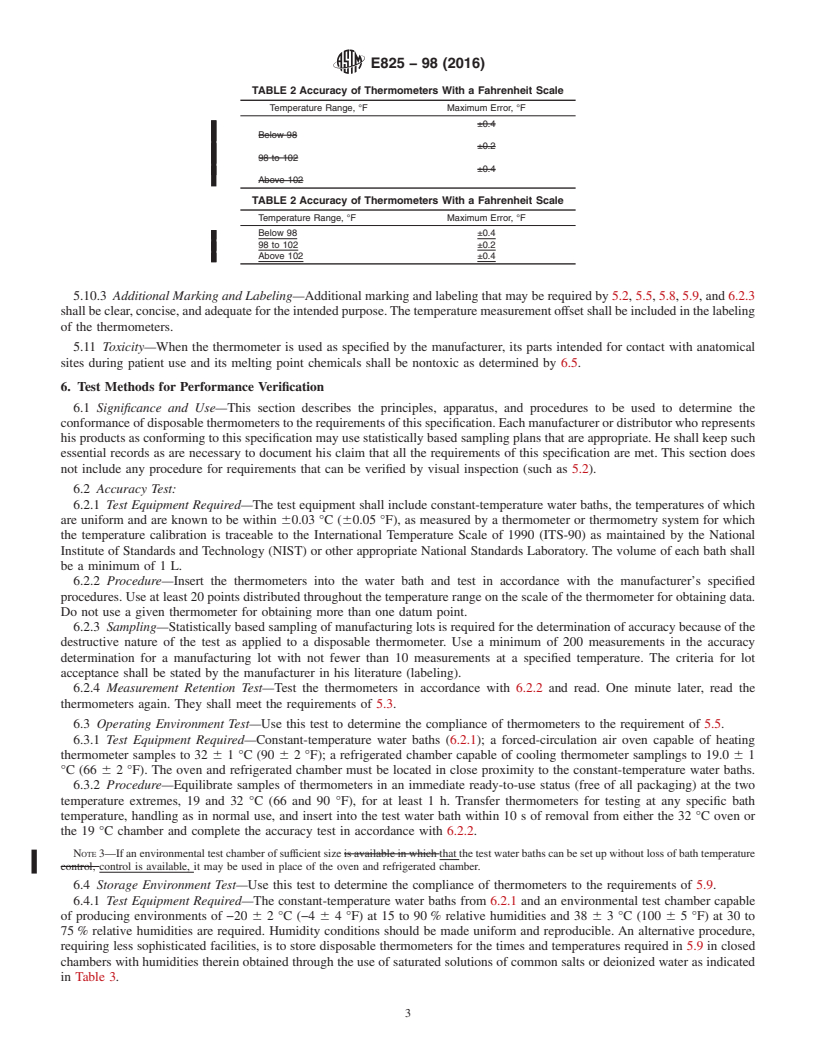
TABLE 2 Accuracy of Thermometers With a Fahrenheit Scale
Temperature Range, °F Maximum Error, °F
Below 98 ±0.4
98 to 102 ±0.2
Above 102 ±0.4
5.10.3 Additional Marking and Labeling—Additional marking and labeling that may be required by 5.2, 5.5, 5.8, 5.9, and 6.2.3
shall be clear, concise, and adequate for the intended purpose. The temperature measurement offset shall be included in the labeling
of the thermometers.
5.11 Toxicity—When the thermometer is used as specified by the manufacturer, its parts in
...
Questions, Comments and Discussion
Ask us and Technical Secretary will try to provide an answer. You can facilitate discussion about the standard in here.