

ASTM F3234/F3234M-21
(Specification)Standard Specification for Exterior Lighting in Small Aircraft
General Information
- Abstract
ABSTRACT
This specification applies to the exterior lighting aspects of airworthiness and design for ”small” aircraft. It establishes the Aircraft Type Code (ATC) compliance matrix based on airworthiness level, number of engines, type of engine(s), stall speed, cruise speed, meteorological conditions, altitude, and maneuvers. An ATC is defined by taking into account both the technical considerations regarding the design of the aircraft and the airworthiness level established based upon risk-based criteria. The exterior lighting requirements defined by this specification cover taxi and landing lights, position light systems, position light dihedral angles, position light distribution and intensities, color specifications, riding lights, and anticollision light systems.
SCOPE
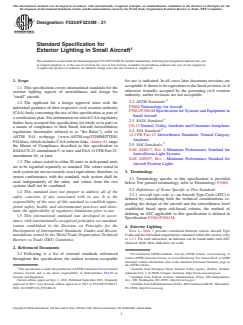
1.1 This specification covers international standards for the exterior lighting aspects of airworthiness and design for “small” aircraft.
1.2 The applicant for a design approval must seek the individual guidance of their respective civil aviation authority (CAA) body concerning the use of this specification as part of a certification plan. For information on which CAA regulatory bodies have accepted this specification (in whole or in part) as a means of compliance to their Small Aircraft Airworthiness regulations (hereinafter referred to as “the Rules”), refer to ASTM F44 webpage (www.ASTM.org/COMMITTEE/F44.htm), which includes CAA website links. Annex A1 maps the Means of Compliance described in this specification to EASA CS-23, amendment 5, or later, and FAA 14 CFR Part 23, amendment 64, or later.
1.3 The values stated in either SI units or inch-pound units are to be regarded separately as standard. The values stated in each system are not necessarily exact equivalents; therefore, to ensure conformance with the standard, each system shall be used independently of the other, and values from the two systems shall not be combined.
1.4 This standard does not purport to address all of the safety concerns, if any, associated with its use. It is the responsibility of the user of this standard to establish appropriate safety, health, and environmental practices and determine the applicability of regulatory limitations prior to use.
1.5 This international standard was developed in accordance with internationally recognized principles on standardization established in the Decision on Principles for the Development of International Standards, Guides and Recommendations issued by the World Trade Organization Technical Barriers to Trade (TBT) Committee.
- Status
- Published
- Publication Date
- 31-Aug-2021
- Technical Committee
- F44 - General Aviation Aircraft
- Drafting Committee
- F44.50 - Systems and Equipment
Buy Documents
ASTM F3234/F3234M-21 - Standard Specification for Exterior Lighting in Small Aircraft
REDLINE ASTM F3234/F3234M-21 - Standard Specification for Exterior Lighting in Small Aircraft
Overview
ASTM F3234/F3234M-21: Standard Specification for Exterior Lighting in Small Aircraft establishes international standards for the design and airworthiness of exterior lighting in small aircraft. Developed by ASTM International, this specification addresses safety, compliance, and performance requirements for lighting systems essential for aircraft visibility and operational effectiveness in various meteorological and operational conditions. It also includes guidance on compliance with key regulatory authorities such as the FAA (14 CFR Part 23) and EASA (CS-23), facilitating the certification process for aircraft manufacturers and operators globally.
Key Topics
- Scope and Applicability: The standard applies to "small" aircraft as classified by specific airworthiness, performance, and operational parameters, including number and type of engines, speed characteristics, and flight conditions.
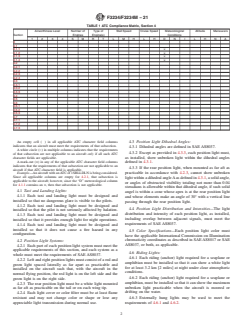
- Aircraft Type Code (ATC): Establishes a compliance matrix based on risk-based criteria and technical design considerations, guiding which requirements apply to each aircraft type.
- Taxi and Landing Lights: Requirements ensure that lighting design avoids glare and halation for pilots, provides sufficient illumination for night operations, and minimizes fire hazards.
- Position Light Systems: Specifies installation and configuration of red, green, and white position lights according to industry standards (e.g., SAE AS8037), ensuring proper visibility and discrimination of aircraft orientation.
- Dihedral Angles and Coverage: Defines the angular distribution of position lights, with stipulations on unbroken light coverage and allowable obstructed visibility within specific limits.
- Light Distribution and Intensity: Demands measurable performance for light output, including color accuracy as per international chromaticity coordinates.
- Riding Lights for Seaplanes and Amphibians: Details requirements for anchor/riding lights, ensuring sufficient range and coverage for aircraft on water.
- Anticollision Light Systems: Stipulates approved types, placement, and coverage of anticollision lighting to safeguard against collision risks, referencing SAE AS8017 for performance.
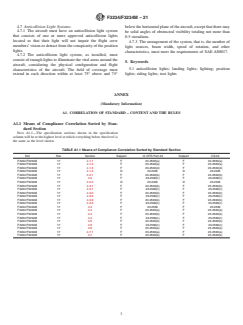
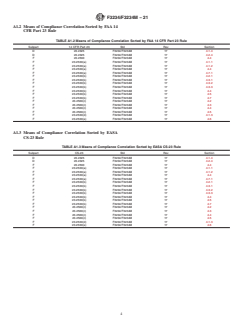
- Means of Compliance: Includes annexes correlating the standard’s requirements to corresponding EASA and FAA rules, providing a clear pathway for regulatory acceptance.
Applications
ASTM F3234/F3234M-21 is essential for:
- Aircraft Manufacturers: Ensuring new designs meet internationally recognized exterior lighting standards, thereby streamlining certification and global acceptance.
- Design Engineers: Implementing compliant and safe lighting systems during the design and modification of small aircraft.
- Certification Authorities and Inspectors: Assessing compliance of lighting installations with airworthiness requirements as part of the approval process.
- MRO (Maintenance, Repair, and Overhaul) Providers: Referencing standardized criteria for inspecting, maintaining, and replacing exterior lighting components.
- Avionics and Lighting Equipment Suppliers: Manufacturing lighting products that meet the performance, safety, and compatibility demands established in this specification.
The standard enhances operational safety by providing clear requirements for visibility-related lighting, vital for safe taxi, takeoff, landing, and in-flight maneuvering, especially in low-visibility or night conditions.
Related Standards
For comprehensive compliance and optimal integration, ASTM F3234/F3234M-21 references and aligns with other key standards:
- ASTM F3060: Terminology for Aircraft
- ASTM F3061/F3061M: Specification for Systems and Equipment in Small Aircraft
- SAE AS8017: Minimum Performance Standard for Anticollision Light Systems
- SAE AS8037: Minimum Performance Standard for Aircraft Position Lights
- EASA CS-23: Airworthiness Standards for Normal, Utility, Aerobatic, and Commuter Aeroplanes
- FAA 14 CFR Part 23: Airworthiness Standards for Normal Category Airplanes
Adherence to these related standards ensures harmonization across regulatory boundaries and technical domains, supporting robust aircraft lighting system design and international acceptance.
Keywords: exterior lighting, small aircraft, airworthiness, position lights, taxi lights, landing lights, anticollision lights, ASTM F3234, aircraft lighting standards, FAA compliance, EASA compliance, general aviation lighting, aircraft certification
Relations
- Effective Date
- 01-Oct-2023
- Effective Date
- 01-Jan-2020
- Effective Date
- 01-Nov-2019
- Effective Date
- 01-Jun-2019
- Effective Date
- 15-Feb-2017
- Effective Date
- 01-Dec-2016
- Effective Date
- 01-Nov-2016
- Effective Date
- 01-Aug-2016
- Effective Date
- 01-Apr-2016
- Effective Date
- 01-Feb-2016
- Effective Date
- 15-Sep-2015
- Effective Date
- 01-May-2015
- Effective Date
- 01-Mar-2015
- Effective Date
- 01-Mar-2015
- Effective Date
- 01-Dec-2014
Buy Documents
ASTM F3234/F3234M-21 - Standard Specification for Exterior Lighting in Small Aircraft
REDLINE ASTM F3234/F3234M-21 - Standard Specification for Exterior Lighting in Small Aircraft
Get Certified
Connect with accredited certification bodies for this standard

BSI Group
BSI (British Standards Institution) is the business standards company that helps organizations make excellence a habit.

Bureau Veritas
Bureau Veritas is a world leader in laboratory testing, inspection and certification services.

DNV
DNV is an independent assurance and risk management provider.
Sponsored listings
Frequently Asked Questions
ASTM F3234/F3234M-21 is a technical specification published by ASTM International. Its full title is "Standard Specification for Exterior Lighting in Small Aircraft". This standard covers: ABSTRACT This specification applies to the exterior lighting aspects of airworthiness and design for ”small” aircraft. It establishes the Aircraft Type Code (ATC) compliance matrix based on airworthiness level, number of engines, type of engine(s), stall speed, cruise speed, meteorological conditions, altitude, and maneuvers. An ATC is defined by taking into account both the technical considerations regarding the design of the aircraft and the airworthiness level established based upon risk-based criteria. The exterior lighting requirements defined by this specification cover taxi and landing lights, position light systems, position light dihedral angles, position light distribution and intensities, color specifications, riding lights, and anticollision light systems. SCOPE 1.1 This specification covers international standards for the exterior lighting aspects of airworthiness and design for “small” aircraft. 1.2 The applicant for a design approval must seek the individual guidance of their respective civil aviation authority (CAA) body concerning the use of this specification as part of a certification plan. For information on which CAA regulatory bodies have accepted this specification (in whole or in part) as a means of compliance to their Small Aircraft Airworthiness regulations (hereinafter referred to as “the Rules”), refer to ASTM F44 webpage (www.ASTM.org/COMMITTEE/F44.htm), which includes CAA website links. Annex A1 maps the Means of Compliance described in this specification to EASA CS-23, amendment 5, or later, and FAA 14 CFR Part 23, amendment 64, or later. 1.3 The values stated in either SI units or inch-pound units are to be regarded separately as standard. The values stated in each system are not necessarily exact equivalents; therefore, to ensure conformance with the standard, each system shall be used independently of the other, and values from the two systems shall not be combined. 1.4 This standard does not purport to address all of the safety concerns, if any, associated with its use. It is the responsibility of the user of this standard to establish appropriate safety, health, and environmental practices and determine the applicability of regulatory limitations prior to use. 1.5 This international standard was developed in accordance with internationally recognized principles on standardization established in the Decision on Principles for the Development of International Standards, Guides and Recommendations issued by the World Trade Organization Technical Barriers to Trade (TBT) Committee.
ABSTRACT This specification applies to the exterior lighting aspects of airworthiness and design for ”small” aircraft. It establishes the Aircraft Type Code (ATC) compliance matrix based on airworthiness level, number of engines, type of engine(s), stall speed, cruise speed, meteorological conditions, altitude, and maneuvers. An ATC is defined by taking into account both the technical considerations regarding the design of the aircraft and the airworthiness level established based upon risk-based criteria. The exterior lighting requirements defined by this specification cover taxi and landing lights, position light systems, position light dihedral angles, position light distribution and intensities, color specifications, riding lights, and anticollision light systems. SCOPE 1.1 This specification covers international standards for the exterior lighting aspects of airworthiness and design for “small” aircraft. 1.2 The applicant for a design approval must seek the individual guidance of their respective civil aviation authority (CAA) body concerning the use of this specification as part of a certification plan. For information on which CAA regulatory bodies have accepted this specification (in whole or in part) as a means of compliance to their Small Aircraft Airworthiness regulations (hereinafter referred to as “the Rules”), refer to ASTM F44 webpage (www.ASTM.org/COMMITTEE/F44.htm), which includes CAA website links. Annex A1 maps the Means of Compliance described in this specification to EASA CS-23, amendment 5, or later, and FAA 14 CFR Part 23, amendment 64, or later. 1.3 The values stated in either SI units or inch-pound units are to be regarded separately as standard. The values stated in each system are not necessarily exact equivalents; therefore, to ensure conformance with the standard, each system shall be used independently of the other, and values from the two systems shall not be combined. 1.4 This standard does not purport to address all of the safety concerns, if any, associated with its use. It is the responsibility of the user of this standard to establish appropriate safety, health, and environmental practices and determine the applicability of regulatory limitations prior to use. 1.5 This international standard was developed in accordance with internationally recognized principles on standardization established in the Decision on Principles for the Development of International Standards, Guides and Recommendations issued by the World Trade Organization Technical Barriers to Trade (TBT) Committee.
ASTM F3234/F3234M-21 is classified under the following ICS (International Classification for Standards) categories: 49.020 - Aircraft and space vehicles in general. The ICS classification helps identify the subject area and facilitates finding related standards.
ASTM F3234/F3234M-21 has the following relationships with other standards: It is inter standard links to ASTM F3061/F3061M-23b, ASTM F3060-20, ASTM F3061/F3061M-19a, ASTM F3061/F3061M-19, ASTM F3061/F3061M-17, ASTM F3061/F3061M-16b, ASTM F3060-16a, ASTM F3061/F3061M-16a, ASTM F3060-16, ASTM F3061/F3061M-16, ASTM F3060-15b, ASTM F3060-15a, ASTM F3060-15, ASTM F3061/F3061M-15, ASTM F3060-14. Understanding these relationships helps ensure you are using the most current and applicable version of the standard.
ASTM F3234/F3234M-21 is available in PDF format for immediate download after purchase. The document can be added to your cart and obtained through the secure checkout process. Digital delivery ensures instant access to the complete standard document.
Standards Content (Sample)
This international standard was developed in accordance with internationally recognized principles on standardization established in the Decision on Principles for the
Development of International Standards, Guides and Recommendations issued by the World Trade Organization Technical Barriers to Trade (TBT) Committee.
Designation: F3234/F3234M −21
Standard Specification for
Exterior Lighting in Small Aircraft
ThisstandardisissuedunderthefixeddesignationF3234/F3234M;thenumberimmediatelyfollowingthedesignationindicatestheyear
of original adoption or, in the case of revision, the year of last revision.Anumber in parentheses indicates the year of last reapproval.
A superscript epsilon (´) indicates an editorial change since the last revision or reapproval.
1. Scope for use is indicated. In all cases later document revisions are
acceptableifshowntobeequivalenttothelistedrevision,orif
1.1 This specification covers international standards for the
otherwise formally accepted by the governing civil aviation
exterior lighting aspects of airworthiness and design for
authority; earlier revisions are not acceptable.
“small” aircraft.
2.2 ASTM Standards:
1.2 The applicant for a design approval must seek the
F3060Terminology for Aircraft
individual guidance of their respective civil aviation authority
F3061/F3061MSpecification for Systems and Equipment in
(CAA) body concerning the use of this specification as part of
Small Aircraft
a certification plan. For information on which CAAregulatory
2.3 EASA Standard:
bodies have accepted this specification (in whole or in part) as
CS-23Normal,Utility,AerobaticandCommuterAeroplanes
a means of compliance to their Small Aircraft Airworthiness
2.4 FAA Standard:
regulations (hereinafter referred to as “the Rules”), refer to
14 CFR Part 23Airworthiness Standards: Normal Category
ASTM F44 webpage (www.ASTM.org/COMMITTEE/
Airplanes
F44.htm), which includes CAAwebsite links. AnnexA1 maps
2.5 SAE Standards:
the Means of Compliance described in this specification to
SAE AS8017, Rev AMinimum Performance Standard for
EASACS-23,amendment5,orlater,andFAA14CFRPart23,
Anticollision Light Systems
amendment 64, or later.
SAE AS8037, Rev –Minimum Performance Standard for
1.3 The values stated in either SI units or inch-pound units
Aircraft Position Lights
are to be regarded separately as standard. The values stated in
each system are not necessarily exact equivalents; therefore, to 3. Terminology
ensure conformance with the standard, each system shall be
3.1 Terminology specific to this specification is provided
used independently of the other, and values from the two
below. For general terminology, refer to Terminology F3060.
systems shall not be combined.
3.2 Definitions of Terms Specific to This Standard:
1.4 This standard does not purport to address all of the
3.2.1 aircraft type code, n—anAircraft Type Code (ATC) is
safety concerns, if any, associated with its use. It is the
defined by considering both the technical considerations re-
responsibility of the user of this standard to establish appro-
garding the design of the aircraft and the airworthiness level
priate safety, health, and environmental practices and deter-
established based upon risk-based criteria; the method of
mine the applicability of regulatory limitations prior to use.
defining an ATC applicable to this specification is defined in
1.5 This international standard was developed in accor-
Specification F3061/F3061M.
dance with internationally recognized principles on standard-
ization established in the Decision on Principles for the
4. Exterior Lighting
Development of International Standards, Guides and Recom-
NOTE 1—Table 1 provides correlation between various Aircraft Type
Codes and the individual requirements contained within this section; refer
mendations issued by the World Trade Organization Technical
to 3.2.1. For each subsection, an indicator can be found under each ATC
Barriers to Trade (TBT) Committee.
character field; three indicators are used:
2. Referenced Documents
2.1 Following is a list of external standards referenced For referenced ASTM standards, visit the ASTM website, www.astm.org, or
contact ASTM Customer Service at service@astm.org. For Annual Book of ASTM
throughout this specification; the earliest revision acceptable
Standards volume information, refer to the standard’s Document Summary page on
the ASTM website.
1 3
ThisspecificationisunderthejurisdictionofASTMCommitteeF44onGeneral Available from European Union Aviation Safety Agency (EASA), Konrad-
Aviation Aircraft and is the direct responsibility of Subcommittee F44.50 on Adenauer-Ufer 3, D-50668 Cologne, Germany, https://www.easa.europa.eu.
Systems and Equipment. Available from Federal Aviation Administration (FAA), 800 Independence
Current edition approved Sept. 1, 2021. Published September 2021. Originally Ave., SW, Washington, DC 20591, http://www.faa.gov.
approved in 2017. Last previous edition approved in 2017 as F3234/F3234M-17. AvailablefromSAEInternational(SAE),400CommonwealthDr.,Warrendale,
DOI: 10.1520/F3234_F3234M-21. PA 15096, http://www.sae.org.
Copyright © ASTM International, 100 Barr Harbor Drive, PO Box C700, West Conshohocken, PA 19428-2959. United States
F3234/F3234M − 21
TABLE 1 ATC Compliance Matrix, Section 4
Airworthiness Level Number of Type of Stall Speed Cruise Speed Meteorological Altitude Maneuvers
Section Engines Engine(s) Conditions
12 34 S M R T L M H L H D N I L H N A
4.1
4.1.1 ×
4.1.2 ×
4.1.3 ×
4.1.4 ×
4.2
4.2.1
4.2.2
4.2.3
4.2.4
4.3
4.3.1
4.3.2
4.3.3
4.4
4.5
4.6
4.6.1
4.6.2
4.6.3
4.7
4.7.1
4.7.2
4.7.3
An empty cell ( ) in all applicable ATC character field columns
4.3 Position Light Dihedral Angles:
indicates that an aircraft must meet the requirements of that subsection.
4.3.1 Dihedral angles are defined in SAE AS8037.
A white circle (○) in multiple columns indicates that the requirements
4.3.2 Except as provided in 4.3.3, each position light must,
of that subsection are not applicable to an aircraft only if all such ATC
character fields are applicable. as installed, show unbroken light within the dihedral angles
A mark-out (×) in any of the applicable ATC character field columns
defined in 4.3.1.
indicates that the requirements of that subsection are not applicable to an
4.3.3 If the rear position light, when mounted as far aft as
aircraft if that ATC character field is applicable.
practicable in accordance with 4.2.3, cannot show unbroken
Example—AnaircraftwithanATCof1SRLLDLNisbeingconsidered.
Since all applicable columns are empty for 4.2.1, that subsection is lightwithinadihedralangleAasdefinedin4.3.1,asolidangle,
applicable to the aircraft; however, since the “D” meteorological column
or angles of obstructed visibility totaling not more than 0.04
for 4.1.1 contains an ×, then that subsection is not applicable.
steradians is allowable within that dihedral angle, if such solid
4.1 Taxi and Landing Lights:
angel is within a cone whose apex is at the rear position light
4.1.1 Each taxi and landing light must be designed and
and whose elements make an angle of 30° with a vertical line
installed so that no dangerous glare is visible to the pilots.
passing through the rear position light.
4.1.2 Each taxi and landing light must be designed and
4.4 Position Light Distribution and Intensities—The light
installed so that the pilot is not seriously affected by halation.
distribution and intensity of each position light, as installed,
4.1.3 Each taxi and landing light must be designed and
including overlap between adjacent signals, must meet the
installed so that it provides enough light for night operations.
requirements of SAE AS8037.
4.1.4 Each taxi and landing light must be designed and
installed so that it does not cause a fire hazard in any
4.5 Color Specifications—Each position light color must
configuration.
have the applicable International Commission on Illumination
chromaticity coordinates as described in SAEAS8017 or SAE
4.2 Position Light Systems:
4.2.1 Each part of ea
...
This document is not an ASTM standard and is intended only to provide the user of an ASTM standard an indication of what changes have been made to the previous version. Because
it may not be technically possible to adequately depict all changes accurately, ASTM recommends that users consult prior editions as appropriate. In all cases only the current version
of the standard as published by ASTM is to be considered the official document.
Designation: F3234/F3234M − 17 F3234/F3234M − 21
Standard Specification for
Exterior Lighting in Small Aircraft
This standard is issued under the fixed designation F3234/F3234M; the number immediately following the designation indicates the year
of original adoption or, in the case of revision, the year of last revision. A number in parentheses indicates the year of last reapproval.
A superscript epsilon (´) indicates an editorial change since the last revision or reapproval.
1. Scope
1.1 This specification covers international standards for the exterior lighting aspects of airworthiness and design for “small”
aircraft.
1.2 The applicant for a design approval must seek the individual guidance of their respective CAA civil aviation authority (CAA)
body concerning the use of this specification as part of a certification plan. For information on which CAA regulatory bodies have
accepted this specification (in whole or in part) as a means of compliance to their Small Aircraft Airworthiness regulations
(hereinafter referred to as “the Rules”), refer to ASTM F44 webpage (www.ASTM.org/COMMITTEE/F44.htm)(www.ASTM.org/
COMMITTEE/F44.htm), which includes CAA website links. Annex A1 maps the Means of Compliance described in this
specification to EASA CS-23, amendment 5, or later, and FAA 14 CFR Part 23, amendment 64, or later.
1.3 The values stated in either SI units or inch-pound units are to be regarded separately as standard. The values stated in each
system mayare not benecessarily exact equivalents; therefore, to ensure conformance with the standard, each system shall be used
independently of the other. Combiningother, and values from the two systems may result in non-conformance with the
standard.shall not be combined.
1.4 This standard does not purport to address all of the safety concerns, if any, associated with its use. It is the responsibility
of the user of this standard to establish appropriate safety safety, health, and healthenvironmental practices and determine the
applicability of regulatory limitations prior to use.
1.5 This international standard was developed in accordance with internationally recognized principles on standardization
established in the Decision on Principles for the Development of International Standards, Guides and Recommendations issued
by the World Trade Organization Technical Barriers to Trade (TBT) Committee.
2. Referenced Documents
2.1 Following is a list of external standards referenced throughout this specification; the earliest revision acceptable for use is
indicated. In all cases later document revisions are acceptable if shown to be equivalent to the listed revision, or if otherwise
formally accepted by the governing civil aviation authority; earlier revisions are not acceptable.
2.2 ASTM Standards:
F3060 Terminology for Aircraft
F3061/F3061M Specification for Systems and Equipment in Small Aircraft
This specification is under the jurisdiction of ASTM Committee F44 on General Aviation Aircraft and is the direct responsibility of Subcommittee F44.50 on Systems
and Equipment.
Current edition approved Feb. 15, 2017Sept. 1, 2021. Published March 2017September 2021. Originally approved in 2017. Last previous edition approved in 2017 as
F3234/F3234M-17. DOI: 10.1520/F3234_F3234M-17.10.1520/F3234_F3234M-21.
For referenced ASTM standards, visit the ASTM website, www.astm.org, or contact ASTM Customer Service at service@astm.org. For Annual Book of ASTM Standards
volume information, refer to the standard’sstandard’s Document Summary page on the ASTM website.
Copyright © ASTM International, 100 Barr Harbor Drive, PO Box C700, West Conshohocken, PA 19428-2959. United States
F3234/F3234M − 21
2.3 EASA Standard:
CS-23 Normal, Utility, Aerobatic and Commuter Aeroplanes
2.4 FAA Standard:
14 CFR Part 23 Airworthiness Standards: Normal Category Airplanes
2.5 SAE Standards:
SAE AS8017, Rev A Minimum Performance Standard for Anticollision Light Systems
SAE AS8037, Rev – Minimum Performance Standard for Aircraft Position Lights
3. Terminology
3.1 Terminology specific to this specification is provided below. For general terminology, refer to Terminology F3060.
3.2 Definitions of Terms Specific to This Standard:
3.2.1 aircraft type code, n—an Aircraft Type Code (ATC) is defined by considering both the technical considerations regarding
the design of the aircraft and the airworthiness level established based upon risk-based criteria; the method of defining an ATC
applicable to this specification is defined in Specification F3061/F3061M.
4. Exterior Lighting
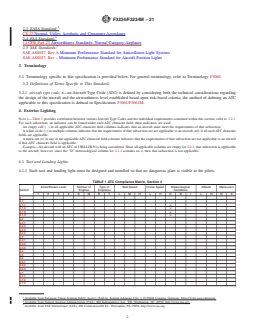
NOTE 1—Table 1 provides correlation between various Aircraft Type Codes and the individual requirements contained within this section; refer to 3.2.1.
For each subsection, an indicator can be found under each ATC character field; three indicators are used:
An empty cell ( ) in all applicable ATC character field columns indicates that an aircraft must meet the requirements of that subsection.
A white circle (○) in multiple columns indicates that the requirements of that subsection are not applicable to an aircraft only if all such ATC character
fields are applicable.
A mark-out (×) in any of the applicable ATC character field columns indicates that the requirements of that subsection are not applicable to an aircraft
if that ATC character field is applicable.
Example—An aircraft with an ATC of 1SRLLDLN is being considered. Since all applicable columns are empty for 4.2.1, that subsection is applicable
to the aircraft; however, since the “D” meteorological column for 4.1.1 contains an ×, then that subsection is not applicable.
4.1 Taxi and Landing Lights:
4.1.1 Each taxi and landing light must be designed and installed so that no dangerous glare is visible to the pilots.
TABLE 1 ATC Compliance Matrix, Section 4
Airworthiness Level Number of Type of Stall Speed Cruise Speed Meteorological Altitude Maneuvers
Section Engines Engine(s) Conditions
1 2 3 4 S M R T L M H L H D N I L H N A
4.1
4.1.1 ×
4.1.2 ×
4.1.3 ×
4.1.4 ×
4.2
4.2.1
4.2.2
4.2.3
4.2.4
4.3
4.3.1
4.3.2
4.3.3
4.4
4.5
4.6
4.6.1
4.6.2
4.6.3
4.7
4.7.1
4.7.2
4.7.3
Available from European Union Aviation Safety Agency (EASA), Konrad-Adenauer-Ufer 3, D-50668 Cologne, Germany, https://www.easa.europa.eu.
Available from Federal Aviation Administration (FAA), 800 Independence Ave., SW, Washington, DC 20591, http://www.faa.gov.
Available from SAE International (SAE), 400 Commonwealth Dr., Warrendale, PA 15096, http://www.sae.org.
F3234/F3234M − 21
4.1.2 Each taxi and landing light must be designed and installed so that the pilot is not seriously affected by halation.
4.1.3 Each taxi and landing light must be designed and installed so that it provides enough light for night operations.
4.1.4 Each taxi and landing light must be designed and installed so that it does not cause a fire hazard in any configuration.
4.2 Position Light Systems:
4.2.1 Each part of each position light system must meet the applicable requirements of this section, and each system as a whole
must meet the requirements of SAE AS8037.
4.2.2 Left and right position lights must consist of a red and green light spaced laterally as far apart as practicable and installed
on the aircraft such that, with the aircraft in the normal flying position, the red light is on the left side and the green light is on
the right side.
4.2.3 The rear position light must be a white light mounted as far aft as practicable on the tail or on each wing tip.
4.2.4 Each light cover or color filter must be at least flame resistant and may not change color or shape or lose any appreciable
light transmission during normal use.
4.3 Position Light Dihedral Angles:
4.3.1 Dihedral angles are defined in SAE AS8037.
4.3.2 Except as provided in 4.3.3, each position light must, as install
...