

ASTM C597-22
(Test Method)Standard Test Method for Ultrasonic Pulse Velocity Through Concrete
General Information
- Abstract
SIGNIFICANCE AND USE
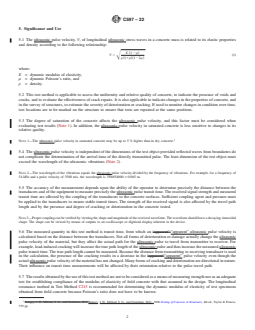
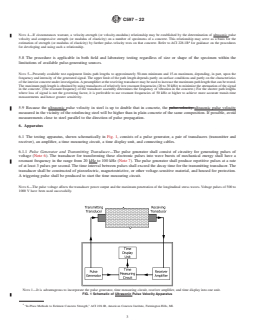
5.1 The ultrasonic pulse velocity, V, of longitudinal ultrasonic stress waves in a concrete mass is related to its elastic properties and density according to the following relationship:
where:
E = dynamic modulus of elasticity, μ = dynamic Poisson's ratio, and ρ = density.
5.2 This test method is applicable to assess the uniformity and relative quality of concrete, to indicate the presence of voids and cracks, and to evaluate the effectiveness of crack repairs. It is also applicable to indicate changes in the properties of concrete, and in the survey of structures, to estimate the severity of deterioration or cracking. If used to monitor changes in condition over time, test locations are to be marked on the structure to ensure that tests are repeated at the same positions.
5.3 The degree of saturation of the concrete affects the ultrasonic pulse velocity, and this factor must be considered when evaluating test results (Note 1). In addition, the ultrasonic pulse velocity in saturated concrete is less sensitive to changes in its relative quality.
Note 1: The ultrasonic pulse velocity in saturated concrete may be up to 5 % higher than in dry concrete.3
5.4 The ultrasonic pulse velocity is independent of the dimensions of the test object provided reflected waves from boundaries do not complicate the determination of the arrival time of the directly transmitted pulse. The least dimension of the test object must exceed the wavelength of the ultrasonic vibrations (Note 2).
Note 2: The wavelength of the vibrations equals the ultrasonic pulse velocity divided by the frequency of vibrations. For example, for a frequency of 54 kHz and a pulse velocity of 3500 m/s, the wavelength is 3500/54000 = 0.065 m.
5.5 The accuracy of the measurement depends upon the ability of the operator to determine precisely the distance between the transducers and of the equipment to measure precisely the ultrasonic pulse transit time. The receive...
SCOPE
1.1 This test method covers the determination of the propagation velocity of longitudinal ultrasonic stress wave pulses through concrete. This test method does not apply to the propagation of other types of stress waves through concrete.
1.2 The values stated in SI units are to be regarded as standard. No other units of measurement are included in this standard.
1.3 This standard does not purport to address all of the safety concerns, if any, associated with its use. It is the responsibility of the user of this standard to establish appropriate safety, health, and environmental practices and determine the applicability of regulatory limitations prior to use.
1.4 This international standard was developed in accordance with internationally recognized principles on standardization established in the Decision on Principles for the Development of International Standards, Guides and Recommendations issued by the World Trade Organization Technical Barriers to Trade (TBT) Committee.
- Status
- Published
- Publication Date
- 14-Dec-2022
- Technical Committee
- C09 - Concrete and Concrete Aggregates
- Drafting Committee
- C09.64 - Nondestructive and In-Place Testing

Overview
ASTM C597-22, "Standard Test Method for Ultrasonic Pulse Velocity Through Concrete," is an internationally recognized standard issued by ASTM International. This standard specifies the method for determining the propagation velocity of longitudinal ultrasonic stress wave pulses through concrete. The ultrasonic pulse velocity (UPV) is closely related to the elastic properties and density of concrete, providing valuable, non-destructive insights into concrete quality, uniformity, and the presence of defects such as voids and cracks.
ASTM C597-22 is widely used in both laboratory and field evaluations, offering a reliable technique for monitoring structural integrity and changes in concrete over time. This standard is an essential reference for professionals involved in nondestructive testing (NDT) of concrete structures, civil engineering, and construction quality assurance.
Key Topics
- Applicability: The method applies exclusively to longitudinal ultrasonic stress waves in concrete and does not cover other types of stress waves.
- Assessment Objectives:
- Uniformity and quality: Identifies variations, voids, and cracks in concrete.
- Repair evaluation: Assesses the effectiveness of concrete crack repairs.
- Structural monitoring: Tracks changes in material properties and deterioration over time.
- Measurement Principle: UPV is calculated by dividing the distance between transducers by the electronically measured transit time of the ultrasonic pulse.
- Factors Affecting Results:
- Concrete saturation: Pulse velocity increases in saturated concrete, which must be considered during interpretation.
- Dimensions and boundaries: Accurate results require test objects larger than the ultrasonic wavelength to avoid effects from reflected waves.
- Reinforcement presence: Steel reinforcements can skew results, as UPV in steel is higher than in concrete.
- Test Equipment: Includes a pulse generator, matched transducers, time-measuring circuit, display unit, reference bar, shielded cables, and suitable coupling agents.
Applications
Ultrasonic pulse velocity testing using ASTM C597-22 plays a crucial role in contemporary concrete assessment and maintenance:
- Nondestructive Testing (NDT): Enables comprehensive evaluation of concrete without damaging the structure, essential for bridges, tunnels, buildings, and other infrastructure.
- Quality Control: Used in both new construction and existing structures to ensure compliance with design specifications and detect early signs of degradation.
- Deterioration and Crack Detection: Locates and determines the extent of defects such as cracks, voids, honeycombing, or damage caused by physical and environmental factors.
- Effectiveness of Repairs: Assesses how successfully repairs or crack injections have restored concrete integrity.
- Research and Structural Health Monitoring: Supports academic and industrial research by providing repeatable data on material performance and the impact of various influences over time.
- Fire Damage Evaluation: Estimation of the impact of high temperatures on the mechanical properties of concrete structures.
Related Standards
Comprehensive concrete evaluation often draws on additional ASTM and related standards:
- ASTM C125: Terminology Relating to Concrete and Concrete Aggregates
- ASTM C215: Test Method for Fundamental Resonant Frequencies of Concrete Specimens
- ASTM C823/C823M: Practice for Examination and Sampling of Hardened Concrete in Constructions
- ASTM E1316: Terminology for Nondestructive Examinations
- ACI 228.1R: In-Place Methods to Estimate Concrete Strength
These documents, together with ASTM C597-22, form the foundation for robust, standardized nondestructive testing procedures for concrete in the construction industry.
Keywords: ultrasonic pulse velocity, ASTM C597-22, nondestructive testing, concrete testing, structural integrity, UPV, concrete uniformity, crack detection, concrete quality, ASTM standards
Relations
- Effective Date
- 01-Feb-2024
- Effective Date
- 15-Dec-2019
- Effective Date
- 01-Dec-2019
- Effective Date
- 01-Mar-2019
- Effective Date
- 01-Jan-2019
- Effective Date
- 01-Oct-2018
- Effective Date
- 01-Jul-2018
- Effective Date
- 01-Jan-2018
- Effective Date
- 01-Jan-2018
- Effective Date
- 15-Jun-2017
- Effective Date
- 01-May-2017
- Effective Date
- 01-Feb-2017
- Effective Date
- 15-Dec-2016
- Effective Date
- 01-Aug-2016
- Effective Date
- 01-Feb-2016
Get Certified
Connect with accredited certification bodies for this standard

DIBt (Deutsches Institut für Bautechnik)
German Institute for Building Technology.
DIN CERTCO
DIN Group product certification.

Aboma Certification B.V.
Specialized in construction, metal, and transport sectors.
Sponsored listings
Frequently Asked Questions
ASTM C597-22 is a standard published by ASTM International. Its full title is "Standard Test Method for Ultrasonic Pulse Velocity Through Concrete". This standard covers: SIGNIFICANCE AND USE 5.1 The ultrasonic pulse velocity, V, of longitudinal ultrasonic stress waves in a concrete mass is related to its elastic properties and density according to the following relationship: where: E = dynamic modulus of elasticity, μ = dynamic Poisson's ratio, and ρ = density. 5.2 This test method is applicable to assess the uniformity and relative quality of concrete, to indicate the presence of voids and cracks, and to evaluate the effectiveness of crack repairs. It is also applicable to indicate changes in the properties of concrete, and in the survey of structures, to estimate the severity of deterioration or cracking. If used to monitor changes in condition over time, test locations are to be marked on the structure to ensure that tests are repeated at the same positions. 5.3 The degree of saturation of the concrete affects the ultrasonic pulse velocity, and this factor must be considered when evaluating test results (Note 1). In addition, the ultrasonic pulse velocity in saturated concrete is less sensitive to changes in its relative quality. Note 1: The ultrasonic pulse velocity in saturated concrete may be up to 5 % higher than in dry concrete.3 5.4 The ultrasonic pulse velocity is independent of the dimensions of the test object provided reflected waves from boundaries do not complicate the determination of the arrival time of the directly transmitted pulse. The least dimension of the test object must exceed the wavelength of the ultrasonic vibrations (Note 2). Note 2: The wavelength of the vibrations equals the ultrasonic pulse velocity divided by the frequency of vibrations. For example, for a frequency of 54 kHz and a pulse velocity of 3500 m/s, the wavelength is 3500/54000 = 0.065 m. 5.5 The accuracy of the measurement depends upon the ability of the operator to determine precisely the distance between the transducers and of the equipment to measure precisely the ultrasonic pulse transit time. The receive... SCOPE 1.1 This test method covers the determination of the propagation velocity of longitudinal ultrasonic stress wave pulses through concrete. This test method does not apply to the propagation of other types of stress waves through concrete. 1.2 The values stated in SI units are to be regarded as standard. No other units of measurement are included in this standard. 1.3 This standard does not purport to address all of the safety concerns, if any, associated with its use. It is the responsibility of the user of this standard to establish appropriate safety, health, and environmental practices and determine the applicability of regulatory limitations prior to use. 1.4 This international standard was developed in accordance with internationally recognized principles on standardization established in the Decision on Principles for the Development of International Standards, Guides and Recommendations issued by the World Trade Organization Technical Barriers to Trade (TBT) Committee.
SIGNIFICANCE AND USE 5.1 The ultrasonic pulse velocity, V, of longitudinal ultrasonic stress waves in a concrete mass is related to its elastic properties and density according to the following relationship: where: E = dynamic modulus of elasticity, μ = dynamic Poisson's ratio, and ρ = density. 5.2 This test method is applicable to assess the uniformity and relative quality of concrete, to indicate the presence of voids and cracks, and to evaluate the effectiveness of crack repairs. It is also applicable to indicate changes in the properties of concrete, and in the survey of structures, to estimate the severity of deterioration or cracking. If used to monitor changes in condition over time, test locations are to be marked on the structure to ensure that tests are repeated at the same positions. 5.3 The degree of saturation of the concrete affects the ultrasonic pulse velocity, and this factor must be considered when evaluating test results (Note 1). In addition, the ultrasonic pulse velocity in saturated concrete is less sensitive to changes in its relative quality. Note 1: The ultrasonic pulse velocity in saturated concrete may be up to 5 % higher than in dry concrete.3 5.4 The ultrasonic pulse velocity is independent of the dimensions of the test object provided reflected waves from boundaries do not complicate the determination of the arrival time of the directly transmitted pulse. The least dimension of the test object must exceed the wavelength of the ultrasonic vibrations (Note 2). Note 2: The wavelength of the vibrations equals the ultrasonic pulse velocity divided by the frequency of vibrations. For example, for a frequency of 54 kHz and a pulse velocity of 3500 m/s, the wavelength is 3500/54000 = 0.065 m. 5.5 The accuracy of the measurement depends upon the ability of the operator to determine precisely the distance between the transducers and of the equipment to measure precisely the ultrasonic pulse transit time. The receive... SCOPE 1.1 This test method covers the determination of the propagation velocity of longitudinal ultrasonic stress wave pulses through concrete. This test method does not apply to the propagation of other types of stress waves through concrete. 1.2 The values stated in SI units are to be regarded as standard. No other units of measurement are included in this standard. 1.3 This standard does not purport to address all of the safety concerns, if any, associated with its use. It is the responsibility of the user of this standard to establish appropriate safety, health, and environmental practices and determine the applicability of regulatory limitations prior to use. 1.4 This international standard was developed in accordance with internationally recognized principles on standardization established in the Decision on Principles for the Development of International Standards, Guides and Recommendations issued by the World Trade Organization Technical Barriers to Trade (TBT) Committee.
ASTM C597-22 is classified under the following ICS (International Classification for Standards) categories: 91.100.30 - Concrete and concrete products. The ICS classification helps identify the subject area and facilitates finding related standards.
ASTM C597-22 has the following relationships with other standards: It is inter standard links to ASTM E1316-24, ASTM C125-19a, ASTM E1316-19b, ASTM E1316-19, ASTM C125-19, ASTM C125-18b, ASTM C125-18a, ASTM E1316-18, ASTM C125-18, ASTM E1316-17a, ASTM C823/C823M-12(2017), ASTM E1316-17, ASTM C125-16, ASTM E1316-16a, ASTM E1316-16. Understanding these relationships helps ensure you are using the most current and applicable version of the standard.
ASTM C597-22 is available in PDF format for immediate download after purchase. The document can be added to your cart and obtained through the secure checkout process. Digital delivery ensures instant access to the complete standard document.
Standards Content (Sample)
This international standard was developed in accordance with internationally recognized principles on standardization established in the Decision on Principles for the
Development of International Standards, Guides and Recommendations issued by the World Trade Organization Technical Barriers to Trade (TBT) Committee.
Designation: C597 − 22
Standard Test Method for
Ultrasonic Pulse Velocity Through Concrete
This standard is issued under the fixed designation C597; the number immediately following the designation indicates the year of
original adoption or, in the case of revision, the year of last revision. A number in parentheses indicates the year of last reapproval. A
superscript epsilon (´) indicates an editorial change since the last revision or reapproval.
This standard has been approved for use by agencies of the U.S. Department of Defense.
1. Scope* 3. Terminology
3.1 Definitions—Refer to Terminology C125 and the section
1.1 This test method covers the determination of the propa-
related to ultrasonic examination in Terminology E1316 for
gation velocity of longitudinal ultrasonic stress wave pulses
definitions of terms used in this test method.
through concrete. This test method does not apply to the
propagation of other types of stress waves through concrete.
4. Summary of Test Method
1.2 The values stated in SI units are to be regarded as
4.1 Pulses of longitudinal ultrasonic stress waves are gen-
standard. No other units of measurement are included in this
erated by an electro-acoustical transducer that is held in contact
standard.
with one surface of the concrete under test. After traversing
through the concrete, the pulses are received and converted
1.3 This standard does not purport to address all of the
into electrical energy by a second transducer located a distance
safety concerns, if any, associated with its use. It is the
L from the transmitting transducer. The transit time T is
responsibility of the user of this standard to establish appro-
measured electronically. The ultrasonic pulse velocity V is
priate safety, health, and environmental practices and deter-
calculated by dividing L by T.
mine the applicability of regulatory limitations prior to use.
1.4 This international standard was developed in accor-
5. Significance and Use
dance with internationally recognized principles on standard-
5.1 The ultrasonic pulse velocity, V, of longitudinal ultra-
ization established in the Decision on Principles for the
sonic stress waves in a concrete mass is related to its elastic
Development of International Standards, Guides and Recom-
properties and density according to the following relationship:
mendations issued by the World Trade Organization Technical
Barriers to Trade (TBT) Committee.
E 1 2 μ
~ !
V 5Π(1)
ρ ~11μ!~1 2 2 μ!
2. Referenced Documents
where:
2.1 ASTM Standards:
E = dynamic modulus of elasticity,
C125 Terminology Relating to Concrete and Concrete Ag-
μ = dynamic Poisson’s ratio, and
gregates
ρ = density.
C215 Test Method for Fundamental Transverse,
5.2 This test method is applicable to assess the uniformity
Longitudinal, and Torsional Resonant Frequencies of
and relative quality of concrete, to indicate the presence of
Concrete Specimens
voids and cracks, and to evaluate the effectiveness of crack
C823/C823M Practice for Examination and Sampling of
repairs. It is also applicable to indicate changes in the proper-
Hardened Concrete in Constructions
ties of concrete, and in the survey of structures, to estimate the
E1316 Terminology for Nondestructive Examinations
severity of deterioration or cracking. If used to monitor
changes in condition over time, test locations are to be marked
on the structure to ensure that tests are repeated at the same
This test method is under the jurisdiction of ASTM Committee C09 on
positions.
Concrete and Concrete Aggregates and is the direct responsibility of Subcommittee
C09.64 on Nondestructive and In-Place Testing.
5.3 The degree of saturation of the concrete affects the
Current edition approved Dec. 15, 2022. Published February 2023. Originally
ultrasonic pulse velocity, and this factor must be considered
approved in 1967. Last previous edition approved in 2016 as C597 – 16. DOI:
when evaluating test results (Note 1). In addition, the ultrasonic
10.1520/C0597-22.
pulse velocity in saturated concrete is less sensitive to changes
For referenced ASTM standards, visit the ASTM website, www.astm.org, or
contact ASTM Customer Service at service@astm.org. For Annual Book of ASTM
in its relative quality.
Standards volume information, refer to the standard’s Document Summary page on
the ASTM website. NOTE 1—The ultrasonic pulse velocity in saturated concrete may be up
*A Summary of Changes section appears at the end of this standard
Copyright © ASTM International, 100 Barr Harbor Drive, PO Box C700, West Conshohocken, PA 19428-2959. United States
C597 − 22
3 4
to 5 % higher than in dry concrete. pulse-velocity tests on that concrete. Refer to ACI 228.1R for guidance
on the procedures for developing and using such a relationship.
5.4 The ultrasonic pulse velocity is independent of the
5.8 The procedure is applicable in both field and laboratory
dimensions of the test object provided reflected waves from
testing regardless of size or shape of the specimen within the
boundaries do not complicate the determination of the arrival
limitations of available pulse-generating sources.
time of the directly transmitted pulse. The least dimension of
the test object must exceed the wavelength of the ultrasonic
NOTE 5—Presently available test equipment limits path lengths to
vibrations (Note 2).
approximately 50-mm minimum and 15-m maximum, depending, in part,
upon the frequency and intensity of the generated signal. The upper limit
NOTE 2—The wavelength of the vibrations equals the ultrasonic pulse
of the path length depends partly on surface conditions and partly on the
velocity divided by the frequency of vibrations. For example, for a
characteristics of the interior concrete under investigation. A preamplifier
frequency of 54 kHz and a pulse velocity of 3500 m/s, the wavelength is
at the receiving transducer may be used to increase the maximum path
3500/54000 = 0.065 m.
length that can be tested. The maximum path length is obtained by using
transducers of relatively low resonant frequencies (20 to 30 kHz) to
5.5 The accuracy of the measurement depends upon the
minimize the attenuation of the signal in the concrete. (The resonant
ability of the operator to determine precisely the distance
frequency of the transducer assembly determines the frequency of
between the transducers and of the equipment to measure
vibration in the concrete.) For the shorter path lengths where loss of signal
precisely the ultrasonic pulse transit time. The received signal
is not the governing factor, it is preferable to use resonant frequencies of
strength and measured transit time are affected by the coupling 50 kHz or higher to achieve more accurate transit-time measurements and
hence greater sensitivity.
of the transducers to the concrete surfaces. Sufficient coupling
agent and pressure must be applied to the transducers to ensure
5.9 Because the ultrasonic pulse velocity in steel is up to
stable transit times. The strength of the received signal is also
double that in concrete, the ultrasonic pulse velocity measured
affected by the travel path length and by the presence and
in the vicinity of the reinforcing steel will be higher than in
degree of cracking or deterioration in the concrete tested.
plain concrete of the same composition. If possible, avoid
measurements close to steel parallel to the direction of pulse
NOTE 3—Proper coupling can be verified by viewing the shape and
propagation.
magnitude of the received waveform. The waveform should have a
decaying sinusoidal shape. The shape can be viewed by means of outputs
6. Apparatus
to an oscilloscope or digitized display inherent in the device.
5.6 The measured quantity in this test method is transit time, 6.1 The testing apparatus, shown schematically in Fig. 1,
consists of a pulse generator, a pair of transducers (transmitter
from which an “apparent” ultrasonic pulse velocity is calcu-
lated based on the distance between the transducers. Not all and receiver), an amplifier, a time measuring circuit, a time
display unit, and connecting cables.
forms of deterioration or damage actually change the ultrasonic
pulse velocity of the material, but they affect the actual path for 6.1.1 Pulse Generator and Transmitting Transducer—The
pulse generator shall consist of circuitry for generating pulses
the ultrasonic pulse to travel from transmitter to receiver. For
example, load-induced cracking will increase the true path of voltage (Note 6). The transducer for transforming these
electronic pulses into wave bursts of mechanical energy shall
length of the ultrasonic pulse and thus increase the measured
ultrasonic pulse transit time. The true path length cannot be have a resonant frequency in the range from 20 kHz to 100 kHz
measured. Because the distance from transmitting to receiving
transducer is used in the calculation, the presence of the
“In-Place Methods to Estimate Concrete Strength,” ACI 228.1R, American
cracking results in a decrease in the “apparent” pulse velocity
Concrete Institute, Farmington Hills, MI.
even though the actual ultrasonic pulse velocity of the material
has not changed. Many forms of cracking and deterioration are
directional in nature. Their influence on transit time measure-
ments will be affected by their orientation relative to the pulse
travel path.
5.7 The results obtained by the use of this test method are
not to be considered as a means of measuring strength nor as
an adequate test for establishing compliance of the modulus of
elasticity of field concrete with that assumed in the design. The
longitudinal resonance method in Test Method C215 is recom-
mended for determining the dynamic modulus of elasticity of
test specimens obtained from field concrete because Poisson’s
ratio does not have to be known.
NOTE 4—If circumstances warrant, a velocity-strength (or velocity-
modulus) relationship may be established by the determination of ultra-
sonic pulse velocity and compressive strength (or modulus of elasticity)
on a number of specimens of a concrete. This relationship may serve as a
basis for the estimation of strength (or modulus of elasticity) by further
NOTE 1—It is advantageou
...
This document is not an ASTM standard and is intended only to provide the user of an ASTM standard an indication of what changes have been made to the previous version. Because
it may not be technically possible to adequately depict all changes accurately, ASTM recommends that users consult prior editions as appropriate. In all cases only the current version
of the standard as published by ASTM is to be considered the official document.
Designation: C597 − 16 C597 − 22
Standard Test Method for
Ultrasonic Pulse Velocity Through Concrete
This standard is issued under the fixed designation C597; the number immediately following the designation indicates the year of
original adoption or, in the case of revision, the year of last revision. A number in parentheses indicates the year of last reapproval. A
superscript epsilon (´) indicates an editorial change since the last revision or reapproval.
This standard has been approved for use by agencies of the U.S. Department of Defense.
1. Scope*
1.1 This test method covers the determination of the propagation velocity of longitudinal ultrasonic stress wave pulses through
concrete. This test method does not apply to the propagation of other types of stress waves through concrete.
1.2 The values stated in SI units are to be regarded as standard. No other units of measurement are included in this standard.
1.3 This standard does not purport to address all of the safety concerns, if any, associated with its use. It is the responsibility
of the user of this standard to establish appropriate safety and healthsafety, health, and environmental practices and determine
the applicability of regulatory limitations prior to use.
1.4 This international standard was developed in accordance with internationally recognized principles on standardization
established in the Decision on Principles for the Development of International Standards, Guides and Recommendations issued
by the World Trade Organization Technical Barriers to Trade (TBT) Committee.
2. Referenced Documents
2.1 ASTM Standards:
C125 Terminology Relating to Concrete and Concrete Aggregates
C215 Test Method for Fundamental Transverse, Longitudinal, and Torsional Resonant Frequencies of Concrete Specimens
C823C823/C823M Practice for Examination and Sampling of Hardened Concrete in Constructions
E1316 Terminology for Nondestructive Examinations
3. Terminology
3.1 Definitions—Refer to Terminology C125 and the section related to ultrasonic examination in Terminology E1316 for
definitions of terms used in this test method.
4. Summary of Test Method
4.1 Pulses of longitudinal ultrasonic stress waves are generated by an electro-acoustical transducer that is held in contact with one
surface of the concrete under test. After traversing through the concrete, the pulses are received and converted into electrical energy
by a second transducer located a distance L from the transmitting transducer. The transit time T is measured electronically. The
ultrasonic pulse velocity V is calculated by dividing L by T.
This test method is under the jurisdiction of ASTM Committee C09 on Concrete and Concrete Aggregates and is the direct responsibility of Subcommittee C09.64 on
Nondestructive and In-Place Testing.
Current edition approved April 1, 2016Dec. 15, 2022. Published May 2016February 2023. Originally approved in 1967. Last previous edition approved in 20092016 as
C597 – 09.C597 – 16. DOI: 10.1520/C0597-16.10.1520/C0597-22.
For referenced ASTM standards, visit the ASTM website, www.astm.org, or contact ASTM Customer Service at service@astm.org. For Annual Book of ASTM Standards
volume information, refer to the standard’s Document Summary page on the ASTM website.
*A Summary of Changes section appears at the end of this standard
Copyright © ASTM International, 100 Barr Harbor Drive, PO Box C700, West Conshohocken, PA 19428-2959. United States
C597 − 22
5. Significance and Use
5.1 The ultrasonic pulse velocity, V, of longitudinal ultrasonic stress waves in a concrete mass is related to its elastic properties
and density according to the following relationship:
E 12 μ
~ !
V 5Π(1)
ρ ~11μ!~122μ!
where:
E = dynamic modulus of elasticity,
μ = dynamic Poisson’s ratio, and
ρ = density.
5.2 This test method is applicable to assess the uniformity and relative quality of concrete, to indicate the presence of voids and
cracks, and to evaluate the effectiveness of crack repairs. It is also applicable to indicate changes in the properties of concrete, and
in the survey of structures, to estimate the severity of deterioration or cracking. If used to monitor changes in condition over time,
test locations are to be marked on the structure to ensure that tests are repeated at the same positions.
5.3 The degree of saturation of the concrete affects the ultrasonic pulse velocity, and this factor must be considered when
evaluating test results (Note 1). In addition, the ultrasonic pulse velocity in saturated concrete is less sensitive to changes in its
relative quality.
NOTE 1—The ultrasonic pulse velocity in saturated concrete may be up to 5 % higher than in dry concrete.
5.4 The ultrasonic pulse velocity is independent of the dimensions of the test object provided reflected waves from boundaries do
not complicate the determination of the arrival time of the directly transmitted pulse. The least dimension of the test object must
exceed the wavelength of the ultrasonic vibrations (Note 2).
NOTE 2—The wavelength of the vibrations equals the ultrasonic pulse velocity divided by the frequency of vibrations. For example, for a frequency of
54 kHz and a pulse velocity of 3500 m/s, the wavelength is 3500/54000 = 0.065 m.
5.5 The accuracy of the measurement depends upon the ability of the operator to determine precisely the distance between the
transducers and of the equipment to measure precisely the ultrasonic pulse transit time. The received signal strength and measured
transit time are affected by the coupling of the transducers to the concrete surfaces. Sufficient coupling agent and pressure must
be applied to the transducers to ensure stable transit times. The strength of the received signal is also affected by the travel path
length and by the presence and degree of cracking or deterioration in the concrete tested.
NOTE 3—Proper coupling can be verified by viewing the shape and magnitude of the received waveform. The waveform should have a decaying sinusoidal
shape. The shape can be viewed by means of outputs to an oscilloscope or digitized display inherent in the device.
5.6 The measured quantity in this test method is transit time, from which an ‘apparent’ “apparent” ultrasonic pulse velocity is
calculated based on the distance between the transducers. Not all forms of deterioration or damage actually change the ultrasonic
pulse velocity of the material, but they affect the actual path for the ultrasonic pulse to travel from transmitter to receiver. For
example, load-induced cracking will increase the true path length of the ultrasonic pulse and thus increase the measured ultrasonic
pulse transit time. The true path length cannot be measured. Because the distance from transmitting to receiving transducer is used
in the calculation, the presence of the cracking results in a decrease in the ‘apparent’“apparent” pulse velocity even though the
actual ultrasonic pulse velocity of the material has not changed. Many forms of cracking and deterioration are directional in nature.
Their influence on transit time measurements will be affected by their orientation relative to the pulse travel path.
5.7 The results obtained by the use of this test method are not to be considered as a means of measuring strength nor as an adequate
test for establishing compliance of the modulus of elasticity of field concrete with that assumed in the design. The longitudinal
resonance method in Test Method C215 is recommended for determining the dynamic modulus of elasticity of test specimens
obtained from field concrete because Poisson’s ratio does not have to be known.
Bungey, J. H., Millard, S. G., and Grantham, M.G.Bungey, J. H., Millard, S. G., and Grantham, M.G., 2006 Testing of Concrete in Structures, 4th ed., Taylor & Francis,
339 pp.
C597 − 22
NOTE 4—If circumstances warrant, a velocity-strength (or velocity-modulus) relationship may be established by the determination of ultrasonic pulse
velocity and compressive strength (or modulus of elasticity) on a number of specimens of a concrete. This relationship may serve as a basis for the
estimation of strength (or modulus of elasticity) by further pulse-velocity tests on that concrete. Refer to ACI 228.1R for guidance on the procedures
for developing and using such a relationship.
5.8 The procedure is applicable in both field and laboratory testing regardless of size or shape of the specimen within the
limitations of available pulse-generating sources.
NOTE 5—Presently available test equipment limits path lengths to approximately 50-mm minimum and 15-m maximum, depending, in part, upon the
frequency and intensity of the generated signal. The upper limit of the path length depends partly on surface conditions and partly on the characteristics
of the interior concrete under investigation. A preamplifier at the receiving transducer may be used to increase the maximum path length that can be tested.
The maximum path length is obtained by using transducers of relatively low resonant frequencies (20 to 30 kHz) to minimize the attenuation of the signal
in the concrete. (The resonant frequency of the transducer assembly determines the frequency of vibration in the concrete.) For the shorter path lengths
where loss of signal is not the governing factor, it is preferable to use resonant frequencies of 50 kHz or higher to achieve more accurate transit-time
measurements and hence greater sensitivity.
5.9 Because the ultrasonic pulse velocity in steel is up to double that in concrete, the pulse-velocity ultrasonic pulse velocity
measured in the vicinity of the reinforcing steel will be higher than in plain concrete of the same composition. If possible, avoid
measurements close to steel parallel to the direction of pulse propagation.
6. Apparatus
6.1 The testing apparatus, shown schematically in Fig. 1, consists of a pulse generator, a pair of transducers (transmitter and
receiver), an amplifier, a time measuring circuit, a time display unit, and connecting cables.
6.1.1 Pulse Generator and Transmitting Transducer—The pulse generator shall consist of circuitry for generating pulses of
voltage (Note 6). The transducer for transforming these electronic pulses into wave bursts of mechanical energy shall have a
resonant frequency in the range from 20 kHz to 100 kHz (Note 7). The pulse generator shall produce repetitive pulses
...