

ASTM C839-82(2020)
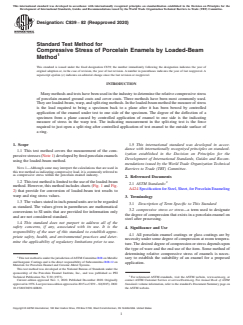
(Test Method)Standard Test Method for Compressive Stress of Porcelain Enamels by Loaded-Beam Method
General Information
- Abstract
SIGNIFICANCE AND USE
4.1 All porcelain enamel coatings or glass coatings are by necessity under some degree of compression at room temperature. The desired degree of compression or stress depends upon the type of ware and the end use of the item. Some method of determining relative compressive stress of enamels is necessary to establish the suitability of an enamel for a proposed application.
SCOPE
1.1 This test method covers the measurement of the compressive stresses (Note 1) developed by fired porcelain enamels using the loaded-beam method.
Note 1: Although some may interpret the calculations that are used in this test method as indicating compressive load, it is commonly referred to as compressive stress within the porcelain enamel industry.
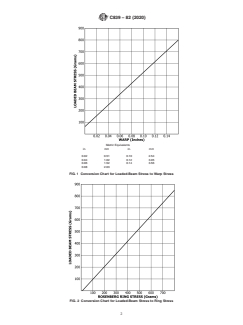
1.2 This test method is limited to the use of the loaded-beam method. However, this method includes charts (Fig. 1 and Fig. 2) that provide for conversion of loaded-beam test results to warp and ring stress values.
FIG. 2 Conversion Chart for Loaded-Beam Stress to Ring Stress
1.3 The values stated in inch-pound units are to be regarded as standard. The values given in parentheses are mathematical conversions to SI units that are provided for information only and are not considered standard.
1.4 This standard does not purport to address all of the safety concerns, if any, associated with its use. It is the responsibility of the user of this standard to establish appropriate safety, health, and environmental practices and determine the applicability of regulatory limitations prior to use.
1.5 This international standard was developed in accordance with internationally recognized principles on standardization established in the Decision on Principles for the Development of International Standards, Guides and Recommendations issued by the World Trade Organization Technical Barriers to Trade (TBT) Committee.
- Status
- Published
- Publication Date
- 31-Oct-2020
- Technical Committee
- B08 - Metallic and Inorganic Coatings
- Drafting Committee
- B08.12 - Materials for Porcelain Enamel and Ceramic-Metal Systems
Overview
ASTM C839-82(2020), titled Standard Test Method for Compressive Stress of Porcelain Enamels by Loaded-Beam Method, specifies a reliable approach for determining the compressive stress in fired porcelain enamels and glass coatings. Developed by ASTM International, this test method is essential for quality control and product development within industries utilizing porcelain enamel coatings, particularly on steel substrates. It utilizes the loaded-beam method, a widely accepted practice to assess the level of compressive stress, which is a critical property influencing the durability and performance of enamel-coated items.
Key Topics
- Compressive Stress Measurement: This standard outlines the procedures to quantify compressive stress in porcelain enamels using the loaded-beam apparatus. This stress arises during the manufacturing process and directly impacts the coating's integrity and lifespan.
- Loaded-Beam Method: The method involves loading enamel-coated specimens until they return to a planar state from a bowed position, allowing calculation of compressive stress.
- Specimen Preparation: The standard includes detailed requirements for specimen dimensions, preparation, and proper firing to ensure consistent and valid results.
- Conversion Charts: Provisions are made for converting loaded-beam test data to equivalent warp and ring stress values using standardized charts, broadening the method's utility.
- Statistical Evaluation: Guidance is provided for averaging results and determining statistical error, ensuring data reliability and enabling informed comparison between batches or products.
- Safety and Units: The test is standardized in inch-pound units, while metric equivalents are provided for information. Users are reminded to manage their own safety and regulatory compliance.
Applications
ASTM C839-82(2020) is widely used in:
- Quality Assurance: Manufacturers use this method to verify the compressive stress of porcelain enamel coatings, ensuring products meet internal and regulatory standards before market release.
- Material Suitability Assessments: By quantifying compressive stress, engineers can establish the suitability of a specific enamel for demanding environments or applications such as in cookware, appliances, architectural panels, and industrial vessels.
- Research and Development: Material scientists and R&D teams apply this test to evaluate new enamel formulas or alternate production parameters, ensuring optimal compression levels for innovative products.
- Comparative Analysis: The standard's conversion charts facilitate direct comparison between the loaded-beam, warp, and ring methods, which is valuable for benchmarking and specification compliance across different testing protocols.
- Regulatory Compliance: Adoption of this internationally recognized method supports product acceptance in global markets and demonstrates commitment to quality and standardization.
Related Standards
- ASTM A424: Specification for Steel, Sheet, for Porcelain Enameling. Reference material for substrate preparation in accordance with C839 requirements.
- Other ASTM Enamel Test Methods: Such as those for adhesion, thermal shock, and surface quality, complementing the compressive stress assessment for a robust evaluation framework.
- ISO and WTO Guidelines: The standard is developed in line with World Trade Organization Technical Barriers to Trade (TBT) Committee principles, ensuring international harmonization.
By implementing ASTM C839-82(2020), companies in the porcelain enamel industry can achieve reliable product performance, facilitate international trade, and demonstrate compliance with best practices in compressive stress testing for coatings.
Relations
- Effective Date
- 01-Mar-2006
- Effective Date
- 10-Mar-2000
Get Certified
Connect with accredited certification bodies for this standard

DVS-ZERT GmbH
German welding certification society.
CARES (UK Certification Authority for Reinforcing Steels)
UK certification for reinforcing steels and construction.
EWF/IIW (European/International Welding Federation)
International welding personnel certification.
Sponsored listings
Frequently Asked Questions
ASTM C839-82(2020) is a standard published by ASTM International. Its full title is "Standard Test Method for Compressive Stress of Porcelain Enamels by Loaded-Beam Method". This standard covers: SIGNIFICANCE AND USE 4.1 All porcelain enamel coatings or glass coatings are by necessity under some degree of compression at room temperature. The desired degree of compression or stress depends upon the type of ware and the end use of the item. Some method of determining relative compressive stress of enamels is necessary to establish the suitability of an enamel for a proposed application. SCOPE 1.1 This test method covers the measurement of the compressive stresses (Note 1) developed by fired porcelain enamels using the loaded-beam method. Note 1: Although some may interpret the calculations that are used in this test method as indicating compressive load, it is commonly referred to as compressive stress within the porcelain enamel industry. 1.2 This test method is limited to the use of the loaded-beam method. However, this method includes charts (Fig. 1 and Fig. 2) that provide for conversion of loaded-beam test results to warp and ring stress values. FIG. 2 Conversion Chart for Loaded-Beam Stress to Ring Stress 1.3 The values stated in inch-pound units are to be regarded as standard. The values given in parentheses are mathematical conversions to SI units that are provided for information only and are not considered standard. 1.4 This standard does not purport to address all of the safety concerns, if any, associated with its use. It is the responsibility of the user of this standard to establish appropriate safety, health, and environmental practices and determine the applicability of regulatory limitations prior to use. 1.5 This international standard was developed in accordance with internationally recognized principles on standardization established in the Decision on Principles for the Development of International Standards, Guides and Recommendations issued by the World Trade Organization Technical Barriers to Trade (TBT) Committee.
SIGNIFICANCE AND USE 4.1 All porcelain enamel coatings or glass coatings are by necessity under some degree of compression at room temperature. The desired degree of compression or stress depends upon the type of ware and the end use of the item. Some method of determining relative compressive stress of enamels is necessary to establish the suitability of an enamel for a proposed application. SCOPE 1.1 This test method covers the measurement of the compressive stresses (Note 1) developed by fired porcelain enamels using the loaded-beam method. Note 1: Although some may interpret the calculations that are used in this test method as indicating compressive load, it is commonly referred to as compressive stress within the porcelain enamel industry. 1.2 This test method is limited to the use of the loaded-beam method. However, this method includes charts (Fig. 1 and Fig. 2) that provide for conversion of loaded-beam test results to warp and ring stress values. FIG. 2 Conversion Chart for Loaded-Beam Stress to Ring Stress 1.3 The values stated in inch-pound units are to be regarded as standard. The values given in parentheses are mathematical conversions to SI units that are provided for information only and are not considered standard. 1.4 This standard does not purport to address all of the safety concerns, if any, associated with its use. It is the responsibility of the user of this standard to establish appropriate safety, health, and environmental practices and determine the applicability of regulatory limitations prior to use. 1.5 This international standard was developed in accordance with internationally recognized principles on standardization established in the Decision on Principles for the Development of International Standards, Guides and Recommendations issued by the World Trade Organization Technical Barriers to Trade (TBT) Committee.
ASTM C839-82(2020) is classified under the following ICS (International Classification for Standards) categories: 25.220.50 - Enamels. The ICS classification helps identify the subject area and facilitates finding related standards.
ASTM C839-82(2020) has the following relationships with other standards: It is inter standard links to ASTM A424-06, ASTM A424-00. Understanding these relationships helps ensure you are using the most current and applicable version of the standard.
ASTM C839-82(2020) is available in PDF format for immediate download after purchase. The document can be added to your cart and obtained through the secure checkout process. Digital delivery ensures instant access to the complete standard document.
Standards Content (Sample)
This international standard was developed in accordance with internationally recognized principles on standardization established in the Decision on Principles for the
Development of International Standards, Guides and Recommendations issued by the World Trade Organization Technical Barriers to Trade (TBT) Committee.
Designation: C839 − 82 (Reapproved 2020)
Standard Test Method for
Compressive Stress of Porcelain Enamels by Loaded-Beam
Method
This standard is issued under the fixed designation C839; the number immediately following the designation indicates the year of
original adoption or, in the case of revision, the year of last revision.Anumber in parentheses indicates the year of last reapproval.A
superscript epsilon (´) indicates an editorial change since the last revision or reapproval.
INTRODUCTION
Manymethodsandtestshavebeenusedintheindustrytodeterminetherelativecompressivestress
of porcelain enamel ground coats and cover coats. Three methods have been most commonly used.
Theyareloaded-beam,warp,andsplit-ringmethods.Intheloaded-beammethodthemeasureofstress
is the load required to bring a specimen back to a plane after it has been bowed by controlled
application of the enamel under test to one side of the specimen. The degree of the deflection of a
specimen from a plane caused by controlled application of enamel to one side is the indicating
measure of stress in the warp test. The indicating measurement in the split-ring test is the force
required to just open a split ring after controlled application of test enamel to the outside surface of
a ring.
1. Scope 1.5 This international standard was developed in accor-
dance with internationally recognized principles on standard-
1.1 This test method covers the measurement of the com-
ization established in the Decision on Principles for the
pressivestresses(Note1)developedbyfiredporcelainenamels
Development of International Standards, Guides and Recom-
using the loaded-beam method.
mendations issued by the World Trade Organization Technical
NOTE 1—Although some may interpret the calculations that are used in
Barriers to Trade (TBT) Committee.
thistestmethodasindicatingcompressiveload,itiscommonlyreferredto
as compressive stress within the porcelain enamel industry.
2. Referenced Documents
1.2 Thistestmethodislimitedtotheuseoftheloaded-beam
2.1 ASTM Standards:
method. However, this method includes charts (Fig. 1 and Fig.
A424SpecificationforSteel,Sheet,forPorcelainEnameling
2) that provide for conversion of loaded-beam test results to
warp and ring stress values.
3. Terminology
1.3 The values stated in inch-pound units are to be regarded
3.1 Description of Term Specific to This Standard
as standard. The values given in parentheses are mathematical
3.2 compressive stress or stress—a term used to designate
conversions to SI units that are provided for information only
the degree of compression that exists in a porcelain enamel on
and are not considered standard.
steel after processing.
1.4 This standard does not purport to address all of the
safety concerns, if any, associated with its use. It is the
4. Significance and Use
responsibility of the user of this standard to establish appro-
4.1 All porcelain enamel coatings or glass coatings are by
priate safety, health, and environmental practices and deter-
necessity under some degree of compression at room tempera-
mine the applicability of regulatory limitations prior to use.
ture.Thedesireddegreeofcompressionorstressdependsupon
the type of ware and the end use of the item. Some method of
determining relative compressive stress of enamels is neces-
ThistestmethodisunderthejurisdictionofASTMCommitteeB08onMetallic
sary to establish the suitability of an enamel for a proposed
and Inorganic Coatings and is the direct responsibility of Subcommittee B08.12 on
application.
Materials for Porcelain Enamel and Ceramic-Metal Systems.
This test method was developed at the National Bureau of Standards under the
sponsorship of the Porcelain Enamel Institute, Inc., and was published as PEI
Technical Publication No. T-30 (1973). For referenced ASTM standards, visit the ASTM website, www.astm.org, or
Current edition approved Nov. 1, 2020. Published December 2020. Originally contact ASTM Customer Service at service@astm.org. For Annual Book of ASTM
approvedin1976.Lastpreviouseditionapprovedin2015asC839–82(2015).DOI: Standards volume information, refer to the standard’s Document Summary page on
10.1520/C0839-82R20. the ASTM website.
Copyright © ASTM International, 100 Barr Harbor Drive, PO Box C700, West Conshohocken, PA 19428-2959. United States
C839 − 82 (2020)
Metric Equivalents
in. mm in. mm
0.02 0.51 0.10 2.54
0.04 1.02 0.12 3.05
0.06 1.52 0.14 3.56
0.08 2.03
FIG. 1 Conversion Chart for Loaded-Beam Stress to Warp Stress
FIG. 2 Conversion Chart for Loaded-Beam Stress to Ring Stress
C839 − 82 (2020)
5. Apparatus 5.4 Metric Weights, slotted, 1 to 500 g.
5.1 Furnace, suitable for simultaneous firing of at least six 5.5 Laboratory Balance, accurate to 10 mg with necessary
1 by 12-in. (25 by 305-mm) specimens in vertical hanging weights (1 to 100 g).
position.
1 15
5.6 Brushing Template, 2 ⁄16 by 10 ⁄16 in. (52 by 278 mm)
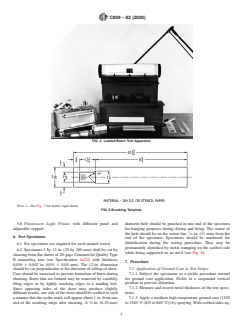
5.2 Firing Rack, suitable for furnace. (seeFig.5foroneexampleofachievingthedesiredendresult).
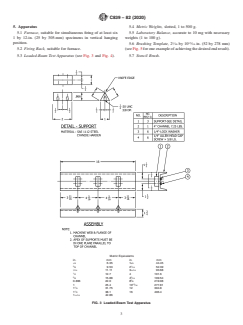
5.3 Loaded-Beam Test Apparatus (see Fig. 3 and Fig. 4). 5.7 Stencil Brush.
Metric Equivalents
in. mm in. mm
1 3
⁄4 6.35 1 ⁄4 44.45
3 1
⁄8 9.53 2 ⁄16 52.39
7 11
⁄16 11.11 3 ⁄16 93.68
⁄2 12.7 4 101.6
5 5
⁄8 15.88 4 ⁄16 109.54
0.866 22.0 8 ⁄8 219.08
1 25.4 10 ⁄16 277.81
1 ⁄4 31.75 12 304.8
1 ⁄2 38.1 16 406.4
1 ⁄16 42.86
FIG. 3 Loaded-Beam Test Apparatus
C839 − 82 (2020)
FIG. 4 Loaded-Beam Test Apparatus
NOTE 1—See Fig. 3 for metric equivalents.
FIG. 5 Brushing Template
5.8 Fluorescent Light Fixture with diffusion panel and diameter hole should be punched in one end of the specimen
adjustable support. for hanging purposes during drying and firing. The center of
the hole should be on the center line ⁄16 in. (11 mm) from the
6. Test Specimens
end of the specimen. Specimens should be numbered for
identification during the testing procedure. They may be
6.1 Six specimens are required for each enamel tested.
permanently identified by metal stamping on the scribed side
6.2 Specimens 1 by 12 in. (25 by 305 mm) shall be cut by
while being supported on an anvil (see Fig. 6).
shearing from flat sheets of 20-gage Commercial QualityType
II enameling iron (see Specification A424) with thickness
7. Procedure
0.036 6 0.002 in. (0.91 6 0.05 mm). The 12-in. dimension
7.1 Application of Ground Coat to Test Strips:
should be cut perpendicular to the direction of rolling of sheet.
7.1.1 Subject the specimens to a pickle procedure normal
Care should be exercised to prevent formation of burrs during
for ground coat application. Pickle in a suspended vertical
shearing. Burrs that are formed may be removed by carefully
position to prevent distortion.
filing edges or by lightly touching edges to a sanding belt.
7.1.2 Measure and record metal thickness of the test speci-
Since opposing sides of the sheet may produce slightly
differentresults,onesideofthesheetshouldbescribedinsuch mens.
a manner that the scribe mark will appear about 1 in. from one 7.1.3 Apply a medium high-temperature ground coat (1520
end of the resulting strips after shearing. A ⁄4-in. (6.35-mm) to1540°F(825to840°C))byspraying.Withscribedsidesup,
C839 − 82 (2020)
NOTE 1—Wipe all bisque cover coat enamel from sides, ends, and back of ground coated test sample before firing cover coat.
NOTE 2—See Fig. 3 for metric equivalents.
FIG. 6 Detail of Test Specimen
first spray the back sides of strips to give 1.5 g dry weight per 7.3.2 Centrally load the strip with slotted weights over the
strip. Dr
...