

ASTM B786/B786M-08(2023)
(Specification)Standard Specification for 19 Wire Combination Unilay-Stranded Aluminum Conductors for Subsequent Insulation
General Information
- Abstract
ABSTRACT
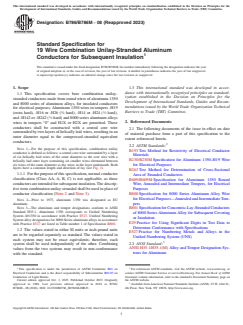
This specification covers the standard requirements for bare combination unilay-stranded conductors made from round wires of aluminum 1350 and 8000 series of aluminum alloys, for insulated conductors to be used for electrical purposes. Aluminum 1350 wires in tempers -H19, -H16 or -H26, -H14 or -H24, and -H142 or -H242 and 8000 series aluminum alloy wires in tempers “0” and H1X or H2X are permitted. These conductors shall be constructed with a central core wire surrounded by two layers of helically laid wires, resulting in an outer diameter equal to the compressed-stranded equivalent conductors. Electric-butt welds, cold pressure welds, or electric-butt cold-upset welds may be made in the finished individual wires composing the conductor. Mechanical (tension) and electrical tests shall be performed on the wires composing the conductors that are annealed and not annealed after stranding. The mass and electrical resistance of a unit length of stranded conductor shall be determined as a function of the length of lay. The conductors shall meet the breaking strength, tensile strength, and bending strength requirements.
SCOPE
1.1 This specification covers bare combination unilay-stranded conductors made from round wires of aluminum 1350 and 8000 series of aluminum alloys, for insulated conductors for electrical purposes. Aluminum 1350 wires in tempers -H19 (extra hard), -H16 or -H26 (3/4 hard), -H14 or -H24 (1/2 hard), and -H142 or -H242 (1/2 hard) and 8000 series aluminum alloys wires in tempers “0” and H1X or H2X are permitted. These conductors shall be constructed with a central core wire surrounded by two layers of helically laid wires, resulting in an outer diameter equal to the compressed-stranded equivalent conductors.
Note 1: For the purpose of this specification, combination unilay conductor is defined as follows: a central core wire surrounded by a layer of six helically laid wires of the same diameter as the core wire with a helically laid outer layer containing six smaller wires alternated between six wires of the same diameter as the wires in the layer underneath. Both layers have a common length and direction of lay (see Fig. 1).
FIG. 1 Cross Section of Conductor
1.1.1 For the purpose of this specification, normal conductor classification (Class AA, A, B, C) is not applicable, as these conductors are intended for subsequent insulation. The descriptive term combination unilay-stranded shall be used in place of conductor classification (Note 2 and Note 3).
Note 2: Prior to 1975, aluminum 1350 was designated as EC aluminum.
Note 3: The aluminum and temper designations conform to ANSI Standard H35.1. Aluminum 1350 corresponds to Unified Numbering System A91350 in accordance with Practice E527. Unified Numbering System alloy designations for 8000 Series aluminum alloys in accordance with Practice E527 are listed in Table number 1 of Specification B800.
1.2 The values stated in either SI units or inch-pound units are to be regarded separately as standard. The values stated in each system may not be exact equivalents; therefore, each system shall be used independently of the other. Combining values from the two systems may result in non-conformance with the standard.
1.3 This international standard was developed in accordance with internationally recognized principles on standardization established in the Decision on Principles for the Development of International Standards, Guides and Recommendations issued by the World Trade Organization Technical Barriers to Trade (TBT) Committee.
- Status
- Published
- Publication Date
- 30-Sep-2023
- Technical Committee
- B01 - Electrical Conductors
- Drafting Committee
- B01.07 - Conductors of Light Metals
Overview
ASTM B786/B786M-08(2023): Standard Specification for 19 Wire Combination Unilay-Stranded Aluminum Conductors for Subsequent Insulation defines the requirements for bare, combination unilay-stranded aluminum conductors made from round wires of Aluminum 1350 and 8000 series alloys. These conductors are specifically designed for use as the core of insulated electrical conductors and are not intended for bare use. The standard establishes the construction, material, mechanical, and testing requirements, ensuring consistent performance and quality for electrical applications.
Combination unilay-stranded conductors constructed under this standard provide a uniform cross-section and mechanical strength, optimizing them for applications where subsequent insulation or covering is applied. The specification supports international commerce and conformity through alignment with globally recognized principles under the WTO Technical Barriers to Trade (TBT) Committee.
Key Topics
Material Requirements:
- Permitted alloys: Aluminum 1350 (tempers -H19, -H16, -H26, -H14, -H24, -H142, -H242) and 8000 series aluminum alloys (tempers "0," H1X, H2X).
- Temper designation and compliance with ANSI H35.1/H35.1(M) and applicable ASTM references.
Conductor Construction:
- 19-wire design: a central core with two helically wound layers, giving an outer diameter matching compressed-stranded equivalents.
- Alternate layering of wire diameters for optimized mechanical and electrical properties.
- Permitted types of wire joints: electric-butt welds, cold pressure welds, and electric-butt cold-upset welds.
Mechanical and Electrical Testing:
- Testing of wires both before and after stranding for tensile strength, breaking strength, and bending properties.
- Direct current (DC) resistance and mass as determined by lay length and strand configuration.
- Conformance testing for both pre-annealed and post-annealed wire products.
Lay and Direction:
- Lay lengths from 8 to 16 times the outer diameter; special lays available by agreement.
- Standard direction is left-hand lay unless otherwise specified.
Packaging and Marking:
- Clear instructions for packaging size, protection during handling and shipping, and detailed package labeling for traceability.
Applications
- Power and Electrical Cables: The primary use of ASTM B786/B786M conductors is as the core of insulated power cables for the distribution and transmission of electrical energy.
- Industrial Cabling: Suited for manufacturing of covered, insulated, or jacketed cables used in industrial facilities.
- Utility and Grid Infrastructure: Preferred in utility-grade applications where reliable performance and insulation compatibility are essential.
- Customized Wiring Solutions: Supports cable manufacturers needing consistent conductor configurations for specific insulation or covering processes.
By adhering to ASTM B786/B786M, manufacturers and purchasers ensure that stranded aluminum conductors meet strict requirements for electrical conductivity, mechanical strength, and dimensional consistency. This improves product reliability, safety, and interoperability within the electrical supply chain.
Related Standards
- ASTM B230/B230M: Specification for Aluminum 1350-H19 Wire for Electrical Purposes
- ASTM B609/B609M: Specification for Aluminum 1350 Round Wire, Annealed and Intermediate Tempers, for Electrical Purposes
- ASTM B800: Specification for 8000 Series Aluminum Alloy Wire for Electrical Purposes
- ASTM B801: Specification for Concentric-Lay-Stranded Conductors of 8000 Series Aluminum Alloy for Subsequent Covering or Insulation
- ANSI H35.1/H35.1(M): Alloy and Temper Designation Systems for Aluminum
- ASTM B193: Test Method for Resistivity of Electrical Conductor Materials
- ASTM B263: Test Method for Determination of Cross-Sectional Area of Stranded Conductors
- E527: Practice for Numbering Metals and Alloys in the Unified Numbering System (UNS)
These related standards support the technical foundation of ASTM B786/B786M and ensure harmonization of conductor production, testing, and designation across the electrical industry.
Keywords: ASTM B786, unilay-stranded conductor, aluminum conductor, electrical conductor, 19 wire conductor, aluminum alloy, conductor for insulation, stranded aluminum conductor, ASTM standard conductors.
Relations
- Effective Date
- 01-Oct-2023
- Effective Date
- 01-Oct-2023
- Effective Date
- 01-Mar-2018
Get Certified
Connect with accredited certification bodies for this standard

IMQ S.p.A. (Certification)
Italian electrical product certification.

SLG Prüf- und Zertifizierungs GmbH
German testing and certification body.

UL Solutions
Global safety science company with testing, inspection and certification.
Sponsored listings
Frequently Asked Questions
ASTM B786/B786M-08(2023) is a technical specification published by ASTM International. Its full title is "Standard Specification for 19 Wire Combination Unilay-Stranded Aluminum Conductors for Subsequent Insulation". This standard covers: ABSTRACT This specification covers the standard requirements for bare combination unilay-stranded conductors made from round wires of aluminum 1350 and 8000 series of aluminum alloys, for insulated conductors to be used for electrical purposes. Aluminum 1350 wires in tempers -H19, -H16 or -H26, -H14 or -H24, and -H142 or -H242 and 8000 series aluminum alloy wires in tempers “0” and H1X or H2X are permitted. These conductors shall be constructed with a central core wire surrounded by two layers of helically laid wires, resulting in an outer diameter equal to the compressed-stranded equivalent conductors. Electric-butt welds, cold pressure welds, or electric-butt cold-upset welds may be made in the finished individual wires composing the conductor. Mechanical (tension) and electrical tests shall be performed on the wires composing the conductors that are annealed and not annealed after stranding. The mass and electrical resistance of a unit length of stranded conductor shall be determined as a function of the length of lay. The conductors shall meet the breaking strength, tensile strength, and bending strength requirements. SCOPE 1.1 This specification covers bare combination unilay-stranded conductors made from round wires of aluminum 1350 and 8000 series of aluminum alloys, for insulated conductors for electrical purposes. Aluminum 1350 wires in tempers -H19 (extra hard), -H16 or -H26 (3/4 hard), -H14 or -H24 (1/2 hard), and -H142 or -H242 (1/2 hard) and 8000 series aluminum alloys wires in tempers “0” and H1X or H2X are permitted. These conductors shall be constructed with a central core wire surrounded by two layers of helically laid wires, resulting in an outer diameter equal to the compressed-stranded equivalent conductors. Note 1: For the purpose of this specification, combination unilay conductor is defined as follows: a central core wire surrounded by a layer of six helically laid wires of the same diameter as the core wire with a helically laid outer layer containing six smaller wires alternated between six wires of the same diameter as the wires in the layer underneath. Both layers have a common length and direction of lay (see Fig. 1). FIG. 1 Cross Section of Conductor 1.1.1 For the purpose of this specification, normal conductor classification (Class AA, A, B, C) is not applicable, as these conductors are intended for subsequent insulation. The descriptive term combination unilay-stranded shall be used in place of conductor classification (Note 2 and Note 3). Note 2: Prior to 1975, aluminum 1350 was designated as EC aluminum. Note 3: The aluminum and temper designations conform to ANSI Standard H35.1. Aluminum 1350 corresponds to Unified Numbering System A91350 in accordance with Practice E527. Unified Numbering System alloy designations for 8000 Series aluminum alloys in accordance with Practice E527 are listed in Table number 1 of Specification B800. 1.2 The values stated in either SI units or inch-pound units are to be regarded separately as standard. The values stated in each system may not be exact equivalents; therefore, each system shall be used independently of the other. Combining values from the two systems may result in non-conformance with the standard. 1.3 This international standard was developed in accordance with internationally recognized principles on standardization established in the Decision on Principles for the Development of International Standards, Guides and Recommendations issued by the World Trade Organization Technical Barriers to Trade (TBT) Committee.
ABSTRACT This specification covers the standard requirements for bare combination unilay-stranded conductors made from round wires of aluminum 1350 and 8000 series of aluminum alloys, for insulated conductors to be used for electrical purposes. Aluminum 1350 wires in tempers -H19, -H16 or -H26, -H14 or -H24, and -H142 or -H242 and 8000 series aluminum alloy wires in tempers “0” and H1X or H2X are permitted. These conductors shall be constructed with a central core wire surrounded by two layers of helically laid wires, resulting in an outer diameter equal to the compressed-stranded equivalent conductors. Electric-butt welds, cold pressure welds, or electric-butt cold-upset welds may be made in the finished individual wires composing the conductor. Mechanical (tension) and electrical tests shall be performed on the wires composing the conductors that are annealed and not annealed after stranding. The mass and electrical resistance of a unit length of stranded conductor shall be determined as a function of the length of lay. The conductors shall meet the breaking strength, tensile strength, and bending strength requirements. SCOPE 1.1 This specification covers bare combination unilay-stranded conductors made from round wires of aluminum 1350 and 8000 series of aluminum alloys, for insulated conductors for electrical purposes. Aluminum 1350 wires in tempers -H19 (extra hard), -H16 or -H26 (3/4 hard), -H14 or -H24 (1/2 hard), and -H142 or -H242 (1/2 hard) and 8000 series aluminum alloys wires in tempers “0” and H1X or H2X are permitted. These conductors shall be constructed with a central core wire surrounded by two layers of helically laid wires, resulting in an outer diameter equal to the compressed-stranded equivalent conductors. Note 1: For the purpose of this specification, combination unilay conductor is defined as follows: a central core wire surrounded by a layer of six helically laid wires of the same diameter as the core wire with a helically laid outer layer containing six smaller wires alternated between six wires of the same diameter as the wires in the layer underneath. Both layers have a common length and direction of lay (see Fig. 1). FIG. 1 Cross Section of Conductor 1.1.1 For the purpose of this specification, normal conductor classification (Class AA, A, B, C) is not applicable, as these conductors are intended for subsequent insulation. The descriptive term combination unilay-stranded shall be used in place of conductor classification (Note 2 and Note 3). Note 2: Prior to 1975, aluminum 1350 was designated as EC aluminum. Note 3: The aluminum and temper designations conform to ANSI Standard H35.1. Aluminum 1350 corresponds to Unified Numbering System A91350 in accordance with Practice E527. Unified Numbering System alloy designations for 8000 Series aluminum alloys in accordance with Practice E527 are listed in Table number 1 of Specification B800. 1.2 The values stated in either SI units or inch-pound units are to be regarded separately as standard. The values stated in each system may not be exact equivalents; therefore, each system shall be used independently of the other. Combining values from the two systems may result in non-conformance with the standard. 1.3 This international standard was developed in accordance with internationally recognized principles on standardization established in the Decision on Principles for the Development of International Standards, Guides and Recommendations issued by the World Trade Organization Technical Barriers to Trade (TBT) Committee.
ASTM B786/B786M-08(2023) is classified under the following ICS (International Classification for Standards) categories: 29.060.20 - Cables. The ICS classification helps identify the subject area and facilitates finding related standards.
ASTM B786/B786M-08(2023) has the following relationships with other standards: It is inter standard links to ASTM B786/B786M-08(2018), ASTM B801-18(2023), ASTM B801-18. Understanding these relationships helps ensure you are using the most current and applicable version of the standard.
ASTM B786/B786M-08(2023) is available in PDF format for immediate download after purchase. The document can be added to your cart and obtained through the secure checkout process. Digital delivery ensures instant access to the complete standard document.
Standards Content (Sample)
This international standard was developed in accordance with internationally recognized principles on standardization established in the Decision on Principles for the
Development of International Standards, Guides and Recommendations issued by the World Trade Organization Technical Barriers to Trade (TBT) Committee.
Designation: B786/B786M − 08 (Reapproved 2023)
Standard Specification for
19 Wire Combination Unilay-Stranded Aluminum
Conductors for Subsequent Insulation
This standard is issued under the fixed designation B786/B786M; the number immediately following the designation indicates the year
of original adoption or, in the case of revision, the year of last revision. A number in parentheses indicates the year of last reapproval.
A superscript epsilon (´) indicates an editorial change since the last revision or reapproval.
1. Scope 1.3 This international standard was developed in accor-
dance with internationally recognized principles on standard-
1.1 This specification covers bare combination unilay-
ization established in the Decision on Principles for the
stranded conductors made from round wires of aluminum 1350
Development of International Standards, Guides and Recom-
and 8000 series of aluminum alloys, for insulated conductors
mendations issued by the World Trade Organization Technical
for electrical purposes. Aluminum 1350 wires in tempers -H19
Barriers to Trade (TBT) Committee.
3 1
(extra hard), -H16 or -H26 ( ⁄4 hard), -H14 or -H24 ( ⁄2 hard),
and -H142 or -H242 ( ⁄2 hard) and 8000 series aluminum alloys
2. Referenced Documents
wires in tempers “0” and H1X or H2X are permitted. These
conductors shall be constructed with a central core wire
2.1 The following documents of the issue in effect on date
surrounded by two layers of helically laid wires, resulting in an
of material purchase form a part of this specification to the
outer diameter equal to the compressed-stranded equivalent
extent referenced herein.
conductors.
2.2 ASTM Standards:
NOTE 1—For the purpose of this specification, combination unilay
B193 Test Method for Resistivity of Electrical Conductor
conductor is defined as follows: a central core wire surrounded by a layer
Materials
of six helically laid wires of the same diameter as the core wire with a
B230/B230M Specification for Aluminum 1350–H19 Wire
helically laid outer layer containing six smaller wires alternated between
six wires of the same diameter as the wires in the layer underneath. Both
for Electrical Purposes
layers have a common length and direction of lay (see Fig. 1).
B263 Test Method for Determination of Cross-Sectional
1.1.1 For the purpose of this specification, normal conductor Area of Stranded Conductors
classification (Class AA, A, B, C) is not applicable, as these
B609/B609M Specification for Aluminum 1350 Round
conductors are intended for subsequent insulation. The descrip- Wire, Annealed and Intermediate Tempers, for Electrical
tive term combination unilay-stranded shall be used in place of
Purposes
conductor classification (Note 2 and Note 3).
B800 Specification for 8000 Series Aluminum Alloy Wire
for Electrical Purposes—Annealed and Intermediate Tem-
NOTE 2—Prior to 1975, aluminum 1350 was designated as EC
pers
aluminum.
NOTE 3—The aluminum and temper designations conform to ANSI B801 Specification for Concentric-Lay-Stranded Conductors
Standard H35.1. Aluminum 1350 corresponds to Unified Numbering
of 8000 Series Aluminum Alloy for Subsequent Covering
System A91350 in accordance with Practice E527. Unified Numbering
or Insulation
System alloy designations for 8000 Series aluminum alloys in accordance
E29 Practice for Using Significant Digits in Test Data to
with Practice E527 are listed in Table number 1 of Specification B800.
Determine Conformance with Specifications
1.2 The values stated in either SI units or inch-pound units
E527 Practice for Numbering Metals and Alloys in the
are to be regarded separately as standard. The values stated in
Unified Numbering System (UNS)
each system may not be exact equivalents; therefore, each
2.3 ANSI Standard:
system shall be used independently of the other. Combining
ANSI H35.1/H35.1(M) Alloy and Temper Designation Sys-
values from the two systems may result in non-conformance
tems for Aluminum
with the standard.
1 2
This specification is under the jurisdiction of ASTM Committee B01 on For referenced ASTM standards, visit the ASTM website, www.astm.org, or
Electrical Conductors and is the direct responsibility of Subcommittee B01.07 on contact ASTM Customer Service at service@astm.org. For Annual Book of ASTM
Conductors of Light Metals. Standards volume information, refer to the standard’s Document Summary page on
Current edition approved Oct. 1, 2023. Published October 2023. Originally the ASTM website.
approved in 1988. Last previous edition approved in 2018 as B786/ Available from American National Standards Institute (ANSI), 25 W. 43rd St.,
B786M – 08 (2018). DOI: 10.1520/B0786_B0786M-08R23. 4th Floor, New York, NY 10036, http://www.ansi.org.
Copyright © ASTM International, 100 Barr Harbor Drive, PO Box C700, West Conshohocken, PA 19428-2959. United States
B786/B786M − 08 (2023)
3.1.7 When physical tests shall be made (see Sections 7 and
8),
3.1.8 Package size (see 16.1),
3.1.9 Heavy wood lagging, if required (see 17.2),
3.1.10 Special package marking, if required (Section 17),
and
3.1.11 Place of inspection (Section 15).
4. Joints
FIG. 1 Cross Section of Conductor
4.1 Electric-butt welds, cold pressure welds, or electric-butt
TABLE 1 Construction Requirements for 19-Wire Combination
cold-upset welds may be made in the finished individual wires
Unilay Stranded Aluminum Conductors
composing the conductor but shall not be closer together than
A B
Wire D Wire D
Area of Size, American (or
1 2
1 ft (Explanatory Note 2).
Diameter Diameter
Cross-Section, Brown and Sharpe)
cmil Wire Gauge
mils mm mils mm
5. Lay
556 500 185.3 4.71 135.6 3.44
500 000 175.6 4.46 128.5 3.26 5.1 For combination unilay conductors the lay of a layer of
477 000 171.5 4.36 125.5 3.19
wires shall be not less than 8 nor more than 16 times the
450 000 166.6 4.23 121.9 3.10
outside diameter of the outer layer.
397 500 156.6 3.98 114.6 2.91
350 000 146.9 3.73 107.5 2.73
5.2 Other lays for special purposes shall be furnished by
336 400 144.0 3.66 105.4 2.68
special agreement between the manufacturer and the purchaser.
300 000 136.0 3.45 99.6 2.53
266 800 128.3 3.26 93.9 2.38
NOTE 4—Certain types of insulation conductors may require shorter lay
250 000 124.2 3.15 90.9 2.31
than other conductors. It is expected that special requirements regarding
211 600 0000 114.2 2.90 83.6 2.12
length of lay will be specified by the purchaser in such instances.
167 800 000 101.7 2.58 74.5 1.89
133 100 00 90.6 2.30 66.3 1.68
5.3 The direction of lay shall be left-hand unless the
105 600 0 80.7 2.05 59.1 1.50
83 690 1 71.8 1.82 52.6 1.34 direction of lay is specified otherwise by the purchaser.
66 360 2 64.0 1.63 46.8 1.19
52 620 3 57.0 1.45 41.7 1.06
6. Construction (Explanatory Note 1)
41 740 4 50.7 1.29 37.1 0.94
33 090 5 45.2 1.15 33.1 0.84 6.1 The areas of cross section, numbers, and diameters of
26 240 6 40.2 1.02 29.4 0.75
wires in the various conductors shall conform to the require-
20 820 7 35.8 0.91 26.2 0.67
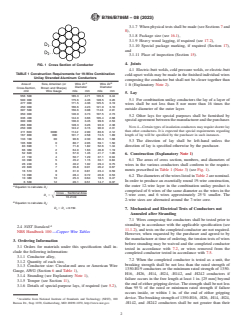
ments prescribed in Table 1 (Note 3) (see Fig. 1).
16 510 8 31.9 0.81 23.4 0.59
13 090 9 28.4 0.72 20.8 0.53
6.2 The diameters of the wires listed in Table 2 are nominal.
10 380 10 25.3 0.64 18.5 0.47
In order to produce an essentially round 19-wire construction,
6 530 12 20.1 0.51 14.7 0.37
A the outer 12-wire layer in the combination unilay product is
Equation to calculate D :
comprised of 6 wires of the same diameter as the wires in the
Cross 2 Sectional Area
D 5
Π7-wire core, and 6 wires approximately 25 % smaller. The
16.2149
2-wire sizes are alternated around the 7-wire core.
B
Equation to calculate D :
D 5 D × 0.732.
7. Mechanical and Electrical Tests of Conductors not
2 1
Annealed after Stranding
7.1 Wires composing the conductors shall be tested prior to
stranding in accordance with the applicable specification (see
2.4 NIST Standard:
11.1.2), and tests on the completed conductor are not required.
NBS Handbook 100 —Copper Wire Tables
However, when requested by the purchaser and agreed to by
the manufacturer at time of ordering, the tension tests of wires
3. Ordering Information
before stranding may be waived and the completed conductor
3.1 Orders for materials under this specification shall in-
tested in accordance with 7.2, or wires removed from the
clude the following information:
completed conductor tested in accordance with 7.5.
3.1.1 Conductor alloy,
7.2 When the completed conductor is tested as a unit, the
3.1.2 Quantity of each size,
breaking strength shall be not less than the rated strength of
3.1.3 Conductor size: Circular-mil area or American Wire
1350-H19 conductors or the minimum rated strength of 1350-
Gauge, AWG (Section 6 and Table 1),
H16, -H26, -H14, -H24, -H142, and -H242 conductors if
3.1.4 Stranding (see Explanatory Note 1),
failure occurs in the free length at least 1 in. [25 mm] beyond
3.1.5 Temper (see Section 11),
the end of either gripping device. The strength shall be not less
3.1.6 Details of special-purpose lays, if required (see 5.2),
than 95 % of the rated or minimum rated strength if failure
occurs inside, or within 1 in. of the end of either gripping
device. The breaking strength of 1350-H16, -H26, -H14, -H24,
Available from National Institute of Standards and Technology (NIST), 100
Bureau Dr., Stop 1070, Gaithersburg, MD 20899-1070, http://www.nist.gov. -H142, and -H242 conductors shall be not greater than their
B786/B786M − 08 (2023)
A
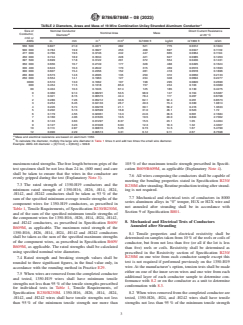
TABLE 2 Diameters, Areas and Mass of 19-Wire Combination Unilay Stranded Aluminum Conductor
Size of
Nominal Conductor Direct Current Resistance
Nominal Area Mass
B
Conductor,
Diameter at 20 °C
cmil or
2 2
in. mm in. mm lb/1000 ft kg/km Ω/1000 ft Ω/km
AWG
556 500 0.827 21.0 0.4371 282 521 775 0.0312 0.1024
500 000 0.784 19.9 0.3927 253 468 697 0.0347 0.1139
477 000 0.766 19.5 0.3746 242 447 665 0.0364 0.1194
450 000 0.744 18.9 0.3534 228 421 627 0.0385 0.1263
397 500 0.699 17.8 0.3122 201 372 554 0.0436 0.1431
350 000 0.656 16.7 0.2749 177 328 488 0.0495 0.1624
336 400 0.643 16.3 0.2642 170 315 469 0.0516 0.1693
300 000 0.607 15.4 0.2356 152 281 418 0.0578 0.1896
266 800 0.573 14.6 0.2095 135 250 372 0.0650 0.2133
250 000 0.554 14.1 0.1963 127 234 348 0.0694 0.2277
0000 0.510 13.0 0.1662 107 198 295 0.0820 0.2690
000 0.454 11.5 0.1318 85.0 157 234 0.103 0.3389
00 0.404 10.3 0.1045 67.4 125 185 0.130 0.4275
0 0.360 9.14 0.08291 53.5 98.9 147 0.164 0.5387
1 0.321 8.15 0.06573 42.4 78.4 117 0.207 0.6798
2 0.286 7.26 0.05212 33.6 62.1 92.4 0.261 0.8573
3 0.254 6.45 0.04133 26.7 49.3 73.4 0.330 1.0814
4 0.226 5.74 0.03278 21.1 39.1 58.2 0.416 1.3633
5 0.202 5.13 0.02599 16.8 31.0 46.1 0.523 1.72
6 0.179 4.55 0.02061 13.3 24.6 36.6 0.661 2.1684
7 0.160 4.06 0.01635 10.5 19.5 29.0 0.834 2.7362
8 0.143 3.63 0.01297 8.37 15.5 23.1 1.05 3.4464
9 0.127 3.23 0.01028 6.63 12.3 18.3 1.32 4.3307
10 0.113 2.87 0.00816 5.26 9.73 14.5 1.67 5.4790
12 0.090 2.29 0.00513 3.31 6.12 9.11 2.67 8.7598
A
Mass and electrical resistance are based on aluminum 1350.
B
To calculate the diameter, multiply the large wire diameter in Table 1 times 3 and add two times the small wire diameter.
Example: AWG 4/0 diameter = [3(114.2) + 2(83.6)] = 509.8
maximum rated strengths. The free length between grips of the 105 % of the maximum tensile strength prescribed in Specifi-
test specimen shall be not less than 24 in. (600 mm) and care cation B609/B609M, as applicable (Explanatory Note 4).
shall be taken to ensure that the wires in the conductor are
7.6 All wires composing the conductors shall be capable of
evenly gripped during the test (Explanatory Note 3).
meeting the bending properties stated in Specification B230/
7.3 The rated strength of 1350-H19 conductors and the
B230M after stranding. Routine production testing after strand-
minimum rated strength of 1350-H16, -H26, -H14, -H24,
ing is not required.
-H142, and -H242 conductors shall be taken as 93 % of the
7.7 Mechanical and electrical tests of conductors in 8000
sum of the specified minimum average tensile strengths of the
series aluminum alloys in “0” temper, H1X or H2X wire and
component wires for 1350-H19 conductors, as prescribed in
not annealed after stranding shall be in accordance with
Table 1, Tensile Requirements, of Specification B230/B230M,
Section 9 of Specification B801.
and of the sum of the specified minimum tensile strengths of
the component wires for 1350-H16, -H26, -H14, -H24, -H142,
8. Mechanical and Electrical Tests of Conductors
and -H242 conductors, as prescribed in Specification B609/
Annealed after Stranding
B609M, as applicable. The maximum rated strength of the
1350-H16, -H26, -H14, -H24, -H142 and -H242 conductors
8.1 Tensile properties and electrical resistivity shall be
shall be taken as the sum of the specified maximum strengths
determined on samples taken from 10 % of the reels or coils of
of the component wires, as prescribed in Specification B609/
conductor, but from not less than five (or all if the lot is less
B609M, as applicable. The rated strengths shall be calculated
than five) reels or coils. Resistivity shall be determined as
using specified nominal wire diameters.
prescribed in the Resistivity section of Specification B230/
B230M on one wire from each conductor sample exce
...