

ASTM D5147/D5147M-18
(Test Method)Standard Test Methods for Sampling and Testing Modified Bituminous Sheet Material
General Information
- Abstract
ABSTRACT
These test methods cover procedures for sampling and testing prefabricated, reinforced, polymer-modified bituminous sheet materials designed for single- or multiple-ply application in roofing and waterproofing membranes. From each shipment or fraction thereof, select at random a number of rolls equal to one half the cube root of the total number of rolls in the lot. If the calculated number is fractional, express it as the next highest whole number. The load strain (tensile elongation and strain energy) properties shall be tested to meet the requirements prescribed. The tensile tear strength, moisture content, and water absorption of polymer-modified bituminous sheets shall be tested to meet the requirements prescribed. The dimensional stability, low-temperature flexibility, heat conditioning, and accelerated weathering of the polymer-modified bituminous sheets shall be tested to meet the requirements prescribed. The granule embedment, compound stability, coating thickness, low temperature unrolling, and precision and bias of the polymer-modified bituminous sheet materials shall be tested to meet the requirements prescribed.
SIGNIFICANCE AND USE
3.1 These test methods are used for sampling and testing modified bitumen sheet materials. Property requirements, determined by these test methods, are found in the following product standards: Specifications D6162/D6162M, D6163/D6163M, D6164/D6164M, D6222/D6222M, D6223/D6223M, D6298/D6298M, and D6509/D6509M.
SCOPE
1.1 These test methods cover procedures for sampling and testing prefabricated, reinforced, polymer-modified bituminous sheet materials designed for single- or multiple-ply application in roofing and waterproofing membranes. These products may use various surfacing materials on one side.
1.2 These test methods cover a number of different products. Not all tests are required for every product. Only those called out in the Product Standard are required.
1.3 These test methods appear in the following order:
Section
Sampling
4
Conditioning
5
Thickness
6
Load Strain Properties
7
Tear Strength
8
Moisture Content
9
Water Absorption
10
Dimensional Stability
11
Low-Temperature Flexibility
12
Heat Conditioning
13
Accelerated Weathering
14
Granule Embedment
15
Compound Stability
16
Coating Thickness
17
Low Temperature Unrolling
18
Precision and Bias
19
1.4 The values stated in either SI units or inch-pound units are to be regarded separately as standard. The values stated in each system may not be exact equivalents; therefore, each system shall be used independently of the other. Combining values from the two systems may result in non-conformance with the standard.
1.5 This standard does not purport to address all of the safety concerns, if any, associated with its use. It is the responsibility of the user of this standard to establish appropriate safety, health, and environmental practices and determine the applicability of regulatory limitations prior to use.
1.6 This international standard was developed in accordance with internationally recognized principles on standardization established in the Decision on Principles for the Development of International Standards, Guides and Recommendations issued by the World Trade Organization Technical Barriers to Trade (TBT) Committee.
- Status
- Published
- Publication Date
- 30-Jun-2018
- Technical Committee
- D08 - Roofing and Waterproofing
- Drafting Committee
- D08.04 - Felts, Fabrics and Bituminous Sheet Materials
Buy Documents
ASTM D5147/D5147M-18 - Standard Test Methods for Sampling and Testing Modified Bituminous Sheet Material
REDLINE ASTM D5147/D5147M-18 - Standard Test Methods for Sampling and Testing Modified Bituminous Sheet Material
Overview
ASTM D5147/D5147M-18 is a widely recognized international standard specifying test methods for sampling and testing modified bituminous sheet materials used in roofing and waterproofing membranes. Developed by ASTM International, this standard applies to prefabricated, reinforced, polymer-modified bituminous sheets intended for single-ply or multiple-ply applications. By outlining consistent procedures, ASTM D5147/D5147M helps manufacturers, laboratories, and inspectors assess critical properties that ensure material suitability, performance, and compliance with related product standards.
Key Topics
- Sampling Procedures: Defines how to select representative rolls from bulk shipments for thorough testing, ensuring that results accurately reflect product quality.
- Conditioning: Details the environmental and handling requirements for specimens prior to testing to standardize results.
- Thickness Measurement: Outlines precise methods for measuring sheet and selvage thickness using calibrated micrometers.
- Load Strain Properties: Provides methods to determine tensile elongation and strain energy, fundamental to assessing material flexibility and resistance to stress.
- Tear Strength: Describes procedures to evaluate the material's resistance to propagation of tears under applied force.
- Moisture Content and Water Absorption: Specifies testing for water uptake and retention, important for waterproofing performance.
- Dimensional Stability: Establishes measurement techniques for monitoring shrinkage or expansion under heat.
- Low-Temperature Flexibility: Details bend testing procedures to assess resistance to cracking at low temperatures.
- Heat Conditioning and Accelerated Weathering: Includes tests for evaluating changes in physical properties under prolonged heat or simulated environmental exposure.
- Granule Embedment and Compound Stability: Addresses tests to determine granule adhesion and high-temperature performance.
- Coating Thickness and Low-Temperature Unrolling: Provides instructions on measuring the thickness of bituminous coatings and unrolling sheets at low temperatures without damage.
Applications
The test methods outlined in ASTM D5147/D5147M-18 are applicable throughout the lifecycle of polymer-modified bituminous sheet materials used in:
- Roofing Membranes: Ensuring durability, flexibility, and water resistance for commercial and residential roofing systems.
- Waterproofing Membranes: Verifying effectiveness in preventing moisture penetration in below-grade applications, tunnels, and decking.
- Quality Assurance: Used by manufacturers for product development, batch approval, and verifying compliance with industry and regulatory standards.
- Third-Party Testing and Inspection: Employed by laboratories and inspectors for independent verification of material characteristics and conformance.
- Product Standards Compliance: Essential for demonstrating that materials used conform to ASTM product specifications referenced in building codes and procurement requirements.
Standardized testing based on ASTM D5147/D5147M-18 ensures bituminous sheet materials meet rigorous performance expectations, helping prevent premature failure and costly repairs.
Related Standards
ASTM D5147/D5147M-18 references and supports compliance with a variety of associated ASTM standards, including:
- ASTM D6162/D6162M: SBS-modified bituminous sheets using polyester and glass fiber reinforcements.
- ASTM D6163/D6163M: SBS-modified sheets reinforced with glass fiber.
- ASTM D6164/D6164M: SBS-modified sheets reinforced with polyester.
- ASTM D6222/D6222M: APP-modified sheets with polyester reinforcements.
- ASTM D6223/D6223M: APP-modified sheets with both polyester and glass fiber reinforcements.
- ASTM D6298/D6298M: Fiberglass-reinforced SBS-modified sheets with factory-applied metal surface.
- ASTM D6509/D6509M: APP-modified base sheets using glass fiber reinforcement.
Additional referenced methods include ASTM D95, D1204, D4073, D4798, D4977, D5636, D5869, E177, and E691, covering specific test protocols.
Summary
Implementing ASTM D5147/D5147M-18 assures reliable, repeatable testing for modified bituminous sheet materials, making it indispensable in roofing and waterproofing membrane quality control. Organizations involved in manufacturing, specifying, or inspecting roofing products rely on this standard to minimize risk, enhance performance, and demonstrate regulatory compliance.
Relations
- Effective Date
- 01-Jul-2018
- Effective Date
- 01-Oct-2023
- Effective Date
- 01-May-2020
- Effective Date
- 01-Apr-2020
- Effective Date
- 01-May-2019
- Effective Date
- 01-Jan-2015
- Effective Date
- 01-Jan-2015
- Effective Date
- 01-Jan-2015
- Effective Date
- 01-May-2014
- Effective Date
- 01-Mar-2014
- Effective Date
- 01-Nov-2013
- Refers
ASTM D4073-06(2013) - Standard Test Method for Tensile-Tear Strength of Bituminous Roofing Membranes - Effective Date
- 01-May-2013
- Effective Date
- 01-May-2013
- Effective Date
- 01-May-2013
- Effective Date
- 01-Nov-2011
Buy Documents
ASTM D5147/D5147M-18 - Standard Test Methods for Sampling and Testing Modified Bituminous Sheet Material
REDLINE ASTM D5147/D5147M-18 - Standard Test Methods for Sampling and Testing Modified Bituminous Sheet Material
Get Certified
Connect with accredited certification bodies for this standard

DIBt (Deutsches Institut für Bautechnik)
German Institute for Building Technology.
DIN CERTCO
DIN Group product certification.

Aboma Certification B.V.
Specialized in construction, metal, and transport sectors.
Sponsored listings
Frequently Asked Questions
ASTM D5147/D5147M-18 is a standard published by ASTM International. Its full title is "Standard Test Methods for Sampling and Testing Modified Bituminous Sheet Material". This standard covers: ABSTRACT These test methods cover procedures for sampling and testing prefabricated, reinforced, polymer-modified bituminous sheet materials designed for single- or multiple-ply application in roofing and waterproofing membranes. From each shipment or fraction thereof, select at random a number of rolls equal to one half the cube root of the total number of rolls in the lot. If the calculated number is fractional, express it as the next highest whole number. The load strain (tensile elongation and strain energy) properties shall be tested to meet the requirements prescribed. The tensile tear strength, moisture content, and water absorption of polymer-modified bituminous sheets shall be tested to meet the requirements prescribed. The dimensional stability, low-temperature flexibility, heat conditioning, and accelerated weathering of the polymer-modified bituminous sheets shall be tested to meet the requirements prescribed. The granule embedment, compound stability, coating thickness, low temperature unrolling, and precision and bias of the polymer-modified bituminous sheet materials shall be tested to meet the requirements prescribed. SIGNIFICANCE AND USE 3.1 These test methods are used for sampling and testing modified bitumen sheet materials. Property requirements, determined by these test methods, are found in the following product standards: Specifications D6162/D6162M, D6163/D6163M, D6164/D6164M, D6222/D6222M, D6223/D6223M, D6298/D6298M, and D6509/D6509M. SCOPE 1.1 These test methods cover procedures for sampling and testing prefabricated, reinforced, polymer-modified bituminous sheet materials designed for single- or multiple-ply application in roofing and waterproofing membranes. These products may use various surfacing materials on one side. 1.2 These test methods cover a number of different products. Not all tests are required for every product. Only those called out in the Product Standard are required. 1.3 These test methods appear in the following order: Section Sampling 4 Conditioning 5 Thickness 6 Load Strain Properties 7 Tear Strength 8 Moisture Content 9 Water Absorption 10 Dimensional Stability 11 Low-Temperature Flexibility 12 Heat Conditioning 13 Accelerated Weathering 14 Granule Embedment 15 Compound Stability 16 Coating Thickness 17 Low Temperature Unrolling 18 Precision and Bias 19 1.4 The values stated in either SI units or inch-pound units are to be regarded separately as standard. The values stated in each system may not be exact equivalents; therefore, each system shall be used independently of the other. Combining values from the two systems may result in non-conformance with the standard. 1.5 This standard does not purport to address all of the safety concerns, if any, associated with its use. It is the responsibility of the user of this standard to establish appropriate safety, health, and environmental practices and determine the applicability of regulatory limitations prior to use. 1.6 This international standard was developed in accordance with internationally recognized principles on standardization established in the Decision on Principles for the Development of International Standards, Guides and Recommendations issued by the World Trade Organization Technical Barriers to Trade (TBT) Committee.
ABSTRACT These test methods cover procedures for sampling and testing prefabricated, reinforced, polymer-modified bituminous sheet materials designed for single- or multiple-ply application in roofing and waterproofing membranes. From each shipment or fraction thereof, select at random a number of rolls equal to one half the cube root of the total number of rolls in the lot. If the calculated number is fractional, express it as the next highest whole number. The load strain (tensile elongation and strain energy) properties shall be tested to meet the requirements prescribed. The tensile tear strength, moisture content, and water absorption of polymer-modified bituminous sheets shall be tested to meet the requirements prescribed. The dimensional stability, low-temperature flexibility, heat conditioning, and accelerated weathering of the polymer-modified bituminous sheets shall be tested to meet the requirements prescribed. The granule embedment, compound stability, coating thickness, low temperature unrolling, and precision and bias of the polymer-modified bituminous sheet materials shall be tested to meet the requirements prescribed. SIGNIFICANCE AND USE 3.1 These test methods are used for sampling and testing modified bitumen sheet materials. Property requirements, determined by these test methods, are found in the following product standards: Specifications D6162/D6162M, D6163/D6163M, D6164/D6164M, D6222/D6222M, D6223/D6223M, D6298/D6298M, and D6509/D6509M. SCOPE 1.1 These test methods cover procedures for sampling and testing prefabricated, reinforced, polymer-modified bituminous sheet materials designed for single- or multiple-ply application in roofing and waterproofing membranes. These products may use various surfacing materials on one side. 1.2 These test methods cover a number of different products. Not all tests are required for every product. Only those called out in the Product Standard are required. 1.3 These test methods appear in the following order: Section Sampling 4 Conditioning 5 Thickness 6 Load Strain Properties 7 Tear Strength 8 Moisture Content 9 Water Absorption 10 Dimensional Stability 11 Low-Temperature Flexibility 12 Heat Conditioning 13 Accelerated Weathering 14 Granule Embedment 15 Compound Stability 16 Coating Thickness 17 Low Temperature Unrolling 18 Precision and Bias 19 1.4 The values stated in either SI units or inch-pound units are to be regarded separately as standard. The values stated in each system may not be exact equivalents; therefore, each system shall be used independently of the other. Combining values from the two systems may result in non-conformance with the standard. 1.5 This standard does not purport to address all of the safety concerns, if any, associated with its use. It is the responsibility of the user of this standard to establish appropriate safety, health, and environmental practices and determine the applicability of regulatory limitations prior to use. 1.6 This international standard was developed in accordance with internationally recognized principles on standardization established in the Decision on Principles for the Development of International Standards, Guides and Recommendations issued by the World Trade Organization Technical Barriers to Trade (TBT) Committee.
ASTM D5147/D5147M-18 is classified under the following ICS (International Classification for Standards) categories: 91.100.50 - Binders. Sealing materials. The ICS classification helps identify the subject area and facilitates finding related standards.
ASTM D5147/D5147M-18 has the following relationships with other standards: It is inter standard links to ASTM D5147/D5147M-14, ASTM D95-23, ASTM D4977/D4977M-20, ASTM D1204-14(2020), ASTM D4977/D4977M-03(2019), ASTM D6162/D6162M-00A(2015)e1, ASTM D6509/D6509M-09(2015), ASTM D6163/D6163M-00(2015)e1, ASTM E177-14, ASTM D1204-14, ASTM D4977/D4977M-03(2013)e1, ASTM D4073-06(2013), ASTM E691-13, ASTM E177-13, ASTM E691-11. Understanding these relationships helps ensure you are using the most current and applicable version of the standard.
ASTM D5147/D5147M-18 is available in PDF format for immediate download after purchase. The document can be added to your cart and obtained through the secure checkout process. Digital delivery ensures instant access to the complete standard document.
Standards Content (Sample)
This international standard was developed in accordance with internationally recognized principles on standardization established in the Decision on Principles for the
Development of International Standards, Guides and Recommendations issued by the World Trade Organization Technical Barriers to Trade (TBT) Committee.
Designation: D5147/D5147M −18
Standard Test Methods for
Sampling and Testing Modified Bituminous Sheet Material
This standard is issued under the fixed designation D5147/D5147M; the number immediately following the designation indicates the
year of original adoption or, in the case of revision, the year of last revision. A number in parentheses indicates the year of last
reapproval. A superscript epsilon (´) indicates an editorial change since the last revision or reapproval.
1. Scope ization established in the Decision on Principles for the
Development of International Standards, Guides and Recom-
1.1 These test methods cover procedures for sampling and
mendations issued by the World Trade Organization Technical
testingprefabricated,reinforced,polymer-modifiedbituminous
Barriers to Trade (TBT) Committee.
sheet materials designed for single- or multiple-ply application
in roofing and waterproofing membranes. These products may
2. Referenced Documents
use various surfacing materials on one side.
2.1 ASTM Standards:
1.2 These test methods cover a number of different prod-
D95Test Method for Water in Petroleum Products and
ucts. Not all tests are required for every product. Only those
Bituminous Materials by Distillation
called out in the Product Standard are required.
D146/D146M Test Methods for Sampling and Testing
1.3 These test methods appear in the following order:
Bitumen-Saturated Felts and Woven Fabrics for Roofing
and Waterproofing
Section
D1204Test Method for Linear Dimensional Changes of
Sampling 4
Nonrigid Thermoplastic Sheeting or Film at Elevated
Conditioning 5
Thickness 6 Temperature
Load Strain Properties 7
D4073TestMethodforTensile-TearStrengthofBituminous
Tear Strength 8
Roofing Membranes
Moisture Content 9
Water Absorption 10 D4798/D4798MPractice for Accelerated Weathering Test
Dimensional Stability 11
Conditions and Procedures for Bituminous Materials
Low-Temperature Flexibility 12
(Xenon-Arc Method)
Heat Conditioning 13
Accelerated Weathering 14
D4977/D4977MTest Method for GranuleAdhesion to Min-
Granule Embedment 15
eral Surfaced Roofing by Abrasion
Compound Stability 16
D5636/D5636MTest Method for Low Temperature Unroll-
Coating Thickness 17
Low Temperature Unrolling 18 ing of Felt or Sheet Roofing and Waterproofing Materials
Precision and Bias 19
D5869/D5869MPractice for Dark Oven Heat Exposure of
1.4 The values stated in either SI units or inch-pound units
Roofing and Waterproofing Materials
are to be regarded separately as standard. The values stated in
D6162/D6162MSpecification for Styrene Butadiene Sty-
each system may not be exact equivalents; therefore, each
rene (SBS) Modified Bituminous Sheet Materials Using a
system shall be used independently of the other. Combining
CombinationofPolyesterandGlassFiberReinforcements
values from the two systems may result in non-conformance
D6163/D6163MSpecification for Styrene Butadiene Sty-
with the standard.
rene (SBS) Modified Bituminous Sheet Materials Using
Glass Fiber Reinforcements
1.5 This standard does not purport to address all of the
D6164/D6164MSpecification for Styrene Butadiene Sty-
safety concerns, if any, associated with its use. It is the
rene (SBS) Modified Bituminous Sheet Materials Using
responsibility of the user of this standard to establish appro-
Polyester Reinforcements
priate safety, health, and environmental practices and deter-
D6222/D6222M Specification for Atactic Polypropylene
mine the applicability of regulatory limitations prior to use.
(APP) Modified Bituminous Sheet Materials Using Poly-
1.6 This international standard was developed in accor-
ester Reinforcements
dance with internationally recognized principles on standard-
D6223/D6223M Specification for Atactic Polypropylene
These test methods are under the jurisdiction of ASTM Committee D08 on
Roofing and Waterproofing and are the direct responsibility of Subcommittee
D08.04 on Felts, Fabrics and Bituminous Sheet Materials. For referenced ASTM standards, visit the ASTM website, www.astm.org, or
Current edition approved July 1, 2018. Published August 2018. Originally contact ASTM Customer Service at service@astm.org. For Annual Book of ASTM
approved in 1991. Last previous edition approved in 2014 as D5147/D5147M–14. Standards volume information, refer to the standard’s Document Summary page on
DOI: 10.1520/D5147_D5147M-18. the ASTM website.
Copyright © ASTM International, 100 Barr Harbor Drive, PO Box C700, West Conshohocken, PA 19428-2959. United States
D5147/D5147M − 18
(APP) Modified Bituminous Sheet Materials Using a contact the side of the sheet that is intended to be exposed
CombinationofPolyesterandGlassFiberReinforcements when applied in accordance with the manufacturer’s instruc-
D6298/D6298M Specification for Fiberglass Reinforced
tions.
Styrene-Butadiene-Styrene (SBS) Modified Bituminous
NOTE 1—When measuring products with particulate surfaces, wiping
Sheets with a Factory Applied Metal Surface
particles from the presser foot between measurements is recommended to
D6509/D6509M Specification for Atactic Polypropylene
prevent buildup of particles that may result in inaccurate measurements.
(APP) Modified Bituminous Base Sheet Materials Using
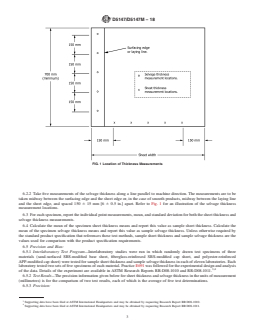
6.2.1 Take five measurements of the sheet thickness along a
Glass Fiber Reinforcements
line parallel to cross-machine direction. Two of the five
E177Practice for Use of the Terms Precision and Bias in
measurements shall be taken 150 6 15 mm [6 6 0.5 in.] from
ASTM Test Methods
each edge of the specimen.The remaining three measurements
E691Practice for Conducting an Interlaboratory Study to
shall be taken at three points approximately equally spaced
Determine the Precision of a Test Method
(615 mm [0.5 in.]) between these two points. Refer to Fig. 1
3. Significance and Use for an illustration of the sheet thickness measurement loca-
tions.
3.1 These test methods are used for sampling and testing
6.2.2 Takefivemeasurementsoftheselvagethicknessalong
modified bitumen sheet materials. Property requirements, de-
a line parallel to machine direction. The measurements are to
termined by these test methods, are found in the following
be taken midway between the surfacing edge and the sheet
product standards: Specifications D6162/D6162M, D6163/
edge or, in the case of smooth products, midway between the
D6163M,D6164/D6164M,D6222/D6222M,D6223/D6223M,
laying line and the sheet edge, and spaced 150 6 15 mm [6 6
D6298/D6298M, and D6509/D6509M.
0.5 in.] apart. Refer to Fig. 1 for an illustration of the selvage
4. Sampling thickness measurement locations.
4.1 Fromeachshipmentorfractionthereof,selectatrandom
6.3 For each specimen, report the individual point
a number of rolls equal to one half the cube root of the total
measurements,mean,andstandarddeviationforboththesheet
numberofrollsinthelot.Ifthecalculatednumberisfractional,
thickness and selvage thickness measurements.
express it as the next highest whole number. For convenience,
6.4 Calculate the mean of the specimen sheet thickness
atableshowingthenumberofrollstobeselectedfromthelots
means and report this value as sample sheet thickness. Calcu-
of various sizes is given in Test Method D146/D146M. When
late the mean of the specimen selvage thickness means and
mutuallyagreeduponbytheconcernedparties,othersampling
reportthisvalueassampleselvagethickness.Unlessotherwise
frequencies may be used and reported within the framework of
required by the standard product specification that references
these procedures. The minimum sample shall consist of five
these test methods, sample sheet thickness and sample selvage
rolls.The rolls so selected constitute the representative sample
thickness are the values used for comparison with the product
used for all subsequent observations and tests pertaining to the
specification requirements.
lot of material being examined.
6.5 Precision and Bias:
5. Conditioning
6.5.1 InterlaboratoryTestProgram—Interlaboratorystudies
5.1 Unless otherwise specified, condition test specimens for
were run in which randomly drawn test specimens of three
a minimum of4hat23 6 2°C [73.4 6 4°F] and 50 65%
materials (sand-surfaced SBS-modified base sheet, fiberglass-
relative humidity before testing.
reinforced SBS-modified cap sheet, and polyester-reinforced
APP-modified cap sheet) were tested for sample sheet thick-
6. Thickness
ness and sample selvage thickness in each of eleven laborato-
6.1 The thickness measuring device shall be a micrometer
ries. Each laboratory tested two sets of five specimens of each
of the dial or digital-electronic type capable of measuring
material. Practice E691 was followed for the experimental
dimensionstoanaccuracyof0.1mm[0.004in.].Themicrom-
design and analysis of the data. Details of the experiment are
eter shall be equipped with a flat, circular presser foot with a
available in ASTM Research Reports RR:D08-1010 and
3,4
diametergreaterorequalto9.5mm[0.375in.]andlessthan32
RR:D08-1011.
mm [1.25 in.]. During operation, contact between the presser
6.5.2 Test Result—The precision information given below
foot and the specimen shall be maintained either by a spring
for sheet thickness and selvage thickness in the units of
inside the micrometer or by the weight of the presser foot and
measurement (millimetres) is for the comparison of two test
attached parts.
results,eachofwhichistheaverageoffivetestdeterminations.
6.2 One specimen shall be obtained from each of the rolls
6.5.3 Precision:
selected in accordance with the Sampling section of these test
methods. Each specimen shall be at least 700 mm [27 ⁄2 in.] in
length by the manufactured width of the roll. Five measure-
Supporting data have been filed atASTM International Headquarters and may
ments of sheet thickness and five measurements of selvage
be obtained by requesting Research Report RR:D08-1010.
thickness shall be taken on each specimen. All measurements
Supporting data have been filed atASTM International Headquarters and may
shall be taken in a manner that requires the presser foot to be obtained by requesting Research Report RR:D08-1011.
D5147/D5147M − 18
FIG. 1 Location of Thickness Measurements
wide by a minimum of 150 mm [6.0 in.] long for sheet
Selvage Sheet Thickness
Thickness
materials having an ultimate elongation of 75% or less at
−18°C [0°F]. Specimens shall be 12.5 mm [0.5 in.] wide by a
Test range 1.952 to 2.706 1.959 to 3.824
minimum of 100 mm [4.0 in.] long for materials having an
mm mm
ultimate elongation of greater than 75% at −18°C [0°F].
r, 95 % repeatability limit 0.088 mm 0.048 mm
7.1.2 Procedure:
(within a laboratory) (0.040 to 0.157 (0.039 to 0.054
mm) mm)
7.1.2.1 Condition each specimen at least 2 h at the selected
test temperature. If conditioning is done outside the machine
R, 95 % reproducibility limit 0.281 mm 0.252 mm
(between laboratories) (0.148 to 0.366 (0.239 to 0.277
clamps, allow the specimen to equilibrate at the testing
mm) mm)
temperature for at least 15 min before the testing force is
applied.
The above terms (repeatability limit and reproducibility limit)
are used as specified in Practice E177.The respective standard
7.1.2.2 Test specimens at both 23 6 2°C [73.4 6 4°F] and
deviations among test results may be obtained by dividing the −18 6 2°C [0 6 4°F].
above limit values by 2.8.
7.1.2.3 Use a constant rate of elongation (CRE) tension
testing machine, preferably with automatic load and strain
6.5.4 Bias—Since there is no accepted reference material
recording equipment, and clamps that permit a uniform clamp-
suitable for determining the bias for the procedure in this test
ing pressure on the specimen without slipping. The initial
method for measuring sheet thickness and selvage thickness,
clamp separation shall be 75 6 2 mm [3.0 6 0.1 in.] for sheet
no statement on bias is being made.
materials having an ultimate elongation of 75% or less at
7. Load Strain Properties
−18°C[0°F],and50 62mm[2.0 60.1in.]forsheetmaterials
having an ultimate elongation greater than 75% at −18°C
7.1 This test method covers the determination of the load
[0°F].
strain (tensile elongation and strain energy) properties of
polymer-modified bituminous sheets. 7.1.2.4 Maintain a rate of separation of 50 mm/min 63%
7.1.1 Specimens—Prepare five specimens from each sample [2.0 in./min 63%] for specimens tested at 23 6 2°C [73.4 6
roll in both the longitudinal and transverse directions for each 4°F] and a rate of separation of 2.0 mm/min 63% [0.08
temperature to be tested. Specimens shall be 25 mm [1.0 in.] in./min 63%] for specimens tested at −18 6 2°C [0 6 4°F].
D5147/D5147M − 18
7.1.2.5 An alternative clamping method can be used for c 2 b
percentelongation 5 3100atpeakload (2)
hightensilematerialsthatslipinconventionaljaws.Clampthe b
specimeninthejawssothatthelengthorwidthisalignedwith
where:
the axis of the jaws.
c = jaw separation at maximum load,
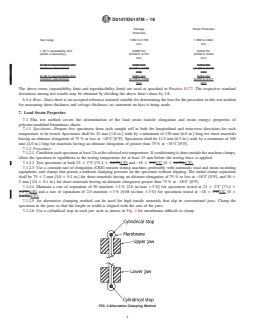
7.1.2.6 Use a cylindrical stop in each jaw such as shown in
maximumextensiononchart3jawseparationrate
=
Fig. 2 for membranes difficult to clamp.
chartspeed
7.1.2.7 Record the percent elongation of each specimen at
and
specimenbreakandalsoatpeakloadusinganextensometer,or
b = initial jaw separation.
calculate the percent elongation at specimen break and also at
7.1.3.4 Calculate the average percent elongation at peak
peak load from the chart of the stress versus time knowing the
load in each direction and the standard deviation of percent
speed of the chart drive and the jaw separation rate.
elongation at peak load in each direction based on the total
7.1.2.8 Record the breaking load and peak load of each
number of measurements taken.
specimen.
7.1.3.5 Calculate the average breaking load in each direc-
7.1.3 Calculation:
7.1.3.1 Determine the percent elongation at break obtained tion and the standard deviation of the breaking loads in each
from the extensometer in accordance with the manufacturer’s direction based on the total number of measurements taken.
instructions, or read directly, calculate the percent elongation
7.1.3.6 Calculate the average peak load in each direction
determined from the chart, without an extensometer, as fol-
and the standard deviation of the peak loads in each direction
lows:
based on the total number of measurements taken.
7.1.3.7 Iftheloadelongationcurveisnotavailable,estimate
a 2 b
Percentelongation 5 3100atbreak (1)
thestrainenergy.Thestrainenergyshouldbereportedaseither
b
measured or estimated.
where:
NOTE 2—The estimation technique requires knowledge of the maxi-
a = jaw separation at specimen break,
mum tensile strength and elongation values of the test specimen. This
maximumextensiononchart3jawseparationrate
=
technique can only be used for fibrous glass-reinforced specimens. If the
chartspeed
values generated by this technique are in question, verification must be
and
made by analysis of the load-elongation curve. Strain energy for fibrous
b = initial jaw separation.
glass-reinforced specimens is estimated by:
@1/23peakload @kN @lbf##3elongation @mm @in.###
7.1.3.2 Determinetheaveragepercentelongationatbreakin
se 5
25mm 1 in. 3gaugelength mm in.
@ # @ @ ##
each direction and the deviation of percent elongation at break
where 25 mm [1 in.]=sample width.
in each direction based on the total number of measurements
Strainenergyrepresentedastheareaundertheload-elongationcurvemay
taken. also be calculated by direct computer integration or analog techniques
such as, the trapezoidal rule, use of planimeter, or gravimetrical analysis.
7.1.3.3 Calculate the percent elongation at peak load ob-
tained from the extensometer in accordance with the manufac-
7.1.3.8 Calculate the average strain energy at peak load and
turer’sinstructions,orreaddirectly,calculatethestrainatpeak
at break in each direction and the standard deviation of the
load determined from the chart, without an extensometer, as
strain energies in each direction based on the total number of
follows:
measurements taken.
7.1.4 Ultimate Elongation—Determine the ultimate elonga-
tion using data obtained from tests conducted in accordance
with 7.1.2. Ultimate elongation is defined as the elongation
measured on the load-elongation curve at which point the load
has dropped to 5% of its maximum value, after the peak load
has been reached.
7.1.5 Report:
7.1.5.1 For each specimen in each direction, record the
temperatureofthetest,specimensize,andindividualmeasure-
mentsofpeakloadinkN/m[lbf/in.],percentelongationatpeak
load, breaking load in kN/m [lbf/in.], percent elongation at
break, method of determining elongation, strain energy in
2 2
kNm/m [inch-pound⁄in. ] at peak load, strain energy in kNm/
2 2
m [inch-pound⁄in. ] at break, and method of determining
elongation.
7.1.5.2 Report the average and the standard deviation in
each direction based on the total measurements taken of peak
load in kN/m [lbf/in.], breaking load in kN/m [lbf/in.], percent
elongation at peak load percent elongation at break, strain
2 2
energy in kNm/m [inch-pound⁄in. ] at peak load and strain
2 2
FIG. 2 Alternative Clamping Method energy in kNm/m [inch-pound⁄in. ] at break.
D5147/D5147M − 18
8. Tear Strength 9.1.1 Prepare five specimens measuring approximately 100
by 100 mm [4 by 4 in.] from each sample roll.
8.1 This test method determines the tensile tear strength of
9.1.2 Determine the mass of each specimen to the nearest
polymer-modified bituminous sheets.
0.1 g. Determine the moisture content in accordance with Test
8.1.1 Prepare five specimens from each sample roll in each
Method D9
...
This document is not an ASTM standard and is intended only to provide the user of an ASTM standard an indication of what changes have been made to the previous version. Because
it may not be technically possible to adequately depict all changes accurately, ASTM recommends that users consult prior editions as appropriate. In all cases only the current version
of the standard as published by ASTM is to be considered the official document.
Designation: D5147/D5147M − 14 D5147/D5147M − 18
Standard Test Methods for
Sampling and Testing Modified Bituminous Sheet Material
This standard is issued under the fixed designation D5147/D5147M; the number immediately following the designation indicates the
year of original adoption or, in the case of revision, the year of last revision. A number in parentheses indicates the year of last
reapproval. A superscript epsilon (´) indicates an editorial change since the last revision or reapproval.
1. Scope
1.1 These test methods cover procedures for sampling and testing prefabricated, reinforced, polymer-modified bituminous sheet
materials designed for single- or multiple-ply application in roofing and waterproofing membranes. These products may use
various surfacing materials on one side.
1.2 These test methods cover a number of different products. Not all tests are required for every product. Only those called out
in the Product Standard are required.
1.3 These test methods appear in the following order:
Section
Sampling 4
Conditioning 5
Thickness 6
Load Strain Properties 7
Tear Strength 8
Moisture Content 9
Water Absorption 10
Dimensional Stability 11
Low-Temperature Flexibility 12
Heat Conditioning 13
Accelerated Weathering 14
Granule Embedment 15
Compound Stability 16
Coating Thickness 17
Low Temperature Unrolling 18
Precision and Bias 19
1.4 The values stated in either SI units or inch-pound units are to be regarded separately as standard. The values stated in each
system may not be exact equivalents; therefore, each system shall be used independently of the other. Combining values from the
two systems may result in non-conformance with the standard.
1.5 This standard does not purport to address all of the safety concerns, if any, associated with its use. It is the responsibility
of the user of this standard to establish appropriate safety safety, health, and healthenvironmental practices and determine the
applicability of regulatory limitations prior to use.
1.6 This international standard was developed in accordance with internationally recognized principles on standardization
established in the Decision on Principles for the Development of International Standards, Guides and Recommendations issued
by the World Trade Organization Technical Barriers to Trade (TBT) Committee.
2. Referenced Documents
2.1 ASTM Standards:
D95 Test Method for Water in Petroleum Products and Bituminous Materials by Distillation
D146D146/D146M Test Methods for Sampling and Testing Bitumen-Saturated Felts and Woven Fabrics for Roofing and
Waterproofing
D1204 Test Method for Linear Dimensional Changes of Nonrigid Thermoplastic Sheeting or Film at Elevated Temperature
These test methods are under the jurisdiction of ASTM Committee D08 on Roofing and Waterproofing and are the direct responsibility of Subcommittee D08.04 on Felts,
Fabrics and Bituminous Sheet Materials.
Current edition approved Jan. 1, 2014July 1, 2018. Published January 2014August 2018. Originally approved in 1991. Last previous edition approved in 20112014 as
D5147/D5147M – 11a.D5147/D5147M – 14. DOI: 10.1520/D5147_D5147M-14.10.1520/D5147_D5147M-18.
For referenced ASTM standards, visit the ASTM website, www.astm.org, or contact ASTM Customer Service at service@astm.org. For Annual Book of ASTM Standards
volume information, refer to the standard’s Document Summary page on the ASTM website.
Copyright © ASTM International, 100 Barr Harbor Drive, PO Box C700, West Conshohocken, PA 19428-2959. United States
D5147/D5147M − 18
D4073 Test Method for Tensile-Tear Strength of Bituminous Roofing Membranes
D4798D4798/D4798M Practice for Accelerated Weathering Test Conditions and Procedures for Bituminous Materials
(Xenon-Arc Method)
D4977D4977/D4977M Test Method for Granule Adhesion to Mineral Surfaced Roofing by Abrasion
D5636D5636/D5636M Test Method for Low Temperature Unrolling of Felt or Sheet Roofing and Waterproofing Materials
D5869D5869/D5869M Practice for Dark Oven Heat Exposure of Roofing and Waterproofing Materials
D6162D6162/D6162M Specification for Styrene Butadiene Styrene (SBS) Modified Bituminous Sheet Materials Using a
Combination of Polyester and Glass Fiber Reinforcements
D6163D6163/D6163M Specification for Styrene Butadiene Styrene (SBS) Modified Bituminous Sheet Materials Using Glass
Fiber Reinforcements
D6164D6164/D6164M Specification for Styrene Butadiene Styrene (SBS) Modified Bituminous Sheet Materials Using
Polyester Reinforcements
D6222D6222/D6222M Specification for Atactic Polypropylene (APP) Modified Bituminous Sheet Materials Using Polyester
Reinforcements
D6223D6223/D6223M Specification for Atactic Polypropylene (APP) Modified Bituminous Sheet Materials Using a Combi-
nation of Polyester and Glass Fiber Reinforcements
D6298D6298/D6298M Specification for Fiberglass Reinforced Styrene-Butadiene-Styrene (SBS) Modified Bituminous Sheets
with a Factory Applied Metal Surface
D6509D6509/D6509M Specification for Atactic Polypropylene (APP) Modified Bituminous Base Sheet Materials Using Glass
Fiber ReinforcementReinforcements
E177 Practice for Use of the Terms Precision and Bias in ASTM Test Methods
E691 Practice for Conducting an Interlaboratory Study to Determine the Precision of a Test Method
3. Significance and Use
3.1 These test methods are used for sampling and testing modified bitumen sheet materials. Property requirements, determined
by these test methods, are found in the following product standards: Specifications D6162D6162/D6162M, D6163D6163/
D6163M, D6164D6164/D6164M, D6222D6222/D6222M, D6223D6223/D6223M, D6298D6298/D6298M, and D6509D6509/
D6509M.
4. Sampling
4.1 From each shipment or fraction thereof, select at random a number of rolls equal to one half the cube root of the total number
of rolls in the lot. If the calculated number is fractional, express it as the next highest whole number. For convenience, a table
showing the number of rolls to be selected from the lots of various sizes is given in Test Method D146D146/D146M. When
mutually agreed upon by the concerned parties, other sampling frequencies may be used and reported within the framework of
these procedures. The minimum sample shall consist of five rolls. The rolls so selected constitute the representative sample used
for all subsequent observations and tests pertaining to the lot of material being examined.
5. Conditioning
5.1 Unless otherwise specified, condition test specimens for a minimum of 4 h at 23 6 2°C [73.4 6 3.6°F]4°F] and 50 6 5 %
relative humidity before testing.
6. Thickness
6.1 The thickness measuring device shall be a micrometer of the dial or digital-electronic type capable of measuring dimensions
to an accuracy of 0.1 mm [0.004 in.]. The micrometer shall be equipped with a flat, circular presser foot with a diameter greater
or equal to 9.5 mm [0.375 in.] and less than 32 mm [1.25 in.]. During operation, contact between the presser foot and the specimen
shall be maintained either by a spring inside the micrometer or by the weight of the presser foot and attached parts.
6.2 One specimen shall be obtained from each of the rolls selected in accordance with the Sampling section of these test
methods. Each specimen shall be at least 700 mm [27 ⁄2 in.] in length by the manufactured width of the roll. Five measurements
of sheet thickness and five measurements of selvage thickness shall be taken on each specimen. All measurements shall be taken
in a manner that requires the presser foot to contact the side of the sheet that is intended to be exposed when applied in accordance
with the manufacturer’s instructions.
NOTE 1—When measuring products with particulate surfaces, wiping particles from the presser foot between measurements is recommended to prevent
buildup of particles that may result in inaccurate measurements.
6.2.1 Take five measurements of the sheet thickness along a line parallel to cross-machine direction. Two of the five
measurements shall be taken 150 615 6 15 mm [6 6 0.5 in.] from each edge of the specimen. The remaining three measurements
shall be taken at three points approximately equally spaced (615 mm [0.5 in.]) between these two points. Refer to Fig. 1 for an
illustration of the sheet thickness measurement locations.
D5147/D5147M − 18
FIG. 1 Location of Thickness Measurements
6.2.2 Take five measurements of the selvage thickness along a line parallel to machine direction. The measurements are to be
taken midway between the surfacing edge and the sheet edge or, in the case of smooth products, midway between the laying line
and the sheet edge, and spaced 150 6 15 mm [6 6 0.5 in.] apart. Refer to Fig. 1 for an illustration of the selvage thickness
measurement locations.
6.3 For each specimen, report the individual point measurements, mean, and standard deviation for both the sheet thickness and
selvage thickness measurements.
6.4 Calculate the mean of the specimen sheet thickness means and report this value as sample sheet thickness. Calculate the
mean of the specimen selvage thickness means and report this value as sample selvage thickness. Unless otherwise required by
the standard product specification that references these test methods, sample sheet thickness and sample selvage thickness are the
values used for comparison with the product specification requirements.
6.5 Precision and Bias:
6.5.1 Interlaboratory Test Program—Interlaboratory studies were run in which randomly drawn test specimens of three
materials (sand-surfaced SBS-modified base sheet, fiberglass-reinforced SBS-modified cap sheet, and polyester-reinforced
APP-modified cap sheet) were tested for sample sheet thickness and sample selvage thickness in each of eleven laboratories. Each
laboratory tested two sets of five specimens of each material. Practice E691 was followed for the experimental design and analysis
3,4
of the data. Details of the experiment are available in ASTM Research Reports RR:D08-1010 and RR:D08-1011.
6.5.2 Test Result—The precision information given below for sheet thickness and selvage thickness in the units of measurement
(millimetres) is for the comparison of two test results, each of which is the average of five test determinations.
6.5.3 Precision:
Supporting data have been filed at ASTM International Headquarters and may be obtained by requesting Research Report RR:D08-1010.
Supporting data have been filed at ASTM International Headquarters and may be obtained by requesting Research Report RR:D08-1011.
D5147/D5147M − 18
Selvage Sheet Thickness
Thickness
Test range 1.952 to 2.706 1.959 to 3.824
mm mm
r, 95 % repeatability limit 0.088 mm 0.048 mm
(within a laboratory) (0.040 to 0.157 (0.039 to 0.054
mm) mm)
R, 95 % reproducibility limit 0.281 mm 0.252 mm
(between laboratories) (0.148 to 0.366 ( 0.239 to 0.277
mm) mm)
R, 95 % reproducibility limit 0.281 mm 0.252 mm
(between laboratories) (0.148 to 0.366 (0.239 to 0.277
mm) mm)
The above terms (repeatability limit and reproducibility limit) are used as specified in Practice E177. The respective standard
deviations among test results may be obtained by dividing the above limit values by 2.8.
6.5.4 Bias—Since there is no accepted reference material suitable for determining the bias for the procedure in this test method
for measuring sheet thickness and selvage thickness, no statement on bias is being made.
7. Load Strain Properties
7.1 This test method covers the determination of the load strain (tensile elongation and strain energy) properties of
polymer-modified bituminous sheets.
7.1.1 Specimens—Prepare five specimens from each sample roll in both the longitudinal and transverse directions for each
temperature to be tested. Specimens shall be 25 mm [1.0 in.] wide by a minimum of 150 mm [6.0 in.] long for sheet materials
having an ultimate elongation of 75 % or less at −18°C [0°F]. Specimens shall be 12.5 mm [0.5 in.] wide by a minimum of 100
mm [4.0 in.] long for materials having an ultimate elongation of greater than 75 % at −18°C [0°F].
7.1.2 Procedure:
7.1.2.1 Condition each specimen at least 2 h at the selected test temperature. If conditioning is done outside the machine clamps,
allow the specimen to equilibrate at the testing temperature for at least 15 min before the testing force is applied.
7.1.2.2 Test specimens at both 23 6 2°C [73.4 6 3.6°F]4°F] and −18 6 3°C2°C [0 6 3.6°F].4°F].
7.1.2.3 Use a constant rate of elongation (CRE) tension testing machine, preferably with automatic load and strain recording
equipment, and clamps that permit a uniform clamping pressure on the specimen without slipping. The initial clamp separation
shall be 75 6 2 mm [3.0 6 0.1 in.] for sheet materials having an ultimate elongation of 75 % or less at −18°C [0°F], and 50 6
2 mm [2.0 6 0.1 in.] for sheet materials having an ultimate elongation greater than 75 % at −18°C [0°F].
7.1.2.4 Maintain a rate of separation of 50 mm/min 63 % [2.0 in./min 63 %] for specimens tested at 23 6 2°C [73.4 6
3.6°F]4°F] and a rate of separation of 2.0 mm/min 63 % [0.08 in./min 63 %] for specimens tested at −18 6 3°C2°C [0 6
3.6°F].4°F].
7.1.2.5 An alternative clamping method can be used for high tensile materials that slip in conventional jaws. Clamp the
specimen in the jaws so that the length or width is aligned with the axis of the jaws.
7.1.2.6 Use a cylindrical stop in each jaw such as shown in Fig. 2 for membranes difficult to clamp.
FIG. 2 Alternative Clamping Method
D5147/D5147M − 18
7.1.2.7 Record the percent elongation of each specimen at specimen break and also at peak load using an extensometer, or
calculate the percent elongation at specimen break and also at peak load from the chart of the stress versus time knowing the speed
of the chart drive and the jaw separation rate.
7.1.2.8 Record the breaking load and peak load of each specimen.
7.1.3 Calculation:
7.1.3.1 Determine the percent elongation at break obtained from the extensometer in accordance with the manufacturer’s
instructions, or read directly, calculate the percent elongation determined from the chart, without an extensometer, as follows:
a 2 b
Percent elongation 5 3100 at break (1)
b
where:
a = jaw separation at specimen break,
maximum extension on chart3jaw separation rate
=
chart speed
and
b = initial jaw separation.
7.1.3.2 Determine the average percent elongation at break in each direction and the deviation of percent elongation at break in
each direction based on the total number of measurements taken.
7.1.3.3 Calculate the percent elongation at peak load obtained from the extensometer in accordance with the manufacturer’s
instructions, or read directly, calculate the strain at peak load determined from the chart, without an extensometer, as follows:
c 2 b
percent elongation 5 3100 at peak load (2)
b
where:
c = jaw separation at maximum load,
maximum extension on chart3jaw separation rate
=
chart speed
and
b = initial jaw separation.
7.1.3.4 Calculate the average percent elongation at peak load in each direction and the standard deviation of percent elongation
at peak load in each direction based on the total number of measurements taken.
7.1.3.5 Calculate the average breaking load in each direction and the standard deviation of the breaking loads in each direction
based on the total number of measurements taken.
7.1.3.6 Calculate the average peak load in each direction and the standard deviation of the peak loads in each direction based
on the total number of measurements taken.
7.1.3.7 If the load elongation curve is not available, estimate the strain energy. The strain energy should be reported as either
measured or estimated.
NOTE 2—The estimation technique requires knowledge of the maximum tensile strength and elongation values of the test specimen. This technique
can only be used for fibrous glass-reinforced specimens. If the values generated by this technique are in question, verification must be made by analysis
of the load-elongation curve. Strain energy for fibrous glass-reinforced specimens is estimated by:
@1/23peak load @kN @lbf##3elongation @mm @in.###
se5
25 mm 1 in. 3gauge length mm in.
@ # @ @ ##
where 25 mm [1 in.] = sample width.
Strain energy represented as the area under the load-elongation curve may also be calculated by direct computer integration or analog techniques such
as, the trapezoidal rule, use of planimeter, or gravimetrical analysis.
7.1.3.8 Calculate the average strain energy at peak load and at break in each direction and the standard deviation of the strain
energies in each direction based on the total number of measurements taken.
7.1.4 Ultimate Elongation—Determine the ultimate elongation using data obtained from tests conducted in accordance with
7.1.2. Ultimate elongation is defined as the elongation measured on the load-elongation curve at which point the load has dropped
to 5 % of its maximum value, after the peak load has been reached.
7.1.5 Report:
7.1.5.1 For each specimen in each direction, record the temperature of the test, specimen size, and individual measurements of
peak load in kN/m [lbf/in.], percent elongation at peak load, breaking load in kN/m [lbf/in.], percent elongation at break, method
2 2 2 2
of determining elongation, strain energy in kNm/m [inch-pound ⁄in. ] at peak load, strain energy in kNm/m [inch-pound ⁄in. ] at
break, and method of determining elongation.
7.1.5.2 Report the average and the standard deviation in each direction based on the total measurements taken of peak load in
kN/m [lbf/in.], breaking load in kN/m [lbf/in.], percent elongation at peak load percent elongation at break, strain energy in
2 2 2 2
kNm/m [inch-pound ⁄in. ] at peak load and strain energy in kNm/m [inch-pound ⁄in. ] at break.
D5147/D5147M − 18
8. Tear Strength
8.1 This test method determines the tensile tear strength of polymer-modified bituminous sheets.
8.1.1 Prepare five specimens from each sample roll in each direction in accordance with Test Method D4073. Co
...