

ASTM D95-23
(Test Method)Standard Test Method for Water in Petroleum Products and Bituminous Materials by Distillation
General Information
- Abstract
SIGNIFICANCE AND USE
5.1 A knowledge of the water content of petroleum products is important in the refining, purchase, sale, and transfer of products.
5.2 The amount of water as determined by this test method (to the nearest 0.05 % or 0.1 % by volume, depending on the trap size used) may be used to correct the volume involved in the custody transfer of petroleum products and bituminous materials.
5.3 The allowable amount of water may be specified in contracts.
SCOPE
1.1 This test method covers the determination of water in the range from 0 % to 25 % by volume in petroleum products, tars, and other bituminous materials by the distillation method.
Note 1: Volatile water-soluble material, if present, may be measured as water.
1.2 The specific products considered during the development of this test method are listed in Table 1. For bituminous emulsions refer to Test Method D244. For crude oils, refer to Test Method D4006 (API MPMS Chapter 10.2).
Note 2: With some types of oil, satisfactory results may be obtained from Test Method D1796 (API MPMS Chapter 10.6).
1.3 The values stated in SI units are to be regarded as standard. The values given in parentheses after SI units are provided for information only and are not considered standard.
1.4 This standard does not purport to address all of the safety concerns, if any, associated with its use. It is the responsibility of the user of this standard to establish appropriate safety, health, and environmental practices and determine the applicability of regulatory limitations prior to use. For specific hazard statements, see Section 6.
1.5 This international standard was developed in accordance with internationally recognized principles on standardization established in the Decision on Principles for the Development of International Standards, Guides and Recommendations issued by the World Trade Organization Technical Barriers to Trade (TBT) Committee.
- Status
- Published
- Publication Date
- 30-Sep-2023
- Technical Committee
- D02 - Petroleum Products, Liquid Fuels, and Lubricants
- Drafting Committee
- D02.02 - Hydrocarbon Measurement for Custody Transfer (Joint ASTM-API)
Buy Documents
ASTM D95-23 - Standard Test Method for Water in Petroleum Products and Bituminous Materials by Distillation
REDLINE ASTM D95-23 - Standard Test Method for Water in Petroleum Products and Bituminous Materials by Distillation
Overview
ASTM D95-23 is the internationally recognized standard test method for determining the water content in petroleum products, tars, and other bituminous materials using the distillation method. Published by ASTM International, this standard outlines a precise procedure to identify water presence in a range from 0% to 25% by volume. Accurate measurement of water content is critical in the petroleum industry for refining, purchasing, selling, and transferring petroleum products and bituminous materials.
This standard is widely used for quality control, contractual compliance, and custody transfer Applications. It supports both laboratory and field operations, ensuring consistent product quality and reliability in transactions involving petroleum products and bituminous materials.
Key Topics
- Water Determination by Distillation: Describes a method where the test sample is mixed with a water-immiscible solvent and heated under reflux. Water distills along with the solvent and is quantitatively measured in a calibrated trap.
- Range of Applicability: Measures water content in various liquid and semi-solid petroleum products, tars, and bitumen from 0% up to 25% by volume.
- Importance in Industry:
- Determines compliance to specifications and contracts, as water content may affect product value.
- Used for volumetric correction during the custody transfer process.
- Supports operational decisions in refining and production.
- Accurate Reporting and Precision: Results are reported to the nearest 0.05% or 0.1% by volume, depending on the measuring trap, ensuring traceability and accuracy.
- Sampling and Verification: Specifies adherence to referenced ASTM practices for sample collection, homogenization, and calibration, maintaining integrity throughout the test process.
Applications
ASTM D95-23 is essential in various sectors within the petroleum industry, including:
- Refining Operations: Precise water measurement helps maintain product quality, avoid equipment corrosion, and prevent process inefficiencies.
- Product Specification and Compliance: Ensures products meet customer and regulatory requirements, supporting both buyers and sellers during commercial transactions.
- Custody Transfer and Logistics:
- Used to adjust volumes for water content during the handover of product ownership.
- Minimizes disputes and ensures fair valuation.
- Research and Quality Assurance: Laboratories employ this standard for routine analysis and special investigations related to petroleum or bituminous materials.
Through its detailed methodology and strict sampling guidelines, ASTM D95-23 promotes reproducibility and comparability of results across operators and laboratories.
Related Standards
Several ASTM and API standards are referenced or closely related to ASTM D95-23:
- ASTM D244: Standard Test Methods for Emulsified Asphalts - for bituminous emulsions.
- ASTM D4006: Standard Test Method for Water in Crude Oil by Distillation - for crude oils.
- ASTM D1796: Standard Test Method for Water and Sediment in Fuel Oils by the Centrifuge Method.
- ASTM D4057: Practice for Manual Sampling of Petroleum and Petroleum Products.
- ASTM D4177: Practice for Automatic Sampling of Petroleum and Petroleum Products.
- ASTM D5854: Practice for Mixing and Handling of Liquid Samples of Petroleum.
- ASTM E123: Specification for Apparatus for Determination of Water by Distillation.
- API MPMS Series: Covers various measurement practices, especially in the context of custody transfer, sampling, handling, and water determination.
For best practices, always ensure compliance with the latest revisions of referenced standards and harmonized international guidance.
Keywords: ASTM D95-23, water in petroleum products, distillation method, bituminous materials, custody transfer, petroleum testing standards, water content measurement, petroleum quality control, bitumen analysis, ASTM petroleum standards.
Relations
- Effective Date
- 01-Oct-2023
- Refers
ASTM E123-02(2024) - Standard Specification for Apparatus for Determination of Water by Distillation - Effective Date
- 01-Feb-2024
- Refers
ASTM D4175-23a - Standard Terminology Relating to Petroleum Products, Liquid Fuels, and Lubricants - Effective Date
- 15-Dec-2023
- Effective Date
- 01-Oct-2023
- Refers
ASTM D4175-23e1 - Standard Terminology Relating to Petroleum Products, Liquid Fuels, and Lubricants - Effective Date
- 01-Jul-2023
- Refers
ASTM D4175-23 - Standard Terminology Relating to Petroleum Products, Liquid Fuels, and Lubricants - Effective Date
- 01-Jul-2023
- Effective Date
- 01-Oct-2017
- Effective Date
- 01-Oct-2023
- Referred By
ASTM D6448-16(2022) - Standard Specification for Industrial Burner Fuels from Used Lubricating Oils - Effective Date
- 01-Oct-2023
- Effective Date
- 01-Oct-2023
- Effective Date
- 01-Oct-2023
- Effective Date
- 01-Oct-2023
- Effective Date
- 01-Oct-2023
- Effective Date
- 01-Oct-2023
- Referred By
ASTM E123-02(2018) - Standard Specification for Apparatus for Determination of Water by Distillation - Effective Date
- 01-Oct-2023
Buy Documents
ASTM D95-23 - Standard Test Method for Water in Petroleum Products and Bituminous Materials by Distillation
REDLINE ASTM D95-23 - Standard Test Method for Water in Petroleum Products and Bituminous Materials by Distillation
Get Certified
Connect with accredited certification bodies for this standard

Element Materials Technology
Materials testing and product certification.

ABS Group Brazil
ABS Group certification services in Brazil.

ABS Quality Evaluations Inc.
American Bureau of Shipping quality certification.
Sponsored listings
Frequently Asked Questions
ASTM D95-23 is a standard published by ASTM International. Its full title is "Standard Test Method for Water in Petroleum Products and Bituminous Materials by Distillation". This standard covers: SIGNIFICANCE AND USE 5.1 A knowledge of the water content of petroleum products is important in the refining, purchase, sale, and transfer of products. 5.2 The amount of water as determined by this test method (to the nearest 0.05 % or 0.1 % by volume, depending on the trap size used) may be used to correct the volume involved in the custody transfer of petroleum products and bituminous materials. 5.3 The allowable amount of water may be specified in contracts. SCOPE 1.1 This test method covers the determination of water in the range from 0 % to 25 % by volume in petroleum products, tars, and other bituminous materials by the distillation method. Note 1: Volatile water-soluble material, if present, may be measured as water. 1.2 The specific products considered during the development of this test method are listed in Table 1. For bituminous emulsions refer to Test Method D244. For crude oils, refer to Test Method D4006 (API MPMS Chapter 10.2). Note 2: With some types of oil, satisfactory results may be obtained from Test Method D1796 (API MPMS Chapter 10.6). 1.3 The values stated in SI units are to be regarded as standard. The values given in parentheses after SI units are provided for information only and are not considered standard. 1.4 This standard does not purport to address all of the safety concerns, if any, associated with its use. It is the responsibility of the user of this standard to establish appropriate safety, health, and environmental practices and determine the applicability of regulatory limitations prior to use. For specific hazard statements, see Section 6. 1.5 This international standard was developed in accordance with internationally recognized principles on standardization established in the Decision on Principles for the Development of International Standards, Guides and Recommendations issued by the World Trade Organization Technical Barriers to Trade (TBT) Committee.
SIGNIFICANCE AND USE 5.1 A knowledge of the water content of petroleum products is important in the refining, purchase, sale, and transfer of products. 5.2 The amount of water as determined by this test method (to the nearest 0.05 % or 0.1 % by volume, depending on the trap size used) may be used to correct the volume involved in the custody transfer of petroleum products and bituminous materials. 5.3 The allowable amount of water may be specified in contracts. SCOPE 1.1 This test method covers the determination of water in the range from 0 % to 25 % by volume in petroleum products, tars, and other bituminous materials by the distillation method. Note 1: Volatile water-soluble material, if present, may be measured as water. 1.2 The specific products considered during the development of this test method are listed in Table 1. For bituminous emulsions refer to Test Method D244. For crude oils, refer to Test Method D4006 (API MPMS Chapter 10.2). Note 2: With some types of oil, satisfactory results may be obtained from Test Method D1796 (API MPMS Chapter 10.6). 1.3 The values stated in SI units are to be regarded as standard. The values given in parentheses after SI units are provided for information only and are not considered standard. 1.4 This standard does not purport to address all of the safety concerns, if any, associated with its use. It is the responsibility of the user of this standard to establish appropriate safety, health, and environmental practices and determine the applicability of regulatory limitations prior to use. For specific hazard statements, see Section 6. 1.5 This international standard was developed in accordance with internationally recognized principles on standardization established in the Decision on Principles for the Development of International Standards, Guides and Recommendations issued by the World Trade Organization Technical Barriers to Trade (TBT) Committee.
ASTM D95-23 is classified under the following ICS (International Classification for Standards) categories: 75.140 - Waxes, bituminous materials and other petroleum products. The ICS classification helps identify the subject area and facilitates finding related standards.
ASTM D95-23 has the following relationships with other standards: It is inter standard links to ASTM D95-13(2018), ASTM E123-02(2024), ASTM D4175-23a, ASTM D244-23, ASTM D4175-23e1, ASTM D4175-23, ASTM D244-09(2017), ASTM D1208-96(2019), ASTM D6448-16(2022), ASTM D6373-23, ASTM D5727/D5727M-00(2023), ASTM D4868-17, ASTM D228/D228M-21, ASTM D2027/D2027M-19, ASTM E123-02(2018). Understanding these relationships helps ensure you are using the most current and applicable version of the standard.
ASTM D95-23 is available in PDF format for immediate download after purchase. The document can be added to your cart and obtained through the secure checkout process. Digital delivery ensures instant access to the complete standard document.
Standards Content (Sample)
This international standard was developed in accordance with internationally recognized principles on standardization established in the Decision on Principles for the
Development of International Standards, Guides and Recommendations issued by the World Trade Organization Technical Barriers to Trade (TBT) Committee.
Designation: D95 − 23
Manual of Petroleum Measurement Standards (MPMS), Chapter 10.5
Standard Test Method for
Water in Petroleum Products and Bituminous Materials by
Distillation
This standard is issued under the fixed designation D95; the number immediately following the designation indicates the year of original
adoption or, in the case of revision, the year of last revision. A number in parentheses indicates the year of last reapproval. A superscript
epsilon (´) indicates an editorial change since the last revision or reapproval.
This standard has been approved for use by agencies of the U.S. Department of Defense.
1. Scope* 2. Referenced Documents
2.1 ASTM Standards:
1.1 This test method covers the determination of water in
D235 Specification for Mineral Spirits (Petroleum Spirits)
the range from 0 % to 25 % by volume in petroleum products,
(Hydrocarbon Dry Cleaning Solvent)
tars, and other bituminous materials by the distillation method.
D244 Test Methods and Practices for Emulsified Asphalts
NOTE 1—Volatile water-soluble material, if present, may be measured
D1796 Test Method for Water and Sediment in Fuel Oils by
as water.
the Centrifuge Method (Laboratory Procedure) (API
1.2 The specific products considered during the develop-
MPMS Chapter 10.6)
ment of this test method are listed in Table 1. For bituminous
D4006 Test Method for Water in Crude Oil by Distillation
emulsions refer to Test Method D244. For crude oils, refer to
(API MPMSChapter 10.2)
Test Method D4006 (API MPMS Chapter 10.2).
D4057 Practice for Manual Sampling of Petroleum and
Petroleum Products (API MPMS Chapter 8.1)
NOTE 2—With some types of oil, satisfactory results may be obtained
D4175 Terminology Relating to Petroleum Products, Liquid
from Test Method D1796 (API MPMS Chapter 10.6).
Fuels, and Lubricants
1.3 The values stated in SI units are to be regarded as
D4177 Practice for Automatic Sampling of Petroleum and
standard. The values given in parentheses after SI units are
Petroleum Products (API MPMS Chapter 8.2)
provided for information only and are not considered standard.
D5854 Practice for Mixing and Handling of Liquid Samples
1.4 This standard does not purport to address all of the
of Petroleum and Petroleum Products (API MPMS Chap-
safety concerns, if any, associated with its use. It is the
ter 8.3)
responsibility of the user of this standard to establish appro-
E123 Specification for Apparatus for Determination of Water
priate safety, health, and environmental practices and deter-
by Distillation
mine the applicability of regulatory limitations prior to use.
2.2 API Standards:
For specific hazard statements, see Section 6.
MPMS Chapter 1 Terms and Definitions Database
1.5 This international standard was developed in accor-
MPMS Chapter 8.1 Manual Sampling of Petroleum and
dance with internationally recognized principles on standard-
Petroleum Products (ASTM Practice D4057)
ization established in the Decision on Principles for the
MPMS Chapter 8.2 Automatic Sampling of Petroleum and
Development of International Standards, Guides and Recom-
Petroleum Products (ASTM Practice D4177)
mendations issued by the World Trade Organization Technical
MPMS Chapter 8.3 Mixing and Handling of Liquid Samples
Barriers to Trade (TBT) Committee.
of Petroleum and Petroleum Products (ASTM Practice
D5854)
MPMS Chapter 10.2 Determination of Water in Crude Oil by
1 the Distillation Method (ASTM Test Method D4006)
This test method is under the jurisdiction of ASTM Committee D02 on
Petroleum Products, Liquid Fuels, and Lubricants and the API Committee on
Petroleum Measurement, and is the direct responsibility of Subcommittee D02.02
/COMQ the joint ASTM-API Committee on Hydrocarbon Measurement for For referenced ASTM standards, visit the ASTM website, www.astm.org, or
Custody Transfer (Joint ASTM-API). This practice has been approved by the contact ASTM Customer Service at service@astm.org. For Annual Book of ASTM
sponsoring committees and accepted by the Cooperating Societies in accordance Standards volume information, refer to the standard’s Document Summary page on
with established procedures. the ASTM website.
Current edition approved Oct. 1, 2023. Published October 2023. Originally Published as Manual of Petroleum Measurement Standards. Available from
approved in 1921. Last previous edition approved in 2018 as D95 – 13 (2018). DOI: American Petroleum Institute (API), 1220 L. St., NW, Washington, DC 20005-4070,
10.1520/D0095-23. http://www.api.org.
*A Summary of Changes section appears at the end of this standard
© Jointly copyrighted by ASTM International, 100 Barr Harbor Drive, PO Box C700, West Conshohocken, PA 19428-2959, USA and the American Petroleum Institute (API), 1220 L Street NW, Washington DC 20005, USA
D95 − 23
MPMS Chapter 10.6 Test Method for Water and Sediment in 6.1.2 Petroleum Distillate Solvent—A petroleum distillate
Fuel Oils by the Centrifuge Method (Laboratory Proce- solvent containing at least 2 % (V/V) aromatics and with an
dure) (ASTM Test Method D1796) initial boiling point (IBP) greater than 80 °C (176 °F); and a
final boiling point (FBP) below 250 °C (482 °F) shall be used.
3. Terminology
NOTE 3—Examples of suitable solvents include Types I and IV and
3.1 Definitions:
Classes A and B of Specification D235.
NOTE 4—It is recommended to use a wide boiling range solvent with
3.1.1 For definitions of terms used in this test method, refer
10 % boiling below 100 °C to help to ensure an even distillation rate.
to Terminology D4175 and API MPMS Chapter 1.
3.1.2 bituminous material, n—in petroleum technology, a 6.1.3 Volatile Spirits Solvent—The following volatile spirits
black or dark-colored very viscous liquid or semi-solid com-
solvents are acceptable:
posed principally of high molecular weight condensed 6.1.3.1 Petroleum Spirit, with a boiling range from 100 °C
aromatic, or naphthenic compounds, or both.
to 120 °C (212 °F to 248 °F). (Warning—Flammable. Vapor
harmful.)
4. Summary of Test Method
6.1.3.2 Iso-octane, of 95 % purity or better. (Warning—
Extremely flammable. Harmful if inhaled. Vapors may cause
4.1 The material to be tested is heated under reflux with a
fire.)
water-immiscible solvent, which co-distills with the water in
the sample. Condensed solvent and water are continuously
6.2 Solvent Blank—The water content of the solvent shall be
separated in a trap, the water settling in the graduated section
determined by distilling an equivalent amount of the same
of the trap and the solvent returning to the still.
solvent used for the test sample in the distillation apparatus and
testing as outlined in Section 10. The blank shall be determined
5. Significance and Use
to the nearest scale division and used to correct the volume of
5.1 A knowledge of the water content of petroleum products water in the trap in Section 11.
is important in the refining, purchase, sale, and transfer of
7. Apparatus
products.
7.1 General—The apparatus comprises a glass or metal still,
5.2 The amount of water as determined by this test method
a heater, a reflux condenser, and a graduated glass trap. The
(to the nearest 0.05 % or 0.1 % by volume, depending on the
still, trap, and condenser may be connected by any suitable
trap size used) may be used to correct the volume involved in
method that produces a leakproof joint. Preferred connections
the custody transfer of petroleum products and bituminous
are ground joints for glass and O-rings for metal to glass.
materials.
Typical assemblies are illustrated in Fig. 1, Fig. 2, and Fig. 3.
5.3 The allowable amount of water may be specified in
The stills and traps should be chosen to cover the range of
contracts.
materials and water contents expected. On assembly, care shall
be taken to prevent the joints from freezing or sticking. Always
6. Solvent-Carrier Liquid
apply a very thin film of stopcock grease to prevent the
6.1 A water-immiscible solvent-carrier liquid that is mis-
glassware joints from seizing.
cible in the material being tested (see Table 1) shall be used.
7.2 Still—A glass or metal vessel with a short neck and
6.1.1 Aromatic Solvent—The following aromatic solvents
suitable joint for accommodating the reflux tube of the trap
are acceptable:
6.1.1.1 Industrial Grade Xylene—(Warning—Flammable.
Vapor harmful.)
6.1.1.2 A blend of 20 % by volume industrial grade toluene
and 80 % by volume industrial grade xylene. (Warning—
Flammable. Vapor harmful.)
6.1.1.3 Petroleum Naphtha or Coal Tar Naphtha, free of
water, yielding not more than 5 % distillates at 125 °C (257 °F)
and not less than 20 % at 160 °C (320 °F) and with a relative
density (specific gravity) not lower than 0.8545 at
15.56 °C ⁄15.56 °C (60 °F ⁄60 °F). (Warning—Extremely
flammable. Harmful if inhaled. Vapors may cause fire.)
TABLE 1 Type of Solvent-Carrier Liquid to Use Versus Material to
Be Tested
Type of Solvent-Carrier Liquid Material to be Tested
Aromatic asphalt, bitumen, tar, and related products
Petroleum distillate fuel oil, lubricating oil, lubricating oil additives
Volatile spirits greases
FIG. 1 Typical Assembly with Glass Still
D95 − 23
9. Verification
9.1 The accuracy of the graduation marks on the trap shall
be certified or verified, using only national or international
standards, such as National Institute of Standards and Technol-
ogy (NIST) traceable equipment. Verification shall be with a
traceable 5 mL Micro Burette or Micro Pipette, readable to the
nearest 0.01 mL.
9.1.1 In styles A, B, C, and D, as specified in Table 2
(Table 1 in Specification E123), each subdivision (that is,
0.1 mL through 1.0 mL) in the conical portion of the tube shall
be verified. Thereafter, each major subdivision (that is, 2.0 mL,
3.0 mL, 4.0 mL, and up to the total volume of the trap) shall be
verified.
9.1.2 In styles E and F, as specified in Table 2, each major
subdivision (0.1 mL, 1.0 mL, 2.0 mL, 4.0 mL, and 5.0 mL in
the case of Style E; 0.05 mL, 0.5 mL, 1.0 mL, 1.5 mL, and
2.0 mL in the case of Style F) shall be verified.
9.2 The entire glassware assembly shall be verified prior to
first use and at a regular frequency thereafter as follows.
FIG. 2 Two-millilitre Receiver Showing Alternative Connections to
9.2.1 Put 400 mL of dry (0.02 % water maximum) xylene or
Glass Still
the solvent to be utilized in the analysis of unknown samples
into the apparatus and test in accordance with Section 10.
When complete, discard the contents of the trap and add the
volume of water as specified as first test in Table 3 directly to
shal
...
This document is not an ASTM standard and is intended only to provide the user of an ASTM standard an indication of what changes have been made to the previous version. Because
it may not be technically possible to adequately depict all changes accurately, ASTM recommends that users consult prior editions as appropriate. In all cases only the current version
of the standard as published by ASTM is to be considered the official document.
Designation: D95 − 13 (Reapproved 2018) D95 − 23
Manual of Petroleum Measurement Standards (MPMS), Chapter 10.5
Standard Test Method for
Water in Petroleum Products and Bituminous Materials by
Distillation
This standard is issued under the fixed designation D95; the number immediately following the designation indicates the year of original
adoption or, in the case of revision, the year of last revision. A number in parentheses indicates the year of last reapproval. A superscript
epsilon (´) indicates an editorial change since the last revision or reapproval.
This standard has been approved for use by agencies of the U.S. Department of Defense.
1. Scope Scope*
1.1 This test method covers the determination of water in the range from 0 % to 25 % by volume in petroleum products, tars, and
other bituminous materials by the distillation method.
NOTE 1—Volatile water-soluble material, if present, may be measured as water.
1.2 The specific products considered during the development of this test method are listed in Table 1. For bituminous emulsions
refer to Test Method D244. For crude oils, refer to Test Method D4006 (API MPMS Chapter 10.2).
NOTE 2—With some types of oil, satisfactory results may be obtained from Test Method D1796 (API MPMS Chapter 10.6).
1.3 The values stated in SI units are to be regarded as standard. The values given in parentheses after SI units are provided for
information only and are not considered standard.
1.4 This standard does not purport to address all of the safety concerns, if any, associated with its use. It is the responsibility
of the user of this standard to establish appropriate safety, health, and environmental practices and determine the applicability of
regulatory limitations prior to use. For specific hazard statements, see Section 6.
1.5 This international standard was developed in accordance with internationally recognized principles on standardization
established in the Decision on Principles for the Development of International Standards, Guides and Recommendations issued
by the World Trade Organization Technical Barriers to Trade (TBT) Committee.
2. Referenced Documents
2.1 ASTM Standards:
D235 Specification for Mineral Spirits (Petroleum Spirits) (Hydrocarbon Dry Cleaning Solvent)
D244 Test Methods and Practices for Emulsified Asphalts
This test method is under the jurisdiction of ASTM Committee D02 on Petroleum Products, Liquid Fuels, and Lubricants and the API Committee on Petroleum
Measurement, and is the direct responsibility of Subcommittee D02.02 /COMQ the joint ASTM-API Committee on Hydrocarbon Measurement for Custody Transfer (Joint
ASTM-API). This practice has been approved by the sponsoring committees and accepted by the Cooperating Societies in accordance with established procedures.
Current edition approved Oct. 1, 2018Oct. 1, 2023. Published November 2018October 2023. Originally approved in 1921. Last previous edition approved in 20132018
ɛ1
as D95 – 13 (2018). . DOI: 10.1520/D0095-13R18.10.1520/D0095-23.
For referenced ASTM standards, visit the ASTM website, www.astm.org, or contact ASTM Customer Service at service@astm.org. For Annual Book of ASTM Standards
volume information, refer to the standard’s Document Summary page on the ASTM website.
*A Summary of Changes section appears at the end of this standard
© Jointly copyrighted by ASTM International, 100 Barr Harbor Drive, PO Box C700, West Conshohocken, PA 19428-2959, USA and the American Petroleum Institute (API), 1220 L Street NW, Washington DC 20005, USA
D95 − 23
D1796 Test Method for Water and Sediment in Fuel Oils by the Centrifuge Method (Laboratory Procedure) (API MPMS Chapter
10.6)
D4006 Test Method for Water in Crude Oil by Distillation (API MPMSChapter 10.2)
D4057 Practice for Manual Sampling of Petroleum and Petroleum Products (API MPMS Chapter 8.1)
D4175 Terminology Relating to Petroleum Products, Liquid Fuels, and Lubricants
D4177 Practice for Automatic Sampling of Petroleum and Petroleum Products (API MPMS Chapter 8.2)
D5854 Practice for Mixing and Handling of Liquid Samples of Petroleum and Petroleum Products (API MPMS Chapter 8.3)
E123 Specification for Apparatus for Determination of Water by Distillation
2.2 API Standards:
MPMS Chapter 1 Terms and Definitions Database
MPMS Chapter 8.1 Manual Sampling of Petroleum and Petroleum Products (ASTM Practice D4057)
MPMS Chapter 8.2 Automatic Sampling of Petroleum and Petroleum Products (ASTM Practice D4177)
MPMS Chapter 8.3 Mixing and Handling of Liquid Samples of Petroleum and Petroleum Products (ASTM Practice D5854)
MPMS Chapter 10.2 Determination of Water in Crude Oil by the Distillation Method (ASTM Test Method D4006)
MPMS Chapter 10.6 Test Method for Water and Sediment in Fuel Oils by the Centrifuge Method (Laboratory Procedure)
(ASTM Test Method D1796)
Published as Manual of Petroleum Measurement Standards. Available from American Petroleum Institute (API), 1220 L. St., NW, Washington, DC 20005-4070,
http://www.api.org.
D95 − 23
3. Terminology
3.1 Definitions:
3.1.1 For definitions of terms used in this test method, refer to Terminology D4175 and API MPMS Chapter 1.
3.1.2 bituminous material, n—in petroleum technology, a black or dark-colored very viscous liquid or semi-solid composed
principally of high molecular weight condensed aromatic, or naphthenic compounds, or both.
4. Summary of Test Method
4.1 The material to be tested is heated under reflux with a water-immiscible solvent, which co-distills with the water in the sample.
Condensed solvent and water are continuously separated in a trap, the water settling in the graduated section of the trap and the
solvent returning to the still.
5. Significance and Use
5.1 A knowledge of the water content of petroleum products is important in the refining, purchase, sale, and transfer of products.
5.2 The amount of water as determined by this test method (to the nearest 0.05 % or 0.1 % by volume, depending on the trap size
used) may be used to correct the volume involved in the custody transfer of petroleum products and bituminous materials.
5.3 The allowable amount of water may be specified in contracts.
6. Solvent-Carrier Liquid
6.1 A water-immiscible solvent-carrier liquid that is miscible in the material being tested (see Table 1) shall be used.
6.1.1 Aromatic Solvent—The following aromatic solvents are acceptable:
6.1.1.1 Industrial Grade Xylene—(Warning—Flammable. Vapor harmful.)
6.1.1.2 A blend of 20 % by volume industrial grade toluene and 80 % by volume industrial grade xylene. (Warning—Flammable.
Vapor harmful.)
6.1.1.3 Petroleum Naphtha or Coal Tar Naphtha, free of water, yielding not more than 5 % distillates at 125 °C (257 °F) and not
less than 20 % at 160 °C (320 °F) and with a relative density (specific gravity) not lower than 0.8545 at 15.56 °C ⁄15.56 °C
(60 °F ⁄60 °F). (Warning—Extremely flammable. Harmful if inhaled. Vapors may cause fire.)
6.1.2 Petroleum Distillate Solvent—A petroleum distillate solvent containing at least 2 % (V/V) aromatics and with an initial
boiling point (IBP) greater than 80 °C (176 °F); and a final boiling point (FBP) below 250 °C (482 °F) shall be used.
NOTE 3—Examples of suitable solvents include Types I and IV and Classes A and B of Specification D235.
NOTE 4—It is recommended to use a wide boiling range solvent with 10 % boiling below 100 °C to help to ensure an even distillation rate.
6.1.3 Volatile Spirits Solvent—The following volatile spirits solvents are acceptable:
6.1.3.1 Petroleum Spirit, with a boiling range from 100 °C to 120 °C (212 °F to 248 °F). (Warning—Flammable. Vapor harmful.)
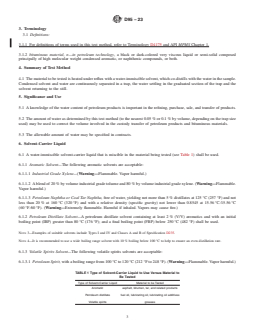
TABLE 1 Type of Solvent-Carrier Liquid to Use Versus Material to
Be Tested
Type of Solvent-Carrier Liquid Material to be Tested
Aromatic asphalt, bitumen, tar, and related products
Petroleum distillate fuel oil, lubricating oil, lubricating oil additives
Volatile spirits greases
D95 − 23
6.1.3.2 Iso-octane, of 95 % purity or better. (Warning—Extremely flammable. Harmful if inhaled. Vapors may cause fire.)
6.2 Solvent Blank—The water content of the solvent shall be determined by distilling an equivalent amount of the same solvent
used for the test sample in the distillation apparatus and testing as outlined in Section 10. The blank shall be determined to the
nearest scale division and used to correct the volume of water in the trap in Section 11.
7. Apparatus
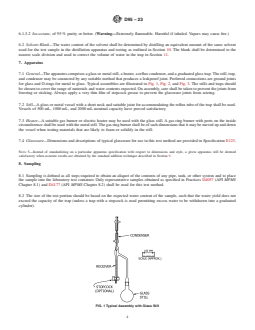
7.1 General—The apparatus comprises a glass or metal still, a heater, a reflux condenser, and a graduated glass trap. The still, trap,
and condenser may be connected by any suitable method that produces a leakproof joint. Preferred connections are ground joints
for glass and O-rings for metal to glass. Typical assemblies are illustrated in Fig. 1, Fig. 2, and Fig. 3. The stills and traps should
be chosen to cover the range of materials and water contents expected. On assembly, care shall be taken to prevent the joints from
freezing or sticking. Always apply a very thin film of stopcock grease to prevent the glassware joints from seizing.
7.2 Still—A glass or metal vessel with a short neck and suitable joint for accommodating the reflux tube of the trap shall be used.
Vessels of 500 mL, 1000 mL, and 2000 mL nominal capacity have proved satisfactory.
7.3 Heater—A suitable gas burner or electric heater may be used with the glass still. A gas ring burner with ports on the inside
circumference shall be used with the metal still. The gas ring burner shall be of such dimensions that it may be moved up and down
the vessel when testing materials that are likely to foam or solidify in the still.
7.4 Glassware—Dimensions and descriptions of typical glassware for use in this test method are provided in Specification E123.
NOTE 5—Instead of standardizing on a particular apparatus specification with respect to dimensions and style, a given apparatus will be deemed
satisfactory when accurate results are obtained by the standard addition technique described in Section 9.
8. Sampling
8.1 Sampling is defined as all steps required to obtain an aliquot of the contents of any pipe, tank, or other system and to place
the sample into the laboratory test container. Only representative samples obtained as specified in Practices D4057 (API MPMS
Chapter 8.1) and D4177 (API MPMS Chapter 8.2) shall be used for this test method.
8.2 The size of the test portion should be based on the expected water content of the sample, such that the water yield does not
exceed the capacity of the trap (unless a trap with a stopcock is used
...