

ASTM D5329-20
(Test Method)Standard Test Methods for Sealants and Fillers, Hot-Applied, for Joints and Cracks in Asphalt Pavements and Portland Cement Concrete Pavements
General Information
- Abstract
SIGNIFICANCE AND USE
3.1 These test methods describe procedures for determining specification conformance for hot-applied, field-molded joint and crack sealants and fillers.
SCOPE
1.1 These test methods cover tests for hot-applied types of joint and crack sealants and fillers for portland cement concrete and asphaltic concrete pavements. There are numerous standard material specifications that use these test methods. Refer to the respective standard material specification of interest to determine which of the following test methods to use. For sample melting and concrete block preparation, see their respective standard practices.
1.2 The test methods appear in the following sections:
Section
Artificial Weathering
13
Asphalt Compatibility
12
Bond, Non-Immersed
8
Bond, Water-Immersed
9
Cone Penetration, Non-Immersed
6
Flexibility
15
Flow
7
Resilience
10
Resilience, Oven-Aged
11
Tensile Adhesion
14
1.3 The values stated in SI units are to be regarded as standard. No other units of measurement are included in this standard.
1.4 This standard does not purport to address all of the safety concerns, if any, associated with its use. It is the responsibility of the user of this standard to establish appropriate safety, health, and environmental practices and determine the applicability of regulatory limitations prior to use.
1.5 This international standard was developed in accordance with internationally recognized principles on standardization established in the Decision on Principles for the Development of International Standards, Guides and Recommendations issued by the World Trade Organization Technical Barriers to Trade (TBT) Committee.
- Status
- Published
- Publication Date
- 30-Apr-2020
- Technical Committee
- D04 - Road and Paving Materials
- Drafting Committee
- D04.33 - Formed In-Place Sealants for Joints and Cracks in Pavements
Buy Documents
ASTM D5329-20 - Standard Test Methods for Sealants and Fillers, Hot-Applied, for Joints and Cracks in Asphalt Pavements and Portland Cement Concrete Pavements
REDLINE ASTM D5329-20 - Standard Test Methods for Sealants and Fillers, Hot-Applied, for Joints and Cracks in Asphalt Pavements and Portland Cement Concrete Pavements
Overview
ASTM D5329-20, titled Standard Test Methods for Sealants and Fillers, Hot-Applied, for Joints and Cracks in Asphalt Pavements and Portland Cement Concrete Pavements, is an essential reference for quality assurance and evaluation of hot-applied, field-molded joint and crack sealants and fillers used in both asphalt and portland cement concrete pavements. Developed by ASTM International, this standard outlines laboratory procedures to determine specification conformance, contributing to the durability and effectiveness of pavement maintenance products.
This standard plays a crucial role in ensuring the long-term performance of pavement sealants and fillers by assessing properties such as bond strength, flexibility, resilience, and compatibility with pavement materials under various conditions.
Key Topics
ASTM D5329-20 encompasses several laboratory test methods to verify the reliability and performance of hot-applied pavement sealants and fillers. Key types of testing covered include:
- Artificial Weathering: Evaluates the sealant’s resistance to environmental deterioration due to sunlight and moisture.
- Asphalt Compatibility: Assesses if the sealant is chemically compatible with asphalt to prevent early failures.
- Bond Testing (Non-Immersed and Water-Immersed): Measures the ability to adhere to concrete with and without the presence of water.
- Cone Penetration: Determines the consistency or hardness of the sealant.
- Flexibility: Tests the product’s ability to withstand movement and deformation, which is critical for long, continuous joints and cracks.
- Flow: Evaluates resistance to flow and sagging at elevated temperatures.
- Resilience: Measures the capacity for recovery after deformation and after aging in an oven.
- Tensile Adhesion: Determines how much the sealant can stretch before detaching from concrete surfaces.
These test methods are used in many standard material specifications for pavement maintenance worldwide.
Applications
The procedures described in ASTM D5329-20 provide critical guidance for:
- Quality Control: Ensuring that hot-applied sealants and fillers meet the functional and safety requirements for pavement construction and maintenance.
- Material Selection: Helping agencies and contractors select sealants and fillers with proven durability, flexibility, and compatibility.
- Performance Validation: Assessing how different joint and crack sealants respond to simulated field conditions such as thermal changes, water exposure, and mechanical stress.
- Conformity Assessment: Verifying compliance of supplies to project specifications and regulatory criteria for public works, highways, and aviation infrastructure.
- Product Development: Supporting manufacturers in improving formulations by providing objective criteria for evaluating new products.
Related Standards
ASTM D5329-20 references or is supplemented by several other important ASTM test methods and specifications relevant to pavement materials and testing, for example:
- ASTM D5167 - Practice for Melting of Hot-Applied Joint and Crack Sealant and Filler for Evaluation
- ASTM D1985 - Practice for Preparing Concrete Blocks for Testing Sealants, for Joints and Cracks
- ASTM D5/D5M - Test Method for Penetration of Bituminous Materials
- ASTM D217 - Test Methods for Cone Penetration of Lubricating Grease
- ASTM D3381 - Specification for Viscosity-Graded Asphalt Binder for Use in Pavement Construction
- ASTM D6690 - Specification for Joint and Crack Sealants, Hot-Applied, for Concrete and Asphalt Pavements
- ASTM G151, G154, and G155 - Practices for Exposing Nonmetallic Materials in Accelerated Test Devices
Practical Value
Adhering to ASTM D5329-20 assures infrastructure stakeholders that pavement preservation solutions will perform under real-world conditions, minimizing costly repairs and extending the service life of roadways and runways. As a benchmark for both manufacturers and engineers, this standard enhances the reliability and safety of sealed or filled pavement joints and cracks, ensuring compliance with industry best practices and regulatory expectations.
For more information, the official ASTM D5329-20 document and the associated material specifications should be consulted for precise testing procedures and acceptance criteria.
Relations
- Effective Date
- 01-May-2020
- Effective Date
- 15-Dec-2019
- Effective Date
- 01-Jul-2019
- Effective Date
- 15-Jun-2019
- Effective Date
- 01-May-2019
- Effective Date
- 01-Mar-2019
- Effective Date
- 01-Oct-2018
- Effective Date
- 01-Apr-2017
- Effective Date
- 01-Oct-2016
- Effective Date
- 01-May-2014
- Effective Date
- 01-Jul-2013
- Effective Date
- 01-Jun-2013
- Effective Date
- 01-May-2013
- Effective Date
- 01-May-2013
- Effective Date
- 01-Jan-2013
Buy Documents
ASTM D5329-20 - Standard Test Methods for Sealants and Fillers, Hot-Applied, for Joints and Cracks in Asphalt Pavements and Portland Cement Concrete Pavements
REDLINE ASTM D5329-20 - Standard Test Methods for Sealants and Fillers, Hot-Applied, for Joints and Cracks in Asphalt Pavements and Portland Cement Concrete Pavements
Get Certified
Connect with accredited certification bodies for this standard

Zavod za gradbeništvo Slovenije (ZAG) - Inšpekcija
ZAG inspection body for construction products, structures, and materials.
Sponsored listings
Frequently Asked Questions
ASTM D5329-20 is a standard published by ASTM International. Its full title is "Standard Test Methods for Sealants and Fillers, Hot-Applied, for Joints and Cracks in Asphalt Pavements and Portland Cement Concrete Pavements". This standard covers: SIGNIFICANCE AND USE 3.1 These test methods describe procedures for determining specification conformance for hot-applied, field-molded joint and crack sealants and fillers. SCOPE 1.1 These test methods cover tests for hot-applied types of joint and crack sealants and fillers for portland cement concrete and asphaltic concrete pavements. There are numerous standard material specifications that use these test methods. Refer to the respective standard material specification of interest to determine which of the following test methods to use. For sample melting and concrete block preparation, see their respective standard practices. 1.2 The test methods appear in the following sections: Section Artificial Weathering 13 Asphalt Compatibility 12 Bond, Non-Immersed 8 Bond, Water-Immersed 9 Cone Penetration, Non-Immersed 6 Flexibility 15 Flow 7 Resilience 10 Resilience, Oven-Aged 11 Tensile Adhesion 14 1.3 The values stated in SI units are to be regarded as standard. No other units of measurement are included in this standard. 1.4 This standard does not purport to address all of the safety concerns, if any, associated with its use. It is the responsibility of the user of this standard to establish appropriate safety, health, and environmental practices and determine the applicability of regulatory limitations prior to use. 1.5 This international standard was developed in accordance with internationally recognized principles on standardization established in the Decision on Principles for the Development of International Standards, Guides and Recommendations issued by the World Trade Organization Technical Barriers to Trade (TBT) Committee.
SIGNIFICANCE AND USE 3.1 These test methods describe procedures for determining specification conformance for hot-applied, field-molded joint and crack sealants and fillers. SCOPE 1.1 These test methods cover tests for hot-applied types of joint and crack sealants and fillers for portland cement concrete and asphaltic concrete pavements. There are numerous standard material specifications that use these test methods. Refer to the respective standard material specification of interest to determine which of the following test methods to use. For sample melting and concrete block preparation, see their respective standard practices. 1.2 The test methods appear in the following sections: Section Artificial Weathering 13 Asphalt Compatibility 12 Bond, Non-Immersed 8 Bond, Water-Immersed 9 Cone Penetration, Non-Immersed 6 Flexibility 15 Flow 7 Resilience 10 Resilience, Oven-Aged 11 Tensile Adhesion 14 1.3 The values stated in SI units are to be regarded as standard. No other units of measurement are included in this standard. 1.4 This standard does not purport to address all of the safety concerns, if any, associated with its use. It is the responsibility of the user of this standard to establish appropriate safety, health, and environmental practices and determine the applicability of regulatory limitations prior to use. 1.5 This international standard was developed in accordance with internationally recognized principles on standardization established in the Decision on Principles for the Development of International Standards, Guides and Recommendations issued by the World Trade Organization Technical Barriers to Trade (TBT) Committee.
ASTM D5329-20 is classified under the following ICS (International Classification for Standards) categories: 93.080.20 - Road construction materials. The ICS classification helps identify the subject area and facilitates finding related standards.
ASTM D5329-20 has the following relationships with other standards: It is inter standard links to ASTM D5329-16, ASTM D5/D5M-19a, ASTM D217-19a, ASTM D1985-13(2019), ASTM D217-19, ASTM E145-19, ASTM D5167-13(2018), ASTM D1074-17, ASTM D217-16, ASTM E177-14, ASTM D1985-13, ASTM D3381/D3381M-13, ASTM E691-13, ASTM E177-13, ASTM D5167-13. Understanding these relationships helps ensure you are using the most current and applicable version of the standard.
ASTM D5329-20 is available in PDF format for immediate download after purchase. The document can be added to your cart and obtained through the secure checkout process. Digital delivery ensures instant access to the complete standard document.
Standards Content (Sample)
This international standard was developed in accordance with internationally recognized principles on standardization established in the Decision on Principles for the
Development of International Standards, Guides and Recommendations issued by the World Trade Organization Technical Barriers to Trade (TBT) Committee.
Designation: D5329 − 20
Standard Test Methods for
Sealants and Fillers, Hot-Applied, for Joints and Cracks in
Asphalt Pavements and Portland Cement Concrete
Pavements
This standard is issued under the fixed designation D5329; the number immediately following the designation indicates the year of
original adoption or, in the case of revision, the year of last revision.Anumber in parentheses indicates the year of last reapproval.A
superscript epsilon (´) indicates an editorial change since the last revision or reapproval.
1. Scope 2. Referenced Documents
2.1 ASTM Standards:
1.1 These test methods cover tests for hot-applied types of
D5/D5MTest Method for Penetration of Bituminous Mate-
jointandcracksealantsandfillersforportlandcementconcrete
rials
and asphaltic concrete pavements. There are numerous stan-
D217Test Methods for Cone Penetration of Lubricating
dard material specifications that use these test methods. Refer
Grease
to the respective standard material specification of interest to
D618Practice for Conditioning Plastics for Testing
determine which of the following test methods to use. For
D1074Test Method for Compressive Strength of Asphalt
sample melting and concrete block preparation, see their
Mixtures
respective standard practices.
D1561/D1561MPractice for Preparation of Bituminous
1.2 The test methods appear in the following sections:
MixtureTestSpecimensbyMeansofCaliforniaKneading
Section
Compactor
Artificial Weathering 13
D1985Practice for Preparing Concrete Blocks for Testing
Asphalt Compatibility 12
Bond, Non-Immersed 8
Sealants, for Joints and Cracks
Bond, Water-Immersed 9
D3381/D3381MSpecification for Viscosity-Graded Asphalt
Cone Penetration, Non-Immersed 6
Binder for Use in Pavement Construction
Flexibility 15
Flow 7 D5167Practice for Melting of Hot-Applied Joint and Crack
Resilience 10
Sealant and Filler for Evaluation
Resilience, Oven-Aged 11
D6690Specification for Joint and Crack Sealants, Hot
Tensile Adhesion 14
Applied, for Concrete and Asphalt Pavements
1.3 The values stated in SI units are to be regarded as
E145Specification for Gravity-Convection and Forced-
standard. No other units of measurement are included in this
Ventilation Ovens
standard.
E177Practice for Use of the Terms Precision and Bias in
1.4 This standard does not purport to address all of the
ASTM Test Methods
safety concerns, if any, associated with its use. It is the
E691Practice for Conducting an Interlaboratory Study to
responsibility of the user of this standard to establish appro-
Determine the Precision of a Test Method
priate safety, health, and environmental practices and deter-
G151PracticeforExposingNonmetallicMaterialsinAccel-
mine the applicability of regulatory limitations prior to use.
erated Test Devices that Use Laboratory Light Sources
1.5 This international standard was developed in accor-
G154Practice for Operating Fluorescent Ultraviolet (UV)
dance with internationally recognized principles on standard-
Lamp Apparatus for Exposure of Nonmetallic Materials
ization established in the Decision on Principles for the
G155Practice for Operating XenonArc LightApparatus for
Development of International Standards, Guides and Recom-
Exposure of Non-Metallic Materials
mendations issued by the World Trade Organization Technical
3. Significance and Use
Barriers to Trade (TBT) Committee.
3.1 These test methods describe procedures for determining
specification conformance for hot-applied, field-molded joint
and crack sealants and fillers.
These test methods are under the jurisdiction of ASTM Committee D04 on
Road and Paving Materials and are the direct responsibility of Subcommittee
D04.33 on Formed In-Place Sealants for Joints and Cracks in Pavements. For referenced ASTM standards, visit the ASTM website, www.astm.org, or
Current edition approved May 1, 2020. Published May 2020. Originally contact ASTM Customer Service at service@astm.org. For Annual Book of ASTM
approved in 1992. Last previous edition approved in 2016 as D5329–16. DOI: Standards volume information, refer to the standard’s Document Summary page on
10.1520/D5329-20. the ASTM website.
Copyright © ASTM International, 100 Barr Harbor Drive, PO Box C700, West Conshohocken, PA 19428-2959. United States
D5329 − 20
4. Sample Melting 6.7.1.3 Multilaboratory Precision—(penetration 40 to 80):
The multilaboratory standard deviation of a single test (test
4.1 See Practice D5167.
result is defined as the average of three penetrations) has been
found to be 3.249. Therefore, the results of two properly
5. Standard Conditions
conducted tests in different laboratories should not differ by
5.1 The laboratory atmospheric conditions, hereinafter re-
more than nine penetration units.
ferred to as standard conditions, shall be in accordance with
6.7.2 ForSpecificationD6690TypeIImaterials,thefollow-
Practice D618 (23 6 2°C, 50 6 10 % relative humidity).
ing precision statement is based on an interlaboratory study of
elevenlaboratoriesthattestedsixdifferentSpecificationD6690
6. Cone Penetration, Non-Immersed
Type II materials.
6.1 Scope—This test method covers determination of cone
6.7.2.1 Within Container—Single-operator precision (for
penetration of bituminous joint and crack sealers and fillers.
penetration between 55 and 85): The single-operator deviation
has been found to be 0.974. Therefore, results of two properly
6.2 Significance and Use—The cone penetration, non-
conductedtestsbythesameoperatorshouldnotdifferbymore
immersed is a measure of consistency. Higher values indicate
than three penetration units.
a softer consistency.
6.7.2.2 Within Laboratories—Single-operator precision
6.3 Apparatus—Conduct this test using the apparatus de-
(penetrations 50 to 70):The single-operator standard deviation
scribed in Test Method D5/D5M, except as specified herein.
of a single test (test result is defined as the average of three
Use a penetration cone in place of the standard penetration
penetrations) has been found to be 1.0865. Therefore, the
needle. The cone shall conform to the requirements given in
resultsoftwoproperlyconductedtestsbythesameoperatoron
Test Methods D217, except that the interior construction may
the same material should not differ by more than three
be modified as desired. The total moving weight of the cone
penetration units.
and attachments shall be 150.0 6 0.1 g.
6.7.2.3 Single-Operator Precision—(penetrations 71 to 85):
6.4 Specimen Preparation—Pour a portion of the sample
The single-operator standard deviation of a single test (test
prepared in accordance with Practice D5167 into a cylindrical,
result is defined as the average of three penetrations) has been
metal, flat-bottom container of essentially 60 to 75 mm in
found to be 2.237. Therefore, the results of two properly
diameter and 45 to 55 mm in depth and fill flush with the rim
conducted tests by the same operator on the same material
of the container. Allow the specimen to cure under standard
should not differ by more than six penetration units.
conditions as specified in its respective material specification.
6.7.2.4 Multilaboratory Precision—(penetration 50 to 70):
The multilaboratory standard deviation of a single test (test
6.5 Procedure—Place the specimen in a water bath main-
result is defined as the average of three penetrations) has been
tained at 25 6 0.1°C for 2 h immediately before testing.
found to be 5.2609. Therefore, the results of two properly
Removethespecimenfromthebathanddrythesurface.Using
conducted tests in different laboratories should not differ by
the apparatus described in 6.3, make determinations at three
more than 15 penetration units.
locations on approximately 120° radii, and halfway between
6.7.2.5 Multilaboratory Precision—(penetration 71 to 85):
the center and outside of the specimen.Take care to ensure the
The multilaboratory standard deviation of a single test (test
cone point is placed on a point in the specimen that is
result is defined as the average of three penetrations) has been
representative of the material itself and is free of dust, water,
found to be 16.8831. Therefore, the results of two properly
bubbles,orotherforeignmaterial.Cleananddrytheconepoint
conducted tests in different laboratories should not differ by
after each determination.
more than 48 penetration units.
6.6 Report—Average the three results and record the value
as the penetration of the specimen in ⁄10 mm units.
7. Flow
6.7 Precision and Bias:
7.1 Scope—This test method measures the amount of flow
6.7.1 For Specification D6690 Type I materials, the follow-
ofbituminousjointandcracksealantswhenheldata75°angle
ing precision statement is based on an interlaboratory study of
at elevated temperatures.
twelve laboratories that tested five different Specification
7.2 Significance and Use—This test method is a means of
D6690 Type I materials.
measuring the ability of a sealant to resist flow from the joint
6.7.1.1 Within Container—Single-operator precision (for
or crack at high ambient temperatures.
penetration between 40 and 80): The single-operator deviation
has been found to be 0.994. Therefore, results of two properly
7.3 Apparatus:
conductedtestsbythesameoperatorshouldnotdifferbymore
7.3.1 Mold—Construct a mold (see Note 1) 40 mm wide by
than three penetration units.
60 mm long by 3.2 mm deep and place it on a bright tin panel.
6.7.1.2 Within Laboratories—Single-operator precision
The tin plate must be free of dirt, oil, and so forth and be
(penetrations 40 to 80):The single-operator standard deviation
between 0.25 to 0.64 mm in thickness.
of a single test (test result is defined as the average of three
NOTE 1—A release agent should be used to coat molds and spacers to
penetrations)hasbeenfoundtobe0.924.Therefore,theresults
prevent them from bonding to the sealants. Extreme care should be
of two properly conducted tests by the same operator on the
exercised to avoid contaminating the area where the joint sealant makes
same material should not differ by more than three penetration
contactwiththeblocks.Anon-toxicreleaseagentisrecommendedforthis
units. purpose.Two examples that have been found suitable for this purpose are
D5329 − 20
KY jelly (available at drug stores) and a release agent prepared by
Therefore, the results of two properly conducted tests by the
grinding a mixture of approximately 50% talc, 35% glycerine, and 15%
same operator should not differ by more than three flow units.
by weight of a water-soluble medical lubricant into a smooth paste.
7.7.2.3 Multilaboratory Precision (flow 0 to 1)—The multi-
7.3.2 Oven—Forced-draft type conforming to Specification
laboratory standard deviation has been found to be 0.5644.
E145 and capable of controlling its temperature 61°C.
Therefore, the results of two properly conducted tests in
different laboratories should not differ by more than three flow
7.4 Specimen Preparation—Pour a portion of the sample
units.
prepared in accordance with Practice D5167 for melting
7.7.2.4 Multilaboratory Precision (flow 1.1 to 4)—The mul-
samples into the mold described in 7.3. Fill the mold with an
tilaboratory standard deviation has been found to be 2.3508.
excess of material.Allow the test specimen to cool at standard
1 Therefore, the results of two properly conducted tests in
conditions for at least ⁄2 h, then trim the specimen flush with
differentlaboratoriesshouldnotdifferbymorethansevenflow
the face of the mold with a heated metal knife or spatula and
units.
remove the mold. Allow the specimen to cure under standard
conditions as specified in its respective material specification.
8. Bond, Non-Immersed
7.5 Procedure—Mark reference lines on the panel at the
8.1 Scope—This test method is used to evaluate the bond to
bottomedgeofthesealant.Thenplacethepanelcontainingthe
concrete.
sampleinaforced-draftovenmaintainedforthetimeandatthe
8.2 Significance and Use—Bondtoconcreteisnecessaryfor
temperature specified in its respective material specification.
a sealant to maintain proper field performance.
Duringthetest,mountthepanelsothatthelongitudinalaxisof
the specimen is at an angle of 75 6 1° with the horizontal, and
8.3 Apparatus:
thetransverseaxisishorizontal.Afterthespecifiedtestperiod,
8.3.1 Extension Machine—The extension machine used in
remove the panel from the oven and measure the movement of
the bond test shall be so designed that the specimen can be
the specimen below the reference lines in millimetres.
extended a minimum of 12.5 mm at a uniform rate of 3.1 6
0.3mm per hour. It shall consist essentially of one or more
7.6 Report—Report the measurement obtained in 7.5 in
screws rotated by an electric motor through suitable gear
millimetres.
reductions.Self-aligningplatesorgrips,onefixedandtheother
7.7 Precision and Bias:
carried by the rotating screw or screws, shall be provided for
7.7.1 For Specification D6690 Type I materials, the follow-
holding the test specimen in position during the test.
ing precision statement is based on an interlaboratory study of
8.3.2 Cold Chamber—Thecoldchambershallbecapableof
twelve laboratories that tested five different Specification
maintaining the required cold test temperature within 61°C.
D6690 Type I materials.
8.4 Concrete Block Preparation—The concrete blocks shall
7.7.1.1 Single-Operator Precision (flow 0 to 5)—Thesingle-
be prepared in accordance with Practice D1985.
operator standard deviation has been found to be 0.255.
8.5 Specimen Preparation:
Therefore, the results of two properly conducted tests by the
8.5.1 Prepare three test specimens (three speci-
same operator should not differ by more than one flow unit.
mens×2=six blocks) as follows: On removal from the
7.7.1.2 Single-Operator Precision (flow 5 to 10)—The
storage container, again scrub the 50 by 75 mm saw-cut faces
single-operator standard deviation has been found to be 1.024.
of the blocks under running water. When all blocks are
Therefore, the results of two properly conducted tests by the
scrubbed, lightly blot them with an oil-free, soft, absorbent
same operator should not differ by more than three flow units.
cloth or paper towel to remove all free surface water and
7.7.1.3 Multilaboratory Precision (flow 0 to 5)—The multi-
condition them by air drying on the 25 by 50 mm ends
laboratory standard deviation has been found to be 4.256.
according to the respective material specification.
Therefore, the results of two properly conducted tests in
8.5.2 Taketheseblocksandmoldthetestspecimenbetween
different laboratories should not differ by more than twelve
them as follows (see Fig. 1): Place four treated (see Note 1)
flow units.
brass or TFE-fluorocarbon spacer strips, approximately 6 mm
7.7.1.4 Multilaboratory Precision (flow 5 to 10)—The mul-
thick, on a treated metal plate base to enclose an open space
tilaboratory standard deviation has been found to be 5.326.
according to the width specified in the respective material
Therefore, the results of two properly conducted tests in
specification by 50 mm long. Place the blocks on the spacer
different laboratories should not differ by more than 15 flow
strips and space them the required width 60.1 mm apart by
units.
meansofothertreatedbrassorTFE-fluorocarbonspacerstrips,
7.7.2 ForSpecificationD6690TypeIImaterials,thefollow-
of the required width placed at such distances from the ends
ing precision statement is based on an interlaboratory study of
that an opening is of the required width by 50.0 6 0.2 by 50.0
elevenlaboratoriesthattestedsixdifferentSpecificationD6690
6 0.2 mm is formed between the blocks with a 6.4-mm
Type II materials.
opening below the blocks.
7.7.2.1 Single-Operator Precision (flow 0 to 1)—Thesingle-
operator standard deviation has been found to be 0.2494.
The sole source of supply of the apparatus known to the committee at this time
Therefore, the results of two properly conducted tests by the
is Applied Test Systems of Butler, PA. If you are aware of alternative suppliers,
same operator should not differ by more than one flow unit.
please provide this information to ASTM International Headquarters. Your com-
7.7.2.2 Single-Operator Precision (flow 1.1 to 4)—The
ments will receive careful consideration at a meeting of the responsible technical
single-operatorstandarddeviationhasbeenfoundtobe0.7616. committee, which you may attend.
D5329 − 20
FIG. 1 Concrete Block Mold
8.5.3 Rubber bands, clamps, or similar suitable means may 8.7 Recompression—After extension as described in 8.6,
be used to hold the blocks in position. Place treated brass or
remove the specimens from the extension machine and imme-
TFE-fluorocarbonspacerstripsidewalls25mmhighontopof diately examine the specimens for obvious separations within
the blocks. Pour material prepared in accordance with Practice
the sealant and between the sealant and the blocks, without
D5167 into the space between the blocks in sufficient quantity
distorting or manually causing extension of the specimens.
tobringflushwiththetopofthesidewalls.Afterthespecimen
After inspection replace the spacer strips, return to storage at
has cooled for at least 2 h, remove the excess material
room temperature for 2 h, and rest each specimen on one
protruding beyond the top and bottom of the blocks by cutting
concreteblocksothattheweightofthetopblockrecompresses
it off with a heated metal knife or spatula. Use extreme care
the joint sealant.
when removing the spacers so as not to damage the sealant. If
8.8 Re-Extension at Low Temperature and Recompression—
this spacer removal causes defects, if shrinkage of the material
After recompression repeat the procedure described in 8.6 and
upon cooling reduces its level below the top of the concrete
8.7 to complete the number of cycles of extension and
blocks, or if other casting defects are apparent, the specimen
recompression as specified in the respective material specifi-
shallbediscarded.ThefinishedspecimenshouldresembleFig.
2. cation.
8.6 Extension at Low Temperature—Place test specimens,
8.9 Evaluation of Bond Test Results—Within 30 min after
preparedasdescribedin8.5,inacoldcabinetattemperatureof
the last required extension, remove the bond test specimens
the respective material specification as described in 8.3.2 for
from the extension machine. Immediately examine the
not less than 4 h; then remove the treated spacer blocks and
specimens, while still frozen, for obvious separations within
mount the specimens immediately in the self-aligning clamps
the sealant and between the sealant and the blocks, without
oftheextensionmachine.Extendthespecimensasrequiredby
distorting or manually causing extension of the specimens.
the respective material specification at a uniform rate of 3.0 6
Determine conformance to the respective material specifica-
0.3 mm per hour. During this period, maintain the atmosphere
tion.
surrounding the test specimens at the temperature specified in
the respective material specification. The specimen shall be 8.10 Precision and Bias—Noinformationispresentedabout
precision or bias of this test method for bond evaluation since
removed from the test device within 30 min after completing
the extension. the results are nonquantitative.
D5329 − 20
FIG. 2 Concrete Block Test Specimen
9. Bond, Water-Immersed remove the excess surface water from the specimens with a
soft, dry, absorbent material. After the surface water has been
9.1 Scope—This test method evaluates bond to concrete
removed, proceed as described in 8.6.
after immersion in water.
9.6 Extension at Low Temperature—Same as described in
9.2 Significance and Use—Bondtoconcreteisnecessaryfor
8.6.
a sealant to maintain for proper field performance. Water
immersioncanhavedeleteriouseffectsonthebondtoconcrete.
9.7 Recompression—Same as described in 8.7.
9.3 Apparatus:
9.8 Re-Extension at Low Temperature and Recompression—
9.3.1 Extension Machine, as described in 8.3.1.
Same as described in 8.8.
9.3.2 Cold Chamber, as described in 8.3.2.
9.9 Evaluation of Bond Test Results—Same as described in
9.4 Concrete Block Preparation:
8.9.
9.4.1 The concrete blocks shall be prepared in accordance
9.10 Precision and Bias—Noinformationispresentedabout
with Practice D1985.
precision or bias of this test method for bond evaluation since
9.5 Specimen Preparation—Prepare three specimens as de-
the results are nonquantitative.
scribed in 8.5, replacing the thicker brass or TFE-fluorocarbon
spacers with thinner spacers between the concrete blocks so
10. Resilience
thatanopeningofnotlessthan6.0by12.5by50.0mmwillbe
produced and maintained between the spacers and the sealant.
10.1 Scope—This test method measures the ability of a
Then immerse the specimens in suitable covered containers to
sealant to recover after a steel ball has been forced into the
provide at least a 12.5-mm water cover for 96 h in 500 mL of surface.
distilled or deionized water per specimen and store under
10.2 Significance and Use—Theabilityofasealanttoreject
standardconditions.Placethespecimensinthecontainerswith
incompressible objects from its surface is important to the
the concrete blocks in the horizontal position, resting on the
functioning of a sealant.
block faces measuring 50 by 75 mm. Three specimens may be
placed in one container provided the water to specimen ratio is 10.3 Apparatus—Conduct this test using the standard pen-
maintained. At the end of a 96 h water-immersion period, etrometer described in Test Method D5/D5M, except replace
remove the specimens from the water, remove the spacers, and theneedleonthisstandardpenetrometerwithaballpenetration
D5329 − 20
tool shown in Fig. 3 (total weight of the
...
This document is not an ASTM standard and is intended only to provide the user of an ASTM standard an indication of what changes have been made to the previous version. Because
it may not be technically possible to adequately depict all changes accurately, ASTM recommends that users consult prior editions as appropriate. In all cases only the current version
of the standard as published by ASTM is to be considered the official document.
Designation: D5329 − 16 D5329 − 20
Standard Test Methods for
Sealants and Fillers, Hot-Applied, for Joints and Cracks in
Asphalt Pavements and Portland Cement Concrete
Pavements
This standard is issued under the fixed designation D5329; the number immediately following the designation indicates the year of
original adoption or, in the case of revision, the year of last revision. A number in parentheses indicates the year of last reapproval. A
superscript epsilon (´) indicates an editorial change since the last revision or reapproval.
1. Scope
1.1 These test methods cover tests for hot-applied types of joint and crack sealants and fillers for portland cement concrete and
asphaltic concrete pavements. There are numerous standard material specifications that use these test methods. Refer to the
respective standard material specification of interest to determine which of the following test methods to use. For sample melting
and concrete block preparation, see their respective standard practices.
1.2 The test methods appear in the following sections:
Section
Artificial Weathering 13
Artificial Weathering 13
Asphalt Compatibility 12
Asphalt Compatibility 12
Bond, Non-Immersed 8
Bond, Non-Immersed 8
Bond, Water-Immersed 9
Bond, Water-Immersed 9
Cone Penetration, Non-Immersed 6
Cone Penetration, Non-Immersed 6
Flexibility 15
Flexibility 15
Flow 7
Flow 7
Resilience 10
Resilience 10
Resilience, Oven-Aged 11
Resilience, Oven-Aged 11
Tensile Adhesion 14
Tensile Adhesion 14
1.3 The values stated in SI units are to be regarded as standard. No other units of measurement are included in this standard.
1.4 This standard does not purport to address all of the safety concerns, if any, associated with its use. It is the responsibility
of the user of this standard to establish appropriate safety safety, health, and healthenvironmental practices and determine the
applicability of regulatory limitations prior to use.
1.5 This international standard was developed in accordance with internationally recognized principles on standardization
established in the Decision on Principles for the Development of International Standards, Guides and Recommendations issued
by the World Trade Organization Technical Barriers to Trade (TBT) Committee.
2. Referenced Documents
2.1 ASTM Standards:
D5D5/D5M Test Method for Penetration of Bituminous Materials
D217 Test Methods for Cone Penetration of Lubricating Grease
D618 Practice for Conditioning Plastics for Testing
These test methods are under the jurisdiction of ASTM Committee D04 on Road and Paving Materials and are the direct responsibility of Subcommittee D04.33 on
Formed In-Place Sealants for Joints and Cracks in Pavements.
Current edition approved July 1, 2016May 1, 2020. Published August 2016May 2020. Originally approved in 1992. Last previous edition approved in 20152016 as
D5329 – 15.D5329 – 16. DOI: 10.1520/D5329-16.10.1520/D5329-20.
For referenced ASTM standards, visit the ASTM website, www.astm.org, or contact ASTM Customer Service at service@astm.org. For Annual Book of ASTM Standards
volume information, refer to the standard’s Document Summary page on the ASTM website.
Copyright © ASTM International, 100 Barr Harbor Drive, PO Box C700, West Conshohocken, PA 19428-2959. United States
D5329 − 20
D1074 Test Method for Compressive Strength of Asphalt Mixtures
D1561D1561/D1561M Practice for Preparation of Bituminous Mixture Test Specimens by Means of California Kneading
Compactor
D1985 Practice for Preparing Concrete Blocks for Testing Sealants, for Joints and Cracks
D3381D3381/D3381M Specification for Viscosity-Graded Asphalt Binder for Use in Pavement Construction
D5167 Practice for Melting of Hot-Applied Joint and Crack Sealant and Filler for Evaluation
D6690 Specification for Joint and Crack Sealants, Hot Applied, for Concrete and Asphalt Pavements
E145 Specification for Gravity-Convection and Forced-Ventilation Ovens
E177 Practice for Use of the Terms Precision and Bias in ASTM Test Methods
E691 Practice for Conducting an Interlaboratory Study to Determine the Precision of a Test Method
G151 Practice for Exposing Nonmetallic Materials in Accelerated Test Devices that Use Laboratory Light Sources
G154 Practice for Operating Fluorescent Ultraviolet (UV) Lamp Apparatus for Exposure of Nonmetallic Materials
G155 Practice for Operating Xenon Arc Light Apparatus for Exposure of Non-Metallic Materials
3. Significance and Use
3.1 These test methods describe procedures for determining specification conformance for hot-applied, field-molded joint and
crack sealants and fillers.
4. Sample Melting
4.1 See Practice D5167.
5. Standard Conditions
5.1 The laboratory atmospheric conditions, hereinafter referred to as standard conditions, shall be in accordance with Practice
D618 (23 6 2°C,2 °C, 50 6 10 % Relative Humidity).relative humidity).
6. Cone Penetration, Non-Immersed
6.1 Scope—This test method covers determination of cone penetration of bituminous joint and crack sealers and fillers.
6.2 Significance and Use—The cone penetration, non-immersed is a measure of consistency. Higher values indicate a softer
consistency.
6.3 Apparatus—Conduct this test using the apparatus described in Test Method D5D5/D5M, except as specified herein. Use a
penetration cone in place of the standard penetration needle. The cone shall conform to the requirements given in Test Methods
D217, except that the interior construction may be modified as desired. The total moving weight of the cone and attachments shall
be 150.0 6 0.1 g.
6.4 Specimen Preparation—Pour a portion of the sample prepared in accordance with Practice D5167 into a cylindrical, metal,
flat bottom flat-bottom container of essentially 60 to 75 mm in diameter and 45 to 55 mm in depth and fill flush with the rim of
the container. Allow the specimen to cure under standard conditions as specified in its respective material specification.
6.5 Procedure—Place the specimen in a water bath maintained at 25 6 0.1°C0.1 °C for 2 h immediately before testing. Remove
the specimen from the bath and dry the surface. Using the apparatus described in 6.3, make determinations at three locations on
approximately 120° radii, and halfway between the center and outside of the specimen. Take care to ensure the cone point is placed
on a point in the specimen that is representative of the material itself and is free of dust, water, bubbles, or other foreign material.
Clean and dry the cone point after each determination.
6.6 Report—Average the three results and record the value as the penetration of the specimen in ⁄10 mm units.
6.7 Precision and Bias:
6.7.1 For Specification D6690 Type I materials, the following precision statement is based on an interlaboratory study of
12twelve laboratories that tested five different Specification D6690 Type I materials.
6.7.1.1 Within Container—Single-Operator PrecisionSingle-operator precision (for penetration between 40 and 80): The
single-operator deviation has been found to be 0.994. Therefore, results of two properly conducted tests by the same operator
should not differ by more than three penetration units.
6.7.1.2 Within Laboratories—Single-Operator PrecisionSingle-operator precision (penetrations 40 to 80): The single-operator
standard deviation of a single test (test result is defined as the average of three penetrations) has been found to be 0.924. Therefore,
the results of two properly conducted tests by the same operator on the same material should not differ by more than three
penetration units.
6.7.1.3 Multilaboratory Precision—(penetration 40 to 80): The multilaboratory standard deviation of a single test (test result is
defined as the average of three penetrations) has been found to be 3.249. Therefore, the results of two properly conducted tests
in different laboratories should not differ by more than nine penetration units.
6.7.2 For Specification D6690 Type II materials, the following precision statement is based on an interlaboratory study of eleven
laboratories that tested six different Specification D6690 Type II materials.
D5329 − 20
6.7.2.1 Within Container—Single-Operator PrecisionSingle-operator precision (for penetration between 55 and 85): The
single-operator deviation has been found to be 0.974. Therefore, results of two properly conducted tests by the same operator
should not differ by more than three penetration units.
6.7.2.2 Within Laboratories—Single-Operator PrecisionSingle-operator precision (penetrations 50 to 70): The single-operator
standard deviation of a single test (test result is defined as the average of three penetrations) has been found to be 1.0865.
Therefore, the results of two properly conducted tests by the same operator on the same material should not differ by more than
three penetration units.
6.7.2.3 Single-Operator Precision—(penetrations 71 to 85): The single-operator standard deviation of a single test (test result
is defined as the average of three penetrations) has been found to be 2.237. Therefore, the results of two properly conducted tests
by the same operator on the same material should not differ by more than six penetration units.
6.7.2.4 Multilaboratory Precision—(penetration 50 to 70): The multilaboratory standard deviation of a single test (test result is
defined as the average of three penetrations) has been found to be 5.2609. Therefore, the results of two properly conducted tests
in different laboratories should not differ by more than 15 penetration units.
6.7.2.5 Multilaboratory Precision—(penetration 71 to 85): The multilaboratory standard deviation of a single test (test result is
defined as the average of three penetrations) has been found to be 16.8831. Therefore, the results of two properly conducted tests
in different laboratories should not differ by more than 48 penetration units.
7. Flow
7.1 Scope—This test method measures the amount of flow of bituminous joint and crack sealants when held at a 75° angle at
elevated temperatures.
7.2 Significance and Use—This test method is a means of measuring the ability of a sealant to resist flow from the joint or crack
at high ambient temperatures.
7.3 Apparatus:
7.3.1 Mold—Construct a mold (see Note 1) 40 mm wide by 60 mm long by 3.2 mm deep and place it on a bright tin panel. The
tin plate must be free of dirt, oil, and so forth and be between 0.25 to 0.64 mm in thickness.
NOTE 1—A release agent should be used to coat molds and spacers to prevent them from bonding to the sealants. Extreme care should be exercised
to avoid contaminating the area where the joint sealant makes contact with the blocks. A non-toxic release agent is recommended for this purpose. Two
examples that have been found suitable for this purpose are KY jelly (available at drug stores) and a release agent prepared by grinding a mixture of
approximately 50 % talc, 35 % glycerine, and 15 % by weight,weight of a water-soluble medical lubricant into a smooth paste.
7.3.2 Oven—Forced draft Forced-draft type conforming to Specification E145 and capable of controlling its temperature
61°C.61 °C.
7.4 Specimen Preparation—Pour a portion of the sample prepared in accordance with Practice D5167 for melting samples into
the mold described in 7.3. Fill the mold with an excess of material. Allow the test specimen to cool at standard conditions for at
least ⁄2 h, then trim the specimen flush with the face of the mold with a heated metal knife or spatula and remove the mold. Allow
the specimen to cure under standard conditions as specified in its respective material specification.
7.5 Procedure—Mark reference lines on the panel at the bottom edge of the sealant. Then place the panel containing the sample
in a forced-draft oven maintained for the time and at the temperature specified in its respective material specification. During the
test, mount the panel so that the longitudinal axis of the specimen is at an angle of 75 6 1° with the horizontal, and the transverse
axis is horizontal. After the specified test period, remove the panel from the oven and measure the movement of the specimen
below the reference lines in millimetres.
7.6 Report—Report the measurement obtained in 7.5 in millimetres.
7.7 Precision and Bias:
7.7.1 For Specification D6690 Type I materials, the following precision statement is based on an interlaboratory study of
12twelve laboratories that tested five different Specification D6690 Type I materials.
7.7.1.1 Single-Operator Precision (flow 0 to 5)—The single-operator standard deviation has been found to be 0.255. Therefore,
the results of two properly conducted tests by the same operator should not differ by more than one flow unit.
7.7.1.2 Single-Operator Precision (flow 5 to 10)—The single-operator standard deviation has been found to be 1.024. Therefore,
the results of two properly conducted tests by the same operator should not differ by more than three flow units.
7.7.1.3 Multilaboratory Precision (flow 0 to 5)—The multilaboratory standard deviation has been found to be 4.256. Therefore,
the results of two properly conducted tests in different laboratories should not differ by more than 12twelve flow units.
7.7.1.4 Multilaboratory Precision (flow 5 to 10)—The multilaboratory standard deviation has been found to be 5.326. Therefore,
the results of two properly conducted tests in different laboratories should not differ by more than 15 flow units.
7.7.2 For Specification D6690 Type II materials, the following precision statement is based on an interlaboratory study of eleven
laboratories that tested six different Specification D6690 Type II materials.
7.7.2.1 Single-Operator Precision (flow 0 to 1)—The single-operator standard deviation has been found to be 0.2494. Therefore,
the results of two properly conducted tests by the same operator should not differ by more than one flow unit.
D5329 − 20
7.7.2.2 Single-Operator Precision (flow 1.1 to 4)—The single-operator standard deviation has been found to be 0.7616.
Therefore, the results of two properly conducted tests by the same operator should not differ by more than three flow units.
7.7.2.3 Multilaboratory Precision (flow 0 to 1)—The multilaboratory standard deviation has been found to be 0.5644. Therefore,
the results of two properly conducted tests in different laboratories should not differ by more than three flow units.
7.7.2.4 Multilaboratory Precision (flow 1.1 to 4)—The multilaboratory standard deviation has been found to be 2.3508.
Therefore, the results of two properly conducted tests in different laboratories should not differ by more than seven flow units.
8. Bond, Non-Immersed
8.1 Scope—This test method is used to evaluate the bond to concrete.
8.2 Significance and Use—Bond to concrete is necessary for a sealant to maintain proper field performance.
8.3 Apparatus:
8.3.1 Extension Machine—The extension machine used in the bond test shall be so designed that the specimen can be extended
a minimum of 12.5 mm at a uniform rate of 3.1 6 0.3 mm 0.3 mm per hour. It shall consist essentially of one or more screws
rotated by an electric motor through suitable gear reductions. Self aligning Self-aligning plates or grips, one fixed and the other
carried by the rotating screw or screws, shall be provided for holding the test specimen in position during the test.
8.3.2 Cold Chamber—The cold chamber shall be capable of maintaining the required cold test temperature within 61°C.61 °C.
8.4 Concrete-Block Concrete Block Preparation—The concrete blocks shall be prepared in accordance with Practice D1985.
8.5 Specimen Preparation:
8.5.1 Prepare three test specimens (3 specimens × 2 = 6(three specimens × 2 = six blocks) as follows: On removal from the
storage container, again scrub the 50 by 75 mm saw-cut faces of the blocks under running water. When all blocks are scrubbed,
lightly blot them with an oil-free, soft, absorbent cloth or paper towel to remove all free surface water and condition them by air
drying on the 25 by 50 mm ends according to the respective material specification.
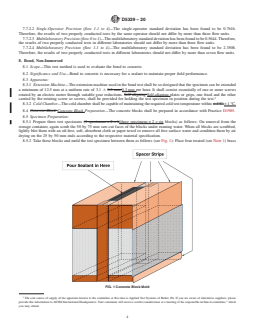
8.5.2 Take these blocks and mold the test specimen between them as follows (see Fig. 1): Place four treated (see Note 1) brass
FIG. 1 Concrete Block Mold
The sole source of supply of the apparatus known to the committee at this time is Applied Test Systems of Butler, PA. If you are aware of alternative suppliers, please
provide this information to ASTM International Headquarters. Your comments will receive careful consideration at a meeting of the responsible technical committee, which
you may attend.
D5329 − 20
or TFE-fluorocarbon spacer strips, approximately 6 mm thick, on a treated metal plate base to enclose an open space according
to the width specified in the respective material specification by 50 mm long. Place the blocks on the spacer strips and space them
the required width 60.1 mm apart by means of other treated brass or TFE-fluorocarbon spacer strips, of the required width placed
at such distances from the ends that an opening is of the required width by 50.0 6 0.2 by 50.0 6 0.2 mm is formed between the
blocks with a 6.4-mm opening below the blocks.
8.5.3 Rubber bands, clamps, or similar suitable means may be used to hold the blocks in position. Place treated brass or
TFE-fluorocarbon spacer strip side walls 25 mm high on top of the blocks. Pour material prepared in accordance with Practice
D5167 into the space between the blocks in sufficient quantity to bring flush with the top of the side walls. After the specimen has
cooled for at least 2 h, remove the excess material protruding beyond the top and bottom of the blocks by cutting it off with a heated
metal knife or spatula. Use extreme care when removing the spacers so as not to damage the sealant. If this spacer removal
causedcauses defects, if shrinkage of the material upon cooling reduces its level below the top of the concrete blocks, or if other
casting defects are apparent, the specimen shall be discarded. The finished specimen should resemble Fig. 2.
8.6 Extension at Low Temperature—Place test specimens, prepared as described in 8.5, in a cold cabinet at temperature of the
respective material specification as described in 8.3.2 for not less than 4 h; then remove the treated spacer blocks and mount the
specimens immediately in the self-aligning clamps of the extension machine. Extend the specimens as required by the respective
material specification at a uniform rate of 3.0 6 0.3 mm per hour. During this period, maintain the atmosphere surrounding the
test specimens at the temperature specified in the respective material specification. The specimen shall be removed from the test
device within 30 min after completing the extension.
8.7 Recompression—After extension as described in 8.6, remove the specimens from the extension machine and immediately
examine the specimens for obvious separations within the sealant and between the sealant and the blocks, without distorting or
manually causing extension of the specimens. After inspection replace the spacer strips, return to storage at room temperature for
2 h, and rest each specimen on one concrete block so that the weight of the top block recompresses the joint sealant.
8.8 ReextensionRe-Extension at Low Temperature and Recompression—After recompression repeat the procedure described in
8.6 and 8.7 to complete the number of cycles of extension and recompression as specified in the respective material specification.
FIG. 2 Concrete Block Test Specimen
D5329 − 20
8.9 Evaluation of Bond-Test Bond Test Results—Within 30 min after the last required extension, remove the bond test specimens
from the extension machine. Immediately examine the specimens, while still frozen, for obvious separations within the sealant and
between the sealant and the blocks, without distorting or manually causing extension of the specimens. Determine conformance
to the respective material specification.
8.10 Precision and Bias—No information is presented about precision or bias of this test method for bond evaluation since the
results are nonquantitative.
9. Bond, Water-Immersed
9.1 Scope—This test method evaluates bond to concrete after immersion in water.
9.2 Significance and Use—Bond to concrete is necessary for a sealant to maintain for proper field performance. Water
immersion can have deleterious effects on the bond to concrete.
9.3 Apparatus:
9.3.1 Extension Machine, as described in 8.3.1.
9.3.2 Cold Chamber, as described in 8.3.2.
9.4 Concrete-Block Concrete Block Preparation:
9.4.1 The concrete blocks shall be prepared in accordance with Practice D1985.
9.5 Specimen Preparation—Prepare three specimens as described in 8.5, replacing the thicker brass or TFE-fluorocarbon
spacers with thinner spacers between the concrete blocks so that an opening of not less than 6.0 by 12.5 by 50.0 mm will be
produced and maintained between the spacers and the sealant. Then immerse the specimens in suitable covered containers to
provide at least a 12.5-mm water cover for 96 h in 500 mL of distilled or deionized water per specimen and store under standard
conditions. Place the specimens in the containers with the concrete blocks in the horizontal position, resting on the block faces
measuring 50 by 75 mm. Three specimens may be placed in one container provided the water to specimen ratio is maintained. At
the end of a 96 h water-immersion period, remove the specimens from the water, remove the spacers, and remove the excess
surface water from the specimens with a soft, dry, absorbent material. After the surface water has been removed, proceed as
described in 8.6.
9.6 Extension at Low Temperature—Same as described in 8.6.
9.7 Recompression—Same as described in 8.7.
9.8 ReextensionRe-Extension at Low Temperature and Recompression—Same as described in 8.8.
9.9 Evaluation of Bond-Test Bond Test Results—Same as described in 8.9.
9.10 Precision and Bias—No information is presented about precision or bias of this test method for bond evaluation since the
results are nonquantitative.
10. Resilience
10.1 Scope—This test method measures the ability of a sealant to recover after a steel ball has been forced into the surface.
10.2 Significance and Use—The ability of a sealant to reject incompressible objects from its surface is important to the
functioning of a sealant.
10.3 Apparatus—Conduct this test using the standard penetrometer described in Test Method D5D5/D5M, except replace the
needle on this standard penetrometer with a ball penetration tool shown in Fig. 3 (total weight of the ball penetration tool and
penetrometer spindle shall be 75 6 0.01 g).
10.4 Specimen Preparation—Prepare one specimen as specified in Practice D5167 using a cylindrical, flat bottom, flat-bottom,
metal container of essentially 60 to 75 mm in diameter and 45 to 55 mm in depth. Cure the specimen at the temperature and for
the time specified in the respective material specification under standard laboratory conditions prior to testing.
10.5 Procedure—Place the specimen in a water bath maintained at 25 6 0.1°C0.1 °C for 2 h immediately before testing.
Remove the specimen from the water bath, dry the sur
...