

ASTM E145-19
(Specification)Standard Specification for Gravity-Convection and Forced-Ventilation Ovens
General Information
- Abstract
ABSTRACT
This specification covers the performance requirements for four types (Types IA, IB, IIA, and IIB) of general-purpose air ovens of the gravity-convection and forced-ventilation types ordinarily used in testing operations. The temperature within the testing chamber shall be controllable by an automatic device and, when examined with appropriate test methods provided herein, shall be uniform within the tolerances for temperature uniformity, time constant, and rate of ventilation requirements for the particular type of oven.
SCOPE
1.1 This specification covers the performance requirements for general-purpose air ovens ordinarily used in testing operations, which have a testing chamber up to 0.6 m3 (25 ft3) in volume. It is applicable to gravity-convection ovens designed to operate over all or part of the temperature range from 20 °C above ambient temperature to 200 °C and to forced-ventilation ovens designed to operate over all or part of the temperature range from 20 °C above ambient temperature to 500 °C.
Note 1: Ovens are designed for maximum operating temperatures of about 200 °C, 300 °C, and 500 °C, the thermal insulation and cost of the oven being dependent on the maximum temperature required.
1.2 This specification does not include safety requirements that are essential for ovens used in the presence of combustible vapors or gases.
1.3 The values stated in SI units are to be regarded as standard. The values given in parentheses after SI units are provided for information only and are not considered standard.
1.4 This standard does not purport to address all of the safety concerns, if any, associated with its use. It is the responsibility of the user of this standard to establish appropriate safety, health, and environmental practices and determine the applicability of regulatory limitations prior to use.
1.5 This international standard was developed in accordance with internationally recognized principles on standardization established in the Decision on Principles for the Development of International Standards, Guides and Recommendations issued by the World Trade Organization Technical Barriers to Trade (TBT) Committee.
- Status
- Published
- Publication Date
- 28-Feb-2019
- Technical Committee
- E41 - Laboratory Apparatus
- Drafting Committee
- E41.06 - Laboratory Instruments and Equipment
Buy Documents
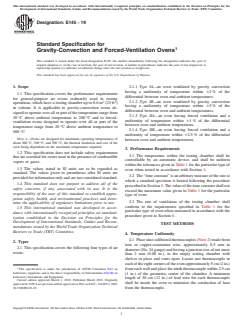
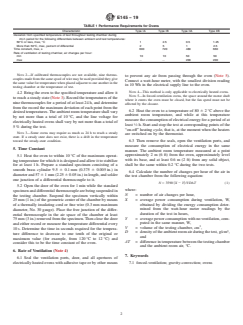


ASTM E145-19 - Standard Specification for Gravity-Convection and Forced-Ventilation Ovens
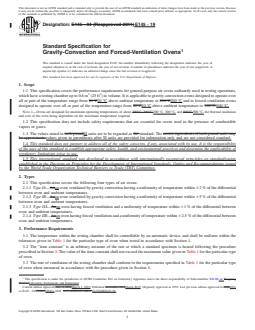
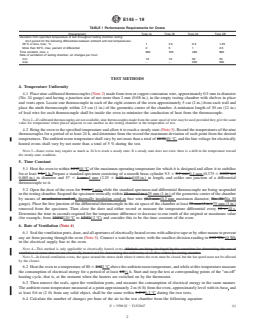


REDLINE ASTM E145-19 - Standard Specification for Gravity-Convection and Forced-Ventilation Ovens
Overview
ASTM E145-19: Standard Specification for Gravity-Convection and Forced-Ventilation Ovens defines the performance requirements for general-purpose air ovens commonly used in laboratory testing operations. Developed by ASTM International, this specification covers ovens with chamber volumes up to 0.6 m³ (25 ft³), addressing both gravity-convection and forced-ventilation types over specific temperature ranges. The document emphasizes criteria such as temperature control, uniformity, and ventilation rates, making it essential for laboratories and industries that require reliable and repeatable heating processes.
Key Topics
Types of Ovens:
The standard outlines four oven types:- Type IA: Gravity-convection with temperature uniformity within ±2% of the temperature differential.
- Type IB: Gravity-convection with uniformity within ±5%.
- Type IIA: Forced-ventilation with superior uniformity, within ±1%.
- Type IIB: Forced-ventilation within ±2.5%.
Each type has specific applications based on required temperature stability and air circulation.
Performance Requirements:
- Temperature Control: Ovens must feature an automatic control device to maintain consistent chamber temperatures within defined tolerances.
- Temperature Uniformity: The standard specifies maximum allowable variation within the chamber over a 24-hour period.
- Time Constant: Specifies the rate at which samples reach the desired temperature, ensuring rapid and uniform heating.
- Ventilation Rate: Defines the minimum and maximum air changes per hour, essential for accurate test conditions.
Test Methods:
- Outlines precise procedures for placing thermocouples, measuring temperature distribution, determining time constants, and calculating air change rates using watt-hour meter readings.
Limitations:
- This specification is not intended for ovens potentially exposed to combustible vapors or gases.
- All values are expressed in standard SI units.
Applications
ASTM E145-19 is widely applied across industries that require controlled heating environments for product qualification, material testing, and quality assurance. Key applications include:
- Materials Testing: Ensuring plastics, metals, and composites are tested under consistent temperature and ventilation conditions.
- Laboratory Analysis: Supporting processes such as drying, curing, and conditioning of samples where precise thermal control is critical.
- Industrial Processes: Used in manufacturing environments to validate the heat treatment performance of small batches.
- Research and Development: Providing reliable test conditions for experimental work and process optimization.
By following ASTM E145-19, organizations can ensure uniform performance standards for gravity-convection and forced-ventilation ovens, reducing variability in testing and improving consistency in results.
Related Standards
When selecting or maintaining laboratory ovens, consider these related standards:
- ASTM D5427: Standard Practice for Determining Decontamination Performance of Steam Sterilizers by Biological Indicators
- ASTM E2877: Standard Guide for Digital Contact Thermometers
- ISO 614: Shortened methods of test for heat insulation
- ASTM D883: Terminology Relating to Plastics (for materials often tested in ovens)
Adopting ASTM E145-19 alongside relevant standards supports laboratory compliance and helps meet global best practices for equipment performance and safety.
Keywords: ASTM E145-19, laboratory oven standard, gravity-convection oven, forced-ventilation oven, temperature uniformity, ventilation rate, performance requirements, testing ovens, laboratory equipment standards
Relations
- Replaces
ASTM E145-94(2011) - Standard Specification for Gravity-Convection and Forced-Ventilation Ovens - Effective Date
- 01-Mar-2019
- Effective Date
- 01-Mar-2019
- Effective Date
- 01-Mar-2019
- Effective Date
- 01-Mar-2019
- Effective Date
- 01-Mar-2019
- Effective Date
- 01-Mar-2019
- Effective Date
- 01-Mar-2019
- Referred By
ASTM D4612-16 - Standard Test Method for Calculating Thermal Diffusivity of Rock and Soil - Effective Date
- 01-Mar-2019
- Effective Date
- 01-Mar-2019
- Referred By
ASTM D6/D6M-95(2018) - Standard Test Method for Loss on Heating of Oil and Asphaltic Compounds - Effective Date
- 01-Mar-2019
- Effective Date
- 01-Mar-2019
- Effective Date
- 01-Mar-2019
- Effective Date
- 01-Mar-2019
- Effective Date
- 01-Mar-2019
- Effective Date
- 01-Mar-2019
Buy Documents
ASTM E145-19 - Standard Specification for Gravity-Convection and Forced-Ventilation Ovens
REDLINE ASTM E145-19 - Standard Specification for Gravity-Convection and Forced-Ventilation Ovens
Get Certified
Connect with accredited certification bodies for this standard

ECOCERT
Organic and sustainability certification.

Eurofins Food Testing Global
Global leader in food, environment, and pharmaceutical product testing.

Intertek Bangladesh
Intertek certification and testing services in Bangladesh.
Sponsored listings
Frequently Asked Questions
ASTM E145-19 is a technical specification published by ASTM International. Its full title is "Standard Specification for Gravity-Convection and Forced-Ventilation Ovens". This standard covers: ABSTRACT This specification covers the performance requirements for four types (Types IA, IB, IIA, and IIB) of general-purpose air ovens of the gravity-convection and forced-ventilation types ordinarily used in testing operations. The temperature within the testing chamber shall be controllable by an automatic device and, when examined with appropriate test methods provided herein, shall be uniform within the tolerances for temperature uniformity, time constant, and rate of ventilation requirements for the particular type of oven. SCOPE 1.1 This specification covers the performance requirements for general-purpose air ovens ordinarily used in testing operations, which have a testing chamber up to 0.6 m3 (25 ft3) in volume. It is applicable to gravity-convection ovens designed to operate over all or part of the temperature range from 20 °C above ambient temperature to 200 °C and to forced-ventilation ovens designed to operate over all or part of the temperature range from 20 °C above ambient temperature to 500 °C. Note 1: Ovens are designed for maximum operating temperatures of about 200 °C, 300 °C, and 500 °C, the thermal insulation and cost of the oven being dependent on the maximum temperature required. 1.2 This specification does not include safety requirements that are essential for ovens used in the presence of combustible vapors or gases. 1.3 The values stated in SI units are to be regarded as standard. The values given in parentheses after SI units are provided for information only and are not considered standard. 1.4 This standard does not purport to address all of the safety concerns, if any, associated with its use. It is the responsibility of the user of this standard to establish appropriate safety, health, and environmental practices and determine the applicability of regulatory limitations prior to use. 1.5 This international standard was developed in accordance with internationally recognized principles on standardization established in the Decision on Principles for the Development of International Standards, Guides and Recommendations issued by the World Trade Organization Technical Barriers to Trade (TBT) Committee.
ABSTRACT This specification covers the performance requirements for four types (Types IA, IB, IIA, and IIB) of general-purpose air ovens of the gravity-convection and forced-ventilation types ordinarily used in testing operations. The temperature within the testing chamber shall be controllable by an automatic device and, when examined with appropriate test methods provided herein, shall be uniform within the tolerances for temperature uniformity, time constant, and rate of ventilation requirements for the particular type of oven. SCOPE 1.1 This specification covers the performance requirements for general-purpose air ovens ordinarily used in testing operations, which have a testing chamber up to 0.6 m3 (25 ft3) in volume. It is applicable to gravity-convection ovens designed to operate over all or part of the temperature range from 20 °C above ambient temperature to 200 °C and to forced-ventilation ovens designed to operate over all or part of the temperature range from 20 °C above ambient temperature to 500 °C. Note 1: Ovens are designed for maximum operating temperatures of about 200 °C, 300 °C, and 500 °C, the thermal insulation and cost of the oven being dependent on the maximum temperature required. 1.2 This specification does not include safety requirements that are essential for ovens used in the presence of combustible vapors or gases. 1.3 The values stated in SI units are to be regarded as standard. The values given in parentheses after SI units are provided for information only and are not considered standard. 1.4 This standard does not purport to address all of the safety concerns, if any, associated with its use. It is the responsibility of the user of this standard to establish appropriate safety, health, and environmental practices and determine the applicability of regulatory limitations prior to use. 1.5 This international standard was developed in accordance with internationally recognized principles on standardization established in the Decision on Principles for the Development of International Standards, Guides and Recommendations issued by the World Trade Organization Technical Barriers to Trade (TBT) Committee.
ASTM E145-19 is classified under the following ICS (International Classification for Standards) categories: 71.040.10 - Chemical laboratories. Laboratory equipment. The ICS classification helps identify the subject area and facilitates finding related standards.
ASTM E145-19 has the following relationships with other standards: It is inter standard links to ASTM E145-94(2011), ASTM D5240/D5240M-20, ASTM D7626-19e1, ASTM D6511/D6511M-18, ASTM D7322/D7322M-17, ASTM D2383-19, ASTM D1754/D1754M-20, ASTM D4612-16, ASTM D7986-17a, ASTM D6/D6M-95(2018), ASTM D4350-16(2022), ASTM D6189-97(2022), ASTM F2524-06(2020), ASTM D3769-20, ASTM D2369-20. Understanding these relationships helps ensure you are using the most current and applicable version of the standard.
ASTM E145-19 is available in PDF format for immediate download after purchase. The document can be added to your cart and obtained through the secure checkout process. Digital delivery ensures instant access to the complete standard document.
Standards Content (Sample)
This international standard was developed in accordance with internationally recognized principles on standardization established in the Decision on Principles for the
Development of International Standards, Guides and Recommendations issued by the World Trade Organization Technical Barriers to Trade (TBT) Committee.
Designation:E145 −19
Standard Specification for
Gravity-Convection and Forced-Ventilation Ovens
This standard is issued under the fixed designation E145; the number immediately following the designation indicates the year of
original adoption or, in the case of revision, the year of last revision. A number in parentheses indicates the year of last reapproval. A
superscript epsilon (´) indicates an editorial change since the last revision or reapproval.
This standard has been approved for use by agencies of the U.S. Department of Defense.
1. Scope 2.1.1 Type IA—an oven ventilated by gravity convection
having a uniformity of temperature within 62 % of the
1.1 This specification covers the performance requirements
differential between oven and ambient temperatures.
for general-purpose air ovens ordinarily used in testing
3 3 2.1.2 Type IB—an oven ventilated by gravity convection
operations, which have a testing chamber up to 0.6 m (25 ft )
having a uniformity of temperature within 65 % of the
in volume. It is applicable to gravity-convection ovens de-
differential between oven and ambient temperatures.
signed to operate over all or part of the temperature range from
2.1.3 Type IIA—an oven having forced ventilation and a
20 °C above ambient temperature to 200 °C and to forced-
uniformity of temperature within 61 % of the differential
ventilation ovens designed to operate over all or part of the
between oven and ambient temperatures.
temperature range from 20 °C above ambient temperature to
2.1.4 Type IIB—an oven having forced ventilation and a
500 °C.
uniformity of temperature within 62.5 % of the differential
NOTE 1—Ovens are designed for maximum operating temperatures of
between oven and ambient temperatures.
about 200 °C, 300 °C, and 500 °C, the thermal insulation and cost of the
oven being dependent on the maximum temperature required.
3. Performance Requirements
1.2 This specification does not include safety requirements
3.1 The temperature within the testing chamber shall be
that are essential for ovens used in the presence of combustible
controllable by an automatic device, and shall be uniform
vapors or gases.
within the tolerances given in Table 1 for the particular type of
1.3 The values stated in SI units are to be regarded as
oven when tested in accordance with Section 4.
standard. The values given in parentheses after SI units are
3.2 The“timeconstant”isanarbitrarymeasureoftherateat
provided for information only and are not considered standard.
which a standard specimen is heated following the procedure
1.4 This standard does not purport to address all of the
prescribedinSection5.Thevalueofthetimeconstantshallnot
safety concerns, if any, associated with its use. It is the
exceed the maximum value given in Table 1 for the particular
responsibility of the user of this standard to establish appro-
type of oven.
priate safety, health, and environmental practices and deter-
3.3 The rate of ventilation of the testing chamber shall
mine the applicability of regulatory limitations prior to use.
conform to the requirements specified in Table 1 for the
1.5 This international standard was developed in accor-
particular type of oven when measured in accordance with the
dance with internationally recognized principles on standard-
procedure given in Section 6.
ization established in the Decision on Principles for the
Development of International Standards, Guides and Recom-
TEST METHODS
mendations issued by the World Trade Organization Technical
Barriers to Trade (TBT) Committee.
4. Temperature Uniformity
4.1 Placeninecalibratedthermocouples(Note2)madefrom
2. Types
iron or copper-constantan wire, approximately 0.5 mm in
2.1 This specification covers the following four types of air
diameter (No. 24 gauge) and having a junction size of not more
ovens:
than 2 mm (0.08 in.), in the empty testing chamber with
shelves in place and vents open. Locate one thermocouple in
eachoftheeightcornersoftheovenapproximately5cm(2in.)
from each wall and place the ninth thermocouple within 2.5 cm
This specification is under the jurisdiction of ASTM Committee E41 on
Laboratory Apparatus and is the direct responsibility of Subcommittee E41.06 on
(1 in.) of the geometric center of the chamber. A minimum
Laboratory Instruments and Equipment.
length of 30 cm (12 in.) of lead wire for each thermocouple
Current edition approved March 1, 2019. Published March 2019. Originally
shall be inside the oven to minimize the conduction of heat
approved in 1959. Last previous edition approved in 2011 as E145 – 94(2011). DOI:
10.1520/E0145-19. from the thermocouple.
Copyright © ASTM International, 100 Barr Harbor Drive, PO Box C700, West Conshohocken, PA 19428-2959. United States
E145−19
TABLE 1 Performance Requirements for Ovens
Characteristic Type IA Type IB Type IIA Type IIB
Deviation from specified temperature of test throughout testing chamber during
24-h period for the following differentials between ambient and test temperatures:
50°C or less, max, °C 1 2.5 0.5 1.25
More than 50°C, max, percent of differential 2 5 1 2.5
Time constant, max, s 600 720 480 660
Rate of ventilation of testing chamber, air changes per hour:
min 10 10 50 50
max . . 200
...
This document is not an ASTM standard and is intended only to provide the user of an ASTM standard an indication of what changes have been made to the previous version. Because
it may not be technically possible to adequately depict all changes accurately, ASTM recommends that users consult prior editions as appropriate. In all cases only the current version
of the standard as published by ASTM is to be considered the official document.
Designation: E145 − 94 (Reapproved 2011) E145 − 19
Standard Specification for
Gravity-Convection and Forced-Ventilation Ovens
This standard is issued under the fixed designation E145; the number immediately following the designation indicates the year of
original adoption or, in the case of revision, the year of last revision. A number in parentheses indicates the year of last reapproval. A
superscript epsilon (´) indicates an editorial change since the last revision or reapproval.
This standard has been approved for use by agencies of the U.S. Department of Defense.
1. Scope
1.1 This specification covers the performance requirements for general-purpose air ovens ordinarily used in testing operations,
3 3
which have a testing chamber up to 0.6 m (25 ft ) in volume. It is applicable to gravity-convection ovens designed to operate over
all or part of the temperature range from 20°C20 °C above ambient temperature to 200°C200 °C and to forced-ventilation ovens
designed to operate over all or part of the temperature range from 20°C20 °C above ambient temperature to 500°C.500 °C.
NOTE 1—Ovens are designed for maximum operating temperatures of about 200°C, 300°C,200 °C, 300 °C, and 500°C,500 °C, the thermal insulation
and cost of the oven being dependent on the maximum temperature required.
1.2 This specification does not include safety requirements that are essential for ovens used in the presence of combustible
vapors or gases.
1.3 The values stated in inch-poundSI units are to be regarded as the standard. The metric equivalents of inch-pound units may
be approximate.values given in parentheses after SI units are provided for information only and are not considered standard.
1.4 This standard does not purport to address all of the safety concerns, if any, associated with its use. It is the responsibility
of the user of this standard to establish appropriate safety, health, and environmental practices and determine the applicability of
regulatory limitations prior to use.
1.5 This international standard was developed in accordance with internationally recognized principles on standardization
established in the Decision on Principles for the Development of International Standards, Guides and Recommendations issued
by the World Trade Organization Technical Barriers to Trade (TBT) Committee.
2. Types
2.1 This specification covers the following four types of air ovens:
2.1.1 Type IA—Anan oven ventilated by gravity convection having a uniformity of temperature within 62 % of the differential
between oven and ambient temperatures.
2.1.2 Type IB—Anan oven ventilated by gravity convection having a uniformity of temperature within 65 % of the differential
between oven and ambient temperatures.
2.1.3 Type IIA—Anan oven having forced ventilation and a uniformity of temperature within 61 % of the differential between
oven and ambient temperatures.
2.1.4 Type IIB—Anan oven having forced ventilation and a uniformity of temperature within 62.5 % of the differential between
oven and ambient temperatures.
3. Performance Requirements
3.1 The temperature within the testing chamber shall be controllable by an automatic device, and shall be uniform within the
tolerances given in Table 1 for the particular type of oven when tested in accordance with Section 4.
3.2 The “time constant” is an arbitrary measure of the rate at which a standard specimen is heated following the procedure
prescribed in Section 5. The value of the time constant shall not exceed the maximum value given in Table 1 for the particular type
of oven.
3.3 The rate of ventilation of the testing chamber shall conform to the requirements specified in Table 1 for the particular type
of oven when measured in accordance with the procedure given in Section 6.
This specification is under the jurisdiction of ASTM Committee E41 on Laboratory Apparatus and is the direct responsibility of Subcommittee E41.06 on Weighing
DevicesLaboratory Instruments and Equipment.
Current edition approved Dec. 1, 2011March 1, 2019. Published December 2011March 2019. Originally approved in 1959. Last previous edition approved in 20062011
as E145 – 94 (2006).(2011). DOI: 10.1520/E0145-94R11.10.1520/E0145-19.
Copyright © ASTM International, 100 Barr Harbor Drive, PO Box C700, West Conshohocken, PA 19428-2959. United States
E145 − 19
TABLE 1 Performance Requirements for Ovens
Characteristic Type IA Type IB Type IIA Type IIB
Deviation from specified temperature of test throughout testing chamber during
24-h period for the following differentials between ambient and test temperatures:
50°C or less, max, °C 1 2.5 0.5 1.25
More than 50°C, max, percent of differential 2 5 1 2.5
Time constant, max, s 600 720 480 660
Rate of ventilation of testing chamber, air changes per hour:
min 10 10 50 50
max . . 200 200
TEST METHODS
4. Temperature Uniformity
4.1 Place nine calibrated thermocouples (Note 2) made from iron or copper-constantan wire, approximately 0.5 mm in diameter
(No. 24 gauge) and having a junction size of not more than 2 mm (0.08 in.), in the empty testing chamber with shelves in place
and vents open. Locate one thermocouple in each of the eight corners of the oven approximately 5 cm (2 in.) from each wall and
place the ninth thermocouple within 2.5 cm (1 in.) of the geometric center of the chamber. A minimum length of 30 cm (12 in.)
of lead wire for each thermocouple shall be inside the oven to minimize the conduction of heat from the thermocouple.
NOTE 2—If cali
...