

ASTM B596-21
(Specification)Standard Specification for Gold-Copper Alloy Electrical Contact Material
General Information
- Abstract
ABSTRACT
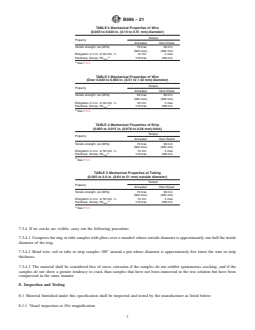
This specification covers wrought gold-copper alloy in the form of wire, rod, strip, and tubing to be used for electrical contacts. Raw materials shall be of such quality and purity that the finished product (produced by cold working, heat treating, annealing, turning, grinding, and/or pickling as required) will have the properties and characteristics prescribed in this specification. The material shall meet the requirements of chemical composition specified for gold, copper, noble metal impurities, and other impurities. Ultimate tensile strength, elongation, microhardness (Knoop or Vickers), hardness (Rockwell or Rockwell Superficial), or a combination of these mechanical properties may be specified as the temper criterion. Annealed and hard drawn wires, strips, and tubings, within the prescribed diameter or thickness, shall conform to the specified tensile strength, elongation, and hardness. The following tests shall be performed: Knoop hardness test, tension test, chemical analysis such as spectrochemical or wet analysis, and stress corrosion crack test by immersion test, compression, and bending.
SCOPE
1.1 This specification covers a wrought alloy containing gold and copper in the form of wire, rod, strip, and tubing for electrical contacts.
1.2 The values stated in inch-pound units are to be regarded as standard. The values given in parentheses are mathematical conversions to SI units that are provided for information only and are not considered standard.
1.3 The following precautionary statement pertains to the test method portion only, Section 7, of this standard: This standard does not purport to address all of the safety concerns, if any, associated with its use. It is the responsibility of the user of this standard to become familiar with all hazards including those identified in the appropriate Safety Data Sheet (SDS) for this product/material as provided by the manufacturer, to establish appropriate safety, health, and environmental practices, and determine the applicability of regulatory limitations prior to use.
1.4 This international standard was developed in accordance with internationally recognized principles on standardization established in the Decision on Principles for the Development of International Standards, Guides and Recommendations issued by the World Trade Organization Technical Barriers to Trade (TBT) Committee.
- Status
- Published
- Publication Date
- 31-Oct-2021
- Technical Committee
- B02 - Nonferrous Metals and Alloys
Buy Documents


ASTM B596-21 - Standard Specification for Gold-Copper Alloy Electrical Contact Material
REDLINE ASTM B596-21 - Standard Specification for Gold-Copper Alloy Electrical Contact Material
Overview
ASTM B596-21: Standard Specification for Gold-Copper Alloy Electrical Contact Material sets requirements for gold-copper alloys in wrought forms, such as wire, rod, strip, and tubing, specifically designed for use as electrical contacts. Published by ASTM International, this standard ensures that materials exhibit the necessary quality, purity, and mechanical properties for reliable performance in electrical applications. The specification outlines chemical composition, mechanical properties, manufacturing processes, and required testing methods to guarantee consistency and suitability in demanding environments.
Key Topics
Scope and Forms Covered
- Applies to wrought gold-copper alloy materials (wire, rod, strip, and tubing) for electrical contacts.
- Specifies both inch-pound and SI units, with inch-pound regarded as standard.
Material Requirements
- Must use high-purity raw materials for consistent performance.
- Gold content: 89.0–91.0% by weight.
- Copper: balance of composition.
- Strict limits on noble metal impurities and other contaminants (max 0.2% each).
Mechanical Properties
- Defines temper by tensile strength, elongation, and hardness.
- Requires conformance to prescribed mechanical properties based on the form and temper (e.g., annealed, hard drawn).
- Testing includes Knoop microhardness, Rockwell hardness, and tension tests.
Test Methods and Inspection
- Chemical analysis: spectrochemical or wet analysis, with fire assay for gold.
- Stress corrosion crack testing via immersion followed by mechanical stressing.
- Visual inspection and dimensional verification.
- All tests conducted at room temperature.
Safety and Compliance
- Users are responsible for understanding safety and regulatory requirements as indicated in Safety Data Sheets (SDS).
- Developed under internationally recognized standards principles.
Applications
Electrical Contacts
- Primary use in high-reliability electrical connectors and switches where low contact resistance and non-arcing performance are critical.
- Ideal for low-energy contact and coin gold applications in telecommunications equipment, aerospace, defense electronics, and precision instruments.
Manufacturing and Engineering
- Used by manufacturers producing contact components requiring superior conductivity, corrosion resistance, and mechanical integrity.
- Suitable for custom electrical connector solutions in harsh or mission-critical environments.
Quality Assurance
- Referenced by quality managers, engineers, and procurement professionals seeking to ensure compliance with internationally recognized material standards.
Related Standards
- ASTM B476 - General Requirements for Wrought Precious Metal Electrical Contact Materials: foundational requirements referenced throughout ASTM B596-21.
- ASTM E8/E8M - Test Methods for Tension Testing of Metallic Materials: procedures for measuring tensile strength and elongation.
- ASTM E384 - Test Method for Microindentation Hardness of Materials: guidelines for Knoop and Vickers microhardness testing.
Practical Value
Adhering to ASTM B596-21 provides assurance that gold-copper alloy materials for electrical contacts meet stringent criteria for purity, mechanical strength, and resistance to stress corrosion. By specifying this standard, organizations benefit from:
- Consistent product quality ensuring optimal electrical performance and reliability.
- Reduced risk of failure in vital electrical circuits and devices.
- Streamlined supplier assessment and material approval processes.
For engineers, manufacturers, and procurement teams in the electrical components industry, referencing ASTM B596-21 supports regulatory compliance, product durability, and the highest standards of performance in gold-copper electrical contact materials.
Relations
- Effective Date
- 01-May-2012
- Effective Date
- 01-Feb-2010
- Effective Date
- 01-Feb-2010
- Effective Date
- 01-May-2009
- Effective Date
- 15-Mar-2008
- Effective Date
- 15-Mar-2008
- Effective Date
- 01-Jan-2008
- Effective Date
- 15-Dec-2007
- Effective Date
- 01-Jul-2007
- Effective Date
- 15-Nov-2006
- Effective Date
- 01-Jun-2006
- Effective Date
- 15-Aug-2005
- Effective Date
- 01-Jul-2005
- Effective Date
- 01-Apr-2004
- Effective Date
- 10-Jul-2003
Buy Documents
ASTM B596-21 - Standard Specification for Gold-Copper Alloy Electrical Contact Material
REDLINE ASTM B596-21 - Standard Specification for Gold-Copper Alloy Electrical Contact Material
Get Certified
Connect with accredited certification bodies for this standard

Element Materials Technology
Materials testing and product certification.

Inštitut za kovinske materiale in tehnologije
Institute of Metals and Technology. Materials testing, metallurgical analysis, NDT.
Sponsored listings
Frequently Asked Questions
ASTM B596-21 is a technical specification published by ASTM International. Its full title is "Standard Specification for Gold-Copper Alloy Electrical Contact Material". This standard covers: ABSTRACT This specification covers wrought gold-copper alloy in the form of wire, rod, strip, and tubing to be used for electrical contacts. Raw materials shall be of such quality and purity that the finished product (produced by cold working, heat treating, annealing, turning, grinding, and/or pickling as required) will have the properties and characteristics prescribed in this specification. The material shall meet the requirements of chemical composition specified for gold, copper, noble metal impurities, and other impurities. Ultimate tensile strength, elongation, microhardness (Knoop or Vickers), hardness (Rockwell or Rockwell Superficial), or a combination of these mechanical properties may be specified as the temper criterion. Annealed and hard drawn wires, strips, and tubings, within the prescribed diameter or thickness, shall conform to the specified tensile strength, elongation, and hardness. The following tests shall be performed: Knoop hardness test, tension test, chemical analysis such as spectrochemical or wet analysis, and stress corrosion crack test by immersion test, compression, and bending. SCOPE 1.1 This specification covers a wrought alloy containing gold and copper in the form of wire, rod, strip, and tubing for electrical contacts. 1.2 The values stated in inch-pound units are to be regarded as standard. The values given in parentheses are mathematical conversions to SI units that are provided for information only and are not considered standard. 1.3 The following precautionary statement pertains to the test method portion only, Section 7, of this standard: This standard does not purport to address all of the safety concerns, if any, associated with its use. It is the responsibility of the user of this standard to become familiar with all hazards including those identified in the appropriate Safety Data Sheet (SDS) for this product/material as provided by the manufacturer, to establish appropriate safety, health, and environmental practices, and determine the applicability of regulatory limitations prior to use. 1.4 This international standard was developed in accordance with internationally recognized principles on standardization established in the Decision on Principles for the Development of International Standards, Guides and Recommendations issued by the World Trade Organization Technical Barriers to Trade (TBT) Committee.
ABSTRACT This specification covers wrought gold-copper alloy in the form of wire, rod, strip, and tubing to be used for electrical contacts. Raw materials shall be of such quality and purity that the finished product (produced by cold working, heat treating, annealing, turning, grinding, and/or pickling as required) will have the properties and characteristics prescribed in this specification. The material shall meet the requirements of chemical composition specified for gold, copper, noble metal impurities, and other impurities. Ultimate tensile strength, elongation, microhardness (Knoop or Vickers), hardness (Rockwell or Rockwell Superficial), or a combination of these mechanical properties may be specified as the temper criterion. Annealed and hard drawn wires, strips, and tubings, within the prescribed diameter or thickness, shall conform to the specified tensile strength, elongation, and hardness. The following tests shall be performed: Knoop hardness test, tension test, chemical analysis such as spectrochemical or wet analysis, and stress corrosion crack test by immersion test, compression, and bending. SCOPE 1.1 This specification covers a wrought alloy containing gold and copper in the form of wire, rod, strip, and tubing for electrical contacts. 1.2 The values stated in inch-pound units are to be regarded as standard. The values given in parentheses are mathematical conversions to SI units that are provided for information only and are not considered standard. 1.3 The following precautionary statement pertains to the test method portion only, Section 7, of this standard: This standard does not purport to address all of the safety concerns, if any, associated with its use. It is the responsibility of the user of this standard to become familiar with all hazards including those identified in the appropriate Safety Data Sheet (SDS) for this product/material as provided by the manufacturer, to establish appropriate safety, health, and environmental practices, and determine the applicability of regulatory limitations prior to use. 1.4 This international standard was developed in accordance with internationally recognized principles on standardization established in the Decision on Principles for the Development of International Standards, Guides and Recommendations issued by the World Trade Organization Technical Barriers to Trade (TBT) Committee.
ASTM B596-21 is classified under the following ICS (International Classification for Standards) categories: 77.120.99 - Other non-ferrous metals and their alloys. The ICS classification helps identify the subject area and facilitates finding related standards.
ASTM B596-21 has the following relationships with other standards: It is inter standard links to ASTM B476-01(2012), ASTM E384-10e1, ASTM E384-10, ASTM E384-09, ASTM E384-08a, ASTM E384-08ae1, ASTM E384-08, ASTM E384-07a, ASTM E384-07, ASTM E384-06, ASTM B476-01(2006), ASTM E384-05a, ASTM E384-05, ASTM E8-04, ASTM E8-03. Understanding these relationships helps ensure you are using the most current and applicable version of the standard.
ASTM B596-21 is available in PDF format for immediate download after purchase. The document can be added to your cart and obtained through the secure checkout process. Digital delivery ensures instant access to the complete standard document.
Standards Content (Sample)
This international standard was developed in accordance with internationally recognized principles on standardization established in the Decision on Principles for the
Development of International Standards, Guides and Recommendations issued by the World Trade Organization Technical Barriers to Trade (TBT) Committee.
Designation:B596 −21
Standard Specification for
Gold-Copper Alloy Electrical Contact Material
This standard is issued under the fixed designation B596; the number immediately following the designation indicates the year of
original adoption or, in the case of revision, the year of last revision.Anumber in parentheses indicates the year of last reapproval.A
superscript epsilon (´) indicates an editorial change since the last revision or reapproval.
This standard has been approved for use by agencies of the U.S. Department of Defense.
1. Scope 3. Materials and Manufacture
1.1 This specification covers a wrought alloy containing 3.1 Raw materials shall be of such quality and purity that
gold and copper in the form of wire, rod, strip, and tubing for thefinishedproductwillhavethepropertiesandcharacteristics
electrical contacts. prescribed in this specification.
1.2 The values stated in inch-pound units are to be regarded 3.2 The material shall be finished by such operations (cold
as standard. The values given in parentheses are mathematical working, heat treating, annealing, turning, grinding, pickling)
conversions to SI units that are provided for information only as are required to produce the prescribed properties.
and are not considered standard.
4. Chemical Composition
1.3 The following precautionary statement pertains to the
test method portion only, Section 7, of this standard: This
4.1 Materials produced under the specification shall meet
standard does not purport to address all of the safety concerns,
the requirements of chemical composition shown in Table 1.
if any, associated with its use. It is the responsibility of the user
of this standard to become familiar with all hazards including
5. Mechanical Properties
those identified in the appropriate Safety Data Sheet (SDS) for
5.1 The contract or order may specify ultimate tensile
this product/material as provided by the manufacturer, to
strength, elongation, microhardness (Knoop or Vickers), hard-
establish appropriate safety, health, and environmental
ness (Rockwell or Rockwell Superficial), or a combination of
practices, and determine the applicability of regulatory limi-
these mechanical properties as temper criterion. If the contract
tations prior to use.
or order does not specify a temper criterion, then the criterion
1.4 This international standard was developed in accor-
for temper designation will be ultimate tensile strength.
dance with internationally recognized principles on standard-
5.2 The material shall conform to the mechanical properties
ization established in the Decision on Principles for the
shown in Table 2, Table 3, Table 4,or Table 5.
Development of International Standards, Guides and Recom-
mendations issued by the World Trade Organization Technical
5.3 The stress corrosion test in accordance with 7.3 is
Barriers to Trade (TBT) Committee.
optional upon a mutual agreement between purchaser and
supplier.
2. Referenced Documents
2.1 ASTM Standards:
6. General Requirements
B476Specification for General Requirements for Wrought
6.1 Specification B476 shall apply to all materials produced
Precious Metal Electrical Contact Materials
to this specification.
E8Test Methods for Tension Testing of Metallic Materials
[Metric] E0008_E0008M
7. Test Methods
E384Test Method for Microindentation Hardness of Mate-
rials
7.1 Test methods shall be in accordance with Specification
B476.
This specification is under the jurisdiction of ASTM Committee B02 on
7.1.1 Knoop hardness tests shall be in accordance with Test
Nonferrous Metals and Alloys and is the direct responsibility of Subcommittee
Method E384. Material 0.005 in. (0.13 mm) in thickness (or
B02.05 on Precious Metals and Electrical Contact Materials.
diameter)andlargershallbetestedusinga100-gindenterload.
Current edition approved Nov. 1, 2021. Published December 2021. Originally
A minimum of five hardness indentations shall be made on
approved in 1974. Last previous edition approved in 2017 as B596–89(2017).
DOI: 10.1520/B0596-21.
each specimen. The hardness value reported shall be the
For referenced ASTM standards, visit the ASTM website, www.astm.org, or
average of the five indentations. Material less than 0.005 in. in
contact ASTM Customer Service at service@astm.org. For Annual Book of ASTM
thickness (or diameter) shall be tested with a 50-g indenter
Standards volume information, refer to the standard’s Document Summary page on
the ASTM website. load.
Copyright © ASTM International, 100 Barr Harbor Drive, PO Box C700, West Conshohocken, PA 19428-2959. United States
B596−21
TABLE 1 Chemical Requirements TABLE 5 Mechanical Properties of Tubing
(0.025 to 2.0 in. (0.64 to 51 mm) outside diameter)
Ele
...
This document is not an ASTM standard and is intended only to provide the user of an ASTM standard an indication of what changes have been made to the previous version. Because
it may not be technically possible to adequately depict all changes accurately, ASTM recommends that users consult prior editions as appropriate. In all cases only the current version
of the standard as published by ASTM is to be considered the official document.
Designation: B596 − 89 (Reapproved 2017) B596 − 21
Standard Specification for
Gold-Copper Alloy Electrical Contact Material
This standard is issued under the fixed designation B596; the number immediately following the designation indicates the year of
original adoption or, in the case of revision, the year of last revision. A number in parentheses indicates the year of last reapproval. A
superscript epsilon (´) indicates an editorial change since the last revision or reapproval.
This standard has been approved for use by agencies of the U.S. Department of Defense.
1. Scope
1.1 This specification covers a wrought alloy containing gold and copper in the form of wire, rod, strip, and tubing for electrical
contacts.
1.2 The values stated in inch-pound units are to be regarded as standard. The values given in parentheses are mathematical
conversions to SI units that are provided for information only and are not considered standard.
1.3 The following precautionary statement pertains to the test method portion only, Section 7, of this standard: This standard
does not purport to address all of the safety concerns, if any, associated with its use. It is the responsibility of the user of this
standard to become familiar with all hazards including those identified in the appropriate Safety Data Sheet (SDS) for this
product/material as provided by the manufacturer, to establish appropriate safety safety, health, and healthenvironmental
practices, and determine the applicability of regulatory limitations prior to use.
1.4 This international standard was developed in accordance with internationally recognized principles on standardization
established in the Decision on Principles for the Development of International Standards, Guides and Recommendations issued
by the World Trade Organization Technical Barriers to Trade (TBT) Committee.
2. Referenced Documents
2.1 ASTM Standards:
B476 Specification for General Requirements for Wrought Precious Metal Electrical Contact Materials
E8 Test Methods for Tension Testing of Metallic Materials [Metric] E0008_E0008M
E384 Test Method for Microindentation Hardness of Materials
3. Materials and Manufacture
3.1 Raw materials shall be of such quality and purity that the finished product will have the properties and characteristics
prescribed in this specification.
3.2 The material shall be finished by such operations (cold working, heat treating, annealing, turning, grinding, pickling) as are
required to produce the prescribed properties.
This specification is under the jurisdiction of ASTM Committee B02 on Nonferrous Metals and Alloys and is the direct responsibility of Subcommittee B02.05 on
Precious Metals and Electrical Contact Materials.
Current edition approved April 1, 2017Nov. 1, 2021. Published April 2017December 2021. Originally approved in 1974. Last previous edition approved in 20122017 as
B596 – 89 (2012).(2017). DOI: 10.1520/B0596-89R17.10.1520/B0596-21.
For referenced ASTM standards, visit the ASTM website, www.astm.org, or contact ASTM Customer Service at service@astm.org. For Annual Book of ASTM Standards
volume information, refer to the standard’s Document Summary page on the ASTM website.
Copyright © ASTM International, 100 Barr Harbor Drive, PO Box C700, West Conshohocken, PA 19428-2959. United States
B596 − 21
4. Chemical Composition
4.1 Materials produced under the specification shall meet the requirements of chemical composition shown in Table 1.
5. Mechanical Properties
5.1 The contract or order may specify ultimate tensile strength, elongation, microhardness (Knoop or Vickers), hardness (Rockwell
or Rockwell Superficial), or a combination of these mechanical properties as temper criterion. If the contract or order does not
specify a temper criterion, then the criterion for temper designation will be ultimate tensile strength.
5.2 The material shall conform to the mechanical properties shown in Table 2, Table 3, Table 4, or Table 5.
5.3 The material shall be free of stress corrosion (as tested) test in accordance with 7.3. is optional upon a mutual agreement
between purchaser and supplier.
6. General Requirements
6.1 Specification B476 shall apply to all materials produced to this specification.
7. Test Methods
7.1 Test methods shall be in accordance with Specification B476.
7.1.1 Knoop hardness tests shall be in accordance with Test Method E384. Material 0.005 in. (0.13 mm) in thickness (or diameter)
and larger shall be tested using a 100-g indenter load. A minimum of five hardness indentations shall be made on each specimen.
The hardness value reported shall be the average of the five indentations. Material less than 0.005 in. in thickness (or diameter)
shall be tested with a 50-g indenter load.
7.1.2 All tension tests shall be in accordance with Test Methods E8 and test specimens
...