

ASTM F2527-24
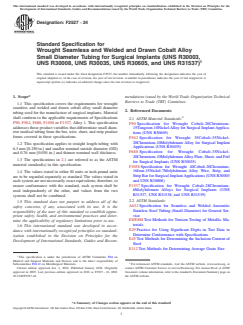
(Specification)Standard Specification for Wrought Seamless and Welded and Drawn Cobalt Alloy Small Diameter Tubing for Surgical Implants (UNS R30003, UNS R30008, UNS R30035, UNS R30605, and UNS R31537)
General Information
- Abstract
ABSTRACT
This specification covers the requirements for wrought seamless and welded and drawn cobalt alloy small diameter tubing used for the manufacture of surgical implants. Product variables that differentiate small diameter medical tubing from the bar, wire, sheet, and strip product forms are addressed. This specification applies to straight length tubing of specified diameters and thickness. Seamless tubing shall be made from bar, hollow bar, rod, or hollow rod raw material forms through a prescribed process. Welded and drawn tubing shall be made from strip or sheet raw material forms that meet the specified chemical requirements. The tubing shall be subject to tensile testing.
SCOPE
1.1 This specification covers the requirements for wrought seamless and welded and drawn cobalt alloy small diameter tubing used for the manufacture of surgical implants. Material shall conform to the applicable requirements of Specifications F90, F562, F688, F1058 or F1537, Alloy 1. This specification addresses those product variables that differentiate small diameter medical tubing from the bar, wire, sheet, and strip product forms covered in these specifications.
1.2 This specification applies to straight length tubing with 6.3 mm [0.250 in.] and smaller nominal outside diameter (OD) and 0.76 mm [0.030 in.] and thinner nominal wall thickness.
1.3 The specifications in 2.1 are referred to as the ASTM material standard(s) in this specification.
1.4 The values stated in either SI units or inch-pound units are to be regarded separately as standard. The values stated in each system are not necessarily exact equivalents; therefore, to ensure conformance with the standard, each system shall be used independently of the other, and values from the two systems shall not be combined.
1.5 This standard does not purport to address all of the safety concerns, if any, associated with its use. It is the responsibility of the user of this standard to establish appropriate safety, health, and environmental practices and determine the applicability of regulatory limitations prior to use.
1.6 This international standard was developed in accordance with internationally recognized principles on standardization established in the Decision on Principles for the Development of International Standards, Guides and Recommendations issued by the World Trade Organization Technical Barriers to Trade (TBT) Committee.
- Status
- Published
- Publication Date
- 31-Dec-2023
- Technical Committee
- F04 - Medical and Surgical Materials and Devices
- Drafting Committee
- F04.12 - Metallurgical Materials
Buy Documents
ASTM F2527-24 - Standard Specification for Wrought Seamless and Welded and Drawn Cobalt Alloy Small Diameter Tubing for Surgical Implants (UNS R30003, UNS R30008, UNS R30035, UNS R30605, and UNS R31537)
REDLINE ASTM F2527-24 - Standard Specification for Wrought Seamless and Welded and Drawn Cobalt Alloy Small Diameter Tubing for Surgical Implants (UNS R30003, UNS R30008, UNS R30035, UNS R30605, and UNS R31537)
Overview
ASTM F2527-24 is the standard specification developed by ASTM International for wrought seamless, and welded and drawn, cobalt alloy small diameter tubing used in the manufacture of surgical implants. This specification addresses product variables that distinguish small diameter medical tubing from other cobalt alloy product forms such as bar, wire, sheet, and strip. It defines requirements for tubing with a nominal outside diameter of 6.3 mm [0.250 in.] or smaller and a wall thickness of 0.76 mm [0.030 in.] or less. Tubing produced under this standard is used specifically for critical medical device applications, including fabricated stents and other implantable devices.
Key Topics
- Product Forms Covered: Applies to straight-length cobalt alloy tubing, both seamless and welded/drawn forms.
- Raw Materials: Seamless tubing must derive from bar, hollow bar, or rod; welded and drawn tubing is manufactured from strip or sheet forms.
- Alloy Designations: The standard covers UNS R30003, UNS R30008, UNS R30035, UNS R30605, and UNS R31537 cobalt alloys.
- Dimensional Tolerances: Permissible variations for outer and inner diameters, wall thickness, length, and straightness are specified, ensuring tight manufacturing control for surgical implant use.
- Surface Finish: Provisions for outer (cold drawn, bright annealed, ground, or polished) and inner (as-drawn, bright annealed, or conditioned) finishes, with defined roughness limits.
- Mechanical Properties and Testing: Requires tubing to meet tensile test requirements and provides methods for measuring concentricity, wall thickness, and surface imperfections.
- Manufacturing Methods: Details for seamless versus welded and drawn processing, including requirements for weld integrity, heat treatment, and surface preparation.
- Quality Assurance: Mandates a quality system compliant with ISO 9001, ISO 13485, or equivalent.
- Certification: Suppliers must provide compliance certification and test results to customers.
Applications
- Medical Implants: The primary application is in surgical implants such as vascular stents and other small-diameter devices, where precise dimensions, excellent mechanical properties, and verified biocompatibility are critical.
- Minimally Invasive Devices: Used in instruments or devices requiring fine tubing with high corrosion resistance and strength-to-weight ratio.
- Biomedical Components: Cobalt alloy tubing manufactured to ASTM F2527-24 is ideal for any scenario demanding consistent wall thickness, tight concentricity, and smooth surface finish for compatibility with biological tissues.
Related Standards
ASTM F2527-24 references several other ASTM, ISO, and ASME standards to support comprehensive material and testing requirements:
- ASTM F90: Specification for Cobalt-Chromium-Tungsten-Nickel Alloy for Surgical Implants
- ASTM F562 / F688 / F1058 / F1537: Complementary specifications for various cobalt alloy forms used in surgical applications.
- ASTM A632: Seamless and welded austenitic stainless steel tubing, for general service.
- ASTM E8/E8M: Test methods for tension testing of metallic materials.
- ASTM E112/E45/E29: Methods for grain size, inclusion content, and statistical rounding, respectively.
- ASTM F2819: Methods for measuring the straightness of bar, rod, tubing, and wire for medical devices.
- ISO 5832 Series: Relevant international standards for metallic materials used in surgical implants.
- ISO 9001 / ISO 13485: International standards for quality management systems, with ISO 13485 focusing on medical device manufacturers.
- ASME Y14.5.1M: Principles for dimensioning and tolerancing.
Relevant Keywords: cobalt alloy tubing, ASTM F2527, surgical implants, small diameter medical tubing, wrought seamless tubing, welded drawn tubing, UNS R30003, UNS R30008, UNS R30035, UNS R30605, UNS R31537, medical device standards, biocompatible tubing, quality assurance, implant tubing specifications.
By adhering to ASTM F2527-24, manufacturers, suppliers, and medical device designers ensure that small diameter cobalt alloy tubing for implantable applications consistently meets the rigorous requirements of global healthcare standards, supporting patient safety and high performance in advanced medical procedures.
Relations
- Effective Date
- 01-Jan-2024
- Effective Date
- 01-Jan-2024
- Effective Date
- 01-May-2022
Buy Documents
ASTM F2527-24 - Standard Specification for Wrought Seamless and Welded and Drawn Cobalt Alloy Small Diameter Tubing for Surgical Implants (UNS R30003, UNS R30008, UNS R30035, UNS R30605, and UNS R31537)
REDLINE ASTM F2527-24 - Standard Specification for Wrought Seamless and Welded and Drawn Cobalt Alloy Small Diameter Tubing for Surgical Implants (UNS R30003, UNS R30008, UNS R30035, UNS R30605, and UNS R31537)
Get Certified
Connect with accredited certification bodies for this standard

BSI Group
BSI (British Standards Institution) is the business standards company that helps organizations make excellence a habit.

TÜV Rheinland
TÜV Rheinland is a leading international provider of technical services.

TÜV SÜD
TÜV SÜD is a trusted partner of choice for safety, security and sustainability solutions.
Sponsored listings
Frequently Asked Questions
ASTM F2527-24 is a technical specification published by ASTM International. Its full title is "Standard Specification for Wrought Seamless and Welded and Drawn Cobalt Alloy Small Diameter Tubing for Surgical Implants (UNS R30003, UNS R30008, UNS R30035, UNS R30605, and UNS R31537)". This standard covers: ABSTRACT This specification covers the requirements for wrought seamless and welded and drawn cobalt alloy small diameter tubing used for the manufacture of surgical implants. Product variables that differentiate small diameter medical tubing from the bar, wire, sheet, and strip product forms are addressed. This specification applies to straight length tubing of specified diameters and thickness. Seamless tubing shall be made from bar, hollow bar, rod, or hollow rod raw material forms through a prescribed process. Welded and drawn tubing shall be made from strip or sheet raw material forms that meet the specified chemical requirements. The tubing shall be subject to tensile testing. SCOPE 1.1 This specification covers the requirements for wrought seamless and welded and drawn cobalt alloy small diameter tubing used for the manufacture of surgical implants. Material shall conform to the applicable requirements of Specifications F90, F562, F688, F1058 or F1537, Alloy 1. This specification addresses those product variables that differentiate small diameter medical tubing from the bar, wire, sheet, and strip product forms covered in these specifications. 1.2 This specification applies to straight length tubing with 6.3 mm [0.250 in.] and smaller nominal outside diameter (OD) and 0.76 mm [0.030 in.] and thinner nominal wall thickness. 1.3 The specifications in 2.1 are referred to as the ASTM material standard(s) in this specification. 1.4 The values stated in either SI units or inch-pound units are to be regarded separately as standard. The values stated in each system are not necessarily exact equivalents; therefore, to ensure conformance with the standard, each system shall be used independently of the other, and values from the two systems shall not be combined. 1.5 This standard does not purport to address all of the safety concerns, if any, associated with its use. It is the responsibility of the user of this standard to establish appropriate safety, health, and environmental practices and determine the applicability of regulatory limitations prior to use. 1.6 This international standard was developed in accordance with internationally recognized principles on standardization established in the Decision on Principles for the Development of International Standards, Guides and Recommendations issued by the World Trade Organization Technical Barriers to Trade (TBT) Committee.
ABSTRACT This specification covers the requirements for wrought seamless and welded and drawn cobalt alloy small diameter tubing used for the manufacture of surgical implants. Product variables that differentiate small diameter medical tubing from the bar, wire, sheet, and strip product forms are addressed. This specification applies to straight length tubing of specified diameters and thickness. Seamless tubing shall be made from bar, hollow bar, rod, or hollow rod raw material forms through a prescribed process. Welded and drawn tubing shall be made from strip or sheet raw material forms that meet the specified chemical requirements. The tubing shall be subject to tensile testing. SCOPE 1.1 This specification covers the requirements for wrought seamless and welded and drawn cobalt alloy small diameter tubing used for the manufacture of surgical implants. Material shall conform to the applicable requirements of Specifications F90, F562, F688, F1058 or F1537, Alloy 1. This specification addresses those product variables that differentiate small diameter medical tubing from the bar, wire, sheet, and strip product forms covered in these specifications. 1.2 This specification applies to straight length tubing with 6.3 mm [0.250 in.] and smaller nominal outside diameter (OD) and 0.76 mm [0.030 in.] and thinner nominal wall thickness. 1.3 The specifications in 2.1 are referred to as the ASTM material standard(s) in this specification. 1.4 The values stated in either SI units or inch-pound units are to be regarded separately as standard. The values stated in each system are not necessarily exact equivalents; therefore, to ensure conformance with the standard, each system shall be used independently of the other, and values from the two systems shall not be combined. 1.5 This standard does not purport to address all of the safety concerns, if any, associated with its use. It is the responsibility of the user of this standard to establish appropriate safety, health, and environmental practices and determine the applicability of regulatory limitations prior to use. 1.6 This international standard was developed in accordance with internationally recognized principles on standardization established in the Decision on Principles for the Development of International Standards, Guides and Recommendations issued by the World Trade Organization Technical Barriers to Trade (TBT) Committee.
ASTM F2527-24 is classified under the following ICS (International Classification for Standards) categories: 11.040.40 - Implants for surgery, prosthetics and orthotics. The ICS classification helps identify the subject area and facilitates finding related standards.
ASTM F2527-24 has the following relationships with other standards: It is inter standard links to ASTM F2527-16, ASTM E8/E8M-24, ASTM E8/E8M-22. Understanding these relationships helps ensure you are using the most current and applicable version of the standard.
ASTM F2527-24 is available in PDF format for immediate download after purchase. The document can be added to your cart and obtained through the secure checkout process. Digital delivery ensures instant access to the complete standard document.
Standards Content (Sample)
This international standard was developed in accordance with internationally recognized principles on standardization established in the Decision on Principles for the
Development of International Standards, Guides and Recommendations issued by the World Trade Organization Technical Barriers to Trade (TBT) Committee.
Designation: F2527 − 24
Standard Specification for
Wrought Seamless and Welded and Drawn Cobalt Alloy
Small Diameter Tubing for Surgical Implants (UNS R30003,
UNS R30008, UNS R30035, UNS R30605, and UNS R31537)
This standard is issued under the fixed designation F2527; the number immediately following the designation indicates the year of
original adoption or, in the case of revision, the year of last revision. A number in parentheses indicates the year of last reapproval. A
superscript epsilon (´) indicates an editorial change since the last revision or reapproval.
1. Scope* mendations issued by the World Trade Organization Technical
Barriers to Trade (TBT) Committee.
1.1 This specification covers the requirements for wrought
seamless and welded and drawn cobalt alloy small diameter
2. Referenced Documents
tubing used for the manufacture of surgical implants. Material
shall conform to the applicable requirements of Specifications
2.1 ASTM Material Standards:
F90, F562, F688, F1058 or F1537, Alloy 1. This specification
F90 Specification for Wrought Cobalt-20Chromium-
addresses those product variables that differentiate small diam-
15Tungsten-10Nickel Alloy for Surgical Implant Applica-
eter medical tubing from the bar, wire, sheet, and strip product
tions (UNS R30605)
forms covered in these specifications.
F562 Specification for Wrought 35Cobalt-35Nickel-
20Chromium-10Molybdenum Alloy for Surgical Implant
1.2 This specification applies to straight length tubing with
Applications (UNS R30035)
6.3 mm [0.250 in.] and smaller nominal outside diameter (OD)
F688 Specification for Wrought Cobalt-35Nickel-
and 0.76 mm [0.030 in.] and thinner nominal wall thickness.
20Chromium-10Molybdenum Alloy Plate, Sheet, and Foil
1.3 The specifications in 2.1 are referred to as the ASTM
for Surgical Implants (UNS R30035)
material standard(s) in this specification.
F1058 Specification for Wrought 40Cobalt-20Chromium-
16Iron-15Nickel-7Molybdenum Alloy Wire, Strip, and
1.4 The values stated in either SI units or inch-pound units
Strip Bar for Surgical Implant Applications (UNS R30003
are to be regarded separately as standard. The values stated in
and UNS R30008)
each system are not necessarily exact equivalents; therefore, to
F1537 Specification for Wrought Cobalt-28Chromium-
ensure conformance with the standard, each system shall be
6Molybdenum Alloys for Surgical Implants (UNS
used independently of the other, and values from the two
R31537, UNS R31538, and UNS R31539)
systems shall not be combined.
2.2 ASTM Standards:
1.5 This standard does not purport to address all of the
A632 Specification for Seamless and Welded Austenitic
safety concerns, if any, associated with its use. It is the
Stainless Steel Tubing (Small-Diameter) for General Ser-
responsibility of the user of this standard to establish appro-
vice
priate safety, health, and environmental practices and deter-
E8/E8M Test Methods for Tension Testing of Metallic Ma-
mine the applicability of regulatory limitations prior to use.
terials
1.6 This international standard was developed in accor-
E29 Practice for Using Significant Digits in Test Data to
dance with internationally recognized principles on standard-
Determine Conformance with Specifications
ization established in the Decision on Principles for the
E45 Test Methods for Determining the Inclusion Content of
Development of International Standards, Guides and Recom-
Steel
E112 Test Methods for Determining Average Grain Size
This specification is under the jurisdiction of ASTM Committee F04 on
Medical and Surgical Materials and Devices and is the direct responsibility of
Subcommittee F04.12 on Metallurgical Materials. For referenced ASTM standards, visit the ASTM website, www.astm.org, or
Current edition approved Jan. 1, 2024. Published January 2024. Originally contact ASTM Customer Service at service@astm.org. For Annual Book of ASTM
approved in 2005. Last previous edition approved in 2016 as F2527 – 16. DOI: Standards volume information, refer to the standard’s Document Summary page on
10.1520/F2527-24. the ASTM website.
*A Summary of Changes section appears at the end of this standard
Copyright © ASTM International, 100 Barr Harbor Drive, PO Box C700, West Conshohocken, PA 19428-2959. United States
F2527 − 24
F2819 Test Methods for Measurement of Straightness of 3.1.8 sample average wall thickness—the arithmetic aver-
Bar, Rod, Tubing and Wire to be used for Medical Devices age of all individual wall thickness measurements measured on
IEEE/ASTM SI 10 American National Standard for Metric a single sample.
Practice
3.1.9 sample concentricity—two times the offset between
the centers of two circles, representing the outside diameter
2.3 ISO Standards:
ISO 5832-5 Implants for Surgery—Metallic Materials Part (OD) and the inside diameter (ID) of the tube.
5: Wrought Cobalt, Chromium, Tungsten, Nickel Alloy 3.1.9.1 Discussion—For the purposes of this specification,
ISO 5832-6 Implants for Surgery—Metallic Materials Part the sample minimum wall and the sample maximum wall
6: Wrought Cobalt, Nickel, Chromium, Molybdenum measured on any one transverse cross section of a single
Alloy sample shall be used to calculate concentricity. The sample
ISO 5832-7 Implants for Surgery—Metallic Materials Part maximum and sample minimum wall thickness shall be the
7: Wrought Cobalt, Chromium, Molybdenum Alloy largest and smallest, respectively, of no less than four indi-
ISO 5832-8 Implants for Surgery—Metallic Materials Part vidual wall thickness measurements taken at uniformly spaced
8: Wrought Cobalt, Nickel, Chromium, Molybdenum, locations around the circumference of a simple sample of the
Tungsten, Iron Alloy tube. Sample concentricity shall be expressed as a percent of
the wall thickness and shall be calculated using the following
ISO 5832-12 Implants for Surgery—Metallic Materials Part
12: Wrought Cobalt, Chromium, Molybdenum Alloy equation:
ISO 6892 Metallic Materials—Tensile Testing
A 2 B
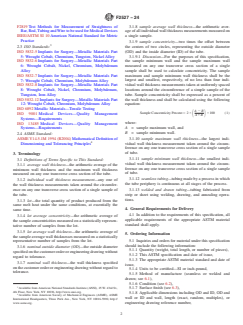
Sample Concentricity Percent 5 2 × × 100 (1)
ISO 9001 Medical Devices—Quality Management S D
A1B
Systems—Requirements
where:
ISO 13485 Medical Devices—Quality Management
A = sample maximum wall, and
Systems—Requirements
B = sample minimum wall.
2.4 ASME Standard:
3.1.10 sample maximum wall thickness—the largest indi-
ASME Y14.5.1M 1994 (R2004) Mathematical Definition of
vidual wall thickness measurement taken around the circum-
Dimensioning and Tolerancing Principles
ference on any one transverse cross section of a single sample
of tube.
3. Terminology
3.1.11 sample minimum wall thickness—the smallest indi-
3.1 Definitions of Terms Specific to This Standard:
vidual wall thickness measurement taken around the circum-
3.1.1 average wall thickness—the arithmetic average of the
ference on any one transverse cross section of a single sample
minimum wall thickness and the maximum wall thickness
of tube.
measured on any one transverse cross section of the tube.
3.1.12 seamless tubing—tubing made by a process in which
3.1.2 individual wall thickness measurement—any one of
the tube periphery is continuous at all stages of the process.
the wall thickness measurements taken around the circumfer-
ence on any one transverse cross section of a single sample of 3.1.13 welded and drawn tubing—tubing fabricated from
the tube.
strip or sheet using welding, drawing, and annealing opera-
tions.
3.1.3 lot—the total quantity of product produced from the
same melt heat under the same conditions, at essentially the
4. General Requirements for Delivery
same time.
4.1 In addition to the requirements of this specification, all
3.1.4 lot average concentricity—the arithmetic average of
applicable requirements of the appropriate ASTM material
the sample concentricities measured on a statistically represen-
standard shall apply.
tative number of samples from the lot.
3.1.5 lot average wall thickness—the arithmetic average of
5. Ordering Information
the sample average wall thicknesses measured on a statistically
5.1 Inquiries and orders for material under this specification
representative number of samples from the lot.
should include the following information:
3.1.6 nominal outside diameter (OD)—the outside diameter
5.1.1 Quantity (weight, total length, or number of pieces),
specified on the customer order or engineering drawing without
5.1.2 This ASTM specification and date of issue,
regard to tolerance.
5.1.3 The appropriate ASTM material standard and date of
3.1.7 nominal wall thickness—the wall thickness specified
issue,
on the customer order or engineering drawing without regard to
5.1.4 Units to be certified—SI or inch-pound,
tolerance.
5.1.5 Method of manufacture (seamless or welded and
drawn; see 6.1),
5.1.6 Condition (see 6.2),
Available from American National Standards Institute (ANSI), 25 W. 43rd St.,
5.1.7 Surface finish (see 6.3),
4th Floor, New York, NY 10036, http://www.ansi.org.
5.1.8 Applicable dimensions including OD and ID, OD and
Available from American Society of Mechanical Engineers (ASME), ASME
wall or ID and wall, length (exact, random, multiples), or
International Headquarters, Three Park Ave., New York, NY 10016-5990, http://
www.asme.org. engineering drawing reference number,
F2527 − 24
5.1.9 Dimensional tolerances (see Section 10 and Table 1), material specification. Where bar or wire data is presented, the
5.1.10 Special requirements or supplementary requirements, mechanical properties listed for bar or wire of similar OD size
if any, and shall apply. Where sheet or strip data is presented, the
5.1.11 Certification requirements. mechanical properties for sheet or strip with thickness similar
to the tubing wall thickness shall apply. Tensile testing shall be
6. Materials and Manufacture
in accordance with Test Methods E8/E8M using unmachined
tubular specimens. Alternative mechanical properties may be
6.1 Method of Manufacture:
agreed upon between purchaser and supplier.
6.1.1 Tubing shall be made by the seamless or the welded
and drawn process.
8.2 If both tensile properties and hardness are specified on
6.1.1.1 Seamless tubing shall be made from bar, hollow bar,
the purchase order, tensile properties shall be used to accept or
rod, or hollow rod raw material forms that meet the chemical
reject. Hardness shall be reported for information only.
requirements of the appropriate material specification.
8.3 Elongation of bar and wire material 1.6 mm [0.063 in.]
6.1.1.2 Seamless tubing shall be made by a process consis-
or greater in diameter (D) shall be measured using a gauge
tent with the definition in 3.1.12.
length of 50 mm [2 in.], or 4D. The gauge length must be
6.1.2 Welded and drawn tubing shall be fabricated from
reported with the test results. The method for determining
strip or sheet using welding, drawing, and annealing opera-
elongation of material under 1.6 mm [0.063 in.] shall be agreed
tions. Welding shall be performed using a liquid phase weld
upon between purchaser and supplier. Alternatively, a gauge
process with no filler metal. Typical weld processes are
length corresponding to ISO 6892 (5.65 times the square root
tungsten inert gas (TIG) and laser. The drawing and annealing
of So, where So is the original cross-sectional area) may be
operations shall be performed in such a way that the weld bead
used when agreed upon between purchaser and supplier.
and heat affected zone are virtually indistinguishable micro-
structurally and dimensionally from the parent metal when 8.4 Elongation for sheet and strip product shall be tested and
reported as required in the appropriate material specification.
examined per 11.3.
6.2 Condition—Tubing shall be furnished, as specified, in
9. Permissible Outer and Inner Surface Imperfections
the annealed, solution annealed, warm worked or cold worked
9.1 Outer surface imperfection shall not exceed 10 % of
and aged condition as defined in the appropriate ASTM
wall thickness in depth. Outer surface imperfections may be
material standard.
removed by grinding or polishing prior to shipment, providing
6.3 Surface Finish:
that the resultant wall thickness meets the minimum wall
6.3.1 The tubing outer surface shall be furnished with a
thickness, and that the ground or polished surface meets the
cold-drawn, bright annealed, ground, or polished finish. Outer
surface finish requirements of 6.3.1.
surface roughness shall be a maximum of 0.6 μm [25 μin.] Ra.
9.2 Inner surface imperfections shall not exceed 10 % of
6.3.2 The tubing inner surface shall be furnished with an
wall thickness in depth.
as-drawn finish, bright annealed, or conditioned finish. Inner
surface roughness shall be a maximum of 0.8 μm [30 μin.] Ra. 9.3 The method of inspecting for these imperfections shall
6.3.3 The method used to determine surface roughness shall
be agreed upon between the purchaser and supplier.
be agreed upon between purchaser and supplier.
10. Dimensions and Permissible Variation
7. Chemical Composition
10.1 Units of Measure:
7.1 The heat analysis limits and product analysis tolerances 10.1.1 Selection—This specification requires that the pur-
of the appropriate ASTM material specification shall apply. chaser selects the units of measure (SI or inch-pound) to be
used for product certification. In the absence of a stated
7.2 Alternative chemistries with more restrictive limits than
selection of units on the purchase order, this selection may be
those in the ASTM material specifications may be specified as
expressed by the purchaser in several alternate forms listed in
agreed upon by purchaser and supplier.
order of precedence.
10.1.1.1 If the purchaser and supplier have a history of
8. Mechanical Properties
using specific units, these units shall continue to be certified
8.1 The required mechanical properties shall be selected
until expressly changed by the purchaser.
from the tables for similar product forms in the appropriate
10.1.1.2 In the absence of historic precedence, if the units
used to define the product on the purchaser’s PO, specification,
TABLE 1 Permissible Variation in OD and ID Dimensions
and engineering dra
...
This document is not an ASTM standard and is intended only to provide the user of an ASTM standard an indication of what changes have been made to the previous version. Because
it may not be technically possible to adequately depict all changes accurately, ASTM recommends that users consult prior editions as appropriate. In all cases only the current version
of the standard as published by ASTM is to be considered the official document.
Designation: F2527 − 16 F2527 − 24
Standard Specification for
Wrought Seamless and Welded and Drawn Cobalt Alloy
Small Diameter Tubing for Surgical Implants (UNS R30003,
UNS R30008, UNS R30035, UNS R30605, and UNS R31537)
This standard is issued under the fixed designation F2527; the number immediately following the designation indicates the year of
original adoption or, in the case of revision, the year of last revision. A number in parentheses indicates the year of last reapproval. A
superscript epsilon (´) indicates an editorial change since the last revision or reapproval.
1. Scope*
1.1 This specification covers the requirements for wrought seamless and welded and drawn cobalt alloy small diameter tubing used
for the manufacture of surgical implants. Material shall conform to the applicable requirements of Specifications F90, F562, F688,
F1058 or F1537, Alloy 1. This specification addresses those product variables that differentiate small diameter medical tubing from
the bar, wire, sheet, and strip product forms covered in these specifications.
1.2 This specification applies to straight length tubing with 6.3 mm [0.250 in.] and smaller nominal outside diameter (OD) and
0.76 mm [0.030 in.] and thinner nominal wall thickness.
1.3 The specifications in 2.1 are referred to as the ASTM material standard(s) in this specification.
1.4 The values stated in either SI units or inch-pound units are to be regarded separately as standard. The values stated in each
system may not beare not necessarily exact equivalents; therefore, to ensure conformance with the standard, each system shall be
used independently of the other. Combiningother, and values from the two systems may result in non-conformance with the
standard.shall not be combined.
1.5 This standard does not purport to address all of the safety concerns, if any, associated with its use. It is the responsibility
of the user of this standard to establish appropriate safety, health, and environmental practices and determine the applicability of
regulatory limitations prior to use.
1.6 This international standard was developed in accordance with internationally recognized principles on standardization
established in the Decision on Principles for the Development of International Standards, Guides and Recommendations issued
by the World Trade Organization Technical Barriers to Trade (TBT) Committee.
2. Referenced Documents
2.1 ASTM Material Standards:
F90 Specification for Wrought Cobalt-20Chromium-15Tungsten-10Nickel Alloy for Surgical Implant Applications (UNS
R30605)
F562 Specification for Wrought 35Cobalt-35Nickel-20Chromium-10Molybdenum Alloy for Surgical Implant Applications
(UNS R30035)
This specification is under the jurisdiction of ASTM Committee F04 on Medical and Surgical Materials and Devices and is the direct responsibility of Subcommittee
F04.12 on Metallurgical Materials.
Current edition approved April 1, 2016Jan. 1, 2024. Published May 2016January 2024. Originally approved in 2005. Last previous edition approved in 20102016 as
F2527 – 10.F2527 – 16. DOI: 10.1520/F2527-16.10.1520/F2527-24.
For referenced ASTM standards, visit the ASTM website, www.astm.org, or contact ASTM Customer Service at service@astm.org. For Annual Book of ASTM Standards
volume information, refer to the standard’s Document Summary page on the ASTM website.
*A Summary of Changes section appears at the end of this standard
Copyright © ASTM International, 100 Barr Harbor Drive, PO Box C700, West Conshohocken, PA 19428-2959. United States
F2527 − 24
F688 Specification for Wrought Cobalt-35Nickel-20Chromium-10Molybdenum Alloy Plate, Sheet, and Foil for Surgical
Implants (UNS R30035)
F1058 Specification for Wrought 40Cobalt-20Chromium-16Iron-15Nickel-7Molybdenum Alloy Wire, Strip, and Strip Bar for
Surgical Implant Applications (UNS R30003 and UNS R30008)
F1537 Specification for Wrought Cobalt-28Chromium-6Molybdenum Alloys for Surgical Implants (UNS R31537, UNS
R31538, and UNS R31539)
2.2 ASTM Standards:
A632 Specification for Seamless and Welded Austenitic Stainless Steel Tubing (Small-Diameter) for General Service
E8E8/E8M Test Methods for Tension Testing of Metallic Materials [Metric] E0008_E0008M
E29 Practice for Using Significant Digits in Test Data to Determine Conformance with Specifications
E45 Test Methods for Determining the Inclusion Content of Steel
E112 Test Methods for Determining Average Grain Size
F2819 Test Methods for Measurement of Straightness of Bar, Rod, Tubing and Wire to be used for Medical Devices
IEEE/ASTM SI 10 American National Standard for Use of the International System of Units (SI): The Modern Metric
SystemMetric Practice
2.3 ISO Standards:
ISO 5832- 55832-5 Implants for Surgery—Metallic Materials Part 5: Wrought Cobalt, Chromium, Tungsten, Nickel Alloy
ISO 5832- 65832-6 Implants for Surgery—Metallic Materials Part 6: Wrought Cobalt, Nickel, Chromium, Molybdenum Alloy
ISO 5832- 75832-7 Implants for Surgery—Metallic Materials Part 7: Wrought Cobalt, Chromium, Molybdenum Alloy
ISO 5832- 85832-8 Implants for Surgery—Metallic Materials Part 8: Wrought Cobalt, Nickel, Chromium, Molybdenum,
Tungsten, Iron Alloy
ISO 5832- 125832-12 Implants for Surgery—Metallic Materials Part 12: Wrought Cobalt, Chromium, Molybdenum Alloy
ISO 6892 Metallic Materials—Tensile Testing
ISO 9001 Medical Devices—Quality Management Systems—Requirements
ISO 13485 Medical Devices—Quality Management Systems—Requirements
2.4 ASME Standard:
ASME Y14.5.1M 1994 (R2004) 1994 (R2004) Mathematical Definition of Dimensioning and Tolerancing Principles
3. Terminology
3.1 Definitions of Terms Specific to This Standard:
3.1.1 average wall thickness—the arithmetic average of the minimum wall thickness and the maximum wall thickness measured
on any one transverse cross section of the tube.
3.1.2 individual wall thickness measurement—Anyany one of the wall thickness measurements taken around the circumference on
any one transverse cross section of a single sample of the tube.
3.1.3 lot—Thethe total quantity of product produced from the same melt heat under the same conditions, at essentially the same
time.
3.1.4 lot average concentricity—Thethe arithmetic average of the sample concentricities measured on a statistically representative
number of samples from the lot.
3.1.5 lot average wall thickness—Thethe arithmetic average of the sample average wall thicknesses measured on a statistically
representative number of samples from the lot.
3.1.6 nominal outside diameter (OD)—the outside diameter specified on the customer order or engineering drawing without regard
to tolerance.
3.1.7 nominal wall thickness—the wall thickness specified on the customer order or engineering drawing without regard to
tolerance.
Available from American National Standards Institute (ANSI), 25 W. 43rd St., 4th Floor, New York, NY 10036, http://www.ansi.org.
Available from American Society of Mechanical Engineers (ASME), ASME International Headquarters, Three Park Ave., New York, NY 10016-5990, http://
www.asme.org.
F2527 − 24
3.1.8 sample average wall thickness—Thethe arithmetic average of all individual wall thickness measurements measured on a
single sample.
3.1.9 sample concentricity—two times the offset between the centers of two circles, representing the outside diameter (OD) and
the inside diameter (ID) of the tube.
3.1.9.1 Discussion—
For the purposes of this specification, the sample minimum wall and the sample maximum wall measured on any one transverse
cross section of a single sample shall be used to calculate concentricity. The sample maximum and sample minimum wall thickness
shall be the largest and smallest, respectively, of no less than four individual wall thickness measurements taken at uniformly
spaced locations around the circumference of a simple sample of the tube. Sample concentricity shall be expressed as a percent
of the wall thickness and shall be calculated using the following equation:
A 2 B
Sample Concentricity Percent 5 2 × ×100 (1)
S D
A1B
where:where:
A = sample maximum wall, and
B = sample minimum wall.
3.1.10 sample maximum wall thickness—Thethe largest individual wall thickness measurement taken around the circumference on
any one transverse cross section of a single sample of tube.
3.1.11 sample minimum wall thickness—Thethe smallest individual wall thickness measurement taken around the circumference
on any one transverse cross section of a single sample of tube.
3.1.12 seamless tubing—tubing made by a process in which the tube periphery is continuous at all stages of the process.
3.1.13 welded and drawn tubing—tubing fabricated from strip or sheet using welding, drawing, and annealing operations.
4. General Requirements for Delivery
4.1 In addition to the requirements of this specification, all applicable requirements of the appropriate ASTM material standard
shall apply.
5. Ordering Information
5.1 Inquiries and orders for material under this specification should include the following information:
5.1.1 Quantity (weight, total length, or number of pieces),
5.1.2 This ASTM specification and date of issue,
5.1.3 The appropriate ASTM material standard and date of issue,
5.1.4 Units to be certified—SI or inch-pound,
5.1.5 Method of manufacture (seamless or welded and drawn; see 6.1),
5.1.6 Condition (see 6.2),
5.1.7 Surface finish (see 6.3),
5.1.8 Applicable dimensions including OD and ID, OD and wall or ID and wall, length (exact, random, multiples)multiples), or
engineering drawing reference number,
5.1.9 Dimensional tolerances (see Section 10 and Table 1),
F2527 − 24
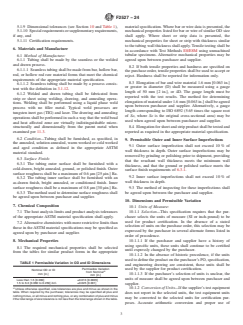
TABLE 1 Permissible Variation in OD and ID Dimensions
Permissible Variation
Nominal OD or ID
A
from Nominal
mm [in.]
mm [in.]
Less than 1.5 [0.060] ±0.013 [0.0005]
1.5 to 6.3 [0.060 to 0.250] incl. ±0.025 [0.001]
A
Unless otherwise specified, size tolerances are plus and minus as shown in the
table. When required by the purchaser, tolerances may be specified all plus and
nothing minus, or all minus and nothing plus, or any combination of plus and minus
if the total range of size tolerance is not less than the total range shown in the table.
5.1.10 Special requirements or supplementary requirements, if any, and
5.1.11 Certification requirements.
6. Materials and Manufacture
6.1 Method of Manufacture:
6.1.1 Tubing shall be made by the seamless or the welded and drawn process.
6.1.1.1 Seamless tubing shall be made from bar, hollow bar, rod, or hollow rod raw material forms that meet the chemical
requirements of the appropriate material specification.
6.1.1.2 Seamless tubing shall be made by a process consistent with the definition in 3.1.12.
6.1.2 Welded and drawn tubing shall be fabricated from strip or sheet using welding, drawing, and annealing operations. Welding
shall be performed using a liquid phase weld process with no filler metal. Typical weld processes are tungsten inert gas (TIG) and
laser. The drawing and annealing operations shall be performed in such a way that the weld bead and heat affected zone are
virtually indistinguishable microstructurally and dimensionally from the parent metal when examined per 11.3.
6.2 Condition—Tubing shall be furnished, as specified, in the annealed, solution annealed, warm worked or cold worked and aged
condition as defined in the appropriate ASTM material standard.
6.3 Surface Finish:
6.3.1 The tubing outer surface shall be furnished with a cold-drawn, bright annealed, ground, or polished finish. Outer surface
roughness shall be a maximum of 0.6 μm [25 μin.] Ra.
6.3.2 The tubing inner surface shall be furnished with an as-drawn finish, bright annealed, or conditioned finish. Inner surface
roughness shall be a maximum of 0.8 μm [30 μin.] Ra.
6.3.3 The method used to determine surface roughness shall be agreed upon between purchaser and supplier.
7. Chemical Composition
7.1 The heat analysis limits and product analysis tolerances of the appropriate ASTM material specification shall apply.
7.2 Alternative chemistries with more restrictive limits than those in the ASTM material specifications may be specified as agreed
upon by purchaser and supplier.
8. Mechanical Properties
8.1 The required mechanical properties shall be selected from the tables for similar product forms in the appropriate material
specification. Where bar or wire data is presented, the mechanical properties listed for bar or wire of similar OD size shall apply.
Where sheet or strip data is presented, the mechanical properties for sheet or strip with thickness similar to the tubing wall
F2527 − 24
thickness shall apply. Tensile testing shall be in accordance with Test Methods E8E8/E8M using unmachined tubular specimens.
Alternative mechanical properties may be agreed upon between purchaser and supplier.
8.2 If both tensile properties and hardness are specified on the purchase order, tensile properties shall be used to accept or reject.
Hardness shall be reported for information only.
8.3 Elongation of bar and wire material 1.6 mm [0.063 in.] or greater in diameter (D) shall be measured using a gauge length of
50 mm [2 in.], or 4D. The gauge length must be reported with the test results. The method for determining elongation of material
under 1.6 mm [0.063 in.] shall be agreed upon between purchaser and supplier. Alternatively, a gauge length corresponding to ISO
6892 (5.65 times the square root of So, where So is the original cross sectional cross-sectional area) may be used when agreed upon
between purchaser and supplier.
8.4 Elongation for sheet and strip product shall be tested and reported as required in the appropriate material specification.
9. Permissible Outer and Inner Surface Imperfections
9.1 Outer surface imperfection shall not exceed 10 % of wall thickness in depth. Outer surface imperfections may be removed by
grinding or polishing prior to shipment, providing that the resultant wall thickness meets the minimum wall thickness, and that the
ground or polished surface meets the surface finish requirements of 6.3.1.
9.2 Inner surface imperfections shall not exceed 10 % of wall thickness in depth.
9.3 The method of inspecting for these imperfections shall be agreed upon between the purchaser and supplier.
10. Dimensions and Permissible Variation
10.1 Units of Measure:
10.1.1 Selection—This specification requires that the purchaser selects the units of measure (SI or inch-pound) to be used for
product certification. In the absence of a stated selection of units on the purc
...