


ASTM D5265-09(2016)
(Test Method)Standard Test Method for Bridge Impact Testing
Standard Test Method for Bridge Impact Testing
SIGNIFICANCE AND USE
4.1 Materials shipped in elongated packages are liable to damage as a result of impact near their midpoint when only the ends are supported. This type of damage can occur during the shipment of packaging of mixed dimensions. It is particularly prevalent during conveyer line transport and sortation. This test method provides a means of determining resistance to such damage.
SCOPE
1.1 This test method is intended to determine the capability of a long package with a narrow cross-section to resist impact near its center when the package is supported only at its ends. This test method allows the user to select from two test options: Option A employs the use of a free-fall drop tester (see Exhibit B), and Option B employs the use of simulated mechanical impact testing equipment (S.M.I.T.E.; see Exhibit A). The two optional procedures are designed to impart the same amount of kinetic energy at impact; therefore, each procedure yields equal damage-producing potential.
1.2 The values stated in inch-pound units are to be regarded as standard. The values given in parentheses are mathematical conversions to SI units that are provided for information only and are not considered standard.
1.3 This standard does not purport to address all of the safety problems, if any, associated with its use. It is the responsibility of the user of this standard to establish appropriate safety and health practices and determine the applicability of regulatory limitations prior to use.
General Information
Buy Standard
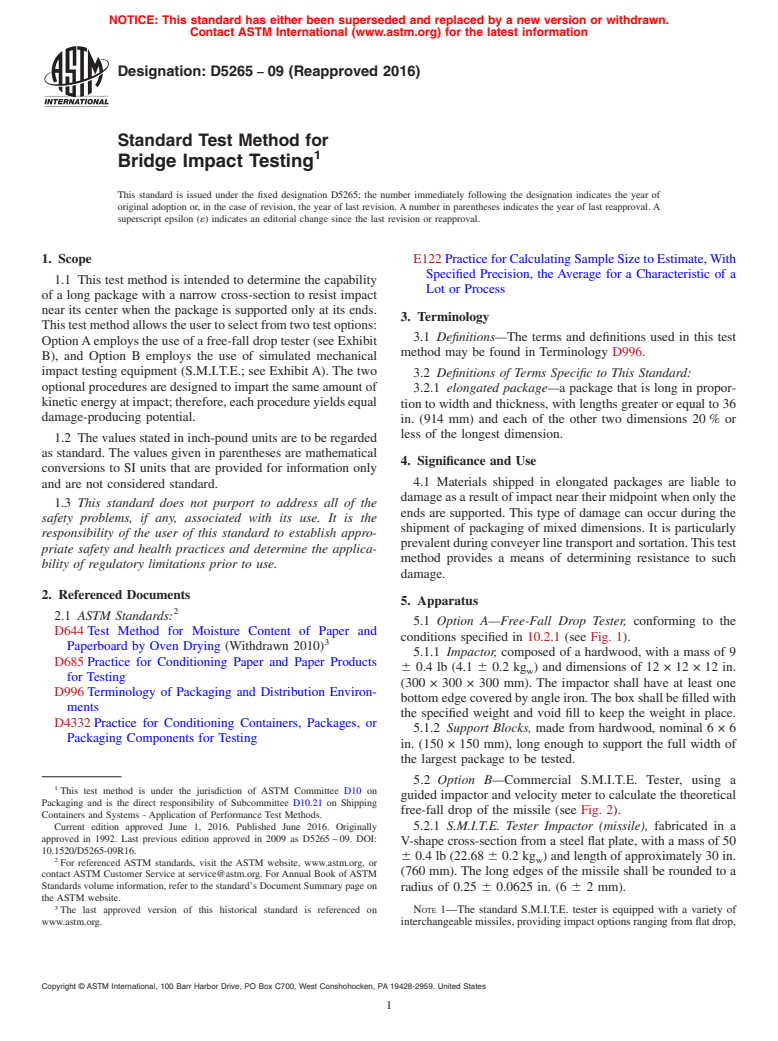
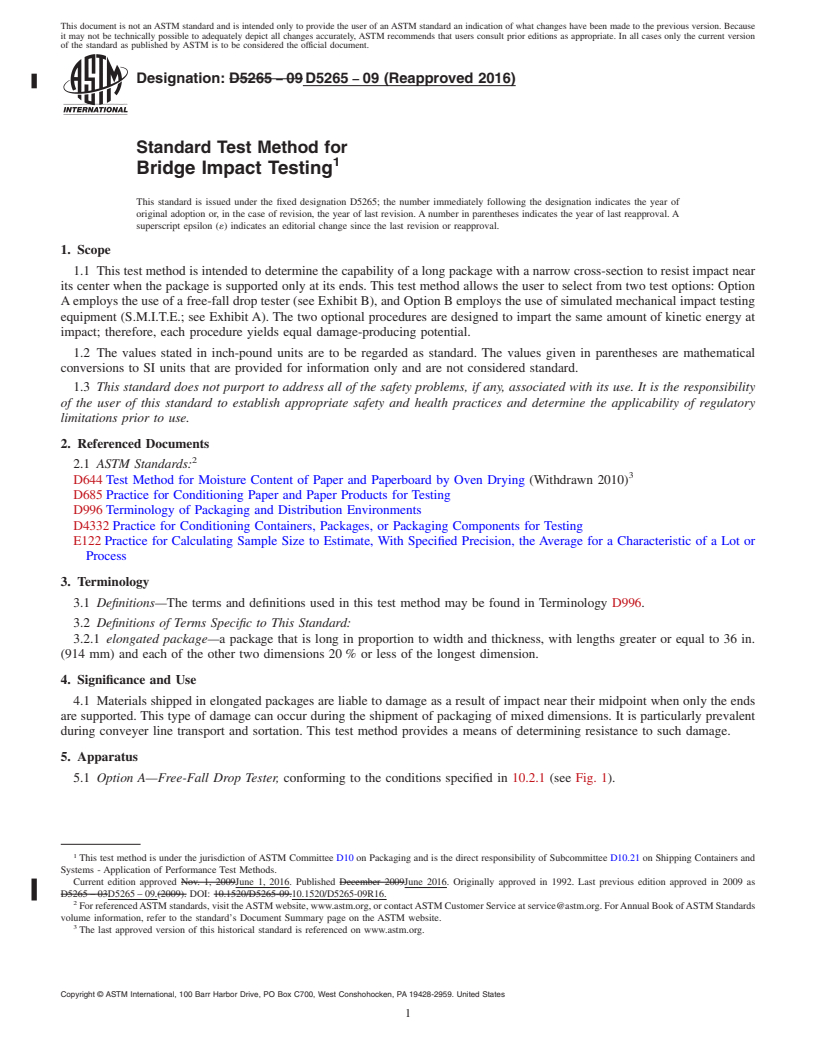
Standards Content (Sample)
NOTICE: This standard has either been superseded and replaced by a new version or withdrawn.
Contact ASTM International (www.astm.org) for the latest information
Designation: D5265 − 09 (Reapproved 2016)
Standard Test Method for
Bridge Impact Testing
This standard is issued under the fixed designation D5265; the number immediately following the designation indicates the year of
original adoption or, in the case of revision, the year of last revision. A number in parentheses indicates the year of last reapproval. A
superscript epsilon (´) indicates an editorial change since the last revision or reapproval.
1. Scope E122 Practice for Calculating Sample Size to Estimate, With
Specified Precision, the Average for a Characteristic of a
1.1 This test method is intended to determine the capability
Lot or Process
of a long package with a narrow cross-section to resist impact
near its center when the package is supported only at its ends.
3. Terminology
This test method allows the user to select from two test options:
3.1 Definitions—The terms and definitions used in this test
Option A employs the use of a free-fall drop tester (see Exhibit
method may be found in Terminology D996.
B), and Option B employs the use of simulated mechanical
impact testing equipment (S.M.I.T.E.; see Exhibit A). The two
3.2 Definitions of Terms Specific to This Standard:
optional procedures are designed to impart the same amount of
3.2.1 elongated package—a package that is long in propor-
kinetic energy at impact; therefore, each procedure yields equal
tion to width and thickness, with lengths greater or equal to 36
damage-producing potential.
in. (914 mm) and each of the other two dimensions 20 % or
less of the longest dimension.
1.2 The values stated in inch-pound units are to be regarded
as standard. The values given in parentheses are mathematical
4. Significance and Use
conversions to SI units that are provided for information only
4.1 Materials shipped in elongated packages are liable to
and are not considered standard.
damage as a result of impact near their midpoint when only the
1.3 This standard does not purport to address all of the
ends are supported. This type of damage can occur during the
safety problems, if any, associated with its use. It is the
shipment of packaging of mixed dimensions. It is particularly
responsibility of the user of this standard to establish appro-
prevalent during conveyer line transport and sortation. This test
priate safety and health practices and determine the applica-
method provides a means of determining resistance to such
bility of regulatory limitations prior to use.
damage.
2. Referenced Documents
5. Apparatus
2.1 ASTM Standards:
5.1 Option A—Free-Fall Drop Tester, conforming to the
D644 Test Method for Moisture Content of Paper and
conditions specified in 10.2.1 (see Fig. 1).
Paperboard by Oven Drying (Withdrawn 2010)
5.1.1 Impactor, composed of a hardwood, with a mass of 9
D685 Practice for Conditioning Paper and Paper Products
6 0.4 lb (4.1 6 0.2 kg ) and dimensions of 12 × 12 × 12 in.
w
for Testing
(300 × 300 × 300 mm). The impactor shall have at least one
D996 Terminology of Packaging and Distribution Environ-
bottom edge covered by angle iron. The box shall be filled with
ments
the specified weight and void fill to keep the weight in place.
D4332 Practice for Conditioning Containers, Packages, or
5.1.2 Support Blocks, made from hardwood, nominal 6 × 6
Packaging Components for Testing
in. (150 × 150 mm), long enough to support the full width of
the largest package to be tested.
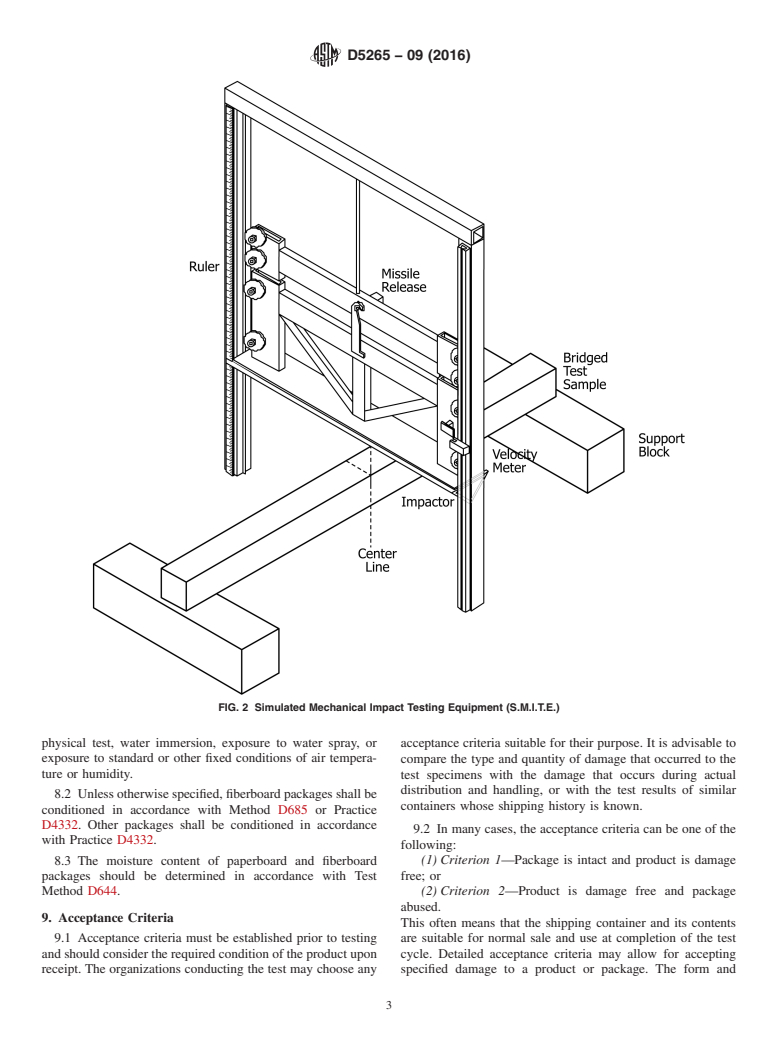
5.2 Option B—Commercial S.M.I.T.E. Tester, using a
This test method is under the jurisdiction of ASTM Committee D10 on
guided impactor and velocity meter to calculate the theoretical
Packaging and is the direct responsibility of Subcommittee D10.21 on Shipping
free-fall drop of the missile (see Fig. 2).
Containers and Systems - Application of Performance Test Methods.
Current edition approved June 1, 2016. Published June 2016. Originally 5.2.1 S.M.I.T.E. Tester Impactor (missile), fabricated in a
approved in 1992. Last previous edition approved in 2009 as D5265 – 09. DOI:
V-shape cross-section from a steel flat plate, with a mass of 50
10.1520/D5265-09R16.
6 0.4 lb (22.68 6 0.2 kg ) and length of approximately 30 in.
w
For referenced ASTM standards, visit the ASTM website, www.astm.org, or
(760 mm). The long edges of the missile shall be rounded to a
contact ASTM Customer Service at service@astm.org. For Annual Book of ASTM
Standards volume information, refer to the standard’s Document Summary page on
radius of 0.25 6 0.0625 in. (6 6 2 mm).
the ASTM website.
NOTE 1—The standard S.M.I.T.E. tester is equipped with a variety of
The last approved version of this historical standard is referenced on
www.astm.org. interchangeable missiles, providing impact options ranging from flat drop,
Copyright © ASTM International, 100 Barr Harbor Drive, PO Box C700, West Conshohocken, PA 19428-2959. United States
D5265 − 09 (2016)
FIG. 1 Vertical Drop Tester
angle edge drop, half round, half ball, and corner. The total missile
capability of a box to withstand rough handling is to be
assembly, regardless of which face is used, will weigh 50 lb (22.68 kg).
evaluated, pack the container with either the actual contents or
Knowing this, the mass of a S.M.I.T.E. tester is always 50 lb (22.68 kg).
a load simulating the contents. Regardless of which procedure
5.2.2 Support Blocks, made from hardwood, nominal 6 × 6
is used, close the container in the same manner that will be
in. (150 × 150 mm), long enough to support the full width of
used in preparing it for shipment.
the largest package to be tested.
NOTE 2—Where the use of actual contents is not feasible because of
excessive cost or danger, a dummy load simulating the contents with
6. Sampling
respect to dimensions, center of gravity, moment of inertia, density, flow
6.1 The test specimens and number of samples shall be characteristics, etc. shall be used.
chosen to permit an adequate determination of representative
7.2 When comparing the performance of various elongated
performance. For large production runs, lot sampling for
package designs, it is preferable to test empty erected cartons,
quality control in accordance with Practice E122 is advised.
which are closed and sealed in the same manner that will be
used in preparing it for shipment.
6.2 In the absence of any sampling plan, at least three
representative specimens should be selected for performance
7.3 Close and seal the container in the normal manner. Dry
evaluation.
and age sufficiently so that any adhesive, protective coatings,
sealing tape, etc. will have reached their final normal condition.
7. Test Specimens
8. Conditioning
7.1 When the protective capability of a package is to be
evaluated, it is preferable to pack the package with the actual 8.1 Depending on the purpose of the tests, packages may be
contents for which it was designed (Note 2). When the conditioned prior to the bridge impact test by either a different
D5265 − 09 (2016)
FIG. 2 Simulated Mechanical Impact Testing Equipment (S.M.I.T.E.)
physical test, water immersion, exposure to water spray, or acceptance criteria suitable for their purpose. It is advisable to
exposure to standard or other fixed conditions of air tempera-
compare the type and quantity of damage that occurred to the
ture or humidity.
test specimens with the damage that occurs during actual
distribution and handling, or with the test results of similar
8.2 Unless otherwise specified, fiberboard packages shall be
containers whose shipping history is known.
conditioned in accordance with Method D685 or Practice
D4332. Other packages shall be conditioned in accordance
9.2 In many cases, the acceptance criteria can be one of the
with Practice D4332.
following:
8.3 The moisture content of paperboard and fiberboard (1) Criterion 1—Package is intact and product is damage
packages should be determined in accordance with Test free; or
Method D644. (2) Criterion 2—Product is damage free and
...
This document is not an ASTM standard and is intended only to provide the user of an ASTM standard an indication of what changes have been made to the previous version. Because
it may not be technically possible to adequately depict all changes accurately, ASTM recommends that users consult prior editions as appropriate. In all cases only the current version
of the standard as published by ASTM is to be considered the official document.
Designation: D5265 − 09 D5265 − 09 (Reapproved 2016)
Standard Test Method for
Bridge Impact Testing
This standard is issued under the fixed designation D5265; the number immediately following the designation indicates the year of
original adoption or, in the case of revision, the year of last revision. A number in parentheses indicates the year of last reapproval. A
superscript epsilon (´) indicates an editorial change since the last revision or reapproval.
1. Scope
1.1 This test method is intended to determine the capability of a long package with a narrow cross-section to resist impact near
its center when the package is supported only at its ends. This test method allows the user to select from two test options: Option
A employs the use of a free-fall drop tester (see Exhibit B), and Option B employs the use of simulated mechanical impact testing
equipment (S.M.I.T.E.; see Exhibit A). The two optional procedures are designed to impart the same amount of kinetic energy at
impact; therefore, each procedure yields equal damage-producing potential.
1.2 The values stated in inch-pound units are to be regarded as standard. The values given in parentheses are mathematical
conversions to SI units that are provided for information only and are not considered standard.
1.3 This standard does not purport to address all of the safety problems, if any, associated with its use. It is the responsibility
of the user of this standard to establish appropriate safety and health practices and determine the applicability of regulatory
limitations prior to use.
2. Referenced Documents
2.1 ASTM Standards:
D644 Test Method for Moisture Content of Paper and Paperboard by Oven Drying (Withdrawn 2010)
D685 Practice for Conditioning Paper and Paper Products for Testing
D996 Terminology of Packaging and Distribution Environments
D4332 Practice for Conditioning Containers, Packages, or Packaging Components for Testing
E122 Practice for Calculating Sample Size to Estimate, With Specified Precision, the Average for a Characteristic of a Lot or
Process
3. Terminology
3.1 Definitions—The terms and definitions used in this test method may be found in Terminology D996.
3.2 Definitions of Terms Specific to This Standard:
3.2.1 elongated package—a package that is long in proportion to width and thickness, with lengths greater or equal to 36 in.
(914 mm) and each of the other two dimensions 20 % or less of the longest dimension.
4. Significance and Use
4.1 Materials shipped in elongated packages are liable to damage as a result of impact near their midpoint when only the ends
are supported. This type of damage can occur during the shipment of packaging of mixed dimensions. It is particularly prevalent
during conveyer line transport and sortation. This test method provides a means of determining resistance to such damage.
5. Apparatus
5.1 Option A—Free-Fall Drop Tester, conforming to the conditions specified in 10.2.1 (see Fig. 1).
This test method is under the jurisdiction of ASTM Committee D10 on Packaging and is the direct responsibility of Subcommittee D10.21 on Shipping Containers and
Systems - Application of Performance Test Methods.
Current edition approved Nov. 1, 2009June 1, 2016. Published December 2009June 2016. Originally approved in 1992. Last previous edition approved in 2009 as
D5265 – 03D5265 – 09.(2009). DOI: 10.1520/D5265-09.10.1520/D5265-09R16.
For referenced ASTM standards, visit the ASTM website, www.astm.org, or contact ASTM Customer Service at service@astm.org. For Annual Book of ASTM Standards
volume information, refer to the standard’s Document Summary page on the ASTM website.
The last approved version of this historical standard is referenced on www.astm.org.
Copyright © ASTM International, 100 Barr Harbor Drive, PO Box C700, West Conshohocken, PA 19428-2959. United States
D5265 − 09 (2016)
FIG. 1 Vertical Drop Tester
5.1.1 Impactor, composed of a hardwood, with a mass of 9 6 0.4 lb (4.1 6 0.2 kg ) and dimensions of 12 × 12 × 12 in. (300
w
× 300 × 300 mm). The impactor shall have at least one bottom edge covered by angle iron. The box shall be filled with the specified
weight and void fill to keep the weight in place.
5.1.2 Support Blocks, made from hardwood, nominal 6 × 6 in. (150 × 150 mm), long enough to support the full width of the
largest package to be tested.
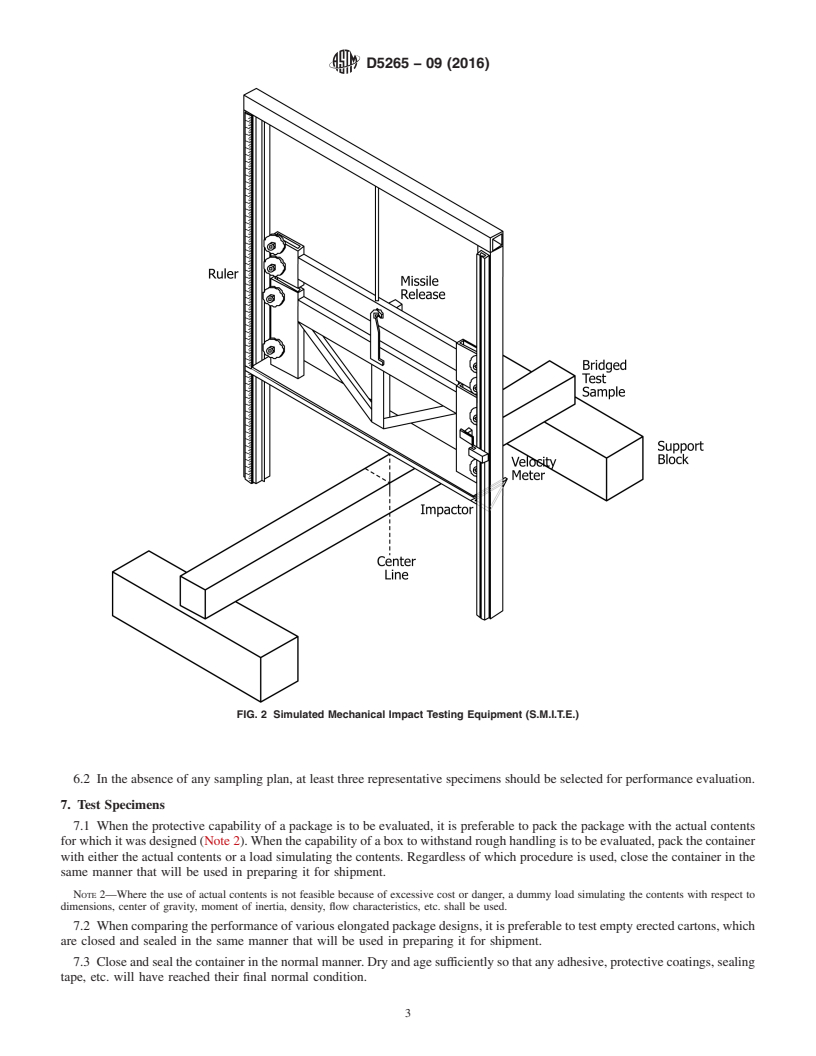
5.2 Option B—Commercial S.M.I.T.E. Tester, using a guided impactor and velocity meter to calculate the theoretical free-fall
drop of the missile (see Fig. 2).
5.2.1 S.M.I.T.E. Tester Impactor (missile), fabricated in a V-shape cross-section from a steel flat plate, with a mass of 50 6 0.4
lb (22.68 6 0.2 kg ) and length of approximately 30 in. (760 mm). The long edges of the missile shall be rounded to a radius of
w
0.25 6 0.0625 in. (6 6 2 mm).
NOTE 1—The standard S.M.I.T.E. tester is equipped with a variety of interchangeable missiles, providing impact options ranging from flat drop, angle
edge drop, half round, half ball, and corner. The total missile assembly, regardless of which face is used, will weigh 50 lb (22.68 kg). Knowing this, the
mass of a S.M.I.T.E. tester is always 50 lb (22.68 kg).
5.2.2 Support Blocks, made from hardwood, nominal 6 × 6 in. (150 × 150 mm), long enough to support the full width of the
largest package to be tested.
6. Sampling
6.1 The test specimens and number of samples shall be chosen to permit an adequate determination of representative
performance. For large production runs, lot sampling for quality control in accordance with Practice E122 is advised.
D5265 − 09 (2016)
FIG. 2 Simulated Mechanical Impact Testing Equipment (S.M.I.T.E.)
6.2 In the absence of any sampling plan, at least three representative specimens should be selected for performance evaluation.
7. Test Specimens
7.1 When the protective capability of a package is to be evaluated, it is preferable to pack the package with the actual contents
for which it was designed (Note 2). When the capability of a box to withstand rough handling is to be evaluated, pack the container
with either the actual contents or a load simulating the contents. Regardless of which procedure is used, close the container in the
same manner that will be used in preparing it for shipment.
NOTE 2—Where the use of actual contents is not feasible because of excessive cost or danger, a dummy load simulating the contents with respect to
dimensions, center of gravity, moment of inertia, density, flow characteristics, etc. shall be used.
7.2 When comparing the performance of various elongated package designs, it is preferable to test empty erected cartons, which
are closed and sealed in the same manner that will be used in preparing it for shipment.
7.3 Close and seal the container in the normal manner. Dry and age sufficiently so that any adhesive, protective coatings, sealing
tape, etc. will have reached their final normal condition.
D5265 − 09 (2016)
8. Conditioning
8.1 Depending on the purpose of the tests, packages may be conditioned prior to the bridge impact test by either a different
physical test, water immersion, exposure to water spray, or exposure to standard or other fixed conditions of air temperature or
humidity.
8.2 Unless otherwise specified, fiberboard packages shall be conditioned in accordance with Method D685 or Practice D4332.
Other packages shall be conditioned in accordance with Practice D4332.
8.3 The moisture content of paperboard and fiberboard packages should be determined in accordance with Test Method D644.
9. Acceptance Criteria
9.1 Acceptance criteria must be established prior to testing and should consider the required condition of the product upon
receipt. The organizations conducting the test may choose any acceptance criteria suitable for their purpose. It is advisable to
compare the type and quantity of damage that occurred to the test specimens with the damage that occurs during actual distribution
and handling, or with the test results of similar containers whose shipping history is known.
9.2 In many cases, the acceptance criteria can be one of the following:
(1) Criterion 1—Package is intact and product is damage free; or
(1) Criterion 1—Package is intact and product is damage free; or
(2) Criterion 2—Product is damage free and package abused.
This often means that the shipping container and its contents are suitable for normal sale and use at completion of the test cycle.
Detailed acceptance criteria may allow for accepting specified damage to a product or package. The form and content of acceptance
criteria may vary widely, according to the particular situat
...
Questions, Comments and Discussion
Ask us and Technical Secretary will try to provide an answer. You can facilitate discussion about the standard in here.