

ASTM F409-22
(Specification)Standard Specification for Thermoplastic Accessible and Replaceable Plastic Tube and Tubular Fittings
General Information
- Abstract
ABSTRACT
This specification covers the material, dimensional ,and performance requirements and associated test methods for thermoplastic tubes and fittings for accessible and replaceable domestic waste connections. The tubes, fittings and mechanical joint components shall be made of either virgin acrylonitrile-butadiene-styrene (ABS) plastic, virgin poly(vinyl chloride) (PVC) plastic, or virgin polypropylene plastic. When evaluated by the test procedures provided herein, the products shall adhere to requirements stipulated for hydrostatic pressure, axial stress, joint integrity, and solvent cement.
SCOPE
1.1 This specification covers requirements and test methods for materials, dimensions and tolerances, hydrostatic pressure, joint integrity, and solvent cement for thermoplastic tube and fittings for accessible and replaceable domestic waste connections. Marking requirements are also included. Thermoplastic that does not meet the material requirements specified in Section 5 is excluded.
1.2 The text of this specification references notes, footnotes, and appendixes which provide explanatory material. These notes and footnotes (excluding those in tables and figures) shall not be considered as requirements of the specification.
1.3 Units—The values stated in inch-pound units are to be regarded as standard. The values given in parentheses are mathematical conversions to SI units that are provided for information only and are not considered standard.
1.4 The following safety hazards caveat pertains only to the test methods portion, Section 8, of this specification: This standard does not purport to address all of the safety concerns, if any, associated with its use. It is the responsibility of the user of this standard to establish appropriate safety, health, and environmental practices and determine the applicability of regulatory limitations prior to use.
1.5 This international standard was developed in accordance with internationally recognized principles on standardization established in the Decision on Principles for the Development of International Standards, Guides and Recommendations issued by the World Trade Organization Technical Barriers to Trade (TBT) Committee.
- Status
- Published
- Publication Date
- 30-Jun-2022
- Technical Committee
- F17 - Plastic Piping Systems
- Drafting Committee
- F17.63 - DWV
Buy Documents
ASTM F409-22 - Standard Specification for Thermoplastic Accessible and Replaceable Plastic Tube and Tubular Fittings
REDLINE ASTM F409-22 - Standard Specification for Thermoplastic Accessible and Replaceable Plastic Tube and Tubular Fittings
Overview
ASTM F409-22 is the standard specification established by ASTM International for thermoplastic accessible and replaceable plastic tube and tubular fittings. This specification outlines the material, dimensional, and performance criteria, as well as test methods, for tubes and fittings used in accessible and replaceable domestic waste connections. The standard applies to products made from virgin acrylonitrile-butadiene-styrene (ABS), poly(vinyl chloride) (PVC), or polypropylene (PP), ensuring consistency and quality in plumbing applications.
The purpose of ASTM F409-22 is to provide reliable requirements for the manufacture and testing of these thermoplastic components, guaranteeing their performance for domestic waste systems, including requirements for hydrostatic pressure, joint integrity, and solvent cement. This standard helps manufacturers, installers, and inspectors ensure that thermoplastic tubes and fittings meet the necessary safety, health, and environmental criteria.
Key Topics
Material Requirements:
- Specifies use of virgin ABS, PVC, or polypropylene for tubes and fittings.
- Only manufacturer’s own clean rework material is allowed; mixing material types is prohibited.
Dimensional Standards:
- Defines tube and fitting dimensions, tolerances, and out-of-roundness, referenced to inch-pound units.
- Sets minimum wall thickness and length tolerances for various components.
Performance Testing:
- Specifies hydrostatic pressure test at 25 psi for tube and fitting assemblies.
- Requires threaded connections to sustain minimum axial load.
- Includes conditioning prior to testing for consistency.
Joint Integrity:
- Mechanical joints incorporate American National Straight Pipe Thread standards.
- Solvent cement is permitted for ABS and PVC only and must meet specific ASTM requirements.
- Polypropylene joints require mechanical connections or heat fusion-no solvent cement permitted.
Marking and Identification:
- Tubes and fittings must be clearly marked with size, manufacturer identification, and material type.
- Direction of flow must be indicated on relevant fittings where installation orientation is critical.
Applications
ASTM F409-22 is vital for ensuring the safety and performance of domestic waste connections in residential and commercial plumbing systems. Its scope includes:
Domestic Waste Systems:
- The standard applies to accessible and replaceable tubes and fittings typically found under sinks, lavatories, and similar fixtures.
- Common applications include waste lines, P traps, extensions, dishwasher branch tailpieces, and transition adapters.
Installation and Inspection:
- Installers rely on this specification to select compatible components and ensure proper joining and assembly.
- Building inspectors use the standard for compliance checks in accordance with plumbing codes and regulations.
Manufacturing and Quality Control:
- Manufacturers use ASTM F409-22 to certify material selection, production methods, and product testing processes.
- Marking and quality assurance requirements help ensure that products in the supply chain meet established criteria.
Related Standards
Several other standards and references support and align with ASTM F409-22:
- ASTM D1784: Classification for rigid PVC compounds
- ASTM D3965: Requirements for rigid ABS materials for pipe and fittings
- ASTM D4101: Specification for polypropylene injection and extrusion materials
- ASTM D2235 / D2564: Requirements for solvent cement for ABS and PVC plastic pipe and fittings
- ASTM D2122: Test method for determining dimensions of thermoplastic pipe and fittings
- ASME B1.20.1: Pipe threads, general purpose (inch)
These standards provide detailed guidance for specific materials, practices, and test methods and are referenced within ASTM F409-22 to ensure thorough and consistent application across the plastic piping industry.
Keywords: ASTM F409-22, thermoplastic tube, tubular fittings, ABS, PVC, polypropylene, domestic waste, plumbing standards, mechanical joints, solvent cement, hydrostatic pressure testing, pipe fitting specification
Relations
- Effective Date
- 01-Apr-2024
- Effective Date
- 01-Feb-2024
- Effective Date
- 01-Feb-2024
- Effective Date
- 01-Nov-2023
- Effective Date
- 01-Aug-2020
- Effective Date
- 01-Aug-2020
- Effective Date
- 01-Apr-2020
- Effective Date
- 15-Jan-2020
- Effective Date
- 01-Jan-2020
- Effective Date
- 01-Aug-2019
- Effective Date
- 15-Apr-2019
- Effective Date
- 01-Feb-2019
- Effective Date
- 01-Jan-2019
- Effective Date
- 01-Dec-2018
- Effective Date
- 01-Nov-2018
Buy Documents
ASTM F409-22 - Standard Specification for Thermoplastic Accessible and Replaceable Plastic Tube and Tubular Fittings
REDLINE ASTM F409-22 - Standard Specification for Thermoplastic Accessible and Replaceable Plastic Tube and Tubular Fittings
Get Certified
Connect with accredited certification bodies for this standard

Institut za varilstvo d.o.o. (Welding Institute)
Slovenia's leading welding institute since 1952. ISO 3834, EN 1090, pressure equipment certification, NDT personnel, welder qualification. Only IIW Au
Sponsored listings
Frequently Asked Questions
ASTM F409-22 is a technical specification published by ASTM International. Its full title is "Standard Specification for Thermoplastic Accessible and Replaceable Plastic Tube and Tubular Fittings". This standard covers: ABSTRACT This specification covers the material, dimensional ,and performance requirements and associated test methods for thermoplastic tubes and fittings for accessible and replaceable domestic waste connections. The tubes, fittings and mechanical joint components shall be made of either virgin acrylonitrile-butadiene-styrene (ABS) plastic, virgin poly(vinyl chloride) (PVC) plastic, or virgin polypropylene plastic. When evaluated by the test procedures provided herein, the products shall adhere to requirements stipulated for hydrostatic pressure, axial stress, joint integrity, and solvent cement. SCOPE 1.1 This specification covers requirements and test methods for materials, dimensions and tolerances, hydrostatic pressure, joint integrity, and solvent cement for thermoplastic tube and fittings for accessible and replaceable domestic waste connections. Marking requirements are also included. Thermoplastic that does not meet the material requirements specified in Section 5 is excluded. 1.2 The text of this specification references notes, footnotes, and appendixes which provide explanatory material. These notes and footnotes (excluding those in tables and figures) shall not be considered as requirements of the specification. 1.3 Units—The values stated in inch-pound units are to be regarded as standard. The values given in parentheses are mathematical conversions to SI units that are provided for information only and are not considered standard. 1.4 The following safety hazards caveat pertains only to the test methods portion, Section 8, of this specification: This standard does not purport to address all of the safety concerns, if any, associated with its use. It is the responsibility of the user of this standard to establish appropriate safety, health, and environmental practices and determine the applicability of regulatory limitations prior to use. 1.5 This international standard was developed in accordance with internationally recognized principles on standardization established in the Decision on Principles for the Development of International Standards, Guides and Recommendations issued by the World Trade Organization Technical Barriers to Trade (TBT) Committee.
ABSTRACT This specification covers the material, dimensional ,and performance requirements and associated test methods for thermoplastic tubes and fittings for accessible and replaceable domestic waste connections. The tubes, fittings and mechanical joint components shall be made of either virgin acrylonitrile-butadiene-styrene (ABS) plastic, virgin poly(vinyl chloride) (PVC) plastic, or virgin polypropylene plastic. When evaluated by the test procedures provided herein, the products shall adhere to requirements stipulated for hydrostatic pressure, axial stress, joint integrity, and solvent cement. SCOPE 1.1 This specification covers requirements and test methods for materials, dimensions and tolerances, hydrostatic pressure, joint integrity, and solvent cement for thermoplastic tube and fittings for accessible and replaceable domestic waste connections. Marking requirements are also included. Thermoplastic that does not meet the material requirements specified in Section 5 is excluded. 1.2 The text of this specification references notes, footnotes, and appendixes which provide explanatory material. These notes and footnotes (excluding those in tables and figures) shall not be considered as requirements of the specification. 1.3 Units—The values stated in inch-pound units are to be regarded as standard. The values given in parentheses are mathematical conversions to SI units that are provided for information only and are not considered standard. 1.4 The following safety hazards caveat pertains only to the test methods portion, Section 8, of this specification: This standard does not purport to address all of the safety concerns, if any, associated with its use. It is the responsibility of the user of this standard to establish appropriate safety, health, and environmental practices and determine the applicability of regulatory limitations prior to use. 1.5 This international standard was developed in accordance with internationally recognized principles on standardization established in the Decision on Principles for the Development of International Standards, Guides and Recommendations issued by the World Trade Organization Technical Barriers to Trade (TBT) Committee.
ASTM F409-22 is classified under the following ICS (International Classification for Standards) categories: 23.040.20 - Plastics pipes; 23.040.45 - Plastics fittings. The ICS classification helps identify the subject area and facilitates finding related standards.
ASTM F409-22 has the following relationships with other standards: It is inter standard links to ASTM D2665-24, ASTM D883-24, ASTM D4101-24, ASTM D883-23, ASTM D2564-20, ASTM D2665-20, ASTM F412-20, ASTM D1784-20, ASTM D883-20, ASTM D883-19c, ASTM D883-19a, ASTM D883-19, ASTM F412-19, ASTM D883-18a, ASTM D883-18. Understanding these relationships helps ensure you are using the most current and applicable version of the standard.
ASTM F409-22 is available in PDF format for immediate download after purchase. The document can be added to your cart and obtained through the secure checkout process. Digital delivery ensures instant access to the complete standard document.
Standards Content (Sample)
This international standard was developed in accordance with internationally recognized principles on standardization established in the Decision on Principles for the
Development of International Standards, Guides and Recommendations issued by the World Trade Organization Technical Barriers to Trade (TBT) Committee.
Designation:F409 −22 An American National Standard
Standard Specification for
Thermoplastic Accessible and Replaceable Plastic Tube and
Tubular Fittings
ThisstandardisissuedunderthefixeddesignationF409;thenumberimmediatelyfollowingthedesignationindicatestheyearoforiginal
adoption or, in the case of revision, the year of last revision.Anumber in parentheses indicates the year of last reapproval.Asuperscript
epsilon (´) indicates an editorial change since the last revision or reapproval.
1. Scope* D883 Terminology Relating to Plastics
D1600 Terminology forAbbreviatedTerms Relating to Plas-
1.1 This specification covers requirements and test methods
tics
for materials, dimensions and tolerances, hydrostatic pressure,
D1784 Classification System and Basis for Specification for
joint integrity, and solvent cement for thermoplastic tube and
Rigid Poly(Vinyl Chloride) (PVC) Compounds and Chlo-
fittings for accessible and replaceable domestic waste connec-
rinated Poly(Vinyl Chloride) (CPVC) Compounds
tions. Marking requirements are also included. Thermoplastic
D2122 Test Method for Determining Dimensions of Ther-
that does not meet the material requirements specified in
Section 5 is excluded. moplastic Pipe and Fittings
D2235 Specification for Solvent Cement for Acrylonitrile-
1.2 Thetextofthisspecificationreferencesnotes,footnotes,
Butadiene-Styrene (ABS) Plastic Pipe and Fittings
and appendixes which provide explanatory material. These
D2564 Specification for Solvent Cements for Poly(Vinyl
notesandfootnotes(excludingthoseintablesandfigures)shall
Chloride) (PVC) Plastic Piping Systems
not be considered as requirements of the specification.
D2657 Practice for Heat Fusion Joining of Polyolefin Pipe
1.3 Units—The values stated in inch-pound units are to be
and Fittings
regarded as standard. The values given in parentheses are
D2661 Specification for Acrylonitrile-Butadiene-Styrene
mathematical conversions to SI units that are provided for
(ABS) Schedule 40 Plastic Drain, Waste, and Vent Pipe
information only and are not considered standard.
and Fittings
1.4 The following safety hazards caveat pertains only to the
D2665 Specification for Poly(Vinyl Chloride) (PVC) Plastic
test methods portion, Section 8, of this specification: This
Drain, Waste, and Vent Pipe and Fittings
standard does not purport to address all of the safety concerns,
D3965 ClassificationSystemandBasisforSpecificationsfor
if any, associated with its use. It is the responsibility of the user
Rigid Acrylonitrile-Butadiene-Styrene (ABS) Materials
of this standard to establish appropriate safety, health, and
for Pipe and Fittings
environmental practices and determine the applicability of
D4000 Classification System for Specifying Plastic Materi-
regulatory limitations prior to use.
als
1.5 This international standard was developed in accor-
D4101 Classification System and Basis for Specification for
dance with internationally recognized principles on standard-
Polypropylene Injection and Extrusion Materials
ization established in the Decision on Principles for the
F402 Practice for Safe Handling of Solvent Cements,
Development of International Standards, Guides and Recom-
Primers, and Cleaners Used for Joining Thermoplastic
mendations issued by the World Trade Organization Technical
Pipe and Fittings
Barriers to Trade (TBT) Committee.
F412 Terminology Relating to Plastic Piping Systems
2. Referenced Documents
F1498 Specification forTaper PipeThreads 60° forThermo-
2.1 ASTM Standards: plastic Pipe and Fittings
D618 Practice for Conditioning Plastics for Testing
2.2 Federal Standard:
Fed. Std. No. 123 Marking for Shipment (Civil Agencies)
This specification is under the jurisdiction ofASTM Committee F17 on Plastic
2.3 Military Standard:
Piping Systems and is the direct responsibility of Subcommittee F17.63 on DWV.
Current edition approved July 1, 2022. Published September 2022. Originally MIL-STD-129 Marking for Shipment and Storage
approved in 1975. Last previous edition approved in 2017 as F409 – 17. DOI:
10.1520/F0409-22.
For referenced ASTM standards, visit the ASTM website, www.astm.org, or
contact ASTM Customer Service at service@astm.org. For Annual Book of ASTM
Standards volume information, refer to the standard’s Document Summary page on Available from DLA Document Services, Building 4/D, 700 Robbins Ave.,
the ASTM website. Philadelphia, PA 19111-5094, http://quicksearch.dla.mil.
*A Summary of Changes section appears at the end of this standard
Copyright © ASTM International, 100 Barr Harbor Drive, PO Box C700, West Conshohocken, PA 19428-2959. United States
F409−22
TABLE 1 Dimensions and Tolerances for Outside Diameters and Thickness of Plastic Tube
Outside Diameter Wall Thickness
Nominal Tube Size Average Tolerance on Average Out-of-Roundness Minimum
(maximum minus minimum)
in. in. (mm) in. (mm) in. (mm) in. (mm)
1 ⁄4 1.250 (31.75) ±0.005 (±0.127) 0.020 (0.51) 0.062 (1.575)
1 ⁄2 1.500 (38.10) ±0.005 (±0.127) 0.020 (0.51) 0.062 (1.575)
2.4 ASME Standard: cementshallmeettherequirementsofSpecificationD2564.No
B1.20.1 Pipe Threads, General Purpose (Inch) solvent cement or adhesive joining of propylene plastic (PP) is
permissible.
3. Terminology
6. Mechanical Connections
3.1 Definitions—Definitions are in accordance with Termi-
nologies D883 and F412.Abbreviations are in accordance with
6.1 Compression or threaded connections shall incorporate
Terminology D1600, unless otherwise specified. Plastic mate-
AmericanNationalStraightPipeThread,MechanicalJointsfor
rials are classified in accordance with Classification D4000.
Fixtures (NPSM). The thread form shall be the form of
American National Straight Pipe Thread and the dimensions
4. Significance and Use
shall be in accordance with ASME B1.20.1 (NPSM). All
4.1 The requirements of this specification are intended to
threads shall have a minimum three-thread engagement for
provide accessible and replaceable tube and fittings to convey
fittings and plastic nuts.
domestic waste from fixtures to the drain, waste, and vent
6.2 Taper Pipe Threads—For all fittings having taper pipe
(DWV) system.
threads, threads shall conform to Specification F1498 and be
gaged in accordance with 8.5.
5. Materials and Manufacture
6.3 Straight Pipe Threads (NPSM)—For all fittings having
5.1 Tube—The tube shall be made of one of the following
straight pipe threads, threads shall conform to ASME B1.20.1
materials:
(NPSM) and be gaged in accordance with 8.6.
5.1.1 Virgin acrylonitrile-butadiene-styrene (ABS) plastic
whichshallmeettherequirementsofSpecificationD3965,Cell
6.4 All tube and fittings made from propylene plastic shall
Classification 4-2-2-2-2.
be assembled by either mechanical connections or by heat
5.1.2 Virgin poly(vinyl chloride) (PVC) plastic which shall
fusion, in accordance with Practice D2657.
meet the requirements for 12454 materials in accordance with
Specification D1784,or
7. Requirements
5.1.3 Virgin polypropylene plastic which shall meet the
7.1 General—The tube and fittings shall be homogeneous
requirements of Specification D4101, Cell Classification
throughout and free of visible cracks, holes, foreign inclusions,
PP0110B55140 and PP0105G20A33350.
or other injurious defects. They shall be as uniform as
5.2 Fittings and Mechanical Joint Components—The fit-
commercially practicable in color, opacity, density, and other
tings and components of mechanical joints shall be comprised
physical properties.
of one or more of the following materials:
5.2.1 VirginABS plastic which shall meet the requirements 7.2 Dimensions and Tolerances:
of Specification D3965, Cell Classification 2-0-2-1-1.
7.2.1 Tube:
5.2.2 VirginPVCplasticswhichshallmeettherequirements
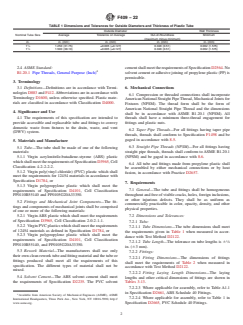
7.2.1.1 Tube Dimensions—The tube dimensions shall meet
of 12454 materials as defined in Specification D1784,or
the requirements given in Table 1 when measured in accor-
5.2.3 Virgin polypropylene plastic which shall meet the
dance with Test Method D2122.
requirements of Specification D4101, Cell Classification
7.2.1.2 Tube Length—The tolerance on tube lengths is 6 ⁄8
PP0110B55140, and PP0105G20A33350.
in. (63 mm).
5.3 Rework Material—The manufacturers shall use only
7.2.2 Fittings:
their own clean rework tube and fitting material and the tube or
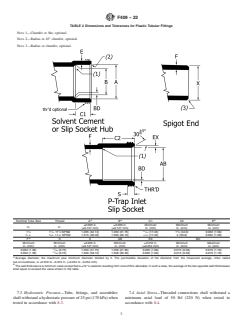
7.2.2.1 Fitting Dimensions—The dimensions of fittings
fittings produced shall meet all the requirements of this
shall meet the requirements of Table 2 when measured in
specification. The different types of material shall not be
accordance with Test Method D2122.
mixed.
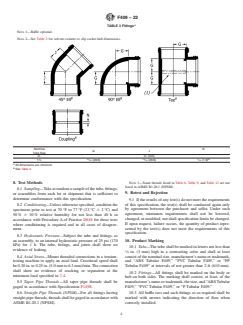
7.2.2.2 Fitting Laying Length Dimensions—The laying
5.4 Solvent Cement—The ABS solvent cement shall meet
lengths and other critical dimensions of fittings are shown in
the requirements of Specification D2235. The PVC solvent
Tables 3-13.
7.2.2.3 Where applicable for assembly, refer to Table A1.1
in Specification D2661, ABS Schedule 40 Fittings.
Available from American Society of Mechanical Engineers (ASME), ASME
7.2.2.4 Where applicable for assembly, refer to Table 1 in
International Headquarters, Three Park Ave., New York, NY 10016-5990, http://
www.asme.org. Specification D2665, PVC Schedule 40 Fittings.
F409−22
TABLE 2 Dimensions and Tolerances for Plastic Tubular Fittings
NOTE 1—Chamfer or flat, optional.
NOTE 2—Radius or 45° chamfer, optional.
NOTE 3—Radius or chamfer, optional.
A A B
Nominal Tube Size Thread A B C1 C2 E
±0.005 in. ±0.005 in. Minimum Minimum Minimum
in. in.
(±0.127 mm) (±0.127 mm) in. (mm) in. (mm) in. (mm)
1 1 1 11 3
1 ⁄4 1 ⁄4-11 ⁄2 NPSM 1.265 (32.13) 1.250 (31.75) ⁄16 (17.46) 1 ⁄8 (34.9) 0.062 (1.58)
1 1 1 11
1 ⁄2 1 ⁄2-11 ⁄2 NPSM 1.515 (38.48) 1.500 (38.10) ⁄16 (17.46) 2 (50.8) 0.062 (1.58)
B
F S X AB EX BD
Minimum Minimum ±0.005 in. Minimum ±0.010 in. Minimum Maximum
in. (mm) in. (mm) (±0.127 mm) in. (mm) (±0.254 mm) in. (mm) in. (mm)
0.062 (1.58) ⁄64 (6.75) 1.250 (31.75) 1.258 (31.95) 0.066 (1.68) 0.015 (0.38) 0.070 (1.78)
0.062 (1.58) ⁄64 (6.75) 1.500 (38.10) 1.508 (38.30) 0.066 (1.68) 0.015 (0.38) 0.070 (1.78)
A
Average diameter, the maximum plus minimum diameter divided by 2. The permissible deviation of the diameter from the measured average, often called
out-of-roundness, is +0.010 to −0.010 in. (+0.254 to −0.254 mm).
B
Thewallthicknessisaminimumvalueexceptthata±10 %variationresultingfromcoreshiftisallowable.Insuchacase,theaverageofthetwooppositewallthicknesses
shall equal or exceed the value shown in the table.
7.3 Hydrostatic Pressure—Tube, fittings, and assemblies 7.4 Axial Stress—Threaded connections shall withstand a
shallwithstandahydrostaticpressureof25psi(170kPa)when minimum axial load of 50 lbf (220 N) when tested in
tested in accordance with 8.3. accordance with 8.4.
F409−22
A
TABLE 3 Fittings
NOTE 1—Baffle optional.
NOTE 2—See Table 2 for solvent cement or slip socket hub dimensions.
Nominal N
GJ
Tube Size
in. in. (mm)
B
1 13 13 1
1 ⁄2 ⁄16 (20.6) ⁄16 (20.6) ⁄16 (1.6)
A
All dimensions are minimum.
B
See Table 2.
NOTE 1—Some threads listed in Table 6, Table 9, and Table 12 are not
8. Test Methods
listed in ASME B1.20.1 (NPSM).
8.1 Sampling—Takeatrandomasampleofthetube,fittings,
9. Retest and Rejection
or assemblies from each lot or shipment that is sufficient to
determine conformance with this specification.
9.1 If the results of any test(s) do not meet the requirements
of this specification, the test(s) shall be conducted again only
8.2 Conditioning—Unlessotherwisespecified,conditionthe
by agreement between the purchaser and seller. Under such
specimens prior to test at 70 °F to 77 °F (23 °C 6 2 °C) and
agreement, minimum requirements shall not be lowered,
50 % 6 10 % relative humidity for not less than 40 h in
changed,ormodified,norshallspecificationlimitsbechanged.
accordance with Procedure A of Practice D618 for those tests
If upon request, failure occurs, the quantity of product repre-
where conditioning is required and in all cases of disagree-
sented by the test(s) does not meet the requirements of this
ment.
specification.
8.3 Hydrostatic Pressure—Subject the tube and fittings, as
an assembly, to an internal hydrostatic pressure of 25 psi (170
10. Product Marking
kPa) for 1 h. The tube, fittings, and joints shall show no
10.1 Tube—The tube shall be marked in letters not less than
evidence of leaking.
⁄8 in. (3 mm) high in a contrasting color and shall at least
8.4 Axial Stress—Mount threaded connections in a tension- consist of the nominal size, manufacturer’s name or trademark,
testing machine to apply an axial load. Crosshead speed shall and “ABS Tubular F409,” “PVC Tubular F409,” or “PP
be0.20in.to0.25in.(5.0mmto6.3mm)/min.Theconnection Tubular F409” at intervals of not greater than 2 ft (610 mm).
shall show no evidence of cracking or separation at the
10.2 Fittings—All fittings shall be marked on the body or
minimum load specified in 7.4.
hub on both sides. The marking shall consist, at least, of the
8.5 Taper Pipe Threads—All taper pipe threads shall be manufacturer’snameortrademark,thesize,and“ABSTubular
gaged in accordance with Specification F1498. F409,” “PVC Tubular F409,” or “P Tubular F409.”
8.6 Straight Pipe Threads (NPSM)—For all fittings having 10.3 All baffle tees and such fittings as so required shall be
straight pipe threads, threads shall be gaged in accordance with marked with arrows indicating the direction of flow when
ASME B1.20.1 (NPSM). correctly installed.
F409−22
TABLE 4 End Outlet Continuous Waste
NOTE 1—Radius optional.
NOTE 2—Baffle optional.
NOTE 3—Arm shall either be one-piece construction or assembled. If assembled, socket shall conform to Table 2.
NOTE 4—Shall be swivel nut, slip nut, or slip socket connection (shown in Table 5).
NOTE 5—Dishwasher branch optional.
NOTE 6—See Table 6.
NOTE 7—See Table 2.
LHJ GG
Minimum Minimum Adjustable in four sizes, in. (mm)
in. (mm) in. (mm)
6 (152.4) 1 ⁄2 (38.1) 12 (305) 16 (406) 21 (533) 25 (635)
11. Quality Assurance 12. Keywords
11.1 When the product is marked with this designation, 12.1 ABS; cellular; DWV; fittings; pipe; plastic; Schedule
F409, the manufacturer affirms that the product was
40; thermoplastic
manufactured, inspected, sampled, and tested in accordance
with this specification and has been f
...
This document is not an ASTM standard and is intended only to provide the user of an ASTM standard an indication of what changes have been made to the previous version. Because
it may not be technically possible to adequately depict all changes accurately, ASTM recommends that users consult prior editions as appropriate. In all cases only the current version
of the standard as published by ASTM is to be considered the official document.
Designation: F409 − 17 F409 − 22 An American National Standard
Standard Specification for
Thermoplastic Accessible and Replaceable Plastic Tube and
Tubular Fittings
This standard is issued under the fixed designation F409; the number immediately following the designation indicates the year of original
adoption or, in the case of revision, the year of last revision. A number in parentheses indicates the year of last reapproval. A superscript
epsilon (´) indicates an editorial change since the last revision or reapproval.
1. Scope*
1.1 This specification covers requirements and test methods for materials, dimensions and tolerances, hydrostatic pressure, joint
integrity, and solvent cement for thermoplastic tube and fittings for accessible and replaceable domestic waste connections.
Marking requirements are also included. Thermoplastic that does not meet the material requirements specified in Section 5 is
excluded.
1.2 The text of this specification references notes, footnotes, and appendixes which provide explanatory material. These notes and
footnotes (excluding those in tables and figures) shall not be considered as requirements of the specification.
1.3 Units—The values stated in inch-pound units are to be regarded as standard. The values given in parentheses are mathematical
conversions to SI units that are provided for information only and are not considered standard.
1.4 The following safety hazards caveat pertains only to the test methods portion, Section 8, of this specification: This standard
does not purport to address all of the safety concerns, if any, associated with its use. It is the responsibility of the user of this
standard to establish appropriate safety, health, and environmental practices and determine the applicability of regulatory
limitations prior to use.
1.5 This international standard was developed in accordance with internationally recognized principles on standardization
established in the Decision on Principles for the Development of International Standards, Guides and Recommendations issued
by the World Trade Organization Technical Barriers to Trade (TBT) Committee.
2. Referenced Documents
2.1 ASTM Standards:
D618 Practice for Conditioning Plastics for Testing
D883 Terminology Relating to Plastics
D1600 Terminology for Abbreviated Terms Relating to Plastics
D1784 Classification System and Basis for Specification for Rigid Poly(Vinyl Chloride) (PVC) Compounds and Chlorinated
Poly(Vinyl Chloride) (CPVC) Compounds
D2122 Test Method for Determining Dimensions of Thermoplastic Pipe and Fittings
D2235 Specification for Solvent Cement for Acrylonitrile-Butadiene-Styrene (ABS) Plastic Pipe and Fittings
D2564 Specification for Solvent Cements for Poly(Vinyl Chloride) (PVC) Plastic Piping Systems
D2657 Practice for Heat Fusion Joining of Polyolefin Pipe and Fittings
This specification is under the jurisdiction of ASTM Committee F17 on Plastic Piping Systems and is the direct responsibility of Subcommittee F17.63 on DWV.
Current edition approved April 1, 2017July 1, 2022. Published May 2017September 2022. Originally approved in 1975. Last previous edition approved in 20122017 as
F409 – 12.F409 – 17. DOI: 10.1520/F0409-17.10.1520/F0409-22.
For referenced ASTM standards, visit the ASTM website, www.astm.org, or contact ASTM Customer Service at service@astm.org. For Annual Book of ASTM Standards
volume information, refer to the standard’s Document Summary page on the ASTM website.
*A Summary of Changes section appears at the end of this standard
Copyright © ASTM International, 100 Barr Harbor Drive, PO Box C700, West Conshohocken, PA 19428-2959. United States
F409 − 22
D2661 Specification for Acrylonitrile-Butadiene-Styrene (ABS) Schedule 40 Plastic Drain, Waste, and Vent Pipe and Fittings
D2665 Specification for Poly(Vinyl Chloride) (PVC) Plastic Drain, Waste, and Vent Pipe and Fittings
D3965 Classification System and Basis for Specifications for Rigid Acrylonitrile-Butadiene-Styrene (ABS) Materials for Pipe
and Fittings
D4000 Classification System for Specifying Plastic Materials
D4101 Classification System and Basis for Specification for Polypropylene Injection and Extrusion Materials
F402 Practice for Safe Handling of Solvent Cements, Primers, and Cleaners Used for Joining Thermoplastic Pipe and Fittings
F412 Terminology Relating to Plastic Piping Systems
F1498 Specification for Taper Pipe Threads 60° for Thermoplastic Pipe and Fittings
2.2 Federal Standard:
Fed. Std. No. 123 Marking for Shipment (Civil Agencies)
2.3 Military Standard:
MIL-STD-129 Marking for Shipment and Storage
2.4 ASME Standard:
B1.20.1 Pipe Threads, General Purpose (Inch)
3. Terminology
3.1 Definitions—Definitions are in accordance with TerminologyTerminologies F412D883, and F412abbreviations . Abbreviations
are in accordance with Terminology D1600, unless otherwise specified. Plastic materials are classified in accordance with
Classification D4000.
4. Significance and Use
4.1 The requirements of this specification are intended to provide accessible and replaceable tube and fittings to convey domestic
waste from fixtures to the drain, waste, and vent (DWV) system.
5. Materials and Manufacture
5.1 Tube—The tube shall be made of one of the following materials:
5.1.1 Virgin acrylonitrile-butadiene-styrene (ABS) plastic which shall meet the requirements of Specification D3965, Cell
Classification 4-2-2-2-2.
5.1.2 Virgin poly(vinyl chloride) (PVC) plastic which shall meet the requirements for 12454 materials in accordance with
Specification D1784, or
5.1.3 Virgin polypropylene plastic which shall meet the requirements of Specification D4101, Cell Classification PP0110B55140
and PP0105G20A33350.
5.2 Fittings and Mechanical Joint Components—The fittings and components of mechanical joints shall be comprised of one or
more of the following materials:
5.2.1 Virgin ABS plastic which shall meet the requirements of Specification D3965, Cell Classification 2-0-2-1-1.
5.2.2 Virgin PVC plastics which shall meet the requirements of 12454 materials as defined in Specification D1784, or
5.2.3 Virgin polypropylene plastic which shall meet the requirements of Specification D4101, Cell Classification PP0110B55140,
and PP0105G20A33350.
5.3 Rework Material—The manufacturers shall use only their own clean rework tube and fitting material and the tube or fittings
produced shall meet all the requirements of this specification. The different types of material shall not be mixed.
Available from DLA Document Services, Building 4/D, 700 Robbins Ave., Philadelphia, PA 19111-5094, http://quicksearch.dla.mil.
Available from American Society of Mechanical Engineers (ASME), ASME International Headquarters, Three Park Ave., New York, NY 10016-5990, http://
www.asme.org.
F409 − 22
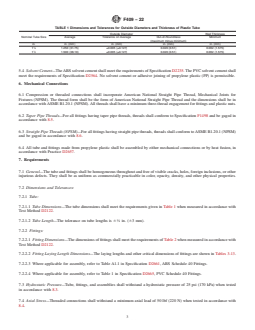
TABLE 1 Dimensions and Tolerances for Outside Diameters and Thickness of Plastic Tube
Outside Diameter Wall Thickness
Nominal Tube Size
Average Tolerance on Average Out-of-Roundness Minimum
(maximum minus minimum)
in. in. (mm) in. (mm) in. (mm) in. (mm)
1 ⁄4 1.250 (31.75) ±0.005 (±0.127) 0.020 (0.51) 0.062 (1.575)
1 ⁄2 1.500 (38.10) ±0.005 (±0.127) 0.020 (0.51) 0.062 (1.575)
5.4 Solvent Cement—The ABS solvent cement shall meet the requirements of Specification D2235. The PVC solvent cement shall
meet the requirements of Specification D2564. No solvent cement or adhesive joining of propylene plastic (PP) is permissible.
6. Mechanical Connections
6.1 Compression or threaded connections shall incorporate American National Straight Pipe Thread, Mechanical Joints for
Fixtures (NPSM). The thread form shall be the form of American National Straight Pipe Thread and the dimensions shall be in
accordance with ASME B1.20.1 (NPSM). All threads shall have a minimum three-thread engagement for fittings and plastic nuts.
6.2 Taper Pipe Threads—For all fittings having taper pipe threads, threads shall conform to Specification F1498 and be gaged in
accordance with 8.5.
6.3 Straight Pipe Threads (NPSM)—For all fittings having straight pipe threads, threads shall conform to ASME B1.20.1 (NPSM)
and be gaged in accordance with 8.6.
6.4 All tube and fittings made from propylene plastic shall be assembled by either mechanical connections or by heat fusion, in
accordance with Practice D2657.
7. Requirements
7.1 General—The tube and fittings shall be homogeneous throughout and free of visible cracks, holes, foreign inclusions, or other
injurious defects. They shall be as uniform as commercially practicable in color, opacity, density, and other physical properties.
7.2 Dimensions and Tolerances:
7.2.1 Tube:
7.2.1.1 Tube Dimensions—The tube dimensions shall meet the requirements given in Table 1 when measured in accordance with
Test Method D2122.
7.2.1.2 Tube Length—The tolerance on tube lengths is 6 ⁄8 in. (63 mm).
7.2.2 Fittings:
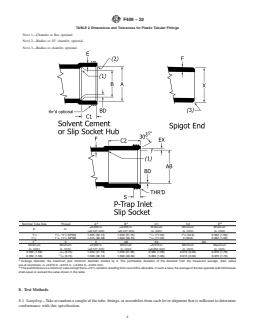
7.2.2.1 Fitting Dimensions—The dimensions of fittings shall meet the requirements of Table 2 when measured in accordance with
Test Method D2122.
7.2.2.2 Fitting Laying Length Dimensions—The laying lengths and other critical dimensions of fittings are shown in Tables 3-13.
7.2.2.3 Where applicable for assembly, refer to Table A1.1 in Specification D2661, ABS Schedule 40 Fittings.
7.2.2.4 Where applicable for assembly, refer to Table 1 in Specification D2665, PVC Schedule 40 Fittings.
7.3 Hydrostatic Pressure—Tube, fittings, and assemblies shall withstand a hydrostatic pressure of 25 psi (170 kPa) when tested
in accordance with 8.3.
7.4 Axial Stress—Threaded connections shall withstand a minimum axial load of 50 lbf (220 N) when tested in accordance with
8.4.
F409 − 22
TABLE 2 Dimensions and Tolerances for Plastic Tubular Fittings
NOTE 1—Chamfer or flat, optional.
NOTE 2—Radius or 45° chamfer, optional.
NOTE 3—Radius or chamfer, optional.
A A B
Nominal Tube Size Thread A B C1 C2 E
±0.005 in. ±0.005 in. Minimum Minimum Minimum
in. in.
(±0.127 mm) (±0.127 mm) in. (mm) in. (mm) in. (mm)
1 1 1 11 3
1 ⁄4 1 ⁄4- 11 ⁄2 NPSM 1.265 (32.13) 1.250 (31.75) ⁄16 (17.46) 1 ⁄8 (34.9) 0.062 (1.58)
1 1 1 11
1 ⁄2 1 ⁄2- 11 ⁄2 NPSM 1.515 (38.48) 1.500 (38.10) ⁄16 (17.46) 2 (50.8) 0.062 (1.58)
B
F S X AB EX BD
Minimum Minimum ±0.005 in. Minimum ±0.010 in. Minimum Maximum
in. (mm) in. (mm) (±0.127 mm) in. (mm) (±0.254 mm) in. (mm) in. (mm)
0.062 (1.58) ⁄64 (6.75) 1.250 (31.75) 1.258 (31.95) 0.066 (1.68) 0.015 (0.38) 0.070 (1.78)
0.062 (1.58) ⁄64 (6.75) 1.500 (38.10) 1.508 (38.30) 0.066 (1.68) 0.015 (0.38) 0.070 (1.78)
A
Average diameter, the maximum plus minimum diameter divided by 2. The permissible deviation of the diameter from the measured average, often called
out-of-roundness, is +0.010 to −0.010 in. (+0.254 to −0.254 mm).
B
The wall thickness is a minimum value except that a ±10 % variation resulting from core shift is allowable. In such a case, the average of the two opposite wall thicknesses
shall equal or exceed the value shown in the table.
8. Test Methods
8.1 Sampling—Take at random a sample of the tube, fittings, or assemblies from each lot or shipment that is sufficient to determine
conformance with this specification.
F409 − 22
A
TABLE 3 Fittings
NOTE 1—Baffle optional.
NOTE 2—See Table 2 for solvent cement or slip socket hub dimensions.
Nominal N
G J
Tube Size
in. in. (mm)
B
1 13 13 1
1 ⁄2 ⁄16 (20.6) ⁄16 (20.6) ⁄16 (1.6)
A
All dimensions are minimum.
B
See Table 2.
8.2 Conditioning—Unless otherwise specified, condition the specimens prior to test at 7070 °F to 77°F (2377 °F (23 °C 6
2°C)2 °C) and 5050 % 6 5 %10 % relative humidity for not less than 40 h in accordance with Procedure A of Practice D618 for
those tests where conditioning is required and in all cases of disagreement.
8.3 Hydrostatic Pressure—Subject the tube and fittings, as an assembly, to an internal hydrostatic pressure of 25 psi (170 kPa) for
1 h. The tube, fittings, and joints shall show no evidence of leaking.
8.4 Axial Stress—Mount threaded connections in a tension-testing machine to apply an axial load. Crosshead speed shall be 0.20
in. to 0.25 in. (5.0 mm to 6.3 mm)/min. The connection shall show no evidence of cracking or separation at the minimum load
specified in 7.4.
8.5 Taper Pipe Threads—All taper pipe threads shall be gaged in accordance with Specification F1498.
8.6 Straight Pipe Threads (NPSM)—For all fittings having straight pipe threads, threads shall be gaged in accordance with ASME
B1.20.1 (NPSM).
NOTE 1—Some threads listed in Table 6, Table 9, and Table 12 are not listed in ASME B1.20.1 (NPSM).
9. Retest and Rejection
9.1 If the results of any test(s) do not meet the requirements of this specification, the test(s) shall be conducted again only by
agreement between the purchaser and seller. Under such agreement, minimum requirements shall not be lowered, changed, or
F409 − 22
TABLE 4 End Outlet Continuous Waste
NOTE 1—Radius optional.
NOTE 2—Baffle optional.
NOTE 3—Arm shall either be one-piece construction or assembled. If assembled, socket shall conform to Table 2.
NOTE 4—Shall be swivel nut, slip nut, or slip socket connection (shown in Table 5).
NOTE 5—Dishwasher branch optional.
NOTE 6—See Table 6.
NOTE 7—See Table 2.
L HJ GG
Minimum Minimum Adjustable in four sizes, in. (mm)
in. (mm) in. (mm)
6 (152.4) 1 ⁄2 (38.1) 12 (305) 16 (406) 21 (533) 25 (635)
modified, nor shall specification limits be changed. If upon request, failure occurs, the quantity of product represented by the test(s)
does not meet the requirements of this specification.
10. Product Marking
10.1 Tube—The tube shall be marked in letters not less than ⁄8 in. (3 mm) high in a contrasting color and shall at least consist
of the nominal size, manufacturer’s name or trademark, and “ABS Tubular F409,” “PVC Tubular F409,” or “PP Tubular F409”
at intervals of not greater than 2 ft (610 mm).
10.2 Fittings—All fittings shall be marked on the body or hub on both sides. The marking shall consist, at least, of the
manufacturer’s name or trademark, the size, and “ABS Tubular F409,” “PVC Tubular F409,” or “P Tubular F409.”
10.3 All baffle tees and such fittings as so required shall be marked with arrows indicating the direction of flow when correctly
installed.
11. Quality Assurance
11.1 When the product is marked with this designation, F409, the manufacturer affirms that the product was manufactured,
inspected, sampled, and tested in accordance with this specification and has been found to meet the require-ments of this
specification.
F409 − 22
TABLE 5 Center Outlet Continuous Waste
NOTE 1—See Table 2.
NOTE 2—Radius optional.
NOTE 3—Baffle optional.
NOTE 4—Arm shall be either one-pi
...