

ASTM D2665-24
(Specification)Standard Specification for Poly(Vinyl Chloride) (PVC) Plastic Drain, Waste, and Vent Pipe and Fittings
General Information
- Abstract
ABSTRACT
This specification covers requirements and test methods for materials, dimensions and tolerances, pipe stiffness, crush resistance, impact resistance, hydrostatic burst resistance, and solvent cement for poly(vinyl chloride) plastic drain, waste, and vent pipe and fittings. The pipe and fittings covered are suitable for the drainage and venting of sewage and certain other liquid wastes. A form of marking is also included. The pipe and fittings shall be made of virgin PVC compounds of defined specification. The pipe shall conform to the required stiffness, deflection load and flattening. The fittings shall be subject to hydrostatic burst pressure. The pipe and fittings shall be subject to impact resistance test.
SCOPE
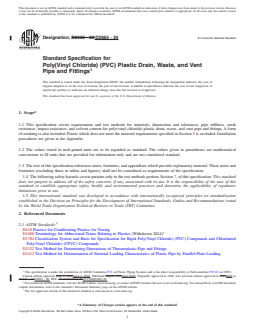
1.1 This specification covers requirements and test methods for materials, dimensions and tolerances, pipe stiffness, crush resistance, impact resistance, and solvent cement for poly(vinyl chloride) plastic drain, waste, and vent pipe and fittings. A form of marking is also included. Plastic which does not meet the material requirements specified in Section 5 is excluded. Installation procedures are given in the Appendix.
1.2 The values stated in inch-pound units are to be regarded as standard. The values given in parentheses are mathematical conversions to SI units that are provided for information only and are not considered standard.
1.3 The text of this specification references notes, footnotes, and appendixes which provide explanatory material. These notes and footnotes (excluding those in tables and figures) shall not be considered as requirements of the specification.
1.4 The following safety hazards caveat pertains only to the test methods portion, Section 7, of this specification: This standard does not purport to address all of the safety concerns, if any, associated with its use. It is the responsibility of the user of this standard to establish appropriate safety, health, and environmental practices and determine the applicability of regulatory limitations prior to use.
1.5 This international standard was developed in accordance with internationally recognized principles on standardization established in the Decision on Principles for the Development of International Standards, Guides and Recommendations issued by the World Trade Organization Technical Barriers to Trade (TBT) Committee.
- Status
- Published
- Publication Date
- 31-Mar-2024
- Technical Committee
- F17 - Plastic Piping Systems
- Drafting Committee
- F17.63 - DWV
Buy Documents
ASTM D2665-24 - Standard Specification for Poly(Vinyl Chloride) (PVC) Plastic Drain, Waste, and Vent Pipe and Fittings
REDLINE ASTM D2665-24 - Standard Specification for Poly(Vinyl Chloride) (PVC) Plastic Drain, Waste, and Vent Pipe and Fittings
Overview
ASTM D2665-24: Standard Specification for Poly(Vinyl Chloride) (PVC) Plastic Drain, Waste, and Vent Pipe and Fittings defines the requirements for PVC plastic piping systems used in drainage, waste, and vent (DWV) applications. Developed by ASTM International, this standard specifies material quality, dimensions, performance properties, and testing methods to ensure safe and reliable installation of PVC piping systems.
ASTM D2665-24 covers:
- Materials and compounds: Use of virgin PVC conforming to defined specifications
- Mechanical properties: Pipe stiffness, crush and impact resistance, and hydrostatic burst resistance
- Dimensional accuracy: Tolerances for pipes and fittings
- Solvent cement requirements for proper joint integrity
- Marking and labeling, ensuring traceability
These comprehensive requirements support plumbing system performance, code compliance, and public safety by establishing uniform criteria for manufacturers, installers, and inspectors.
Key Topics
- Material Requirements: Pipes and fittings must be manufactured from virgin PVC compounds, meeting strict standards for tensile strength and modulus of elasticity.
- Dimensional Standards: The specification defines minimum and average wall thicknesses, outside diameters, and allowable tolerances to guarantee compatibility and integrity.
- Mechanical Performance: Requirements for pipe stiffness, ensured through deflection and flattening tests, as well as minimum crush and impact resistance for both pipes and fittings.
- Testing Protocols: Specifies sampling, conditioning, and testing procedures, including standard test methods for evaluating physical and mechanical properties (such as ASTM D2412 and ASTMD2444).
- Solvent Cement Compatibility: Solvent cements used must comply with ASTM D2564 to ensure secure and leak-free joints.
- Product Marking: Clear marking requirements for pipes and fittings, including manufacturer identification, standard reference, material type (PVC), and DWV designation.
- Installation Guidance: Best practices for storage, handling, joint assembly, and support are included in the appendix to promote long-term system reliability.
Applications
ASTM D2665-24 is essential for manufacturers, contractors, engineers, and code officials involved in:
- Residential, commercial, and institutional plumbing systems: Ensuring safe conveyance of sewage, greywater, and venting of gases.
- Wastewater management: Used extensively for below-ground and above-ground drainage lines, building drains, and vent lines.
- Renovation and retrofit projects: Compatibility with existing DWV materials and reliable transition fittings.
- Building code compliance: Meeting requirements for new construction and upgrades, widely referenced by plumbing codes and regulatory agencies.
- Quality assurance: Used as a benchmark in procurement, inspection, and acceptance testing for PVC pipes and fittings in DWV service.
Related Standards
When applying ASTM D2665-24, consider these related and referenced standards for a complete PVC piping system specification:
- ASTM D1784: Specification for Rigid PVC Compounds
- ASTM D2122: Test Method for Thermoplastic Pipe and Fittings Dimensions
- ASTM D2412: Test Method for External Loading Characteristics of Plastic Pipe
- ASTM D2444: Impact Resistance of Thermoplastic Pipe and Fittings
- ASTM D2564: Specification for Solvent Cements for PVC Piping Systems
- ASTM D3311: DWV Fittings Patterns
- ASTM F1498: Taper Pipe Threads for Thermoplastic Pipe
- ASTM F402: Safe Handling of Solvent Cements, Primers, and Cleaners
- ASTM F412: Terminology Relating to Plastic Piping Systems
Keywords: ASTM D2665, PVC drain pipe standard, DWV fittings, plastic plumbing pipe, PVC waste pipe, vent pipe, ASTM standards, plumbing code compliance, PVC pipe testing, solvent-weld joints
By incorporating ASTM D2665-24, stakeholders ensure performance, safety, and regulatory alignment for PVC DWV systems across a wide range of construction and maintenance projects.
Relations
- Effective Date
- 01-Apr-2024
- Referred By
ASTM F2536-17(2022) - Standard Guide for Installing Plastic DWV Piping Suspended from On-Grade Slabs - Effective Date
- 01-Apr-2024
- Effective Date
- 01-Apr-2024
- Referred By
ASTM F1499-22 - Standard Specification for Coextruded Composite Drain, Waste, and Vent Pipe (DWV) - Effective Date
- 01-Apr-2024
- Effective Date
- 01-Apr-2024
- Effective Date
- 01-Apr-2024
- Effective Date
- 01-Apr-2024
- Effective Date
- 01-Apr-2024
- Effective Date
- 01-Apr-2024
- Effective Date
- 01-Apr-2024
- Effective Date
- 01-Apr-2024
- Effective Date
- 01-Apr-2024
- Referred By
ASTM D2672-20e1 - Standard Specification for Joints for IPS PVC Pipe Using Solvent Cement - Effective Date
- 01-Apr-2024
- Effective Date
- 01-Apr-2024
- Referred By
ASTM D3311-22 - Standard Specification for Drain, Waste, and Vent (DWV) Plastic Fittings Patterns - Effective Date
- 01-Apr-2024
Buy Documents
ASTM D2665-24 - Standard Specification for Poly(Vinyl Chloride) (PVC) Plastic Drain, Waste, and Vent Pipe and Fittings
REDLINE ASTM D2665-24 - Standard Specification for Poly(Vinyl Chloride) (PVC) Plastic Drain, Waste, and Vent Pipe and Fittings
Get Certified
Connect with accredited certification bodies for this standard

Institut za varilstvo d.o.o. (Welding Institute)
Slovenia's leading welding institute since 1952. ISO 3834, EN 1090, pressure equipment certification, NDT personnel, welder qualification. Only IIW Au
Sponsored listings
Frequently Asked Questions
ASTM D2665-24 is a technical specification published by ASTM International. Its full title is "Standard Specification for Poly(Vinyl Chloride) (PVC) Plastic Drain, Waste, and Vent Pipe and Fittings". This standard covers: ABSTRACT This specification covers requirements and test methods for materials, dimensions and tolerances, pipe stiffness, crush resistance, impact resistance, hydrostatic burst resistance, and solvent cement for poly(vinyl chloride) plastic drain, waste, and vent pipe and fittings. The pipe and fittings covered are suitable for the drainage and venting of sewage and certain other liquid wastes. A form of marking is also included. The pipe and fittings shall be made of virgin PVC compounds of defined specification. The pipe shall conform to the required stiffness, deflection load and flattening. The fittings shall be subject to hydrostatic burst pressure. The pipe and fittings shall be subject to impact resistance test. SCOPE 1.1 This specification covers requirements and test methods for materials, dimensions and tolerances, pipe stiffness, crush resistance, impact resistance, and solvent cement for poly(vinyl chloride) plastic drain, waste, and vent pipe and fittings. A form of marking is also included. Plastic which does not meet the material requirements specified in Section 5 is excluded. Installation procedures are given in the Appendix. 1.2 The values stated in inch-pound units are to be regarded as standard. The values given in parentheses are mathematical conversions to SI units that are provided for information only and are not considered standard. 1.3 The text of this specification references notes, footnotes, and appendixes which provide explanatory material. These notes and footnotes (excluding those in tables and figures) shall not be considered as requirements of the specification. 1.4 The following safety hazards caveat pertains only to the test methods portion, Section 7, of this specification: This standard does not purport to address all of the safety concerns, if any, associated with its use. It is the responsibility of the user of this standard to establish appropriate safety, health, and environmental practices and determine the applicability of regulatory limitations prior to use. 1.5 This international standard was developed in accordance with internationally recognized principles on standardization established in the Decision on Principles for the Development of International Standards, Guides and Recommendations issued by the World Trade Organization Technical Barriers to Trade (TBT) Committee.
ABSTRACT This specification covers requirements and test methods for materials, dimensions and tolerances, pipe stiffness, crush resistance, impact resistance, hydrostatic burst resistance, and solvent cement for poly(vinyl chloride) plastic drain, waste, and vent pipe and fittings. The pipe and fittings covered are suitable for the drainage and venting of sewage and certain other liquid wastes. A form of marking is also included. The pipe and fittings shall be made of virgin PVC compounds of defined specification. The pipe shall conform to the required stiffness, deflection load and flattening. The fittings shall be subject to hydrostatic burst pressure. The pipe and fittings shall be subject to impact resistance test. SCOPE 1.1 This specification covers requirements and test methods for materials, dimensions and tolerances, pipe stiffness, crush resistance, impact resistance, and solvent cement for poly(vinyl chloride) plastic drain, waste, and vent pipe and fittings. A form of marking is also included. Plastic which does not meet the material requirements specified in Section 5 is excluded. Installation procedures are given in the Appendix. 1.2 The values stated in inch-pound units are to be regarded as standard. The values given in parentheses are mathematical conversions to SI units that are provided for information only and are not considered standard. 1.3 The text of this specification references notes, footnotes, and appendixes which provide explanatory material. These notes and footnotes (excluding those in tables and figures) shall not be considered as requirements of the specification. 1.4 The following safety hazards caveat pertains only to the test methods portion, Section 7, of this specification: This standard does not purport to address all of the safety concerns, if any, associated with its use. It is the responsibility of the user of this standard to establish appropriate safety, health, and environmental practices and determine the applicability of regulatory limitations prior to use. 1.5 This international standard was developed in accordance with internationally recognized principles on standardization established in the Decision on Principles for the Development of International Standards, Guides and Recommendations issued by the World Trade Organization Technical Barriers to Trade (TBT) Committee.
ASTM D2665-24 is classified under the following ICS (International Classification for Standards) categories: 23.040.20 - Plastics pipes. The ICS classification helps identify the subject area and facilitates finding related standards.
ASTM D2665-24 has the following relationships with other standards: It is inter standard links to ASTM D2665-20, ASTM F2536-17(2022), ASTM F1488-14(2019), ASTM F1499-22, ASTM F891-23, ASTM F1866-23, ASTM D2855-20, ASTM F1760-16(2020), ASTM F2135-01(2022), ASTM F3128-23, ASTM D3138-21, ASTM F409-22, ASTM D2672-20e1, ASTM F2021-17(2022), ASTM D3311-22. Understanding these relationships helps ensure you are using the most current and applicable version of the standard.
ASTM D2665-24 is available in PDF format for immediate download after purchase. The document can be added to your cart and obtained through the secure checkout process. Digital delivery ensures instant access to the complete standard document.
Standards Content (Sample)
This international standard was developed in accordance with internationally recognized principles on standardization established in the Decision on Principles for the
Development of International Standards, Guides and Recommendations issued by the World Trade Organization Technical Barriers to Trade (TBT) Committee.
Designation: D2665 − 24 An American National Standard
Standard Specification for
Poly(Vinyl Chloride) (PVC) Plastic Drain, Waste, and Vent
Pipe and Fittings
This standard is issued under the fixed designation D2665; the number immediately following the designation indicates the year of
original adoption or, in the case of revision, the year of last revision. A number in parentheses indicates the year of last reapproval. A
superscript epsilon (´) indicates an editorial change since the last revision or reapproval.
This standard has been approved for use by agencies of the U.S. Department of Defense.
1. Scope* 2. Referenced Documents
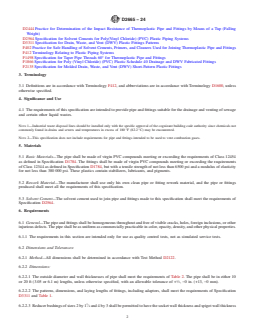
2.1 ASTM Standards:
1.1 This specification covers requirements and test methods
D618 Practice for Conditioning Plastics for Testing
for materials, dimensions and tolerances, pipe stiffness, crush
D1600 Terminology for Abbreviated Terms Relating to Plas-
resistance, impact resistance, and solvent cement for poly(vinyl
tics (Withdrawn 2024)
chloride) plastic drain, waste, and vent pipe and fittings. A form
D1784 Classification System and Basis for Specification for
of marking is also included. Plastic which does not meet the
Rigid Poly(Vinyl Chloride) (PVC) Compounds and Chlo-
material requirements specified in Section 5 is excluded.
rinated Poly(Vinyl Chloride) (CPVC) Compounds
Installation procedures are given in the Appendix.
D2122 Test Method for Determining Dimensions of Ther-
1.2 The values stated in inch-pound units are to be regarded moplastic Pipe and Fittings
as standard. The values given in parentheses are mathematical D2412 Test Method for Determination of External Loading
Characteristics of Plastic Pipe by Parallel-Plate Loading
conversions to SI units that are provided for information only
D2444 Practice for Determination of the Impact Resistance
and are not considered standard.
of Thermoplastic Pipe and Fittings by Means of a Tup
1.3 The text of this specification references notes, footnotes,
(Falling Weight)
and appendixes which provide explanatory material. These
D2564 Specification for Solvent Cements for Poly(Vinyl
notes and footnotes (excluding those in tables and figures) shall
Chloride) (PVC) Plastic Piping Systems
not be considered as requirements of the specification.
D3311 Specification for Drain, Waste, and Vent (DWV)
Plastic Fittings Patterns
1.4 The following safety hazards caveat pertains only to the
F402 Practice for Safe Handling of Solvent Cements,
test methods portion, Section 7, of this specification: This
Primers, and Cleaners Used for Joining Thermoplastic
standard does not purport to address all of the safety concerns,
Pipe and Fittings
if any, associated with its use. It is the responsibility of the user
F412 Terminology Relating to Plastic Piping Systems
of this standard to establish appropriate safety, health, and
F1498 Specification for Taper Pipe Threads 60° for Thermo-
environmental practices and determine the applicability of
plastic Pipe and Fittings
regulatory limitations prior to use.
F1866 Specification for Poly (Vinyl Chloride) (PVC) Plastic
1.5 This international standard was developed in accor-
Schedule 40 Drainage and DWV Fabricated Fittings
dance with internationally recognized principles on standard-
F2135 Specification for Molded Drain, Waste, and Vent
ization established in the Decision on Principles for the
(DWV) Short-Pattern Plastic Fittings
Development of International Standards, Guides and Recom-
mendations issued by the World Trade Organization Technical
3. Terminology
Barriers to Trade (TBT) Committee.
3.1 Definitions are in accordance with Terminology F412,
and abbreviations are in accordance with Terminology D1600,
unless otherwise specified.
For referenced ASTM standards, visit the ASTM website, www.astm.org, or
This specification is under the jurisdiction of ASTM Committee F17 on Plastic contact ASTM Customer Service at service@astm.org. For Annual Book of ASTM
Piping Systems and is the direct responsibility of Subcommittee F17.63 on DWV. Standards volume information, refer to the standard’s Document Summary page on
Current edition approved April 1, 2024. Published April 2024. Originally the ASTM website.
approved in 1968. Last previous edition approved in 2020 as D2665 – 20. DOI: The last approved version of this historical standard is referenced on
10.1520/D2665-24. www.astm.org.
*A Summary of Changes section appears at the end of this standard
Copyright © ASTM International, 100 Barr Harbor Drive, PO Box C700, West Conshohocken, PA 19428-2959. United States
D2665 − 24
4. Significance and Use 6.2.2.5 For all fittings having taper pipe threads, threads
shall conform to Specification F1498 and be gaged in accor-
4.1 The requirements of this specification are intended to
dance with 7.5. Fittings of nominal sizes not given in Speci-
provide pipe and fittings suitable for the drainage and venting
fication F1498 shall not have threads.
of sewage and certain other liquid wastes.
6.2.2.6 Fabricated DWV fittings shall comply with Specifi-
NOTE 1—Industrial waste disposal lines should be installed only with
cation F1866.
the specific approval of the cognizant building code authority since
chemicals not commonly found in drains and sewers and temperatures in
6.3 Pipe Stiffness, Deflection Load and Flattening:
excess of 180 °F (82.2 °C) may be encountered.
6.3.1 Pipe—The minimum pipe stiffness at 5 % deflection
NOTE 2—This specification does not include requirements for pipe and
shall be in accordance with Table 3. The pipe shall deflect by
fittings intended to be used to vent combustion gases.
60 % of the nominal outside diameter (flattening) without
5. Materials
cracking, rupture, or other visible evidence of failure when
tested in accordance with 7.4.
5.1 Basic Materials—The pipe shall be made of virgin PVC
6.3.1.1 Pipe Stiffness (PS)—Three specimens shall be tested.
compounds meeting or exceeding the requirements of Class
If all three meet the PS requirement, the sample meets the PS
12454 as defined in Specification D1784. The fittings shall be
requirement. If one or two fail, additional testing shall be
made of virgin PVC compounds meeting or exceeding the
conducted in accordance with 6.3.1.2. If all three fail, the
requirements of Class 12344 as defined in Specification
sample does not meet the PS requirement.
D1784, but with a tensile strength of not less than 6500 psi and
6.3.1.2 Pipe Stiffness and Lower Confidence Limit—In the
a modulus of elasticity for not less than 380 000 psi. These
event that one or two of the specimens tested in 6.3.1 fail to
plastics contain stabilizers, lubricants, and pigments.
meet the minimum PS requirement, the average pipe stiffness
5.2 Rework Material—The manufacturer shall use only his
of eleven specimens shall meet or exceed the minimum
own clean pipe or fitting rework material, and the pipe or
requirement given in Table 3. The 99 % lower confidence limit
fittings produced shall meet all the requirements of this
(LCL) shall be within 15 % of the average value. The LCL
specification.
shall be calculated using the Student’s “t” distribution, with
5.3 Solvent Cement—The solvent cement used to join pipe
N-1 degrees of freedom, where N is the number of specimens.
and fittings made to this specification shall meet the require-
The critical t value shall be used to at least three significant
ments of Specification D2564.
digits. Alternatively, if the LCL exceeds the minimum PS
requirement in Table 3, but is not within 15 % of the average,
6. Requirements
the sample meets the requirements of the pipe stiffness testing.
6.1 General—The pipe and fittings shall be homogeneous
The eleven specimens include the three tested under 6.3.1, and
throughout and free of visible cracks, holes, foreign inclusions,
an additional eight with rotation by 35°, as specified in Test
or other injurious defects. The pipe shall be as uniform as
Method D2412, continuing throughout the remaining speci-
commercially practicable in color, opacity, density, and other
mens.
physical properties.
6.3.1.3 The LCL based on testing eleven specimens is
6.1.1 The requirements in this section are intended only for
calculated as follows:
use as quality control tests, not as simulated service tests.
LCL 5 avg PS 2 $2.76 std. dev. /= N % (1)
~ ! ~ ! ~ !
6.2 Dimensions and Tolerances:
6.2.1 Method—All dimensions shall be determined in accor-
where:
dance with Test Method D2122.
avg PS 5 @ PS #/ (2)
~ ! ~ !
i
(
6.2.2 Dimensions:
2 1/2
6.2.2.1 The outside diameter and wall thicknesses of pipe PS 2 PS /N
~ !
( (
std. dev. 5
~ ! F G
shall meet the requirements of Table 2. The pipe shall be in N 2 1
N = 11
either 10 or 20 ft (3.05 or 6.1 m) lengths, unless otherwise
specified, with an allowable tolerance of + ⁄2, −0 in. (+13, −0
6.3.1.4 The 15 % requirement is calculated as follows:
mm).
Avg 2 LCL / Avg × 100 # 15 % (3)
~ ! ~ !
6.2.2.2 The patterns, dimensions, and laying lengths of
NOTE 3—The 5 % deflection criterion, which was arbitrarily selected
fittings, including adaptors, shall meet the requirements of
for testing convenience, should not be considered as a limitation with
Specification D3311 and Table 1.
respect to in-use deflection. The engineer is responsible for establishing
6.2.2.3 Reducer bushings of sizes 2 by 1 ⁄4 and 4 by 3 shall
the acceptable deflection.
be permitted to have the socket wall thickness and spigot wall
6.3.2 Fittings—Individual fittings unassembled shall with-
thickness below the minimum requirements defined in Table 1,
stand a minimum load of 750 lbf/ft (11 kN/m) of centerline
but not less than 0.098 in. (2.5 mm), provided the inner socket
length without cracking or other visible evidence of failure
and outer spigot are reinforced by a minimum of four ribs. The
when tested in accordance with 7.4.
thickness of the supporting ribs shall not be less than 0.098 in.
(2.5 mm). 6.4 Impact Resistance—The minimum impact resistance of
6.2.2.4 The patterns, dimensions, and laying lengths of pipe and fittings, when tested at the time of manufacture, shall
Short-Pattern fittings shall meet the requirements of Specifica- comply with Table 4. Test in accordance with Test Method
tion F2135. D2444 using Tup C and Holder A for pipe and Tup A and
D2665 − 24
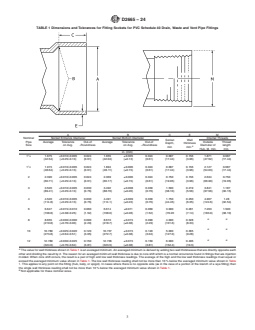
TABLE 1 Dimensions and Tolerances for Fitting Sockets for PVC Schedule 40 Drain, Waste and Vent Pipe Fittings
A B C E M
Nominal Socket Entrance Diameter Socket Bottom Diameter Internal Threads
Socket Wall
Pipe Average Tolerance Out-of Average Tolerance Out-of Outside Thread
Depth, thickness
Size on Avg. -Roundness on Avg. –Roundness Diameter of length
A
min min.
Hub, M. min. min.
in. (mm)
1 ⁄4 1.675 +0.010/-0.005 0.024 1.655 ±0.005 0.024 0.687 0.156 1.871 0.687
(42.54) (+0.25/-0.13) (0.61) (42.04) (±0.13) (0.61) (17.44) (3.96) (47.52) (17.44)
1 ⁄2 1.915 +0.010/-0.005 0.024 1.894 ±0.006 0.024 0.687 0.156 2.127 0.687
(48.64) (+0.25/-0.13) (0.61) (48.11) (±0.15) (0.61) (17.44) (3.96) (54.03) (17.44)
2 2.390 +0.010/-0.005 0.024 2.369 ±0.006 0.024 0.750 0.156 2.634 0.750
(60.71) (+0.25/-0.13) (0.61) (60.17) (±0.15) (0.61) (19.05) (3.96) (66.90) (19.05)
3 3.520 +0.010/-0.005 0.030 3.492 ±0.008 0.030 1.500 0.219 3.841 1.187
(89.41) (+0.25/-0.13) (0.76) (88.70) (±0.20) (0.76) (38.10) (5.56) (97.56) (30.15)
4 4.520 +0.010/-0.005 0.030 4.491 ±0.009 0.030 1.750 0.250 4.907 1.28
(114.8) (+0.25/-0.13) (0.76) (114.1) (±0.23) (0.76) (44.45) (6.35) (124.6) (32.54)
6 6.647 +0.015/-0.010 0.060 6.614 ±0.011 0.060 3.000 0.281 7.203 1.500
(168.8) (+0.38/-0.25) (1.52) (168.0) (±0.28) (1.52) (76.20 (7.14) (183.0) (38.10)
B B
8 8.655 +0.030/-0.000 0.090 8.610 ±0.015 0.090 4.000 0.328
(219.8) (+0.76/-0.00) (2.29) (218.7) (±0.38) (2.29) (101.6) (8.33)
B B
10 10.780 +0.025/-0.020 0.120 10.737 ±0.015 0.120 5.000 0.365
(273.8) (+0.64/-0.51) (3.05) (272.7) (±0.38) (3.04) (127.0) (9.28)
B B
12 12.780 +0.030/-0.025 0.150 12.736 ±0.015 0.150 6.000 0.406
(324.6) (+0.76/-0.64) (3.81) (323.5) (±0.38) (3.81) (152.4) (10.3)
A
The value for wall thickness shown in Table 1 is an averaged minimum. An averaged minimum is derived by adding two wall thicknesses that are directly opposite each
other and dividing the result by 2. The reason for an averaged minimum wall thickness is due to core shift which is a normal occurrence found in fittings that are injection
molded. When core shift occurs, the result is a pair of high and low wall thickness readings. The average of the high and the low wall thickness readings must equal or
exceed the averaged minimum value shown in Table 1. The low wall thickness reading shall not be more than 10 % below the averaged minimum value shown in Table
1. This applies to any point on the fitting (hub, body, or spigot). In cases where there is no opposite side (as in the case of a portion of the branch of a wye fitting) then
the single wall thickness reading shall not be more than 10 % below the averaged minimum value shown in Table 1.
B
Not applicable for these nominal sizes.
D2665 − 24
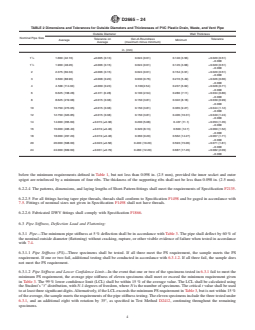
TABLE 2 Dimensions and Tolerances for Outside Diameters and Thicknesses of PVC Plastic Drain, Waste, and Vent Pipe
Outside Diameter Wall Thickness
Nominal Pipe Size
Tolerance on Out-of-Roundness Tolerance
Average Minimum
Average (maximum minus minimum)
in. (mm)
1 ⁄4 1.660 (42.16) ±0.005 (0.13) 0.024 (0.61) 0.140 (3.56) +0.020 (0.51)
−0.000
1 ⁄2 1.900 (48.26) ±0.006 (0.15) 0.024 (0.61) 0.145 (3.68) +0.020 (0.51)
−0.000
2 2.375 (60.33) ±0.006 (0.15) 0.024 (0.61) 0.154 (3.91) +0.020 (0.51)
−0.000
3 3.500 (88.90) ±0.008 (0.20) 0.030 (0.76) 0.216 (5.49) +0.026 (0.66)
−0.000
4 4.500 (114.30) ±0.009 (0.23) 0.100(2.54) 0.237 (6.02) +0.028 (0.71)
−0.000
6 6.625 (168.28) ±0.011 (0.28) 0.100 (2.54) 0.280 (7.11) +0.034 (0.86)
−0.000
8 8.625 (219.08) ±0.015 (0.38) 0.150 (3.81) 0.322 (8.18) +0.039 (0.99)
−0.000
10 10.750 (273.05) ±0.015 (0.38) 0.150 (3.81) 0.365 (9.27) +0.044 (1.12)
−0.000
12 12.750 (323.85) ±0.015 (0.38) 0.150 (3.81) 0.406 (10.31) +0.049 (1.24)
−0.000
14 14.000 (355.60) ±0.015 (±0.38) 0.200 (5.08) 0.437 (11.1) +0.053 (1.35)
−0.000
16 16.000 (406.40) ±0.019 (±0.48) 0.320 (8.13) 0.500 (12.7) +0.060 (1.52)
−0.000
18 18.000 (457.20) ±0.019 (±0.48) 0.360 (9.20) 0.562 (14.27) +0.067 (1.71)
−0.000
20 20.000 (508.00) ±0.023 (±0.58) 0.400 (10.20) 0.593 (15.06) +0.071 (1.81)
−0.000
24 24.000 (609.60) ±0.031 (±0.79) 0.480 (12.20) 0.687 (17.45) +0.082 (2.09)
−0.000
A
TABLE 3 Pipe Stiffness Requirements for PVC DWV Pipe TABLE 4 Impact Resistance of PVC Plastic Drain, Waste and Vent
Pipe and Fittings
Nominal Pipe Size, Pipe Stiffness,
in. min, psi (kPa)
Description Impact Resistance, min.,
ft-lbf (J)
1 ⁄4 1400 (9650) 73 °F (23 °C)
All pipe sizes 60 (81)
1 ⁄2 1010 (6960)
2 600 (4140)
Fitting sizes and types 15 (20)
3 510 (3520)
4 310 (2140) (larger than 2 in. nominal OD)
6 150 (1030)
Fitting sizes and types 7.5 (10)
8 100 (690)
(2 in. and smaller nonimal OD)
10 78 (530)
12 63 (430)
14 60 (415)
16 60 (415)
18 60 (415)
sizes 4 in. and smaller and a 20-lb (10-kg) tup for pipe larger
20 51 (350)
than 4 in. Test fittings with a 12 lb (5 kg) Tup. Test couplings
24 45 (315)
A
cemented to short pieces of pipe and allowed to dry for 24 h.
Measured at 5 % deflection.
For fittings larger than 4-in, a symmetric section cut from the
hub or body with a minimum centerline length of 2 in. shall be
Holder B for fittings. Use a 12-lb (5-kg) tup for testing pipe permitted to be used rather than the entire fitting.
D2665 − 24
6.4.1 Test 10 specimens. When 9 or 10 specimens pass, centerline contact with platens. Fittings having nonuniform
accept the lot. When 2 or more specimens fail, test 10 diameters, such as reducers, shall be considered acceptable
additional specimens. When 17 of 20 specimens tested pass, when the wall thickness at all points is equal to or greater than
accept the lot. When 4 or more of 20 specimens tested f
...
This document is not an ASTM standard and is intended only to provide the user of an ASTM standard an indication of what changes have been made to the previous version. Because
it may not be technically possible to adequately depict all changes accurately, ASTM recommends that users consult prior editions as appropriate. In all cases only the current version
of the standard as published by ASTM is to be considered the official document.
Designation: D2665 − 20 D2665 − 24 An American National Standard
Standard Specification for
Poly(Vinyl Chloride) (PVC) Plastic Drain, Waste, and Vent
Pipe and Fittings
This standard is issued under the fixed designation D2665; the number immediately following the designation indicates the year of
original adoption or, in the case of revision, the year of last revision. A number in parentheses indicates the year of last reapproval. A
superscript epsilon (´) indicates an editorial change since the last revision or reapproval.
This standard has been approved for use by agencies of the U.S. Department of Defense.
1. Scope*
1.1 This specification covers requirements and test methods for materials, dimensions and tolerances, pipe stiffness, crush
resistance, impact resistance, and solvent cement for poly(vinyl chloride) plastic drain, waste, and vent pipe and fittings. A form
of marking is also included. Plastic which does not meet the material requirements specified in Section 5 is excluded. Installation
procedures are given in the Appendix.
1.2 The values stated in inch-pound units are to be regarded as standard. The values given in parentheses are mathematical
conversions to SI units that are provided for information only and are not considered standard.
1.3 The text of this specification references notes, footnotes, and appendixes which provide explanatory material. These notes and
footnotes (excluding those in tables and figures) shall not be considered as requirements of the specification.
1.4 The following safety hazards caveat pertains only to the test methods portion, Section 7, of this specification: This standard
does not purport to address all of the safety concerns, if any, associated with its use. It is the responsibility of the user of this
standard to establish appropriate safety, health, and environmental practices and determine the applicability of regulatory
limitations prior to use.
1.5 This international standard was developed in accordance with internationally recognized principles on standardization
established in the Decision on Principles for the Development of International Standards, Guides and Recommendations issued
by the World Trade Organization Technical Barriers to Trade (TBT) Committee.
2. Referenced Documents
2.1 ASTM Standards:
D618 Practice for Conditioning Plastics for Testing
D1600 Terminology for Abbreviated Terms Relating to Plastics (Withdrawn 2024)
D1784 Classification System and Basis for Specification for Rigid Poly(Vinyl Chloride) (PVC) Compounds and Chlorinated
Poly(Vinyl Chloride) (CPVC) Compounds
D2122 Test Method for Determining Dimensions of Thermoplastic Pipe and Fittings
D2412 Test Method for Determination of External Loading Characteristics of Plastic Pipe by Parallel-Plate Loading
This specification is under the jurisdiction of ASTM Committee F17 on Plastic Piping Systems and is the direct responsibility of Subcommittee F17.63 on DWV.
Current edition approved Aug. 1, 2020April 1, 2024. Published August 2020April 2024. Originally approved in 1968. Last previous edition approved in 20142020 as
D2665 – 14.D2665 – 20. DOI: 10.1520/D2665-20.10.1520/D2665-24.
For referenced ASTM standards, visit the ASTM website, www.astm.org, or contact ASTM Customer Service at service@astm.org. For Annual Book of ASTM Standards
volume information, refer to the standard’s Document Summary page on the ASTM website.
The last approved version of this historical standard is referenced on www.astm.org.
*A Summary of Changes section appears at the end of this standard
Copyright © ASTM International, 100 Barr Harbor Drive, PO Box C700, West Conshohocken, PA 19428-2959. United States
D2665 − 24
D2444 Practice for Determination of the Impact Resistance of Thermoplastic Pipe and Fittings by Means of a Tup (Falling
Weight)
D2564 Specification for Solvent Cements for Poly(Vinyl Chloride) (PVC) Plastic Piping Systems
D3311 Specification for Drain, Waste, and Vent (DWV) Plastic Fittings Patterns
F402 Practice for Safe Handling of Solvent Cements, Primers, and Cleaners Used for Joining Thermoplastic Pipe and Fittings
F412 Terminology Relating to Plastic Piping Systems
F1498 Specification for Taper Pipe Threads 60° for Thermoplastic Pipe and Fittings
F1866 Specification for Poly (Vinyl Chloride) (PVC) Plastic Schedule 40 Drainage and DWV Fabricated Fittings
F2135 Specification for Molded Drain, Waste, and Vent (DWV) Short-Pattern Plastic Fittings
3. Terminology
3.1 Definitions are in accordance with Terminology F412, and abbreviations are in accordance with Terminology D1600, unless
otherwise specified.
4. Significance and Use
4.1 The requirements of this specification are intended to provide pipe and fittings suitable for the drainage and venting of sewage
and certain other liquid wastes.
NOTE 1—Industrial waste disposal lines should be installed only with the specific approval of the cognizant building code authority since chemicals not
commonly found in drains and sewers and temperatures in excess of 180 °F (82.2 °C) may be encountered.
NOTE 2—This specification does not include requirements for pipe and fittings intended to be used to vent combustion gases.
5. Materials
5.1 Basic Materials—The pipe shall be made of virgin PVC compounds meeting or exceeding the requirements of Class 12454
as defined in Specification D1784. The fittings shall be made of virgin PVC compounds meeting or exceeding the requirements
of Class 12344 as defined in Specification D1784, but with a tensile strength of not less than 6500 psi and a modulus of elasticity
for not less than 380 000 psi. These plastics contain stabilizers, lubricants, and pigments.
5.2 Rework Material—The manufacturer shall use only his own clean pipe or fitting rework material, and the pipe or fittings
produced shall meet all the requirements of this specification.
5.3 Solvent Cement—The solvent cement used to join pipe and fittings made to this specification shall meet the requirements of
Specification D2564.
6. Requirements
6.1 General—The pipe and fittings shall be homogeneous throughout and free of visible cracks, holes, foreign inclusions, or other
injurious defects. The pipe shall be as uniform as commercially practicable in color, opacity, density, and other physical properties.
6.1.1 The requirements in this section are intended only for use as quality control tests, not as simulated service tests.
6.2 Dimensions and Tolerances:
6.2.1 Method—All dimensions shall be determined in accordance with Test Method D2122.
6.2.2 Dimensions:
6.2.2.1 The outside diameter and wall thicknesses of pipe shall meet the requirements of Table 2. The pipe shall be in either 10
or 20 ft (3.05 or 6.1 m) lengths, unless otherwise specified, with an allowable tolerance of + ⁄2, −0 in. (+13, −0 mm).
6.2.2.2 The patterns, dimensions, and laying lengths of fittings, including adaptors, shall meet the requirements of Specification
D3311 and Table 1.
6.2.2.3 Reducer bushings of sizes 2 by 1 ⁄4 and 4 by 3 shall be permitted to have the socket wall thickness and spigot wall thickness
D2665 − 24
TABLE 1 Dimensions and Tolerances for Fitting Sockets for PVC Schedule 40 Drain, Waste and Vent Pipe Fittings
A B C E M
Nominal Socket Entrance Diameter Socket Bottom Diameter Internal Threads
Socket Wall
Pipe Average Tolerance Out-of Average Tolerance Out-of Outside Thread
Depth, thickness
Size on Avg. -Roundness on Avg. –Roundness Diameter of length
A
min min.
Hub, M. min. min.
in. (mm)
1 ⁄4 1.675 +0.010/-0.005 0.024 1.655 ±0.005 0.024 0.687 0.156 1.871 0.687
(42.54) (+0.25/-0.13) (0.61) (42.04) (±0.13) (0.61) (17.44) (3.96) (47.52) (17.44)
1 ⁄2 1.915 +0.010/-0.005 0.024 1.894 ±0.006 0.024 0.687 0.156 2.127 0.687
(48.64) (+0.25/-0.13) (0.61) (48.11) (±0.15) (0.61) (17.44) (3.96) (54.03) (17.44)
2 2.390 +0.010/-0.005 0.024 2.369 ±0.006 0.024 0.750 0.156 2.634 0.750
(60.71) (+0.25/-0.13) (0.61) (60.17) (±0.15) (0.61) (19.05) (3.96) (66.90) (19.05)
3 3.520 +0.010/-0.005 0.030 3.492 ±0.008 0.030 1.500 0.219 3.841 1.187
(89.41) (+0.25/-0.13) (0.76) (88.70) (±0.20) (0.76) (38.10) (5.56) (97.56) (30.15)
4 4.520 +0.010/-0.005 0.030 4.491 ±0.009 0.030 1.750 0.250 4.907 1.28
(114.8) (+0.25/-0.13) (0.76) (114.1) (±0.23) (0.76) (44.45) (6.35) (124.6) (32.54)
6 6.647 +0.015/-0.010 0.060 6.614 ±0.011 0.060 3.000 0.281 7.203 1.500
(168.8) (+0.38/-0.25) (1.52) (168.0) (±0.28) (1.52) (76.20 (7.14) (183.0) (38.10)
B B
8 8.655 +0.030/-0.000 0.090 8.610 ±0.015 0.090 4.000 0.328
(219.8) (+0.76/-0.00) (2.29) (218.7) (±0.38) (2.29) (101.6) (8.33)
B B
10 10.780 +0.025/-0.020 0.120 10.737 ±0.015 0.120 5.000 0.365
(273.8) (+0.64/-0.51) (3.05) (272.7) (±0.38) (3.04) (127.0) (9.28)
B B
12 12.780 +0.030/-0.025 0.150 12.736 ±0.015 0.150 6.000 0.406
(324.6) (+0.76/-0.64) (3.81) (323.5) (±0.38) (3.81) (152.4) (10.3)
A
The value for wall thickness shown in Table 1 is an averaged minimum. An averaged minimum is derived by adding two wall thicknesses that are directly opposite each
other and dividing the result by 2. The reason for an averaged minimum wall thickness is due to core shift which is a normal occurrence found in fittings that are injection
molded. When core shift occurs, the result is a pair of high and low wall thickness readings. The average of the high and the low wall thickness readings must equal or
exceed the averaged minimum value shown in Table 1. The low wall thickness reading shall not be more than 10 % below the averaged minimum value shown in Table
1. This applies to any point on the fitting (hub, body, or spigot). In cases where there is no opposite side (as in the case of a portion of the branch of a wye fitting) then
the single wall thickness reading shall not be more than 10 % below the averaged minimum value shown in Table 1.
B
Not applicable for these nominal sizes.
D2665 − 24
TABLE 2 Dimensions and Tolerances for Outside Diameters and Thicknesses of PVC Plastic Drain, Waste, and Vent Pipe
Outside Diameter Wall Thickness
Nominal Pipe Size
Tolerance on Out-of-Roundness Tolerance
Average Minimum
Average (maximum minus minimum)
in. (mm)
1 ⁄4 1.660 (42.16) ±0.005 (0.13) 0.024 (0.61) 0.140 (3.56) +0.020 (0.51)
−0.000
1 ⁄2 1.900 (48.26) ±0.006 (0.15) 0.024 (0.61) 0.145 (3.68) +0.020 (0.51)
−0.000
2 2.375 (60.33) ±0.006 (0.15) 0.024 (0.61) 0.154 (3.91) +0.020 (0.51)
−0.000
3 3.500 (88.90) ±0.008 (0.20) 0.030 (0.76) 0.216 (5.49) +0.026 (0.66)
−0.000
4 4.500 (114.30) ±0.009 (0.23) 0.100(2.54) 0.237 (6.02) +0.028 (0.71)
−0.000
6 6.625 (168.28) ±0.011 (0.28) 0.100 (2.54) 0.280 (7.11) +0.034 (0.86)
−0.000
8 8.625 (219.08) ±0.015 (0.38) 0.150 (3.81) 0.322 (8.18) +0.039 (0.99)
−0.000
10 10.750 (273.05) ±0.015 (0.38) 0.150 (3.81) 0.365 (9.27) +0.044 (1.12)
−0.000
12 12.750 (323.85) ±0.015 (0.38) 0.150 (3.81) 0.406 (10.31) +0.049 (1.24)
−0.000
14 14.000 (355.60) ±0.015 (±0.38) 0.200 (5.08) 0.437 (11.1) +0.053 (1.35)
−0.000
16 16.000 (406.40) ±0.019 (±0.48) 0.320 (8.13) 0.500 (12.7) +0.060 (1.52)
−0.000
18 18.000 (457.20) ±0.019 (±0.48) 0.360 (9.20) 0.562 (14.27) +0.067 (1.71)
−0.000
20 20.000 (508.00) ±0.023 (±0.58) 0.400 (10.20) 0.593 (15.06) +0.071 (1.81)
−0.000
24 24.000 (609.60) ±0.031 (±0.79) 0.480 (12.20) 0.687 (17.45) +0.082 (2.09)
−0.000
below the minimum requirements defined in Table 1, but not less than 0.098 in. (2.5 mm), provided the inner socket and outer
spigot are reinforced by a minimum of four ribs. The thickness of the supporting ribs shall not be less than 0.098 in. (2.5 mm).
6.2.2.4 The patterns, dimensions, and laying lengths of Short-Pattern fittings shall meet the requirements of Specification F2135.
6.2.2.5 For all fittings having taper pipe threads, threads shall conform to Specification F1498 and be gaged in accordance with
7.5. Fittings of nominal sizes not given in Specification F1498 shall not have threads.
6.2.2.6 Fabricated DWV fittings shall comply with Specification F1866.
6.3 Pipe Stiffness, Deflection Load and Flattening:
6.3.1 Pipe—The minimum pipe stiffness at 5 % deflection shall be in accordance with Table 3. The pipe shall deflect by 60 % of
the nominal outside diameter (flattening) without cracking, rupture, or other visible evidence of failure when tested in accordance
with 7.4.
6.3.1.1 Pipe Stiffness (PS)—Three specimens shall be tested. If all three meet the PS requirement, the sample meets the PS
requirement. If one or two fail, additional testing shall be conducted in accordance with 6.3.1.2. If all three fail, the sample does
not meet the PS requirement.
6.3.1.2 Pipe Stiffness and Lower Confidence Limit—In the event that one or two of the specimens tested in 6.3.1 fail to meet the
minimum PS requirement, the average pipe stiffness of eleven specimens shall meet or exceed the minimum requirement given
in Table 3. The 99 % lower confidence limit (LCL) shall be within 15 % of the average value. The LCL shall be calculated using
the Student’s “t” distribution, with N-1 degrees of freedom, where N is the number of specimens. The critical t value shall be used
to at least three significant digits. Alternatively, if the LCL exceeds the minimum PS requirement in Table 3, but is not within 15 %
of the average, the sample meets the requirements of the pipe stiffness testing. The eleven specimens include the three tested under
6.3.1, and an additional eight with rotation by 35°, as specified in Test Method D2412, continuing throughout the remaining
specimens.
D2665 − 24
A
TABLE 3 Pipe Stiffness Requirements for PVC DWV Pipe
Nominal Pipe Size, Pipe Stiffness,
in. min, psi (kPa)
1 ⁄4 1400 (9650)
1 ⁄2 1010 (6960)
2 600 (4140)
3 510 (3520)
4 310 (2140)
6 150 (1030)
8 100 (690)
10 78 (530)
12 63 (430)
14 60 (415)
16 60 (415)
18 60 (415)
20 51 (350)
24 45 (315)
A
Measured at 5 % deflection.
6.3.1.3 The LCL based on testing eleven specimens is calculated as follows:
LCL 5 avg PS 2$2.76 std. dev. /= N % (1)
~ ! ~ ! ~ !
where:
avg PS 5@ PS #/ (2)
~ ! ~ !
( i
2 1/2
PS 2 PS /N
~ !
( (
std. dev. 5
~ ! F G
N 2 1
N = 11
6.3.1.4 The 15 % requirement is calculated as follows:
~Avg 2 LCL!/~Avg! ×100 # 15 % (3)
NOTE 3—The 5 % deflection criterion, which was arbitrarily selected for testing convenience, should not be considered as a limitation with respect to
in-use deflection. The engineer is responsible for establishing the acceptable deflection.
6.3.2 Fittings—Individual fittings unassembled shall withstand a minimum load of 750 lbf/ft (11 kN/m) of centerline length
without cracking or other visible evidence of failure when tested in accordance with 7.4.
6.4 Impact Resistance—The minimum impact resistance of pipe and fittings, when tested at the time of manufacture, shall comply
with Table 4. Test in accordance with Test Method D2444 using Tup C and Holder A for pipe and Tup A and Holder B for fittings.
Use a 12-lb (5-kg) tup for testing pipe sizes 4 in. and smaller and a 20-lb (10-kg) tup for pipe larger than 4 in. Test fittings with
a 12 lb (5 kg) Tup. Test couplings cemented to short pieces of pipe and allowed to dry for 24 h. For fittings larger than 4-in, a
symmetric section cut from the hub or body with a minimum centerline length of 2 in. shall be permitted to be used rather than
the entire fitting.
D2665 − 24
TABLE 4 Impact Resistance of PVC Plastic Drain, Waste and Vent
Pipe and Fittings
Description Impact Resistance, min.,
ft-lbf (J)
73 °F (23 °C)
All pipe sizes 60 (81)
Fitting sizes and types 15 (20)
(larger than 2 in. nominal OD)
Fitting sizes and types 7.5 (10)
(2 in. and smaller nonimal OD)
6.4.1 Test 10 specimens. When 9 or 10 specimens pass, accept the lot. When 2 or more specimens fail, test 10 additional
specimens. When 17 of 20 specimens tested pass, accept the lot. When 4 or more of 20 specimens tested fail, test 20 additional
specimens. When 32 of 40 specimens pass, accept the lot. When 9 or more of 40 specimens fail, the lot does not meet the
requirements of this specification.
6.4.2 Failure in
...