


ASTM F755-19
(Specification)Standard Specification for Selection of Porous Polyethylene for Use in Surgical Implants
Standard Specification for Selection of Porous Polyethylene for Use in Surgical Implants
ABSTRACT
This specification covers the raw material and final product requirements, and the associated test methods for the selection of porous high density and ultra high molecular weight polyethylenes intended for use in surgical implants. The porous polyethylene may be used as a free standing product or as a coating on a substrate in nonloaded applications. Physical properties such as pore size and volume, as well as tensile, compressive, flexural, and shear properties shall be determined, but will be specified in the particular device to which its end use shall be applied.
SCOPE
1.1 This specification covers the properties and test methods for porous high-density-polyethylene (HDPE) and porous ultra-high-molecular-weight-polyethylene (UHMWPE) intended for use in surgical implants. The porous polyethylene may be used as a free-standing product or as a coating on a substrate in non-loaded applications.
1.2 Materials covered by this standard can have a broad range of mechanical and morphological properties depending on the starting material and fabrication processes. Therefore no attempt has been made to standardize the properties, and the requirements for a specific application are not within the scope of this standard.
1.3 Evaluation of the tissue response to a porous polyethylene must be completed. Guidance in establishing biocompatibility may be found in the list of references.
1.4 Clinical experience and animal studies have shown that tissue will grow into the open pores of porous polyethylene. The tissue ingrowth into the pores may facilitate the establishment of implant fixation.
1.5 The values stated in SI units are to be regarded as standard. No other units of measurement are included in this standard.
1.6 This standard does not purport to address all of the safety concerns, if any, associated with its use. It is the responsibility of the user of this standard to establish appropriate safety, health, and environmental practices and determine the applicability of regulatory limitations prior to use.
1.7 This international standard was developed in accordance with internationally recognized principles on standardization established in the Decision on Principles for the Development of International Standards, Guides and Recommendations issued by the World Trade Organization Technical Barriers to Trade (TBT) Committee.
General Information
- Status
- Published
- Publication Date
- 30-Nov-2019
- Technical Committee
- F04 - Medical and Surgical Materials and Devices
- Drafting Committee
- F04.11 - Polymeric Materials
Relations
- Effective Date
- 01-Dec-2019
- Effective Date
- 01-Feb-2024
- Refers
ASTM D1238-23a - Standard Test Method for Melt Flow Rates of Thermoplastics by Extrusion Plastometer - Effective Date
- 15-Nov-2023
- Effective Date
- 01-Nov-2023
- Effective Date
- 29-Sep-2023
- Effective Date
- 01-Jan-2020
- Effective Date
- 15-Aug-2019
- Effective Date
- 01-Aug-2019
- Effective Date
- 15-Apr-2019
- Effective Date
- 01-Feb-2019
- Effective Date
- 01-Dec-2018
- Effective Date
- 15-Nov-2018
- Effective Date
- 01-Nov-2018
- Effective Date
- 15-Aug-2017
- Effective Date
- 01-Jul-2017
Overview
ASTM F755-19: Standard Specification for Selection of Porous Polyethylene for Use in Surgical Implants establishes requirements and test methods for porous high-density polyethylene (HDPE) and ultra-high-molecular-weight polyethylene (UHMWPE) used in surgical implants. This international standard from ASTM covers material selection, physical and mechanical property determination, biocompatibility guidance, and necessary product qualities for medical applications. The porous material may be applied as a standalone product or as a coating in non-load-bearing applications, with its properties tuned for specific clinical uses.
Key Topics
Material Requirements
- Specifies use of HDPE and UHMWPE made predominantly from ethylene monomer.
- Requires material cleanliness, with no dirt or foreign matter contaminating raw or finished products.
- Establishes that all polymer properties must be validated using referenced ASTM and ISO test methods.
Physical and Mechanical Properties
- Addresses the evaluation of pore size, volume, and porosity of the polymer matrix.
- Requires testing for tensile, compressive, flexural, and shear properties relevant to the final surgical application.
- Stipulates that mechanical property requirements are set by the intended device's application, not by this standard alone.
Biocompatibility and Tissue Response
- Requires assessment of tissue response to the porous polyethylene, leveraging ISO 10993-1 and related ASTM practices.
- Encourages biocompatibility testing after all processing steps, including sterilization.
- Recognizes the clinically demonstrated ability of connective tissue to grow into the pores, promoting implant fixation.
Certification and Quality Assurance
- Vendors must certify conformity with raw material and product requirements, including reporting all test methods used.
- Product quality and uniformity are validated through agreed-upon, application-specific test methods.
Applications
Porous polyethylene specified under ASTM F755-19 is widely used in medical and surgical implant applications, particularly where tissue ingrowth and stable fixation are required. Notable application areas include:
- Craniofacial reconstruction: Utilized for repairing bone defects and augmentation due to its capacity for tissue integration.
- Maxillofacial and dental surgeries: Supports soft and hard tissue regeneration.
- Orthopedic implants: Facilitates bone and soft tissue attachment in non-load-bearing implant elements.
- Custom medical devices: Serves as either the main implant material or as a specialized coating to enhance biocompatibility and fixation.
The open porous structure of these polyethylenes enables multidirectional tissue ingrowth, which can improve long-term implant stability without the need for additional fixation hardware.
Related Standards
ASTM F755-19 references several critical standards for testing and compliance in surgical implant materials, including:
- ASTM D638 - Test Method for Tensile Properties of Plastics
- ASTM D790 - Test Methods for Flexural Properties of Plastics
- ASTM D732 - Shear Strength of Plastics by Punch Tool
- ASTM D1505 - Density of Plastics by the Density-Gradient Technique
- ASTM D1621 - Compressive Properties of Rigid Cellular Plastics
- ASTM F648 - Ultra-High-Molecular-Weight Polyethylene for Surgical Implants
- ASTM F748 & F981 - Biocompatibility Assessment Practices
- ISO 10993-1 - Biological Evaluation of Medical Devices
For sampling, porosity, and structural assessment, ASTM also refers to methods such as mercury intrusion porosimetry, optical microscopy, and point count evaluations.
By specifying the requirements for porous polyethylene used in surgical implants, ASTM F755-19 helps manufacturers, regulatory bodies, and healthcare professionals ensure the reliable selection and consistent quality of biomaterials that support safe, effective patient outcomes in a variety of medical applications.
Buy Documents

ASTM F755-19 - Standard Specification for Selection of Porous Polyethylene for Use in Surgical Implants
REDLINE ASTM F755-19 - Standard Specification for Selection of Porous Polyethylene for Use in Surgical Implants
Get Certified
Connect with accredited certification bodies for this standard

BSI Group
BSI (British Standards Institution) is the business standards company that helps organizations make excellence a habit.

TÜV Rheinland
TÜV Rheinland is a leading international provider of technical services.

TÜV SÜD
TÜV SÜD is a trusted partner of choice for safety, security and sustainability solutions.
Sponsored listings
Frequently Asked Questions
ASTM F755-19 is a technical specification published by ASTM International. Its full title is "Standard Specification for Selection of Porous Polyethylene for Use in Surgical Implants". This standard covers: ABSTRACT This specification covers the raw material and final product requirements, and the associated test methods for the selection of porous high density and ultra high molecular weight polyethylenes intended for use in surgical implants. The porous polyethylene may be used as a free standing product or as a coating on a substrate in nonloaded applications. Physical properties such as pore size and volume, as well as tensile, compressive, flexural, and shear properties shall be determined, but will be specified in the particular device to which its end use shall be applied. SCOPE 1.1 This specification covers the properties and test methods for porous high-density-polyethylene (HDPE) and porous ultra-high-molecular-weight-polyethylene (UHMWPE) intended for use in surgical implants. The porous polyethylene may be used as a free-standing product or as a coating on a substrate in non-loaded applications. 1.2 Materials covered by this standard can have a broad range of mechanical and morphological properties depending on the starting material and fabrication processes. Therefore no attempt has been made to standardize the properties, and the requirements for a specific application are not within the scope of this standard. 1.3 Evaluation of the tissue response to a porous polyethylene must be completed. Guidance in establishing biocompatibility may be found in the list of references. 1.4 Clinical experience and animal studies have shown that tissue will grow into the open pores of porous polyethylene. The tissue ingrowth into the pores may facilitate the establishment of implant fixation. 1.5 The values stated in SI units are to be regarded as standard. No other units of measurement are included in this standard. 1.6 This standard does not purport to address all of the safety concerns, if any, associated with its use. It is the responsibility of the user of this standard to establish appropriate safety, health, and environmental practices and determine the applicability of regulatory limitations prior to use. 1.7 This international standard was developed in accordance with internationally recognized principles on standardization established in the Decision on Principles for the Development of International Standards, Guides and Recommendations issued by the World Trade Organization Technical Barriers to Trade (TBT) Committee.
ABSTRACT This specification covers the raw material and final product requirements, and the associated test methods for the selection of porous high density and ultra high molecular weight polyethylenes intended for use in surgical implants. The porous polyethylene may be used as a free standing product or as a coating on a substrate in nonloaded applications. Physical properties such as pore size and volume, as well as tensile, compressive, flexural, and shear properties shall be determined, but will be specified in the particular device to which its end use shall be applied. SCOPE 1.1 This specification covers the properties and test methods for porous high-density-polyethylene (HDPE) and porous ultra-high-molecular-weight-polyethylene (UHMWPE) intended for use in surgical implants. The porous polyethylene may be used as a free-standing product or as a coating on a substrate in non-loaded applications. 1.2 Materials covered by this standard can have a broad range of mechanical and morphological properties depending on the starting material and fabrication processes. Therefore no attempt has been made to standardize the properties, and the requirements for a specific application are not within the scope of this standard. 1.3 Evaluation of the tissue response to a porous polyethylene must be completed. Guidance in establishing biocompatibility may be found in the list of references. 1.4 Clinical experience and animal studies have shown that tissue will grow into the open pores of porous polyethylene. The tissue ingrowth into the pores may facilitate the establishment of implant fixation. 1.5 The values stated in SI units are to be regarded as standard. No other units of measurement are included in this standard. 1.6 This standard does not purport to address all of the safety concerns, if any, associated with its use. It is the responsibility of the user of this standard to establish appropriate safety, health, and environmental practices and determine the applicability of regulatory limitations prior to use. 1.7 This international standard was developed in accordance with internationally recognized principles on standardization established in the Decision on Principles for the Development of International Standards, Guides and Recommendations issued by the World Trade Organization Technical Barriers to Trade (TBT) Committee.
ASTM F755-19 is classified under the following ICS (International Classification for Standards) categories: 11.040.40 - Implants for surgery, prosthetics and orthotics. The ICS classification helps identify the subject area and facilitates finding related standards.
ASTM F755-19 has the following relationships with other standards: It is inter standard links to ASTM F755-99(2011), ASTM D883-24, ASTM D1238-23a, ASTM D883-23, ASTM D1898-68(1989), ASTM D883-20, ASTM E562-19e1, ASTM D883-19c, ASTM D883-19a, ASTM D883-19, ASTM D883-18a, ASTM F2450-18, ASTM D883-18, ASTM D883-17, ASTM D790-17. Understanding these relationships helps ensure you are using the most current and applicable version of the standard.
ASTM F755-19 is available in PDF format for immediate download after purchase. The document can be added to your cart and obtained through the secure checkout process. Digital delivery ensures instant access to the complete standard document.
Standards Content (Sample)
This international standard was developed in accordance with internationally recognized principles on standardization established in the Decision on Principles for the
Development of International Standards, Guides and Recommendations issued by the World Trade Organization Technical Barriers to Trade (TBT) Committee.
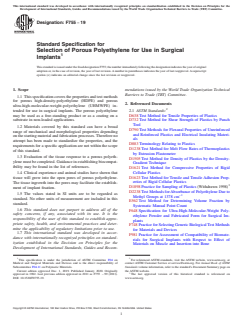
Designation: F755 −19
Standard Specification for
Selection of Porous Polyethylene for Use in Surgical
Implants
ThisstandardisissuedunderthefixeddesignationF755;thenumberimmediatelyfollowingthedesignationindicatestheyearoforiginal
adoptionor,inthecaseofrevision,theyearoflastrevision.Anumberinparenthesesindicatestheyearoflastreapproval.Asuperscript
epsilon (´) indicates an editorial change since the last revision or reapproval.
1. Scope mendations issued by the World Trade Organization Technical
Barriers to Trade (TBT) Committee.
1.1 Thisspecificationcoversthepropertiesandtestmethods
for porous high-density-polyethylene (HDPE) and porous
2. Referenced Documents
ultra-high-molecular-weight-polyethylene (UHMWPE) in-
2.1 ASTM Standards:
tended for use in surgical implants. The porous polyethylene
may be used as a free-standing product or as a coating on a D638Test Method for Tensile Properties of Plastics
D732Test Method for Shear Strength of Plastics by Punch
substrate in non-loaded applications.
Tool
1.2 Materials covered by this standard can have a broad
D790Test Methods for Flexural Properties of Unreinforced
range of mechanical and morphological properties depending
and Reinforced Plastics and Electrical Insulating Materi-
onthestartingmaterialandfabricationprocesses.Thereforeno
als
attempt has been made to standardize the properties, and the
D883Terminology Relating to Plastics
requirementsforaspecificapplicationarenotwithinthescope
D1238Test Method for Melt Flow Rates of Thermoplastics
of this standard.
by Extrusion Plastometer
1.3 Evaluation of the tissue response to a porous polyeth-
D1505Test Method for Density of Plastics by the Density-
ylenemustbecompleted.Guidanceinestablishingbiocompat-
Gradient Technique
ibility may be found in the list of references.
D1621Test Method for Compressive Properties of Rigid
Cellular Plastics
1.4 Clinical experience and animal studies have shown that
D1623Test Method for Tensile and TensileAdhesion Prop-
tissue will grow into the open pores of porous polyethylene.
The tissue ingrowth into the pores may facilitate the establish- erties of Rigid Cellular Plastics
D1898Practice for Sampling of Plastics (Withdrawn 1998)
ment of implant fixation.
D2238TestMethodsforAbsorbanceofPolyethyleneDueto
1.5 The values stated in SI units are to be regarded as
−1
Methyl Groups at 1378 cm
standard. No other units of measurement are included in this
E562Test Method for Determining Volume Fraction by
standard.
Systematic Manual Point Count
1.6 This standard does not purport to address all of the
F648Specification for Ultra-High-Molecular-Weight Poly-
safety concerns, if any, associated with its use. It is the
ethylene Powder and Fabricated Form for Surgical Im-
responsibility of the user of this standard to establish appro-
plants
priate safety, health, and environmental practices and deter-
F748PracticeforSelectingGenericBiologicalTestMethods
mine the applicability of regulatory limitations prior to use.
for Materials and Devices
1.7 This international standard was developed in accor-
F981Practice for Assessment of Compatibility of Biomate-
dance with internationally recognized principles on standard-
rials for Surgical Implants with Respect to Effect of
ization established in the Decision on Principles for the
Materials on Muscle and Insertion into Bone
Development of International Standards, Guides and Recom-
1 2
This specification is under the jurisdiction of ASTM Committee F04 on For referenced ASTM standards, visit the ASTM website, www.astm.org, or
Medical and Surgical Materials and Devices and is the direct responsibility of contact ASTM Customer Service at service@astm.org. For Annual Book of ASTM
Subcommittee F04.11 on Polymeric Materials. Standards volume information, refer to the standard’s Document Summary page on
Current edition approved Dec. 1, 2019. Published January 2020. Originally the ASTM website.
approved in 1982. Last previous edition approved in 2011 as F755 –99 (2011). The last approved version of this historical standard is referenced on
DOI: 10.1520/F0755-19. www.astm.org.
Copyright © ASTM International, 100 Barr Harbor Drive, PO Box C700, West Conshohocken, PA 19428-2959. United States
F755 − 19
F2450Guide for Assessing Microstructure of Polymeric 4.7 The polymer shall be characterized by one or more of
Scaffolds for Use in Tissue-Engineered Medical Products the following test methods:
4.7.1 Thepolymershallbecharacterizedbydeterminingthe
2.2 ISO Standards:
melt point range and rate of melt by thermal analysis.
ISO 10993-1Biological Evaluation of Medical Devices—
4.7.2 Thecompositionalcharacteristicsofthepolymershall
Part1:EvaluationandTestingWithinaRiskManagement
be analyzed by thermogravimetric analysis.
Process
4.7.3 The flow rate of high density polyethylene shall be
2.3 Other Documents:
determined in accordance with Test Method D1238.
Code of Federal RegulationsTitle 21, Paragraph 177.1520
Olefin Polymers
5. Product Requirements
U.S. FDA Guidance Document Use of International Stan-
5.1 The biocompatibility of porous polyethylene materials
dard ISO 10993-1, “Biological Evaluation of Medical
and implant devices made from them shall be determined in
Devices—Part 1: Evaluation and Testing Within a Risk
accordance with ISO 10993-1 or Practice F748, unless other-
Management Process”
wise agreed upon between the supplier, the customer, and
regulating bodies. Additional information on biocompatibility
3. Significance and Use
evaluationandtestselectionisgivenintheU.S.FDAguidance
3.1 Porous polyethylene is a matrix of substantially open
document on the use of ISO 10993-1. It is intended that
cells, interconnected to form multidirectional paths. Perfor-
biocompatibility be established on the finished product by the
mance of these structures, including tissue ingrowth, depends
appropriate procedures depending on the application, after it
upon the biocompatibility of the polymer, average pore and
has gone through all processing steps including sterilization.
interstitial opening diameters (ordinarily referred to as average
5.2 Thesurfaceoftheporouspolyethyleneshallnotcontain
poresize)inconjunctionwithvoidvolume(referredtoaspore
particles of residue or loose particles of plastic of a diameter
volume or percent porosity).
greater than 300 µm. The concentration of particles visible at
3.2 This specification is applicable to all surgical implant
8×magnificationshallnotbegreaterthan10particles/400cm .
devicesinwhichaporouspolyethyleneisused.Inapplications
5.3 The level of extractables found in the porous product
where the use of a porous polyethylene has not been
whentestedinaccordancewith4.5shallnotincreasefromthat
established, the mechanical and physical characteristics re-
found in the raw material.
quiredshallbedeterminedbyappropriatetesting.Therequired
pore size, pore volume, and mechanical properties shall be
5.4 The porous product shall be inspected under 8× magni-
specified.
fication to ensure that the surface porosity is open.
5.5 The average pore size shall be specified by vendor-user
4. Raw Material Requirements
agreement and shall be held to within 20% of the nominal
4.1 The polyethylene plastic shall consist of basic polymers
value unless the end-use application requires less deviation.
made with ethylene as essentially the sole monomer as defined
5.6 Porous product quality and uniformity shall be ensured
in Terminology D883.
by the appropriate test methods as specified by vendor-user
4.2 HDPE shall exhibit a density of not less than 0.941
agreement and listed in Section 6.
g/cm when tested in acco
...
This document is not an ASTM standard and is intended only to provide the user of an ASTM standard an indication of what changes have been made to the previous version. Because
it may not be technically possible to adequately depict all changes accurately, ASTM recommends that users consult prior editions as appropriate. In all cases only the current version
of the standard as published by ASTM is to be considered the official document.
Designation: F755 − 99 (Reapproved 2011) F755 − 19
Standard Specification for
Selection of Porous Polyethylene for Use in Surgical
Implants
This standard is issued under the fixed designation F755; the number immediately following the designation indicates the year of original
adoption or, in the case of revision, the year of last revision. A number in parentheses indicates the year of last reapproval. A superscript
epsilon (´) indicates an editorial change since the last revision or reapproval.
1. Scope
1.1 This specification covers the properties and test methods for porous high density and ultra high molecular weight
polyethylenes high-density-polyethylene (HDPE) and porous ultra-high-molecular-weight-polyethylene (UHMWPE) intended for
use in surgical implants. The porous polyethylene may be used as a free standing free-standing product or as a coating on a
substrate in nonloadednon-loaded applications.
1.2 Materials covered by this standard can have a broad range of mechanical and morphological properties depending on the
starting material and fabrication processes. Therefore no attempt has been made to standardize the properties, and the requirements
for a specific application are not within the scope of this standard.
1.3 Evaluation of the tissue response to a porous polyethylene must be completed. Guidance in establishing biocompatibility
may be found in the list of references.
1.4 Clinical experience and animal studies have shown that tissue will grow into the open pores of porous polyethylene. The
tissue ingrowth into the pores may allow for facilitate the establishment of implant fixation.
1.5 The values stated in SI units are to be regarded as standard. No other units of measurement are included in this standard.
1.6 This sectionstandard does not purport to address all of the safety concerns, if any, associated with its use. It is the
responsibility of the user of this standard to establish appropriate safety safety, health, and healthenvironmental practices and
determine the applicability of regulatory limitations prior to use.
1.7 This international standard was developed in accordance with internationally recognized principles on standardization
established in the Decision on Principles for the Development of International Standards, Guides and Recommendations issued
by the World Trade Organization Technical Barriers to Trade (TBT) Committee.
2. Referenced Documents
2.1 ASTM Standards:
D638 Test Method for Tensile Properties of Plastics
D732 Test Method for Shear Strength of Plastics by Punch Tool
D790 Test Methods for Flexural Properties of Unreinforced and Reinforced Plastics and Electrical Insulating Materials
D883 Terminology Relating to Plastics
D1238 Test Method for Melt Flow Rates of Thermoplastics by Extrusion Plastometer
D1505 Test Method for Density of Plastics by the Density-Gradient Technique
D1621 Test Method for Compressive Properties of Rigid Cellular Plastics
D1623 Test Method for Tensile and Tensile Adhesion Properties of Rigid Cellular Plastics
D1898 Practice for Sampling of Plastics (Withdrawn 1998)
−1
D2238 Test Methods for Absorbance of Polyethylene Due to Methyl Groups at 1378 cm
D2873 Test Method for Interior Porosity of Poly(Vinyl Chloride) (PVC) Resins by Mercury Intrusion Porosimetry (Withdrawn
2003)
This specification is under the jurisdiction of ASTM Committee F04 on Medical and Surgical Materials and Devices and is the direct responsibility of Subcommittee
F04.11 on Polymeric Materials.
Current edition approved Dec. 1, 2011Dec. 1, 2019. Published January 2012January 2020. Originally approved in 1982. Last previous edition approved in 20052011 as
F755 – 99 (2005).(2011). DOI: 10.1520/F0755-99R11. 10.1520/F0755-19.
For referenced ASTM standards, visit the ASTM website, www.astm.org, or contact ASTM Customer Service at service@astm.org. For Annual Book of ASTM Standards
volume information, refer to the standard’s Document Summary page on the ASTM website.
The last approved version of this historical standard is referenced on www.astm.org.
Copyright © ASTM International, 100 Barr Harbor Drive, PO Box C700, West Conshohocken, PA 19428-2959. United States
F755 − 19
E562 Test Method for Determining Volume Fraction by Systematic Manual Point Count
F316 Test Methods for Pore Size Characteristics of Membrane Filters by Bubble Point and Mean Flow Pore Test
F648 Specification for Ultra-High-Molecular-Weight Polyethylene Powder and Fabricated Form for Surgical Implants
F748 Practice for Selecting Generic Biological Test Methods for Materials and Devices
F763 Practice for Short-Term Screening of Implant Materials
F981 Practice for Assessment of Compatibility of Biomaterials for Surgical Implants with Respect to Effect of Materials on
Muscle and Insertion into Bone
F2450 Guide for Assessing Microstructure of Polymeric Scaffolds for Use in Tissue-Engineered Medical Products
2.2 ISO Standards:
ISO 10993-1 Biological Evaluation of Medical Devices—Part 1: Evaluation and Testing Within a Risk Management Process
2.3 Other Documents:
Code of Federal Regulations Title 21, Paragraph 177.1520 Olefin Polymers
U.S. Pharmacopeia,FDA Guidance Document Vol 23, 1995Use of International Standard ISO 10993-1, “Biological Evaluation
of Medical Devices—Part 1: Evaluation and Testing Within a Risk Management Process”
3. Significance and Use
3.1 Porous polyethylene is a matrix of substantially open cells, interconnected to form multidirectional paths. Performance of
these structures, including tissue ingrowth, depends upon the biocompatibility of the polymer, average pore and interstitial opening
diameters (ordinarily referred to as average pore size) in conjunction with void volume (referred to as pore volume or percent
porosity).
3.2 This specification is applicable to all device standards surgical implant devices in which a porous polyethylene is used. A
complete list of end uses has not been established. In those cases In applications where the use of a porous polyethylene has not
been established, the mechanical and physical characteristics required shall be determined by properappropriate testing. The
required pore size, pore volume, and the mechanical properties will be specified in the particular device standard. shall be specified.
4. Raw Material Requirements
4.1 The polyethylene plastic shall consist of basic polymers made with ethylene as essentially the sole monomer as defined in
Terminology D883.
4.2 High-density polyethylene HDPE shall exhibit a density of not less than 0.941 g/cm when tested in accordance with Test
Method D1505.
4.3 Ultra-high-molecular-weight polyethylene UHMWPE shall conform to those sections of Specification F648 that apply to
base resin.
4.4 Particular The raw materials shall contain no dirt or other foreign matter which will cause the end product to fail to meet
the product requirement specified in 5.2. Specification F648 provides a method that may be used to assess the cleanliness of
polyethylene resins for surgical implant applications.
4.5 The polyethylene HDPE resin shall conform to all parts of Paragraph 177.1520 of Title 21CFR Title 21, Paragraph
177.1520 which apply to polyethylene.
4.6 The polymer shall be characterized by determining the infrared absorption spectrum. An acceptable procedure may be found
in Test Methods D2238.
4.7 The polymer shall be characterized by one or more of the following test methods:
4.7.1 The polymer shall be characterized by determining the melt point range and rate of melt by thermal analysis.
4.7.2 The compositional characteristics of the polymer shall be analyzed by thermogravimetric analysis.
4.7.3 The flow rate of high density polyethylene shall be determined in accordance with Test Method D1238.
5. Product Requirements
5.1 Until a porous polymer biocompatibility standard is available, porous polyethylene shall be screened by biocompatibility
and toxicology tests applicable toThe biocompatibility of porous polyethylene materials and implant devices made from them shall
be determined in accordance with ISO 10993-1 or Practice F748its end use. Biological test procedures appropriate to determine
biological safety and tissue reactions are described in Practices, unless otherwise agreed upon between the supplier, the customer,
and regulating bodies. Additional information on biocompatibility evaluation F748 andand test F981 and the United States
Available from American National Standards Institute (ANSI), 25 W. 43rd St., 4th Floor, New York, NY 10036, http://www.ansi.org.
Available from U.S. Government Printing Office Superintendent of Documents, 732 N. Capitol St., NW, Mail Stop: SDE, Washington, DC 20401, http://
www.access.gpo.gov.
Available from U.S. Pharmacopeia (USP), 12601 Twinbrook Pkwy., Rockville, MD 20852-1790, http://www.usp.org.the U.S. FDA, https://www.fda.gov/regulatory-
information/search-fda-guidance-documents.
F755 − 19
Pharmacopeia which recommends generic biological test methods according
...
Questions, Comments and Discussion
Ask us and Technical Secretary will try to provide an answer. You can facilitate discussion about the standard in here.
Loading comments...