


ASTM C1347-08(2023)
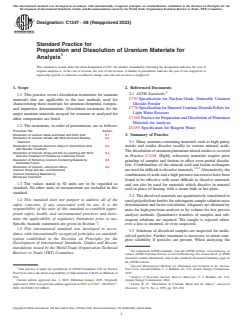
(Practice)Standard Practice for Preparation and Dissolution of Uranium Materials for Analysis
Standard Practice for Preparation and Dissolution of Uranium Materials for Analysis
SIGNIFICANCE AND USE
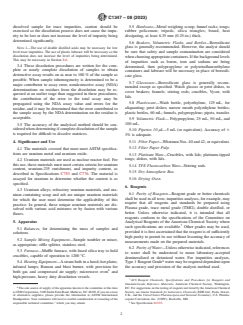
4.1 The materials covered that must meet ASTM specifications are uranium metal and uranium oxide.
4.2 Uranium materials are used as nuclear reactor fuel. For this use, these materials must meet certain criteria for uranium content, uranium-235 enrichment, and impurity content, as described in Specifications C753 and C776. The material is assayed for uranium to determine whether the content is as specified.
4.3 Uranium alloys, refractory uranium materials, and uranium containing scrap and ash are unique uranium materials for which the user must determine the applicability of this practice. In general, these unique uranium materials are dissolved with various acid mixtures or by fusion with various fluxes.
SCOPE
1.1 This practice covers dissolution treatments for uranium materials that are applicable to the test methods used for characterizing these materials for uranium elemental, isotopic, and impurities determinations. Dissolution treatments for the major uranium materials assayed for uranium or analyzed for other components are listed.
1.2 The treatments, in order of presentation, are as follows:
Procedure Title
Section
Dissolution of Uranium Metal and Oxide with Nitric Acid
8.1
Dissolution of Uranium Oxides with Nitric Acid and Residue
Treatment
8.2
Dissolution of Uranium-Aluminum Alloys in Hydrochloric Acid
with Residue Treatment
8.3
Dissolution of Uranium Scrap and Ash by Leaching with Nitric
Acid and Treatment of Residue by Carbonate Fusion
8.4
Dissolution of Refractory Uranium-Containing Material by
Carbonate Fusion
8.5
Dissolution of Uranium—Aluminum Alloys
Uranium Scrap and Ash, and Refractory
Uranium-Containing Materials by
Microwave Treatment
8.6
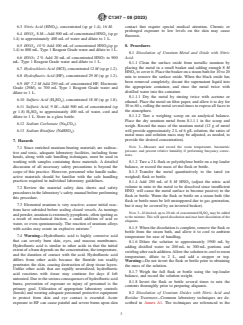
1.3 The values stated in SI units are to be regarded as standard. No other units of measurement are included in this standard.
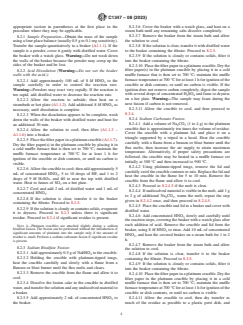
1.4 This standard does not purport to address all of the safety concerns, if any, associated with its use. It is the responsibility of the user of this standard to establish appropriate safety, health, and environmental practices and determine the applicability of regulatory limitations prior to use. Specific hazards statements are given in Section 7.
1.5 This international standard was developed in accordance with internationally recognized principles on standardization established in the Decision on Principles for the Development of International Standards, Guides and Recommendations issued by the World Trade Organization Technical Barriers to Trade (TBT) Committee.
General Information
- Status
- Published
- Publication Date
- 31-Dec-2022
- Technical Committee
- C26 - Nuclear Fuel Cycle
- Drafting Committee
- C26.05 - Methods of Test
Relations
- Effective Date
- 01-Oct-2023
- Effective Date
- 01-Feb-2016
- Effective Date
- 01-Sep-2015
- Effective Date
- 01-Jun-2011
- Effective Date
- 01-Jan-2008
- Effective Date
- 01-Aug-2006
- Effective Date
- 01-Mar-2006
- Effective Date
- 01-Jun-2004
- Effective Date
- 10-Jan-2001
- Effective Date
- 10-Jan-2000
- Effective Date
- 10-Jun-1999
- Effective Date
- 10-Feb-1999
- Effective Date
- 10-Feb-1999
Overview
ASTM C1347-08(2023) - Standard Practice for Preparation and Dissolution of Uranium Materials for Analysis provides the key procedures for the preparation and dissolution of uranium-bearing materials prior to chemical analysis. This standard, maintained by ASTM International, ensures accurate quantification of uranium content, isotopic composition, and impurities - essential for nuclear fuel quality, safety, and regulatory compliance.
The practice applies to uranium metal, uranium oxide, and related materials, outlining specific dissolution techniques for reliable laboratory characterization. These procedures are crucial for meeting the stringent criteria for nuclear reactor fuel as described in other relevant ASTM specifications.
Key Topics
Dissolution Techniques: The standard covers a range of methods using various acids and fusion processes to dissolve uranium metal, uranium oxides, uranium-aluminum alloys, scrap, ash, and refractory uranium-containing materials. Specific approaches include:
- Dissolution with nitric acid (for metals and oxides)
- Hydrochloric acid treatments (especially for uranium-aluminum alloys)
- Microwave-assisted dissolution for challenging matrices
- Fusion with sodium carbonate or bisulfate for residues
Sample Handling and Preparation: Guidelines for quantitative transfer of material, prevention of cross-contamination, and steps to ensure complete or near-complete dissolution are provided to support high-precision analytical work.
Apparatus and Reagents: Details on required labware (glassware, plasticware, platinum crucibles), balances, furnaces, and reagent purity are specified to support accurate analysis and trace impurity measurement.
Safety Practices: Emphasis on safe handling of radioactive, toxic, and corrosive materials, including uranium compounds and acids such as hydrofluoric acid. The standard highlights the need for appropriate laboratory facilities and adherence to safety protocols.
Applications
ASTM C1347-08(2023) is integral to:
- Nuclear Fuel Manufacturing: Ensuring the uranium input meets the strict material and impurity specification for nuclear-reactor fuel elements.
- Quality Control & Assurance: Supporting routine and investigative analyses of uranium materials to monitor consistency and compliance.
- Research & Development: Offering standardized practices for dissolving uranium samples in R&D labs, including the processing of uranium-containing residues, alloys, and unique forms.
- Regulatory Compliance: Providing a recognized method that helps organizations satisfy national and international nuclear material handling standards.
- Waste Management: Facilitating the analysis of uranium-containing scrap and ash for waste minimization or recovery operations.
Related Standards
Organizations working with uranium materials often reference additional ASTM standards for comprehensive quality management and analysis:
- ASTM C753 - Specification for Nuclear-Grade, Sinterable Uranium Dioxide Powder
- ASTM C776 - Specification for Sintered Uranium Dioxide Pellets for Light Water Reactors
- ASTM C1168 - Practice for Preparation and Dissolution of Plutonium Materials for Analysis
- ASTM D1193 - Specification for Reagent Water
These standards, when used in conjunction with ASTM C1347-08(2023), help ensure complete adherence to best practices in uranium analysis and nuclear fuel production.
Keywords: uranium dissolution, uranium analysis, sample preparation, nuclear fuel, uranium oxide, uranium metal, uranium alloys, ASTM C1347-08(2023), uranium impurities, uranium assay, nuclear industry standards, laboratory safety, reagent purity, trace analysis.
Get Certified
Connect with accredited certification bodies for this standard

DNV
DNV is an independent assurance and risk management provider.

Lloyd's Register
Lloyd's Register is a global professional services organisation specialising in engineering and technology.
DNV Energy Systems
Energy and renewable energy certification.
Sponsored listings
Frequently Asked Questions
ASTM C1347-08(2023) is a standard published by ASTM International. Its full title is "Standard Practice for Preparation and Dissolution of Uranium Materials for Analysis". This standard covers: SIGNIFICANCE AND USE 4.1 The materials covered that must meet ASTM specifications are uranium metal and uranium oxide. 4.2 Uranium materials are used as nuclear reactor fuel. For this use, these materials must meet certain criteria for uranium content, uranium-235 enrichment, and impurity content, as described in Specifications C753 and C776. The material is assayed for uranium to determine whether the content is as specified. 4.3 Uranium alloys, refractory uranium materials, and uranium containing scrap and ash are unique uranium materials for which the user must determine the applicability of this practice. In general, these unique uranium materials are dissolved with various acid mixtures or by fusion with various fluxes. SCOPE 1.1 This practice covers dissolution treatments for uranium materials that are applicable to the test methods used for characterizing these materials for uranium elemental, isotopic, and impurities determinations. Dissolution treatments for the major uranium materials assayed for uranium or analyzed for other components are listed. 1.2 The treatments, in order of presentation, are as follows: Procedure Title Section Dissolution of Uranium Metal and Oxide with Nitric Acid 8.1 Dissolution of Uranium Oxides with Nitric Acid and Residue Treatment 8.2 Dissolution of Uranium-Aluminum Alloys in Hydrochloric Acid with Residue Treatment 8.3 Dissolution of Uranium Scrap and Ash by Leaching with Nitric Acid and Treatment of Residue by Carbonate Fusion 8.4 Dissolution of Refractory Uranium-Containing Material by Carbonate Fusion 8.5 Dissolution of Uranium—Aluminum Alloys Uranium Scrap and Ash, and Refractory Uranium-Containing Materials by Microwave Treatment 8.6 1.3 The values stated in SI units are to be regarded as standard. No other units of measurement are included in this standard. 1.4 This standard does not purport to address all of the safety concerns, if any, associated with its use. It is the responsibility of the user of this standard to establish appropriate safety, health, and environmental practices and determine the applicability of regulatory limitations prior to use. Specific hazards statements are given in Section 7. 1.5 This international standard was developed in accordance with internationally recognized principles on standardization established in the Decision on Principles for the Development of International Standards, Guides and Recommendations issued by the World Trade Organization Technical Barriers to Trade (TBT) Committee.
SIGNIFICANCE AND USE 4.1 The materials covered that must meet ASTM specifications are uranium metal and uranium oxide. 4.2 Uranium materials are used as nuclear reactor fuel. For this use, these materials must meet certain criteria for uranium content, uranium-235 enrichment, and impurity content, as described in Specifications C753 and C776. The material is assayed for uranium to determine whether the content is as specified. 4.3 Uranium alloys, refractory uranium materials, and uranium containing scrap and ash are unique uranium materials for which the user must determine the applicability of this practice. In general, these unique uranium materials are dissolved with various acid mixtures or by fusion with various fluxes. SCOPE 1.1 This practice covers dissolution treatments for uranium materials that are applicable to the test methods used for characterizing these materials for uranium elemental, isotopic, and impurities determinations. Dissolution treatments for the major uranium materials assayed for uranium or analyzed for other components are listed. 1.2 The treatments, in order of presentation, are as follows: Procedure Title Section Dissolution of Uranium Metal and Oxide with Nitric Acid 8.1 Dissolution of Uranium Oxides with Nitric Acid and Residue Treatment 8.2 Dissolution of Uranium-Aluminum Alloys in Hydrochloric Acid with Residue Treatment 8.3 Dissolution of Uranium Scrap and Ash by Leaching with Nitric Acid and Treatment of Residue by Carbonate Fusion 8.4 Dissolution of Refractory Uranium-Containing Material by Carbonate Fusion 8.5 Dissolution of Uranium—Aluminum Alloys Uranium Scrap and Ash, and Refractory Uranium-Containing Materials by Microwave Treatment 8.6 1.3 The values stated in SI units are to be regarded as standard. No other units of measurement are included in this standard. 1.4 This standard does not purport to address all of the safety concerns, if any, associated with its use. It is the responsibility of the user of this standard to establish appropriate safety, health, and environmental practices and determine the applicability of regulatory limitations prior to use. Specific hazards statements are given in Section 7. 1.5 This international standard was developed in accordance with internationally recognized principles on standardization established in the Decision on Principles for the Development of International Standards, Guides and Recommendations issued by the World Trade Organization Technical Barriers to Trade (TBT) Committee.
ASTM C1347-08(2023) is classified under the following ICS (International Classification for Standards) categories: 27.120.30 - Fissile materials and nuclear fuel technology. The ICS classification helps identify the subject area and facilitates finding related standards.
ASTM C1347-08(2023) has the following relationships with other standards: It is inter standard links to ASTM C1168-23, ASTM C753-16, ASTM C1168-15, ASTM C776-06(2011), ASTM C1168-08, ASTM C776-06, ASTM D1193-06, ASTM C753-04, ASTM C1168-01, ASTM C776-00, ASTM C753-99, ASTM D1193-99e1, ASTM D1193-99. Understanding these relationships helps ensure you are using the most current and applicable version of the standard.
ASTM C1347-08(2023) is available in PDF format for immediate download after purchase. The document can be added to your cart and obtained through the secure checkout process. Digital delivery ensures instant access to the complete standard document.
Standards Content (Sample)
This international standard was developed in accordance with internationally recognized principles on standardization established in the Decision on Principles for the
Development of International Standards, Guides and Recommendations issued by the World Trade Organization Technical Barriers to Trade (TBT) Committee.
Designation: C1347 − 08 (Reapproved 2023)
Standard Practice for
Preparation and Dissolution of Uranium Materials for
Analysis
This standard is issued under the fixed designation C1347; the number immediately following the designation indicates the year of
original adoption or, in the case of revision, the year of last revision. A number in parentheses indicates the year of last reapproval. A
superscript epsilon (´) indicates an editorial change since the last revision or reapproval.
1. Scope 2. Referenced Documents
2.1 ASTM Standards:
1.1 This practice covers dissolution treatments for uranium
C753 Specification for Nuclear-Grade, Sinterable Uranium
materials that are applicable to the test methods used for
Dioxide Powder
characterizing these materials for uranium elemental, isotopic,
C776 Specification for Sintered Uranium Dioxide Pellets for
and impurities determinations. Dissolution treatments for the
Light Water Reactors
major uranium materials assayed for uranium or analyzed for
C1168 PracticeforPreparationandDissolutionofPlutonium
other components are listed.
Materials for Analysis
1.2 The treatments, in order of presentation, are as follows:
D1193 Specification for Reagent Water
Procedure Title Section
Dissolution of Uranium Metal and Oxide with NitricAcid 8.1
3. Summary of Practice
Dissolution of Uranium Oxides with NitricAcid and Residue 8.2
Treatment 3.1 Many uranium-containing materials such as high-purity
Dissolution of Uranium-AluminumAlloys in HydrochloricAcid 8.3
metals and oxides dissolve readily in various mineral acids.
with Residue Treatment
The dissolution of uranium-plutonium mixed oxides is covered
Dissolution of Uranium Scrap andAsh by Leaching with Nitric 8.4
Acid and Treatment of Residue by Carbonate Fusion in Practice C1168. Highly refractory materials require prior
Dissolution of Refractory Uranium-Containing Material by 8.5
grinding of samples and fusions to affect even partial dissolu-
Carbonate Fusion
tion. Combinations of the mineral acid and fusion techniques
Dissolution of Uranium—AluminumAlloys 8.6
3,4,5
areusedfordifficulttodissolvematerials. Alternatively,the
Uranium Scrap andAsh, and Refractory
Uranium-Containing Materials by
combinationofacidsandahighpressuremicrowavehavebeen
Microwave Treatment
found to be effective with more difficult to dissolve materials
1.3 The values stated in SI units are to be regarded as
and can also be used for materials which dissolve in mineral
standard. No other units of measurement are included in this
acid in place of heating with a steam bath or hot plate.
standard.
3.2 The dissolved materials are quantitatively transferred to
1.4 This standard does not purport to address all of the
tared polyethylene bottles for subsequent sample solution mass
safety concerns, if any, associated with its use. It is the
determination and factor calculation.Aliquants are obtained by
responsibility of the user of this standard to establish appro-
mass for high-precision analysis or by volume for less precise
priate safety, health, and environmental practices and deter-
analysis methods. Quantitative transfers of samples and sub-
mine the applicability of regulatory limitations prior to use.
sequent solutions are required. The sample is rejected when-
Specific hazards statements are given in Section 7.
ever a loss is incurred, or even suspected.
1.5 This international standard was developed in accor-
3.3 Solutions of dissolved samples are inspected for undis-
dance with internationally recognized principles on standard-
solved particles. Further treatment is necessary to attain com-
ization established in the Decision on Principles for the
plete solubility if particles are present. When analyzing the
Development of International Standards, Guides and Recom-
mendations issued by the World Trade Organization Technical
For referenced ASTM standards, visit the ASTM website, www.astm.org, or
Barriers to Trade (TBT) Committee.
contact ASTM Customer Service at service@astm.org. For Annual Book of ASTM
Standards volume information, refer to the standard’s Document Summary page on
the ASTM website.
Selected Measurement Methods for Plutonium and Uranium in the Nuclear
This practice is under the jurisdiction of ASTM Committee C26 on Nuclear Fuel Cycle, Second Edition, C. J. Rodden, ed., U.S. Atomic Energy Commission,
Fuel Cycle and is the direct responsibility of Subcommittee C26.05 on Methods of 1972.
Test. Analysis of Essential Nuclear Reactor Materials, C. J. Rodden, ed., U.S.
Current edition approved Jan. 1, 2023. Published January 2023. Originally Atomic Energy Commission, 1964.
ɛ1
approved in 1996. Last previous edition approved in 2014 as C1347 – 08 (2014) . Larsen, R. P., “Dissolution of Uranium Metal and Its Alloys,” Analytical
DOI: 10.1520/C1347-08R23. Chemistry , Vol 31, No. 4, 1959, pp. 545–549.
Copyright ©ASTM International, 100 Barr Harbor Drive, PO Box C700, West Conshohocken, PA19428-2959. United States
C1347 − 08 (2023)
dissolved sample for trace impurities, caution should be 5.5 Hardware—Metal weighing scoop; funnel racks; tongs;
exercised so the dissolution process does not cause the impu- rubber policemen; tripods; silica triangles; board, heat
rity to be lost or does not increase the level of impurity being dissipating, at least 6.35 mm (0.25-in.) thick.
determined significantly.
5.6 Beakers, Volumetric Flasks, and Bottles—Borosilicate
glass is generally recommended. However, the analyst should
NOTE 1—The use of double distilled acids may be necessary for low
level trace impurities. The use of plastic labware will be necessary so the
be sure that safety and sample contamination are considered
dissolution does not increase the level of impurities being determined.
whenchoosingappropriatecontainers.Ifthebackgroundlevels
This may be necessary in Section 8.6.
of impurities such as boron, iron and sodium are being
3.4 These dissolution procedures are written for the com-
determined, then polypropylene or polytetrafluoroethylene
plete or nearly complete dissolution of samples to obtain
containers and labware will be necessary in place of borosili-
destructive assay results on as near to 100 % of the sample as
cate glass.
possible. When sample inhomogeneity is determined to be a
5.7 Glassware—Borosilicate glass is generally recom-
major contributor to assay error, nondestructive assay (NDA)
mended except as specified. Watch glasses or petri dishes, to
determinations on residues from the dissolution may be re-
cover beakers; funnels; stirring rods; crucibles, Vycor, with
quested at an earlier stage than suggested in these procedures;
lids.
the contribution of the error to the total assay may be
5.8 Plasticware—Wash bottle, polyethylene, 125 mL, for
propagated using the NDA assay value and errors for the
aliquanting; petri dishes; narrow mouth polyethylene bottles;
residue, and it may be determined that the error contributed to
plastic bottles, 60 mL; funnels, polypropylene; pipets, transfer.
the sample assay by the NDA determination on the residue is
acceptable.
5.9 Volumetric Flask— Polypropylene, 25 mL, 50 mL, and
100 mL.
3.5 The accuracy of the analytical method should be con-
sideredwhendeterminingifcompletedissolutionofthesample
5.10 Pipettes 10 µL—5 mL (or equivalent). Accuracy of 6
is required for difficult to dissolve matrices.
3% is adequate.
5.11 Filter Paper—Whatman Nos. 40 and 42, or equivalent.
4. Significance and Use
5.12 Filter Paper Pulp.
4.1 The materials covered that must meet ASTM specifica-
tions are uranium metal and uranium oxide.
5.13 Platinum Ware—Crucibles, with lids; platinum-tipped
tongs; dishes, with lids.
4.2 Uranium materials are used as nuclear reactor fuel. For
this use, these materials must meet certain criteria for uranium
5.14 TFE Fluorocarbon Ware—Stirring rods.
content, uranium-235 enrichment, and impurity content, as
5.15 Dry Atmosphere Box.
described in Specifications C753 and C776. The material is
5.16 Drying Oven.
assayed for uranium to determine whether the content is as
specified.
6. Reagents
4.3 Uranium alloys, refractory uranium materials, and ura-
6.1 Purity of Reagents—Reagent grade or better chemicals
nium containing scrap and ash are unique uranium materials
shall be used in all tests; impurities analyses, for example, may
for which the user must determine the applicability of this
require that all reagents and standards be prepared using
practice. In general, these unique uranium materials are dis-
Plasma grade, trace metal grade (TMG), double distilled, or
solved with various acid mixtures or by fusion with various
better. Unless otherwise indicated, it is intended that all
fluxes.
reagents conform to the specifications of the Committee on
5. Apparatus
Analytical Reagents of the American Chemical Society where
such specifications are available. Other grades may be used,
5.1 Balances, for determining the mass of samples and
provided it is first ascertained that the reagent is of sufficiently
solutions.
high purity to permit its use without lessening the accuracy of
5.2 Sample Mixing Equipment—Sample tumbler or mixer,
measurements made on the prepared materials.
as appropriate; riffle splitter, stainless steel.
6.2 Purity of Water—Unless otherwise indicated, references
5.3 Furnace—Muffle furnace, with fused silica tray to hold
to water shall be understood to mean laboratory-accepted
crucibles, capable of operation to 1200 °C.
demineralized or deionized water. For impurities analyses,
5.4 Heating Equipment—Asteam bath in a hood; hot plates; Type 1 Reagent Grade water may be required dependent upon
infrared lamps; Bunsen and blast burner, with provision for the accuracy and precision of the analysis method used.
both gas and compressed air supply; microwave oven and
high-pressure, heavy duty dissolution vessels.
ACS Reagent Chemicals, Specifications and Procedures for Reagents and
Standard-Grade Reference Materials, American Chemical Society, Washington,
The sole source of supply of the apparatus known to the committee at this time DC. For suggestions on the testing of reagents not listed by theAmerican Chemical
isCEMCorporation,3100SmithFarmRoad,Mathews,NC28105.Ifyouareaware Society, see Analar Standards for Laboratory Chemicals, BDH Ltd., Poole, Dorset,
of alternative suppliers, please provide the information to ASTM International U.K., and the United States Pharmacopeia and National Formulary, U.S. Pharma-
Headquarters.Your comments will receive careful consideration at a meeting of the copeial Convention, Inc. (USPC), Rockville, MD.
1 8
responsible technical committee, which you may attend. See Specification D1193.
C1347 − 08 (2023)
6.3 Nitric Acid (HNO ), concentrated (sp gr 1.4), 16 M. contact that require special medical attention. Chronic or
prolonged exposure to low levels on the skin may cause
6.4 HNO , 8 M—Add 500 mLof concentrated HNO (sp gr
3 3
fluorosis.
1.4) to approximately 400 mL of water and dilute to 1 L.
6.5 HNO ,10% Add 100 mL of concentrated HNO (sp gr
8. Procedures
3 3
1.4) to 800 mL. Type 1 Reagent Grade water and dilute to 1 L.
8.1 Dissolution of Uranium Metal and Oxide with Nitric
6.6 HNO ,2% Add 20 mL of concentrated HNO to 900
Acid:
3 3
mL. Type 1 Reagent Grade water and dilute to 1 L.
8.1.1 Clean the surface oxide from metallic uranium by
placing the metal in a small beaker and adding enough 8 M
6.7 Hydrochloric Acid(HCI),concentrated12 M(spgr1.2).
HNO to cover it. Place the beaker on a steam bath for 10 to 20
6.8 Hydrofluoric Acid (HF), concentrated 29 M (sp gr 1.2).
min to remove the surface oxide. When the black oxide has
been removed completely, decant the supernatant liquid into
6.9 HF 7.2 M Add 250 mL of concentrated HF, Electronic
the appropriate container, and rinse the metal twice with
Grade (29M), to 700 mL Type 1 Reagent Grade water and
distilled water into the container.
dilute to 1 L.
8.1.1.1 Dry the metal by rinsing twice with acetone or
6.10 Sulfuric Acid (H SO ), concentrated 18 M (sp gr 1.8).
2 4
ethanol. Place the metal on filter paper, and allow it to dry for
30 to 60 s, rolling the metal several times to expose all faces to
6.11 Sulfuric Acid, 9 M—Add 500 mL of concentrated (sp
the atmosphere.
gr 1.8) H SO to approximately 400 mL of water, cool and
2 4
8.1.1.2 Tare a weighing scoop on an analytical balance.
dilute to 1 L. Store in a glass bottle.
Place the dry uranium metal from 8.1.1.1 in the scoop and
6.12 Sodium Carbonate (Na CO ).
2 3
weigh. Record the mass of the uranium metal (12 g of metal
will provide approximately 2 L of 6 g/L solution; the ratios of
6.13 Sodium Bisulfate (NaHSO ).
metal mass and solution mass may be adjusted, as needed, to
provide the desired concentration).
7. Hazards
NOTE 2—Measure and record the room temperature, barometric
7.1 Since enriched uranium-bearing materials are radioac-
pressure, and percent relative humidity if performing buoyancy correc-
tive and toxic, adequate laboratory facilities, including fume
tions.
hoods, along with safe handling techniques, must be used in
8.1.2 Tare a 2 L flask or polyethylene bottle on a top loader
working with samples containing these materials. A detailed
balance, or record the mass of the flask or bottle.
discussion of all necessary safety precautions is beyond the
scope of this practice. However, personnel who handle radio- 8.1.3 Transfer the metal quantitatively to the tared (or
active materials should be familiar with the safe handling weighed) flask or bottle.
practices required in individual laboratory guidelines.
8.1.4 Add 250 mL of 8 M HNO (adjust the nitric acid
volume in ratio to the metal to be dissolved since insufficient
7.2 Review the material safety data sheets and safety
HNO will cause the metal surface to become passive) to the
proceduresinthelaboratory’ssafetymanualbeforeperforming
flask or bottle. Warm the flask or bottle on a steam bath (the
this procedure.
flask or bottle must be left unstoppered due to gas generation,
7.3 Elemental uranium is very reactive; assure initial reac-
but it may be covered by an inverted beaker).
tions have subsided before sealing closed vessels. As turnings
NOTE 3—If desired, up to 20 mLof concentrated H SO may be added
2 4
andpowder,uraniumisextremelypyrophoric,oftenignitingas
to the mixture.This will speed dissolution and ease later dissolution of the
a result of mechanical friction, a small addition of acid or
aliquants.
water, or even spontaneously. The reaction of uranium alloys
8.1.5 When the dissolution is complete, remove the flask or
with acides may create an explosive mixture.
bottle from the steam bath, and allow it to cool to ambient
7.4 Warning—Hydrofluoric acid is highly corrosive acid
temperature for ease of handling.
that can severly burn skin, eyes, and mucous membranes.
8.1.6 Dilute the solution to approximately 1900 mL by
Hydrofluoric acid is similar to other acids in that the initial
adding distilled water in 200 mL to 300 mL portions and
extent of a burn depends on the concentration, the temperature,
swirling after each addition.Allow the solution to cool to room
and the duration of contact with the acid. Hydrofluoric acid
temperature, dilute to 2 L, and add a stopper or top.
differs from other acids because the fluoride ion readily
Warning—Do not invert the flask or bottle prior to obtaining
penetrates the skin, causing destruction of deep tissue layers.
the mass of the solution.
Unlike other acids that are rapidly neutralized, hydrofluoric
8.1.7 Weigh the full flask or bottle using the top-loader
acid reactions with tissue may continue for days if left
balance, and record the solution weight.
untreated.Duetotheseriousconsequencesofhydrofluoricacid
8.1.8 Invert the flask or bottle several times to mix the
burns, prevention of exposure or injury of personnel is the
contents thoroughly prior to preparing aliquants.
primary goal. Utilization of appropriate laboratory controls
(hoods) and wearing adequate personnel protective equipment 8.2 Dissolution of Uranium Oxides with Nitric Acid and
to protect from skin and eye contact is essential. Acute Residue Treatment—Common laboratory techniques are de-
exposure to HF can cause painful and severe burns upon skin scribed in Annex A1. The techniques are referenced to the
C1347 − 08 (2023)
appropriate section in parentheses at the first place in the 8.2.3.6 Cover the beaker with a watch glass, and heat on a
procedure where they may be applicable. steam bath until any remaining salts dissolve completely.
8.2.1 Sample Preparation—Obtain the mass of the sample 8.2.3.7 Remove the beaker from the steam bath and allow
the solution to cool.
using a four-place balance (usually 0.5 g to 0.1 mg sensitivity).
Transfer the sample quantitatively to a beaker (A1.1.1). If the 8.2.3.8 If the solution is clear, transfer it with distilled water
sample is a powder, cover it gently with distilled water. Cover to the beaker containing the filtrate. Proceed to 8.2.5.
the beaker with a watch glass. Warning—Do not wash down
8.2.3.9 If the solution is cloudy or contains solids, filter it
the walls of the beaker because the powder may creep up the into the beaker containing the filtrate.
sides of the beaker and be lost.
8.2.3.10 Placethefilterpaperinaplatinumcrucible.Drythe
8.2.2 Acid Dissolution (Warning—Do not wet the beaker filter paper(s) in the platinum crucible by placing it in a cold
walls with the acid.): muffle furnace that is then set to 700 °C; maintain the muffle
furnacetemperatureat700 °Cforatleast1hforignitionofthe
8.2.2.1 Add approximately 100 mL of 8 M HNO to the
crucible or dish contents, or until no carbon is visible. If the
sample carefully in order to control the reaction rate.
ignition does not remove carbon completely, digest the sample
Warning—Powders may react very rapidly. If the reaction is
with several drops of concentrated H SO and fume to dryness
too rapid, add distilled water to decrease the reaction rate.
2 4
on a hot plate. Warning—The sample may foam during the
8.2.2.2 Allow the reaction to subside; then heat on a
next fusion if carbon is not removed.
steambath or hot plate (A1.1.2). Add additional 8 M HNO as
8.2.3.11 Allow the crucible to cool, and then proceed to
necessary, until dissolution is complete.
8.2.4.
8.2.2.3 When the dissolution appears to be complete, wash
8.2.4 Sodium Carbonate Fusion:
down the walls of the beaker with distilled water and heat for
8.2.4.1 Add a volume of Na CO (1 to 4 g) to the platinum
an additional 30 min.
2 3
crucible that is approximately ten times the volume of residue.
8.2.2.4 Allow the solution to cool; then filter (A1.1.3 –
Cover the crucible with a platinum lid, and place it on a
A1.1.6) into a beaker.
triangle supported by a tripod in a hood. Heat the crucible
8.2.2.5 Placethefilterpaperinaplatinumcrucible(A1.1.7).
carefully with a flame from a bunsen or blast burner until the
Dry the filter paper(s) in the platinum crucible by placing it in
flux melts; then increase the air supply to attain maximum
a cold muffle furnace that is then set to 700 °C; maintain the
temperature. Alternatively, if proper safety precautions are
muffle furnace temperature at 700 °C for at least1hfor
followed, the crucible may be heated in a muffle furnace set
ignition of the crucible or dish contents, or until no carbon is
initially at 300 °C and then increased to 900 °C.
visible.
8.2.4.2 Using platinum-tipped tongs, remove the lid and
8.2.2.6 Allowthecrucibletocool;thenaddapproximately5
carefullyswirlthecruciblecontentstomix.Replacethelidand
mL of concentrated HNO , 5 to 10 drops of HF, and 1 to 2
heat the crucible in the flame for 5 to 10 min. Remove the
drops of 9 M H SO , and fill to near the top with distilled
2 4
crucible from the flame and allow it to cool.
water. Heat to fumes of SO on a hot plate.
8.2.4.3 Proceed to 8.2.4.5 if the melt is clear.
8.2.2.7 Cool and add 2 mL of distilled water and 1 mL of
8.2.4.4 If undissolved material is visible in the melt, add 1 g
concentrated HNO .
to2gof additional Na CO , warm the melt, repeat the step
2 3
8.2.2.8 If the solution is clear, transfer it to the beaker
given in 8.2.4.2 once, and then proceed to 8.2.4.5.
containing the filtrate. Proceed to 8.2.5.
8.2.4.5 Place the crucible and lid in a beaker and cover with
8.2.2.9 Ifthesolutioniscloudyorcontainssolids,evaporate
distilled water.
it to dryness. Proceed to 8.2.3 unless there is significant
8.2.4.6 Add concentrated HNO slowly and carefully until
residue. Proceed to 8.2.4 if significant residue is present.
the reaction stops, covering the beaker with a watch glass after
NOTE 4—Platinum crucibles are attacked slightly during a sodium each addition of acid. Remove the crucible and lid from the
bisulfate fusion. The fusion can be performed without the introduction of
beaker, using 8 M HNO to rinse. Add 10 mL of concentrated
significant amounts of platinum into the sample only if the amount of
HNO , and heat the covered beaker on a steam bath for 1 to 2
residue is small. Perform a sodium carbonate fusion if significant residue
h.
is present.
8.2.4.7 Remove the beaker from the steam bath and allow
8.2.3 Sodium Bisulfate Fusion:
the solution to cool.
8.2.3.1 Addapproximately0.5gofNaHSO tothecrucible.
8.2.4.8 If the solution is clear, transfer it to the beaker
8.2.3.2 Holding the crucible with platinum-tipped tongs,
containing the filtrate. Proceed to 8.2.5.
heat the crucible carefully and slowly with a flame from a
8.2.4.9 If the solution is cloudy or contains solids, filter it
Bunsen or blast burner until the flux melts and clears.
into the beaker containing the filtrate.
8.2.3.3 Remove the crucible from the flame and allow it to
8.2.4.10 Placethefilterpaperinaplatinumcrucible.Drythe
cool.
filter paper in the platinum crucible by placing it in a cold
8.2.3.4 Dissolve the fusion cake in the crucible in distilled
muffle furnace that is then set to 700 °C; maintain the muffle
water,andtransferthesolutionandanyundissolvedmaterialto
furnacetemperatureat700 °Cforatleast1hforignitionofthe
a beaker.
crucible or dish contents, or until no carbon is visible.
8.2.3.5 Add approximately 2 mL of concentrated HNO to 8.2.4.11 Allow the crucible to cool, then dry transfer as
the beaker. much of the residue as possible to a plastic petri dish, and
C1347 − 08 (2023)
submit it for uranium assay. Save the crucible, which may 8.3.2.5 If the solution appears clear, filter (A1.1.3 – A1.1.6)
contain a small amount of residue, until it is determined it into a beaker using Whatman No. 42 filter paper, or
whether further treatment is required. equivalent.
8.3.2.6 If the solution is cloudy or murky, filter it first into
8.2.4.12 If the residue contains less than 0.01 % of the
a beaker using Whatman No. 40 filter paper, or equivalent.
amount of uranium estimated to be in the sample, proceed to
Then refilter the solution into another beaker using Whatman
8.2.5.
No. 42 filter paper, or equivalent.
8.2.4.1
...
Questions, Comments and Discussion
Ask us and Technical Secretary will try to provide an answer. You can facilitate discussion about the standard in here.
Loading comments...