

ASTM B339-19
(Specification)Standard Specification for Pig Tin
General Information
- Abstract
ABSTRACT
This specification covers refined tin in pig form recovered and cast from primary and secondary tin bearing materials. One grade of tin metal is specified and is designated as Grade A. The refined tin shall be produced from primary, secondary, or a combination of tin-bearing materials to obtain the requirements of this specification, and may be manufactured by fire refining, vacuum refining, electrolytic or electrowinning refining methods, or a combination of these methods. The metal shall conform to the chemical composition requirements prescribed for tin, antimony, arsenic, bismuth, cadmium, copper, iron, lead, nickel, sulfur, zinc, silver, and other impurities. All tin of Grade A produced and cast at one time shall constitute a lot for chemical analysis. Sampling for chemical analysis shall be one of the following methods: (1) sampling from the lot during casting, and (2) sampling from the solidified cast pig product by sawing, drilling, or melting. The methods of sampling cast pig product are illustrated. If product analysis is desired, it may be made by methods including, but not limited to, wet chemical or spectrographic techniques.
SIGNIFICANCE AND USE
11.1 For the purpose of determining compliance with the specified limits for requirements of the properties listed in Table 1, an observed value or a calculated value shall be rounded as indicated in accordance with the rounding method of Practice E29.
SCOPE
1.1 This specification covers refined tin in pig form recovered and cast from primary and secondary tin-bearing materials. One grade of tin metal is specified and is designated by the grade letter shown in Table 1.
1.2 The percent values of tin contained are to be regarded as the standard.
1.3 The values stated in inch-pound units are to be regarded as standard. The values given in parentheses are mathematical conversions to SI units that are provided for information only and are not considered standard.
1.4 This standard does not purport to address all of the safety concerns, if any, associated with its use. It is the responsibility of the user of this standard to become familiar with all hazards including those identified in the appropriate Material Safety Data Sheet (MSDS) for this product/material as provided by the manufacturer, to establish appropriate safety, health, and environmental practices, and determine the applicability of regulatory limitations prior to use.
1.5 This international standard was developed in accordance with internationally recognized principles on standardization established in the Decision on Principles for the Development of International Standards, Guides and Recommendations issued by the World Trade Organization Technical Barriers to Trade (TBT) Committee.
- Status
- Published
- Publication Date
- 31-Oct-2019
- Technical Committee
- B02 - Nonferrous Metals and Alloys
- Drafting Committee
- B02.02 - Refined Lead, Tin, Antimony, and Their Alloys
Overview
ASTM B339-19: Standard Specification for Pig Tin establishes the requirements for refined tin supplied in pig form, originating from primary or secondary tin-bearing materials. Developed by ASTM International, this specification defines a single grade, known as Grade A, and sets mandatory criteria for chemical composition, manufacturing processes, sampling, and marking. Pig tin produced under this standard is widely utilized in various metallurgical, chemical, and industrial applications where high purity is required.
Key Topics
Chemical Composition and Purity
- Specifies minimum tin content (99.85%) for Grade A pig tin.
- Sets stringent limits for allowable impurities, including antimony, arsenic, bismuth, cadmium, copper, iron, lead, nickel, sulfur, zinc, and silver.
- Allows the inclusion of other impurities in minimal amounts, ensuring product consistency and suitability for sensitive applications.
Manufacturing and Refining Methods
- Permits the use of primary or secondary source materials, or a combination thereof.
- Accepts various production methods, such as fire refining, vacuum refining, electrolytic refining, or electrowinning, to achieve the required purity.
Sampling and Analysis
- Outlines strict procedures for sampling, which may be done either during the casting process or from the solidified pig.
- Accepts mechanical sawing, drilling, or melting as sampling methods, depending on lot size and agreement between manufacturer and purchaser.
- Recommends analytical techniques including wet chemical or spectrographic analysis for determining chemical composition.
- Mandates representative sampling to verify conformance with the specification.
Product Marking and Certification
- Requires clear manufacturer identification to be cast or stamped on each pig.
- Ensures traceability through unique lot numbers.
- Offers provisions for certificates of analysis and weight certification upon request.
Applications
Pig tin produced according to ASTM B339-19 is essential for:
- Manufacture of tinplate for food containers, electronics, and automotive components.
- Production of specialized alloys and solders for electrical, plumbing, and industrial applications, where precise chemical composition and low impurity levels are critical.
- Serving as a raw material for chemical processes or further refining into ultra-high purity tin for advanced technological uses.
- Utilization in industries requiring stable, high-quality tin with guaranteed traceability and conformity to international norms.
Related Standards
ASTM B339-19 references and aligns with several key ASTM documents:
- ASTM E29: Practice for rounding significant digits in test data for conformance with specifications.
- ASTM E88: Practice for sampling nonferrous metals and alloys in cast form, ensuring representative chemical analysis.
- Historical methods such as ASTM E46, E51, and E57 for chemical or spectrographic analysis of lead, tin, and white metal alloys.
Additional relevance:
- Compliance with international standardization principles as stated by the World Trade Organization's Technical Barriers to Trade (TBT) Committee.
- Direct implications for procurement, material verification, and quality assurance in supply chains handling refined tin.
Keywords: pig tin, ASTM B339, tin specification, tin purity, industrial metals, chemical analysis, refined tin, pig cast, nonferrous metals, tin alloys, metal certification, sampling methods, impurity limits.
This document serves as a critical reference for purchasers, manufacturers, and quality assurance professionals seeking to ensure the reliability, purity, and consistent performance of pig tin in demanding applications.
Relations
- Effective Date
- 01-Nov-2019
- Effective Date
- 01-Sep-2017
- Effective Date
- 01-May-2011
- Effective Date
- 01-Oct-2008
- Effective Date
- 15-Nov-2006
- Effective Date
- 15-Sep-2006
- Effective Date
- 01-May-2006
- Effective Date
- 01-Oct-2005
- Effective Date
- 01-Dec-2004
- Effective Date
- 10-May-2002
- Effective Date
- 01-Jan-2001
- Effective Date
- 01-Jan-2001
- Effective Date
- 10-May-1999
- Effective Date
- 01-Nov-2019
- Effective Date
- 01-Nov-2019
Get Certified
Connect with accredited certification bodies for this standard

Element Materials Technology
Materials testing and product certification.

Inštitut za kovinske materiale in tehnologije
Institute of Metals and Technology. Materials testing, metallurgical analysis, NDT.
Sponsored listings
Frequently Asked Questions
ASTM B339-19 is a technical specification published by ASTM International. Its full title is "Standard Specification for Pig Tin". This standard covers: ABSTRACT This specification covers refined tin in pig form recovered and cast from primary and secondary tin bearing materials. One grade of tin metal is specified and is designated as Grade A. The refined tin shall be produced from primary, secondary, or a combination of tin-bearing materials to obtain the requirements of this specification, and may be manufactured by fire refining, vacuum refining, electrolytic or electrowinning refining methods, or a combination of these methods. The metal shall conform to the chemical composition requirements prescribed for tin, antimony, arsenic, bismuth, cadmium, copper, iron, lead, nickel, sulfur, zinc, silver, and other impurities. All tin of Grade A produced and cast at one time shall constitute a lot for chemical analysis. Sampling for chemical analysis shall be one of the following methods: (1) sampling from the lot during casting, and (2) sampling from the solidified cast pig product by sawing, drilling, or melting. The methods of sampling cast pig product are illustrated. If product analysis is desired, it may be made by methods including, but not limited to, wet chemical or spectrographic techniques. SIGNIFICANCE AND USE 11.1 For the purpose of determining compliance with the specified limits for requirements of the properties listed in Table 1, an observed value or a calculated value shall be rounded as indicated in accordance with the rounding method of Practice E29. SCOPE 1.1 This specification covers refined tin in pig form recovered and cast from primary and secondary tin-bearing materials. One grade of tin metal is specified and is designated by the grade letter shown in Table 1. 1.2 The percent values of tin contained are to be regarded as the standard. 1.3 The values stated in inch-pound units are to be regarded as standard. The values given in parentheses are mathematical conversions to SI units that are provided for information only and are not considered standard. 1.4 This standard does not purport to address all of the safety concerns, if any, associated with its use. It is the responsibility of the user of this standard to become familiar with all hazards including those identified in the appropriate Material Safety Data Sheet (MSDS) for this product/material as provided by the manufacturer, to establish appropriate safety, health, and environmental practices, and determine the applicability of regulatory limitations prior to use. 1.5 This international standard was developed in accordance with internationally recognized principles on standardization established in the Decision on Principles for the Development of International Standards, Guides and Recommendations issued by the World Trade Organization Technical Barriers to Trade (TBT) Committee.
ABSTRACT This specification covers refined tin in pig form recovered and cast from primary and secondary tin bearing materials. One grade of tin metal is specified and is designated as Grade A. The refined tin shall be produced from primary, secondary, or a combination of tin-bearing materials to obtain the requirements of this specification, and may be manufactured by fire refining, vacuum refining, electrolytic or electrowinning refining methods, or a combination of these methods. The metal shall conform to the chemical composition requirements prescribed for tin, antimony, arsenic, bismuth, cadmium, copper, iron, lead, nickel, sulfur, zinc, silver, and other impurities. All tin of Grade A produced and cast at one time shall constitute a lot for chemical analysis. Sampling for chemical analysis shall be one of the following methods: (1) sampling from the lot during casting, and (2) sampling from the solidified cast pig product by sawing, drilling, or melting. The methods of sampling cast pig product are illustrated. If product analysis is desired, it may be made by methods including, but not limited to, wet chemical or spectrographic techniques. SIGNIFICANCE AND USE 11.1 For the purpose of determining compliance with the specified limits for requirements of the properties listed in Table 1, an observed value or a calculated value shall be rounded as indicated in accordance with the rounding method of Practice E29. SCOPE 1.1 This specification covers refined tin in pig form recovered and cast from primary and secondary tin-bearing materials. One grade of tin metal is specified and is designated by the grade letter shown in Table 1. 1.2 The percent values of tin contained are to be regarded as the standard. 1.3 The values stated in inch-pound units are to be regarded as standard. The values given in parentheses are mathematical conversions to SI units that are provided for information only and are not considered standard. 1.4 This standard does not purport to address all of the safety concerns, if any, associated with its use. It is the responsibility of the user of this standard to become familiar with all hazards including those identified in the appropriate Material Safety Data Sheet (MSDS) for this product/material as provided by the manufacturer, to establish appropriate safety, health, and environmental practices, and determine the applicability of regulatory limitations prior to use. 1.5 This international standard was developed in accordance with internationally recognized principles on standardization established in the Decision on Principles for the Development of International Standards, Guides and Recommendations issued by the World Trade Organization Technical Barriers to Trade (TBT) Committee.
ASTM B339-19 is classified under the following ICS (International Classification for Standards) categories: 77.120.60 - Lead, zinc, tin and their alloys. The ICS classification helps identify the subject area and facilitates finding related standards.
ASTM B339-19 has the following relationships with other standards: It is inter standard links to ASTM B339-12, ASTM E88-11(2017), ASTM E88-11, ASTM E29-08, ASTM E29-06b, ASTM E29-06a, ASTM E29-06, ASTM E88-91(2005), ASTM E29-04, ASTM E29-02e1, ASTM E88-91(2001), ASTM E88-91(1996), ASTM E29-93a(1999), ASTM B200-22, ASTM A626/A626M-22. Understanding these relationships helps ensure you are using the most current and applicable version of the standard.
ASTM B339-19 is available in PDF format for immediate download after purchase. The document can be added to your cart and obtained through the secure checkout process. Digital delivery ensures instant access to the complete standard document.
Standards Content (Sample)
This international standard was developed in accordance with internationally recognized principles on standardization established in the Decision on Principles for the
Development of International Standards, Guides and Recommendations issued by the World Trade Organization Technical Barriers to Trade (TBT) Committee.
Designation:B339 −19
Standard Specification for
Pig Tin
This standard is issued under the fixed designation B339; the number immediately following the designation indicates the year of
original adoption or, in the case of revision, the year of last revision. A number in parentheses indicates the year of last reapproval. A
superscript epsilon (´) indicates an editorial change since the last revision or reapproval.
This standard has been approved for use by agencies of the U.S. Department of Defense.
1. Scope Tin-Base Solder (Withdrawn 1994)
E51 Method for Spectrographic Analysis of Tin Alloys by
1.1 This specification covers refined tin in pig form recov-
the Powder Technique (Withdrawn 1983)
ered and cast from primary and secondary tin-bearing materi-
E57 Methods for ChemicalAnalysis ofWhite Metal Bearing
als. One grade of tin metal is specified and is designated by the
Alloys (Withdrawn 1986)
grade letter shown in Table 1.
E88 Practice for Sampling Nonferrous Metals and Alloys in
1.2 The percent values of tin contained are to be regarded as
Cast Form for Determination of Chemical Composition
the standard.
1.3 The values stated in inch-pound units are to be regarded 3. Terminology
as standard. The values given in parentheses are mathematical
3.1 Definitions of Terms Specific to This Standard:
conversions to SI units that are provided for information only
3.1.1 pig, n—an oblong or square mass of metal that has
and are not considered standard.
been cast while still molten into a mold that gives the metal its
1.4 This standard does not purport to address all of the
particular shape.
safety concerns, if any, associated with its use. It is the
responsibility of the user of this standard to become familiar
4. Ordering Information
with all hazards including those identified in the appropriate
4.1 Orders for material under this specification shall include
Material Safety Data Sheet (MSDS) for this product/material
the following information:
as provided by the manufacturer, to establish appropriate
4.1.1 ASTM designation and year of issue,
safety, health, and environmental practices, and determine the
4.1.2 Quantity in weight, metric tons or kilograms,
applicability of regulatory limitations prior to use.
4.1.3 Shape and size,
1.5 This international standard was developed in accor-
4.1.4 Method of manufacturing (Section 5),
dance with internationally recognized principles on standard-
4.1.5 Chemistry (Section 6) including grade,
ization established in the Decision on Principles for the
4.1.6 Product marking (Section 16), and
Development of International Standards, Guides and Recom-
4.1.7 Packaging (Section 17).
mendations issued by the World Trade Organization Technical
Barriers to Trade (TBT) Committee.
5. Materials and Manufacture
5.1 The refined tin shall be produced from primary,
2. Referenced Documents
secondary, or a combination of tin-bearing materials to obtain
2.1 ASTM Standards:
the requirements of this specification.
E29 Practice for Using Significant Digits in Test Data to
5.2 The refined metal for Grade A or B tin may be
Determine Conformance with Specifications
manufactured by fire refining, vacuum refining, electrolytic or
E46 Test Methods for Chemical Analysis of Lead- and
electrowinning refining methods, or a combination of these
methods.
This specification is under the jurisdiction of ASTM Committee B02 on
6. Chemical Composition
Nonferrous Metals and Alloys and is the direct responsibility of Subcommittee
B02.02 on Refined Lead, Tin, Antimony, and Their Alloys.
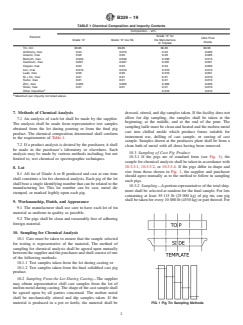
6.1 The tin shall conform to the requirements as to chemical
Current edition approved Nov. 1, 2019. Published November 2019. Originally
composition prescribed in Table 1.
approved in 1967. Last previous edition approved in 2012 as B339 – 12. DOI:
10.1520/B0339-19.
For referenced ASTM standards, visit the ASTM website, www.astm.org, or
contact ASTM Customer Service at service@astm.org. For Annual Book of ASTM
Standards volume information, refer to the standard’s Document Summary page on The last approved version of this historical standard is referenced on
the ASTM website. www.astm.org.
Copyright ©ASTM International, 100 Barr Harbor Drive, PO Box C700, West Conshohocken, PA19428-2959. United States
B339−19
TABLE 1 Chemical Composition and Impurity Contents
Composition, - wt%
Grade “A” for
Element
Ultra Pure
Grade “A” Grade “A” low Sb the Manufacture
Grade
of Tinplate
Tin, min 99.85 99.85 99.85 99.95
Antimony, max 0.04 0.015 0.04 0.005
Arsenic, max 0.05 0.05 0.05 0.005
Bismuth, max 0.030 0.030 0.030 0.015
Cadmium, max 0.001 0.001 0.001 0.001
Copper, max 0.04 0.04 0.04 0.005
Iron, max 0.010 0.010 0.010 0.010
Lead, max 0.05 0.05 0.010 0.001
Ni+ Co, max 0.01 0.01 0.01 0.010
Sulfur, max 0.01 0.01 0.01 0.010
Zinc, max 0.005 0.005 0.005 0.005
Silver, max 0.01 0.01 0.01 0.010
A
Other impurities 0.010 0.010
A
Maximum per impurity not listed above.
7. Methods of Chemical Analysis drossed, stirred, and dip samples taken. If the facility does not
allow for dip sampling, the samples shall be taken at the
7.1 An analysis of each lot shall be made by the supplier.
beginning, at the middle, and at the end of the pour. The
The analysis shall be made from representative test samples
sampling ladle must be clean and heated and the molten metal
obtained from the lot during pouring or from the final pig
cast into chilled molds which produce forms suitable for
product. The chemical composition determined shall conform
instrument use, drilling of cast sample, or sawing of cast
to the requirements of Table 1.
sample. Samples drawn at the producers plant shall be from a
7.2 If a product analysis is desired by the purchaser, it shall
clean bath of metal with all dross having been removed.
be made in the purchaser’s laboratory or elsewhere. Such
10.3 Sampling of Cast Pig Product:
analysis may be made by various methods including, but not
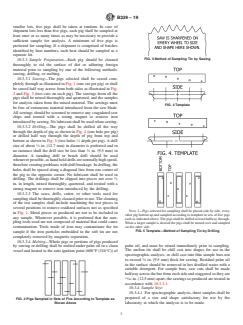
10.3.1 If the pigs are of standard form (see Fig. 1), the
limited to, wet chemical or spectrographic techniques.
sample for chemical analysis shall be taken in accordance with
10.3.3.1, 10.3.3.2,or 10.3.3.4. If the pigs differ in shape and
8. Lot
size from those shown in Fig. 1, the supplier and purchaser
8.1 All tin of Grade A or B produced and cast at one time
should agree mutually as to the method to follow in sampling
shall constitute a lot for chemical analysis. Each pig of the lot
such pigs.
shall bear a single identifying number that can be related to the
10.3.2 Sampling—Aportion representative of the total ship-
manufacturing lot. This lot number can be cast, metal die
ment shall be selected at random for the final sample. For lots
stamped, or marked legibly upon each pig.
containing at least 55 115 lb (25 000 kg) of pig tin, one pig
shallbetakenforevery10 000lb(4530kg)orpartthereof.For
9. Workmanship, Finish, and Appearance
9.1 The manufacturer shall use care to have each lot of tin
material as uniform in quality as possible.
9.2 The pigs shall be clean and reasonably free of adhering
foreign material.
10. Sampling for Chemical Analysis
10.1 Care must be taken to ensure that the sample selected
for testing is representative of the material. The method of
sampling for chemical analysis shall be agreed upon mutually
between the supplier and the purchaser and shall consist of one
of the following methods:
10.1.1 Test samples taken from the lot during casting or
10.1.2 Test samples taken from the final solidified cast pig
product.
10.2 Sampling From the Lot During Casting—The supplier
may obtain representative chill cast samples from the lot of
molten metal during casting.The shape of the cast sample shall
be agreed upon by all parties concerned. The molten metal
shall be mechanically stirred and dip samples taken. If the
material is produced in a pot or kettle, the material shall be FIG. 1Pig Tin Sampling Methods
B339−19
smaller lots, five pigs shall be taken at random. In case of
shipment lots less than five pigs, each pig shall be sampled at
least once or as many times as may be necessary to provide a
sufficient sample for analysis. A minimum of five pigs is
preferred for sampling. If a shipment is comprised of batches
identified by heat numbers, each heat should be sampled as a
separate lot.
FIG. 3Method of Sampling Tin by Sawing
10.3.3 Sample Preparation—Each pig should be cleaned
thoroughly to rid the surface of dirt or adhering foreign
material prior to sampling by one of the following methods:
sawing, drilling, or melting.
10.3.3.1 Sawing—The pigs selected shall be sawed com-
pletely through as illustrated in Fig. 1 (one cut per pig) or shall
be sawed half way across from both sides as illustrated in Fig.
2 and Fig. 3 (two cuts on each pig). The sawings from all the
pigs shall be mixed th
...
This document is not an ASTM standard and is intended only to provide the user of an ASTM standard an indication of what changes have been made to the previous version. Because
it may not be technically possible to adequately depict all changes accurately, ASTM recommends that users consult prior editions as appropriate. In all cases only the current version
of the standard as published by ASTM is to be considered the official document.
Designation: B339 − 12 B339 − 19
Standard Specification for
Pig Tin
This standard is issued under the fixed designation B339; the number immediately following the designation indicates the year of
original adoption or, in the case of revision, the year of last revision. A number in parentheses indicates the year of last reapproval. A
superscript epsilon (´) indicates an editorial change since the last revision or reapproval.
This standard has been approved for use by agencies of the U.S. Department of Defense.
1. Scope
1.1 This specification covers refined tin in pig form recovered and cast from primary and secondary tin-bearing materials. One
grade of tin metal is specified and is designated by the grade letter shown in Table 1.
1.2 The percent values of tin contained are to be regarded as the standard.
1.3 The values stated in inch-pound units are to be regarded as standard. The values given in parentheses are mathematical
conversions to SI units that are provided for information only and are not considered standard.
1.4 This standard does not purport to address all of the safety concerns, if any, associated with its use. It is the responsibility
of the user of this standard to become familiar with all hazards including those identified in the appropriate Material Safety Data
Sheet (MSDS) for this product/material as provided by the manufacturer, to establish appropriate safety safety, health, and
healthenvironmental practices, and determine the applicability of regulatory limitations prior to use.
1.5 This international standard was developed in accordance with internationally recognized principles on standardization
established in the Decision on Principles for the Development of International Standards, Guides and Recommendations issued
by the World Trade Organization Technical Barriers to Trade (TBT) Committee.
2. Referenced Documents
2.1 ASTM Standards:
E29 Practice for Using Significant Digits in Test Data to Determine Conformance with Specifications
E46 Test Methods for Chemical Analysis of Lead- and Tin-Base Solder (Withdrawn 1994)
E51 Method for Spectrographic Analysis of Tin Alloys by the Powder Technique (Withdrawn 1983)
E57 Methods for Chemical Analysis of White Metal Bearing Alloys (Withdrawn 1986)
E88 Practice for Sampling Nonferrous Metals and Alloys in Cast Form for Determination of Chemical Composition
3. Terminology
3.1 Definitions of Terms Specific to This Standard:
3.1.1 pig, n—an oblong or square mass of metal that has been cast while still molten into a mold that gives the metal its
particular shape.
4. Ordering Information
4.1 Orders for material under this specification shall include the following information:
4.1.1 ASTM designation and year of issue,
4.1.2 Quantity in weight, metric tons or kilograms,
4.1.3 Shape and size,
4.1.4 Method of manufacturing (Section 5),
4.1.5 Chemistry (Section 6),) including grade,
4.1.6 Product marking (Section 16), and
This specification is under the jurisdiction of ASTM Committee B02 on Nonferrous Metals and Alloys and is the direct responsibility of Subcommittee B02.02 on Refined
Lead, Tin, Antimony, and Their Alloys.
Current edition approved May 1, 2012Nov. 1, 2019. Published August 2012November 2019. Originally approved in 1967. Last previous edition approved in 20102012
as B339 – 00 (2010).B339 – 12. DOI: 10.1520/B0339-12.10.1520/B0339-19.
For referenced ASTM standards, visit the ASTM website, www.astm.org, or contact ASTM Customer Service at service@astm.org. For Annual Book of ASTM Standards
volume information, refer to the standard’s Document Summary page on the ASTM website.
The last approved version of this historical standard is referenced on www.astm.org.
Copyright © ASTM International, 100 Barr Harbor Drive, PO Box C700, West Conshohocken, PA 19428-2959. United States
B339 − 19
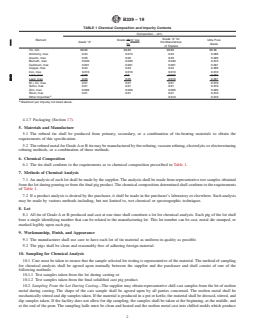
TABLE 1 Chemical Composition and Impurity Contents
Composition, - wt%
Grade “A” for
Element
Grade “B”“A” low Ultra Pure
Grade “A” the Manufacture
Sb Grade
of Tinplate
Tin, min 99.85 99.85 99.85 99.95
Antimony, max 0.04 0.015 0.04 0.005
Arsenic, max 0.05 0.05 0.05 0.005
Bismuth, max 0.030 0.030 0.030 0.015
Cadmium, max 0.001 0.001 0.001 0.001
Copper, max 0.04 0.04 0.04 0.005
Iron, max 0.010 0.010 0.010 0.010
Lead, max 0.05 0.5 0.010 0.001
Lead, max 0.05 0.05 0.010 0.001
Ni + Co, max 0.01 0.01 0.01 0.010
Sulfur, max 0.01 0.01 0.01 0.010
Zinc, max 0.005 0.005 0.005 0.005
Silver, max 0.01 0.01 0.01 0.010
A
Other impurities 0.010 0.010
A
Maximum per impurity not listed above.
4.1.7 Packaging (Section 17).
5. Materials and Manufacture
5.1 The refined tin shall be produced from primary, secondary, or a combination of tin-bearing materials to obtain the
requirements of this specification.
5.2 The refined metal for Grade A or B tin may be manufactured by fire refining, vacuum refining, electrolytic or electrowinning
refining methods, or a combination of these methods.
6. Chemical Composition
6.1 The tin shall conform to the requirements as to chemical composition prescribed in Table 1.
7. Methods of Chemical Analysis
7.1 An analysis of each lot shall be made by the supplier. The analysis shall be made from representative test samples obtained
from the lot during pouring or from the final pig product. The chemical composition determined shall conform to the requirements
of Table 1.
7.2 If a product analysis is desired by the purchaser, it shall be made in the purchaser’s laboratory or elsewhere. Such analysis
may be made by various methods including, but not limited to, wet chemical or spectrographic techniques.
8. Lot
8.1 All tin of Grade A or B produced and cast at one time shall constitute a lot for chemical analysis. Each pig of the lot shall
bear a single identifying number that can be related to the manufacturing lot. This lot number can be cast, metal die stamped, or
marked legibly upon each pig.
9. Workmanship, Finish, and Appearance
9.1 The manufacturer shall use care to have each lot of tin material as uniform in quality as possible.
9.2 The pigs shall be clean and reasonably free of adhering foreign material.
10. Sampling for Chemical Analysis
10.1 Care must be taken to ensure that the sample selected for testing is representative of the material. The method of sampling
for chemical analysis shall be agreed upon mutually between the supplier and the purchaser and shall consist of one of the
following methods:
10.1.1 Test samples taken from the lot during casting or
10.1.2 Test samples taken from the final solidified cast pig product.
10.2 Sampling From the Lot During Casting—The supplier may obtain representative chill cast samples from the lot of molten
metal during casting. The shape of the cast sample shall be agreed upon by all parties concerned. The molten metal shall be
mechanically stirred and dip samples taken. If the material is produced in a pot or kettle, the material shall be drossed, stirred, and
dip samples taken. If the facility does not allow for dip sampling, the samples shall be taken at the beginning, at the middle, and
at the end of the pour. The sampling ladle must be clean and heated and the molten metal cast into chilled molds which produce
B339 − 19
forms suitable for instrument use, drilling of cast sample, or sawing of cast sample. Samples drawn at the producers plant shall
be from a clean bath of metal with all dross having been removed.
10.3 Sampling of Cast Pig Product:
10.3.1 If the pigs are of standard form (see Fig. 1), the sample for chemical analysis shall be taken in accordance with 10.3.3.1,
10.3.3.2, or 10.3.3.4. If the pigs differ in shape and size from those shown in Fig. 1, the supplier and purchaser should agree
mutually as to the method to follow in sampling such pigs.
10.3.2 Sampling—A portion representative of the total shipment shall be selected at random for the final sample. For lots
containing at least 55 115 lb (25 000 kg) of pig tin, one pig shall be taken for every 10 000 lb (4530 kg) or part thereof. For smaller
lots, five pigs shall be taken at random. In case of shipment lots less than five pigs, each pig shall be sampled at least once or as
many times as may be necessary to provide a sufficient sample for analysis. A minimum of five pigs is preferred for sampling. If
a shipment is comprised of batches identified by heat numbers, each heat should be sampled as a separate lot.
10.3.3 Sample Preparation—Each pig should be cleaned thoroughly to rid the surface of dirt or adhering foreign material prior
to sampling by one of the following methods: sawing, drilling, or melting.
10.3.3.1 Sawing—The pigs selected shall be sawed completely through as illustrated in Fig. 1 (one cut per pig) or shall be sawed
half way across from both sides as illustrated in Fig. 2 and Fig. 3 (two cuts on each pig). The sawings from all the pigs shall be
mixed thoroughly
...