

ASTM F1447-18
(Specification)Standard Specification for Helmets Used in Recreational Bicycling or Roller Skating
General Information
- Abstract
ABSTRACT
This specification covers performance requirements for helmets manufactured for use by recreational bicyclists or roller skaters. This specification recognizes the desirability of lightweight construction and ventilation; however, it is a performance standard and is not intended to restrict design. Helmets shall be impacted with anvils centered on or above the prescribed test line. The test anvils can be oriented in any horizontal, centered position. One each hot, cold, wet, and ambient helmet shall be impacted using the flat and hemispherical anvils only. The curbstone anvil shall be used to impact one time each of the second set of four samples, one conditioned under each of the four conditioning environments. The peak acceleration of the impulse during the impact shall be measured. The ambient helmet shall be subjected to the positional stability (roll-off) test, while the hot, cold, and wet helmets shall be subjected to the dynamic strength retention test.
SCOPE
1.1 This specification covers performance requirements for helmets manufactured for use by recreational bicyclists or roller skaters. This specification recognizes the desirability of lightweight construction and ventilation; however, it is a performance standard and is not intended to restrict design.
1.2 All testing and requirements of this specification shall be in accordance with Test Methods F1446, except where noted herein.
1.3 Partial utilization of this specification is prohibited. Any statement of compliance with this specification shall be a certification that the product meets all of the requirements of the specification in its entirety. A product that fails to meet any one of the requirements of this specification is considered to have failed the standard and should not be sold with any indication that it meets parts of the standard.
1.4 This standard is subject to revision at any time by ASTM. It must be reviewed every five years and if not revised either reapproved or withdrawn. References to the standard must include the version date. No references to a version that has been replaced or withdrawn shall be placed on any product or its packaging manufactured more than 24 months after the effective revision or withdrawal date. Go to astm.org to verify the latest version of this standard.
Note 1: The current edition of this standard was approved on June 1, 2018.
1.5 This international standard was developed in accordance with internationally recognized principles on standardization established in the Decision on Principles for the Development of International Standards, Guides and Recommendations issued by the World Trade Organization Technical Barriers to Trade (TBT) Committee.
- Status
- Published
- Publication Date
- 31-May-2018
- Technical Committee
- F08 - Sports Equipment, Playing Surfaces, and Facilities
- Drafting Committee
- F08.53 - Headgear and Helmets
Buy Documents
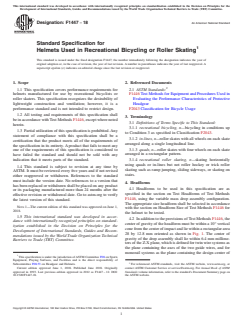
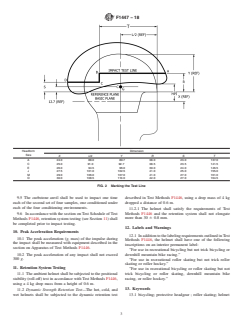

ASTM F1447-18 - Standard Specification for Helmets Used in Recreational Bicycling or Roller Skating

REDLINE ASTM F1447-18 - Standard Specification for Helmets Used in Recreational Bicycling or Roller Skating
Overview
ASTM F1447-18: Standard Specification for Helmets Used in Recreational Bicycling or Roller Skating establishes the performance requirements for helmets designed specifically for recreational bicyclists and roller skaters. Issued by ASTM International, this standard emphasizes both safety and user comfort, recognizing the desirability of lightweight construction and adequate ventilation, while maintaining a focus on helmet performance rather than restricting design innovation. Helmets certified to this standard undergo rigorous impact and retention system testing under various environmental conditions to ensure consistent protective performance.
Key Topics
- Performance Requirements: Helmets must meet stringent impact attenuation and retention system standards, ensuring significant protection for users in typical recreational activities such as casual bicycling and roller skating.
- Testing Procedures: All helmets are evaluated using the referenced ASTM F1446 test methods. Key tests include:
- Impact testing with flat, hemispherical, and curbstone anvils under hot, cold, wet, and ambient conditions.
- Peak acceleration measurement during impacts, with limits set to enhance head protection.
- Retention system assessment, including positional stability (roll-off) and dynamic strength retention.
- Design Flexibility: While prioritizing safety, the standard does not limit the helmet’s design features except for key safety-related elements, affording manufacturers flexibility to innovate in areas like ventilation and weight reduction.
- Labeling and Compliance: Only helmets fully meeting all requirements can claim compliance. Products must have permanent interior labels clearly stating appropriate usage restrictions (e.g., not for trick skating or downhill mountain biking).
Applications
ASTM F1447-18 applies primarily to recreational helmets intended for use in casual bicycling and roller skating environments, encompassing both in-line (rollerblades) and quad skates. Following the guidance in Classification ASTM F2043, recreational use excludes activities such as trick riding, competitive racing, and roller hockey, for which different standards may apply.
Key practical uses include:
- Consumer Protection: Ensures recreational cyclists and skaters use equipment that meets a recognized minimum level of impact protection and retention system reliability.
- Manufacturer Assurance: Provides clear benchmarks and standardized testing protocols for helmet development, supporting robust quality control and product claims.
- Market Access: Governs helmet certification necessary for legal sale and market acceptance in regions and retailers requiring adherence to ASTM helmet standards.
Related Standards
Consider these related ASTM standards and classifications for protective headgear:
- ASTM F1446: Specifies the test methods and procedures used to evaluate helmet performance characteristics and is directly referenced in ASTM F1447-18.
- ASTM F2043: Provides a classification system for different types and conditions of bicycle usage, aiding in determining helmet suitability for specific activities.
- ASTM F2032 and ASTM F1492: Address helmet requirements for BMX cycling and skateboarding, respectively, offering additional guidance for non-recreational or higher-risk activities.
By complying with ASTM F1447-18, helmet manufacturers, retailers, and consumers gain confidence in the safety, quality, and proper usage of helmets intended for recreational bicycling and roller skating, supporting ongoing efforts to reduce injury and promote safe participation in these popular activities. For the most up-to-date information and version of the standard, always refer to the official ASTM website.
Relations
- Replaces
ASTM F1447-12 - Standard Specification for Helmets Used in Recreational Bicycling or Roller Skating - Effective Date
- 01-Jun-2018
- Effective Date
- 01-Nov-2018
- Effective Date
- 01-Nov-2013
- Effective Date
- 01-Jan-2009
- Effective Date
- 10-Jul-2000
- Effective Date
- 01-Jun-2018
- Effective Date
- 01-Jun-2018
Buy Documents
ASTM F1447-18 - Standard Specification for Helmets Used in Recreational Bicycling or Roller Skating
REDLINE ASTM F1447-18 - Standard Specification for Helmets Used in Recreational Bicycling or Roller Skating
Get Certified
Connect with accredited certification bodies for this standard

CIS Institut d.o.o.
Personal Protective Equipment (PPE) certification body. Notified Body NB-2890 for EU Regulation 2016/425 PPE.

Kiwa BDA Testing
Building and construction product certification.
Kmetijski inštitut Slovenije
Agricultural Institute of Slovenia. Soil testing, plant health, agricultural product analysis.
Sponsored listings
Frequently Asked Questions
ASTM F1447-18 is a technical specification published by ASTM International. Its full title is "Standard Specification for Helmets Used in Recreational Bicycling or Roller Skating". This standard covers: ABSTRACT This specification covers performance requirements for helmets manufactured for use by recreational bicyclists or roller skaters. This specification recognizes the desirability of lightweight construction and ventilation; however, it is a performance standard and is not intended to restrict design. Helmets shall be impacted with anvils centered on or above the prescribed test line. The test anvils can be oriented in any horizontal, centered position. One each hot, cold, wet, and ambient helmet shall be impacted using the flat and hemispherical anvils only. The curbstone anvil shall be used to impact one time each of the second set of four samples, one conditioned under each of the four conditioning environments. The peak acceleration of the impulse during the impact shall be measured. The ambient helmet shall be subjected to the positional stability (roll-off) test, while the hot, cold, and wet helmets shall be subjected to the dynamic strength retention test. SCOPE 1.1 This specification covers performance requirements for helmets manufactured for use by recreational bicyclists or roller skaters. This specification recognizes the desirability of lightweight construction and ventilation; however, it is a performance standard and is not intended to restrict design. 1.2 All testing and requirements of this specification shall be in accordance with Test Methods F1446, except where noted herein. 1.3 Partial utilization of this specification is prohibited. Any statement of compliance with this specification shall be a certification that the product meets all of the requirements of the specification in its entirety. A product that fails to meet any one of the requirements of this specification is considered to have failed the standard and should not be sold with any indication that it meets parts of the standard. 1.4 This standard is subject to revision at any time by ASTM. It must be reviewed every five years and if not revised either reapproved or withdrawn. References to the standard must include the version date. No references to a version that has been replaced or withdrawn shall be placed on any product or its packaging manufactured more than 24 months after the effective revision or withdrawal date. Go to astm.org to verify the latest version of this standard. Note 1: The current edition of this standard was approved on June 1, 2018. 1.5 This international standard was developed in accordance with internationally recognized principles on standardization established in the Decision on Principles for the Development of International Standards, Guides and Recommendations issued by the World Trade Organization Technical Barriers to Trade (TBT) Committee.
ABSTRACT This specification covers performance requirements for helmets manufactured for use by recreational bicyclists or roller skaters. This specification recognizes the desirability of lightweight construction and ventilation; however, it is a performance standard and is not intended to restrict design. Helmets shall be impacted with anvils centered on or above the prescribed test line. The test anvils can be oriented in any horizontal, centered position. One each hot, cold, wet, and ambient helmet shall be impacted using the flat and hemispherical anvils only. The curbstone anvil shall be used to impact one time each of the second set of four samples, one conditioned under each of the four conditioning environments. The peak acceleration of the impulse during the impact shall be measured. The ambient helmet shall be subjected to the positional stability (roll-off) test, while the hot, cold, and wet helmets shall be subjected to the dynamic strength retention test. SCOPE 1.1 This specification covers performance requirements for helmets manufactured for use by recreational bicyclists or roller skaters. This specification recognizes the desirability of lightweight construction and ventilation; however, it is a performance standard and is not intended to restrict design. 1.2 All testing and requirements of this specification shall be in accordance with Test Methods F1446, except where noted herein. 1.3 Partial utilization of this specification is prohibited. Any statement of compliance with this specification shall be a certification that the product meets all of the requirements of the specification in its entirety. A product that fails to meet any one of the requirements of this specification is considered to have failed the standard and should not be sold with any indication that it meets parts of the standard. 1.4 This standard is subject to revision at any time by ASTM. It must be reviewed every five years and if not revised either reapproved or withdrawn. References to the standard must include the version date. No references to a version that has been replaced or withdrawn shall be placed on any product or its packaging manufactured more than 24 months after the effective revision or withdrawal date. Go to astm.org to verify the latest version of this standard. Note 1: The current edition of this standard was approved on June 1, 2018. 1.5 This international standard was developed in accordance with internationally recognized principles on standardization established in the Decision on Principles for the Development of International Standards, Guides and Recommendations issued by the World Trade Organization Technical Barriers to Trade (TBT) Committee.
ASTM F1447-18 is classified under the following ICS (International Classification for Standards) categories: 13.340.20 - Head protective equipment; 97.220.40 - Outdoor and water sports equipment. The ICS classification helps identify the subject area and facilitates finding related standards.
ASTM F1447-18 has the following relationships with other standards: It is inter standard links to ASTM F1447-12, ASTM F2043-13(2018), ASTM F2043-13, ASTM F2043-09, ASTM F2043-00, ASTM F3175-16, ASTM F2032-22. Understanding these relationships helps ensure you are using the most current and applicable version of the standard.
ASTM F1447-18 is available in PDF format for immediate download after purchase. The document can be added to your cart and obtained through the secure checkout process. Digital delivery ensures instant access to the complete standard document.
Standards Content (Sample)
This international standard was developed in accordance with internationally recognized principles on standardization established in the Decision on Principles for the
Development of International Standards, Guides and Recommendations issued by the World Trade Organization Technical Barriers to Trade (TBT) Committee.
Designation:F1447 −18 An American National Standard
Standard Specification for
Helmets Used in Recreational Bicycling or Roller Skating
This standard is issued under the fixed designation F1447; the number immediately following the designation indicates the year of
original adoption or, in the case of revision, the year of last revision. A number in parentheses indicates the year of last reapproval. A
superscript epsilon (´) indicates an editorial change since the last revision or reapproval.
1. Scope 2. Referenced Documents
2.1 ASTM Standards:
1.1 This specification covers performance requirements for
helmets manufactured for use by recreational bicyclists or F1446 Test Methods for Equipment and Procedures Used in
Evaluating the Performance Characteristics of Protective
roller skaters. This specification recognizes the desirability of
lightweight construction and ventilation; however, it is a Headgear
F2043 Classification for Bicycle Usage
performance standard and is not intended to restrict design.
1.2 All testing and requirements of this specification shall
3. Terminology
beinaccordancewithTestMethodsF1446,exceptwherenoted
3.1 Definitions of Terms Specific to This Standard:
herein.
3.1.1 recreational bicycling, n—bicycling in conditions up
1.3 Partial utilization of this specification is prohibited.Any
to Condition 3 as specified in Classification F2043.
statement of compliance with this specification shall be a
3.1.2 in-lines, n—roller skates with all wheels on each skate
certification that the product meets all of the requirements of
arranged along a single longitudinal line.
the specification in its entirety.Aproduct that fails to meet any
3.1.3 quads, n—roller skates with four wheels on each skate
one of the requirements of this specification is considered to
arranged in a rectangular pattern.
have failed the standard and should not be sold with any
indication that it meets parts of the standard.
3.1.4 recreational roller skating, n—skating horizontally
using quads or in-lines but not roller hockey or trick roller
1.4 This standard is subject to revision at any time by
skating such as ramp jumping, sliding sideways, or skating on
ASTM. It must be reviewed every five years and if not revised
stairs.
either reapproved or withdrawn. References to the standard
must include the version date. No references to a version that
4. Headforms
has been replaced or withdrawn shall be placed on any product
4.1 Headforms to be used in this specification are as
or its packaging manufactured more than 24 months after the
specified in the section on Test Headforms of Test Methods
effective revision or withdrawal date. Go to astm.org to verify
F1446, using the variable mass drop assembly configuration.
the latest version of this standard.
The appropriate size headform shall be selected in accordance
NOTE 1—The current edition of this standard was approved on June 1,
with the section on Headform Size of Test Methods F1446 for
2018.
the helmet to be tested.
1.5 This international standard was developed in accor-
4.2 In addition to the provisions ofTest Methods F1446, the
dance with internationally recognized principles on standard-
center of gravity of the headform must be within a 10° vertical
ization established in the Decision on Principles for the
conefromthecenterofimpactandliewithinarectangulararea
Development of International Standards, Guides and Recom-
28 by 12.8 mm oriented as shown in Fig. 1. The center of
mendations issued by the World Trade Organization Technical
gravity of the drop assembly shall lie within 6.4 mm millime-
Barriers to Trade (TBT) Committee.
tersoftheZ-Xplane,whichisdefinedfortwinwiresystemsas
the plane containing the axes of the two guide wires, and for
monorail systems as the plane containing the design center of
This specification is under the jurisdiction ofASTM Committee F08 on Sports
Equipment, Playing Surfaces, and Facilities and is the direct responsibility of
Subcommittee F08.53 on Headgear and Helmets. For referenced ASTM standards, visit the ASTM website, www.astm.org, or
Current edition approved June 1, 2018. Published June 2018. Originally contact ASTM Customer Service at service@astm.org. For Annual Book of ASTM
approved in 1993. Last previous edition approved in 2012 as F1447 – 12. DOI: Standards volume information, refer to the standard’s Document Summary page on
10.1520/F1447-18. the ASTM website.
Copyright © ASTM International, 100 Barr Harbor Drive, PO Box C700, West Conshohocken, PA 19428-2959. United States
F1447−18
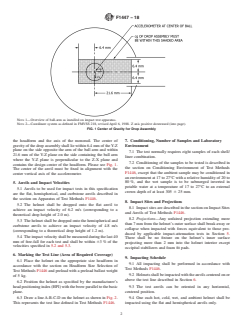
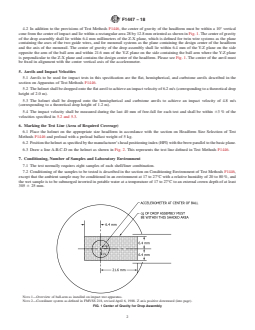
NOTE 1—Overview of ball-arm as installed on impact test apparatus.
NOTE 2—Coordinate system as defined in FMVSS 218, revised April 6, 1988. Z axis positive downward (into page).
FIG. 1Center of Gravity for Drop Assembly
the headform and the axis of the monorail. The center of 7. Conditioning, Number of Samples and Laboratory
gravity of the drop assembly shall lie within 6.4 mm of theY-Z Environment
plane on the side opposite the arm of the ball arm and within
7.1 The test normally requires eight samples of each shell/
21.6 mm of the Y-Z plane on the side containing the ball arm
liner combination.
where the Y-Z plane is perpendicular to the Z-X plane and
7.2 Conditioning of the samples to be tested is described in
contains the design center of the headform. Please see Fig. 1.
the section on Conditioning Environment of Test Methods
The center of the anvil must be fixed in alignment with the
F1446, except that the ambient sample may be conditioned in
center vertical axis of the accelerometer.
an environmen
...
This document is not an ASTM standard and is intended only to provide the user of an ASTM standard an indication of what changes have been made to the previous version. Because
it may not be technically possible to adequately depict all changes accurately, ASTM recommends that users consult prior editions as appropriate. In all cases only the current version
of the standard as published by ASTM is to be considered the official document.
Designation: F1447 − 12 F1447 − 18 An American National Standard
Standard Specification for
Helmets Used in Recreational Bicycling or Roller Skating
This standard is issued under the fixed designation F1447; the number immediately following the designation indicates the year of
original adoption or, in the case of revision, the year of last revision. A number in parentheses indicates the year of last reapproval. A
superscript epsilon (´) indicates an editorial change since the last revision or reapproval.
1. Scope
1.1 This specification covers performance requirements for helmets manufactured for use by recreational bicyclists or roller
skaters. This specification recognizes the desirability of lightweight construction and ventilation; however, it is a performance
standard and is not intended to restrict design.
1.2 All testing and requirements of this specification shall be in accordance with Test Methods F1446, except where noted
herein.
1.3 Partial utilization of this specification is prohibited. Any statement of compliance with this specification shall be a
certification that the product meets all of the requirements of the specification in its entirety. A product that fails to meet any one
of the requirements of this specification is considered to have failed the standard and should not be sold with any indication that
it meets parts of the standard.
1.4 This standard is subject to revision at any time by ASTM. It must be reviewed every five years and if not revised either
reapproved or withdrawn. References to the standard must include the version date. No references to a version that has been
replaced or withdrawn shall be placed on any product or its packaging manufactured more than 24 months after the effective
revision or withdrawal date. Go to astm.org to verify the latest version of this standard.
NOTE 1—The current edition of this standard was approved on June 1, 2018.
1.5 This international standard was developed in accordance with internationally recognized principles on standardization
established in the Decision on Principles for the Development of International Standards, Guides and Recommendations issued
by the World Trade Organization Technical Barriers to Trade (TBT) Committee.
2. Referenced Documents
2.1 ASTM Standards:
F1446 Test Methods for Equipment and Procedures Used in Evaluating the Performance Characteristics of Protective Headgear
F2043 Classification for Bicycle Usage
3. Terminology
3.1 Definitions of Terms Specific to This Standard:
3.1.1 recreational bicycling, n—bicycling in conditions up to Condition 3 as specified in Classification F2043.
3.1.2 in-lines, n—roller skates with all wheels on each skate arranged along a single longitudinal line.
3.1.3 quads, n—roller skates with four wheels on each skate arranged in a rectangular pattern.
3.1.4 recreational roller skating, n—skating horizontally using quads or in-lines but not roller hockey or trick roller skating such
as ramp jumping, sliding sideways, or skating on stairs.
4. Headforms
4.1 Headforms to be used in this specification are as specified in the section on Test Headforms of Test Methods F1446, using
the variable mass drop assembly configuration. The appropriate size headform shall be selected in accordance with the section on
Headform Size of Test Methods F1446 for the helmet to be tested.
This specification is under the jurisdiction of ASTM Committee F08 on Sports Equipment, Playing Surfaces, and Facilities and is the direct responsibility of
Subcommittee F08.53 on Headgear and Helmets.
Current edition approved July 1, 2012June 1, 2018. Published August 2012June 2018. Originally approved in 1993. Last previous edition approved in 20062012 as
F1447 – 06.F1447 – 12. DOI: 10.1520/F1447-12.10.1520/F1447-18.
For referenced ASTM standards, visit the ASTM website, www.astm.org, or contact ASTM Customer Service at service@astm.org. For Annual Book of ASTM Standards
volume information, refer to the standard’s Document Summary page on the ASTM website.
Copyright © ASTM International, 100 Barr Harbor Drive, PO Box C700, West Conshohocken, PA 19428-2959. United States
F1447 − 18
4.2 In addition to the provisions of Test Methods F1446, the center of gravity of the headform must be within a 10° vertical
cone from the center of impact and lie within a rectangular area 28 by 12.8 mm oriented as shown in Fig. 1. The center of gravity
of the drop assembly shall lie within 6.4 mm millimeters of the Z-X plane, which is defined for twin wire systems as the plane
containing the axes of the two guide wires, and for monorail systems as the plane containing the design center of the headform
and the axis of the monorail. The center of gravity of the drop assembly shall lie within 6.4 mm of the Y-Z plane on the side
opposite the arm of the ball arm and within 21.6 mm of the Y-Z plane on the side containing the ball arm where the Y-Z plane
is perpendicular to the Z-X plane and contains the design center of the headform. Please see Fig. 1. The center of the anvil must
be fixed in alignment with the center vertical axis of the accelerometer.
5. Anvils and Impact Velocities
5.1 Anvils to be used for impact tests in this specification are the flat, hemispherical, and curbstone anvils described in the
section on Apparatus of Test Methods F1446.
5.2 The helmet shall be dropped onto the flat anvil to achieve an impact velocity of 6.2 m/s (corresponding to a theoretical drop
height of 2.0 m).
5.3 The helmet shall be dropped onto the hemispherical and curbstone anvils to achieve an impact velocity of 4.8 m/s
(corre
...