

ASTM F2390-21
(Specification)Standard Specification for Poly(Vinyl Chloride) (PVC) Plastic Drain, Waste, and Vent (DWV) Pipe and Fittings Having Post-Industrial Recycle Content
General Information
- Abstract
ABSTRACT
This specification covers the basic requirements and corresponding test methods for poly(vinyl chloride) (PVC) plastic drain, waste, and vent (DWV) pipes and fittings that contain a uniform blend of virgin PVC compound and post-industrial recycle material. When evaluated by the test procedures provided herein, the pipes and fittings shall conform to specified values of the following requirements: dimensions; pipe stiffness, deflection load, lower confidence limit, and flattening resistance; crush resistance; impact resistance; hydrostatic burst resistance; and solvent cement.
SCOPE
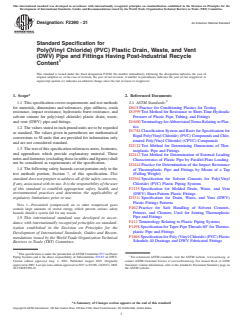
1.1 This specification covers requirements and test methods for materials, dimensions and tolerances, pipe stiffness, crush resistance, impact resistance, hydrostatic burst resistance, and solvent cement for poly(vinyl chloride) plastic drain, waste, and vent (DWV) pipe and fittings.
1.2 The values stated in inch-pound units are to be regarded as standard. The values given in parentheses are mathematical conversions to SI units that are provided for information only and are not considered standard.
1.3 The text of this specification references notes, footnotes, and appendixes which provide explanatory material. These notes and footnotes (excluding those in tables and figures) shall not be considered as requirements of the specification.
1.4 The following safety hazards caveat pertains only to the test methods portion, Section 7, of this specification. This standard does not purport to address all of the safety concerns, if any, associated with its use. It is the responsibility of the user of this standard to establish appropriate safety, health, and environmental practices and determine the applicability of regulatory limitations prior to use.
Note 1: Pressurized (compressed) air or other compressed gases contain large amounts of stored energy which present serious safety hazards should a system fail for any reason.
1.5 This international standard was developed in accordance with internationally recognized principles on standardization established in the Decision on Principles for the Development of International Standards, Guides and Recommendations issued by the World Trade Organization Technical Barriers to Trade (TBT) Committee.
- Status
- Published
- Publication Date
- 31-Jul-2021
- Technical Committee
- F17 - Plastic Piping Systems
- Drafting Committee
- F17.63 - DWV
Buy Documents
ASTM F2390-21 - Standard Specification for Poly(Vinyl Chloride) (PVC) Plastic Drain, Waste, and Vent (DWV) Pipe and Fittings Having Post-Industrial Recycle Content
REDLINE ASTM F2390-21 - Standard Specification for Poly(Vinyl Chloride) (PVC) Plastic Drain, Waste, and Vent (DWV) Pipe and Fittings Having Post-Industrial Recycle Content
Overview
ASTM F2390-21 is the Standard Specification for Poly(Vinyl Chloride) (PVC) Plastic Drain, Waste, and Vent (DWV) Pipe and Fittings Having Post-Industrial Recycle Content. Published by ASTM International, this specification sets out the fundamental requirements and associated test methods for the production of DWV pipes and fittings made from a blend of virgin PVC compounds and post-industrial recycled PVC. The standard emphasizes the importance of quality, safety, and performance, ensuring that recycled-content PVC pipes and fittings meet established criteria for use in drainage, waste, and venting systems.
Key focus areas include material composition, dimensional tolerances, mechanical properties, performance under stress, and proper identification and marking. This standard supports sustainable manufacturing by enabling the use of recycled materials while maintaining the integrity and reliability necessary for building infrastructure.
Key Topics
- Material Requirements: Pipes and fittings must use a consistent blend of virgin PVC and 10%-50% post-industrial recycled material, sourcing clean, traceable recycled content. Post-consumer recycled PVC is prohibited.
- Product Performance: The specification sets detailed requirements for:
- Dimensions and tolerances
- Pipe stiffness and deflection load
- Crush and flattening resistance
- Hydrostatic burst resistance
- Impact resistance
- Solvent cement compatibility
- Test Methods: Describes standardized testing for physical properties, employing referenced ASTM methods, including sampling, conditioning, and measurement procedures.
- Marking and Identification: Pipes and fittings must be permanently marked with manufacturer, material, and standard identifiers to ensure traceability and compliance.
- Quality Assurance: Certifications confirm that products have been manufactured and tested in compliance with ASTM F2390-21.
Applications
ASTM F2390-21 applies to the manufacture and quality assurance of PVC pipes and fittings used in non-pressure drain, waste, and vent systems for residential, commercial, and industrial buildings. Main applications include:
- Drainage Systems: Transporting wastewater and sewage away from fixtures.
- Waste and Vent Systems: Ensuring proper air flow and waste removal in multi-level and complex installations.
- Plumbing Infrastructure: Integration into existing and new construction projects requiring sustainable, high-performance piping.
- Green Building Initiatives: Supports environmentally responsible building by facilitating the use of recycled materials without sacrificing durability or safety.
In practice, these pipes and fittings are specified where building codes require compliance with standards that address both structural performance and environmental considerations.
Related Standards
ASTM F2390-21 references and aligns with several other significant ASTM standards for plastic piping systems, including:
- ASTM D1784: Rigid Poly(Vinyl Chloride) and Chlorinated Poly(Vinyl Chloride) Compounds
- ASTM D2122: Dimensions of Thermoplastic Pipe and Fittings
- ASTM D2412: External Loading Characteristics of Plastic Pipe
- ASTM D2444: Impact Resistance of Thermoplastic Pipe and Fittings
- ASTM D2564: Solvent Cements for PVC Piping Systems
- ASTM F2135: Molded DWV Plastic Fittings
- ASTM F1498: Taper Pipe Threads for Thermoplastic Pipe and Fittings
These referenced standards ensure proper material classification, design, testing, and installation practices align throughout the plastic piping industry.
Keywords: ASTM F2390-21, PVC pipe, recycled PVC, post-industrial recycle, DWV, drainage, waste, vent, plumbing, pipe standards, sustainable construction, impact resistance, crush resistance, hydrostatic burst resistance, solvent cement, building infrastructure.
Relations
- Effective Date
- 01-Aug-2020
- Effective Date
- 01-Apr-2020
- Effective Date
- 15-Jan-2020
- Effective Date
- 01-Jan-2019
- Effective Date
- 01-Sep-2018
- Effective Date
- 01-Aug-2018
- Refers
ASTM D1600-18 - Standard Terminology for Abbreviated Terms Relating to Plastics (Withdrawn 2024) - Effective Date
- 01-Jan-2018
- Effective Date
- 15-Nov-2017
- Effective Date
- 01-Aug-2017
- Effective Date
- 01-Aug-2017
- Effective Date
- 01-Feb-2017
- Effective Date
- 01-Feb-2017
- Effective Date
- 15-Nov-2016
- Effective Date
- 01-Aug-2016
- Effective Date
- 01-Feb-2016
Buy Documents
ASTM F2390-21 - Standard Specification for Poly(Vinyl Chloride) (PVC) Plastic Drain, Waste, and Vent (DWV) Pipe and Fittings Having Post-Industrial Recycle Content
REDLINE ASTM F2390-21 - Standard Specification for Poly(Vinyl Chloride) (PVC) Plastic Drain, Waste, and Vent (DWV) Pipe and Fittings Having Post-Industrial Recycle Content
Get Certified
Connect with accredited certification bodies for this standard

Institut za varilstvo d.o.o. (Welding Institute)
Slovenia's leading welding institute since 1952. ISO 3834, EN 1090, pressure equipment certification, NDT personnel, welder qualification. Only IIW Au
Sponsored listings
Frequently Asked Questions
ASTM F2390-21 is a technical specification published by ASTM International. Its full title is "Standard Specification for Poly(Vinyl Chloride) (PVC) Plastic Drain, Waste, and Vent (DWV) Pipe and Fittings Having Post-Industrial Recycle Content". This standard covers: ABSTRACT This specification covers the basic requirements and corresponding test methods for poly(vinyl chloride) (PVC) plastic drain, waste, and vent (DWV) pipes and fittings that contain a uniform blend of virgin PVC compound and post-industrial recycle material. When evaluated by the test procedures provided herein, the pipes and fittings shall conform to specified values of the following requirements: dimensions; pipe stiffness, deflection load, lower confidence limit, and flattening resistance; crush resistance; impact resistance; hydrostatic burst resistance; and solvent cement. SCOPE 1.1 This specification covers requirements and test methods for materials, dimensions and tolerances, pipe stiffness, crush resistance, impact resistance, hydrostatic burst resistance, and solvent cement for poly(vinyl chloride) plastic drain, waste, and vent (DWV) pipe and fittings. 1.2 The values stated in inch-pound units are to be regarded as standard. The values given in parentheses are mathematical conversions to SI units that are provided for information only and are not considered standard. 1.3 The text of this specification references notes, footnotes, and appendixes which provide explanatory material. These notes and footnotes (excluding those in tables and figures) shall not be considered as requirements of the specification. 1.4 The following safety hazards caveat pertains only to the test methods portion, Section 7, of this specification. This standard does not purport to address all of the safety concerns, if any, associated with its use. It is the responsibility of the user of this standard to establish appropriate safety, health, and environmental practices and determine the applicability of regulatory limitations prior to use. Note 1: Pressurized (compressed) air or other compressed gases contain large amounts of stored energy which present serious safety hazards should a system fail for any reason. 1.5 This international standard was developed in accordance with internationally recognized principles on standardization established in the Decision on Principles for the Development of International Standards, Guides and Recommendations issued by the World Trade Organization Technical Barriers to Trade (TBT) Committee.
ABSTRACT This specification covers the basic requirements and corresponding test methods for poly(vinyl chloride) (PVC) plastic drain, waste, and vent (DWV) pipes and fittings that contain a uniform blend of virgin PVC compound and post-industrial recycle material. When evaluated by the test procedures provided herein, the pipes and fittings shall conform to specified values of the following requirements: dimensions; pipe stiffness, deflection load, lower confidence limit, and flattening resistance; crush resistance; impact resistance; hydrostatic burst resistance; and solvent cement. SCOPE 1.1 This specification covers requirements and test methods for materials, dimensions and tolerances, pipe stiffness, crush resistance, impact resistance, hydrostatic burst resistance, and solvent cement for poly(vinyl chloride) plastic drain, waste, and vent (DWV) pipe and fittings. 1.2 The values stated in inch-pound units are to be regarded as standard. The values given in parentheses are mathematical conversions to SI units that are provided for information only and are not considered standard. 1.3 The text of this specification references notes, footnotes, and appendixes which provide explanatory material. These notes and footnotes (excluding those in tables and figures) shall not be considered as requirements of the specification. 1.4 The following safety hazards caveat pertains only to the test methods portion, Section 7, of this specification. This standard does not purport to address all of the safety concerns, if any, associated with its use. It is the responsibility of the user of this standard to establish appropriate safety, health, and environmental practices and determine the applicability of regulatory limitations prior to use. Note 1: Pressurized (compressed) air or other compressed gases contain large amounts of stored energy which present serious safety hazards should a system fail for any reason. 1.5 This international standard was developed in accordance with internationally recognized principles on standardization established in the Decision on Principles for the Development of International Standards, Guides and Recommendations issued by the World Trade Organization Technical Barriers to Trade (TBT) Committee.
ASTM F2390-21 is classified under the following ICS (International Classification for Standards) categories: 23.040.20 - Plastics pipes; 23.040.45 - Plastics fittings. The ICS classification helps identify the subject area and facilitates finding related standards.
ASTM F2390-21 has the following relationships with other standards: It is inter standard links to ASTM D2564-20, ASTM F412-20, ASTM D1784-20, ASTM F412-19, ASTM D1599-18, ASTM D2564-12(2018), ASTM D1600-18, ASTM D2444-17, ASTM F412-17a, ASTM F1866-13(2017), ASTM F412-17, ASTM F2135-01(2017), ASTM F412-16a, ASTM F412-16, ASTM D3311-11(2016). Understanding these relationships helps ensure you are using the most current and applicable version of the standard.
ASTM F2390-21 is available in PDF format for immediate download after purchase. The document can be added to your cart and obtained through the secure checkout process. Digital delivery ensures instant access to the complete standard document.
Standards Content (Sample)
This international standard was developed in accordance with internationally recognized principles on standardization established in the Decision on Principles for the
Development of International Standards, Guides and Recommendations issued by the World Trade Organization Technical Barriers to Trade (TBT) Committee.
Designation:F2390 −21 An American National Standard
Standard Specification for
Poly(Vinyl Chloride) (PVC) Plastic Drain, Waste, and Vent
(DWV) Pipe and Fittings Having Post-Industrial Recycle
Content
This standard is issued under the fixed designation F2390; the number immediately following the designation indicates the year of
original adoption or, in the case of revision, the year of last revision. A number in parentheses indicates the year of last reapproval. A
superscript epsilon (´) indicates an editorial change since the last revision or reapproval.
1. Scope* 2. Referenced Documents
1.1 This specification covers requirements and test methods 2.1 ASTM Standards:
for materials, dimensions and tolerances, pipe stiffness, crush D618 Practice for Conditioning Plastics for Testing
resistance, impact resistance, hydrostatic burst resistance, and D1599 Test Method for Resistance to Short-Time Hydraulic
solvent cement for poly(vinyl chloride) plastic drain, waste, Pressure of Plastic Pipe, Tubing, and Fittings
and vent (DWV) pipe and fittings. D1600 TerminologyforAbbreviatedTermsRelatingtoPlas-
tics
1.2 The values stated in inch-pound units are to be regarded
D1784 Classification System and Basis for Specification for
as standard. The values given in parentheses are mathematical
Rigid Poly(Vinyl Chloride) (PVC) Compounds and Chlo-
conversions to SI units that are provided for information only
rinated Poly(Vinyl Chloride) (CPVC) Compounds
and are not considered standard.
D2122 Test Method for Determining Dimensions of Ther-
1.3 Thetextofthisspecificationreferencesnotes,footnotes,
moplastic Pipe and Fittings
and appendixes which provide explanatory material. These
D2412 Test Method for Determination of External Loading
notesandfootnotes(excludingthoseintablesandfigures)shall
Characteristics of Plastic Pipe by Parallel-Plate Loading
not be considered as requirements of the specification.
D2444 Practice for Determination of the Impact Resistance
1.4 The following safety hazards caveat pertains only to the of Thermoplastic Pipe and Fittings by Means of a Tup
test methods portion, Section 7, of this specification. This
(Falling Weight)
standard does not purport to address all of the safety concerns,
D2564 Specification for Solvent Cements for Poly(Vinyl
if any, associated with its use. It is the responsibility of the user Chloride) (PVC) Plastic Piping Systems
of this standard to establish appropriate safety, health, and
F2135 Specification for Molded Drain, Waste, and Vent
environmental practices and determine the applicability of (DWV) Short-Pattern Plastic Fittings
regulatory limitations prior to use.
D3311 Specification for Drain, Waste, and Vent (DWV)
Plastic Fittings Patterns
NOTE 1—Pressurized (compressed) air or other compressed gases
F402 Practice for Safe Handling of Solvent Cements,
contain large amounts of stored energy which present serious safety
Primers, and Cleaners Used for Joining Thermoplastic
hazards should a system fail for any reason.
Pipe and Fittings
1.5 This international standard was developed in accor-
F412 Terminology Relating to Plastic Piping Systems
dance with internationally recognized principles on standard-
F1498 Specification forTaper PipeThreads 60° forThermo-
ization established in the Decision on Principles for the
plastic Pipe and Fittings
Development of International Standards, Guides and Recom-
F1866 Specification for Poly (Vinyl Chloride) (PVC) Plastic
mendations issued by the World Trade Organization Technical
Schedule 40 Drainage and DWV Fabricated Fittings
Barriers to Trade (TBT) Committee.
This specification is under the jurisdiction ofASTM Committee F17 on Plastic
Piping Systems and is the direct responsibility of Subcommittee F17.63 on DWV. For referenced ASTM standards, visit the ASTM website, www.astm.org, or
Current edition approved Aug. 1, 2021. Published August 2021. Originally contact ASTM Customer Service at service@astm.org. For Annual Book of ASTM
approvedin2007.Lastpreviouseditionapprovedin2017asF2390–12(2017).DOI: Standards volume information, refer to the standard’s Document Summary page on
10.1520/F2390-21. the ASTM website.
*A Summary of Changes section appears at the end of this standard
Copyright © ASTM International, 100 Barr Harbor Drive, PO Box C700, West Conshohocken, PA 19428-2959. United States
F2390−21
3. Terminology 5.3 Rework Material—The manufacturer is permitted to use
his own clean pipe or fitting rework material, except as
3.1 Definitions—Definitions are in accordance with Termi-
specified in 5.4, provided that the pipe or fittings produced
nology in F412, and abbreviations are in accordance with
shall meet all the requirements of this specification.
Terminology in D1600, unless otherwise specified.
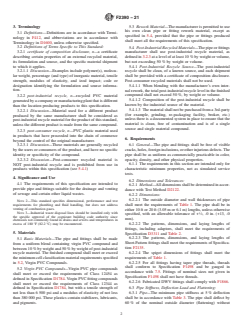
3.2 Definitions of Terms Specific to This Standard: 5.4 Post-Industrial Recycled Materials—Thepipeorfittings
3.2.1 certificate of composition disclosure, n—a certificate manufacturer shall use post-industrial recycle material, as
describing certain properties of an external recycled material, definedin3.2.3atalevelofatleast10 %byweightorvolume,
its formulation and source, and the specific material shipment but not exceeding 50 % by weight or volume.
to which it applies.
5.4.1 Post-Industrial Recycle Source—The post-industrial
3.2.1.1 Discussion—Examples include polymer(s), molecu- recycle shall be clean, of a known source, and each shipment
lar weight, percentage (and type) of inorganic material, tensile shall be provided with a certificate of composition disclosure.
strength, modulus of elasticity, and izod impact; code or Post-consumer recycled materials shall not be used.
designation identifying the formulation and source informa-
5.4.1.1 When blending with the manufacturer’s own inter-
tion. nalrework,thetotalpost-industrialrecyclelevelinthefinished
compound shall not exceed 50 %, by weight or volume.
3.2.2 post-industrial recycle, n—recycled PVC material
5.4.1.2 Composition of the post-industrial recycle shall be
generatedbyacompanyormanufacturingplantthatisdifferent
known by the industrial source of the material.
than the location producing products to this specification.
5.4.1.3 Thematerialshallnotbepurchasedfroma3rd-party
3.2.2.1 Discussion—Material used for a different product
(for example, grinding, re-packaging facility, broker, etc.)
produced by the same manufacturer shall be considered as
unless there is a documented system in place to ensure that the
post-industrialrecyclematerialfortheproductofthisstandard,
material is clean, free of contamination and is of a single
unless the different product is made from the same compound.
source and single material compound.
3.2.3 post-consumer recycle, n—PVC plastic material used
in products that have proceeded into the chain of commerce
6. Requirements
beyond the control of the original manufacturer.
6.1 General—The pipe and fittings shall be free of visible
3.2.3.1 Discussion—These materials are generally recycled
by the users or consumers of the product, and have no specific cracks,holes,foreigninclusions,orotherinjuriousdefects.The
pipe shall be as uniform as commercially practicable in color,
identity or specificity of the compound.
3.2.3.2 Discussion—Post-consumer recycled material is opacity, density, and other physical properties.
NOT post-industrial recycle and is prohibited from use in 6.1.1 The requirements in this section are intended only for
products within this specification (see 5.4.1) characteristic minimum properties, not as simulated service
tests.
4. Significance and Use
6.2 Dimensions and Tolerances:
4.1 The requirements of this specification are intended to
6.2.1 Method—Alldimensionsshallbedeterminedinaccor-
provide pipe and fittings suitable for the drainage and venting
dance with Test Method D2122.
of sewage and certain other liquid wastes.
6.2.2 Dimensions:
6.2.2.1 The outside diameter and wall thicknesses of pipe
NOTE 2—This standard specifies dimensional, performance and test
requirements for plumbing and fluid handling, but does not address
shall meet the requirements of Table 1. The pipe shall be in
venting of combustion gases.
either 10 ft or 20 ft (3.05 m or 6.1 m) lengths, unless otherwise
NOTE 3—Industrial waste disposal lines should be installed only with
specified, with an allowable tolerance of + ⁄2, -0 in. (+13, -0
the specific approval of the cognizant building code authority since
mm).
chemicals not commonly found in drains and sewers and temperatures in
6.2.2.2 The patterns, dimensions, and laying lengths of
excess of 180 °F (82.2 °C) may be encountered.
fittings, including adaptors, shall meet the requirements of
5. Materials
Specification D3311 and Table 2.
6.2.2.3 The patterns, dimensions, and laying lengths of
5.1 Basic Materials—The pipe and fittings shall be made
Short-Pattern fittings shall meet the requirements of Specifica-
from a uniform blend containing virgin PVC compound and
tion F2135.
between 10 % by weight and 50 % by weight of post-industrial
6.2.2.4 The spigot dimensions of fittings shall meet the
recycle material. The finished compound shall meet or exceed
requirements of Table 1.
theminimumcellclassificationmaterialrequirementsspecified
6.2.2.5 For all fittings having taper pipe threads, threads
in 5.2, Virgin PVC Compounds.
shall conform to Specification F1498 and be gauged in
5.2 Virgin PVC Compounds—Virgin PVC pipe compounds
accordance with 7.5. Fittings of nominal sizes not given in
shall meet or exceed the requirements of Class 12454 as
Specification F1498 shall not have threads.
defined in Specification D1784. Virgin PVC fitting compounds
6.2.2.6 Fabricated DWV fittings shall comply with F1866.
shall meet or exceed the requirements of Class 12344 as
6.3 Pipe Stiffness, Deflection Load and Flattening:
defined in Specification D1784, but with a tensile strength of
not less than 6 500 psi and a modulus of elasticity of not less 6.3.1 Pipe—The minimum pipe stiffness at 5 % deflection
than 380 000 psi. These plastics contain stabilizers, lubricants, shall be in accordance with Table 3. The pipe shall deflect by
and pigments. 60 % of the nominal outside diameter (flattening) without
F2390−21
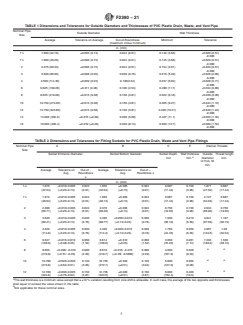
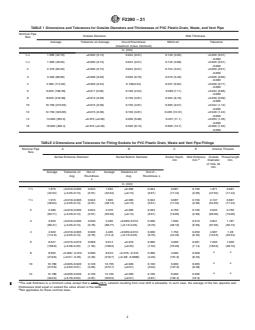
TABLE 1 Dimensions and Tolerances for Outside Diameters and Thicknesses of PVC Plastic Drain, Waste, and Vent Pipe
Nominal Pipe
Outside Diameter Wall Thickness
Size
Average Tolerance on Average Out-of-Roundness Minimum Tolerance
(maximum minus minimum)
in. (mm)
1 ⁄4 1.660 (42.16) ±0.005 (0.13) 0.024 (0.61) 0.140 (3.56) +0.020 (0.51)
-0.000
1 ⁄2 1.900 (48.26) ±0.006 (0.15) 0.024 (0.61) 0.145 (3.68) +0.020 (0.51)
-0.000
2 2.375 (60.33) ±0.006 (0.15) 0.024 (0.61) 0.154 (3.91) +0.020 (0.51)
-0.000
3 3.500 (88.90) ±0.008 (0.20) 0.030 (0.76) 0.216 (5.49) +0.026 (0.66)
-0.000
4 4.500 (114.30) ±0.009 (0.23) 0.100(2.54) 0.237 (6.02) +0.028 (0.71)
-0.000
6 6.625 (168.28) ±0.011 (0.28) 0.100 (2.54) 0.280 (7.11) +0.034 (0.86)
-0.000
8 8.625 (219.08) ±0.015 (0.38) 0.150 (3.81) 0.322 (8.18) +0.039 (0.99)
-0.000
10 10.750 (273.05) ±0.015 (0.38) 0.150 (3.81) 0.365 (9.27) +0.044 (1.12)
-0.000
12 12.750 (323.85) ±0.015 (0.38) 0.150 (3.81) 0.406 (10.31) +0.049 (1.24)
-0.000
14 14.000 (355.6) ±0.015 (±0.38) 0.200 (5.08) 0.437 (11.1) +0.053 (1.35)
-0.000
16 16.000 (406.4) ±0.019 (±0.48) 0.320 (8.13) 0.500 (12.7) +0.060 (1.52)
-0.000
TABLE 2 Dimensions and Tolerances for Fitting Sockets for PVC Plastic Drain, Waste and Vent Pipe Fittings
Nominal Pipe A B C E Internal Threads
Size
Socket Entrance Diameter Socket Bottom Diameter Socket Depth, Wall thickness Outside Thread length
A
min min. Diameter min.
of Hub, M.
min.
Average Tolerance on Out-of - Average Tolerance on Out-of –
Avg. Roundness Avg. Roundness s
s
in. (mm)
1 ⁄4 1.675 +0.010/-0.005 0.024 1.655 ±0.005 0.024 0.687 0.156 1.871 0.687
(42.54) (+0.25/-0.13) (0.61) (42.04) (±0.13) (0.61) (17.44) (3.96) (47.52) (17.44)
1 ⁄2 1.915 +0.010/-0.005 0.024 1.895 ±0.005 0.024 0.687 0.156 2.127 0.687
(48.64) (+0.25/-0.13) (0.61) (48.13) (±0.13) (0.61) (17.44) (3.96) (54.03) (17.44)
2 2.390 +0.010/-0.005 0.024 2.370 ±0.005 0.024 0.750 0.156 2.634 0.750
(60.71) (+0.25/-0.13) (0.61) (60.20) (±0.13) (0.61) (19.05) (3.96) (66.90) (19.05)
3 3.520 +0.010/-0.005 0.030 3.495 +0.005/-0.010 0.030 1.500 0.219 3.841 1.187
(89.41) (+0.25/-0.13) (0.76) (88.77) (+0.13/-0.25) (0.76) (38.10) (5.56) (97.56) (30.15)
4 4.520 +0.010/-0.005 0.030 4.495 +0.005/-0.010 0.030 1.750 0.250 4.907 1.28
(114.8) (+0.25/-0.13) (0.76) (114.2) (+0.13/-0.25) (0.76) (44.45) (6.35) (124.6) (32.54)
6 6.647 +0.015/-0.010 0.060 6.614 ±0.010 0.060 3.000 0.281 7.203 1.500
(168.8) (+0.38/-0.25) (1.52) (168.0) (±0.25) (1.52) (76.20) (7.14) (183.0) (38.10)
BB
8 8.655 +0.020/ -0.010 0.090 8.610 +0.015/ -0.015 0.090 4.000 0.328
(219.8) (+0.51/ -0.25) (2.29) (218.7) (+0.38/ -0.3800) (2.29) (101.6) (8.33)
BB
10 10.780 +0.025/-0.020 0.120 10.735 ±0.020 0.120 5.000 0.365
(273.8) (+0.64/-0.51) (3.05) (272.7) (±0.51) (3.04) (127.0) (9.28)
BB
12 12.780 +0.030/-0.025 0.150 12.735 ±0.020 0.150 6.000 0.406
(324.6) (+0.76/-0.64) (3.81) (323.5) (±0.51) (3.81) (152.4) (10.3)
A
The wall thickness is a minimum value except that a ±10 % variation resulting from core shift is allowable. In such case, the average of the two opposite wall thicknesses
shall equal or exceed the value shown in the table.
B
Not applicable for these nominal sizes.
F2390−21
A
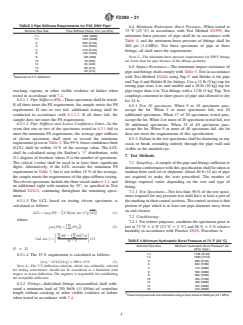
TABLE 3 Pipe Stiffness Requirements for PVC DWV Pipe
6.4 Minimum Hydrostatic Burst Pressure—When tested at
Nominal Pipe Size Pipe Stiffness Factor, min, psi (kPa)
73 °F (23 °C) in accordance with Test Method D1599, the
1 ⁄4 1400 (9650)
minimum burst pressure of pipe shall be in accordance with
1 ⁄2 1010 (6960)
Table 4, and the minimum burst pressure of fittings shall be
2 600 (4140)
200 psi (1.4 MPa). Test three specimens of pipe or three
3 510 (3520)
4 310 (2140)
fittings; all shall meet the requirements.
6 150 (1030)
8 100 (690)
NOTE 5—The minimum burst pressure requirements for DWV fittings
10 78 (530)
are lower than for pipe because of the fittings geometry.
12 63 (430)
6.5 Impact Resistance—The minimum impact resistance of
14 60 (415)
16 60 (415)
pipe and fittings shall comply with Table 5. Test in accordance
A
Measured at 5 % deflection.
with Test Method D2444 using Tup C and Holder A for pipe
and TupAand Holder B for fittings. Use a 12 lb (5 kg) tup for
testing pipe sizes 4 in. and smaller and a 20 lb (10 kg) tup for
cracking, rupture, or other visible evidence of failure when pipe larger than 4 in. Test fittings with a 12 lb (5 kg) Tup. Test
tested in accordance with 7.4.
couplings cemented to short pieces of pipe and allowed to dry
6.3.1.1 PipeStiffness(PS)—Threespecimensshallbetested. for 24 h.
If all three meet the PS requirement, the sample meets the PS
6.5.1 Test 10 specimens. When 9 or 10 specimens pass,
requirement. If one or two fail, additional testing shall be accept the lot. When 2 or more specimens fail, test 10
conducted in accordance with 6.3.1.2. If all three fail, the
additional specimens. When 17 of 20 specimens tested pass,
sample does not meet the PS requirement. accept the lot.When 4 or more of 20 specimens tested fail, test
6.3.1.2 Pipe Stiffness and Lower Confidence Limit—In the
20 additional specimens. When 32 of 40 specimens pass,
event that one or two of the specimens tested in 6.3.1 fail to accept the lot. When 9 or more of 40 specimens fail, the lot
meet the minimum PS requirement, the average pipe stiffness
does not meet the requirements of this specification.
of eleven specimens shall meet or exceed the minimum 6.5.2 Failure in the test specimens shall be shattering or any
requirement given in Table 3.The 99 % lower confidence limit
crack or break extending entirely through the pipe wall and
(LCL) shall be within 15 % of the average value. The LCL
visible to the unaided eye.
shall be calculated using the Student’s “t” distribution, with
7. Test Methods
N-1 degrees of freedom, where N is the number of specimens.
The critical t-value shall be used to at least three significant
7.1 Sampling—Asampleofthepipeandfittingssufficientto
digits. Alternatively, if the LCL exceeds the minimum PS
determine conformance with this specification shall be taken at
requirement in Table 3, but is not within 15 % of the average,
random from each lot or shipment.About 40 ft (12 m) of pipe
the sample meets the requirements of the pipe stiffness testing.
are required to make the tests prescribed. The number of
The eleven specimens include the three tested under 6.3.1, and
fittings required varies depending on the size and type of
an additional eight with rotation by 35°, as specified in Test
fitting.
Method D2412, continuing throughout the remaining speci-
7.1.1 Test Specimens—Not less than 50 % of the test speci-
mens.
mens re
...
This document is not an ASTM standard and is intended only to provide the user of an ASTM standard an indication of what changes have been made to the previous version. Because
it may not be technically possible to adequately depict all changes accurately, ASTM recommends that users consult prior editions as appropriate. In all cases only the current version
of the standard as published by ASTM is to be considered the official document.
Designation: F2390 − 12 (Reapproved 2017) F2390 − 21 An American National Standard
Standard Specification for
Poly(Vinyl Chloride) (PVC) Plastic Drain, Waste, and Vent
(DWV) Pipe and Fittings Having Post-Industrial Recycle
Content
This standard is issued under the fixed designation F2390; the number immediately following the designation indicates the year of
original adoption or, in the case of revision, the year of last revision. A number in parentheses indicates the year of last reapproval. A
superscript epsilon (´) indicates an editorial change since the last revision or reapproval.
1. Scope*
1.1 This specification covers requirements and test methods for materials, dimensions and tolerances, pipe stiffness, crush
resistance, impact resistance, hydrostatic burst resistance, and solvent cement for poly(vinyl chloride) plastic drain, waste, and vent
(DWV) pipe and fittings.
1.2 The values stated in inch-pound units are to be regarded as standard. The values given in parentheses are mathematical
conversions to SI units that are provided for information only and are not considered standard.
1.3 The text of this specification references notes, footnotes, and appendixes which provide explanatory material. These notes and
footnotes (excluding those in tables and figures) shall not be considered as requirements of the specification.
1.4 The following safety hazards caveat pertains only to the test methods portion, Section 7, of this specification. This standard
does not purport to address all of the safety concerns, if any, associated with its use. It is the responsibility of the user of this
standard to establish appropriate safety, health, and environmental practices and determine the applicability of regulatory
limitations prior to use.
NOTE 1—Pressurized (compressed) air or other compressed gases contain large amounts of stored energy which present serious safety hazards should a
system fail for any reason.
1.5 This international standard was developed in accordance with internationally recognized principles on standardization
established in the Decision on Principles for the Development of International Standards, Guides and Recommendations issued
by the World Trade Organization Technical Barriers to Trade (TBT) Committee.
2. Referenced Documents
2.1 ASTM Standards:
D618 Practice for Conditioning Plastics for Testing
D1599 Test Method for Resistance to Short-Time Hydraulic Pressure of Plastic Pipe, Tubing, and Fittings
D1600 Terminology for Abbreviated Terms Relating to Plastics
D1784 Classification System and Basis for Specification for Rigid Poly(Vinyl Chloride) (PVC) Compounds and Chlorinated
Poly(Vinyl Chloride) (CPVC) Compounds
This specification is under the jurisdiction of ASTM Committee F17 on Plastic Piping Systems and is the direct responsibility of Subcommittee F17.63 on DWV. Current
edition approved Aug. 1, 2017Aug. 1, 2021. Published September 2017August 2021. Originally approved in 2007. Last previous edition approved in 20122017 as
F2390F2390–12(2017).–12. DOI: 10.1520/F2390-12R17.10.1520/F2390-21.
For referenced ASTM standards, visit the ASTM website, www.astm.org, or contact ASTM Customer Service at service@astm.org. For Annual Book of ASTM Standards
volume information, refer to the standard’s Document Summary page on the ASTM website.
*A Summary of Changes section appears at the end of this standard
Copyright © ASTM International, 100 Barr Harbor Drive, PO Box C700, West Conshohocken, PA 19428-2959. United States
F2390 − 21
D2122 Test Method for Determining Dimensions of Thermoplastic Pipe and Fittings
D2412 Test Method for Determination of External Loading Characteristics of Plastic Pipe by Parallel-Plate Loading
D2444 Practice for Determination of the Impact Resistance of Thermoplastic Pipe and Fittings by Means of a Tup (Falling
Weight)
D2564 Specification for Solvent Cements for Poly(Vinyl Chloride) (PVC) Plastic Piping Systems
F2135 Specification for Molded Drain, Waste, and Vent (DWV) Short-Pattern Plastic Fittings
D3311 Specification for Drain, Waste, and Vent (DWV) Plastic Fittings Patterns
F402 Practice for Safe Handling of Solvent Cements, Primers, and Cleaners Used for Joining Thermoplastic Pipe and Fittings
F412 Terminology Relating to Plastic Piping Systems
F1498 Specification for Taper Pipe Threads 60° for Thermoplastic Pipe and Fittings
F1866 Specification for Poly (Vinyl Chloride) (PVC) Plastic Schedule 40 Drainage and DWV Fabricated Fittings
3. Terminology
3.1 Definitions—Definitions are in accordance with Terminology in F412, and abbreviations are in accordance with
Terminology in D1600, unless otherwise specified.
3.2 Definitions of Terms Specific to This Standard:
3.2.1 certificate of composition disclosure, n—a certificate describing certain properties of an external recycled material, its
formulation and source, and the specific material shipment to which it applies.
3.2.1.1 Discussion—
Examples include polymer(s), molecular weight, percentage (and type) of inorganic material, tensile strength, modulus of
elasticity, and izod impact; code or designation identifying the formulation and source information.
3.2.2 post-industrial recycle, n—recycled PVC material generated by a company or manufacturing plant that is different than the
location producing products to this specification.
3.2.2.1 Discussion—
Material used for a different product produced by the same manufacturer shall be considered as post-industrial recycle material for
the product of this standard, unless the different product is made from the same compound.
3.2.3 post-consumer recycle, n—PVC plastic material used in products that have proceeded into the chain of commerce beyond
the control of the original manufacturer.
3.2.3.1 Discussion—
These materials are generally recycled by the users or consumers of the product, and have no specific identity or specificity of the
compound.
3.2.3.2 Discussion—
Post-consumer recycled material is NOT post-industrial recycle and is prohibited from use in products within this specification (see
5.4.1)
4. Significance and Use
4.1 The requirements of this specification are intended to provide pipe and fittings suitable for the drainage and venting of sewage
and certain other liquid wastes.
NOTE 2—This standard specifies dimensional, performance and test requirements for plumbing and fluid handling, but does not address venting of
combustion gases.
NOTE 3—Industrial waste disposal lines should be installed only with the specific approval of the cognizant building code authority since chemicals not
commonly found in drains and sewers and temperatures in excess of 180 °F (82.2 °C) may be encountered.
5. Materials
5.1 Basic Materials—The pipe and fittings shall be made from a uniform blend containing virgin PVC compound and between
10 % by weight and 50 % by weight of post-industrial recycle material. The finished compound shall meet or exceed the minimum
cell classification material requirements specified in 5.2, Virgin PVC Compounds.
5.2 Virgin PVC Compounds—Virgin PVC pipe compounds shall meet or exceed the requirements of Class 12454 as defined in
Specification D1784. Virgin PVC fitting compounds shall meet or exceed the requirements of Class 12344 as defined in
F2390 − 21
Specification D1784, but with a tensile strength of not less than 6 500 psi and a modulus of elasticity of not less than 380 000 psi.
These plastics contain stabilizers, lubricants, and pigments.
5.3 Rework Material—The manufacturer is permitted to use his own clean pipe or fitting rework material, except as specified in
5.4, provided that the pipe or fittings produced shall meet all the requirements of this specification.
5.4 Post-Industrial Recycled Materials—The pipe or fittings manufacturer shall use post-industrial recycle material, as defined in
3.2.3 at a level of at least 10 % by weight or volume, but not exceeding 50 % by weight or volume.
5.4.1 Post-Industrial Recycle Source—The post-industrial recycle shall be clean, of a known source, and each shipment shall be
provided with a certificate of composition disclosure. Post-consumer recycled materials shall not be used.
5.4.1.1 When blending with the manufacturer’s own internal rework, the total post-industrial recycle level in the finished
compound shall not exceed 50 %, by weight or volume.
5.4.1.2 Composition of the post-industrial recycle shall be known by the industrial source of the material.
5.4.1.3 The material shall not be purchased from a 3rd-party (for example, grinding, re-packaging facility, broker, etc.) unless there
is a documented system in place to ensure that the material is clean, free of contamination and is of a single source and single
material compound.
6. Requirements
6.1 General—The pipe and fittings shall be free of visible cracks, holes, foreign inclusions, or other injurious defects. The pipe
shall be as uniform as commercially practicable in color, opacity, density, and other physical properties.
6.1.1 The requirements in this section are intended only for characteristic minimum properties, not as simulated service tests.
6.2 Dimensions and Tolerances:
6.2.1 Method—All dimensions shall be determined in accordance with Test Method D2122.
6.2.2 Dimensions:
6.2.2.1 The outside diameter and wall thicknesses of pipe shall meet the requirements of Table 1. The pipe shall be in either 1010 ft
or 20-ft (3.0520 ft (3.05 m or 6.1-m)6.1 m) lengths, unless otherwise specified, with an allowable tolerance of +1/2,+ ⁄2, -0 in. (+13,
-0 mm).
6.2.2.2 The patterns, dimensions, and laying lengths of fittings, including adaptors, shall meet the requirements of Specification
D3311 and Table 2.
6.2.2.3 The patterns, dimensions, and laying lengths of Short-Pattern fittings shall meet the requirements of Specification F2135.
6.2.2.4 The spigot dimensions of fittings shall meet the requirements of Table 1.
6.2.2.5 For all fittings having taper pipe threads, threads shall conform to Specification F1498 and be gauged in accordance with
7.5. Fittings of nominal sizes not given in Specification F1498 shall not have threads.
6.2.2.6 Fabricated DWV fittings shall comply with F1866.
6.3 Pipe Stiffness, Deflection Load and Flattening:
6.3.1 Pipe—The minimum pipe stiffness at 5 % deflection shall be in accordance with Table 3. The pipe shall deflect by 60 % of
the nominal outside diameter (flattening) without cracking, rupture, or other visible evidence of failure when tested in accordance
with 7.4.
F2390 − 21
TABLE 1 Dimensions and Tolerances for Outside Diameters and Thicknesses of PVC Plastic Drain, Waste, and Vent Pipe
Nominal Pipe
Outside Diameter Wall Thickness
Size
Average Tolerance on Average Out-of-Roundness Minimum Tolerance
(maximum minus minimum)
in. (mm)
1 ⁄4 1.660 (42.16) ±0.005 (0.13) 0.024 (0.61) 0.140 (3.56) +0.020 (0.51)
-0.000
1 ⁄2 1.900 (48.26) ±0.006 (0.15) 0.024 (0.61) 0.145 (3.68) +0.020 (0.51)
-0.000
2 2.375 (60.33) ±0.006 (0.15) 0.024 (0.61) 0.154 (3.91) +0.020 (0.51)
-0.000
3 3.500 (88.90) ±0.008 (0.20) 0.030 (0.76) 0.216 (5.49) +0.026 (0.66)
-0.000
4 4.500 (114.30) ±0.009 (0.23) 0.100(2.54) 0.237 (6.02) +0.028 (0.71)
-0.000
6 6.625 (168.28) ±0.011 (0.28) 0.100 (2.54) 0.280 (7.11) +0.034 (0.86)
-0.000
8 8.625 (219.08) ±0.015 (0.38) 0.150 (3.81) 0.322 (8.18) +0.039 (0.99)
-0.000
10 10.750 (273.05) ±0.015 (0.38) 0.150 (3.81) 0.365 (9.27) +0.044 (1.12)
-0.000
12 12.750 (323.85) ±0.015 (0.38) 0.150 (3.81) 0.406 (10.31) +0.049 (1.24)
-0.000
14 14.000 (355.6) ±0.015 (±0.38) 0.200 (5.08) 0.437 (11.1) +0.053 (1.35)
-0.000
16 16.000 (406.4) ±0.019 (±0.48) 0.320 (8.13) 0.500 (12.7) +0.060 (1.52)
-0.000
TABLE 2 Dimensions and Tolerances for Fitting Sockets for PVC Plastic Drain, Waste and Vent Pipe Fittings
Nominal Pipe A B C E Internal Threads
Size
Socket Entrance Diameter Socket Bottom Diameter Socket Depth, Wall thickness Outside Thread length
A
min min. Diameter min.
of Hub, M.
min.
Average Tolerance on Out-of - Average Tolerance on Out-of –
Avg. Roundness Avg. Roundness s
s
in. (mm)
1 ⁄4 1.675 +0.010/-0.005 0.024 1.655 ±0.005 0.024 0.687 0.156 1.871 0.687
(42.54) (+0.25/-0.13) (0.61) (42.04) (±0.13) (0.61) (17.44) (3.96) (47.52) (17.44)
1 ⁄2 1.915 +0.010/-0.005 0.024 1.895 ±0.005 0.024 0.687 0.156 2.127 0.687
(48.64) (+0.25/-0.13) (0.61) (48.13) (±0.13) (0.61) (17.44) (3.96) (54.03) (17.44)
2 2.390 +0.010/-0.005 0.024 2.370 ±0.005 0.024 0.750 0.156 2.634 0.750
(60.71) (+0.25/-0.13) (0.61) (60.20) (±0.13) (0.61) (19.05) (3.96) (66.90) (19.05)
3 3.520 +0.010/-0.005 0.030 3.495 +0.005/-0.010 0.030 1.500 0.219 3.841 1.187
(89.41) (+0.25/-0.13) (0.76) (88.77) (+0.13/-0.25) (0.76) (38.10) (5.56) (97.56) (30.15)
4 4.520 +0.010/-0.005 0.030 4.495 +0.005/-0.010 0.030 1.750 0.250 4.907 1.28
(114.8) (+0.25/-0.13) (0.76) (114.2) (+0.13/-0.25) (0.76) (44.45) (6.35) (124.6) (32.54)
6 6.647 +0.015/-0.010 0.060 6.614 ±0.010 0.060 3.000 0.281 7.203 1.500
(168.8) (+0.38/-0.25) (1.52) (168.0) (±0.25) (1.52) (76.20) (7.14) (183.0) (38.10)
B B
8 8.655 +0.020/ -0.010 0.090 8.610 +0.015/ -0.015 0.090 4.000 0.328
(219.8) (+0.51/ -0.25) (2.29) (218.7) (+0.38/ -0.3800) (2.29) (101.6) (8.33)
B B
10 10.780 +0.025/-0.020 0.120 10.735 ±0.020 0.120 5.000 0.365
(273.8) (+0.64/-0.51) (3.05) (272.7) (±0.51) (3.04) (127.0) (9.28)
B B
12 12.780 +0.030/-0.025 0.150 12.735 ±0.020 0.150 6.000 0.406
(324.6) (+0.76/-0.64) (3.81) (323.5) (±0.51) (3.81) (152.4) (10.3)
A
The wall thickness is a minimum value except that a ±10%±10 % variation resulting from core shift is allowable. In such case, the average of the two opposite wall
thicknesses shall equal or exceed the value shown in the table.
B
Not applicable for these nominal sizes.
F2390 − 21
A
TABLE 3 Pipe Stiffness Requirements for PVC DWV Pipe
Nominal Pipe Size, in.Size Pipe Stiffness Factor, min, psi (kPa)
1 ⁄4 1400 (9650)
1 ⁄2 1010 (6960)
2 600 (4140)
3 510 (3520)
4 310 (2140)
6 150 (1030)
8 100 (690)
10 78 (530)
12 63 (430)
14 60 (415)
16 60 (415)
A
Measured at 5 % deflection.
6.3.1.1 Pipe Stiffness (PS)—Three specimens shall be tested. If all three meet the PS requirement, the sample meets the PS
requirement. If one or two fail, additional testing shall be conducted in accordance with 6.3.1.2. If all three fail, the sample does
not meet the PS requirement.
6.3.1.2 Pipe Stiffness and Lower Confidence Limit—In the event that one or two of the specimens tested in 6.3.1 fail to meet the
minimum PS requirement, the average pipe stiffness of eleven specimens shall meet or exceed the minimum requirement given
in Table 3. The 99 % lower confidence limit (LCL) shall be within 15 % of the average value. The LCL shall be calculated using
the Student’s “t” distribution, with N-1 degrees of freedom, where N is the number of specimens. The critical t-value shall be used
to at least three significant digits. Alternatively, if the LCL exceeds the minimum PS requirement in Table 3, but is not within 15 %
of the average, the sample meets the requirements of the pipe stiffness testing. The eleven specimens include the three tested under
6.3.1, and an additional eight with rotation by 35°, as specified in Test Method D2412, continuing throughout the remaining
specimens.
6.3.1.3 The LCL based on testing eleven specimens is calculated as follows:
LCL 5 ~avg PS! 2$2.76~std. dev.!/=~N!% (1)
where:
~avg PS! 5@ ~PS !#/ (2)
( i
PS 2~ PS! /N
( (
~std. dev.!5F G1/2
N 2 1
N = 11
6.3.1.4 The 15 % requirement is calculated as follows:
~Avg 2 LCL!/~Avg! 3100 # 15 % (3)
NOTE 4—The 5 % deflection criterion, which was arbitrarily selected for testing convenience, should not be considered as a limitation with respect to
in-use deflection. The engineer is responsible for establishing the acceptable deflection.
6.3.2 Fittings—Individual fittings unassembled shall withstand a minimum load of 750 lbf/ft (11 kN/m) of centerline length
without cracking or other visible evidence of failure when tested in accordance with 7.4.
6.4 Minimum Hydrostatic Burst Pressure—When tested at 73°F (23°C)73 °F (23 °C) in accordance with Test Method D1599, the
minimum burst pressure of pipe shall be in accordance with Table 4, and the minimum burst pressure of fittings shall be 200 psi
(1.4 MPa). (1.4 MPa). Test three specimens of pipe or three fittings; all shall meet the requirements.
NOTE 5—The minimum burst pressure requirements for DWV fittings are lower than for pipe because of the fittings geometry.
6.5 Impact Resistance—The minimum impact resistance of pipe and fittings shall comply with Table 5. Test in accordance with
Test Method D2444 using Tup C and Holder A for pipe and Tup A and Holder B for fittings. Use a 12-lb (5-kg)12 lb (5 kg) tup
F2390 − 21
TABLE 4 Minimum Hydrostatic Burst Pressure at 73°F
(23°C)73 °F (23 °C)
A
Nominal Pipe Size, in.Size Minimum Hydrostatic Burst Pressure psi
(kPa) Type I
1 ⁄4 1180 (8140)
1 ⁄2 1060 (7310)
2 890 (6140)
3 840 (5790)
4 710 (4900)
6 560 (3680)
8 500 (3450)
10 450 (3100)
12 420 (2890)
14 410 (2830)
16 410 (2830)
A
These bu
...