


ASTM C1212-98(2010)
(Practice)Standard Practice for Fabricating Ceramic Reference Specimens Containing Seeded Voids
Standard Practice for Fabricating Ceramic Reference Specimens Containing Seeded Voids
SIGNIFICANCE AND USE
This practice describes a method of fabricating known discontinuities in a ceramic specimen. Such specimens are needed and used in nondestructive examination to demonstrate sensitivity and resolution and to assist in establishing proper examination parameters.
SCOPE
1.1 This practice describes procedures for fabricating both green and sintered test bars of silicon carbide and silicon nitride containing both internal and surface voids at prescribed locations.
1.2 The values stated in SI units are to be regarded as standard. No other units of measurement are included in this standard.
1.3 This standard does not purport to address all of the safety concerns, if any, associated with its use. It is the responsibility of the user of this standard to establish appropriate safety and health practices and determine the applicability of regulatory limitations prior to use.
General Information
Relations
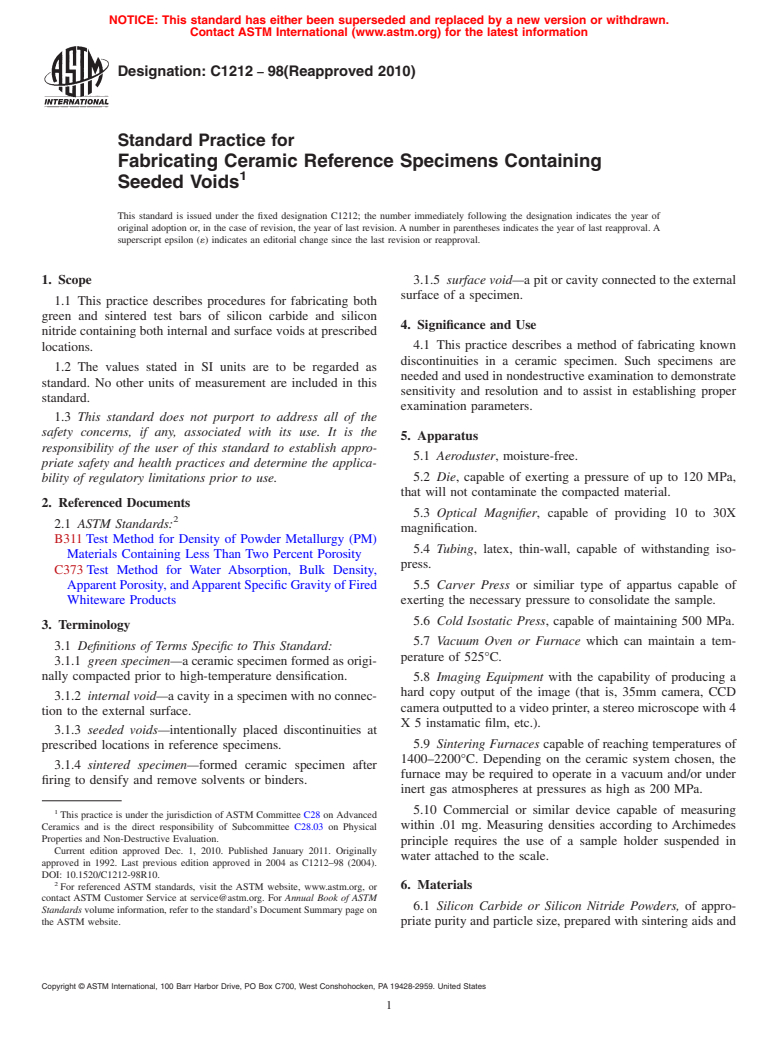
Standards Content (Sample)
NOTICE: This standard has either been superseded and replaced by a new version or withdrawn.
Contact ASTM International (www.astm.org) for the latest information
Designation: C1212 − 98(Reapproved 2010)
Standard Practice for
Fabricating Ceramic Reference Specimens Containing
1
Seeded Voids
This standard is issued under the fixed designation C1212; the number immediately following the designation indicates the year of
original adoption or, in the case of revision, the year of last revision. A number in parentheses indicates the year of last reapproval. A
superscript epsilon (´) indicates an editorial change since the last revision or reapproval.
1. Scope 3.1.5 surface void—a pit or cavity connected to the external
surface of a specimen.
1.1 This practice describes procedures for fabricating both
green and sintered test bars of silicon carbide and silicon
4. Significance and Use
nitride containing both internal and surface voids at prescribed
4.1 This practice describes a method of fabricating known
locations.
discontinuities in a ceramic specimen. Such specimens are
1.2 The values stated in SI units are to be regarded as
needed and used in nondestructive examination to demonstrate
standard. No other units of measurement are included in this
sensitivity and resolution and to assist in establishing proper
standard.
examination parameters.
1.3 This standard does not purport to address all of the
safety concerns, if any, associated with its use. It is the
5. Apparatus
responsibility of the user of this standard to establish appro-
5.1 Aeroduster, moisture-free.
priate safety and health practices and determine the applica-
5.2 Die, capable of exerting a pressure of up to 120 MPa,
bility of regulatory limitations prior to use.
that will not contaminate the compacted material.
2. Referenced Documents
5.3 Optical Magnifier, capable of providing 10 to 30X
2
2.1 ASTM Standards:
magnification.
B311 Test Method for Density of Powder Metallurgy (PM)
5.4 Tubing, latex, thin-wall, capable of withstanding iso-
Materials Containing Less Than Two Percent Porosity
press.
C373 Test Method for Water Absorption, Bulk Density,
Apparent Porosity, andApparent Specific Gravity of Fired 5.5 Carver Press or similiar type of appartus capable of
Whiteware Products exerting the necessary pressure to consolidate the sample.
5.6 Cold Isostatic Press, capable of maintaining 500 MPa.
3. Terminology
5.7 Vacuum Oven or Furnace which can maintain a tem-
3.1 Definitions of Terms Specific to This Standard:
perature of 525°C.
3.1.1 green specimen—a ceramic specimen formed as origi-
nally compacted prior to high-temperature densification.
5.8 Imaging Equipment with the capability of producing a
hard copy output of the image (that is, 35mm camera, CCD
3.1.2 internal void—a cavity in a specimen with no connec-
camera outputted to a video printer, a stereo microscope with 4
tion to the external surface.
X 5 instamatic film, etc.).
3.1.3 seeded voids—intentionally placed discontinuities at
5.9 Sintering Furnaces capable of reaching temperatures of
prescribed locations in reference specimens.
1400–2200°C. Depending on the ceramic system chosen, the
3.1.4 sintered specimen—formed ceramic specimen after
furnace may be required to operate in a vacuum and/or under
firing to densify and remove solvents or binders.
inert gas atmospheres at pressures as high as 200 MPa.
1 5.10 Commercial or similar device capable of measuring
This practice is under the jurisdiction of ASTM Committee C28 on Advanced
Ceramics and is the direct responsibility of Subcommittee C28.03 on Physical within .01 mg. Measuring densities according to Archimedes
Properties and Non-Destructive Evaluation.
principle requires the use of a sample holder suspended in
Current edition approved Dec. 1, 2010. Published January 2011. Originally
water attached to the scale.
approved in 1992. Last previous edition approved in 2004 as C1212–98 (2004).
DOI: 10.1520/C1212-98R10.
2
For referenced ASTM standards, visit the ASTM website, www.astm.org, or 6. Materials
contact ASTM Customer Service at service@astm.org. For Annual Book of ASTM
6.1 Silicon Carbide or Silicon Nitride Powders, of appro-
Standards volume information, refer to the standard’s Document Summary page on
the ASTM website. priate purity and particle size, prepared with sintering aids and
Copyright © ASTM International, 100 Barr Harbor Drive, PO Box C700, West Conshohocken, PA 19428-2959. United States
1
---------------------- Page: 1 ----------------------
C1212 − 98 (2010)
binder representative of the product to be inspected and in a 7.2.1 Procedure:
manner appropriate for dry pressing with granule size less than 7.2.1.1 Follow the steps given in 7.1.2 to produce green
100-mesh.
specimens.
7.2.1.2 Sinter green samples under suitable conditions to
6.2 Styrene Divinyl Benzene Spheres, with diameters as
achieve full densification. Nominal sintering conditions for
necessary. Other material with low vaporization temperatures
silicon nitride are 1700
...
Questions, Comments and Discussion
Ask us and Technical Secretary will try to provide an answer. You can facilitate discussion about the standard in here.