


ASTM A295/A295M-14(2020)
(Specification)Standard Specification for High-Carbon Anti-Friction Bearing Steel
Standard Specification for High-Carbon Anti-Friction Bearing Steel
ABSTRACT
This specification covers high-carbon bearing-quality steel to be used in the manufacture of anti-friction bearings. Materials shall conform to chemical compositions as specified herein, and to physical size and shape as agreed upon between the manufacturer and purchaser. Steels shall exhibit fine fracture grain size when quenched from normal austenitizing temperatures. Decarburization and surface imperfections shall not exceed the limits also specified herein. When annealing is specified in the order, the steel shall adhere to hardness requirements and have a completely spheroidized microstructure, which shall accordingly be rated and reported as carbide size, carbide network, and lamellar content.
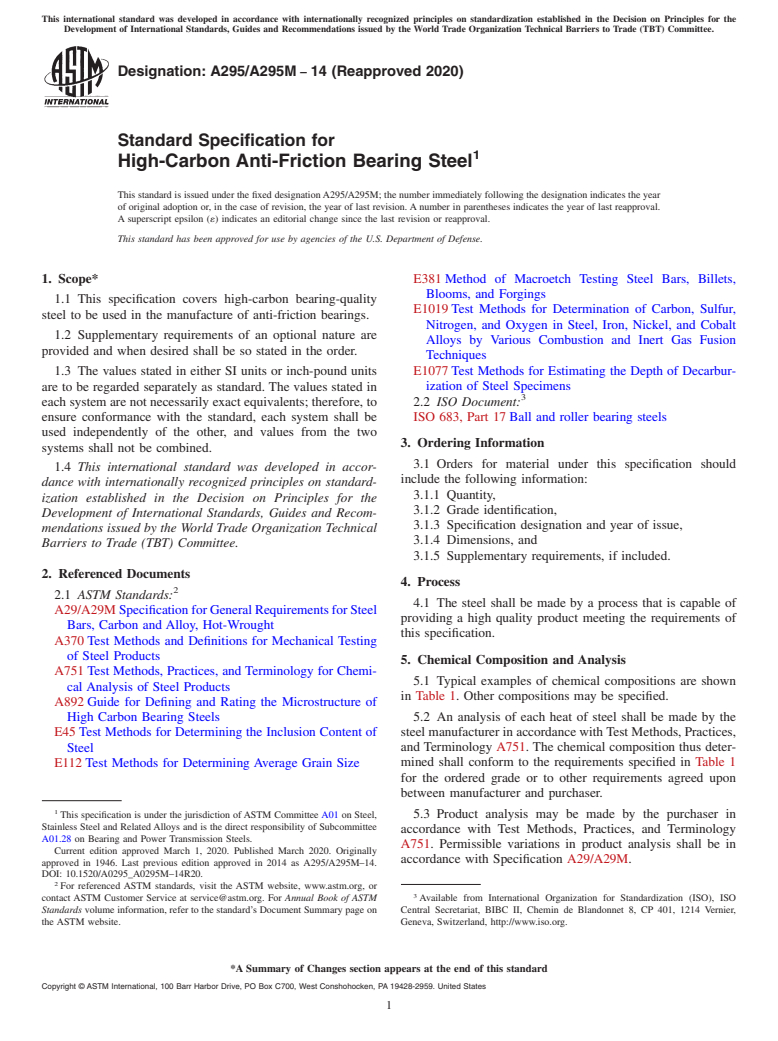
SCOPE
1.1 This specification covers high-carbon bearing-quality steel to be used in the manufacture of anti-friction bearings.
1.2 Supplementary requirements of an optional nature are provided and when desired shall be so stated in the order.
1.3 The values stated in either SI units or inch-pound units are to be regarded separately as standard. The values stated in each system are not necessarily exact equivalents; therefore, to ensure conformance with the standard, each system shall be used independently of the other, and values from the two systems shall not be combined.
1.4 This international standard was developed in accordance with internationally recognized principles on standardization established in the Decision on Principles for the Development of International Standards, Guides and Recommendations issued by the World Trade Organization Technical Barriers to Trade (TBT) Committee.
General Information
Relations
Standards Content (Sample)
This international standard was developed in accordance with internationally recognized principles on standardization established in the Decision on Principles for the
Development of International Standards, Guides and Recommendations issued by the World Trade Organization Technical Barriers to Trade (TBT) Committee.
Designation: A295/A295M −14 (Reapproved 2020)
Standard Specification for
1
High-Carbon Anti-Friction Bearing Steel
This standard is issued under the fixed designationA295/A295M; the number immediately following the designation indicates the year
of original adoption or, in the case of revision, the year of last revision. A number in parentheses indicates the year of last reapproval.
A superscript epsilon (´) indicates an editorial change since the last revision or reapproval.
This standard has been approved for use by agencies of the U.S. Department of Defense.
1. Scope* E381 Method of Macroetch Testing Steel Bars, Billets,
Blooms, and Forgings
1.1 This specification covers high-carbon bearing-quality
E1019 Test Methods for Determination of Carbon, Sulfur,
steel to be used in the manufacture of anti-friction bearings.
Nitrogen, and Oxygen in Steel, Iron, Nickel, and Cobalt
1.2 Supplementary requirements of an optional nature are
Alloys by Various Combustion and Inert Gas Fusion
provided and when desired shall be so stated in the order.
Techniques
1.3 The values stated in either SI units or inch-pound units E1077 Test Methods for Estimating the Depth of Decarbur-
ization of Steel Specimens
are to be regarded separately as standard. The values stated in
3
each system are not necessarily exact equivalents; therefore, to 2.2 ISO Document:
ensure conformance with the standard, each system shall be ISO 683, Part 17 Ball and roller bearing steels
used independently of the other, and values from the two
3. Ordering Information
systems shall not be combined.
3.1 Orders for material under this specification should
1.4 This international standard was developed in accor-
include the following information:
dance with internationally recognized principles on standard-
3.1.1 Quantity,
ization established in the Decision on Principles for the
3.1.2 Grade identification,
Development of International Standards, Guides and Recom-
3.1.3 Specification designation and year of issue,
mendations issued by the World Trade Organization Technical
3.1.4 Dimensions, and
Barriers to Trade (TBT) Committee.
3.1.5 Supplementary requirements, if included.
2. Referenced Documents
4. Process
2
2.1 ASTM Standards:
4.1 The steel shall be made by a process that is capable of
A29/A29M SpecificationforGeneralRequirementsforSteel
providing a high quality product meeting the requirements of
Bars, Carbon and Alloy, Hot-Wrought
this specification.
A370 Test Methods and Definitions for Mechanical Testing
of Steel Products
5. Chemical Composition and Analysis
A751 Test Methods, Practices, and Terminology for Chemi-
5.1 Typical examples of chemical compositions are shown
cal Analysis of Steel Products
in Table 1. Other compositions may be specified.
A892 Guide for Defining and Rating the Microstructure of
5.2 An analysis of each heat of steel shall be made by the
High Carbon Bearing Steels
E45 Test Methods for Determining the Inclusion Content of steel manufacturer in accordance withTest Methods, Practices,
and Terminology A751. The chemical composition thus deter-
Steel
E112 Test Methods for Determining Average Grain Size mined shall conform to the requirements specified in Table 1
for the ordered grade or to other requirements agreed upon
between manufacturer and purchaser.
1
This specification is under the jurisdiction of ASTM Committee A01 on Steel, 5.3 Product analysis may be made by the purchaser in
Stainless Steel and Related Alloys and is the direct responsibility of Subcommittee
accordance with Test Methods, Practices, and Terminology
A01.28 on Bearing and Power Transmission Steels.
A751. Permissible variations in product analysis shall be in
Current edition approved March 1, 2020. Published March 2020. Originally
accordance with Specification A29/A29M.
approved in 1946. Last previous edition approved in 2014 as A295/A295M–14.
DOI: 10.1520/A0295_A0295M–14R20.
2
For referenced ASTM standards, visit the ASTM website, www.astm.org, or
3
contact ASTM Customer Service at service@astm.org. For Annual Book of ASTM Available from International Organization for Standardization (ISO), ISO
Standards volume information, refer to the standard’s Document Summary page on Central Secretariat, BIBC II, Chemin de Blandonnet 8, CP 401, 1214 Vernier,
the ASTM website. Geneva, Switzerland, http://www.iso.org.
*A Summary of Changes section appears at the end of this standard
Copyright © ASTM International, 100 Barr Harbor Drive, PO Box C700, West Conshohocken, PA 19428-2959. United States
1
---------------------- Page: 1 ----------------------
A295/A295M − 14 (2020)
A, B
TABLE 1 Composition
C D
Name C Mn P (max) S (max) Si Cr Ni (max) Mo Cu (max) O (max) Al (max)
...
Questions, Comments and Discussion
Ask us and Technical Secretary will try to provide an answer. You can facilitate discussion about the standard in here.