


ASTM B600-11(2017)
(Guide)Standard Guide for Descaling and Cleaning Titanium and Titanium Alloy Surfaces
Standard Guide for Descaling and Cleaning Titanium and Titanium Alloy Surfaces
ABSTRACT
This guide covers a cleaning and descaling procedure useful to producers, users, and fabricators of titanium and titanium alloys for the removal of ordinary shop soils, oxides, and scales resulting from heat treatment operations and foreign substances present as surface contaminants. It is recommended that the materials shall be subjected to soil removal prior to heat treatment or application of acid treatment. Mechanical descaling methods such as sandblasting, shot blasting, and vapor blasting may be used to remove hot work scales and lubricants from titanium surfaces. Recommended post treatment of shot or abrasive blasted titanium surfaces may include acid pickling to ensure complete removal of surface contaminants. For chemically milled materials, salt bath conditioning may be required to remove the oxygen-contaminated layer. Acid etching treatment may be required following mechanical abrading or chemical conditioning of materials to completely clean the surface.
SCOPE
1.1 This guide covers a cleaning and descaling procedure useful to producers, users, and fabricators of titanium and titanium alloys for the removal of ordinary shop soils, oxides, and scales resulting from heat treatment operations and foreign substances present as surface contaminants.
1.2 It is not intended that these procedures be mandatory for removal of any of the indicated soils but rather serve as a guide when titanium and titanium alloys are being processed in the wrought, cast, or fabricated form.
1.3 It is the intent that these soils be removed prior to chemical milling, joining, plating, fabrication, and in any situation where foreign substances interfere with the corrosion resistance, stability, and quality of the finished product.
1.4 Acid etching may be required following cleaning when the surface has an oxygen-contaminated layer or alpha case present.
1.5 The values stated in inch-pound units are to be regarded as standard. The values given in parentheses are mathematical conversions to SI units that are provided for information only and are not considered standard.
1.6 This standard does not purport to address the safety concerns, if any, associated with its use. It is the responsibility of the user of this standard to consult and establish appropriate safety and health practices and determine the applicability of regulatory limitations prior to use.
1.7 This international standard was developed in accordance with internationally recognized principles on standardization established in the Decision on Principles for the Development of International Standards, Guides and Recommendations issued by the World Trade Organization Technical Barriers to Trade (TBT) Committee.
General Information
Buy Standard
Standards Content (Sample)
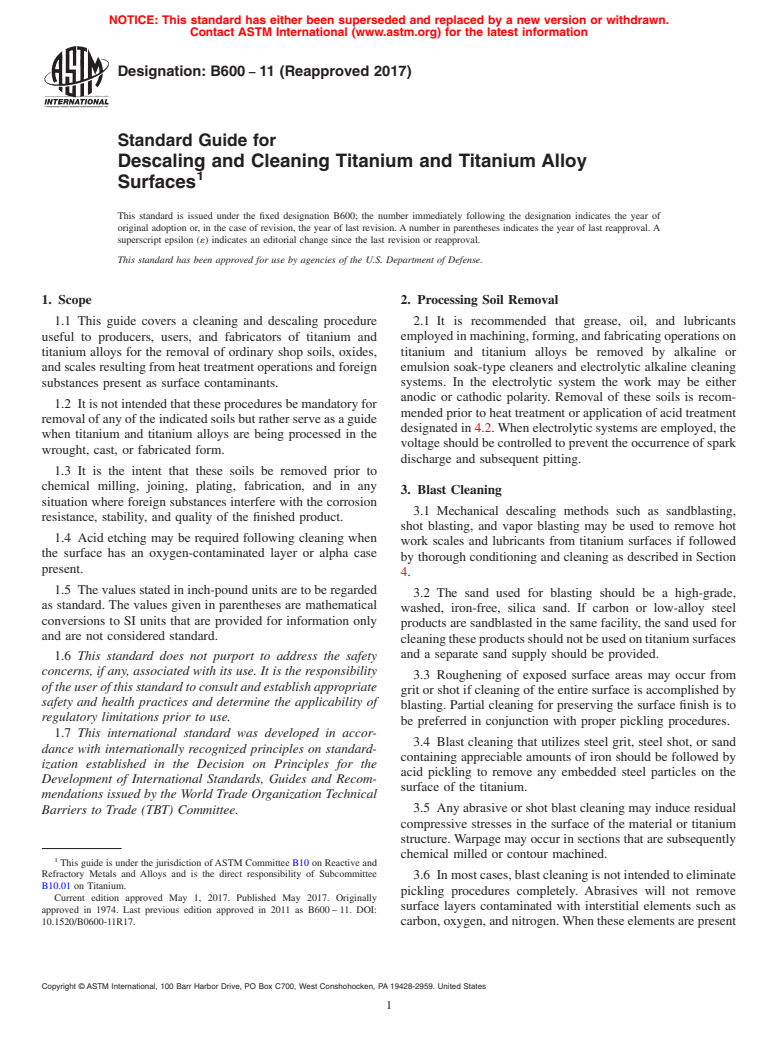
NOTICE: This standard has either been superseded and replaced by a new version or withdrawn.
Contact ASTM International (www.astm.org) for the latest information
Designation: B600 − 11 (Reapproved 2017)
Standard Guide for
Descaling and Cleaning Titanium and Titanium Alloy
Surfaces
This standard is issued under the fixed designation B600; the number immediately following the designation indicates the year of
original adoption or, in the case of revision, the year of last revision. A number in parentheses indicates the year of last reapproval. A
superscript epsilon (´) indicates an editorial change since the last revision or reapproval.
This standard has been approved for use by agencies of the U.S. Department of Defense.
1. Scope 2. Processing Soil Removal
1.1 This guide covers a cleaning and descaling procedure 2.1 It is recommended that grease, oil, and lubricants
useful to producers, users, and fabricators of titanium and employedinmachining,forming,andfabricatingoperationson
titanium alloys for the removal of ordinary shop soils, oxides, titanium and titanium alloys be removed by alkaline or
and scales resulting from heat treatment operations and foreign emulsion soak-type cleaners and electrolytic alkaline cleaning
substances present as surface contaminants. systems. In the electrolytic system the work may be either
anodic or cathodic polarity. Removal of these soils is recom-
1.2 It is not intended that these procedures be mandatory for
mended prior to heat treatment or application of acid treatment
removal of any of the indicated soils but rather serve as a guide
designated in 4.2.When electrolytic systems are employed, the
when titanium and titanium alloys are being processed in the
voltage should be controlled to prevent the occurrence of spark
wrought, cast, or fabricated form.
discharge and subsequent pitting.
1.3 It is the intent that these soils be removed prior to
chemical milling, joining, plating, fabrication, and in any
3. Blast Cleaning
situation where foreign substances interfere with the corrosion
3.1 Mechanical descaling methods such as sandblasting,
resistance, stability, and quality of the finished product.
shot blasting, and vapor blasting may be used to remove hot
1.4 Acid etching may be required following cleaning when
work scales and lubricants from titanium surfaces if followed
the surface has an oxygen-contaminated layer or alpha case
by thorough conditioning and cleaning as described in Section
present.
4.
1.5 The values stated in inch-pound units are to be regarded
3.2 The sand used for blasting should be a high-grade,
as standard. The values given in parentheses are mathematical
washed, iron-free, silica sand. If carbon or low-alloy steel
conversions to SI units that are provided for information only
products are sandblasted in the same facility, the sand used for
and are not considered standard.
cleaningtheseproductsshouldnotbeusedontitaniumsurfaces
and a separate sand supply should be provided.
1.6 This standard does not purport to address the safety
concerns, if any, associated with its use. It is the responsibility
3.3 Roughening of exposed surface areas may occur from
oftheuserofthisstandardtoconsultandestablishappropriate
grit or shot if cleaning of the entire surface is accomplished by
safety and health practices and determine the applicability of
blasting. Partial cleaning for preserving the surface finish is to
regulatory limitations prior to use.
be preferred in conjunction with proper pickling procedures.
1.7 This international standard was developed in accor-
3.4 Blast cleaning that utilizes steel grit, steel shot, or sand
dance with internationally recognized principles on standard-
containing appreciable amounts of iron should be followed by
ization established in the Decision on Principles for the
acid pickling to remove any embedded steel particles on the
Development of International Standards, Guides and Recom-
surface of the titanium.
mendations issued by the World Trade Organization Technical
Barriers to Trade (TBT) Committee. 3.5 Any abrasive or shot blast cleaning may induce residual
compressive stresses in the surface of the material or titanium
structure. Warpage may occur in sections that are subsequently
chemical milled or contour machined.
This guide is under the jurisdiction ofASTM Committee B10 on Reactive and
Refractory Metals and Alloys and is the direct responsibility of Subcommittee
3.6 In most cases, blast cleaning is not intended to eliminate
B10.01 on Titanium.
pickling procedures completely. Abrasives will not remove
Current edition approved May 1, 2017. Published May 2017. Originally
surface layers contaminated with interstitial elements such as
approved in 1974. Last previous edition approved in 2011 as B600 – 11. DOI:
10.1520/B0600-11R17. carbon, oxygen, and nitrogen.When these elements are present
Copyright © ASTM International, 100 Barr Harbor Drive, PO Box C700, West Conshohocken, PA 19428-2959. United States
B600 − 11 (2017)
formation during hot forming or annealing of titanium alloys are soluble
in excessive amounts, they are preferably removed by con-
in the molten salt bath.All of the coating should be removed prior to any
trolled acid pickling in accordance with 4.3.
acid treatment.
4. Pickling, Cleaning, and Descaling
4.3 Following mechanical abrading or chemical
conditioning, the material may be further treated to completely
4.1 Recommendedposttreatmentofshotorabrasiveblasted
clean the surface in one of the following solutions:
titanium surfaces may include acid pickling as described in
4.3.2, or acid cleaning as described in 4.3.3. If the product is to
4.3.1 After salt bath conditioning and water rinse, the
be chemical milled for the removal of the oxygen-
titanium or titanium alloy may be immersed in a sulfuric acid
contaminated layer, salt bath conditioning may be required to
solution to remove the converted scale product. It is recom-
avoid selectively etched surfaces if configuration interferes
mended that the acid solution be maintained at 150°F (66°C)
with uniform blasting.
and a concentration of 10 to 40 volume % of sulfuric acid
(95 % solution by weight). Final brightening may be accom-
4.2 Scale and lubricant residues developed on mill, foundry,
plished by a short immersion in the acid solution of 4.3.2.
forged, or fabricated titanium products usually require condi-
tioning by one of the following commercial methods prior to 4.3.2 To ensure complete removal of metallic iron, oxide,
scale, and other surface contaminants, material that has been
final pickling as described in 4.3.2 to produce a completely
scale-free surface. mechanically abraded in accordance with 3.1 or chemically
conditioned in accordance with 4.2.1, 4.2.2,or 4.2.3 may be
4.2.1 Proprietary solutions of caustic-based compounds in
tap water in accordance with the manufacturer’s recommenda- finish cleaned by immersion in an acid solution composed of
tion. 10 to 30 volume % (150 to 450 g/L) of nitric acid (70 %) and
4.2.2 Molten alkaline-based salt baths operating at 750 to 1 to 3 volume % (12 to 36 g/L) of hydrofluoric acid (60 %) at
850°F (399 to 454°C) in accordance with prescribed proce- 120°F (49°C), maintaining a ratio of 10 parts nitric acid to 1
dures. part hydrofluoric acid.
4.2.3 Molten alkaline-based salt baths operating at 400°F
NOTE 4—Hot-formed or heat-treated titanium fabrications or assem-
(204°C) in accordance with prescribed procedures.
blies that have a mixed surface contamination consisting of graphite or
4.2.4 Oxides and heat tints developed below 1100°F
molybdenum disulfide with titanium oxides should be conditioned in a
(593°C) can frequently be removed by pickling in an acid
molten salt bath. The 400°F (204°
...
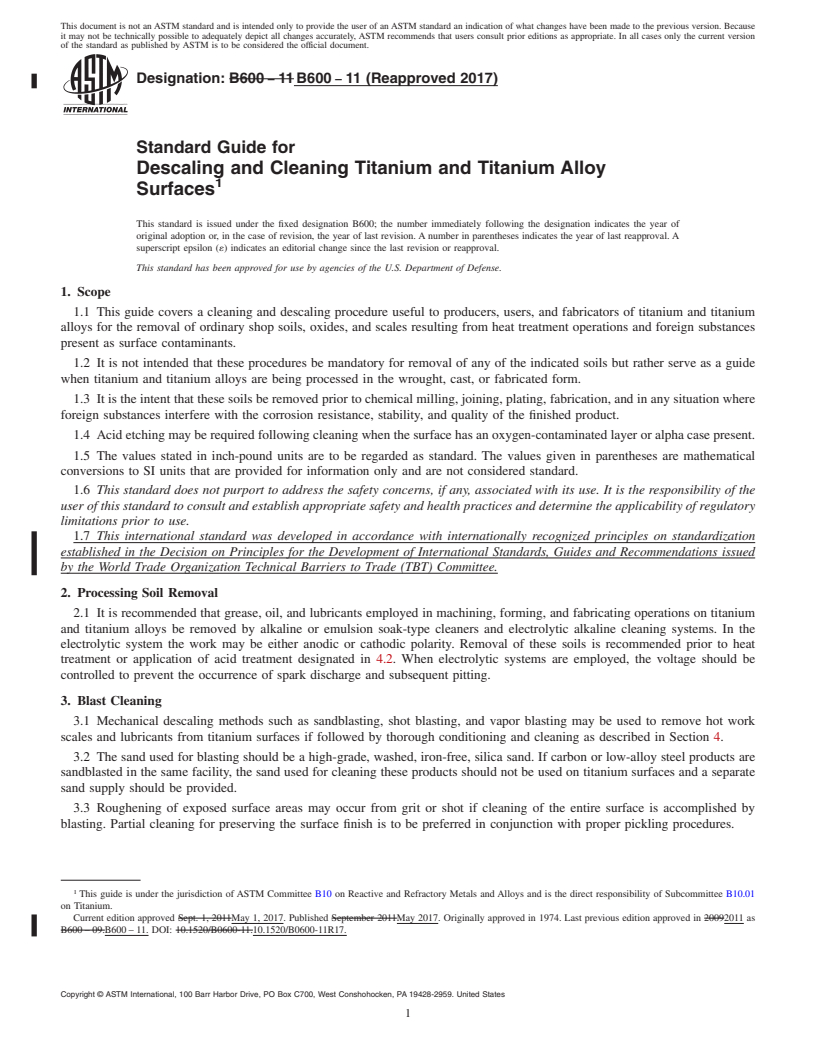
This document is not an ASTM standard and is intended only to provide the user of an ASTM standard an indication of what changes have been made to the previous version. Because
it may not be technically possible to adequately depict all changes accurately, ASTM recommends that users consult prior editions as appropriate. In all cases only the current version
of the standard as published by ASTM is to be considered the official document.
Designation: B600 − 11 B600 − 11 (Reapproved 2017)
Standard Guide for
Descaling and Cleaning Titanium and Titanium Alloy
Surfaces
This standard is issued under the fixed designation B600; the number immediately following the designation indicates the year of
original adoption or, in the case of revision, the year of last revision. A number in parentheses indicates the year of last reapproval. A
superscript epsilon (´) indicates an editorial change since the last revision or reapproval.
This standard has been approved for use by agencies of the U.S. Department of Defense.
1. Scope
1.1 This guide covers a cleaning and descaling procedure useful to producers, users, and fabricators of titanium and titanium
alloys for the removal of ordinary shop soils, oxides, and scales resulting from heat treatment operations and foreign substances
present as surface contaminants.
1.2 It is not intended that these procedures be mandatory for removal of any of the indicated soils but rather serve as a guide
when titanium and titanium alloys are being processed in the wrought, cast, or fabricated form.
1.3 It is the intent that these soils be removed prior to chemical milling, joining, plating, fabrication, and in any situation where
foreign substances interfere with the corrosion resistance, stability, and quality of the finished product.
1.4 Acid etching may be required following cleaning when the surface has an oxygen-contaminated layer or alpha case present.
1.5 The values stated in inch-pound units are to be regarded as standard. The values given in parentheses are mathematical
conversions to SI units that are provided for information only and are not considered standard.
1.6 This standard does not purport to address the safety concerns, if any, associated with its use. It is the responsibility of the
user of this standard to consult and establish appropriate safety and health practices and determine the applicability of regulatory
limitations prior to use.
1.7 This international standard was developed in accordance with internationally recognized principles on standardization
established in the Decision on Principles for the Development of International Standards, Guides and Recommendations issued
by the World Trade Organization Technical Barriers to Trade (TBT) Committee.
2. Processing Soil Removal
2.1 It is recommended that grease, oil, and lubricants employed in machining, forming, and fabricating operations on titanium
and titanium alloys be removed by alkaline or emulsion soak-type cleaners and electrolytic alkaline cleaning systems. In the
electrolytic system the work may be either anodic or cathodic polarity. Removal of these soils is recommended prior to heat
treatment or application of acid treatment designated in 4.2. When electrolytic systems are employed, the voltage should be
controlled to prevent the occurrence of spark discharge and subsequent pitting.
3. Blast Cleaning
3.1 Mechanical descaling methods such as sandblasting, shot blasting, and vapor blasting may be used to remove hot work
scales and lubricants from titanium surfaces if followed by thorough conditioning and cleaning as described in Section 4.
3.2 The sand used for blasting should be a high-grade, washed, iron-free, silica sand. If carbon or low-alloy steel products are
sandblasted in the same facility, the sand used for cleaning these products should not be used on titanium surfaces and a separate
sand supply should be provided.
3.3 Roughening of exposed surface areas may occur from grit or shot if cleaning of the entire surface is accomplished by
blasting. Partial cleaning for preserving the surface finish is to be preferred in conjunction with proper pickling procedures.
This guide is under the jurisdiction of ASTM Committee B10 on Reactive and Refractory Metals and Alloys and is the direct responsibility of Subcommittee B10.01
on Titanium.
Current edition approved Sept. 1, 2011May 1, 2017. Published September 2011May 2017. Originally approved in 1974. Last previous edition approved in 20092011 as
B600 – 09.B600 – 11. DOI: 10.1520/B0600-11.10.1520/B0600-11R17.
Copyright © ASTM International, 100 Barr Harbor Drive, PO Box C700, West Conshohocken, PA 19428-2959. United States
B600 − 11 (2017)
3.4 Blast cleaning that utilizes steel grit, steel shot, or sand containing appreciable amounts of iron should be followed by acid
pickling to remove any embedded steel particles on the surface of the titanium.
3.5 Any abrasive or shot blast cleaning may induce residual compressive stresses in the surface of the material or titanium
structure. Warpage may occur in sections that are subsequently chemical milled or contour machined.
3.6 In most cases, blast cleaning is not intended to eliminate pickling procedures completely. Abrasives will not remove surface
layers contaminated with interstitial elements such as carbon, oxygen, and nitrogen. When these elements are present in excessive
amounts, they are preferably removed by controlled acid pickling in accordance with 4.3.
4. Pickling, Cleaning, and Descaling
4.1 Recommended post treatment of shot or abrasive blasted titanium surfaces may include acid pickling as described in 4.3.2,
or acid cleaning as described in 4.3.3. If the product is to be chemical milled for the removal of the oxygen-contaminated layer,
salt bath conditioning may be required to avoid selectively etched surfaces if configuration interferes with uniform blasting.
4.2 Scale and lubricant residues developed on mill, foundry, forged, or fabricated titanium products usually require conditioning
by one of the following commercial methods prior to final pickling as described in 4.3.2 to produce a completely scale-free surface.
4.2.1 Proprietary solutions of caustic-based compounds in tap water in accordance with the manufacturer’s recommendation.
4.2.2 Molten alkaline-based salt baths operating at 750 to 850°F (399 to 454°C) in accordance with prescribed procedures.
4.2.3 Molten alkaline-based salt baths operating at 400°F (204°C) in accordance with prescribed procedures.
4.2.4 Oxides and heat tints developed below 1100°F (593°C) can frequently be removed by pickling in an acid solution
composed of 10 to 20 volume % (150 to 300 g/L) of nitric acid (70 %) and 1 to 2 volume % (12 to 24 g/L) of hydrofluoric acid
(60 %) at 120°F (49°C).
4.2.5 Forged and hot-worked titanium alloys that have the normal heat-developed scale mixed with graphitic or glass-type
lubricants may be conditioned in a molten alkaline-based salt bath operating at 850°F (454°C) to effect complete solubility of the
complex scale. Following conditioning, the part should be pickled as described in 4.3.2.
4.2.6 It is recommended that heat-treatable alpha beta and beta alloys in the solution-treated condition that have been processed
at temperatures above 1100°F (593°C), with graphitic and molybdenum disulfide lubricant residues mixed with the heat-developed
scale, be conditioned in a molten alkaline-based salt bath operating at 400°F (204°C). After conditioning, the part may be pickled
in accordance with the treatment described in 4.3.2.
4.2.7 Abrasive methods such as wheel or belt grinding, segmented flapper wheels, and grit or shot blasting, when available, may
be used when surface configuration is such that the scaled areas are readily accessible.
NOTE 1—Conditioning of titanium in high-temperature oxidizing salt can generate galvanic currents where the work is contacting ferrous base
materials. Titanium is electrically positive or
...
Questions, Comments and Discussion
Ask us and Technical Secretary will try to provide an answer. You can facilitate discussion about the standard in here.