


ASTM D1574-04(2013)
(Test Method)Standard Test Method for Extractable Matter in Wool and Other Animal Fibers (Withdrawn 2022)
Standard Test Method for Extractable Matter in Wool and Other Animal Fibers (Withdrawn 2022)
SIGNIFICANCE AND USE
5.1 Test Method D1574 is considered satisfactory for acceptance testing since the method has been used extensively in the trade for acceptance testing.
5.1.1 In case of a dispute arising from differences in reported test results when using Test Method D1574 for acceptance testing of commercial shipments, the purchaser and the supplier should conduct comparative tests to determine if there is a statistical bias between their laboratories. Competent statistical assistance is recommended for the investigation of bias. As a minimum, the two parties should take a group of test specimens that are as homogeneous as possible and that are from a lot of material of the type in question. The test specimens should then be randomly assigned in equal numbers to each laboratory for testing. The average results from the two laboratories should be compared using Student's t-test for unpaired data and an acceptable probability level chosen by the two parties before the testing is begun. If a bias is found, either its cause must be found and corrected or the purchaser and the supplier must agree to interpret future test results in the light of the known bias.
5.2 This test method may be used to estimate the quantity of oil, grease, and waxy materials remaining on or in wool fibers after scouring, or the quantity of lubricant added before carding or remaining after carding, or the quantity of such materials added or removed in subsequent processing operations.
5.3 The residues obtained in this test may be subjected to chemical analysis for identification and assay of the component materials, if desired.
5.4 The specified solvent in this test method does not remove some materials, such as soaps, that may be present in wool and hence in some cases may reflect more closely the added content of some extractables in wool such as oils. When such materials are present and an estimate of their quantity is desired, some other solvent or combination of solvents should be used as spec...
SCOPE
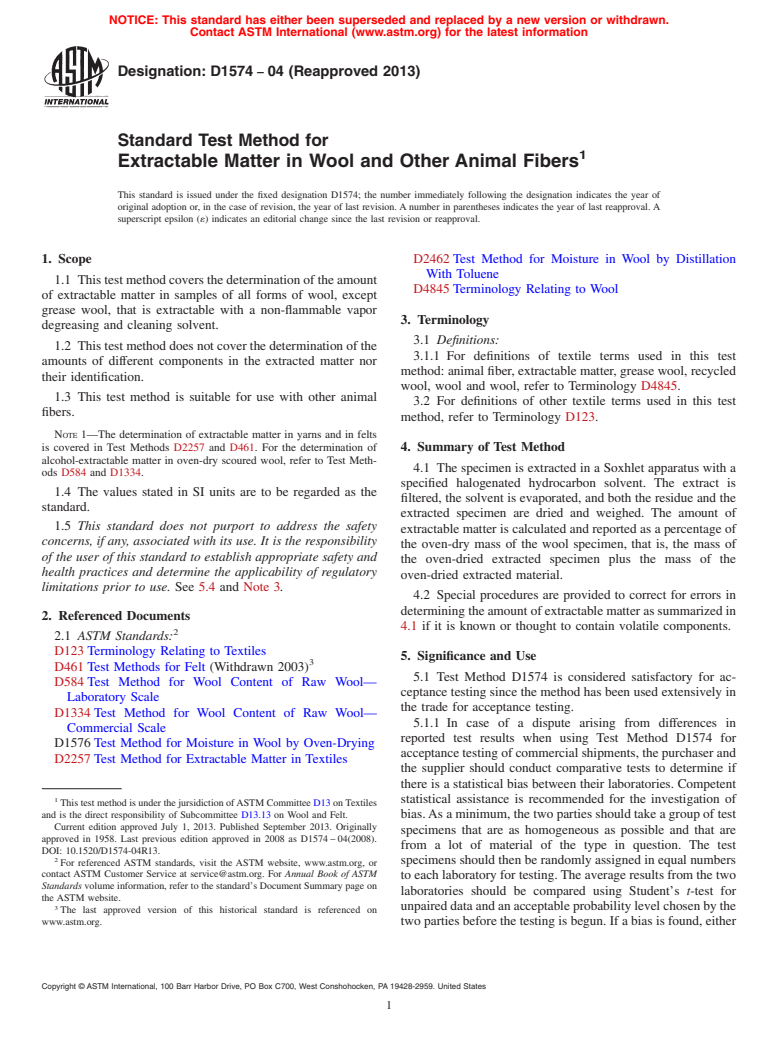
1.1 This test method covers the determination of the amount of extractable matter in samples of all forms of wool, except grease wool, that is extractable with a non-flammable vapor degreasing and cleaning solvent.
1.2 This test method does not cover the determination of the amounts of different components in the extracted matter nor their identification.
1.3 This test method is suitable for use with other animal fibers. Note 1—The determination of extractable matter in yarns and in felts is covered in Test Methods D2257 and D461. For the determination of alcohol-extractable matter in oven-dry scoured wool, refer to Test Methods D584 and D1334.
1.4 The values stated in SI units are to be regarded as the standard.
1.5 This standard does not purport to address the safety concerns, if any, associated with its use. It is the responsibility of the user of this standard to establish appropriate safety and health practices and determine the applicability of regulatory limitations prior to use. See 5.4 and Note 3.
General Information
Standards Content (Sample)
NOTICE: This standard has either been superseded and replaced by a new version or withdrawn.
Contact ASTM International (www.astm.org) for the latest information
Designation: D1574 − 04 (Reapproved 2013)
Standard Test Method for
Extractable Matter in Wool and Other Animal Fibers
This standard is issued under the fixed designation D1574; the number immediately following the designation indicates the year of
original adoption or, in the case of revision, the year of last revision. A number in parentheses indicates the year of last reapproval. A
superscript epsilon (´) indicates an editorial change since the last revision or reapproval.
1. Scope D2462 Test Method for Moisture in Wool by Distillation
With Toluene
1.1 This test method covers the determination of the amount
D4845 Terminology Relating to Wool
of extractable matter in samples of all forms of wool, except
grease wool, that is extractable with a non-flammable vapor
3. Terminology
degreasing and cleaning solvent.
3.1 Definitions:
1.2 This test method does not cover the determination of the
3.1.1 For definitions of textile terms used in this test
amounts of different components in the extracted matter nor
method: animal fiber, extractable matter, grease wool, recycled
their identification.
wool, wool and wool, refer to Terminology D4845.
1.3 This test method is suitable for use with other animal
3.2 For definitions of other textile terms used in this test
fibers.
method, refer to Terminology D123.
NOTE 1—The determination of extractable matter in yarns and in felts
is covered in Test Methods D2257 and D461. For the determination of 4. Summary of Test Method
alcohol-extractable matter in oven-dry scoured wool, refer to Test Meth-
4.1 The specimen is extracted in a Soxhlet apparatus with a
ods D584 and D1334.
specified halogenated hydrocarbon solvent. The extract is
1.4 The values stated in SI units are to be regarded as the
filtered, the solvent is evaporated, and both the residue and the
standard.
extracted specimen are dried and weighed. The amount of
1.5 This standard does not purport to address the safety
extractable matter is calculated and reported as a percentage of
concerns, if any, associated with its use. It is the responsibility
the oven-dry mass of the wool specimen, that is, the mass of
of the user of this standard to establish appropriate safety and
the oven-dried extracted specimen plus the mass of the
health practices and determine the applicability of regulatory
oven-dried extracted material.
limitations prior to use. See 5.4 and Note 3.
4.2 Special procedures are provided to correct for errors in
determiningtheamountofextractablematterassummarizedin
2. Referenced Documents
4.1 if it is known or thought to contain volatile components.
2.1 ASTM Standards:
D123 Terminology Relating to Textiles
5. Significance and Use
D461 Test Methods for Felt (Withdrawn 2003)
5.1 Test Method D1574 is considered satisfactory for ac-
D584 Test Method for Wool Content of Raw Wool—
ceptance testing since the method has been used extensively in
Laboratory Scale
the trade for acceptance testing.
D1334 Test Method for Wool Content of Raw Wool—
5.1.1 In case of a dispute arising from differences in
Commercial Scale
reported test results when using Test Method D1574 for
D1576 Test Method for Moisture in Wool by Oven-Drying
acceptance testing of commercial shipments, the purchaser and
D2257 Test Method for Extractable Matter in Textiles
the supplier should conduct comparative tests to determine if
there is a statistical bias between their laboratories. Competent
1 statistical assistance is recommended for the investigation of
This test method is under the jursidiction ofASTM Committee D13 on Textiles
and is the direct responsibility of Subcommittee D13.13 on Wool and Felt.
bias.As a minimum, the two parties should take a group of test
Current edition approved July 1, 2013. Published September 2013. Originally
specimens that are as homogeneous as possible and that are
approved in 1958. Last previous edition approved in 2008 as D1574 – 04(2008).
from a lot of material of the type in question. The test
DOI: 10.1520/D1574-04R13.
specimens should then be randomly assigned in equal numbers
For referenced ASTM standards, visit the ASTM website, www.astm.org, or
contact ASTM Customer Service at service@astm.org. For Annual Book of ASTM
to each laboratory for testing.The average results from the two
Standards volume information, refer to the standard’s Document Summary page on
laboratories should be compared using Student’s t-test for
the ASTM website.
unpaireddataandanacceptableprobabilitylevelchosenbythe
The last approved version of this historical standard is referenced on
www.astm.org. two parties before the testing is begun. If a bias is found, either
Copyright © ASTM International, 100 Barr Harbor Drive, PO Box C700, West Conshohocken, PA 19428-2959. United States
D1574 − 04 (2013)
its cause must be found and corrected or the purchaser and the containers that can be hermetically sealed (such as glass
supplier must agree to interpret future test results in the light of weighingbottles)ifthespecimenistobecooledinadesiccator
the known bias. before weighing in the ambient atmosphere.
5.2 This test method may be used to estimate the quantity of 6.6 Balance, having a capacity adequate for weighing
oil, grease, and waxy materials remaining on or in wool fibers specimens, flasks, and containers and having a sensitivity of
afterscouring,orthequantityoflubricantaddedbeforecarding 0.001 g.
or remaining after carding, or the quantity of such materials 5
6.7 Solvent—Ensolv.
added or removed in subsequent processing operations.
7. Sampling
5.3 The residues obtained in this test may be subjected to
chemicalanalysisforidentificationandassayofthecomponent 7.1 Lot Sample—As a lot sample for acceptance testing,
materials, if desired.
unless otherwise agreed upon between purchaser and supplier,
take at random the number of packages of wool from a lot as
5.4 The specified solvent in this test method does not
directed in Table 1. Consider packages of wool as the primary
remove some materials, such as soaps, that may be present in
sampling unit.
wool and hence in some cases may reflect more closely the
added content of some extractables in wool such as oils. When
7.2 Laboratory Sample—Consider the package of wool in
such materials are present and an estimate of their quantity is
the lot sample as the laboratory sample.
desired, some other solvent or combination of solvents should
7.3 Test Specimen—From each package in the laboratory
beusedasspecifiedinamaterialspecificationorbyagreement.
sample take at random two specimens each weighing 10 61g.
TheinformationintheAnnexofthistestmethodmaybeuseful
7.3.1 If the determination of volatile matter in extractables,
for this purpose. Various solvents have been used in the past,
as described in 9.5.2, is to be undertaken, weigh the test
and are still used to some extent. Many of these solvents are
specimen to the nearest 0.001 g and record this mass as T.This
undesirable, however, because of flammability, toxic or anes-
specimen is for extraction.
thetic effects, or unpleasant odors. Trichlorotrifluoroethane is
7.3.2 For each test specimen taken for extraction, take a
nonflammable, has a very low level of toxicity, and a high
second test specimen for moisture determination, weighing
degree of stability and is a good solvent for most fatty or
between50and70g.Weightothenearest0.05gthesametime
mineral oils, greases, and waxes. The specified solvent, under
the extraction test specimen is weighed so that the moisture
conditions of the test, was found in interlaboratory test not to
content of the two specimens at the time of weighing will be
extract wool protein.
identical.
NOTE2—Sincethespecifiedsolventisprimarilyasolventforoilsrather
8. Conditioning
than soap, the extractable matter obtained in this procedure may be
considered a measure of commercial oil content.
8.1 Neither preconditioning nor conditioning is necessary.
NOTE 3—Due to the hazardous nature of some of the solvents listed in
Table A1.1, the user should refer to the manufacturer’s recommendations
9. Procedure
for use before using under the conditions of this test method.
9.1 Wrap the specimen in a single sheet of fresh filter paper
6. Apparatus and Reagents
(or place in an extraction thimble free of matter extractable by
the specified solvent) and insert the assemblage in the extrac-
6.1 Soxhlet Extraction Apparatus, including an extraction
tion tube. Make certain that all open edges of the filter paper or
tube, condenser, and flask. A large extraction tube having a
thimble extend above the siphon tube.
standard-taper joints T55/50 and 24/40 and a 300-mL flask are
recommended, but any size capable of holding at least a 10-g
9.2 Attach to the extraction tube a 300-mL flask that has
specimen is satisfactory.
previouslybeendriedat105 63°C,cooledinadesiccator,and
weighed to the nearest 1 mg.
6.2 Heater for Extraction Apparatus, preferably electric,
thermostatically controlled, and of a design that avoids direct
9.3 Slowly pour sufficient solvent over the specimen to start
heating of the flask above the lowest solution level.
thesiphoningaction.(Ifathimbleisusedtoholdthespecimen,
pour the solvent onto the specimen within the thimble). When
6.3 Drying Oven, ventilated either by natural convection or
forced draft, thermostatically controlled and maintained at 105
6 3°C throughout the oven chamber. 5
This solvent is available from Enviro Tech International Inc., West LeMoyne,
4 Melrose Park, IL 60160 (www.ensolv.com).
6.4 Filter Paper, medium speed, retentive, in large sheets,
580 by 580 mm (23 by 23 in.), or in circles large enough to
TABLE 1 Sampling Schedule for Wool in Package
formathimbleofasizetofittheapparatus,orasanalternative,
Number of Packages Number of Packages
a cellulose extraction thimble.
in Lot in Lot Sample
6.5 Weighing Containers, of perforated metal if weighing of
1to3 all
4to24 4
the specimen is to be performed in the drying enclosure; or
25 to 50 5
more than 50 10% of the packages
with a maximum
Whatman Filter Paper No. 2, or its equivalent, has been found satisfactory for of 8
this test method.
D1574 − 04 (2013)
the siphoning has stopped add another 20 mL of solvent. (1) Test Method D2462 is not applicable to material known
Connect the extraction tube to the condenser, place the flask on to contain any steam distillable water-soluble matter. If it is
suspected that such matter is present, the method should be
the heater, and extract for 20 siphon cycles.Adjust the heat so
used with caution.
that the total time taken for 20 siphon cycles is 100 6 10 min.
9.5.2.2 Extract the first test specimen as described in Sec-
NOTE 4—The specified solvent, Ensolv, boils at 69 ° C at sea level.
tion 9, having determined the mass T of the test specimen
However, at higher elevations the boiling point is reduced and care must
before extraction (see 7.3.1), and the mass W of the oven-dried
be taken to ensure the specified rate of siphoning.
test specimen after extraction.
9.4 Following the twentieth cycle of siphoning, remove the
9.5.2.3 Rationale—Extractable matter, as calculated using
flask and the extraction tube from the heater. Pull the specimen
Eq 4, consists of non-volatile matter only. When the percent of
andfilterpaper(thimble)uptothemouthoftheextractiontube
true-moisture, X, is determined as directed in 9.5.2.1, the
and allow to drain until a state of dripping only is observed.
corresponding mass of moisture, U, can be calculated. When
Remove the specimen and filter paper (thimble) from the the weighed test specimen has been extracted and oven-dried,
extraction tube and treat as described in 9.6. its mass, W, is determined. But W is also equal to T, less the
moisture U, less the non-volatile extractables M, less the
9.5 Pour the solvent thus contained in the extraction tube
volatile extractables N (Eq 7), from the available experimental
into the flask. Reconnect the flask, extraction tube, and
data (T, U, M, and W), the mass of the volatile extractable
condenser and place back the flask on the heater to slowly boil
matter Ncanbecalculated(Eq8)andsubsequently,thepercent
off the solvent (for recovery if desired) into the extraction tube
volatile matter Y, can be obtained (Eq 9).
until the flask contains about 20 to 30 mL of solvent. Remove
9.6 Air-dry the extracted specimen, then place the specimen
the flask from the assemblage and slowly evaporate the
in a suitable container and dry in an oven at 105 6 3°C to
solvent, in the flask, below the boiling point (care should be
constant mass, defined as the absence of any progressive
taken to avoid any loss of solvent and extractable matter by
decrease in mass in excess of 0.10 % of the average, as
overheating and sputtering); then dry to constant mass, by
determined by three successive weighings using the procedure
placing the flask in an oven at 105 6 3°C. Cool in a desiccator
in either 9.6.1 or 9.6.2 to obtain the oven-dry mass of the
and weigh to the nearest 1 mg.
specimen.
9.5.1 Certain oils and finishing agents may contain volatile
9.6.1 If the weighings of the dried specimen are to be
components that may be lost during evaporation of the solvent
obtained with the specimen inside the oven, perform the
and oven-drying. If the identification of the oil or finishing
weighings with any forced-air circulation turned off. Continue
agent is known, a weighed specimen of the material may be
readings of mass until the conditions specified in 9.6 are
dissolved in a fresh portion of the solvent, the solvent then
achieved.
being evaporated as described in 9.5, and the residue weighed
9.6.2 If the weighings of the dried specimen are to be
to determine the volatility of the oil. A correction factor
obtained outside the oven, dry the specimen in a container
specific for the known oil may be calculated using Eq 1 and 2
provided with a tight-fitting cover with this cover removed
and subsequently using the correction factor to determine the
while in the oven. At the end of the drying period, cover the
mass of oven-dried matter corrected for the loss of volatile
container and remove it from the oven. Place the covered
material for use in 10.1, Eq 5:
container in a desiccator, loosen the cover, and cool the
specimen and container to approximately room temperature.
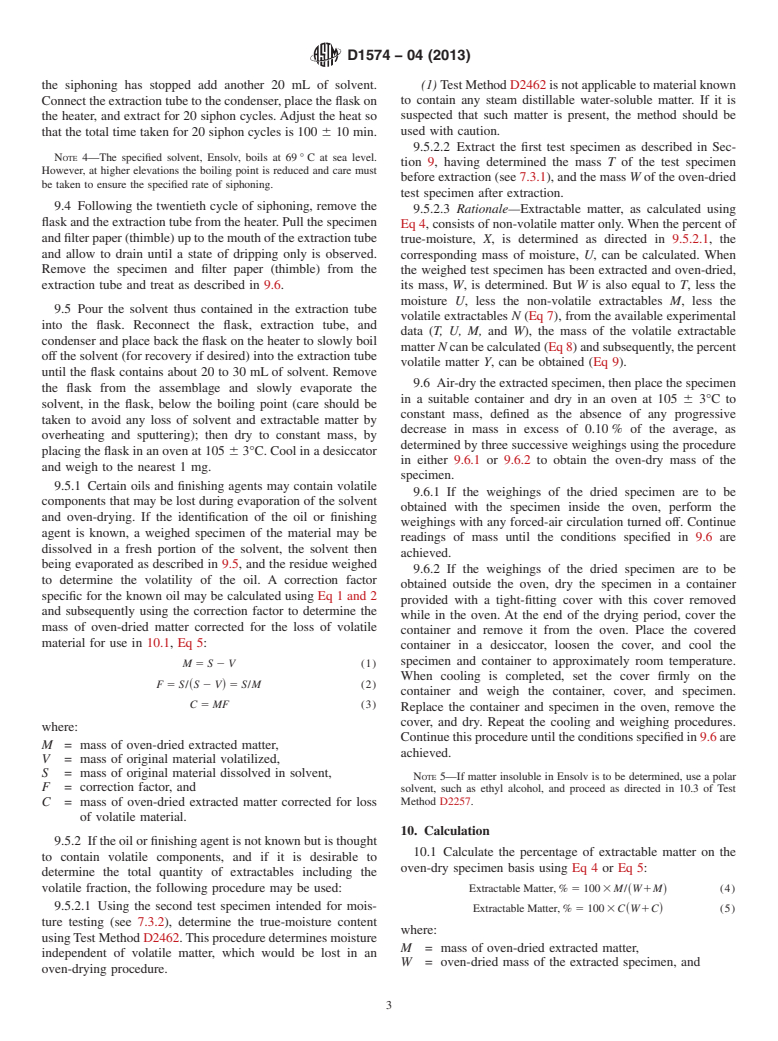
M 5 S 2 V (1)
When cooling is completed, set the cover firmly on the
F 5 S/~S 2 V! 5 S/M (2)
container and weigh the container, cover, and specimen.
C 5 MF (3)
Replace the container and specimen in the oven, remove the
cover, and dry. Repeat the cooling and weighing procedures.
where:
Continuethisprocedureuntiltheconditionsspecifiedin9.6are
M = mass of oven-dried extracted matter,
achieved.
V = mass of original material volatilized,
S = mass of original material dissolved in solvent,
NOTE 5—If matter insoluble in Ensolv is
...
Questions, Comments and Discussion
Ask us and Technical Secretary will try to provide an answer. You can facilitate discussion about the standard in here.