

ASTM F3415-20
(Test Method)Standard Test Method for Triaxial Shear Strength and Cohesion of Equine Sports Surfaces
General Information
- Abstract
SIGNIFICANCE AND USE
5.1 To test the shear strength of a materials describing how the material resists sliding of surface layers. Data from these tests are used to calculate the friction angle and cohesion of a surface sample. This test can be used to help determine if a material falls within a suitable for equine sports surfaces.
SCOPE
1.1 This adapted test method covers the determination of strength and stress-strain relationships of a cylindrical specimen of a compacted, drained cohesive natural or synthetic soil surface used in equine sports surfaces. Specimens are isotropically consolidated and sheared in compression at a constant rate of axial deformation (strain controlled).
1.2 The shear strength of an equine sports surface material describes the resistance of the material to sliding of the surface layers. Shear strength influences both slide and penetration of the hoof in the track surface. It is generally accepted that a small amount of slide on impact is desirable (1-3).2 However, the surface must have sufficient shear strength to support the horse during propulsion (1-5). Thus, an optimal shear strength would be expected for an equestrian surface.
1.3 To determine the shear strength of an equine sports surface, a representative dirt or synthetic sample is placed into a cylindrical cell and a vertical load is applied. Shear strength is measured as per the procedures outlined in Test Method D4767 for lab-consolidated samples. This ASTM standard was adapted by Racing Surfaces Testing Laboratory for the drained condition to more accurately model the conditions of an equestrian surface.
1.4 Dirt samples are tested over a range of forming moisture contents to determine the maximum bulk density and optimal forming moisture content for a given energy input. The dirt samples are then compacted at this optimal moisture content. The maximum stress failure criteria is assumed and results are presented as the failure stress at 15 psi confining pressure versus sample forming moisture content, along with friction angle and cohesion.
1.5 Synthetic samples with good drainage are tested at a 4% forming moisture content, and over a specified range of temperatures. The temperature is controlled using a heated/refrigerated water bath with a triaxial cell cap fitted with a copper coil. Failure criteria is assumed under similar conditions for the dirt surfaces, and results are presented as the failure stress at 15 psi confining pressure versus sample temperature, along with friction angle and cohesion.
1.6 This standard does not purport to address all of the safety concerns, if any, associated with its use. It is the responsibility of the user of this standard to establish appropriate safety, health, and environmental practices and determine the applicability of regulatory limitations prior to use.
1.7 This international standard was developed in accordance with internationally recognized principles on standardization established in the Decision on Principles for the Development of International Standards, Guides and Recommendations issued by the World Trade Organization Technical Barriers to Trade (TBT) Committee.
- Status
- Published
- Publication Date
- 31-Dec-2019
- Technical Committee
- F08 - Sports Equipment, Playing Surfaces, and Facilities
- Drafting Committee
- F08.28 - Equestrian Surfaces

Overview
ASTM F3415-20: Standard Test Method for Triaxial Shear Strength and Cohesion of Equine Sports Surfaces establishes a laboratory procedure for measuring the shear strength and cohesion of dirt and synthetic surfaces used in equine sports. This test method is essential for evaluating how well a surface can support horse movement, ensuring optimal performance and safety. Developed by ASTM International, this standard aligns with recognized international standardization principles and offers guidance for consistent testing and reporting.
Key Topics
- Shear Strength Measurement: The standard focuses on the resistance of equine sports surface materials to the sliding (shear) of surface layers, a property critical to both safety and performance.
- Triaxial Shear Test: A core feature is the adaptation of a triaxial compression test (using isotropically consolidated specimens) to specifically model equestrian surface conditions under drained scenarios.
- Test Procedure:
- Preparation of compacted, cylindrical test specimens from either natural or synthetic materials.
- Application of controlled vertical axial loads in a lab setting until surface failure is observed.
- Testing at a range of forming moisture contents (for dirt) and at controlled temperatures (for synthetic samples).
- Data Collection: Recording key parameters such as friction angle, cohesion, bulk density, and stress-strain characteristics.
- Sample Variability: Emphasizes strict control of moisture content, compaction, and temperature to ensure reproducible results.
Applications
ASTM F3415-20 is crucial for multiple stakeholders in the equestrian sports industry:
- Track and Arena Operators: Use results to select or modify surface materials for optimal shear strength, balancing impact absorption and stability to minimize risk of injury to horses.
- Racing Surfaces Testing Laboratories: Employ this standard to assess the mechanical properties of both new and existing equine surfaces, contributing to data-driven maintenance and construction.
- Manufacturers of Synthetic and Natural Sports Surfaces: Reference the standard for quality assurance, R&D, and material innovation, targeting specific performance criteria.
- Regulatory Bodies and Governing Organizations: Utilize consistent testing protocols to set safety and performance benchmarks for equine racing and training venues.
- Research Institutions: Apply the method for biomechanical and engineering studies related to horse-surface interaction, friction angle, and cohesion effects on performance.
Related Standards
The following standards and references are commonly used in conjunction with ASTM F3415-20 to provide comprehensive material evaluation for equine sports surfaces:
- ASTM D4767 - Standard Test Method for Consolidated Undrained Triaxial Compression Test for Cohesive Soils: Serves as the basis for the laboratory procedure in ASTM F3415-20.
- Industry White Papers and Research Articles: For example, resources on the biomechanical interface between horse hooves and track surfaces, and studies on temperature effects in synthetic materials.
Key terms: triaxial shear test, equine sports surface, shear strength, cohesion, stress-strain relationships, dirt surface, synthetic surface, strain-controlled loading, moisture content, friction angle.
Adhering to ASTM F3415-20 provides a scientific basis for the assessment and management of equine sports surfaces, ensuring that they meet performance and safety criteria essential to the welfare of horses and the integrity of competition.
Relations
- Effective Date
- 01-Apr-2020
- Effective Date
- 01-Nov-2004
- Effective Date
- 10-Dec-2002
- Effective Date
- 01-Jan-1995
Frequently Asked Questions
ASTM F3415-20 is a standard published by ASTM International. Its full title is "Standard Test Method for Triaxial Shear Strength and Cohesion of Equine Sports Surfaces". This standard covers: SIGNIFICANCE AND USE 5.1 To test the shear strength of a materials describing how the material resists sliding of surface layers. Data from these tests are used to calculate the friction angle and cohesion of a surface sample. This test can be used to help determine if a material falls within a suitable for equine sports surfaces. SCOPE 1.1 This adapted test method covers the determination of strength and stress-strain relationships of a cylindrical specimen of a compacted, drained cohesive natural or synthetic soil surface used in equine sports surfaces. Specimens are isotropically consolidated and sheared in compression at a constant rate of axial deformation (strain controlled). 1.2 The shear strength of an equine sports surface material describes the resistance of the material to sliding of the surface layers. Shear strength influences both slide and penetration of the hoof in the track surface. It is generally accepted that a small amount of slide on impact is desirable (1-3).2 However, the surface must have sufficient shear strength to support the horse during propulsion (1-5). Thus, an optimal shear strength would be expected for an equestrian surface. 1.3 To determine the shear strength of an equine sports surface, a representative dirt or synthetic sample is placed into a cylindrical cell and a vertical load is applied. Shear strength is measured as per the procedures outlined in Test Method D4767 for lab-consolidated samples. This ASTM standard was adapted by Racing Surfaces Testing Laboratory for the drained condition to more accurately model the conditions of an equestrian surface. 1.4 Dirt samples are tested over a range of forming moisture contents to determine the maximum bulk density and optimal forming moisture content for a given energy input. The dirt samples are then compacted at this optimal moisture content. The maximum stress failure criteria is assumed and results are presented as the failure stress at 15 psi confining pressure versus sample forming moisture content, along with friction angle and cohesion. 1.5 Synthetic samples with good drainage are tested at a 4% forming moisture content, and over a specified range of temperatures. The temperature is controlled using a heated/refrigerated water bath with a triaxial cell cap fitted with a copper coil. Failure criteria is assumed under similar conditions for the dirt surfaces, and results are presented as the failure stress at 15 psi confining pressure versus sample temperature, along with friction angle and cohesion. 1.6 This standard does not purport to address all of the safety concerns, if any, associated with its use. It is the responsibility of the user of this standard to establish appropriate safety, health, and environmental practices and determine the applicability of regulatory limitations prior to use. 1.7 This international standard was developed in accordance with internationally recognized principles on standardization established in the Decision on Principles for the Development of International Standards, Guides and Recommendations issued by the World Trade Organization Technical Barriers to Trade (TBT) Committee.
SIGNIFICANCE AND USE 5.1 To test the shear strength of a materials describing how the material resists sliding of surface layers. Data from these tests are used to calculate the friction angle and cohesion of a surface sample. This test can be used to help determine if a material falls within a suitable for equine sports surfaces. SCOPE 1.1 This adapted test method covers the determination of strength and stress-strain relationships of a cylindrical specimen of a compacted, drained cohesive natural or synthetic soil surface used in equine sports surfaces. Specimens are isotropically consolidated and sheared in compression at a constant rate of axial deformation (strain controlled). 1.2 The shear strength of an equine sports surface material describes the resistance of the material to sliding of the surface layers. Shear strength influences both slide and penetration of the hoof in the track surface. It is generally accepted that a small amount of slide on impact is desirable (1-3).2 However, the surface must have sufficient shear strength to support the horse during propulsion (1-5). Thus, an optimal shear strength would be expected for an equestrian surface. 1.3 To determine the shear strength of an equine sports surface, a representative dirt or synthetic sample is placed into a cylindrical cell and a vertical load is applied. Shear strength is measured as per the procedures outlined in Test Method D4767 for lab-consolidated samples. This ASTM standard was adapted by Racing Surfaces Testing Laboratory for the drained condition to more accurately model the conditions of an equestrian surface. 1.4 Dirt samples are tested over a range of forming moisture contents to determine the maximum bulk density and optimal forming moisture content for a given energy input. The dirt samples are then compacted at this optimal moisture content. The maximum stress failure criteria is assumed and results are presented as the failure stress at 15 psi confining pressure versus sample forming moisture content, along with friction angle and cohesion. 1.5 Synthetic samples with good drainage are tested at a 4% forming moisture content, and over a specified range of temperatures. The temperature is controlled using a heated/refrigerated water bath with a triaxial cell cap fitted with a copper coil. Failure criteria is assumed under similar conditions for the dirt surfaces, and results are presented as the failure stress at 15 psi confining pressure versus sample temperature, along with friction angle and cohesion. 1.6 This standard does not purport to address all of the safety concerns, if any, associated with its use. It is the responsibility of the user of this standard to establish appropriate safety, health, and environmental practices and determine the applicability of regulatory limitations prior to use. 1.7 This international standard was developed in accordance with internationally recognized principles on standardization established in the Decision on Principles for the Development of International Standards, Guides and Recommendations issued by the World Trade Organization Technical Barriers to Trade (TBT) Committee.
ASTM F3415-20 is classified under the following ICS (International Classification for Standards) categories: 97.220.10 - Sports facilities. The ICS classification helps identify the subject area and facilitates finding related standards.
ASTM F3415-20 has the following relationships with other standards: It is inter standard links to ASTM D4767-11(2020), ASTM D4767-04, ASTM D4767-02, ASTM D4767-95. Understanding these relationships helps ensure you are using the most current and applicable version of the standard.
ASTM F3415-20 is available in PDF format for immediate download after purchase. The document can be added to your cart and obtained through the secure checkout process. Digital delivery ensures instant access to the complete standard document.
Standards Content (Sample)
This international standard was developed in accordance with internationally recognized principles on standardization established in the Decision on Principles for the
Development of International Standards, Guides and Recommendations issued by the World Trade Organization Technical Barriers to Trade (TBT) Committee.
Designation: F3415 − 20
Standard Test Method for
Triaxial Shear Strength and Cohesion of Equine Sports
Surfaces
This standard is issued under the fixed designation F3415; the number immediately following the designation indicates the year of
original adoption or, in the case of revision, the year of last revision. A number in parentheses indicates the year of last reapproval. A
superscript epsilon (´) indicates an editorial change since the last revision or reapproval.
1. Scope refrigerated water bath with a triaxial cell cap fitted with a
copper coil. Failure criteria is assumed under similar condi-
1.1 This adapted test method covers the determination of
tions for the dirt surfaces, and results are presented as the
strength and stress-strain relationships of a cylindrical speci-
failure stress at 15 psi confining pressure versus sample
men of a compacted, drained cohesive natural or synthetic soil
temperature, along with friction angle and cohesion.
surface used in equine sports surfaces. Specimens are isotro-
1.6 This standard does not purport to address all of the
pically consolidated and sheared in compression at a constant
safety concerns, if any, associated with its use. It is the
rate of axial deformation (strain controlled).
responsibility of the user of this standard to establish appro-
1.2 The shear strength of an equine sports surface material
priate safety, health, and environmental practices and deter-
describes the resistance of the material to sliding of the surface
mine the applicability of regulatory limitations prior to use.
layers. Shear strength influences both slide and penetration of
1.7 This international standard was developed in accor-
the hoof in the track surface. It is generally accepted that a
dance with internationally recognized principles on standard-
small amount of slide on impact is desirable (1-3). However,
ization established in the Decision on Principles for the
the surface must have sufficient shear strength to support the
Development of International Standards, Guides and Recom-
horse during propulsion (1-5). Thus, an optimal shear strength
mendations issued by the World Trade Organization Technical
would be expected for an equestrian surface.
Barriers to Trade (TBT) Committee.
1.3 To determine the shear strength of an equine sports
2. Referenced Documents
surface, a representative dirt or synthetic sample is placed into
a cylindrical cell and a vertical load is applied. Shear strength
2.1 ASTM Standards:
is measured as per the procedures outlined in Test Method
D4767 Test Method for Consolidated Undrained Triaxial
D4767 for lab-consolidated samples. ThisASTM standard was
Compression Test for Cohesive Soils
adapted by Racing Surfaces Testing Laboratory for the drained
3. Terminology
condition to more accurately model the conditions of an
equestrian surface. 3.1 Definitions:
3.1.1 failure, n—stress condition at failure for a test speci-
1.4 Dirtsamplesaretestedoverarangeofformingmoisture
men.
contents to determine the maximum bulk density and optimal
3.1.1.1 Discussion—Failure for dirt is taken at 15 psi
forming moisture content for a given energy input. The dirt
confining pressure versus sample forming moisture content,
samples are then compacted at this optimal moisture content.
along with friction angle and cohesion. Failure for a synthetic
The maximum stress failure criteria is assumed and results are
sample is taken under similar conditions for dirt surfaces, and
presented as the failure stress at 15 psi confining pressure
results are presented as the failure stress at 15 psi confining
versus sample forming moisture content, along with friction
pressure versus sample temperature, along with friction angle
angle and cohesion.
and cohesion.
1.5 Synthetic samples with good drainage are tested at a 4%
3.1.2 shear strength, n—resistance of the material to sliding
forming moisture content, and over a specified range of
of the surface layers.
temperatures. The temperature is controlled using a heated/
3.1.3 triaxial shear test, n—method to measure the me-
chanical properties of deformable solids and other granular
This test method is under the jurisdiction of ASTM Committee F08 on Sports
materials or powders.
Equipment, Playing Surfaces, and Facilities and is the direct responsibility of
Subcommittee F08.28 on Equestrian Surfaces.
Current edition approved Jan. 1, 2020. Published January 2020. DOI: 10.1520/ For referenced ASTM standards, visit the ASTM website, www.astm.org, or
F3415-20. contact ASTM Customer Service at service@astm.org. For Annual Book of ASTM
The boldface numbers in parentheses refer to a list of references at the end of Standards volume information, refer to the standard’s Document Summary page on
this standard. the ASTM website.
Copyright © ASTM International, 100 Barr Harbor Drive, PO Box C700, West Conshohocken, PA 19428-2959. United States
F3415 − 20
4. Summary of Test Method the rate of axial strain (loading) prescribed in Test Method
D4767. The rate of advance of the loading device shall not
4.1 The test is done by creating a cylindrical-shaped, 70
deviate by more than 61 % from the selected value. Vibration
mm-diameter, 150 mm-tall compacted sample using a rubber
due to the operation of the loading device shall be sufficiently
membrane and an aluminum shell mold. Once the compacted
small to not cause dimensional changes in the specimen.
sample(withmembrane)isremovedfromthemold,thesample
is placed in a cylindrical Plexiglas cell which is then filled with
7.3 Axial Load Measuring Device—The axial load- measur-
water, placed in a tensile test machine, and subjected to a
ing device shall be a load ring, electronic load cell, hydraulic
vertical compressive load until failure is reached (Fig. 1).Tests
load cell, or any other load-measuring device capable of the
are conducted at various confining pressures, moisture
accuracy prescribed in this paragraph and may be a part of the
contents,andtemperaturesdependingonwhetherthesampleis
axial loading device. The axial load-measuring device shall be
dirt or synthetic. The samples are compacted in six 25 mm (1
capable of measuring the axial load to an accuracy of within 1
in.) lifts to reach the sample height of 150 mm (6 in.).Tests are
% of the axial load at failure. If the load-measuring device is
performedatconfiningpressuresof5,10,15and20psiandare
located inside the triaxial compression chamber, it shall be
conducted for both dirt and synthetic surface samples.
insensitive to horizontal forces and to the magnitude of the
chamber pressure.
5. Significance and Use
5.1 To test the shear strength of a materials describing how
8. Test Specimen Preparation
the material resists sliding of surface layers. Data from these
8.1 Test sample size needed is at least 2000 g and furnace-
tests are used to calculate the friction angle and cohesion of a
heated to remove all moisture from sample before testing per
surface sample. This test can be used to help determine if a
ASTM Equine surface moisture removal spec. Any foreign
material falls within a suitable for equine sports surfaces.
matter also needs to be removed from the sample to include
rubber bits greater than 1 cm in length or diameter before
6. Interferences
weighing. After cleaning, the following steps need to be
6.1 Accurate moisture content is important for consistent
completed for sample preparation: a) Cover the bottom O-ring
test results.
of aluminum mold with aluminum foil and or carefully clean
6.2 Similarcompactionbetweensamplesarealsocriticalfor the mating surfaces b) transfer material to the inside of the
consistent results. membrane c) compact with hand (or other tamper) based on
bulk density energy input d) repeat (a) and (b) until material is
7. Apparatus
level with the top lip of the mold – add/remove material as
neededonthetopsurfacetoensurethatitislevel.Thereshould
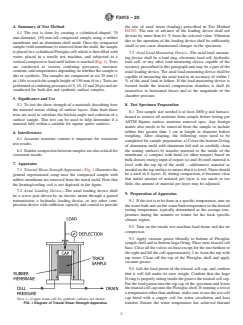
7.1 Triaxial Shear StrengthApparatus—Fig.1illustratesthe
be a total of 6 layers. If, during compaction, it becomes clear
general experimental setup once the compacted sample with
that initial amount of material per layer is too much or too
rubber membrane are removed from the metal mold. Note that
little, the amount of material per layer may be adjusted.
the heating/cooling coil is not depicted in the figure.
7.2 Axial Loading Device—The axial loading device shall
9. Preparation of Apparatus
be a screw jack driven by an electric motor through a geared
transmission, a hydraulic loading device, or any other com-
9.1 If the test is to be done at a specific temperature, turn on
pression device with sufficient capacity and control to provide the water bath and set the water bath temperature to the desired
testing temperature, typically determined as the average tem-
perature during the summer or winter for the track specific
climate region.
9.2 Turn on the tensile test machine load frame and the air
compressor.
9.3 Apply vacuum grease liberally to bottom of Plexiglas
sample shell and to bottom large Oring. Place onto triaxial cell
base. Close all the valves on base except for the one furthest to
the right and fill the cell approximately 2 in. from the top with
tap water. Clean off the top of the Plexiglas shell and apply
vacuum grease.
9.4 Lift the load piston of the triaxial cell cap, and confirm
that it will fall under its own weight. Confirm that the large
O-ring is properly sitting inside the groove the triaxial cell cap.
Put the load piston into the top cap of the specimen and lower
the triaxial cell cap onto the Plexiglas shell. If running a test at
a temperature other than ambient, make sure to use the test cell
cap fitted with a copper coil for water circulation and heat
NOTE 1—Copper water coil for synthetic surfaces not shown.
FIG. 1 Diagram of Triaxial Shear Strength Apparatus transfer. Ensure the water temperature has achieved thermal
...