

ASTM F1015-21
(Test Method)Standard Test Method for Relative Abrasiveness of Synthetic Turf Playing Surfaces
General Information
- Abstract
SIGNIFICANCE AND USE
5.1 Data obtained from the procedure of this test method are indicative of the relative abrasiveness of fabric or carpet type synthetic playing surfaces.
SCOPE
1.1 This test method is applicable to both laboratory and field measurement of synthetic turf surfaces used for sports.
1.2 The values stated in SI units are to be regarded as the standard. The values given in parentheses are for information only.
1.3 This standard does not purport to address all of the safety concerns, if any, associated with its use. It is the responsibility of the user of this standard to establish appropriate safety, health, and environmental practices and determine the applicability of regulatory limitations prior to use.
1.4 This international standard was developed in accordance with internationally recognized principles on standardization established in the Decision on Principles for the Development of International Standards, Guides and Recommendations issued by the World Trade Organization Technical Barriers to Trade (TBT) Committee.
- Status
- Published
- Publication Date
- 30-Nov-2021
- Technical Committee
- F08 - Sports Equipment, Playing Surfaces, and Facilities
- Drafting Committee
- F08.65 - Artificial Turf Surfaces and Systems
Buy Documents

ASTM F1015-21 - Standard Test Method for Relative Abrasiveness of Synthetic Turf Playing Surfaces
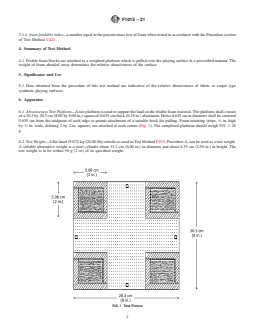
REDLINE ASTM F1015-21 - Standard Test Method for Relative Abrasiveness of Synthetic Turf Playing Surfaces
Overview
ASTM F1015-21: Standard Test Method for Relative Abrasiveness of Synthetic Turf Playing Surfaces describes a recognized procedure for evaluating the abrasiveness of fabric- or carpet-type synthetic turf used in sports. Developed by ASTM International, the standard is widely referenced for both laboratory and field assessments. By following the defined test method, users can quantitatively compare the relative abrasiveness of different synthetic turf surfaces, which is vital for assessing player safety, durability, and product performance.
This test method is applicable to a wide range of synthetic turf systems, incorporating both artificial grass fibers and optional underpads, and provides significant insight into how a surface may interact with users or equipment during sporting activities.
Key Topics
- Test Scope: The method applies to both laboratory and field measurements of synthetic turf playing surfaces.
- Abrasiveness Index: The core measurement is the "abrasiveness index," reflecting the weight loss from a standardized foam after controlled dragging over the surface. This index allows surfaces to be compared for relative abrasiveness.
- Test Apparatus: The procedure uses a specified aluminum platform, a standard test weight, and friable foam test blocks. The platform is pulled across the surface in defined directions and distances.
- Sample Preparation: Test samples, including both surfaces and foam blocks, require strict conditioning to ensure reliable, repeatable results.
- Precision and Sources of Error: ASTM F1015-21 notes potential variability in foam composition, pull direction, and surface properties, emphasizing the need for careful adherence to sampling and conditioning protocols.
Applications
The ASTM F1015-21 standard is critical in several areas related to synthetic turf:
- Surface Safety Evaluation: Quantifying surface abrasiveness supports safety assessments for athletes, helping minimize the risk of injuries such as turf burn.
- Product Comparison: Manufacturers and sports facilities can benchmark various turf systems, including new designs and maintenance procedures, to select or certify products with optimal performance.
- Quality Assurance: Routine field measurements ensure that installed synthetic sports surfaces maintain acceptable abrasiveness levels throughout their lifecycle.
- Research and Development: The test method aids in the development and improvement of new turf materials and systems by providing a quantifiable, repeatable measure of surface properties.
Related Standards
For quality consistency and integrated testing, ASTM F1015-21 references and complements several other ASTM standards, including:
- ASTM C421 - Test Method for Tumbling Friability of Preformed Block-Type and Preformed Pipe-Covering-Type Thermal Insulation (used to qualify the friable test foam).
- ASTM F355 - Test Method for Impact Attenuation of Playing Surface Systems, Other Protective Sport Systems, and Materials Used for Athletics, Recreation and Play.
- ASTM E105 - Guide for Probability Sampling of Materials.
- ASTM E122 - Practice for Calculating Sample Size to Estimate, With Specified Precision, the Average for a Characteristic of a Lot or Process.
- ASTM D1776 - Practice for Conditioning Textiles for Testing.
Practical Value
By implementing ASTM F1015-21, stakeholders in the sports surface industry-including facility managers, product developers, safety engineers, and sports organizations-have a reliable, internationally recognized methodology for evaluating and comparing the abrasiveness of synthetic turf. This helps ensure safety standards, product consistency, and regulatory compliance across a global market, supporting better performance and user satisfaction for athletic and recreational facilities.
Relations
- Effective Date
- 01-Dec-2023
- Effective Date
- 01-Mar-2020
- Effective Date
- 01-Jul-2016
- Effective Date
- 01-Jul-2016
- Effective Date
- 01-Apr-2014
- Effective Date
- 01-Aug-2011
- Effective Date
- 01-Oct-2010
- Refers
ASTM F355-10a - Standard Test Method for Impact Attenuation of Playing Surface Systems and Materials - Effective Date
- 01-Jul-2010
- Refers
ASTM F355-10 - Standard Test Method for Impact Attenuation of Playing Surface Systems and Materials - Effective Date
- 15-Apr-2010
- Refers
ASTM F355-09 - Standard Test Method for Impact Attenuation of Playing Surface Systems and Materials - Effective Date
- 15-Nov-2009
- Effective Date
- 01-Aug-2009
- Effective Date
- 15-Apr-2008
- Effective Date
- 01-Oct-2007
- Effective Date
- 01-Aug-2005
- Effective Date
- 01-Jun-2004
Buy Documents
ASTM F1015-21 - Standard Test Method for Relative Abrasiveness of Synthetic Turf Playing Surfaces
REDLINE ASTM F1015-21 - Standard Test Method for Relative Abrasiveness of Synthetic Turf Playing Surfaces
Frequently Asked Questions
ASTM F1015-21 is a standard published by ASTM International. Its full title is "Standard Test Method for Relative Abrasiveness of Synthetic Turf Playing Surfaces". This standard covers: SIGNIFICANCE AND USE 5.1 Data obtained from the procedure of this test method are indicative of the relative abrasiveness of fabric or carpet type synthetic playing surfaces. SCOPE 1.1 This test method is applicable to both laboratory and field measurement of synthetic turf surfaces used for sports. 1.2 The values stated in SI units are to be regarded as the standard. The values given in parentheses are for information only. 1.3 This standard does not purport to address all of the safety concerns, if any, associated with its use. It is the responsibility of the user of this standard to establish appropriate safety, health, and environmental practices and determine the applicability of regulatory limitations prior to use. 1.4 This international standard was developed in accordance with internationally recognized principles on standardization established in the Decision on Principles for the Development of International Standards, Guides and Recommendations issued by the World Trade Organization Technical Barriers to Trade (TBT) Committee.
SIGNIFICANCE AND USE 5.1 Data obtained from the procedure of this test method are indicative of the relative abrasiveness of fabric or carpet type synthetic playing surfaces. SCOPE 1.1 This test method is applicable to both laboratory and field measurement of synthetic turf surfaces used for sports. 1.2 The values stated in SI units are to be regarded as the standard. The values given in parentheses are for information only. 1.3 This standard does not purport to address all of the safety concerns, if any, associated with its use. It is the responsibility of the user of this standard to establish appropriate safety, health, and environmental practices and determine the applicability of regulatory limitations prior to use. 1.4 This international standard was developed in accordance with internationally recognized principles on standardization established in the Decision on Principles for the Development of International Standards, Guides and Recommendations issued by the World Trade Organization Technical Barriers to Trade (TBT) Committee.
ASTM F1015-21 is classified under the following ICS (International Classification for Standards) categories: 97.220.10 - Sports facilities. The ICS classification helps identify the subject area and facilitates finding related standards.
ASTM F1015-21 has the following relationships with other standards: It is inter standard links to ASTM F355-23, ASTM C421-08(2020), ASTM F355-16e1, ASTM F355-16, ASTM C421-08(2014), ASTM E122-09e1, ASTM E105-10, ASTM F355-10a, ASTM F355-10, ASTM F355-09, ASTM E122-09, ASTM C421-08, ASTM E122-07, ASTM C421-05, ASTM E105-04. Understanding these relationships helps ensure you are using the most current and applicable version of the standard.
ASTM F1015-21 is available in PDF format for immediate download after purchase. The document can be added to your cart and obtained through the secure checkout process. Digital delivery ensures instant access to the complete standard document.
Standards Content (Sample)
This international standard was developed in accordance with internationally recognized principles on standardization established in the Decision on Principles for the
Development of International Standards, Guides and Recommendations issued by the World Trade Organization Technical Barriers to Trade (TBT) Committee.
Designation: F1015 − 21 An American National Standard
Standard Test Method for
Relative Abrasiveness of Synthetic Turf Playing Surfaces
This standard is issued under the fixed designation F1015; the number immediately following the designation indicates the year of
original adoption or, in the case of revision, the year of last revision. A number in parentheses indicates the year of last reapproval. A
superscript epsilon (´) indicates an editorial change since the last revision or reapproval.
1. Scope 3.1.1 synthetic turf playing surface—a man-made playing
surface incorporating artificial grass-like fibers.
1.1 This test method is applicable to both laboratory and
3.1.2 abrasiveness—that property of a synthetic turf which
field measurement of synthetic turf surfaces used for sports.
causes material in moving contact with the turf surface to wear
1.2 The values stated in SI units are to be regarded as the
away.
standard. The values given in parentheses are for information
3.1.3 abrasiveness index—a number equal to the weight lost
only.
in grams per foot of travel of a standard weighted friable foam
1.3 This standard does not purport to address all of the
set multiplied by 100, when the foam is pulled through a
safety concerns, if any, associated with its use. It is the
complete 1.8-m (6-ft) test cycle.
responsibility of the user of this standard to establish appro-
3.1.4 foam friability index—a number equal to the percent
priate safety, health, and environmental practices and deter-
mass loss of foam when tested in accordance with the
mine the applicability of regulatory limitations prior to use.
Procedure section of Test Method C421.
1.4 This international standard was developed in accor-
dance with internationally recognized principles on standard-
4. Summary of Test Method
ization established in the Decision on Principles for the
Development of International Standards, Guides and Recom-
4.1 Friable foam blocks are attached to a weighted platform
mendations issued by the World Trade Organization Technical
which is pulled over the playing surface in a prescribed
Barriers to Trade (TBT) Committee.
manner. The weight of foam abraded away determines the
relative abrasiveness of the surface.
2. Referenced Documents
5. Significance and Use
2.1 ASTM Standards:
C421 Test Method for Tumbling Friability of Preformed
5.1 Data obtained from the procedure of this test method are
Block-Type and Preformed Pipe-Covering-Type Thermal
indicative of the relative abrasiveness of fabric or carpet type
Insulation
synthetic playing surfaces.
E105 Guide for Probability Sampling of Materials
E122 Practice for Calculating Sample Size to Estimate,With
6. Apparatus
Specified Precision, the Average for a Characteristic of a
6.1 Abrasiveness Test Platform—A test platform is used to
Lot or Process
support the load on the friable foam material. The platform
F355 TestMethodforImpactAttenuationofPlayingSurface
shall consist of a 20.3 by 20.3 cm (8.00 by 8.00 in.) square of
Systems, Other Protective Sport Systems, and Materials
0.635-cm thick (0.25 in.) aluminum. Holes 0.635 cm in
Used for Athletics, Recreation and Play
diameter shall be centered 0.635 cm from the midpoint of each
edge to permit attachment of a suitable hook for pulling. Foam
3. Terminology
1 1
retaining strips, ⁄4 in. high by ⁄2 in. wide, defining 2 by 2-in.
3.1 Definitions of Terms Specific to This Standard:
squares, are attached at each corner (Fig. 1). The completed
platform should weigh 931 6 28 g.
6.2 Test Weight—A flat-head (9.072-kg (20.00-lb)) missile
This test method is under the jurisdiction of ASTM Committee F08 on Sports
asusedinTestMethodF355,ProcedureA,canbeusedasatest
Equipment, Playing Surfaces, and Facilities and is the direct responsibility of
Subcommittee F08.65 on Artificial Turf Surfaces and Systems.
weight. A suitable alternative weight is a steel cylinder about
Current edition approved Dec. 1, 2021. Published January 2022. Originally
15.2 cm (6.00 in.) in diameter and about 6.35 cm (2.50 in.) in
approved in 1986. Last previous edition approved in 2017 as F1015 – 03 (2017).
height. The test weight is to be within 56 g (2 oz) of its
DOI: 10.1520/F1015-21.
For referenced ASTM standards, visit the ASTM website, www.astm.org, or specified weight.
contact ASTM Customer Service at service@astm.org. For Annual Book of ASTM
6.3 Pull Cable and Direction Changing Pulley—Adirection
Standards volume information, refer to the standard’s Document Summary page on
the ASTM website. changing pulley attached to an operator foot restraint may be
Copyright © ASTM International, 100 Barr Harbor Drive, PO Box C700, West Conshohocken, PA 19428-2959. United States
F1015 − 21
FIG. 1 Test Fixture
usedtofacilitatemovingtheloadedplatformacrossthesurface 8.2 In the case of field evaluation abrasiveness, measure-
while keeping the pull cable parallel to the surface. The pull ments should be made in representative areas of the field or
cablemustnotstretchundertensionandmustbeequippedwith specific area of interest.
a method of determining the distance pulled. For example,
9. Number of Specimens
mechanical stops on either side of the direction changing
9.1 At least five specimens shall be tested and may be
pulley can be set to give the 45.7-cm (18-in.) pull length.
required. In the case of field evaluation, five tests shall be
performed, and may be required, in the area of interest or over
7. Test Foam
the entire playing surface depending on the intended data use.
7.1 Thefriablefoamblocksusedasthetestmaterialshallbe
9.2 The sampling procedures of Recommended Practices
rigid closed-cell isocyanurate foam having a bulk density of
3 3
E105 and E122 should be followed and may be required.
0.321 6 0.0008 g/cm (2.00 6 0.05 lb/ft ). In addition, the test
foam must have a mass loss of 50 6 5 % as measured by Test
10. Sample Conditioning
Method C421. Test blocks must be cut to 5.08 by 5.08 by 2.54
10.1 Field samples shall be under the intended use
cm,
...
This document is not an ASTM standard and is intended only to provide the user of an ASTM standard an indication of what changes have been made to the previous version. Because
it may not be technically possible to adequately depict all changes accurately, ASTM recommends that users consult prior editions as appropriate. In all cases only the current version
of the standard as published by ASTM is to be considered the official document.
Designation: F1015 − 03 (Reapproved 2017) F1015 − 21 An American National Standard
Standard Test Method for
Relative Abrasiveness of Synthetic Turf Playing Surfaces
This standard is issued under the fixed designation F1015; the number immediately following the designation indicates the year of
original adoption or, in the case of revision, the year of last revision. A number in parentheses indicates the year of last reapproval. A
superscript epsilon (´) indicates an editorial change since the last revision or reapproval.
1. Scope
1.1 This test method is applicable to both laboratory and field measurement of synthetic turf surfaces used for sports.
1.2 The values stated in SI units are to be regarded as the standard. The values given in parentheses are for information only.
1.3 This standard does not purport to address all of the safety concerns, if any, associated with its use. It is the responsibility
of the user of this standard to establish appropriate safety, health, and environmental practices and determine the applicability of
regulatory limitations prior to use.
1.4 This international standard was developed in accordance with internationally recognized principles on standardization
established in the Decision on Principles for the Development of International Standards, Guides and Recommendations issued
by the World Trade Organization Technical Barriers to Trade (TBT) Committee.
2. Referenced Documents
2.1 ASTM Standards:
C421 Test Method for Tumbling Friability of Preformed Block-Type and Preformed Pipe-Covering-Type Thermal Insulation
E105 Guide for Probability Sampling of Materials
E122 Practice for Calculating Sample Size to Estimate, With Specified Precision, the Average for a Characteristic of a Lot or
Process
F355 Test Method for Impact Attenuation of Playing Surface Systems, Other Protective Sport Systems, and Materials Used for
Athletics, Recreation and Play
3. Terminology
3.1 Definitions of Terms Specific to This Standard:
3.1.1 synthetic turf playing surface—a man-made playing surface incorporating artificial grass-like fibers.
3.1.2 abrasiveness—that property of a synthetic turf which causes material in moving contact with the turf surface to wear away.
3.1.3 abrasiveness index—a number equal to the weight lost in grams per foot of travel of a standard weighted friable foam set
multiplied by 100, when the foam is pulled through a complete 1.8-m (6-ft) test cycle.
This test method is under the jurisdiction of ASTM Committee F08 on Sports Equipment, Playing Surfaces, and Facilities and is the direct responsibility of Subcommittee
F08.65 on Artificial Turf Surfaces and Systems.
Current edition approved Dec. 1, 2017Dec. 1, 2021. Published December 2017January 2022. Originally approved in 1986. Last previous edition approved in 20092017
as F1015 – 03 (2009).(2017). DOI: 10.1520/F1015-03R17.10.1520/F1015-21.
For referenced ASTM standards, visit the ASTM website, www.astm.org, or contact ASTM Customer Service at service@astm.org. For Annual Book of ASTM Standards
volume information, refer to the standard’s Document Summary page on the ASTM website.
Copyright © ASTM International, 100 Barr Harbor Drive, PO Box C700, West Conshohocken, PA 19428-2959. United States
F1015 − 21
3.1.4 foam friability index—a number equal to the percent mass loss of foam when tested in accordance with the Procedure section
of Test Method C421.
4. Summary of Test Method
4.1 Friable foam blocks are attached to a weighted platform which is pulled over the playing surface in a prescribed manner. The
weight of foam abraded away determines the relative abrasiveness of the surface.
5. Significance and Use
5.1 Data obtained from the procedure of this test method are indicative of the relative abrasiveness of fabric or carpet type
synthetic playing surfaces.
6. Apparatus
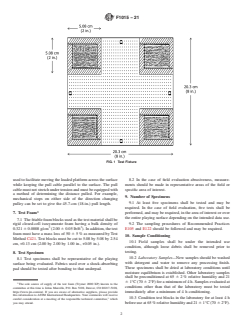
6.1 Abrasiveness Test Platform—A test platform is used to support the load on the friable foam material. The platform shall consist
of a 20.3 by 20.3 cm (8.00 by 8.00 in.) square of 0.635-cm thick (0.25 in.) aluminum. Holes 0.635 cm in diameter shall be centered
0.635 cm from the midpoint of each edge to permit attachment of a suitable hook for pulling. Foam retaining strips, ⁄4 in. high
by ⁄2 in. wide, defining 2 by 2-in. squares, are attached at each corner (Fig. 1). The completed platform should weigh 931 6 28
g.
6.2 Test Weight—A flat-head (9.072-kg (20.00-lb)) missile as used in Test Method F355, Procedure A, can be used as a test weight.
A suitable alternative weight is a steel cylinder about 15.2 cm (6.00 in.) in diameter and about 6.35 cm (2.50 in.) in height. The
test weight is to be within 56 g (2 oz) of its specified weight.
FIG. 1 Test Fixture
F1015 − 21
6.3 Pull Cable and Direction Changing Pulley—A direction changing pulley attached to an operator foot restraint may be used
to facilitate moving the loaded platform across the surface while keeping the pull cable parallel to the surface. The pull cable must
not stretch under tension and must be equipped with a method of determining the distance pulled. For example, mechanical stops
on either side of the direction changing pulley can be set to give the 45.7-cm (18-in.) pull length.
7. Test Foam
7.1 The friable foam blocks used as the test material shall be rigid closed-cell isocyanurate foam having a bulk density of
3 3
0.03120.321 6 0.0008 g/cm (1.95(2.00 6 0.05 lb/ft ). In addition, the test foam must have a mass loss of 4050 6 2 %5 % as
measured by Test Method C421. Test blocks must be cut to 5.08 by 5.08 by 2.54 cm, −0.13cm, +0.13 cm (2.00 by 2.00 by 1.00
in., −0.05in., +0.05 in.).
8. Test Specimen
8.1 Test specimens shall be representative of the playing surface being evaluated. Fabrics used over a shock-absorbing pad should
be tested after bonding to that underpad.
8.2 In the case of field evaluation abrasiveness, measurements should be made in representative areas of the field or specific area
of interest.
9. Number of Specimens
9.1 At least five specimens shall be tested and may be required. In the case of field evaluat
...