

ASTM F3272-18
(Guide)Standard Guide for Selection, Care, and Use of Arc Protective Blankets
General Information
- Abstract
SIGNIFICANCE AND USE
5.1 This guide provides positioning, installation, and anchoring techniques that may be used to arrange arc protective blankets to confine or divert the energies found from a fault that may include plasma arcing, pressure wave, and projectiles.
5.2 Arc protective blankets may be used in an electrical application to confine or divert energy away from a work zone for electrical or other workers who may be exposed to an electric arc in the event of an equipment or conductor failure.
5.3 This guide provides information for working around cables, splices, and any equipment components that have historical failures deemed to require additional protection or engineering controls, which could benefit from added protection provided by an arc protective blanket.
5.4 This guide is designed for electrical engineers and qualified installers of arc protective blankets.
5.5 The practice is limited by the blanket protective value, the sturdiness of the installation, and the engineering assumptions of the hazard assessment.
5.6 These blankets do not typically provide dielectric protection.
5.7 These blankets do not eliminate the need for arc-rated PPE but may reduce the level of the hazard in some installations.
SCOPE
1.1 This guide provides information for the selection, care, and use of arc protective blankets for personnel protection.
1.2 This guide covers positioning and securing arc protective blankets (tested to Test Method F2676) and channeling the thermal, ballistic, and concussive forces generated by an arc flash event using arc protective blankets.
1.3 This guide describes the use of the arc protective blanket to maximize its protective effectiveness to workers exposed to energized electrical equipment where complete de-energizing of the work zone cannot be achieved or for low-risk exposures with sufficient arc flash incident energy to warrant secondary protective means in the event of an arc flash.
1.4 The values stated in SI units are to be regarded as the standard. See IEEE/ASTM SI-10.
1.5 This standard does not purport to address all of the safety concerns, if any, associated with its use. It is the responsibility of the user of this standard to establish appropriate safety, health, and environmental practices and determine the applicability of regulatory limitations prior to use.
1.6 This international standard was developed in accordance with internationally recognized principles on standardization established in the Decision on Principles for the Development of International Standards, Guides and Recommendations issued by the World Trade Organization Technical Barriers to Trade (TBT) Committee.
- Status
- Published
- Publication Date
- 28-Feb-2018
- Technical Committee
- F18 - Electrical Protective Equipment for Workers
- Drafting Committee
- F18.65 - Wearing Apparel
Overview
ASTM F3272-18 - Standard Guide for Selection, Care, and Use of Arc Protective Blankets provides essential guidance for electrical safety professionals, engineers, and qualified installers tasked with protecting personnel from the effects of electrical arc flash events. This standard outlines how to choose, position, install, and maintain arc protective blankets to effectively confine or divert hazardous energies-including thermal, ballistic, and concussive forces-away from work zones. These guidelines facilitate informed decisions to enhance electrical worker safety where de-energizing equipment is not fully possible or where historical failures demand additional safeguards.
Key Topics
Selection and Application
- Criteria for selecting arc protective blankets based on anticipated fault current, blanket rating, and equipment configuration.
- Guidance on matching blanket type, size, and installation method to specific work environments and exposures.
- Emphasis on using the largest blanket that fits the space and on utilizing manufacturer-recommended attachment and securing methods.
Installation Practices
- Techniques for anchoring and securing blankets to structures such as walls, vaults, racks, or portable frames.
- Installation methods to channel arc energy away from workers, such as the "J" installation, clamshell, suspended wall, arc cube, and portable barrier techniques.
- Addressing complexities in three-dimensional installations and the need to assess wall and anchoring integrity, especially in aging infrastructure.
Care and Maintenance
- Regular inspection before use for damage, contamination, wear, or missing components.
- Cleaning procedures tailored to blanket materials, such as using appropriate detergents and avoiding flammable or conductive cleaners.
- Storage considerations to avoid UV or ozone degradation, and periodic re-evaluation of blanket condition.
Limitations and Hazard Assessment
- Understanding that arc protective blankets do not eliminate the need for arc-rated PPE.
- Limitations of protection based on blanket design, anchoring strength, and adherence to installation best practices.
- Importance of conducting comprehensive electrical hazard assessments and arc flash incident energy calculations as part of an overall safety program.
Applications
Arc protective blankets are a critical element in electrical safety programs, particularly in:
- Underground manholes and vaults where energized cable splices are accessible.
- Electrical substations and transformer rooms.
- Switchgear, disconnects, pad-mounted gear, and switchgear rooms.
- Scenarios where electrical equipment cannot be fully de-energized or where there is a documented need for secondary protective barriers.
Practical benefits include:
- Providing secondary protection to workers during high-risk operations.
- Channeling arc blast energy and associated projectiles away from personnel.
- Enhancing hazard mitigation practices for utility maintenance, installation, and repair crews.
Related Standards
Professionals applying ASTM F3272-18 should also be familiar with related regulations and standards, including:
- ASTM F2676 – Test Method for Determining the Protective Performance of an Arc Protective Blanket for Electric Arc Hazards
- NFPA 70E – Standard for Electrical Safety in the Workplace
- CSA Z462 – Workplace Electrical Safety
- OSHA 29 CFR 1910.269 – Occupational Safety and Health Standards for Special Industries
- OSHA 29 CFR 1926.950-969 – Safety and Health Regulations for Construction
- IEEE/ASTM SI-10 – American National Standard for Metric Practice
Keywords: arc protective blanket, arc flash safety, electrical PPE, arc blast hazards, electrical safety equipment, hazard assessment, worker protection, blanket installation, asset protection, ASTM F3272 compliance
This standard supports the implementation of comprehensive electrical safety strategies by focusing on the proper selection, use, and maintenance of arc protective blankets, ultimately reducing injuries and improving workplace safety.
Relations
- Effective Date
- 01-Mar-2018
- Effective Date
- 01-May-2018
- Effective Date
- 01-Apr-2016
- Effective Date
- 15-Feb-2016
- Effective Date
- 15-Feb-2016
- Effective Date
- 01-Jan-2013
- Effective Date
- 01-Jan-2013
- Effective Date
- 01-Jan-2013
- Effective Date
- 01-Apr-2010
- Effective Date
- 01-May-2009
- Effective Date
- 15-May-2008
- Effective Date
- 15-Nov-2006
- Effective Date
- 01-Jun-2006
- Effective Date
- 01-Jun-2006
- Effective Date
- 01-Jan-2005
Get Certified
Connect with accredited certification bodies for this standard

CIS Institut d.o.o.
Personal Protective Equipment (PPE) certification body. Notified Body NB-2890 for EU Regulation 2016/425 PPE.

Kiwa BDA Testing
Building and construction product certification.
Kmetijski inštitut Slovenije
Agricultural Institute of Slovenia. Soil testing, plant health, agricultural product analysis.
Sponsored listings
Frequently Asked Questions
ASTM F3272-18 is a guide published by ASTM International. Its full title is "Standard Guide for Selection, Care, and Use of Arc Protective Blankets". This standard covers: SIGNIFICANCE AND USE 5.1 This guide provides positioning, installation, and anchoring techniques that may be used to arrange arc protective blankets to confine or divert the energies found from a fault that may include plasma arcing, pressure wave, and projectiles. 5.2 Arc protective blankets may be used in an electrical application to confine or divert energy away from a work zone for electrical or other workers who may be exposed to an electric arc in the event of an equipment or conductor failure. 5.3 This guide provides information for working around cables, splices, and any equipment components that have historical failures deemed to require additional protection or engineering controls, which could benefit from added protection provided by an arc protective blanket. 5.4 This guide is designed for electrical engineers and qualified installers of arc protective blankets. 5.5 The practice is limited by the blanket protective value, the sturdiness of the installation, and the engineering assumptions of the hazard assessment. 5.6 These blankets do not typically provide dielectric protection. 5.7 These blankets do not eliminate the need for arc-rated PPE but may reduce the level of the hazard in some installations. SCOPE 1.1 This guide provides information for the selection, care, and use of arc protective blankets for personnel protection. 1.2 This guide covers positioning and securing arc protective blankets (tested to Test Method F2676) and channeling the thermal, ballistic, and concussive forces generated by an arc flash event using arc protective blankets. 1.3 This guide describes the use of the arc protective blanket to maximize its protective effectiveness to workers exposed to energized electrical equipment where complete de-energizing of the work zone cannot be achieved or for low-risk exposures with sufficient arc flash incident energy to warrant secondary protective means in the event of an arc flash. 1.4 The values stated in SI units are to be regarded as the standard. See IEEE/ASTM SI-10. 1.5 This standard does not purport to address all of the safety concerns, if any, associated with its use. It is the responsibility of the user of this standard to establish appropriate safety, health, and environmental practices and determine the applicability of regulatory limitations prior to use. 1.6 This international standard was developed in accordance with internationally recognized principles on standardization established in the Decision on Principles for the Development of International Standards, Guides and Recommendations issued by the World Trade Organization Technical Barriers to Trade (TBT) Committee.
SIGNIFICANCE AND USE 5.1 This guide provides positioning, installation, and anchoring techniques that may be used to arrange arc protective blankets to confine or divert the energies found from a fault that may include plasma arcing, pressure wave, and projectiles. 5.2 Arc protective blankets may be used in an electrical application to confine or divert energy away from a work zone for electrical or other workers who may be exposed to an electric arc in the event of an equipment or conductor failure. 5.3 This guide provides information for working around cables, splices, and any equipment components that have historical failures deemed to require additional protection or engineering controls, which could benefit from added protection provided by an arc protective blanket. 5.4 This guide is designed for electrical engineers and qualified installers of arc protective blankets. 5.5 The practice is limited by the blanket protective value, the sturdiness of the installation, and the engineering assumptions of the hazard assessment. 5.6 These blankets do not typically provide dielectric protection. 5.7 These blankets do not eliminate the need for arc-rated PPE but may reduce the level of the hazard in some installations. SCOPE 1.1 This guide provides information for the selection, care, and use of arc protective blankets for personnel protection. 1.2 This guide covers positioning and securing arc protective blankets (tested to Test Method F2676) and channeling the thermal, ballistic, and concussive forces generated by an arc flash event using arc protective blankets. 1.3 This guide describes the use of the arc protective blanket to maximize its protective effectiveness to workers exposed to energized electrical equipment where complete de-energizing of the work zone cannot be achieved or for low-risk exposures with sufficient arc flash incident energy to warrant secondary protective means in the event of an arc flash. 1.4 The values stated in SI units are to be regarded as the standard. See IEEE/ASTM SI-10. 1.5 This standard does not purport to address all of the safety concerns, if any, associated with its use. It is the responsibility of the user of this standard to establish appropriate safety, health, and environmental practices and determine the applicability of regulatory limitations prior to use. 1.6 This international standard was developed in accordance with internationally recognized principles on standardization established in the Decision on Principles for the Development of International Standards, Guides and Recommendations issued by the World Trade Organization Technical Barriers to Trade (TBT) Committee.
ASTM F3272-18 is classified under the following ICS (International Classification for Standards) categories: 13.340.99 - Other protective equipment. The ICS classification helps identify the subject area and facilitates finding related standards.
ASTM F3272-18 has the following relationships with other standards: It is inter standard links to ASTM F3272-17, ASTM D4391-18, ASTM F2676-16, ASTM D4391-16, ASTM D4391-16e1, ASTM D4391-93a(2013), ASTM D4391-93a(2013)e2, ASTM D4391-93A(2013)e1, ASTM F819-10, ASTM F2676-09, ASTM F819-08, ASTM F819-06, ASTM D4391-93a(2006)e1, ASTM D4391-93a(2006), ASTM F819-05. Understanding these relationships helps ensure you are using the most current and applicable version of the standard.
ASTM F3272-18 is available in PDF format for immediate download after purchase. The document can be added to your cart and obtained through the secure checkout process. Digital delivery ensures instant access to the complete standard document.
Standards Content (Sample)
This international standard was developed in accordance with internationally recognized principles on standardization established in the Decision on Principles for the
Development of International Standards, Guides and Recommendations issued by the World Trade Organization Technical Barriers to Trade (TBT) Committee.
Designation: F3272 − 18
Standard Guide for
Selection, Care, and Use of Arc Protective Blankets
This standard is issued under the fixed designation F3272; the number immediately following the designation indicates the year of
original adoption or, in the case of revision, the year of last revision. A number in parentheses indicates the year of last reapproval. A
superscript epsilon (´) indicates an editorial change since the last revision or reapproval.
1. Scope F2676 Test Method for Determining the Protective Perfor-
mance of an Arc Protective Blanket for Electric Arc
1.1 This guide provides information for the selection, care,
Hazards
and use of arc protective blankets for personnel protection.
2.2 IEEE/ASTM Standard:
1.2 This guide covers positioning and securing arc protec-
IEEE/ASTM SI-10 American National Standard for Metric
tive blankets (tested toTest Method F2676) and channeling the
Practice
thermal, ballistic, and concussive forces generated by an arc
2.3 NFPA Standard:
flash event using arc protective blankets.
NFPA70E-2018 Standard for Electrical Safety in the Work-
1.3 Thisguidedescribestheuseofthearcprotectiveblanket
place
to maximize its protective effectiveness to workers exposed to
2.4 CSA Standard:
energized electrical equipment where complete de-energizing
CSA Z462-2018 Workplace electrical safety
of the work zone cannot be achieved or for low-risk exposures
2.5 OSHA Standards:
with sufficient arc flash incident energy to warrant secondary
29 CFR 1910.269 Occupational Safety and Health Stan-
protective means in the event of an arc flash.
dards: Special Industries
1.4 The values stated in SI units are to be regarded as the
29 CFR 1926.950-969 Safety and Health Regulations for
standard. See IEEE/ASTM SI-10.
Construction
1.5 This standard does not purport to address all of the
3. Terminology
safety concerns, if any, associated with its use. It is the
responsibility of the user of this standard to establish appro-
3.1 Definitions:
priate safety, health, and environmental practices and deter-
3.1.1 For definitions relating to the burning behavior of
mine the applicability of regulatory limitations prior to use.
textiles, see Terminology D4391 and for definitions relating to
1.6 This international standard was developed in accor-
electrical protective equipment for workers, see Terminology
dance with internationally recognized principles on standard-
F819.
ization established in the Decision on Principles for the
3.1.2 abnormal condition, n—abnormalities such as but not
Development of International Standards, Guides and Recom-
limited to, oil or compound leaking from cable or joints,
mendations issued by the World Trade Organization Technical
broken cable sheaths or joint sleeves, hot localized surface
Barriers to Trade (TBT) Committee.
temperatures of cables or joints, or joints that are swollen
beyond normal tolerance are presumed to lead to or be an
2. Referenced Documents
indication of an impending fault.
2.1 ASTM Standards:
3.1.3 anchoring, n—method of physical attachment for
D4391 Terminology Relating to The Burning Behavior of
securing the blanket and all attached components (straps,
Textiles
stanchions,otherhardware,etc.)inplaceforthedurationofthe
F819 Terminology Relating to Electrical Protective Equip-
protection level for which the blanket is rated.
ment for Workers
3.1.4 arc protective blanket, n—a flat assembly of fabric(s)
withlocationsforattachmentsusedtoprotectworkersfromthe
This guide is under the jurisdiction of ASTM Committee F18 on Electrical
effects of arc flash and arc blast.
Protective Equipment for Workers and is the direct responsibility of Subcommittee
F18.65 on Wearing Apparel.
Current edition approved March 1, 2018. Published May 2018. Originally
approved in 2017. Last previous edition approved in 2017 as F3272-17. DOI: Available from National Fire Protection Association (NFPA), 1 Batterymarch
10.1520/F3272-18. Park, Quincy, MA 02169-7471, http://www.nfpa.org.
2 4
For referenced ASTM standards, visit the ASTM website, www.astm.org, or Available from Canadian Standards Association (CSA), 178 Rexdale Blvd.,
contact ASTM Customer Service at service@astm.org. For Annual Book of ASTM Toronto, ON M9W 1R3, Canada, http://www.csagroup.org.
Standards volume information, refer to the standard’s Document Summary page on Available from Occupational Safety and Health Administration (OSHA), 200
the ASTM website. Constitution Ave., NW, Washington, DC 20210, http://www.osha.gov.
Copyright © ASTM International, 100 Barr Harbor Drive, PO Box C700, West Conshohocken, PA 19428-2959. United States
F3272 − 18
3.1.5 arc protective blanket maximum arc current lmax, 4.3 The guide is based on the collective knowledge of the
n—maximum value of RMS arc current that blanket can committee,publishedpracticesofcommitteemembers,testing,
withstand without breakopen for no less than ten cycles of 60 and OSHA testimony in 29 CFR 1910.269.
Hz.
5. Significance and Use
3.1.5.1 Discussion—Standard values of the maximum arc
5.1 This guide provides positioning, installation, and an-
current for this test method are 16 kA, 25 kA, or 40 kA.
choring techniques that may be used to arrange arc protective
3.1.6 arc protective blanket breakopen threshold perfor-
blankets to confine or divert the energies found from a fault
mance (BTP), n—the product of the arc current l, kA and arc
that may include plasma arcing, pressure wave, and projectiles.
duration in cycles required for breakopen to occur at this same
5.2 Arc protective blankets may be used in an electrical
arc current level.
application to confine or divert energy away from a work zone
3.1.7 blistered insulation, n—a condition in which electrical
for electrical or other workers who may be exposed to an
insulation exhibits visible signs of thermal deformation usually
electric arc in the event of an equipment or conductor failure.
exhibited as a bubble on the insulation.
5.3 This guide provides information for working around
3.1.8 conduit channel type construction, n—a standardized
cables, splices, and any equipment components that have
formedstructuralsystemusedintheconstructionandelectrical
historical failures deemed to require additional protection or
industries for light structural support, often for supporting
engineering controls, which could benefit from added protec-
wiring, plumbing, or mechanical components such as air
tion provided by an arc protective blanket.
conditioning or ventilation systems. The strut is typically
5.4 This guide is designed for electrical engineers and
formed from sheet metal, folded over into an open channel
shape with inwards-curving lips to provide additional stiffness qualified installers of arc protective blankets.
and as a location to mount interconnecting components.
5.5 The practice is limited by the blanket protective value,
3.1.8.1 Discussion—The sizing and types of strut vary, but
the sturdiness of the installation, and the engineering assump-
typicallyitis14-gaugewithhalf-inchhardwareconstructionor
tions of the hazard assessment.
equivalent for concrete construction. Rated blanket attachment
5.6 These blankets do not typically provide dielectric pro-
straps with rated carabiners are used to hold the blankets in
tection.
place. This construction method is also widely used when the
5.7 These blankets do not eliminate the need for arc-rated
integrity of the vault wall is questionable and the need to
PPE but may reduce the level of the hazard in some installa-
spread the load is necessary. Using this method, longer pieces
tions.
of strut are used and more anchor bolts are used to attach it,
thus spreading the load.
6. How Blankets Work to Help Protect from Arc Flash
3.1.9 fixed mechanical concrete anchor, n—this type of
6.1 An arc protective blanket is designed to direct heat,
anchor is produced in a variety of styles that includes standard
gasses, and projectiles away from the worker. While the arc
fastening hardware and rated hardware and may come with
protective blanket is tested to confine or divert an ejected arc
torque indicators (shear bolts) notifying the user the anchor has
up to the arc protective blanket breakopen threshold perfor-
been installed properly.
mance (BTP) level in the rating, it is always safer to channel
3.1.10 inverse square distance formula, n—heat and con-
energyawayfromtheworkersratherthanchallengetheenergy.
cussive energy/force decreases generally as the square of the
For example, putting slack in the center at the top of the
distance.
blanket to allow the energy to be directed above the blanket
3.1.11 removable concrete anchor, n—a removable securing
may be more protective in some scenarios.
device for securely attaching an arc protective blanket to walls
6.2 Tension in testing ensures full, worst case exposure to
made of concrete.
arc (the blanket is installed like a trampoline). This installation
3.1.11.1 Discussion—This type of anchor is quick and easy
method is typically used only when installing the blanket like
to install and can be reused, thus holding down hardware costs.
a wall. Installing blankets with other methods typically will
This type of anchor is produced in a variety of styles that
allow better performance of the blanket but may compromise
include,butarenotlimitedto,D-ringanchorswithandwithout
the area protected by the blanket by diverting the energy.
friction sleeve bolt attachments and are typically rated at 5000-
Energy diversion away from workers is a key method to use in
and 10 000-lb (2268- and 4536-kg) maximum capacity.
blanket installation. Some allowance for blanket movement
away from arc can allow for greater protection.
4. Summary of Guide
6.3 Some blankets have a sidedness and the marked side
4.1 This guide provides background understanding for
should always be installed as recommended by the manufac-
selection, care and use of arc protective blankets as tested by
turer.
Test Method F2676. The guide is not a work practice and does
not require blankets be used in the conditions described.
7. Installation Practices
4.2 The guide provides guidance for users to inform work 7.1 General:
practices, for development of blanket use schemes and ideas 7.1.1 Choose a blanket with a maximum rating greater than
for testing efficacy of blanket configurations and practices. the predicted fault current at the location. Exceeding the
F3272 − 18
blanket rating or failure to secure the blanket by the method as
tested may result in failure to completely protect or provide
limited or no protection.
7.1.2 Use the largest blanket that will fit into the available
space.
7.1.3 Use the attachments provided by or required by the
manufacturer, which are typically flame resistant. If the manu-
facturer’s connecting means are not used, any alternate con-
necting means should have tensile strength equal to or greater
than the manufacturer’s supplied means and not be affected by
the thermal energy from the arc to ensure the efficacy of the
connecting means. This is typically done through testing.
7.1.4 Install the top of blankets at a height ideally above the
worker’s head in a work situation to allow energy to be
diverted above the worker’s head. Secure the blanket at the top
to prevent energy diverting into the area of the face.
NOTE 1—In the case of an arc flash suit, the torso typically has more
protection than the head or the legs due to the overlap of the bib from the
overalls and the hood bib that covers the top of the torso.
NOTE 2—When wrapping or installing in a horizontal, planar
installation,tools,equipment,orpartsplacedonablanketcouldbeejected
in the event of a failure.
7.1.5 Ensure the blanket’s rating is adequate for the antici-
pated fault current and predicted clearing time for the work
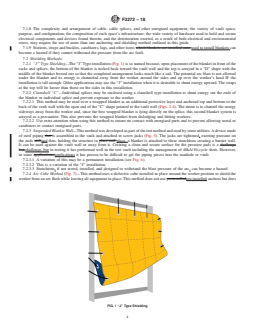
FIG. 1 “J” Type Shielding
location using the BTP of the blanket but not above the
maximumratedcurrentoftheblanket.Useofablanketbeyond
the middle of the blanket bowed out so that the completed
its maximum fault current or its maximum BTP may have
arrangement looks much like a sail. The potential arc blast is
unintended effects such as complete blanket failure or exten-
not allowed under the blanket and its energy is channeled away
sive after flame of the blanket. In an enclosed area, this effect
from the worker around the sides and up over the worker’s
can be dangerous. Some blankets may have harmful effects at
head IF the installation is tall enough. Other applications may
higher levels but this is typically not discernable by standard
use the “J” installation when it is desirable to shunt energy
test results. Contact the manufacturer for guidance on blanket
upward. The straps at the top will be looser than those on the
use in unusual conditions (such as oil-filled cables or breakers,
sides in this installation.
higher fault currents, enclosed spaces), or in abnormal condi-
7.2.2 Clamshell “C”—Individual splices may be enclosed
tions.
using a clamshell type installation to shunt energy out the ends
7.1.6 Disturbing energized electrical equipment, especially
of the blanket or individual splice and prevent exposure to the
cables and cable splices, can cause an arc flash. Exercise best
worker.
practices when installing blankets for worker protection.
7.2.2.1 This method may be used over a wrapped blanket as
7.1.7 Engineering a blanket installation by using distance
an additional protective layer and anchored top and bottom to
from the exposure, electrode geometry, the clearing time, and
the back of the vault wall with the open end of the “C” shape
other applicable factors would be acceptable.
pointedtothevaultwall(Figs.2-4).Theintentistochannelthe
7.1.8 The complexity and arrangement of cable, cable
splices, and other energized equipment; the variety of vault
space, purpose, and configuration; the composition of each
space’s infrastructure; the wide variety of hardware used to
hold and secure electrical components and devices found
therein; and the deterioration exerted, as a result of both
electrical and environmental stress, may require the use of
more than one anchoring and shielding method outlined in this
guide.
7.1.9 Stations, straps and buckles, carabiners, lugs, and
other items used to install blankets can become a hazard if they
cannot withstand the pressure from the arc fault.
7.2 Shielding Methods:
7.2.1 “J” Type Shielding—The “J”Type installation (Fig. 1)
is so named because, upon placement of the blanket in front of
the racks and splices, the bottom of the blanket is tucked back
NOTE 1—Straps and anchors are not shown.
towardthevaultwallandthetopisarrayedina“D”shapewith FIG. 2 Clamshell with Wrapped Cable Splice
F3272 − 18
7.2.4.2 This method does not shield the worker in Fig. 7
from an arc flash in the voltage testing in front since there are
no blankets installed in that side, but would serve to shield
from arc flash energy from the two protected sides.
7.2.5 Portable Barrier Method (Figs. 8 and 9):
7.2.5.1 This method uses a heavy, weighted frame and
blanket assembly to shield the worker from an arc flash while
leaving all equipment in place. This method does not use
pre-installed anchors but does require the frame be designed
forusewithaspecificsizedblanketandtheblanketbeinstalled
properly.Theframemustbedesignedtowithstandthepressure
from the blanket in an arc event.This design allows venting on
the sides in some installations and venting upward with the
bowed design. The frame must be adequately weighted to
prevent capsizing onto a worker.The utility that developed this
portablebarriermethodusesitwhenequipmentisuncoveredto
protect workers passing by.
FIG. 3 Blanket Installation (clamshell method over cable splices)
7.2.5.2 Another use of this portable barrier method could be
to make the blanket with a hole in the location of a switchgear
racking point to allow a racking screw to be inserted and used
for additional protection when racking a breaker.
energy sideways away from the worker and, since the first
wrapped blanket is lying directly on the splice, this second 7.2.6 Woven Method—The attachment points for the blanket
blanket system is arrayed as a precaution. This also prevents
would be behind the splices, which are located on racks (Fig.
the wrapped blanket from dislodging and hitting workers. 10). In the testing, the suspension wall device was used against
7.2.2.2 Useextraattentionwhenusingthismethodtoensure
the vault wall and fitted around the splices. Of the three splices
no contact with energized parts and to prevent allowing metal
in the figure, the middle would be de-energized while the top
or carabiners to contact energized parts.
and bottom would be energized. The blanket is attached at the
7.2.3 Suspended Blanket Wall—This method was developed
top in the same manner as the “J” method and then woven
as part of the test method and used by some utilities. A device
behind the dead circuit and then back into the front of the rack
made of steel piping is assembled in the vault and attached to
and draped down the rest of the racks and splices. A
...
This document is not an ASTM standard and is intended only to provide the user of an ASTM standard an indication of what changes have been made to the previous version. Because
it may not be technically possible to adequately depict all changes accurately, ASTM recommends that users consult prior editions as appropriate. In all cases only the current version
of the standard as published by ASTM is to be considered the official document.
Designation: F3272 − 17 F3272 − 18
Standard Guide for
Selection, Care, and Use of Arc Protective Blankets
This standard is issued under the fixed designation F3272; the number immediately following the designation indicates the year of
original adoption or, in the case of revision, the year of last revision. A number in parentheses indicates the year of last reapproval. A
superscript epsilon (´) indicates an editorial change since the last revision or reapproval.
1. Scope
1.1 This guide provides information for the selection, care, and use of arc protective blankets for personnel protection.
1.2 This guide covers positioning,positioning and securing,securing arc protective blankets (tested to Test Method F2676) and
channeling the thermal, ballistic, and concussive forces generated by an arc flash event using arc protective blankets.
1.3 This guide definesdescribes the use of the arc protective blanket to maximize its protective effectiveness to workers exposed
to energized electrical equipment where complete de-energizing of the work zone cannot be achieved or for low-risk exposures
with sufficient arc flash incident energy to warrant secondary protective means in the event of an arc flash.
1.4 The values stated in SI units are to be regarded as the standard. See IEEE/ASTM SI-10.
1.5 This standard does not purport to address all of the safety concerns, if any, associated with its use. It is the responsibility
of the user of this standard to establish appropriate safety, health, and environmental practices and determine the applicability of
regulatory limitations prior to use.
1.6 This international standard was developed in accordance with internationally recognized principles on standardization
established in the Decision on Principles for the Development of International Standards, Guides and Recommendations issued
by the World Trade Organization Technical Barriers to Trade (TBT) Committee.
2. Referenced Documents
2.1 ASTM Standards:
D4391 Terminology Relating to The Burning Behavior of Textiles
F819 Terminology Relating to Electrical Protective Equipment for Workers
F2676 Test Method for Determining the Protective Performance of an Arc Protective Blanket for Electric Arc Hazards
2.2 IEEE/ASTM Standard:
IEEE/ASTM SI-10 American National Standard for Metric Practice
2.3 NFPA Standard:
NFPA 70E70E-2018 Standard for Electrical Safety in the Workplace
2.4 CSA Standard:
CSA Z462Z462-2018 Workplace electrical safety
2.5 OSHA Standards:
29 CFR 1910.269 Occupational Safety and Health Standards: Special Industries
29 CFR 1926.950-969 Safety and Health Regulations for Construction
3. Terminology
3.1 Definitions:
3.1.1 For definitions relating to the burning behavior of textiles, see Terminology D4391 and for definitions relating to electrical
protective equipment for workers, see Terminology F819.
This guide is under the jurisdiction of ASTM Committee F18 on Electrical Protective Equipment for Workers and is the direct responsibility of Subcommittee F18.65
on Wearing Apparel.
Current edition approved Nov. 15, 2017March 1, 2018. Published December 2017May 2018. DOI: 10.1520/F3272-17.Originally approved in 2017. Last previous edition
approved in 2017 as F3272-17. DOI: 10.1520/F3272-18.
For referenced ASTM standards, visit the ASTM website, www.astm.org, or contact ASTM Customer Service at service@astm.org. For Annual Book of ASTM Standards
volume information, refer to the standard’s Document Summary page on the ASTM website.
Available from National Fire Protection Association (NFPA), 1 Batterymarch Park, Quincy, MA 02169-7471, http://www.nfpa.org.
Available from Canadian Standards Association (CSA), 178 Rexdale Blvd., Toronto, ON M9W 1R3, Canada, http://www.csagroup.org.
Available from Occupational Safety and Health Administration (OSHA), 200 Constitution Ave., NW, Washington, DC 20210, http://www.osha.gov.
Copyright © ASTM International, 100 Barr Harbor Drive, PO Box C700, West Conshohocken, PA 19428-2959. United States
F3272 − 18
3.1.2 abnormal condition, n—abnormalities such as but not limited to, oil or compound leaking from cable or joints, broken
cable sheaths or joint sleeves, hot localized surface temperatures of cables or joints, or joints that are swollen beyond normal
tolerance are presumed to lead to or be an indication of an impending fault. Note: this term does not appear in the standard.
3.1.3 anchoring, v—n—method of physical attachment for securing the blanket and all attached components (straps, stanchions,
other hardware, etc.) in place for the duration of the protection level for which the blanket is rated.
3.1.4 arc protective blanket, n—a flat assembly of fabric(s) with locations for attachments used to protect workers from the
effects of arc flash and arc blast.
3.1.5 arc protective blanket maximum arc current lmax, n—maximum value of RMS arc current that blanket can withstand
without breakopen for no less than ten cycles of 60 Hz.
3.1.5.1 Discussion—
Standard values of the maximum arc current for this test method are 16 kA, 25 kA, or 40 kA.
3.1.6 arc protective blanket breakopen threshold performance (BTP), n—the product of the arc current l, kA and arc duration
in cycles required for breakopen to occur at this same arc current level.
3.1.7 blistered insulation, n—a condition in which electrical insulation exhibits visible signs of thermal deformation usually
exhibited as a bubble on the insulation.
3.1.8 conduit channel type construction, n—this is a common choice by many utilities because it is already widely used in their
systems and they are typically stock and coded items that can be easily issued from company stores.a standardized formed
structural system used in the construction and electrical industries for light structural support, often for supporting wiring,
plumbing, or mechanical components such as air conditioning or ventilation systems. The strut is typically formed from sheet
metal, folded over into an open channel shape with inwards-curving lips to provide additional stiffness and as a location to mount
interconnecting components.
3.1.8.1 Discussion—
The sizing and types of strut vary, but typically it is 14-gauge with half-inch hardware construction or equivalent for concrete
construction. Rated blanket attachment straps with rated carabineerscarabiners are used to hold the blankets in place. This
construction method is also widely used when the integrity of the vault wall is questionable and the need to spread the load is
necessary. So, Using this method, longer pieces of strut are used and more anchor bolts are used to attach it, thus spreading the
load.
3.1.9 fixed mechanical concrete anchor, n—this type of anchor is produced in a variety of styles that includes standard fastening
hardware and rated hardware and may come with torque indicators (shear bolts) notifying the user the anchor has been installed
properly.
3.1.10 inverse square distance formula, n—heat and concussive energy/force decreases generally as the square of the distance.
3.1.11 removable concrete anchor, n—this type of anchor is produced in a variety of styles that include, but are not limited to,
D-ring anchors with and without friction sleeve bolt attachments and are typically rated at 5000- and 10 000-lbs. (2268- and
4536-kg) maximum capacity.a removable securing device for securely attaching an arc protective blanket to walls made of
concrete.
3.1.11.1 Discussion—
This type of anchor is quick and easy to install and can be reused, thus holding down hardware costs. This type of anchor is
produced in a variety of styles that include, but are not limited to, D-ring anchors with and without friction sleeve bolt attachments
and are typically rated at 5000- and 10 000-lb (2268- and 4536-kg) maximum capacity.
4. Summary of Guide
4.1 This guide provides background understanding for selection, care and use of arc protective blankets as tested by Test Method
F2676. The guide is not a work practice and does not require blankets be used in the conditions described.
4.2 The guide provides guidance for users can use to inform work practices, for development of blanket use schemes,schemes
and ideas for testing efficacy of blanket configurations and practices.
4.3 The guide is based on the collective knowledge of the committee, published practices of committee members, testing, and
OSHA testimony in 29 CFR 1910.269.
F3272 − 18
5. Significance and Use
5.1 This guide provides positioning, installation, and anchoring techniques that may be used to arrange arc protective blankets
to confine or divert the energies found from a fault that may include plasma arcing, pressure wave, and projectiles.
5.2 Arc protective blankets may be used in anyan electrical application to confine or divert energy away from a work zone for
electrical or other workers who may be exposed to an electric arc in the event of an equipment or conductor failure.
5.3 Cables, This guide provides information for working around cables, splices, and any equipment components whichthat have
historical failures deemed to require additional protection or engineering controls, which could benefit from added protection
provided by an arc protective blanket.
5.4 This guide is designed for electrical engineers and qualified installers of arc protective blankets.
5.5 The practice is limited by the blanket protective value, the sturdiness of the installation, and the engineering assumptions
of the hazard assessment.
5.6 These blankets do not typically provide dielectric protection.
5.7 They These blankets do not eliminate the need for arc-rated PPE but may reduce the level of the hazard in some installations.
6. How Blankets Work to Help Protect from Arc Flash
6.1 An arc protective blanket is designed to direct heat, gases,gasses, and projectiles away from the worker. While the arc
protective blanket is tested to confine or divert an ejected arc up to the arc protective blanket breakopen threshold performance
(BTP) level in the rating. Itrating, it is always safer to channel energy away from the workers rather than challenge the energy.
For example, putting slack in the center at the top of the blanket to allow the energy to be directed above the blanket may be more
protective in some scenarios.
6.2 Tension in testing ensures full, worst case exposure to arc (The(the blanket is installed like a trampoline). This installation
method is typically used only when installing the blanket like a wall. Installing blankets with other methods typically will allow
better performance of the blanket but may compromise the area protected by the blanket by diverting the energy. Energy diversion
away from workers is a key method to use in blanket installation. Some allowance for blanket movement away from arc can allow
for greater protection.
6.3 Some blankets have a sidedness and the marked side should always be installed as recommended by the manufacturer.
7. Installation Practices
7.1 General:
7.1.1 Choose a blanket with a maximum rating greater than the predicted fault current at the location. Exceeding the blanket
rating or failure to secure the blanket by the method as tested may result in failure to completely protect or provide limited or no
protection.
7.1.2 Use the largest blanket that will fit into the available space.
7.1.3 Use the attachments provided by or required by the manufacturer, which are typically flame resistant. If the manufacturer’s
connecting means do not use manufacturer’s connecting means, are not used, any alternate connecting means should have tensile
strength equal to or greater than the manufacturer’s supplied means and not be affected by the thermal energy from the arc to ensure
the efficacy of the connecting means. This is typically done through testing.
7.1.4 Install the top of blankets at a height ideally above the worker’s head in a work situation to allow energy to be diverted
above the worker’s head. Secure the blanket at the top to prevent energy diverting into the area of the face.
NOTE 1—Typically, a worker’s head may not be as well protected as the torso. This is not typically true In the case of an arc flash suit which suit, the
torso typically has more protection on the torso than the legs.than the head or the legs due to the overlap of the bib from the overalls and the hood bib
that covers the top of the torso.
NOTE 2—When wrapping or installing in a horizontal, planar installation, tools, equipment, or parts placed on a blanket could be ejected in the event
of a failure.
7.1.5 Match the blanket to the worst case Ensure the blanket’s rating is adequate for the anticipated fault current and predicted
clearing time for the work location using the BTP of the blanket and but not above the maximum rated current of the blanket. Use
of a blanket beyond its maximum fault current or its maximum BTP may have unintended effects such as complete blanket failure
or extensive after flame of the blanket. In an enclosed area, this effect can be dangerous. Some blankets may have
deleteriousharmful effects at higher levels but this is typically not discernable by standard test results. Contact the manufacturer
for guidance on blanket use in unusual conditions (oil-filled (such as oil-filled cables or breakers, higher fault currents, enclosed
spaces, etc.)spaces), or in abnormal conditions.
7.1.6 Disturbing energized electrical equipment, especially cables and cable splices, can cause an arc flash. Exercise best
practices when installing blankets for worker protection.
7.1.7 Engineering a blanket installation by using distance from the exposure, electrode geometry, the clearing time, and other
applicable factors would be acceptable.
F3272 − 18
7.1.8 The complexity and arrangement of cable, cable splices, and other energized equipment; the variety of vault space,
purpose, and configuration; the composition of each space’s infrastructure; the wide variety of hardware used to hold and secure
electrical components and devices found therein; and the deterioration exerted, as a result of both electrical and environmental
stress, may require the use of more than one anchoring and shielding method outlined in this guide.
7.1.9 Stations, straps and buckles, carabiners, lugs, and other items which blankets are installed onto used to install blankets can
become a hazard if they cannot withstand the pressure from the arc fault.
7.2 Shielding Methods:
7.2.1 “J” Type Shielding—The “J” Type installation (Fig. 1) is so named because, upon placement of the blanket in front of the
racks and splices, the bottom of the blanket is tucked back toward the vault wall and the top is arrayed in a “D” shape with the
middle of the blanket bowed out so that the completed arrangement looks much like a sail. The potential arc blast is not allowed
under the blanket and its energy is channeled away from the worker around the sides and up over the worker’s head IF the
installation is tall enough. Other applications may use the “J” installation when it is desirable to shunt energy upward. The straps
at the top will be looser than those on the sides in this installation.
7.2.2 Clamshell “C”—Individual splices may be enclosed using a clamshell type installation to shunt energy out the ends of
the blanket or individual splice and prevent exposure to the worker.
7.2.2.1 This method may be used over a wrapped blanket as an additional protective layer and anchored top and bottom to the
back of the vault wall with the open end of the “C” shape pointed to the vault wall (Figs. 2-4). The intent is to channel the energy
sideways away from the worker and, since the first wrapped blanket is lying directly on the splice, this second blanket system is
arrayed as a precaution. This also prevents the wrapped blanket from dislodging and hitting workers.
7.2.2.2 Use extra attention when using this method to ensure no contact with energized parts and to prevent allowing metal or
carabiners to contact energized parts.
7.2.3 Suspended Blanket Wall—This method was developed as part of the test method and used by some utilities. A device made
of steel piping that is assembled in the vault and attached to screw jacks (Fig. 5). The jacks are tightened, exerting pressure on
the ends and,and thus, holding the structure in place and place, a blanket is attached to these stanchions creating a barrier wall.
It can be used against the vault wall or away from it. Creating a clean and secure surface for the pressure pads is a challenge
but,challenge, but in testing it has performed well in the test vault including the management of 40kA/10-cycle shots. However,
in some applications,applications it has proven to be difficult to get the piping pieces into the manhole or vault.
7.2.3.1 A variation of this may be a permanent installation (see Fig. 6).
7.2.3.2 This is a variation of the “J” installation.
7.2.3.3 Stanchions, if not tested, installed, and designed to withstand the blast pressure of the arc, can become a hazard.
7.2.4 Arc Cube Method (Fig. 7)—This method uses a dielectric cube installed in place around the worker position to shield the
worker from an arc flash while leaving all equipment in place. This method does not use preinstalledpre-installed anchors but does
FIG. 1 “J” Type Shielding
F3272 − 18
NOTE 1—Straps and anchors are not shown.
FIG. 2 Clamshell with Wrapped Cable Splice
FIG. 3 Blanket Installation (clamshell method over cable splices)
require a blanket designed for use on the cube, and the cube itself needs to be anchored or tightly installed in the vault so that
movement is limited to prevent destruction to the cube.
7.2.4.1 This method may allow the cube to move or block the cube in place to prevent movement from the arc blast. Cube The
cube may be to protect the workzone work zone only and be far away from the potential blast to prevent the worker from being
inside the arc flash boundary or
...