

ASTM F2676/F2676M-22
(Specification)Standard Specification for Arc Protective Blankets
General Information
- Abstract
SCOPE
1.1 This product specification is used to determine the ability of the arc protective blankets to withstand the effects of arc flash and arc blast in a configuration in which the blanket is hung or anchored near energized equipment. Specifically, the imbedded test method is used to determine and specify the arc protective blanket’s (1) resistance to breakopen, (2) mechanical strength, and (3) ability to self-extinguish flames following a controlled arc exposure.
1.2 The products covered by this specification are labeled with a performance level for arc protective blankets in terms of: maximum arc current level expressed in kA and Breakopen Threshold Performance (BTP) expressed as the product of arc current in kA and arc duration in number of cycles to cause breakopen (kA*cycles). Cycles are on the basis of 60 Hz.
1.3 Blanket test specimens used in this specification are test size blankets of 152 ± 5 cm [60 ± 2 in.] by 122 ± 5 cm [48 ± 2 in.]. The test specimen size is for testing purposes only. Commercially available arc protective blankets either larger or smaller than the test specimen size are covered by this specification.
1.4 The arc protective blankets described in this specification are made of flame-resistant materials and are available in varying sizes and configurations based on the application.
1.5 The specification is used to measure and describe the properties of materials, products, or assemblies in response to incident thermal (convective and radiant) and pressure energies generated by an electric arc under controlled laboratory conditions.
1.6 The values stated in SI units shall be regarded as standard except as noted. The values stated in each system may not be exact equivalents; therefore, alternate systems must be used independently of the other. Combining values from the systems described in the text may result in nonconformance with the method.
1.7 This standard shall not be used to describe or appraise the fire hazard or fire risk of materials, products, or assemblies under actual fire conditions. However, results of this test may be used as elements of a fire assessment, which takes into account all of the factors, which are pertinent to an assessment of the fire hazard of a particular end use.
1.8 This standard does not purport to address all of the safety concerns, if any, associated with its use. It is the responsibility of the user of this standard to establish appropriate safety, health, and environmental practices and determine the applicability of regulatory limitations prior to use. For specific precautions, see Section 9.
1.9 This international standard was developed in accordance with internationally recognized principles on standardization established in the Decision on Principles for the Development of International Standards, Guides and Recommendations issued by the World Trade Organization Technical Barriers to Trade (TBT) Committee.
- Status
- Published
- Publication Date
- 30-Nov-2022
- Technical Committee
- F18 - Electrical Protective Equipment for Workers
- Drafting Committee
- F18.65 - Wearing Apparel
Overview
ASTM F2676/F2676M-22: Standard Specification for Arc Protective Blankets is an internationally recognized standard published by ASTM International. It specifies the performance requirements and test methods for arc protective blankets, which are critical safety products designed to protect workers from the dangers of electric arc flash and arc blast near energized equipment. This specification provides a framework for evaluating a blanket's capability to resist breakopen, mechanical strength, and ability to self-extinguish after exposure to an electric arc, ensuring reliable protection in hazardous electrical environments.
Key Topics
- Arc Resistance: The standard determines a blanket’s resistance to breakopen under the intense thermal and pressure effects caused by arc faults.
- Mechanical Strength: Evaluation includes the ability of the blanket to remain attached and intact during and after arc exposure.
- Flame Self-Extinguishing: Blankets are tested on their ability to self-extinguish flames after a controlled arc event.
- Performance Levels: Products are labeled according to their maximum arc current capability (expressed in kA) and their Breakopen Threshold Performance (BTP), which is calculated as the product of arc current (kA) and arc duration (number of cycles at 60 Hz).
- Test Methods: Standardized test specimen sizes are used, but the specification covers commercially available arc blankets of all sizes. Tests simulate real-world scenarios, such as use near switchgear or substations.
- Material Requirements: The blankets must be constructed from flame-resistant materials suitable for varying operational needs.
Applications
Arc protective blankets play a vital role in electrical safety protocols across various industries, most notably:
- Electrical Utilities: Used in substations, vaults, and control centers to shield workers from arc energy during maintenance or fault conditions.
- Industrial Facilities: Protection for personnel working near switchgear, motor control centers, or energized conductors.
- Emergency and Repair Crews: Provides portable arc flash protection in field operations where energized equipment must be serviced or secured.
- Renewable Energy Installations: Used wherever maintenance on energized PV, wind, or storage systems presents arc flash risks.
By adhering to ASTM F2676/F2676M-22, organizations ensure that their arc protective blankets offer verified arc flash and blast protection, supporting regulatory compliance and reducing risk of injury.
Related Standards
ASTM F2676/F2676M-22 references and aligns with several other key standards to ensure comprehensive safety and performance:
- ASTM D4391: Terminology Relating to the Burning Behavior of Textiles
- ASTM F819: Terminology Relating to Electrical Protective Equipment for Workers
- ASTM F1506: Performance Specification for Flame Resistant and Electric Arc Rated Protective Clothing
- ASTM F1959: Test Method for Determining the Arc Rating of Materials for Clothing
- ASTM F2302: Labeling of Protective Clothing for Heat or Flame Resistance
- ASTM F3272: Guide for Selection, Care, and Use of Arc Protective Blankets
Practical Value
Implementing this standard in the selection and assessment of arc protective blankets:
- Improves workplace safety by verifying products meet stringent arc flash protection requirements.
- Facilitates risk assessment and safety compliance for electrical operations, maintenance, and emergency response.
- Supports informed purchasing with clear, performance-based labeling for arc protection, maximizing worker protection in high-risk environments.
- Ensures international compatibility and recognition, supporting organizations with global operations.
Keywords: arc protective blankets, arc flash protection, arc blast, electrical safety, ASTM F2676, arc rating, breakopen threshold performance, flame resistance, PPE, substation safety
Relations
- Effective Date
- 01-Dec-2019
- Effective Date
- 01-Aug-2019
- Effective Date
- 01-May-2018
- Effective Date
- 15-Apr-2018
- Effective Date
- 01-Mar-2018
- Effective Date
- 15-Nov-2017
- Effective Date
- 15-Nov-2017
- Effective Date
- 15-Nov-2017
- Effective Date
- 01-Oct-2017
- Effective Date
- 01-May-2017
- Effective Date
- 01-Mar-2017
- Effective Date
- 15-Feb-2016
- Effective Date
- 15-Feb-2016
- Effective Date
- 01-Nov-2015
- Effective Date
- 15-Sep-2015
Get Certified
Connect with accredited certification bodies for this standard

CIS Institut d.o.o.
Personal Protective Equipment (PPE) certification body. Notified Body NB-2890 for EU Regulation 2016/425 PPE.

Kiwa BDA Testing
Building and construction product certification.
Kmetijski inštitut Slovenije
Agricultural Institute of Slovenia. Soil testing, plant health, agricultural product analysis.
Sponsored listings
Frequently Asked Questions
ASTM F2676/F2676M-22 is a technical specification published by ASTM International. Its full title is "Standard Specification for Arc Protective Blankets". This standard covers: SCOPE 1.1 This product specification is used to determine the ability of the arc protective blankets to withstand the effects of arc flash and arc blast in a configuration in which the blanket is hung or anchored near energized equipment. Specifically, the imbedded test method is used to determine and specify the arc protective blanket’s (1) resistance to breakopen, (2) mechanical strength, and (3) ability to self-extinguish flames following a controlled arc exposure. 1.2 The products covered by this specification are labeled with a performance level for arc protective blankets in terms of: maximum arc current level expressed in kA and Breakopen Threshold Performance (BTP) expressed as the product of arc current in kA and arc duration in number of cycles to cause breakopen (kA*cycles). Cycles are on the basis of 60 Hz. 1.3 Blanket test specimens used in this specification are test size blankets of 152 ± 5 cm [60 ± 2 in.] by 122 ± 5 cm [48 ± 2 in.]. The test specimen size is for testing purposes only. Commercially available arc protective blankets either larger or smaller than the test specimen size are covered by this specification. 1.4 The arc protective blankets described in this specification are made of flame-resistant materials and are available in varying sizes and configurations based on the application. 1.5 The specification is used to measure and describe the properties of materials, products, or assemblies in response to incident thermal (convective and radiant) and pressure energies generated by an electric arc under controlled laboratory conditions. 1.6 The values stated in SI units shall be regarded as standard except as noted. The values stated in each system may not be exact equivalents; therefore, alternate systems must be used independently of the other. Combining values from the systems described in the text may result in nonconformance with the method. 1.7 This standard shall not be used to describe or appraise the fire hazard or fire risk of materials, products, or assemblies under actual fire conditions. However, results of this test may be used as elements of a fire assessment, which takes into account all of the factors, which are pertinent to an assessment of the fire hazard of a particular end use. 1.8 This standard does not purport to address all of the safety concerns, if any, associated with its use. It is the responsibility of the user of this standard to establish appropriate safety, health, and environmental practices and determine the applicability of regulatory limitations prior to use. For specific precautions, see Section 9. 1.9 This international standard was developed in accordance with internationally recognized principles on standardization established in the Decision on Principles for the Development of International Standards, Guides and Recommendations issued by the World Trade Organization Technical Barriers to Trade (TBT) Committee.
SCOPE 1.1 This product specification is used to determine the ability of the arc protective blankets to withstand the effects of arc flash and arc blast in a configuration in which the blanket is hung or anchored near energized equipment. Specifically, the imbedded test method is used to determine and specify the arc protective blanket’s (1) resistance to breakopen, (2) mechanical strength, and (3) ability to self-extinguish flames following a controlled arc exposure. 1.2 The products covered by this specification are labeled with a performance level for arc protective blankets in terms of: maximum arc current level expressed in kA and Breakopen Threshold Performance (BTP) expressed as the product of arc current in kA and arc duration in number of cycles to cause breakopen (kA*cycles). Cycles are on the basis of 60 Hz. 1.3 Blanket test specimens used in this specification are test size blankets of 152 ± 5 cm [60 ± 2 in.] by 122 ± 5 cm [48 ± 2 in.]. The test specimen size is for testing purposes only. Commercially available arc protective blankets either larger or smaller than the test specimen size are covered by this specification. 1.4 The arc protective blankets described in this specification are made of flame-resistant materials and are available in varying sizes and configurations based on the application. 1.5 The specification is used to measure and describe the properties of materials, products, or assemblies in response to incident thermal (convective and radiant) and pressure energies generated by an electric arc under controlled laboratory conditions. 1.6 The values stated in SI units shall be regarded as standard except as noted. The values stated in each system may not be exact equivalents; therefore, alternate systems must be used independently of the other. Combining values from the systems described in the text may result in nonconformance with the method. 1.7 This standard shall not be used to describe or appraise the fire hazard or fire risk of materials, products, or assemblies under actual fire conditions. However, results of this test may be used as elements of a fire assessment, which takes into account all of the factors, which are pertinent to an assessment of the fire hazard of a particular end use. 1.8 This standard does not purport to address all of the safety concerns, if any, associated with its use. It is the responsibility of the user of this standard to establish appropriate safety, health, and environmental practices and determine the applicability of regulatory limitations prior to use. For specific precautions, see Section 9. 1.9 This international standard was developed in accordance with internationally recognized principles on standardization established in the Decision on Principles for the Development of International Standards, Guides and Recommendations issued by the World Trade Organization Technical Barriers to Trade (TBT) Committee.
ASTM F2676/F2676M-22 is classified under the following ICS (International Classification for Standards) categories: 13.340.99 - Other protective equipment. The ICS classification helps identify the subject area and facilitates finding related standards.
ASTM F2676/F2676M-22 has the following relationships with other standards: It is inter standard links to ASTM F1506-19a, ASTM F1506-19, ASTM D4391-18, ASTM F1506-18, ASTM F3272-18, ASTM F1506-17be1, ASTM F3272-17, ASTM F1506-17b, ASTM F1506-17a, ASTM F1506-17, ASTM D123-17, ASTM D4391-16e1, ASTM D4391-16, ASTM F1506-15, ASTM D123-15b. Understanding these relationships helps ensure you are using the most current and applicable version of the standard.
ASTM F2676/F2676M-22 is available in PDF format for immediate download after purchase. The document can be added to your cart and obtained through the secure checkout process. Digital delivery ensures instant access to the complete standard document.
Standards Content (Sample)
This international standard was developed in accordance with internationally recognized principles on standardization established in the Decision on Principles for the
Development of International Standards, Guides and Recommendations issued by the World Trade Organization Technical Barriers to Trade (TBT) Committee.
Designation: F2676/F2676M − 22
Standard Specification for
Arc Protective Blankets
This standard is issued under the fixed designation F2676/F2676M; the number immediately following the designation indicates the year
of original adoption or, in the case of revision, the year of last revision. A number in parentheses indicates the year of last reapproval.
A superscript epsilon (´) indicates an editorial change since the last revision or reapproval.
1. Scope 1.7 This standard shall not be used to describe or appraise
the fire hazard or fire risk of materials, products, or assemblies
1.1 This product specification is used to determine the
under actual fire conditions. However, results of this test may
ability of the arc protective blankets to withstand the effects of
be used as elements of a fire assessment, which takes into
arc flash and arc blast in a configuration in which the blanket
account all of the factors, which are pertinent to an assessment
is hung or anchored near energized equipment. Specifically, the
of the fire hazard of a particular end use.
imbedded test method is used to determine and specify the arc
1.8 This standard does not purport to address all of the
protective blanket’s (1) resistance to breakopen, (2) mechanical
safety concerns, if any, associated with its use. It is the
strength, and (3) ability to self-extinguish flames following a
responsibility of the user of this standard to establish appro-
controlled arc exposure.
priate safety, health, and environmental practices and deter-
1.2 The products covered by this specification are labeled
mine the applicability of regulatory limitations prior to use.
with a performance level for arc protective blankets in terms
For specific precautions, see Section 9.
of: maximum arc current level expressed in kA and Breakopen
1.9 This international standard was developed in accor-
Threshold Performance (BTP) expressed as the product of arc
dance with internationally recognized principles on standard-
current in kA and arc duration in number of cycles to cause
ization established in the Decision on Principles for the
breakopen (kA*cycles). Cycles are on the basis of 60 Hz.
Development of International Standards, Guides and Recom-
1.3 Blanket test specimens used in this specification are test
mendations issued by the World Trade Organization Technical
size blankets of 152 6 5 cm [60 6 2 in.] by 122 6 5 cm [48
Barriers to Trade (TBT) Committee.
6 2 in.]. The test specimen size is for testing purposes only.
2. Referenced Documents
Commercially available arc protective blankets either larger or
smaller than the test specimen size are covered by this
2.1 ASTM Standards:
specification.
D123 Terminology Relating to Textiles
D1682 Test Method for Breaking Load and Elongation of
1.4 The arc protective blankets described in this specifica-
Textile Fabric (Withdrawn 1992)
tion are made of flame-resistant materials and are available in
D4391 Terminology Relating to The Burning Behavior of
varying sizes and configurations based on the application.
Textiles
1.5 The specification is used to measure and describe the
D6413 Test Method for Flame Resistance of Textiles (Ver-
properties of materials, products, or assemblies in response to
tical Test)
incident thermal (convective and radiant) and pressure energies
F819 Terminology Relating to Electrical Protective Equip-
generated by an electric arc under controlled laboratory con-
ment for Workers
ditions.
F1506 Performance Specification for Flame Resistant and
1.6 The values stated in SI units shall be regarded as
Electric Arc Rated Protective Clothing Worn by Workers
standard except as noted. The values stated in each system may
Exposed to Flames and Electric Arcs
not be exact equivalents; therefore, alternate systems must be
F1959 Test Method for Determining the Arc Rating of
used independently of the other. Combining values from the
Materials for Clothing
systems described in the text may result in nonconformance
F2302 Performance Specification for Labeling Protective
with the method.
Clothing Which Provides Resistance to Incidental Expo-
sures to Heat or Open Flame
1 2
This specification is under the jurisdiction of ASTM Committee F18 on For referenced ASTM standards, visit the ASTM website, www.astm.org, or
Electrical Protective Equipment for Workers and is the direct responsibility of contact ASTM Customer Service at service@astm.org. For Annual Book of ASTM
Subcommittee F18.65 on Wearing Apparel. Standards volume information, refer to the standard’s Document Summary page on
Current edition approved Dec. 1, 2022. Published February 2023. Originally the ASTM website.
approved in 2009. Last previous edition approved in 2019 as F2676 – 19. DOI: The last approved version of this historical standard is referenced on www.ast-
10.1520/F2676_F2676M-22. m.org.
Copyright © ASTM International, 100 Barr Harbor Drive, PO Box C700, West Conshohocken, PA 19428-2959. United States
F2676/F2676M − 22
F3272 Guide for Selection, Care, and Use of Arc Protective 3.1.14 peak arc current, n—maximum value of the AC arc
Blankets current, A.
3.1.15 pressure wave, n—a certain force over an area
3. Terminology
created by air movement caused by an electric arc.
3.1 Definitions:
3.1.16 RMS arc current, n—root mean square of the AC arc
3.1.1 arc, n—conductive path in air for the electric current
current, A.
caused by ionization of air between two electrodes.
3.1.17 shrinkage, n—a decrease in one or more dimensions
3.1.2 arc induced fragmentation, n—molten metal frag- of an object or material.
ments or other fragments emitted from an electric arc.
3.2 For definitions of other terms see Terminologies D4391
3.1.3 arc protective blanket, n—a flat assembly of fabric(s) or F819.
with locations for attachment used to protect workers from the
4. Summary of Specification
effects of arc flash and arc blast.
4.1 This specification determines resistance to breakopen
3.1.4 arc protective blanket maximum arc current I ,
max
and mechanical strength under directional arc exposure, ability
n—maximum value of RMS arc current that blanket can
to self-extinguish flames and the afterflame time of the exposed
withstand without breakopen for no less than ten cycles of 60
arc protective blankets. This specification simulates a condition
Hz.
in a vault or substation or energy center where arc protective
3.1.4.1 Discussion—Standard values of the maximum arc
blanket may be attached to provide protection from the thermal
current for specification are 15 kA, 25 kA, or 40 kA.
effects and the pressure wave experienced during an electrical
3.1.5 arc protective blanket breakopen threshold perfor-
arc fault. This specification replicates most severe conditions
mance (BTP), n—the product of the arc current I, kA and arc
when the arc is directed and focused on the blanket.
duration in cycles required for breakopen to occur at this same
4.2 This specification determines two ratings for arc protec-
arc current level.
tive blanket: Maximum Arc Current, I , and BTP.
max
3.1.6 breakopen, n—in electrical arc testing, a material
4.3 Three nominal values of I are established in this
max
response evidenced by the formation of one or more holes in
specification: 15 kA, 25 kA and 40 kA. In this specification,
the material which may allow thermal energy to pass through
each arc protective blanket test specimen is intentionally forced
the material.
to break open. To be considered arc rated, blanket shall
3.1.6.1 Discussion—The instant of breakopen will only be
withstand three times at least one of the nominal values of I
max
visible with a high-speed (HS) camera. The size of the
without breakopen during at least 10 cycles.
breakopen will quickly expand as the arc blows through the
NOTE 1—Additional testing at a higher I than 40 kA is permitted but
max
blanket and burns back the edges of the materials. The final
the arc protective blanket shall be rated at one of the three nominal values
size of the breakopen hole is not significant, as it will depend
of I which shall be the official rating.
max
to a great extent on the duration of the arc once the breakopen
4.4 BTP is determined as the product of arc current and arc
point is reached. The important measure using the HS camera
duration causing breakopen. Arc duration is the number of 60
is the time from arc initiation to the first evidence of arc plasma
Hz cycles between arc initiation and breakopen of the blanket.
through the blanket.
4.5 BTP is determined for at least three different arc current
3.1.7 charring, n—the formation of carbonaceous residue as
levels. A minimum value of BTP is assigned as arc rating to an
the result of pyrolysis or incomplete combustion.
arc protective blanket.
3.1.8 directional arc, n—in arc protective blanket testing, an
4.6 In this specification, the arc electrodes configuration is
arc expanding in direction of the blanket perpendicular to and
designed so that the arc blast projects directionally towards the
centered to the blanket plane.
test specimen.
3.1.9 dripping, n—in arc testing, a material response evi-
4.7 This specification involves observing HS video record-
denced by flowing of a specimen’s material of composition and
ings to determine test specimen breakopen and afterflame time.
droplets separation from the material.
Each trial is recorded with a HS video camera.
3.1.10 embrittlement, n—the formation of a brittle residue
as the result of pyrolysis or incomplete combustion. 5. Significance and Use
3.1.11 ignition, n—the initiation of combustion. 5.1 This specification determines the effectiveness of arc
protective blankets in suppressing the combined effects of an
3.1.12 ignitability, n (ignitable, adj)—in electric arc
arc flash and arc blast.
exposure, the property of a material involving ignition accom-
panied by heat and light, and continued burning resulting in 5.2 The arc exposure energy is produced from controlled
consumption of at least 25 % of the exposed area of the test phase-to-ground arc fault. The resulting arc flash and blast
specimen. energy are intentionally directed onto the test specimen to
simulate worst case conditions.
3.1.13 mechanical strength, n—for an arc protective
blanket, the ability to remain attached to its support(s) in 5.3 Test results will describe the maximum arc current and
essentially its original configuration. product of arc current and cycles at which test specimens block
F2676/F2676M − 22
the energy without breakopen, ability to self-extinguish 6.1.2 Type of material in the blanket (for instance some
afterflaming, afterflame time and the detection of mechanical materials cannot be folded, others must be stored out of
attachment failures during testing. Mechanical attachment sunlight),
failure and afterflame time are obtained from visual observa- 6.1.3 Weight of the blanket,
tions and video recording after each arc exposure. 6.1.4 Straps or other structural supports to hold the blanket
in place,
5.4 This specification maintains the arc protective blanket
6.1.5 Style and design or catalog number,
in a vertical position and does not involve movement except
6.1.6 Special identification markings (optional), and
that resulting from the arc exposure.
6.1.7 Notation of conformance to this specification.
5.5 In this specification, test specimens are exposed at three
arc current levels to determine the test specimen’s perfor-
7. Physical Requirements
mance.
7.1 The blankets shall include an attachment means as used
NOTE 2—In experimental testing, some blankets increase in protection
in testing unless otherwise specified by the buyer.
(in value of kA*cycles to cause breakopen) as the arc current increases
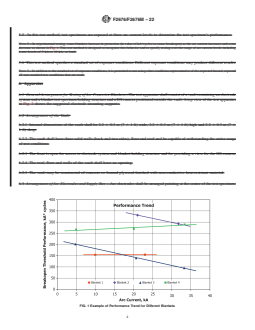
and some decrease as shown in Fig. 1. This specification is designed to
7.2 The blanket shall be proportional to the originally tested
recognize this behavior and to specify testing over the range of arc current
blanket in number and spacing of attachment points.
levels including lower levels of 5 kA or 10 kA, or both.
7.3 The blanket shall be constructed in a similar manner to
5.6 This specification specifies a standard set of exposure
the blanket tested. Quilting shall be accomplished in the same
conditions. Different exposure conditions may produce differ-
pattern and size as tested since this has been found to affect
ent results.
afterflame time in some blankets.
NOTE 3—In addition to the standard set of exposure conditions, it is
permitted to test using other conditions representative of the expected
7.4 Attachment means, straps, carbineers, ropes, etc. shall
hazard, reported all non-standard test conditions that are used.
be of the same material and construction as those tested unless
5.7 The user is encouraged to use Guide F3272 when
otherwise specified and agreed to by the purchaser and
applying blankets from this specification.
supplier.
6. Ordering Information 7.5 Attachment reinforcement points may be metal, if al-
lowed by the purchaser, but shall be as tested or stronger to
6.1 The following items should be considered by the pur-
prevent breakaway of attachment points.
chaser when buying arc protective blankets under this specifi-
cation and included, as necessary, in purchasing documents: 7.6 Preference shall be given to non-metallic reinforcement
6.1.1 BTP of the arc protective blanket, and attachment means in the design process.
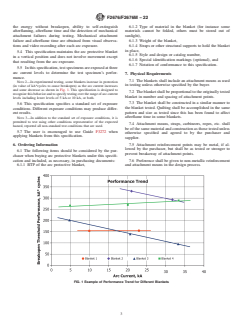
FIG. 1 Example of Performance Trend for Different Blankets
F2676/F2676M − 22
8. Performance Requirements 10.3.4 The spacing between parallel arc electrodes shall be
10 6 0.6 cm [4 6 0.25 in.]. This spacing is equal to arc gap in
8.1 Specification F2676/F2676M shall be used and the BTP
this specification.
shall be at least that in Table 1.
10.3.5 The arc electrodes shall protrude into the vault for the
distance of approximately 30 cm [12 in.] and be terminated to
9. Thermal Performance Requirements
a supply bus outside the vault. The electrode distance to the
9.1 If the withstand version of the test is used, the materials
blanket is 6 in.; this requires to be adjusted before every test.
used in the manufacture of these products shall meet the
10.3.6 Care must be taken in the position and configuration
requirements of oven test and flame resistance requirements of
of the supply bus or feeding cables to the arc electrodes as not
F2302 for all layers.
to adversely affect the direction or motion of the arc. For
9.2 Straps for use with blankets shall meet the test require- testing purposes, the arc is directed towards the blanket test
ments of F1506 for vertical flame testing using D6413. specimen providing a controlled test exposure. The general
arrangement of supply buses and arc electrodes is shown in
10. Apparatus Fig. 2.
10.1 General Arrangement for Testing of Arc Protective 10.4 Arrangement of Blanket Test Specimen—The test
Blankets—The test apparatus shall consist of a vault containing specimen of the arc protective blanket shall be arranged
an electrode system and a blanket test specimen holding perpendicular to arc electrodes and at the distance of 15 6 1
structure and a HS camera positioned outside the vault. A top cm [6 6 0.5 in.], from the tips of the arc electrodes.
view of the test apparatus in Fig. 2 shows the suggested 10.4.1 The test specimen shall be attached to the blanket
electrode mounting supports. holding structure.
10.4.2 The blanket holding structure shall have the dimen-
10.2 Arrangement of the Vault:
sions of 183 6 2.5 cm [72 6 1 in.] by 152 6 2.5 cm [60 6 1
10.2.1 Internal dimensions of the vault shall be 2.2 6 0.3 m
in.].
[7 6 1 ft] wide, 2.2 6 0.3 m [7 6 1 ft] high, and 2.2 6 0.3 m
10.4.3 The blanket holding structure shall be mounded
[7 6 1 ft] deep.
vertically and parallel to the side wall of the vault and at the
10.2.2 The vault shall have three solid walls (back and two
distance of 46 cm [18 in.] from the side wall.
sides), floor and roof and be capable of withstanding the entire
10.4.4 The blanket holding structure shall be equidistant
range of test conditions.
from the floor and the roof in a vertical plane and equidistant
10.2.3 The front is open for access to electrode system and
from back wall and front opening in a horizontal plane.
blanket-holding structure and for providing a view for the HS
10.4.5 The center of the test specimen shall be aligned with
camera.
the midpoint of the arc gap.
10.2.4 The roof, floor, and walls of the vault shall have no
opening.
10.5 Fuse Wire—A fuse wire, connecting the ends of elec-
10.2.5 The vault may be constructed of concrete or framed trodes tips, is used to initiate the arc. This wire is consumed
plywood finished with non-conductive heat-resistant material.
during the test. The fuse wire shall be a copper 16 gauge wire.
10.3 Arrangement of Arc Electrodes and Supply Bus—Arc 10.6 Electric Supply—The electric supply shall be sufficient
electrodes shall be arranged pointing at the center of the test
to allow for the discharge of an electric arc with a gap of up to
specimen. 10 cm [4 in.], with alternating arc current from 5 kA up to 50
10.3.1 Two arc electrodes shall penetrate into the vault
kA and with arc duration from 0.05 s [3 cycles at 60 Hz] up to
through a side wall. 2.5 s [150 cycles at 60 Hz]. The arc shall not self extinguish
10.3.2 Material and diameter of the arc electrodes shall be
during the test. The X/R ratio of the test circuit shall be such
copper rod with 18 mm [0.75 in.] diameter. that the test current contains a DC component resulting in the
10.3.3 The arc electrodes shall be positioned horizontally,
first peak of the test current having a magnitude of 2.3 times
parallel to each other, equidistant from the floor and the roof in the symmetrical RMS value.
vertical plane and equidistant from back wall and front opening
10.7 Test Circuit Control—Repeat exposures of the arc
in horizontal plane.
currents shall be within the tolerance of the selected test level.
NOTE 4—Electromagnetic forces generated by arc current can bend or The make switch shall be capable of point on wave closing
move parallel electrodes. In order to keep electrodes parallel, it is
within 0.2 cycles from test to test, such that the closing angle
recommended to use spacers made of insulating materials.
will produce maximum asymmetrical current with an X/R ratio
of the test circuit as stated in 10.6. The arc current, arc
duration, and arc voltage shall be measured. The arc current,
duration, arc voltage, and arc energy shall be displayed on a
TABLE 1 Full BTP Rating Required Samples
test control monitor in graph form and stored in digital format.
Rated Arc
Current Test Arc Current Values, kA (No. of Samples) 10.8 Data Acquisition System—The system shall be capable
I , kA
max
of recording voltage and current outputs with a resolution of 1
15 15 (3) 10 (2) 5 (2)
% of the applied voltage and current.
25 25 (3) 15 (2) 5 (2)
10.8.1 The current and voltage data shall be acquired at a
40 40 (3) 25 (2) 5 (2)
minimum rate of 2000 samples per second.
F2676/F2676M − 22
FIG. 2 Test Cubicle Set Up
An additional camera shall be positioned next to and provide the same
10.8.2 The arc voltage shall be measured as close as
view as the HS camera.
practical to the electrodes.
10.9 High-Speed (HS) Camera—The camera shall have a
11. Hazards
speed of no less than 1000 frames per second. The analyzing
11.1 The test apparatus discharges large amounts of energy.
software shall be capable of frame-by-frame steps with a time
index to allow the measurement of time from the arc initiation In addition, the electric arc produces very intense light. Take
to the breakopen of the blanket. care to protect personnel working in the area. Position workers
NOTE 5—As high speed shall be used to observe the point of breakopen
behind protective barriers or at a safe distance to prevent
of test specimen and to observe the arc behavior, there are no critical
electrocution and contact with molten metal. Workers wishing
factors and no exact specifications that are necessary for such a camera
to directly view the test shall use very heavily tinted glasses
setting. Observing high intensity arc flash with a HS camera requires some
such as ANSI/ASC Filter Shade 12 welding glasses. If the test
knowledge of such photography and experience to obtain a good image.
Neutral density filters are commonly used along with adjustment of the iris is conducted indoors, there shall be a means to ventilate the
of the lens and camera shutter settings to obtain the desired exposure.
area to carry away combustion products, smoke, and fumes.
Several arc exposures may be required to adjust the camera for the best
Outdoor tests shall be conducted in a manner appropriate to
field of view and light exposure.
prevent exposure of the test specimen to moisture and wind.
NOTE
...
This document is not an ASTM standard and is intended only to provide the user of an ASTM standard an indication of what changes have been made to the previous version. Because
it may not be technically possible to adequately depict all changes accurately, ASTM recommends that users consult prior editions as appropriate. In all cases only the current version
of the standard as published by ASTM is to be considered the official document.
Designation: F2676 − 19 F2676/F2676M − 22
Standard Test Method Specification for
Determining the Protective Performance of an Arc
Protective Blanket for Electric Arc HazardsArc Protective
Blankets
This standard is issued under the fixed designation F2676;F2676/F2676M; the number immediately following the designation indicates
the year of original adoption or, in the case of revision, the year of last revision. A number in parentheses indicates the year of last
reapproval. A superscript epsilon (´) indicates an editorial change since the last revision or reapproval.
1. Scope
1.1 This test method is used to evaluate the ability of the arc protective blankets to withstand the effects of arc flash and arc blast
in a configuration in which the blanket is hung or anchored near energized equipment. Specifically, this test method is used to
determine the arc protective blanket’s (1) resistance to breakopen, (2) mechanical strength, and (3) ability to self-extinguish flames
following a controlled arc exposure.
1.2 This method is used to determine the performance of arc protective blankets in terms of: maximum arc current level expressed
in kA and BTP (BTP) expressed as the product of arc current in kA and arc duration in number of cycles to cause breakopen
(kA*cycles). Cycles are on the basis of 60 Hz.
1.3 Blanket test specimens used in this test method are test size blankets of 152 6 5 cm (60 6 2 in.) by 122 6 5 cm (48 6 2
in.). The test specimen size is for testing purposes only. Commercially available arc protective blankets either larger or smaller than
the test specimen size are covered by this standard.
1.4 The arc protective blankets described in this test method are made of flame-resistant materials and are available in varying
sizes and configurations based on the application.
1.5 This test method shall be used to measure and describe the properties of materials, products, or assemblies in response to
incident thermal (convective and radiant) and pressure energies generated by an electric arc under controlled laboratory conditions.
1.6 The values stated in SI units shall be regarded as standard. The values given in parentheses are mathematical conversion to
inch-pound or other units commonly used for arc testing.
1.7 This standard shall not be used to describe or appraise the fire hazard or fire risk of materials, products, or assemblies under
actual fire conditions. However, results of this test may be used as elements of a fire assessment, which takes into account all of
the factors, which are pertinent to an assessment of the fire hazard of a particular end use.
1.8 This standard does not purport to address all of the safety concerns, if any, associated with its use. It is the responsibility
of the user of this standard to establish appropriate safety, health, and environmental practices and determine the applicability of
regulatory limitations prior to use. For specific precautions, see Section 7.
This test method specification is under the jurisdiction of ASTM Committee F18 on Electrical Protective Equipment for Workers and is the direct responsibility of
Subcommittee F18.65 on Wearing Apparel.
Current edition approved March 1, 2019Dec. 1, 2022. Published April 2019February 2023. Originally approved in 2009. Last previous edition approved in 20162019 as
F2676 - 16.F2676 – 19. DOI: 10.1520/F2676-19.10.1520/F2676_F2676M-22.
Copyright © ASTM International, 100 Barr Harbor Drive, PO Box C700, West Conshohocken, PA 19428-2959. United States
F2676/F2676M − 22
1.9 This international standard was developed in accordance with internationally recognized principles on standardization
established in the Decision on Principles for the Development of International Standards, Guides and Recommendations issued
by the World Trade Organization Technical Barriers to Trade (TBT) Committee.
2. Referenced Documents
2.1 ASTM Standards:
D4391 Terminology Relating to The Burning Behavior of Textiles
F819 Terminology Relating to Electrical Protective Equipment for Workers
3. Terminology
3.1 Definitions:
3.1.1 arc, n—conductive path in air for the electric current caused by ionization of air between two electrodes.
3.1.2 arc induced fragmentation, n—molten metal fragments or other fragments emitted from an electric arc.
3.1.3 arc protective blanket, n—a flat assembly of fabric(s) with locations for attachment used to protect workers from the effects
of arc flash and arc blast.
3.1.4 arc protective blanket maximum arc current I ,n—maximum value of RMS arc current that blanket can withstand without
max
breakopen for no less than ten cycles of 60 Hz.
3.1.4.1 Discussion—
Standard values of the maximum arc current for this test method are 15 kA, 25 kA, or 40 kA.
3.1.5 arc protective blanket breakopen threshold performance (BTP) , n—the product of the arc current I, kA and arc duration in
cycles required for breakopen to occur at this same arc current level.
3.1.6 breakopen, n—in electrical arc testing, a material response evidenced by the formation of one or more holes in the material
which may allow thermal energy to pass through the material.
3.1.6.1 Discussion—
The instant of breakopen will only be visible with a high-speed (HS) camera. The size of the breakopen will quickly expand as
the arc blows through the blanket and burns back the edges of the materials. The final size of the breakopen hole is not significant,
as it will depend to a great extent on the duration of the arc once the breakopen point is reached. The important measure using
the HS camera is the time from arc initiation to the first evidence of arc plasma through the blanket.
3.1.7 charring, n—the formation of carbonaceous residue as the result of pyrolysis or incomplete combustion.
3.1.8 directional arc, n—in arc protective blanket testing, an arc expanding in direction of the blanket perpendicular to and
centered to the blanket plane.
3.1.9 dripping, n—in arc testing, a material response evidenced by flowing of a specimen’s material of composition and droplets
separation from the material.
3.1.10 embrittlement, n—the formation of a brittle residue as the result of pyrolysis or incomplete combustion.
3.1.11 ignition, n—the initiation of combustion.
3.1.12 ignitability, n (ignitable, adj)—in electric arc exposure, the property of a material involving ignition accompanied by heat
and light, and continued burning resulting in consumption of at least 25 % of the exposed area of the test specimen.
3.1.13 mechanical strength, n—for an arc protective blanket, the ability to remain attached to its support(s) in essentially its
original configuration.
For referenced ASTM standards, visit the ASTM website, www.astm.org, or contact ASTM Customer Service at service@astm.org. For Annual Book of ASTM Standards
volume information, refer to the standard’s Document Summary page on the ASTM website.
F2676/F2676M − 22
3.1.14 peak arc current, n—maximum value of the AC arc current, A.
3.1.15 pressure wave, n—a certain force over an area created by air movement caused by an electric arc.
3.1.16 RMS arc current, n—root mean square of the AC arc current, A.
3.1.17 shrinkage, n—a decrease in one or more dimensions of an object or material.
3.2 For definitions of other terms see Terminologies D4391 or F819.
4. Summary of Test Method
4.1 This test method determines resistance to breakopen and mechanical strength under directional arc exposure, ability to
self-extinguish flames and the afterflame time of the exposed arc protective blankets. This test method simulates a condition in a
vault or substation or energy center where arc protective blanket may be attached to provide protection from the thermal effects
and the pressure wave experienced during an electrical arc fault. This test method replicates most severe conditions when the arc
is directed and focused on the blanket.
4.2 This test method determines two ratings for arc protective blanket: Maximum Arc Current, I , and BTP.
max
4.3 Three nominal values of I are established in this test method: 15 kA, 25 kA and 40 kA. In this test method each arc
max
protective blanket test specimen is intentionally forced to break open. To be considered arc rated, blanket shall withstand three
times at least one of the nominal values of I without breakopen during at least 10 cycles.
max
NOTE 1—Additional testing at a higher I than 40 kA is permitted but the arc protective blanket shall be rated at one of the three nominal values of
max
I which shall be the official rating.
max
4.4 BTP is determined as the product of arc current and arc duration causing breakopen. Arc duration is the number of 60 Hz
cycles between arc initiation and breakopen of the blanket.
4.5 BTP is determined for at least three different arc current levels. A minimum value of BTP is assigned as arc rating to an arc
protective blanket.
4.6 In this test method the arc electrodes configuration is designed so that the arc blast projects directionally towards the test
specimen.
4.7 This test method involves observing HS video recordings to determine test specimen breakopen and afterflame time. Each
trial is recorded with a HS video camera.
5. Significance and Use
5.1 This test method determines the effectiveness of arc protective blankets in suprressing the combined effects of an arc flash and
arc blast.
5.2 The arc exposure energy is produced from controlled phase-to-ground arc fault. The resulting arc flash and blast energy are
intentionally directed onto the test specimen to simulate worst case conditions.
5.3 Test results will describe the maximum arc current and product of arc current and cycles at which test specimens block the
energy without breakopen, ability to self-extinguish afterflaming, afterflame time and the detection of mechanical attachment
failures during testing. Mechanical attachment failure and afterflame time are obtained from visual observations and video
recording after each arc exposure.
5.4 This test method maintains the arc protective blanket in a vertical position and does not involve movement except that
resulting from the arc exposure.
F2676/F2676M − 22
5.5 In this test method, test specimens are exposed at three arc current levels to determine the test specimen’s performance.
NOTE 2—In experimental testing, some blankets increase in protection (in value of kA*cycles to cause breakopen) as the arc current increases and some
decrease as shown in Fig. 1. This test method is designed to recognize this behavior and to specify testing over the range of arc current levels including
lower levels of 5 kA or 10 kA, or both.
5.6 This test method specifies a standard set of exposure conditions. Different exposure conditions may produce different results.
NOTE 3—In addition to the standard set of exposure conditions, it is permitted to test using other conditions representative of the expected hazard, reported
all non-standard test conditions that are used.
6. Apparatus
6.1 General Arrangement for Testing of Arc Protective Blankets—The test apparatus shall consist of a vault containing an electrode
system and a blanket test specimen holding structure and a HS camera positioned outside the vault. A top view of the test apparatus
in Fig. 2 shows the suggested electrode mounting supports.
6.2 Arrangement of the Vault:
6.2.1 Internal dimensions of the vault shall be 2.2 6 0.3 m (7 6 1 ft) wide, 2.2 6 0.3 m (7 6 1 ft) high and 2.2 6 0.3 m (7 6
1 ft) deep.
6.2.2 The vault shall have three solid walls (back and two sides), floor and roof and be capable of withstanding the entire range
of test conditions.
6.2.3 The front is open for access to electrode system and blanket-holding structure and for providing a view for the HS camera.
6.2.4 The roof, floor and walls of the vault shall have no opening.
6.2.5 The vault may be constructed of concrete or framed plywood finished with non-conductive heat-resistant material.
6.3 Arrangement of Arc Electrodes and Supply Bus —Arc electrodes shall be arranged pointing at the center of the test specimen.
FIG. 1 Example of Performance Trend for Different Blankets
F2676/F2676M − 22
FIG. 2 Test Cubicle Set Up
6.3.1 Two arc electrodes shall penetrate into the vault through a side wall.
6.3.2 Material and diameter of the arc electrodes shall be copper rod with 18-mm (0.75-in.) diameter.
6.3.3 The arc electrodes shall be positioned horizontally, parallel to each other, equidistant from the floor and the roof in vertical
plane and equidistant from back wall and front opening in horizontal plane.
NOTE 4—Electromagnetic forces generated by arc current can bend or move parallel electrodes. In order to keep electrodes parallel, it is recommended
to use spacers made of insulating materials.
6.3.4 The spacing between parallel arc electrodes shall be 10 6 0.6 cm (4 6 0.25 in.). This spacing is equal to arc gap in this test
method.
6.3.5 The arc electrodes shall protrude into the vault for the distance of approximately 30 cm (12 in.) and be terminated to a supply
bus outside the vault. The electrode distance to the blanket is 6 in.; this requires to be adjusted before every test.
F2676/F2676M − 22
6.3.6 Care must be taken in the position and configuration of the supply bus or feeding cables to the arc electrodes as not to
adversely affect the direction or motion of the arc. For testing purposes, the arc is directed towards the blanket test specimen
providing a controlled test exposure. The general arrangement of supply buses and arc electrodes is shown in Fig. 2.
6.4 Arrangement of Blanket Test Specimen—The test specimen of the arc protective blanket shall be arranged perpendicular to arc
electrodes and at the distance of 15 6 1 cm (6 6 0.5 in.), from the tips of the arc electrodes.
6.4.1 The test specimen shall be attached to the blanket holding structure.
6.4.2 The blanket holding structure shall have the dimensions of 183 6 2.5 cm (72 6 1 in.) by 152 6 2.5 cm (6061 in.).
6.4.3 The blanket holding structure shall be mounded vertically and parallel to the side wall of the vault and at the distance of
46 cm (18 in.) from the side wall.
6.4.4 The blanket holding structure shall be equidistant from the floor and the roof in a vertical plane and equidistant from back
wall and front opening in a horizontal plane.
6.4.5 The center of the test specimen shall be aligned with the midpoint of the arc gap.
6.5 Fuse Wire—A fuse wire, connecting the ends of electrodes tips, is used to initiate the arc. This wire is consumed during the
test. The fuse wire shall be a copper 16 gauge wire.
6.6 Electric Supply—The electric supply shall be sufficient to allow for the discharge of an electric arc with a gap of up to 10 cm
(4 in.), with alternating arc current from 5 kA up to 50 kA and with arc duration from 0.05 s (3 cycles at 60 Hz) up to 2.5 s (150
cycles at 60 Hz). The arc shall not self extinguish during the test. The X/R ratio fo the test circuit shall be such that the test current
contains a DC component resulting in the first peak of the test current having a magnitude of 2.3 times the symmetrical RMS value.
6.7 Test Circuit Control—Repeat exposures of the arc currents shall be within the tolerance of the selected test level. The make
switch shall be capable of point on wave closing within 0.2 cycles from test to test, such that the closing angle will produce
maximum asymmetrical current with an X/R ratio of the test circuit as stated in 6.6. The arc current, arc duration, and arc voltage
shall be measured. The arc current, duration, arc voltage and arc energy shall be displayed on a test control monitor in graph form
and stored in digital format.
6.8 Data Acquisition System—The system shall be capable of recording voltage and current outputs with a resolution of 1 % of
the applied voltage and current.
6.8.1 The current and voltage data shall be acquired at a minimum rate of 2000 samples per second.
6.8.2 The arc voltage shall be measured as close as practical to the electrodes.
6.9 High-Speed (HS) Camera—The camera shall have a speed of no less than 1000 frames per second. The analyzing software
shall be capable of frame by frame steps with a time index to allow the measurement of time from the arc initiation to the breakopen
of the blanket.
NOTE 5—As high speed shall be used to observe the point of breakopen of test specimen and to observe the arc behavior, there are no critical factors and
no exact specifications that are necessary for such a camera setting. Observing high intensity arc flash with a HS camera requires some knowledge of
such photography and experience to obtain a good image. Neutral density filters are commonly used along with adjustment of the iris of the lens and
camera shutter settings to obtain the desired exposure. Several arc exposures may be required to adjust the camera for the best field of view and light
exposure.
NOTE 6—An additional video camera is recommended to be used for determining afterflame time if afterflame is not visible on the HS camera. An
additional camera shall be positioned next to and provide the same view as the HS camera.
7. Precautions
7.1 The test apparatus discharges large amounts of energy. In addition, the electric arc produces very intense light. Take care to
protect personnel working in the area. Position workers behind protective barriers or at a safe distance to prevent electrocution and
F2676/F2676M − 22
contact with molten metal. Workers wishing to directly view the test shall use very heavily tinted glasses such as ANSI/ASC Filter
Shade 12 welding glasses. If the test is conducted indoors, there shall be a means to ventilate the area to carry away combustion
products, smoke, and fumes. Outdoor tests shall be conducted in a manner appropriate to prevent exposure of the test specimen
to moisture and wind. Position the leads to the test apparatus to prevent blowout of the electric arc. Insulate the arc electrodes from
ground for the appropriate test voltage.
7.2 The test apparatus, arc electrodes become hot during testing. Use protective gloves when handling these hot objects.
7.3 Use care when the specimen ignites or releases combustible gases. An appropriate fire extinguisher should be readily available.
Ensure all materials are fully extinguished.
7.4 Immediately after each test, the electric supply shall be shut off from the test apparatus and all other laboratory equipment used
to generate the arc. The apparatus and other laboratory equipment shall be isolated and grounded. After data acquisition has been
completed, appropriate methods shall be used to ventilate the test area before it is entered by personnel. No one should enter the
test area prior to exhausting all smoke and fumes.
8. Sampling and Specimen Preparation
8.1 Test Specimens for Arc Protective Blanket:
8.1.1 A minimum of seven test specimens shall be produced from findings, materials, and layers identical to the production arc
protective blanket.
8.1.2 Quilting or seaming constructions, or both on the test specimen shall have identical surface orientation and applications as
the production arc protective blanket. Quilt patterns that exceeded the test specimen dimensions shall be truncated at the specimen
borders. Edge seeming shall be identical to the production arc protective blanket.
8.1.3 The test specimen shall be constructed with finished dimensions of 152 cm (60 in.) by 122 cm (48 in.).
8.1.4 The test specimen shall be replaced after each arc exposure.
8.2 Attachment for the Test Specimens :
8.2.1 The style and materials for attachment shall be of the same material and construction as for the production arc protective
blanket.
8.2.2 Spacing between attachment points shall be the same as for the production arc protective blanket.
8.3 Installation of Test Specimens for Testing—The blanket should be installed tight fitting within the test frame in the same way
as the production blanket. As a guide, a deflection of approximately 7 to 10 cm (3 to 4 in.) in the center of the blanket would be
observed with a force of 5 kg (11 lb).
8.3.1 During the installation an adjustment of the test specimen tension shall be made manually changing tension in the
attachments.
9. Apparatus Care and Maintenance
9.1 This test method is a destructive test for arc protective blanket. Each arc exposure results in burned and fractured blanket and
attachment materials accumulated in the vault. Clean the vault, blanket holding structure, and arc electrodes after each arc
exposure.
10. Calibration and Standardization
10.1 Arc Exposure Calibration—Adjustments of the test station may be required if the current is out of range of the required test
levels as indicated in Table 1. The test controller should also be verified to provide the required waveform and duration. The test
trials should be performed without a test specimen in place.
F2676/F2676M − 22
TABLE 1 Arc Full BTP Rating Required Samples
Rated Arc
Test Arc Current Values, kA and No. of Samples(No. of
Current
Samples)
I , kA
max
15 15 (3) 10 (2) 5 (2)
25 25 (3) 15 (2) 5 (2)
40 40 (3) 25 (2) 5 (2)
10.1.1 Arc Directionality Calibration :
10.1.1.1 Arc directionality calibration can be done at the same time with arc exposure calibration or separately following steps
10.1.1.2 through 10.1.1.4.
10.1.1.2 Discharge arc with the arc blast videotaping using HS digital video camera.
10.1.1.3 Review the videotape. Select and print out the frame with the most arc extension. Measure an angle of the arc deviation
up or down from the arc electrodes horizontal plain.
10.1.1.4 From the review of the HS camera, the arc should be observed as essential horizontal coming out of the electrodes. The
best effort should be made to position the supply bus and feeding cable to minimize the affect on the arc.
10.1.2 HS Camera Time Base and Exposure Calibration:
10.1.2.1 Record a 10-cycle calibration arc exposure.
10.1.2.2 Review the video record and measure arc duration.
10.1.2.3 Arc duration time shall be comparable with the time recorded on the data acquisition system within 3 %.
10.1.2.4 The light-exposure level of the camera should allow a good view of the arc without being completely saturated.
11. Procedure
11.1 General Test Procedure:
11.1.1 A minimum of seven new test specimens of blankets are required to obtain ratings: maximum arc current and BTP.
11.1.2 The arc shall be projected horizontally towards the center of the test specimen. HS video record shall be used to observe
and verify a proper direction of the arc projection.
11.1.3 The center of the test specimen shall be aligned with the midpoint of the arc gap.
11.1.4 Each trial shall be recorded with a HS video camera with a minimum speed of 1000 frames per second (1 millisecond
resolution). Time to test specimen breakopen is determined using HS video record. Afterflame time may be determined using a
standard video camera.
11.1.5 Each test specimen shall be intentionally tested past the point of breakopen.
11.1.6 In addition to I , test specimens shall be exposed at two more levels of test arc current. Test values of arc current are
max
shown in Table 1. The practical tolerance on the test current is 1 kA for 15, 25, 40 kA and 500A for 10 and 5 kA.
11.1.7 At least three test specimens shall be exposed at arc current equal to Rated Maximum Arc Current and at least two
specimens at each additional current level.
11.1.8 To be considered arc rated, the blanket test specimens shall withstand at least three arc current levels without breakopen
for at least 10 cycles.
F2676/F2676M − 22
11.1.9 The value of BTP (product of kA*cycles) shall be calculated for each arc exposure. The average value is calculated for each
arc current level exposed.
11.1.10 The lowest of the averages of BTP values resulting from exposures at three different arc current levels is assigned to arc
protective blanket as BTP rating.
11.2 Test Sequence :
11.2.1 Select an initial arc current level based on the composition of the blanket test specimens. Based on the blanket performance
at the initial current, select the three arc current test values from Table 1 based on desired (targeted) Maximum Arc Current I
max
for the test Blanket.
11.2.2 Adjust test controller to produce arc current equal to desired Maximum Arc Current I with 10 cycles duration and
max
discharge an arc without test specimen installed. Videotape an arc using the HS video camera.
11.2.3 Review the actual test parameters: symmetrical and peak currents, directionality of arc, and HS camera time base. Test
parameters shall meet requirements of 10.1.1.4 and 10.1.2.3.
11.2.4 Install the test specimen following the requirements of 8.3 and take a picture before arc exposure.
11.2.5 Adjust the test controller to produce an arc current equal to a desired rated Maximum Arc Current I . Duration of an arc
max
current shall be long enough to cause breakopen of the test specimen. Discharge the arc. Videotape an arc exposure using a HS
video camera. Inspect conditions of the attachments. Take a picture after exposure showing test specimen condition including
attachments.
11.2.6 Review the video record of exposure and determine the time interval between arc initiation and breakopen point of the test
specimen in milliseconds. Recalculate time interval into number of cycles.
11.2.7 The test specimen shall withstand the arc without breakopen for at least 10 cycles.
NOTE 7—If arc duration was not long enough to cause breakopen, repeat expose with extended arc duration and a new test specimen installed.
NOTE 8—If arc duration was too long and arc lasted well beyond breakopen point, reduce arc duration to approximately 30 % longer than the time at
the breakopen point.
11.2.8 Calculate the value of BTP as a product of the arc current value and the number of cycles causing breakopen for each
exposure.
11.2.9 Complete two more arc exposures at the Maximum Arc Current I level. Discontinue testing at the selected arc current
max
level if time to breakopen is less than 10 cycles.
11.2.10 Adjust the test controller to produce a second level of test arc current and complete two exposures following the
requirements of 11.2.6 – 11.2.8.
11.2.11 Adjust the test controller to produce a third level of test arc current and complete two exposures following the
requirements of 11.2.6 – 11.2.8.
12. Interpretation of Results
12.1 Arc Ratings:
12.1.1 The arc protective blanket is considered arc rated if all seven test specimens withstood 10 cycles without breakopen at three
different arc current levels as identified in 11.1.8. The highest of these three arc current levels tested is assigned as Maximum Arc
Current I of arc protective blanket.
max
12.1.2 BTP (BTP) Rating is the lowest of three average values resulting from exposures at three different arc currents.
F2676/F2676M − 22
12.2 Mechanical Strength:
12.2.1 The attachment points shall hold the blanket specimen in place for the duration of the arc. Mechanical rapture of any
attachment point is considered a failure with no rating assigned to an arc protective blanket and shall be noted in the report.
12.2.2 If an attachment point failure occurs after the arc is extinguished due to a thermal effect of the arc, and the blanket specimen
remains suspended, the test shall be valid. Attachment devices shall not ignite and burn to the point where the attachments fails
to secure the blanket specimen to the holding structure. Melting and dripping of attachments is considered a failure with no rating
assigned and shall be noted in the report.
12.2.3 1Blanket fragments or projectiles becoming detached and flying away from the blanket test specimen can be a cause for
failure of a blanket. For a projectile failure, the blanket fragment shall become detached before the breakopen point of the blanket
test specimen.
12.3 Afterflame Time:
12.3.1 Average the afterflame time for all tests of a blanket specimen or attachments used in the calculation of the BTP; if the
average afterflame time exceeds 30 s, the tested design shall fail. Additionally, if any individual test on any blanket or attachment
exhibits afterflame time which exceeds 60 s, that blanket design shall fail. As the specimen is tested to thermal and mechanical
failure, the afterflame shall be measured on all test exposures but only exposures with a total arc duration of no more than 30 %
longer than the time of the breakopen point shall be included in the afterflame failure assessment. No more than one point >30
% of the time to breakopen may be excluded.
12.4 Subjective Data—– Observe and note the effect of the exposure after test specimens have cooled. This may be described by
one or more of the following terms described in Section 3: (1) breakopen, (2) melting, (3) dripping, (4) charring, (5) embrittlement,
(6) shrinkage and (7) ignition.
13. Report
13.1 The report shall include a statement that testing has been performed in accordance with this test method.
13.2 Report the following information:
13.2.1 Arc protective blanket description including the following: (1) manufacture, (2) part number, (3) style, (4) construction, (5)
number of attachment points per test specimen, (6) weight of each fabric layer, (7) dimensions.
13.2.2 Conditions of each arc exposure, including the following: (1) test number, (2) RMS arc current, (3) peak arc current, (4)
arc gap, (5) arc duration, (6) arc energy, and (7) plot of arc current.
13.2.3 Test data to include: (1) test ID number, (2) dimensions of the arc protective blanket, (3) distance from the arc electrodes
to the arc protective blanket, (4) photographs of exposed test specimen, (5) video records of each arc exposure, (6)I of the
max
blanket, (7) BTP values and averages at three arc current levels for the arc protective blanket, (8) condition of attachments, (9)
afterflame time of the blanket specimen and the attachments for each test exposure, (10) subjective data.
13.2.4 Any variation to the prescribed test conditions.
13.3 Report any abnormalities relating to the test apparatus and test controller.
13.4 Return the exposed specimens, plots, test data, and unused specimens to the person requesting the test, in accordance with
any prior arrangement. All test specimens shall be marked with an identifying reference to its respective testing number and testing
date for test data association and tracking purposes.
14. Precision and Bias
14.1 Precision:
F2676/F2676M − 22
14.1.1 An intra-laboratory test program to determine method precision was sponsored and funded by Arc Protective Blanket
Manufacturers and Distributors, Consultant Firms, and Utilities and supported by ASTM. The testing was conducted by F18.65
WK 14926 at Kinectrics; Inc., Toronto, Ontario, Canada. The data was generated May 29-30, 2008 at the High Current Testing
facility using test apparatus specified in this standard.
14.1.2 No information is presented for measuring the precision and bias for the Maximum Arc Current rating of an arc protective
blanket since the test result is not quantitative.
NOTE 9—Maximum Arc Current Rating of the arc protective blanket is pass/fail in nature and no values are measured or calculated.
14.1.3 BTP rating of arc protective blanket is a calculated value.
14.1.4 Six specimens of commercially available arc protective blankets were selected for testing. Specimens one through six were
used to determine precision of the BTP.
14.1.5 The results of intra-laboratory precision study are shown in Table 2.
14.1.6 Repeatability—The repeatability, r, of this test method has been established as the value tabulated in Table 1. Two single
test results, obtained in the same laboratory under normal test method procedures that differ by more than this tabulated r must
be considered as derived from different or nonidentical specimen populations.
14.1.7 Reproducibility—The reproducibility of this test method was not established as there is only one testing facility in North
America currently capable of performing the test.
14.2 Bias:
14.2.1 Values of Breakopen Threshold can be defined only in terms of a test method. There is no independent test method, nor
any established standard reference material, by which any bias in this test method can be determined. This test method has no
known bias.
15. Keywords
15.1 arc blast; arc flash; arc flash protection; arc protective blankets; arc rating; blanket; breakopen threshold performance;
electrical arc protection
TABLE 2 For 15 kA Rated Blankets (Quantity)
Arc Rating BTP
15 kA (3) cycles 10 kA (2) cycles 5 kA (2) cycles
kA cycle
150 10 15 30
200 13 20 40
250 17 25 50
300 20 30 60
350 23 35 70
400 27 40 80
450 30 45 90
500 33 50 100
600 40 60 120
700 47 70 140
800 53 80 160
F2676/F2676M − 22
ASTM International takes no position respecting the validity of any patent rights asserted in connection with any item mentioned
in this standard. Users of this standard are expressly advised that determination of the validity of any such patent rights, and the risk
of infringement of such rights, are entirely their own responsibility.
This standard is subject to revision at any time by the responsible technical committee and must be reviewed every five years and
if not revised, either reapproved or withdrawn. Your comments are invited either for revision of this standard or for additional standards
and should be addressed to ASTM International Headquarters. Your comments will receive careful consideration at a meeting of the
responsible technical committee, which you may attend. If you feel that your comments have not received a fair hearing you should
make your views known to the ASTM Committee on Standards, at the address shown below.
This standard is copyrighted by ASTM International, 100 Barr Harbor Drive, PO Box C700, West Conshohocken, PA 19428-2959,
United States. Individual reprints (single or multiple copies) of this standard may be obtained by contacting ASTM at the above
address or at 610-832-9585 (phone), 610-832-9555 (fax), or service@astm.org (e-mail); or through the ASTM website (www.ast-
m.org). Permission rights to photocopy the standard may also be secured from the Copyright Clearance Center, 222 Rosewood Drive,
Danvers, MA 01923, Tel: (978) 646-2600; http://www.copyright.com/
1. Scope
1.1 This product specification is used to determine the ability of the arc protective blankets to withstand the effects of arc flash
and arc blast in a configuration in which the blanket is hung or anchored near energized equipment. Specifically, the imbedded test
method is used to determine and specify the arc protective blanket’s (1) resistance to breakopen, (2) mechanical strength, and (3)
ability to self-extinguish flames following a controlled arc exposure.
1.2 The products covered by this specification are labeled with a performance level for arc protective blankets in terms of:
maximum arc current level expressed in kA and Breakopen Threshold Performance (BTP) expressed as the product of arc current
in kA and arc duration in number of cycles to cause breakopen (kA*cycles). Cycles are on the basis of 60 Hz.
1.3 Blanket test specimens used in this specification are test size blankets of 152 6 5 cm [60 6 2 in.] by 122 6 5 cm [48 6 2
in.]. The test specimen size is for testing purposes only. Commercially available arc protective blankets either larger or smaller than
the test specimen size are covered by this specification.
1.4 The arc protective blankets described in this specification are made of flame-resistant materials and are available in varying
sizes and configurations based on the application.
1.5 The specification is used to measure and describe the properties of materials, products, or assemblies in response to incident
thermal (convective and radiant) and pressure energies generated by an electric arc under controlled laboratory conditions.
1.6 The values stated in SI units shall be regarded as standard except as noted. The values stated in each system may not be exact
equivalents; therefore, alternate systems must be used independently of the other. Combining values from the systems described
in the text may result in nonconformance with the method.
1.7 This standard shall not be used to describe or appraise the fire hazard or fire risk of materials, products, or assemblies under
actual fire conditions. However, results of this test may be used as elements of a fire assessment, which takes into account all of
the factors, which are pertinent to an assessment of the fire hazard of a particular end use.
1.8 This standard does not purport to address all of the safety concerns, if any, associated with its use. It is the responsibility
of the user of this standard to establish appropriate safety, health, and environmental practices and determine the applicability of
regulatory limitations prior to use. For specific precautions, see Section 9.
1.9 This international standard was developed in accordance with internationally recognized principles on standardization
established in the Decision on Principles for the Development of International Standards, Guides and Recommendations issued
by the World Trade Organization Technical Barriers to Trade (TBT) Committee.
2. Referenced Documents
2.1 ASTM Standards:
D123 Terminology Relating to Textiles
F2676/F2676M − 22
D1682 Test Method for Breaking Load and Elongation of Textile Fabric (Withdrawn 1992)
D4391 Terminology Relating to The Burning Behavior of Textiles
D6413 Test Method for Flame Resistance of Textiles (Vertical Test)
F819 Terminology Relating to Electrical Protective Equipment for Workers
F1506 Performance Specification for Flame Resistant and Electric Arc Rated Protective Clothing Worn by Workers Exposed to
Flames and Electric Arcs
F1959 Test Method for Determining the Arc Rating of Materials for Clothing
F2302 Performance Specification for Labeling Protective Clothing Which Provides Resistance to Incidental Exposures to Heat
or Open Flame
F3272 Guide for Selection, Care, and Use of Arc Protective Blankets
3. Terminology
3.1 Definitions:
3.1.1 arc, n—conductive path in air for the electric current caused by ionization of air between two electrodes.
3.1.2 arc induced fragmentation, n—molten metal fragments or other fragments emitted from an electric arc.
3.1.3 arc protective blanket, n—a flat assembly of fabric(s) with locations for attachment used to protect workers from the effects
of arc flash and arc blast.
3.1.4 arc protective blanket maximum arc current I ,n—maximum value of RMS arc current that blanket can withstand without
max
breakopen for no less than ten cycles of 60 Hz.
3.1.4.1 Discussion—
Standard values of the maximum arc current for specification are 15 kA, 25 kA, or 40 kA.
3.1.5 arc protective blanket breakopen threshold performance (BTP), n—the product of the arc current I, kA and arc duration in
cycles required for breakopen to occur at this same arc current level.
3.1.6 breakopen, n—in electrical arc testing, a material response evidenced by the formation of one or more holes in the material
which may allow thermal energy to pass through the material.
3.1.6.1 Discussion—
The instant of breakopen will only be visible with a high-speed (HS) camera. The size of the breakopen will quickly expand as
the arc blows through the blanket and burns back the edges of the materials. The final size of the breakopen hole is not significant,
as it will depend to a great extent on the duration of the arc once the breakopen point is reached. The important measure using
the HS camera is the time from arc initiation to the first evidence of arc plasma through the blanket.
3.1.7 charring, n—the formation of carbonaceous residue as the result of pyrolysis or incomplete combustion.
3.1.8 directional arc, n—in arc protective blanket testing, an arc expanding in direction of the blanket perpendicular to and
centered to the blanket plane.
3.1.9 dripping, n—in arc testing, a material response evidenced by flowing of a specimen’s material of composition and droplets
separation from the material.
3.1.10 embrittlement, n—the formation of a brittle residue as the result of pyrolysis or incomplete combustion.
3.1.11 ignition, n—the initiation of combustion.
3.1.12 ignitability, n (ignitable, adj)—in electric arc exposure, the property of a material involving ignition accompanied by heat
and light, and continued burning resulting in consumption of at least 25 % of the exposed area of the test specimen.
The last approved version of this historical standard is referenced on www.astm.org.
F2676/F2676M − 22
3.1.13 mechanical strength, n—for an arc protective blanket, the ability to remain attached to its support(s) in essentially its
original configuration.
3.1.14 peak arc current, n—maximum value of the AC arc current, A.
3.1.15 pressure wave, n—a certain force over an area created by air movement caused by an electric arc.
3.1.16 RMS arc current, n—root mean square of the AC arc current, A.
3.1.17 shrinkage, n—a decrease in one or more dimensions of an object or material.
3.2 For definitions of other terms see Terminologies D4391 or F819.
4. Summary of Specification
4.1 This specification determines resistance to breakopen and mechanical strength under directional arc exposure, ability to
self-extinguish flames and the afterflame time of the exposed arc protective blankets. This specification simulates a condition in
a vault or substation or energy center where arc protective blanket may be attached to provide protection from the thermal effects
and the pressure wave experienced during an electrical arc fault. This specification replicates most severe conditions when the arc
is directed and focused on the blanket.
4.2 This specification determines two ratings for arc protective blanket: Maximum Arc Current, I , and BTP.
max
4.3 Three nominal values of I are established in this specification: 15 kA, 25 kA and 40 kA. In this specification, each arc
max
protective blanket test specimen is intentionally forced to break open. To be considered arc rated, blanket shall withstand three
times at least one of the nominal values of I without breakopen during at least 10 cycles.
max
NOTE 1—Additional testing at a higher I than 40 kA is permitted but the arc protective blanket shall be rated at one of the three nominal values of
max
I which shall be the official rating.
max
4.4 BTP is determined as the product of arc current and arc duration causing breakopen. Arc duration is the number of 60 Hz
cycles between arc initiation and breakopen of the blanket.
4.5 BTP is determined for at least three different arc current levels. A minimum value of BTP is assigned as arc rating to an arc
protective blanket.
4.6 In this specification, the arc electrodes configuration is designed so that the arc blast projects directionally towards the test
specimen.
4.7 This specification involves observing HS video recordings to determine test specimen breakopen and afterflame time. Each
trial is recorded with a HS video camera.
5. Significance and Use
5.1 This specification determines the effectiveness of arc protective blankets in suppressing the combined effects of an arc flash
and arc blast.
5.2 The arc exposure energy is produced from controlled phase-to-ground arc fault. The resulting arc flash and blast energy are
intentionally directed onto the test specimen to simulate worst case conditions.
5.3 Test results will describe the maximum arc current and product of arc current and cycles at which test specimens block the
energy without breakopen, ability to self-extinguish afterflaming, afterflame time and the detection of mechanical attachment
failures during testing. Mechanical attachment failure and afterflame time are obtained from visual observations and video
recording after each arc exposure.
F2676/F2676M − 22
5.4 This specification maintains the arc protective blanket in a vertical position and does not involve movement except that
resulting from the arc exposure.
...