

ASTM C1233-15(2021)
(Practice)Standard Practice for Determining Equivalent Boron Contents of Nuclear Materials
General Information
- Abstract
ABSTRACT
This practice details the recommended method for calculating the equivalent boron content (EBC) values of nuclear elements and materials that are of potential significance as thermal neutron poisons. EBC factors are determined from the atomic weight of elements and the thermal neutron absorption cross section in barns. These may be used depending upon the actual neutron energy characteristics of the applicable reactor system. The elements aluminum, fluorine, rubidium, barium, lead, silicon, beryllium, neon, tin, bismuth, oxygen, zirconium, carbon, magnesium, cerium, and phosphorus are not required to be included in the EBC calculations as their contribution to the total poison effect is not considerably significant.
SIGNIFICANCE AND USE
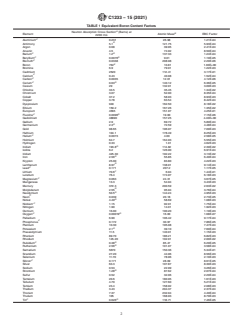
4.1 Use of this standard practice yields an equivalent boron content (EBC) that can be used to characterize the neutron-absorbing properties of a nuclear material. The elements included in the calculation are typically chosen so that the EBC represents either the entire material (for example, for a moderator) or the impurities in the material (for example, for a nuclear fuel). This practice is typically used for materials in which thermal neutron absorption is undesirable. The EBC is not intended for use as an input to any neutronic calculation. The EBC factors in Table 1 were selected to represent neutron absorption in water reactors under normal operating conditions. It is the responsibility of the user to evaluate their suitability for other purposes. (A) Neutron Cross Sections , Vol 1, Parts A and B, Academic Press, New York, 1981 and 1984, respectively.(B) Holden, N. E., and Martin, R. L., Pure and Applied Chemistry, Vol 56, p. 653, 1984.(C) When present in small concentrations, this element should be excluded from determinations of the total EBC.(D) In the absence of other data, the neutron capture cross section for a Maxwellian flux is used.(E) Cross section is primarily due to a single isotope, whose isotopic abundance is variable in nature. The value can vary between 733 and 779 barns depending upon the source. See Holden, N. E., Neutron Capture Cross Section Standards for BNL-325, Fourth Ed., BNL-NCS-51388, January 1981.(F) Cross section is primarily due to a single isotope, whose isotopic abundance is variable in nature. The value can vary between 69 and 72 barns depending upon the source. See Holden, N. E., Neutron Capture Cross Section Standards for BNL-325, Fourth Ed., BNL-NCS-51388, January 1981.
SCOPE
1.1 This standard details a recommended practice for the calculation of the Equivalent Boron Content (EBC) for nuclear materials. The EBC is used to provide a measure of the macroscopic neutron absorption cross section of a nuclear material. EBC factors for the natural elements are determined from their atomic masses and thermal neutron absorption cross sections. This practice is illustrated by using EBC factors that are based on thermal neutron (2200 m/s) absorption cross sections. Other EBC factors may be used depending upon the actual neutron energy spectrum.
1.2 The EBC is a characteristic of a homogeneous material. Characterization of inhomogeneous materials and calculation of neutron multiplication factors require techniques that are beyond the scope of this practice.
1.3 The values stated in SI units are to be regarded as standard. No other units of measurement are included in this standard.
1.4 This international standard was developed in accordance with internationally recognized principles on standardization established in the Decision on Principles for the Development of International Standards, Guides and Recommendations issued by the World Trade Organization Technical Barriers to Trade (TBT) Committee.
- Status
- Published
- Publication Date
- 30-Sep-2021
- Technical Committee
- C26 - Nuclear Fuel Cycle
- Drafting Committee
- C26.02 - Fuel and Fertile Material Specifications


Overview
ASTM C1233-15(2021): Standard Practice for Determining Equivalent Boron Contents of Nuclear Materials establishes a standardized method to calculate the equivalent boron content (EBC) in nuclear materials. By quantifying the EBC, this practice enables effective characterization of a material's macroscopic thermal neutron absorption properties, crucial for the nuclear industry where controlling neutron absorption directly impacts reactor safety and performance.
The standard is primarily applicable to materials or impurities where thermal neutron absorption is a factor of interest. EBC values are calculated from the atomic mass and thermal neutron absorption cross section of constituent elements, providing a comparative measure relative to boron's neutron-absorbing capability.
Key Topics
- Equivalent Boron Content (EBC): A calculated measure representing a material’s relative thermal neutron absorption ability, expressed as an equivalent amount of boron.
- Thermal Neutron Absorption: Focuses on how specific elements interact with thermal neutrons, impacting reactor moderation and safety.
- Elemental Selection: Only elements with significant neutron absorption cross sections are typically included in the calculations. Elements such as aluminum, fluorine, rubidium, barium, lead, silicon, beryllium, neon, tin, bismuth, oxygen, zirconium, carbon, magnesium, cerium, and phosphorus are generally excluded in most calculations, as their contribution is negligible.
- Calculation Methodology: Uses both the atomic mass and the thermal neutron absorption cross section at 2200 m/s to derive EBC factors.
- Material Characterization: The EBC is intended for homogeneous materials; inhomogeneous materials require advanced analysis beyond the scope of this standard.
- Collaborative Approach: Buyers and sellers must agree on which elements are analyzed for EBC determination, ensuring relevance to specific applications.
Applications
This standard has practical value in various sectors of the nuclear industry that require precise characterization of neutron-absorbing properties:
- Nuclear Fuel Assessment: Determining the impact of impurities within nuclear fuels that could modify neutron economy through unwanted absorption.
- Material Qualification: Characterizing structural or moderator materials for use in nuclear reactors, ensuring they meet stringent neutron absorption criteria.
- Safety Analysis: Supporting the evaluation and standardization of materials that may serve as neutron poisons (materials intentionally used to absorb neutrons and regulate reactivity).
- Regulatory Compliance: Facilitates conformity to international and national nuclear safety standards by providing a reliable, transparent methodology for EBC calculation.
Related Standards
ASTM C1233-15(2021) references several other ASTM standards and sector-specific terminology for comprehensive analysis and consistency across the nuclear field:
- ASTM C696: Test Methods for Chemical, Mass Spectrometric, and Spectrochemical Analysis of Nuclear-Grade Uranium Dioxide Powders and Pellets
- ASTM C698: Test Methods for Chemical, Mass Spectrometric, and Spectrochemical Analysis of Nuclear-Grade Mixed Oxides
- ASTM C761: Test Methods for Analysis of Uranium Hexafluoride
- ASTM C799: Test Methods for Analysis of Nuclear-Grade Uranyl Nitrate Solutions
- ASTM C859: Terminology Relating to Nuclear Materials
These referenced standards ensure compatible analytical procedures and harmonized terminology throughout the nuclear materials assessment process.
By adhering to ASTM C1233-15(2021), laboratories, manufacturers, and regulatory bodies can standardize the assessment of neutron-absorbing properties in materials, supporting safe, efficient, and compliant operation in nuclear environments. This practice is essential for anyone involved in nuclear materials specification, quality assurance, or reactor safety analysis.
Relations
- Effective Date
- 01-Jan-2024
- Effective Date
- 01-Nov-2019
- Effective Date
- 01-Jul-2019
- Effective Date
- 01-Feb-2018
- Effective Date
- 01-Jun-2016
- Effective Date
- 15-Jun-2014
- Effective Date
- 15-Jan-2014
- Effective Date
- 01-Jun-2013
- Effective Date
- 01-May-2013
- Effective Date
- 01-Sep-2011
- Effective Date
- 15-May-2011
- Effective Date
- 01-Nov-2010
- Effective Date
- 01-Aug-2010
- Effective Date
- 01-Jun-2010
- Effective Date
- 01-Feb-2010
Get Certified
Connect with accredited certification bodies for this standard

DNV
DNV is an independent assurance and risk management provider.

Lloyd's Register
Lloyd's Register is a global professional services organisation specialising in engineering and technology.
DNV Energy Systems
Energy and renewable energy certification.
Sponsored listings
Frequently Asked Questions
ASTM C1233-15(2021) is a standard published by ASTM International. Its full title is "Standard Practice for Determining Equivalent Boron Contents of Nuclear Materials". This standard covers: ABSTRACT This practice details the recommended method for calculating the equivalent boron content (EBC) values of nuclear elements and materials that are of potential significance as thermal neutron poisons. EBC factors are determined from the atomic weight of elements and the thermal neutron absorption cross section in barns. These may be used depending upon the actual neutron energy characteristics of the applicable reactor system. The elements aluminum, fluorine, rubidium, barium, lead, silicon, beryllium, neon, tin, bismuth, oxygen, zirconium, carbon, magnesium, cerium, and phosphorus are not required to be included in the EBC calculations as their contribution to the total poison effect is not considerably significant. SIGNIFICANCE AND USE 4.1 Use of this standard practice yields an equivalent boron content (EBC) that can be used to characterize the neutron-absorbing properties of a nuclear material. The elements included in the calculation are typically chosen so that the EBC represents either the entire material (for example, for a moderator) or the impurities in the material (for example, for a nuclear fuel). This practice is typically used for materials in which thermal neutron absorption is undesirable. The EBC is not intended for use as an input to any neutronic calculation. The EBC factors in Table 1 were selected to represent neutron absorption in water reactors under normal operating conditions. It is the responsibility of the user to evaluate their suitability for other purposes. (A) Neutron Cross Sections , Vol 1, Parts A and B, Academic Press, New York, 1981 and 1984, respectively.(B) Holden, N. E., and Martin, R. L., Pure and Applied Chemistry, Vol 56, p. 653, 1984.(C) When present in small concentrations, this element should be excluded from determinations of the total EBC.(D) In the absence of other data, the neutron capture cross section for a Maxwellian flux is used.(E) Cross section is primarily due to a single isotope, whose isotopic abundance is variable in nature. The value can vary between 733 and 779 barns depending upon the source. See Holden, N. E., Neutron Capture Cross Section Standards for BNL-325, Fourth Ed., BNL-NCS-51388, January 1981.(F) Cross section is primarily due to a single isotope, whose isotopic abundance is variable in nature. The value can vary between 69 and 72 barns depending upon the source. See Holden, N. E., Neutron Capture Cross Section Standards for BNL-325, Fourth Ed., BNL-NCS-51388, January 1981. SCOPE 1.1 This standard details a recommended practice for the calculation of the Equivalent Boron Content (EBC) for nuclear materials. The EBC is used to provide a measure of the macroscopic neutron absorption cross section of a nuclear material. EBC factors for the natural elements are determined from their atomic masses and thermal neutron absorption cross sections. This practice is illustrated by using EBC factors that are based on thermal neutron (2200 m/s) absorption cross sections. Other EBC factors may be used depending upon the actual neutron energy spectrum. 1.2 The EBC is a characteristic of a homogeneous material. Characterization of inhomogeneous materials and calculation of neutron multiplication factors require techniques that are beyond the scope of this practice. 1.3 The values stated in SI units are to be regarded as standard. No other units of measurement are included in this standard. 1.4 This international standard was developed in accordance with internationally recognized principles on standardization established in the Decision on Principles for the Development of International Standards, Guides and Recommendations issued by the World Trade Organization Technical Barriers to Trade (TBT) Committee.
ABSTRACT This practice details the recommended method for calculating the equivalent boron content (EBC) values of nuclear elements and materials that are of potential significance as thermal neutron poisons. EBC factors are determined from the atomic weight of elements and the thermal neutron absorption cross section in barns. These may be used depending upon the actual neutron energy characteristics of the applicable reactor system. The elements aluminum, fluorine, rubidium, barium, lead, silicon, beryllium, neon, tin, bismuth, oxygen, zirconium, carbon, magnesium, cerium, and phosphorus are not required to be included in the EBC calculations as their contribution to the total poison effect is not considerably significant. SIGNIFICANCE AND USE 4.1 Use of this standard practice yields an equivalent boron content (EBC) that can be used to characterize the neutron-absorbing properties of a nuclear material. The elements included in the calculation are typically chosen so that the EBC represents either the entire material (for example, for a moderator) or the impurities in the material (for example, for a nuclear fuel). This practice is typically used for materials in which thermal neutron absorption is undesirable. The EBC is not intended for use as an input to any neutronic calculation. The EBC factors in Table 1 were selected to represent neutron absorption in water reactors under normal operating conditions. It is the responsibility of the user to evaluate their suitability for other purposes. (A) Neutron Cross Sections , Vol 1, Parts A and B, Academic Press, New York, 1981 and 1984, respectively.(B) Holden, N. E., and Martin, R. L., Pure and Applied Chemistry, Vol 56, p. 653, 1984.(C) When present in small concentrations, this element should be excluded from determinations of the total EBC.(D) In the absence of other data, the neutron capture cross section for a Maxwellian flux is used.(E) Cross section is primarily due to a single isotope, whose isotopic abundance is variable in nature. The value can vary between 733 and 779 barns depending upon the source. See Holden, N. E., Neutron Capture Cross Section Standards for BNL-325, Fourth Ed., BNL-NCS-51388, January 1981.(F) Cross section is primarily due to a single isotope, whose isotopic abundance is variable in nature. The value can vary between 69 and 72 barns depending upon the source. See Holden, N. E., Neutron Capture Cross Section Standards for BNL-325, Fourth Ed., BNL-NCS-51388, January 1981. SCOPE 1.1 This standard details a recommended practice for the calculation of the Equivalent Boron Content (EBC) for nuclear materials. The EBC is used to provide a measure of the macroscopic neutron absorption cross section of a nuclear material. EBC factors for the natural elements are determined from their atomic masses and thermal neutron absorption cross sections. This practice is illustrated by using EBC factors that are based on thermal neutron (2200 m/s) absorption cross sections. Other EBC factors may be used depending upon the actual neutron energy spectrum. 1.2 The EBC is a characteristic of a homogeneous material. Characterization of inhomogeneous materials and calculation of neutron multiplication factors require techniques that are beyond the scope of this practice. 1.3 The values stated in SI units are to be regarded as standard. No other units of measurement are included in this standard. 1.4 This international standard was developed in accordance with internationally recognized principles on standardization established in the Decision on Principles for the Development of International Standards, Guides and Recommendations issued by the World Trade Organization Technical Barriers to Trade (TBT) Committee.
ASTM C1233-15(2021) is classified under the following ICS (International Classification for Standards) categories: 27.120.30 - Fissile materials and nuclear fuel technology. The ICS classification helps identify the subject area and facilitates finding related standards.
ASTM C1233-15(2021) has the following relationships with other standards: It is inter standard links to ASTM C859-24, ASTM C696-19, ASTM C799-19, ASTM C761-18, ASTM C698-16, ASTM C859-14a, ASTM C859-14, ASTM C859-13a, ASTM C859-13, ASTM C696-11, ASTM C761-11, ASTM C859-10b, ASTM C859-10a, ASTM C698-10, ASTM C859-10. Understanding these relationships helps ensure you are using the most current and applicable version of the standard.
ASTM C1233-15(2021) is available in PDF format for immediate download after purchase. The document can be added to your cart and obtained through the secure checkout process. Digital delivery ensures instant access to the complete standard document.
Standards Content (Sample)
This international standard was developed in accordance with internationally recognized principles on standardization established in the Decision on Principles for the
Development of International Standards, Guides and Recommendations issued by the World Trade Organization Technical Barriers to Trade (TBT) Committee.
Designation: C1233 − 15 (Reapproved 2021)
Standard Practice for
Determining Equivalent Boron Contents of Nuclear
Materials
This standard is issued under the fixed designation C1233; the number immediately following the designation indicates the year of
original adoption or, in the case of revision, the year of last revision. A number in parentheses indicates the year of last reapproval. A
superscript epsilon (´) indicates an editorial change since the last revision or reapproval.
1. Scope Spectrochemical Analysis of Nuclear-Grade Mixed Ox-
ides ((U, Pu)O )
1.1 This standard details a recommended practice for the
C761 Test Methods for Chemical, Mass Spectrometric,
calculation of the Equivalent Boron Content (EBC) for nuclear
Spectrochemical, Nuclear, and RadiochemicalAnalysis of
materials. The EBC is used to provide a measure of the
Uranium Hexafluoride
macroscopic neutron absorption cross section of a nuclear
C799 Test Methods for Chemical, Mass Spectrometric,
material. EBC factors for the natural elements are determined
Spectrochemical, Nuclear, and RadiochemicalAnalysis of
from their atomic masses and thermal neutron absorption cross
Nuclear-Grade Uranyl Nitrate Solutions
sections. This practice is illustrated by using EBC factors that
C859 Terminology Relating to Nuclear Materials
are based on thermal neutron (2200 m/s) absorption cross
sections. Other EBC factors may be used depending upon the
3. Terminology
actual neutron energy spectrum.
3.1 Terminology used in this practice is in accordance with
1.2 The EBC is a characteristic of a homogeneous material.
Terminology C859.
Characterization of inhomogeneous materials and calculation
4. Significance and Use
of neutron multiplication factors require techniques that are
beyond the scope of this practice.
4.1 Use of this standard practice yields an equivalent boron
content (EBC) that can be used to characterize the neutron-
1.3 The values stated in SI units are to be regarded as
absorbing properties of a nuclear material. The elements
standard. No other units of measurement are included in this
included in the calculation are typically chosen so that the EBC
standard.
represents either the entire material (for example, for a mod-
1.4 This international standard was developed in accor-
erator) or the impurities in the material (for example, for a
dance with internationally recognized principles on standard-
nuclear fuel). This practice is typically used for materials in
ization established in the Decision on Principles for the
which thermal neutron absorption is undesirable. The EBC is
Development of International Standards, Guides and Recom-
not intended for use as an input to any neutronic calculation.
mendations issued by the World Trade Organization Technical
The EBC factors in Table 1 were selected to represent neutron
Barriers to Trade (TBT) Committee.
absorption in water reactors under normal operating condi-
tions. It is the responsibility of the user to evaluate their
2. Referenced Documents
suitability for other purposes.
2.1 ASTM Standards:
5. Procedures for EBC Determination
C696 Test Methods for Chemical, Mass Spectrometric, and
Spectrochemical Analysis of Nuclear-Grade Uranium Di-
5.1 Agreement shall be reached between the buyer and
oxide Powders and Pellets
seller as to which elements shall be analyzed for calculation of
C698 Test Methods for Chemical, Mass Spectrometric, and
their EBC. It is recommended that B, Cd, Dy, Eu, Sm, and Gd
be included in this calculation. Analytical methods for such
elements shall be those given in Test Methods C696, C698,
This practice is under the jurisdiction of ASTM Committee C26 on Nuclear C761, and C799 as applicable or as otherwise agreed upon
Fuel Cycle and is the direct responsibility of Subcommittee C26.02 on Fuel and
between buyer and seller.
Fertile Material Specifications.
Current edition approved Oct. 1, 2021. Published October 2021. Originally 5.2 TheindividualEBCvaluesarecalculatedusingtheEBC
approved in 1993. Last previous approved in 2015 as C1233 – 15. DOI: 10.1520/
factors from Table 1 as follows:
C1233-15R21.
For referenced ASTM standards, visit the ASTM website, www.astm.org, or
EBC of constituent =
contact ASTM Customer Service at service@astm.org. For Annual Book of ASTM
(EBC factor of constituent)(µg of constituent/gof material)
Standards volume information, refer to the standard’s Document Summary page on
theASTM website. where:
Copyright © ASTM International, 100 Barr Harbor Drive, PO Box C700, West Conshohocken, PA 19428-2959. United States
C1233 − 15 (2021)
TABLE 1 Equivalent Boron Content Factors
A
Neutron Absorption Cross Section (Barns) at B
Element Atomic Mass EBC Factor
2200 m/s
C
Aluminium 0.231 26.98 1.21E-04
D
Antimony 5.1 121.75 5.93E-04
Argon 0.68 39.95 2.41E-04
Arsenic 4.5 74.92 8.50E-04
C D
Barium 1.2 137.33 1.24E-04
C D
Beryllium 0.0076 9.01 1.19E-05
C
Bismuth 0.0338 208.98 2.29E-06
E
Boron 764 10.81 1.00E+00
Bromine 6.9 79.91 1.22E-03
Cadmium 2520 112.41 3.17E-01
C
Calcium 0.43 40.08 1.52E-04
C
Carbon 0.0035 12.01 4.12E-06
C D
Cerium 0.63 140.12 6.36E-05
Cesium 29 132.91 3.09E-03
Chlorine 33.5 35.45 1.34E-02
Chromium 3.07 52.00 8.35E-04
Cobalt 37.2 58.93 8.93E-03
Copper 3.78 63.54 8.42E-04
Dysprosium 940 162.50 8.18E-02
Erbium 159.2 167.26 1.35E-02
Europium 4565 151.97 4.25E-01
C D
Fluorine 0.0096 19.00 7.15E-06
Gado
...