

ASTM C755-20
(Practice)Standard Practice for Selection of Water Vapor Retarders for Thermal Insulation
General Information
- Abstract
SIGNIFICANCE AND USE
4.1 Experience has shown that uncontrolled water entry into thermal insulation is the most serious factor causing impaired performance. Several ways exist by which water enters into an insulation system, the primary ones being diffusion of water vapor, air leakage carrying water vapor, and leakage of surface water. Application specifications for insulation systems that operate below ambient dew-point temperatures necessarily include an adequate vapor retarder system. A vapor retarder system is separate and distinct from the insulation, or is provided by the insulation itself when it is has adequate vapor resistant properties and all joints are sealed against water vapor intrusion, in which case a separate vapor retarder system is not necessary. For selection of adequate retarder systems to control vapor diffusion, it is necessary to establish acceptable practices and standards.
4.2 Vapor Retarder Function—The primary function of a vapor retarder is to control movement of diffusing water vapor into or through a permeable insulation system. The vapor retarder system in some cases is designed to prevent entry of surface water. When properly functioning as a vapor retarder, it will also serve as a barrier to air leakage.
4.3 Vapor Retarder Performance—Design choice of retarders will be affected by thickness of retarder materials, substrate to which applied, the number of joints, available length and width of sheet materials, useful life of the system, and inspection procedures. Each of these factors will have an effect on the retarder system performance and each must be considered and evaluated by the designer.
4.3.1 Although this practice properly places major emphasis on selecting the best vapor retarders, it must be recognized that faulty installation is likely to impair vapor retarder performance. The effectiveness of installation or application techniques in obtaining design water vapor permeance (WVP) performance must be considered in the selection of ret...
SCOPE
1.1 This practice outlines factors to be considered, describes design principles and procedures for water vapor retarder selection, and defines water vapor transmission values appropriate for established criteria. It is intended for the guidance of design engineers in preparing vapor retarder application specifications for control of water vapor flow through thermal insulation. It covers commercial and residential building construction and industrial applications in the service temperature range from −40 to +150°F (−40 to +66°C). Emphasis is placed on the control of moisture penetration by choice of the most suitable components of the system.
1.2 The values stated in inch-pound units are to be regarded as standard. The values given in parentheses are mathematical conversions to SI units that are provided for information only and are not considered standard.
1.3 This standard does not purport to address all of the safety concerns, if any, associated with its use. It is the responsibility of the user of this standard to establish appropriate safety, health, and environmental practices and determine the applicability of regulatory limitations prior to use.
1.4 This international standard was developed in accordance with internationally recognized principles on standardization established in the Decision on Principles for the Development of International Standards, Guides and Recommendations issued by the World Trade Organization Technical Barriers to Trade (TBT) Committee.
- Status
- Published
- Publication Date
- 29-Feb-2020
- Technical Committee
- C16 - Thermal Insulation
- Drafting Committee
- C16.33 - Insulation Finishes and Moisture
Buy Documents
ASTM C755-20 - Standard Practice for Selection of Water Vapor Retarders for Thermal Insulation
REDLINE ASTM C755-20 - Standard Practice for Selection of Water Vapor Retarders for Thermal Insulation
Overview
ASTM C755-20 is the Standard Practice for Selection of Water Vapor Retarders for Thermal Insulation. Developed by ASTM International, this standard provides essential guidance for selecting appropriate water vapor retarders in thermal insulation systems. It outlines factors, design principles, and procedures to control water vapor movement through insulation used in commercial, residential, and industrial applications. The standard is applicable for service temperatures ranging from −40 to +150°F (−40 to +66°C), with a primary emphasis on preventing moisture infiltration and maintaining insulation performance over time.
Key Topics
Significance of Vapor Control
The standard highlights that uncontrolled water entry is a significant threat to thermal insulation effectiveness. Key pathways for water entry include:- Diffusion of water vapor
- Air leakage carrying vapor
- Surface water intrusion Specifying an adequate vapor retarder system is necessary, especially where insulation operates below ambient dew-point temperatures.
Functions of Vapor Retarders
Vapor retarders are designed to:- Minimize water vapor diffusion through permeable insulation
- Prevent surface water ingress in some cases
- Act as barriers against air leakage, enhancing the overall moisture protection
Factors in Retarder Selection
Several considerations influence vapor retarder selection and system performance:- Thickness and physical properties of retarder materials
- Type and condition of substrate
- Number and quality of sealed joints
- Sizes available for sheets or membranes
- Expected system lifespan and inspection regimes
- Quality of installation is critical; poor workmanship can reduce effectiveness
Design Principles
Three main design approaches are identified:- Moisture Blocking: Employs low-permeance vapor retarders to eliminate or minimize vapor ingress, suitable for unidirectional vapor flow.
- Flow-Through: Accepts controlled vapor passage through the insulation, suitable only where vapor can escape or be removed.
- Moisture Storage: Permits limited accumulation of moisture that can be safely contained and later expelled.
Applications
Building Construction
Vapor retarders are specified for both new and renovated residential and commercial buildings where insulation encounters significant vapor pressure differences. Placement of vapor retarders depends on:- Climate (heating or cooling dominated)
- Vapor flow direction (inward or outward)
- Material permeance and system design
Cold Storage Facilities
Specialized design considerations are needed for freezers and coolers, where temperature and humidity conditions demand robust vapor retarder and insulation integration. Flow reversal and condensation risks require careful selection of retarder systems and consideration of venting or purging for moisture dissipation.Industrial Applications
For pipes and vessels operating at low or sub-ambient temperatures, vapor retarders prevent moisture ingress that could severely degrade insulation performance. Recommendations address tight sealing of joints, use of suitable materials, and, where needed, multiple retarder layers or additional barriers.
Related Standards
Several ASTM standards are referenced to support proper selection and testing of vapor retarders:
- ASTM C168 – Terminology Relating to Thermal Insulation
- ASTM C647 – Guide to Properties and Tests of Mastics and Coating Finishes for Thermal Insulation
- ASTM C921 – Practice for Determining the Properties of Jacketing Materials for Thermal Insulation
- ASTM C1136 – Specification for Flexible, Low Permeance Vapor Retarders for Thermal Insulation
- ASTM E96/E96M – Test Methods for Water Vapor Transmission of Materials
Practical Value
Adhering to ASTM C755-20 ensures effective water vapor control within thermal insulation systems, which is key for:
- Protecting insulation thermal efficiency and building energy performance
- Preventing structural degradation due to trapped moisture
- Reducing maintenance and replacement costs by extending insulation system lifespan
- Supporting compliance with building codes and industry best practices
Keywords: ASTM C755, vapor retarders, thermal insulation, moisture control, building construction, industrial insulation, water vapor barrier, insulation performance, commercial buildings, cold storage.
Relations
- Replaces
ASTM C755-19b - Standard Practice for Selection of Water Vapor Retarders for Thermal Insulation - Effective Date
- 01-Mar-2020
- Effective Date
- 15-Apr-2024
- Effective Date
- 01-Mar-2024
- Effective Date
- 15-Nov-2023
- Effective Date
- 01-Mar-2019
- Effective Date
- 15-Apr-2018
- Effective Date
- 01-Jun-2017
- Effective Date
- 15-May-2017
- Effective Date
- 01-Nov-2016
- Effective Date
- 15-Oct-2015
- Effective Date
- 01-Jun-2015
- Effective Date
- 01-May-2015
- Effective Date
- 15-Oct-2014
- Effective Date
- 01-Nov-2013
- Effective Date
- 01-Nov-2013
Buy Documents
ASTM C755-20 - Standard Practice for Selection of Water Vapor Retarders for Thermal Insulation
REDLINE ASTM C755-20 - Standard Practice for Selection of Water Vapor Retarders for Thermal Insulation
Get Certified
Connect with accredited certification bodies for this standard

DIBt (Deutsches Institut für Bautechnik)
German Institute for Building Technology.
DIN CERTCO
DIN Group product certification.

Aboma Certification B.V.
Specialized in construction, metal, and transport sectors.
Sponsored listings
Frequently Asked Questions
ASTM C755-20 is a standard published by ASTM International. Its full title is "Standard Practice for Selection of Water Vapor Retarders for Thermal Insulation". This standard covers: SIGNIFICANCE AND USE 4.1 Experience has shown that uncontrolled water entry into thermal insulation is the most serious factor causing impaired performance. Several ways exist by which water enters into an insulation system, the primary ones being diffusion of water vapor, air leakage carrying water vapor, and leakage of surface water. Application specifications for insulation systems that operate below ambient dew-point temperatures necessarily include an adequate vapor retarder system. A vapor retarder system is separate and distinct from the insulation, or is provided by the insulation itself when it is has adequate vapor resistant properties and all joints are sealed against water vapor intrusion, in which case a separate vapor retarder system is not necessary. For selection of adequate retarder systems to control vapor diffusion, it is necessary to establish acceptable practices and standards. 4.2 Vapor Retarder Function—The primary function of a vapor retarder is to control movement of diffusing water vapor into or through a permeable insulation system. The vapor retarder system in some cases is designed to prevent entry of surface water. When properly functioning as a vapor retarder, it will also serve as a barrier to air leakage. 4.3 Vapor Retarder Performance—Design choice of retarders will be affected by thickness of retarder materials, substrate to which applied, the number of joints, available length and width of sheet materials, useful life of the system, and inspection procedures. Each of these factors will have an effect on the retarder system performance and each must be considered and evaluated by the designer. 4.3.1 Although this practice properly places major emphasis on selecting the best vapor retarders, it must be recognized that faulty installation is likely to impair vapor retarder performance. The effectiveness of installation or application techniques in obtaining design water vapor permeance (WVP) performance must be considered in the selection of ret... SCOPE 1.1 This practice outlines factors to be considered, describes design principles and procedures for water vapor retarder selection, and defines water vapor transmission values appropriate for established criteria. It is intended for the guidance of design engineers in preparing vapor retarder application specifications for control of water vapor flow through thermal insulation. It covers commercial and residential building construction and industrial applications in the service temperature range from −40 to +150°F (−40 to +66°C). Emphasis is placed on the control of moisture penetration by choice of the most suitable components of the system. 1.2 The values stated in inch-pound units are to be regarded as standard. The values given in parentheses are mathematical conversions to SI units that are provided for information only and are not considered standard. 1.3 This standard does not purport to address all of the safety concerns, if any, associated with its use. It is the responsibility of the user of this standard to establish appropriate safety, health, and environmental practices and determine the applicability of regulatory limitations prior to use. 1.4 This international standard was developed in accordance with internationally recognized principles on standardization established in the Decision on Principles for the Development of International Standards, Guides and Recommendations issued by the World Trade Organization Technical Barriers to Trade (TBT) Committee.
SIGNIFICANCE AND USE 4.1 Experience has shown that uncontrolled water entry into thermal insulation is the most serious factor causing impaired performance. Several ways exist by which water enters into an insulation system, the primary ones being diffusion of water vapor, air leakage carrying water vapor, and leakage of surface water. Application specifications for insulation systems that operate below ambient dew-point temperatures necessarily include an adequate vapor retarder system. A vapor retarder system is separate and distinct from the insulation, or is provided by the insulation itself when it is has adequate vapor resistant properties and all joints are sealed against water vapor intrusion, in which case a separate vapor retarder system is not necessary. For selection of adequate retarder systems to control vapor diffusion, it is necessary to establish acceptable practices and standards. 4.2 Vapor Retarder Function—The primary function of a vapor retarder is to control movement of diffusing water vapor into or through a permeable insulation system. The vapor retarder system in some cases is designed to prevent entry of surface water. When properly functioning as a vapor retarder, it will also serve as a barrier to air leakage. 4.3 Vapor Retarder Performance—Design choice of retarders will be affected by thickness of retarder materials, substrate to which applied, the number of joints, available length and width of sheet materials, useful life of the system, and inspection procedures. Each of these factors will have an effect on the retarder system performance and each must be considered and evaluated by the designer. 4.3.1 Although this practice properly places major emphasis on selecting the best vapor retarders, it must be recognized that faulty installation is likely to impair vapor retarder performance. The effectiveness of installation or application techniques in obtaining design water vapor permeance (WVP) performance must be considered in the selection of ret... SCOPE 1.1 This practice outlines factors to be considered, describes design principles and procedures for water vapor retarder selection, and defines water vapor transmission values appropriate for established criteria. It is intended for the guidance of design engineers in preparing vapor retarder application specifications for control of water vapor flow through thermal insulation. It covers commercial and residential building construction and industrial applications in the service temperature range from −40 to +150°F (−40 to +66°C). Emphasis is placed on the control of moisture penetration by choice of the most suitable components of the system. 1.2 The values stated in inch-pound units are to be regarded as standard. The values given in parentheses are mathematical conversions to SI units that are provided for information only and are not considered standard. 1.3 This standard does not purport to address all of the safety concerns, if any, associated with its use. It is the responsibility of the user of this standard to establish appropriate safety, health, and environmental practices and determine the applicability of regulatory limitations prior to use. 1.4 This international standard was developed in accordance with internationally recognized principles on standardization established in the Decision on Principles for the Development of International Standards, Guides and Recommendations issued by the World Trade Organization Technical Barriers to Trade (TBT) Committee.
ASTM C755-20 is classified under the following ICS (International Classification for Standards) categories: 91.120.10 - Thermal insulation of buildings. The ICS classification helps identify the subject area and facilitates finding related standards.
ASTM C755-20 has the following relationships with other standards: It is inter standard links to ASTM C755-19b, ASTM C168-24, ASTM E96/E96M-24, ASTM E96/E96M-23, ASTM C647-19, ASTM C168-18, ASTM C168-17, ASTM C1136-17, ASTM C1136-16, ASTM C168-15a, ASTM C168-15, ASTM E96/E96M-15, ASTM E96/E96M-14, ASTM E96/E96M-13, ASTM C647-08(2013). Understanding these relationships helps ensure you are using the most current and applicable version of the standard.
ASTM C755-20 is available in PDF format for immediate download after purchase. The document can be added to your cart and obtained through the secure checkout process. Digital delivery ensures instant access to the complete standard document.
Standards Content (Sample)
This international standard was developed in accordance with internationally recognized principles on standardization established in the Decision on Principles for the
Development of International Standards, Guides and Recommendations issued by the World Trade Organization Technical Barriers to Trade (TBT) Committee.
Designation: C755 − 20
Standard Practice for
Selection of Water Vapor Retarders for Thermal Insulation
This standard is issued under the fixed designation C755; the number immediately following the designation indicates the year of
original adoption or, in the case of revision, the year of last revision.Anumber in parentheses indicates the year of last reapproval.A
superscript epsilon (´) indicates an editorial change since the last revision or reapproval.
1. Scope C921Practice for Determining the Properties of Jacketing
Materials for Thermal Insulation
1.1 Thispracticeoutlinesfactorstobeconsidered,describes
C1136Specification for Flexible, Low Permeance Vapor
design principles and procedures for water vapor retarder
Retarders for Thermal Insulation
selection, and defines water vapor transmission values appro-
E96/E96MTest Methods for Water Vapor Transmission of
priate for established criteria. It is intended for the guidance of
Materials
design engineers in preparing vapor retarder application speci-
fications for control of water vapor flow through thermal
3. Terminology
insulation. It covers commercial and residential building con-
struction and industrial applications in the service temperature
3.1 For definitions of terms used in this practice, refer to
range from−40 to+150°F (−40 to+66°C). Emphasis is placed
Terminology C168.
on the control of moisture penetration by choice of the most
suitable components of the system.
4. Significance and Use
1.2 The values stated in inch-pound units are to be regarded
4.1 Experiencehasshownthatuncontrolledwaterentryinto
as standard. The values given in parentheses are mathematical
thermal insulation is the most serious factor causing impaired
conversions to SI units that are provided for information only
performance. Several ways exist by which water enters into an
and are not considered standard.
insulation system, the primary ones being diffusion of water
1.3 This standard does not purport to address all of the
vapor, air leakage carrying water vapor, and leakage of surface
safety concerns, if any, associated with its use. It is the
water. Application specifications for insulation systems that
responsibility of the user of this standard to establish appro-
operate below ambient dew-point temperatures necessarily
priate safety, health, and environmental practices and deter-
include an adequate vapor retarder system. A vapor retarder
mine the applicability of regulatory limitations prior to use.
system is separate and distinct from the insulation, or is
1.4 This international standard was developed in accor-
provided by the insulation itself when it is has adequate vapor
dance with internationally recognized principles on standard-
resistantpropertiesandalljointsaresealedagainstwatervapor
ization established in the Decision on Principles for the
intrusion, in which case a separate vapor retarder system is not
Development of International Standards, Guides and Recom-
necessary.Forselectionofadequateretardersystemstocontrol
mendations issued by the World Trade Organization Technical
vapordiffusion,itisnecessarytoestablishacceptablepractices
Barriers to Trade (TBT) Committee.
and standards.
4.2 Vapor Retarder Function—The primary function of a
2. Referenced Documents
vapor retarder is to control movement of diffusing water vapor
2.1 ASTM Standards:
into or through a permeable insulation system. The vapor
C168Terminology Relating to Thermal Insulation
retarder system in some cases is designed to prevent entry of
C647Guide to Properties and Tests of Mastics and Coating
surface water. When properly functioning as a vapor retarder,
Finishes for Thermal Insulation
it will also serve as a barrier to air leakage.
4.3 Vapor Retarder Performance—Design choice of retard-
erswillbeaffectedbythicknessofretardermaterials,substrate
This practice is under the jurisdiction of ASTM Committee C16 on Thermal
Insulation and is the direct responsibility of Subcommittee C16.33 on Insulation
to which applied, the number of joints, available length and
Finishes and Moisture.
width of sheet materials, useful life of the system, and
Current edition approved March 1, 2020. Published March 2020. Originally
inspectionprocedures.Eachofthesefactorswillhaveaneffect
approved in 1973. Last previous edition approved in 2019 as C755–19b. DOI:
10.1520/C0755-20. on the retarder system performance and each must be consid-
For referenced ASTM standards, visit the ASTM website, www.astm.org, or
ered and evaluated by the designer.
contact ASTM Customer Service at service@astm.org. For Annual Book of ASTM
4.3.1 Althoughthispracticeproperlyplacesmajoremphasis
Standards volume information, refer to the standard’s Document Summary page on
the ASTM website. onselectingthebestvaporretarders,itmustberecognizedthat
Copyright © ASTM International, 100 Barr Harbor Drive, PO Box C700, West Conshohocken, PA 19428-2959. United States
C755 − 20
FIG. 1 Dew Point (Dp) Relation to Water Vapor Pressure
faulty installation is likely to impair vapor retarder perfor- 5.1.2 Fig. 2 illustrates the magnitude of water vapor pres-
mance. The effectiveness of installation or application tech- sure differences for four ambient air conditions and cold-side
niques in obtaining design water vapor permeance (WVP) operating temperatures between +40 and −40°F (+4.4
performance must be considered in the selection of retarder and−40°C).
materials. 5.1.3 At a stated temperature the water vapor pressure is
4.3.2 Itisimpracticaltospecifyan“asinstalled”permeance proportional to relative humidity but at a stated relative
valuebecause,duetothenatureoffieldapplication,attainment humidity the vapor pressure is not proportional to temperature.
ofsystempermeanceequivalenttothevaporretardermaterials 5.1.4 Outdoor design conditions vary greatly depending
themselves is assumed not possible. The best approach is to upongeographiclocationandseasonwiththepotentialtohave
specify an appropriate vapor retarder and insure that proper a substantial impact on system design requirements. It is
installation and sealing procedures are followed. therefore necessary to calculate the actual conditions rather
than rely on estimates. As an example, consider the cold-
5. Factors to Be Considered in Choosing Water Vapor storageapplicationshowninTable1.Thewatervaporpressure
Retarders
difference for the facility located in Biloxi, MS is 0.98 in. Hg
(3.25 kPa) as compared to a 0.001 in. Hg (3 Pa) pressure
5.1 Water Vapor Pressure Difference is the difference in the
differenceifthefacilitywaslocatedinInternationalFalls,MN.
pressure exerted on each side of an insulation system or
In the United States the design dew point temperature seldom
insulated structure that is due to the temperature and moisture
exceeds 75°F (24°C) (1).
content of the air on each side of the insulated system or
5.1.5 The expected vapor pressure difference is a very
structure.Thispressuredifferencedeterminesthedirectionand
importantfactorthatmustbebasedonrealisticdesigndata(not
magnitude of the driving force for the diffusion of the water
estimated) to determine vapor retarder requirements.
vapor through the insulated system or structure. In general, for
a given permeable structure, the greater the water vapor
5.2 Service Conditions—The direction and magnitude of
pressuredifference,thegreatertherateofdiffusion.Oneisable water vapor flow are established by the range of ambient
to calculate water vapor pressure differences for specific
atmospheric and design service conditions. These conditions
conditions by numerical methods or from psychrometric tables
showing thermodynamic properties of water at saturation.
5.1.1 Fig. 1 shows the variation of dew-point temperature
Theboldfacenumbersinparenthesesrefertothelistofreferencesattheendof
with water vapor pressure. this practice.
C755 − 20
FIG. 2 Magnitude of Water Vapor Pressure Difference for Selected Conditions (Derived from Fig. 1)
TABLE 1 Cold Storage Example
5.2.2 It is possible that reversible flow will occur where the
Location Biloxi, MS International higher vapor pressure alternates between sides of the system,
Season Summer Falls, MN
changing because of seasonal variations, for example. It is
Winter
possible that the inside temperature and vapor pressure of a
Outside Design Conditions
Temperature , °F (°C) 93 (34) -35 (-37)
refrigeratedstructurewillbebelowtheoutsidetemperatureand
Relative Humidity, % 63 67
vapor pressure at times, and above them at other times. Cooler
Dew Point Temperature, °F (°C) 78.4 (26) -42 (-41)
Water Vapor Pressure .9795 (3.32) .003 (0.01) rooms with operating temperatures in the range from 35 to
in. Hg (kPa)
45°F (2 to 7°C) at 90 % relative humidity and located in
northern latitudes will experience an outward vapor flow in
Inside Design Conditions
Temperature, °F (°C) -10 -10
winter and an inward flow in summer. This reversing vapor
Relative Humidity, % 90 90
flow requires special design consideration.
Water Vapor Pressure in. .02 .02
Hg (kPa)
5.3 Properties of Insulating Materials with Respect to
System Design Conditions Moisture—Insulating materials permeable to water vapor will
Water Vapor Pressure 0.9795 0.001 (0.067)
allow moisture to diffuse through at a rate defined by its
Difference in. Hg (kPa)
permeance and exposure. The rate of movement is inversely
Direction of Diffusion From outside From inside
proportional to the vapor flow resistance in the vapor path.
Insulationhavinglowpermeanceandvapor-tightjointswillact
as a vapor retarder to varying degrees, depending on type of
normally will cause vapor flow to be variable in magnitude,
insulation and sealing materials.
and either unidirectional or reversible.
5.3.1 When condensed water vapor becomes entrained in
5.2.1 Unidirectional flow exists where the water vapor
the insulation, the insulation’s thermal properties will be
pressure is constantly higher on one side of the system. With
affected to varying degrees where wetted. The overall effect is
buildings operated for cold storage or frozen food storage, the
lessimpactfulwhenthecondensationdoesnotbecometrapped
summer outdoor air conditions will usually determine vapor
intheinsulationitself,orisdissipatedfromthesysteminsome
retarder requirements, with retarder placement on the outdoor
manner. Liquid water resulting from condensation has a
(warmer) side of the insulation. In heating only buildings for
thermal conductivity some fifteen times greater than that of a
human occupancy, the winter outdoor air conditions would
typical low-temperature insulation. Ice conductivity is nearly
require retarder placement on the indoor (warmer) side of the
four times that of water. Condensation reduces the thermal
insulation. In cooling only buildings for human occupancy
(that is, tropic and subtropic locations), the summer outside air effectiveness of the insulation in the zone where it occurs, but
when the zone is thin and perpendicular to the heat flow path,
conditions would require retarder placement on the outdoor
(warmer) side. the reduction is not extreme. Water or ice in insulation joints
C755 − 20
that are parallel to the heat flow path provide higher conduc- only a part of the system. Sufficient airflow rate could virtually
tance paths with consequent increased heat flow. Generally, eliminate the temperature gradient through the insulation.
hygroscopic moisture in insulation is disregarded. 5.5.3 When air flows from a cold region of low vapor
pressure through the system to the warm side there will be a
5.3.2 Thermal insulation materials range in permeability
drying effect along the flow path; the accompanying lowering
from essentially 0 (zero) perm-in. (0 g/Pa-s-m) to greater than
–7
of temperatures along the flow path, if significant, is undesir-
100 perm-in. (1.45 × 10 g/Pa-s-m). Because insulation is
able.
supplied in pieces of various size and thickness, vapor diffu-
5.5.4 Inanyinsulationsystemwherethereisapossibilityof
sion through joints must be considered in the permeance of the
condensation due to air leakage, the designer needs to ensure
materials as applied. The effect of temperature changes on
that a continuous unbroken air barrier is present. Often this is
dimensionsandotherphysicalcharacteristicsofallmaterialsof
provided by the vapor retarder system, but sometimes it is best
theassemblymustbeconsideredasitrelatestovaporflowinto
provided by a separate element. Particular attention is to be
the joints and into the insulation.
given to providing airtightness at discontinuities in the system,
5.4 Properties of Boundary or Finish Materials at the Cold
such as at intersections of walls, roofs and floors, at the
Side of Insulation—When a vapor pressure gradient exists the
boundariesofstructuralelementsformingpartofanenclosure,
lower vapor pressure value usually will be on the lower
and around window and service openings. The insulation
temperature side of the system, but not always. (There are
system needs to be designed so that it is practical to obtain a
some exceptions, but these must be considered as special
continuous air barrier under the conditions that will prevail on
cases.) The finish on the cold side of the insulation-enclosing
the job site, keeping in mind the problem of ensuring good
refrigerated spaces needs to have high permeance relative to
workmanship.
that of the warm side construction, so that water vapor
5.5.5 Itispossibletouserecirculationofairbetweenspaces
penetrating the system is able to flow through the insulation
on the cold side of the insulation and a region of low vapor
system without condensing. This moisture must be able to
pressure (usually on the cold side of the insulation system)
movefreelytotherefrigeratingsurfaceswhereitisremovedas
advantageously to maintain continuity of vapor flow, whether
condensate. When the cold side permeance is zero, as with
due to diffusion or air leakage, and thus to avoid condensation.
insulated cold piping, water vapor that enters the insulation
This will often be the only practical approach to the control of
system usually will condense within the assembly and remain
condensation and maintenance of dry conditions within the
as an accumulation of water, frost, or ice.
system. In thus venting the insulation system, whether by
natural or mechanical means, care must be taken to avoid
5.5 Effect of Air Leakage—Where leakage exists, water
adverse thermal effects.
vapor will in most cases be transported as a component of air
5.6 Other Factors—In some cases, physical properties of
movement into and out of an air-permeable insulation system.
retarder material, insulations, and structures that are not within
This fact must be taken into account in the design and
the scope of this practice will affect choice of barrier. These
construction of any system in which moisture control is a
include such properties as combustibility, compatibility of
requirement. It is possible for the quantity of water vapor
systemcomponents,damageresistance,andsurfaceroughness.
transported by air leakage through cracks or air-permeable
construction to be several times greater than that which occurs
6. Fundamental Design Principles of Vapor Control
by vapor diffusion alone.
6.1 Moisture Blocking Design—Themoistureblockingprin-
5.5.1 Air movement occurs as a result of air pressure
ciple is applied in a design wherein the passage of water vapor
differences. In insulated structures, various factors cause these
into the insulation is eliminated or minimized to an insignifi-
air pressure differences, including wind action, buoyancy
cant level. In such a design, unless it is possible to provide a
forces due to temperature difference between interconnected
totally impermeable vapor retarding system, condensation will
spaces, volume changes due to fluctuations in temperature and
occurinthesystemeventually,probablylimitingservicelife.It
barometric pressure, and the operation of mechanical air
is applicable in cases of predominantly or exclusively unidi-
supply or exhaust systems. Air leakage occurs through open-
rectional vapor flow. The design must incorporate the follow-
ingsorthroughair-permeableconstructionacrosswhichtheair
ing:
pressure differences occur. Water vapor in air flowing from a
6.1.1 A vapor retarder with suitably low permeance.
warm humidified region to a colder zone in an insulation
6.1.2 A joint and seam sealing system which maintains
system will condense in the same way as water vapor moving
vapor retarding system integrity.
only by diffusion.
6.1.3 Accommodation for future damage repair, joint and
5.5.2 If there is no opportunity for dilution with air at lower
seam resealing, and reclosing after maintenance.
vapor pressure along the flow path, there will be no vapor
pressure gradient. It is possible that condensation will occur 6.2 Flow-Through Design—The flow-through principle is
when the air stream passes through a region in the insulation limited to essentially unidirectional vapor flow in installations
systemwherethetemperatureisequaltoorlowerthanthedew where any water vapor that diffuses into the insulation system
point of the warm region of origin. Possible scenarios are is permitted to pass through without significant accumulation.
airflow from a warm region on one side of the system through This concept is acceptable only:
to a cold region on the other side, or recirculation between 6.2.1 Where vapor is able to escape beyond the cold side of
interconnected air spaces at different temperatures forming the system, or
C755 − 20
6.2.2 Where vapor cannot so escape, it is possible for it to properties. The vapor retarders are applied with adhesives or
be continuously purged out, or mechanicalfasteners.Alljoints,penetrations,holesandcuts,or
6.2.3 Where provision is made to collect it as condensation anyotherdiscontinuitiesinthevaporretardermustbesealedto
and to remove it periodically. maintainsystemintegrity.Propersealants,methods,andwork-
manship must be employed to insure overall design vapor
6.3 Moisture-Storage Design:
resistance of the installed system.
6.3.1 Thus far the discussion has dealt with methods of
7.2.2 Mastics and Coatings:
avoiding any condensation. In many cases, however, some
7.2.2.1 Mastics and coating vapor retarders (“mastic” here-
condensation is tolerable, the amount depending on the water-
after for simplification) are field-applied semiliquid composi-
holdingcapacityorwatertoleranceofaparticularconstruction
tions of low permeance after curing. They are intended for
under particular conditions of use. The moisture-storage prin-
application by spraying, brushing, or troweling. The specified
ciple permits accumulation of water vapor in the insulation
thickness must be applied, in one or more continuous coats,
system but at a rate designed to prevent harmful effects. This
and suitable membrane reinforcement shall also be required
concept is acceptable when:
when recommended by the manufacturer. The system must
6.3.1.1 Unidirectional vapor flow occurs, but during severe
resistcrackingcausedbysubstratemovement.Goodworkman-
seasonal conditions, accumulations build up, which, in less
severe (compensating seasonal) conditions are adequately ship during application is essential to attain design vapor
diffusion resistance. See Guide C647 for properties of mastics
expelled to the low vapor-pressure side.
6.3.1.2 Reverse-flow conditions regularly occur on a sea- and coatings. On systems operating at below-ambient
temperatures, mastic is often used solely to seal the seams,
sonal cycle and sometimes occur on a diurnal cycle. Possible
design solutions include: punctures, penetrations and terminations of vapor retarder
membranes, and when used in this manner, the mastic must be
(1)Prevention of reverse flow by flushing the usually
avaporretardingtypeasopposedtonon-vaporretardingtypes.
colder side with low dew point air. This procedure requires a
supply of conditioned air and means for its adequate distribu-
7.2.2.2 The permeance of mastics and coatings varies with
tion in passages.
varying dry thickness, and data showing this relationship for
(2)Limitation of the magnitude of one reversed flow cycle specific products are available from manufacturers. Compari-
to a level of accumulation that system materials are able to
sonofpermeancevaluesforvariousmasticsandcoatingsisnot
absorb safely without insulation deficiency or damage. System to be based on wet thickness, but rather on dry thickness (after
design must enable the substantial removal of the vapor
curing and evaporation of all volatile ingredients).
accumulation during the opposite cycle.
7.2.2.3 Because of environmental regulations and sustain-
(3)Use of an insulation system of such low permeability
ability initiatives, mastics used for sealing below-ambient
that an accumulation of vapor during periods of flow reversal
systems are now most commonly water-borne. These water-
is of little importance. Such a design must ensure that the
borne mastics are not available with a permeance as low as the
expulsion of the accumulation during the opposite cycle is
sheet vapor retarders used in below-ambient applications.
adequate.
When mastic is used solely to seal the seams, punctures,
(4)Supplementation of design (3) by the use of selected
penetrations and terminations of vapor retarder membranes,
vapor retarders at the boundaries of the insulation.
concern about the higher permeance of mastic is mitigated by
6.3.2 The moisture storage design practice is in widespread
thefactthatarelativelysmallareaofthevaporretardersystem
usethroughoutindustry.However,athoroughunderstandingof
will consist of, or be sealed with, mastic.
a given system is necessary. The effect of moisture accumula-
7.2.2.4 The mastic itself, when used solely to seal the
tion on thermal conductivity, frost action on wet materials,
seams, punctures, penetrations and terminations of vapor
dimensionalchangesproducedbychangesinmoisturecontent,
retarder membranes and applied per manufacturer’s
andmanyotherfactorsmustbeconsideredbeforethissolution
instructions, must have a permeance of 0.15 perm or less for
is adopted. References (1, 2, 3) and (4) contain information on
applications operating at 33°F to ambient, or 0.05 perm or less
results taken from in-use systems and studies on moisture
forapplicationsoperatingbelow33°Fwhentestedaccordingto
accumulation in insulation products and systems under varied
Test Methods E96/E96M desiccant method at 73°F and 50 %
environmentalconditions.Arealisticdesignapproachnormally
RH. When reinforcing mesh is recommended by the manufac-
assumes there will be some moisture accumulation but desir-
turer’s application instructions, permeance values shall be
ably within controllable limits to do the job intended.
based upon reinforced films. The applied mastic shall not
exceed 10 % of the total vapor retarder area, unless the mastic
7. Vapor Retarder Materials
itself meets the requirements of Table 2, in which case the
7.1 Vapor retarder materials need to be water resistant,
coverage is not restricted. The mastic and vapor retarder
puncture resistant, abrasion resistant, tear resistant, fire
membrane combination shall be as agreed upon by specifier
resistant, noncorrosive, rot and mildew resistant, and of strong
and installer.
tensile strength, in addition to having low permeance.
7.2.2.5 The use of mastics meeting the above permeance
7.2 Types: values with vapor retarder membranes meeting the require-
7.2.1 Membrane retarders are non-structural laminated ments of Table 2 will in some cases increase the weighted
sheets, plastic films, or metal foils of low permeance. See average permeance of the mastic and vapor retarder combina-
Specification C1136 or Practice C921 for required physical tion to slightly above the Table 2 requirements. Such increase
C755 − 20
A
TABLE 2 Recommended Maximum Permeance of Water Vapor Retarders for Blocking Design
Insulation Permeability Insulation Permeability,
B B
Insulation Application
Less than 4.0 perm-in. 4.0 or greater perm-in.
-9 -9
(5.8 × 10 g/Pa-s-m) (5.8 × 10 g/Pa-s-m)
A A
Vapor Retarder Permeance, perms Vapor Retarder Permeance, perms
-8 -8
Wall (residential) 1.0 (5.72 × 10 ) 1.0 (5.72 × 10 )
-8 -8
Underslab (residential and commercial) 1.0 (5.72 × 10 ) 0.4 (2.29 × 10 )
-8 -8 C
Roof deck 1.0 (5.72 × 10 ) 0.4 (2.29 × 10 )
-9 -9
Pipe and vessels (33 to Ambient (1°C to Ambient)) 0.05 (2.86 × 10 ) 0.05(2.86×10 )
-9 -9
Pipe and vessels (−40 to 32°F (−40 to 0°C)) 0.02 (1.14 × 10 ) 0.02(1.14×10 )
-8 -9 C
Ducts (40°F to Ambient (4°C to Ambient)) 1.0 (5.72 × 10 ) 0.03(1.72×10 )
-9 -9
Ducts (39°F and below (4°C and below)) 0.02 (1.14 × 10 ) 0.02(1.14×10 )
-8 -8 C
Metal buildings 1.0 (5.72 × 10 ) 1.0 (5.72 × 10 )
-8 -9
Cold storage 1.0 (5.72 × 10 ) 0.1 (5.72 × 10 )
A
Water vapor permeance of the vapor retarder in perms when tested in accordance with Test Methods E96/E96M.
B
Water vapor permeability of the insulation material when tested in accordance with Test Methods E96/E96M, Desiccant Method at 73.4°F (23°C) at 50 % RH.
C
Subject to climatic and service conditions.
is considered insignificant when mastic is 10 % or less of the 7.4.2 Theintentoftheflow-throughprincipleistoeliminate
total vapor retarder area. condensation within the insulation system to continuously
periodically purge condensation from the insulation system;
NOTE 1—Solvent-borne mastics that provide lower permeance are
therefore, this system is used with insulation materials with
available if their use is permitted.
higher permeability to prevent accumulation of moisture.
7.2.3 Structural retarders are typically formed from rigid or
7.4.3 The moisture-storage principle allows some accumu-
semirigid materials of low permeability, which form a part of
lation of moisture within the insulation system. This principle
the structure. They include some insulation materials, as well
is used with lower permeability insulation systems because the
as prefabricated composite units comprising insulation and
rate of accumulation is small.
finish, and metal curtain walls. They require careful sealing of
7.4.4 The rate and quantity of moisture accumulation in
joints and seams.
insulation used in a given end-use application is a function of
7.2.4 Caulks and mastics are the typical sealants used in
the permeability of the insulation and the operating conditions
conjunction with vapor retarder materials. Pressure sensitive
of the application as well as being a function of the vapor
tapes are also employed as a sealing method. Consideration
retarder materials. Therefore, the vapor retarder requirements
must be given in the selection of the product most appropriate
necessary to control moisture and ensure successful operation
to the specific application, including installation, ambient, and
will in some cases deviate from indicated theory. A case in
systemoperatingconditions.Manufacturers’recommendations
point is the practice of using higher permeance vapor retarder
for proper application must be followed.
systems with lower permeability insulations, whereas the
7.3 Test Method and Values:
flow-throughtheorywouldindicatetheopposite.Thisiswhere
7.3.1 TestMethodsE96/E96Misacceptablefordetermining
the moisture-storage theory comes into practice. From a
water vapor transmission of materials.
practical standpoint, a lower permeability insulation collects
7.3.1.1 This test method provides isothermal conditions for
and stores less water in case of moisture entry, and, therefore,
testing materials by the cup method. In the “dry cup” method,
a higher permeance vapor retarder is tolerable.
Procedure A (desiccant method), relative humidity inside is
7.4.5 Table 2 outlines the general recommended vapor
approximately 0% and approximately 50% on the outside. In
retarder practices presently advocated in various field applica-
the “wet cup” method or water method, the relative humidity
tions by specifiers and manufacturers. In this table, the recom-
insideisapproximately100%andusually50%ontheoutside.
mended permeance for vapor retarder systems is listed for two
WhenevaluatingWVTdataitispreferabletousedataobtained
types of insulations: those with permeabilities of 0.3 to 4.0
by the procedure in which the test conditions approximate the
-11 -9
perm-in.(4.35×10 to5.8×10 g/Pa-s-m)andthosegreater
service conditions.
-9
than 4.0 perm-in. (5.8 × 10 g/Pa-s-m) For insulations having
7.3.1.2 This test method does not permit measurement of
permeabilities of less than 0.3 perm in. where the joints and
WVT values under all conditions of temperature and moisture
seams have a permeance equal to or less than that of the
found in service. It does provide values that permit the
insulation, no separately applied vapor retarder is normally
selection of suitable barrier materials.
recommended except under severe ser
...
This document is not an ASTM standard and is intended only to provide the user of an ASTM standard an indication of what changes have been made to the previous version. Because
it may not be technically possible to adequately depict all changes accurately, ASTM recommends that users consult prior editions as appropriate. In all cases only the current version
of the standard as published by ASTM is to be considered the official document.
Designation: C755 − 19b C755 − 20
Standard Practice for
Selection of Water Vapor Retarders for Thermal Insulation
This standard is issued under the fixed designation C755; the number immediately following the designation indicates the year of
original adoption or, in the case of revision, the year of last revision. A number in parentheses indicates the year of last reapproval. A
superscript epsilon (´) indicates an editorial change since the last revision or reapproval.
1. Scope
1.1 This practice outlines factors to be considered, describes design principles and procedures for water vapor retarder selection,
and defines water vapor transmission values appropriate for established criteria. It is intended for the guidance of design engineers
in preparing vapor retarder application specifications for control of water vapor flow through thermal insulation. It covers
commercial and residential building construction and industrial applications in the service temperature range from −40 to +150°F
(−40 to +66°C). Emphasis is placed on the control of moisture penetration by choice of the most suitable components of the
system.
1.2 The values stated in inch-pound units are to be regarded as standard. The values given in parentheses are mathematical
conversions to SI units that are provided for information only and are not considered standard.
1.3 This standard does not purport to address all of the safety concerns, if any, associated with its use. It is the responsibility
of the user of this standard to establish appropriate safety, health, and environmental practices and determine the applicability of
regulatory limitations prior to use.
1.4 This international standard was developed in accordance with internationally recognized principles on standardization
established in the Decision on Principles for the Development of International Standards, Guides and Recommendations issued
by the World Trade Organization Technical Barriers to Trade (TBT) Committee.
2. Referenced Documents
2.1 ASTM Standards:
C168 Terminology Relating to Thermal Insulation
C647 Guide to Properties and Tests of Mastics and Coating Finishes for Thermal Insulation
C921 Practice for Determining the Properties of Jacketing Materials for Thermal Insulation
C1136 Specification for Flexible, Low Permeance Vapor Retarders for Thermal Insulation
E96/E96M Test Methods for Water Vapor Transmission of Materials
3. Terminology
3.1 For definitions of terms used in this practice, refer to Terminology C168.
4. Significance and Use
4.1 Experience has shown that uncontrolled water entry into thermal insulation is the most serious factor causing impaired
performance. Several ways exist by which water enters into an insulation system, the primary ones being diffusion of water vapor,
air leakage carrying water vapor, and leakage of surface water. Application specifications for insulation systems that operate below
ambient dew-point temperatures necessarily include an adequate vapor retarder system. A vapor retarder system is separate and
distinct from the insulation itself, insulation, or is provided by the insulation itself when it is has adequate vapor resistant properties
and all joints are properly sealed against water vapor intrusion, in which case a separate vapor retarder system is not necessary.
For selection of adequate retarder systems to control vapor diffusion, it is necessary to establish acceptable practices and standards.
4.2 Vapor Retarder Function—The primary function of a vapor retarder is to control movement of diffusing water vapor into
or through a permeable insulation system. The vapor retarder system in some cases is designed to prevent entry of surface water.
When properly functioning as a vapor retarder, it will also serve as a barrier to air leakage.
This practice is under the jurisdiction of ASTM Committee C16 on Thermal Insulation and is the direct responsibility of Subcommittee C16.33 on Insulation Finishes
and Moisture.
Current edition approved Oct. 15, 2019March 1, 2020. Published November 2019March 2020. Originally approved in 1973. Last previous edition approved in 2019 as
C755 – 19a.C755 – 19b. DOI: 10.1520/C0755-19B.10.1520/C0755-20.
For referenced ASTM standards, visit the ASTM website, www.astm.org, or contact ASTM Customer Service at service@astm.org. For Annual Book of ASTM Standards
volume information, refer to the standard’s Document Summary page on the ASTM website.
Copyright © ASTM International, 100 Barr Harbor Drive, PO Box C700, West Conshohocken, PA 19428-2959. United States
C755 − 20
4.3 Vapor Retarder Performance—Design choice of retarders will be affected by thickness of retarder materials, substrate to
which applied, the number of joints, available length and width of sheet materials, useful life of the system, and inspection
procedures. Each of these factors will have an effect on the retarder system performance and each must be considered and evaluated
by the designer.
4.3.1 Although this practice properly places major emphasis on selecting the best vapor retarders, it must be recognized that
faulty installation is likely to impair vapor retarder performance. The effectiveness of installation or application techniques in
obtaining design water vapor permeance (WVP) performance must be considered in the selection of retarder materials.
4.3.2 It is impractical to specify an “as installed” permeance value because, due to the nature of field application, attainment
of system permeance equivalent to the vapor retarder materials themselves is assumed not possible. The best approach is to specify
an appropriate vapor retarder and insure that proper installation and sealing procedures are followed.
5. Factors to Be Considered in Choosing Water Vapor Retarders
5.1 Water Vapor Pressure Difference is the difference in the pressure exerted on each side of an insulation system or insulated
structure that is due to the temperature and moisture content of the air on each side of the insulated system or structure. This
pressure difference determines the direction and magnitude of the driving force for the diffusion of the water vapor through the
insulated system or structure. In general, for a given permeable structure, the greater the water vapor pressure difference, the greater
the rate of diffusion. One is able to calculate water vapor pressure differences for specific conditions by numerical methods or from
psychrometric tables showing thermodynamic properties of water at saturation.
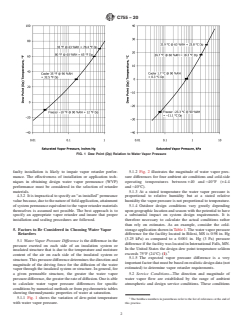
5.1.1 Fig. 1 shows the variation of dew-point temperature with water vapor pressure.
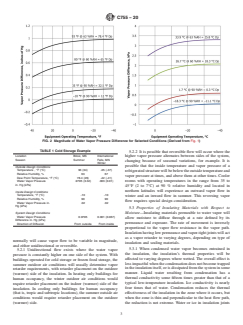
5.1.2 Fig. 2 illustrates the magnitude of water vapor pressure differences for four ambient air conditions and cold-side operating
temperatures between +40 and −40°F (+4.4 and −40°C).
5.1.3 At a stated temperature the water vapor pressure is proportional to relative humidity but at a stated relative humidity the
vapor pressure is not proportional to temperature.
5.1.4 Outdoor design conditions vary greatly depending upon geographic location and season with the potential to have a
substantial impact on system design requirements. It is therefore necessary to calculate the actual conditions rather than rely on
estimates. As an example, consider the cold-storage application shown in Table 1. The water vapor pressure difference for the
FIG. 1 Dew Point (Dp) Relation to Water Vapor Pressure
C755 − 20
FIG. 2 Magnitude of Water Vapor Pressure Difference for Selected Conditions (Derived from Fig. 1)
TABLE 1 Cold Storage Example
Location Biloxi, MS International
Season Summer Falls, MN
Winter
Outside Design Conditions
Temperature , °F (°C) 93 (34) -35 (-37)
Relative Humidity, % 63 67
Dew Point Temperature, °F (°C) 78.4 (26) -42 (-41)
Water Vapor Pressure .9795 (3.32) .003 (0.01)
in. Hg (kPa)
Inside Design Conditions
Temperature, °F (°C) -10 -10
Relative Humidity, % 90 90
Water Vapor Pressure in. .02 .02
Hg (kPa)
System Design Conditions
Water Vapor Pressure 0.9795 0.001 (0.067)
Difference in. Hg (kPa)
Direction of Diffusion From outside From inside
facility located in Biloxi, MS is 0.98 in. Hg (3.25 kPa) as compared to a 0.001 in. Hg (3 Pa) pressure difference if the facility was
located in International Falls, MN. In the United States the design dew point temperature seldom exceeds 75°F (24°C) (1).
5.1.5 The expected vapor pressure difference is a very important factor that must be based on realistic design data (not
estimated) to determine vapor retarder requirements.
5.2 Service Conditions—The direction and magnitude of water vapor flow are established by the range of ambient atmospheric
and design service conditions. These conditions normally will cause vapor flow to be variable in magnitude, and either
unidirectional or reversible.
5.2.1 Unidirectional flow exists where the water vapor pressure is constantly higher on one side of the system. With buildings
operated for cold storage or frozen food storage, the summer outdoor air conditions will usually determine vapor retarder
requirements, with retarder placement on the outdoor (warmer) side of the insulation. In heating only buildings for human
occupancy, the winter outdoor air conditions would require retarder placement on the indoor (warmer) side of the insulation. In
The boldface numbers in parentheses refer to the list of references at the end of this practice.
C755 − 20
cooling only buildings for human occupancy (that is, tropic and subtropic locations), the summer outside air conditions would
require retarder placement on the outdoor (warmer) side.
5.2.2 It is possible that reversible flow will occur where the higher vapor pressure alternates between sides of the system,
changing because of seasonal variations, for example. It is possible that the inside temperature and vapor pressure of a refrigerated
structure will be below the outside temperature and vapor pressure at times, and above them at other times. Cooler rooms with
operating temperatures in the range from 35 to 45°F (2 to 7°C) at 90 % relative humidity and located in northern latitudes will
experience an outward vapor flow in winter and an inward flow in summer. This reversing vapor flow requires special design
consideration.
5.3 Properties of Insulating Materials with Respect to Moisture—Insulating materials permeable to water vapor will allow
moisture to diffuse through at a rate defined by its permeance and exposure. The rate of movement is inversely proportional to the
vapor flow resistance in the vapor path. Insulation having low permeance and vapor-tight joints will act as a vapor retarder to
varying degrees, depending on type of insulation and sealing materials.
5.3.1 When condensed water vapor becomes entrained in the insulation, the insulation’s thermal properties will be affected to
varying degrees where wetted. The overall effect is less impactful when the condensation does not become trapped in the insulation
itself, or is dissipated from the system in some manner. Liquid water resulting from condensation has a thermal conductivity some
fifteen times greater than that of a typical low-temperature insulation. Ice conductivity is nearly four times that of water.
Condensation reduces the thermal effectiveness of the insulation in the zone where it occurs, but when the zone is thin and
perpendicular to the heat flow path, the reduction is not extreme. Water or ice in insulation joints that are parallel to the heat flow
path provide higher conductance paths with consequent increased heat flow. Generally, hygroscopic moisture in insulation is
disregarded.
5.3.2 Thermal insulation materials range in permeability from essentially 0 (zero) perm-in. (0 g/Pa-s-m) to greater than 100
–7
perm-in. (1.45 × 10 g/Pa-s-m). Because insulation is supplied in pieces of various size and thickness, vapor diffusion through
joints must be considered in the permeance of the materials as applied. The effect of temperature changes on dimensions and other
physical characteristics of all materials of the assembly must be considered as it relates to vapor flow into the joints and into the
insulation.
5.4 Properties of Boundary or Finish Materials at the Cold Side of Insulation—When a vapor pressure gradient exists the lower
vapor pressure value usually will be on the lower temperature side of the system, but not always. (There are some exceptions, but
these must be considered as special cases.) The finish on the cold side of the insulation-enclosing refrigerated spaces needs to have
high permeance relative to that of the warm side construction, so that water vapor penetrating the system is able to flow through
the insulation system without condensing. This moisture must be able to move freely to the refrigerating surfaces where it is
removed as condensate. When the cold side permeance is zero, as with insulated cold piping, water vapor that enters the insulation
system usually will condense within the assembly and remain as an accumulation of water, frost, or ice.
5.5 Effect of Air Leakage—Where leakage exists, water vapor will in most cases be transported as a component of air movement
into and out of an air-permeable insulation system. This fact must be taken into account in the design and construction of any
system in which moisture control is a requirement. It is possible for the quantity of water vapor transported by air leakage through
cracks or air-permeable construction to be several times greater than that which occurs by vapor diffusion alone.
5.5.1 Air movement occurs as a result of air pressure differences. In insulated structures, various factors cause these air pressure
differences, including wind action, buoyancy forces due to temperature difference between interconnected spaces, volume changes
due to fluctuations in temperature and barometric pressure, and the operation of mechanical air supply or exhaust systems. Air
leakage occurs through openings or through air-permeable construction across which the air pressure differences occur. Water
vapor in air flowing from a warm humidified region to a colder zone in an insulation system will condense in the same way as
water vapor moving only by diffusion.
5.5.2 If there is no opportunity for dilution with air at lower vapor pressure along the flow path, there will be no vapor pressure
gradient. It is possible that condensation will occur when the air stream passes through a region in the insulation system where
the temperature is equal to or lower than the dew point of the warm region of origin. Possible scenarios are airflow from a warm
region on one side of the system through to a cold region on the other side, or recirculation between interconnected air spaces at
different temperatures forming only a part of the system. Sufficient airflow rate could virtually eliminate the temperature gradient
through the insulation.
5.5.3 When air flows from a cold region of low vapor pressure through the system to the warm side there will be a drying effect
along the flow path; the accompanying lowering of temperatures along the flow path, if significant, is undesirable.
5.5.4 In any insulation system where there is a possibility of condensation due to air leakage, the designer needs to ensure that
a continuous unbroken air barrier is present. Often this is provided by the vapor retarder system, but sometimes it is best provided
by a separate element. Particular attention is to be given to providing airtightness at discontinuities in the system, such as at
intersections of walls, roofs and floors, at the boundaries of structural elements forming part of an enclosure, and around window
and service openings. The insulation system needs to be designed so that it is practical to obtain a continuous air barrier under the
conditions that will prevail on the job site, keeping in mind the problem of ensuring good workmanship.
5.5.5 It is possible to use recirculation of air between spaces on the cold side of the insulation and a region of low vapor pressure
(usually on the cold side of the insulation system) advantageously to maintain continuity of vapor flow, whether due to diffusion
C755 − 20
or air leakage, and thus to avoid condensation. This will often be the only practical approach to the control of condensation and
maintenance of dry conditions within the system. In thus venting the insulation system, whether by natural or mechanical means,
care must be taken to avoid adverse thermal effects.
5.6 Other Factors—In some cases, physical properties of retarder material, insulations, and structures that are not within the
scope of this practice will affect choice of barrier. These include such properties as combustibility, compatibility of system
components, damage resistance, and surface roughness.
6. Fundamental Design Principles of Vapor Control
6.1 Moisture Blocking Design—The moisture blocking principle is applied in a design wherein the passage of water vapor into
the insulation is eliminated or minimized to an insignificant level. In such a design, unless it is possible to provide a totally
impermeable vapor retarding system, condensation will occur in the system eventually, probably limiting service life. It is
applicable in cases of predominantly or exclusively unidirectional vapor flow. The design must incorporate the following:
6.1.1 A vapor retarder with suitably low permeance.
6.1.2 A joint and seam sealing system which maintains vapor retarding system integrity.
6.1.3 Accommodation for future damage repair, joint and seam resealing, and reclosing after maintenance.
6.2 Flow-Through Design—The flow-through principle is limited to essentially unidirectional vapor flow in installations where
any water vapor that diffuses into the insulation system is permitted to pass through without significant accumulation. This concept
is acceptable only:
6.2.1 Where vapor is able to escape beyond the cold side of the system, or
6.2.2 Where vapor cannot so escape, it is possible for it to be continuously purged out, or
6.2.3 Where provision is made to collect it as condensation and to remove it periodically.
6.3 Moisture-Storage Design:
6.3.1 Thus far the discussion has dealt with methods of avoiding any condensation. In many cases, however, some condensation
is tolerable, the amount depending on the water-holding capacity or water tolerance of a particular construction under particular
conditions of use. The moisture-storage principle permits accumulation of water vapor in the insulation system but at a rate
designed to prevent harmful effects. This concept is acceptable when:
6.3.1.1 Unidirectional vapor flow occurs, but during severe seasonal conditions, accumulations build up, which, in less severe
(compensating seasonal) conditions are adequately expelled to the low vapor-pressure side.
6.3.1.2 Reverse-flow conditions regularly occur on a seasonal cycle and sometimes occur on a diurnal cycle. Possible design
solutions include:
(1) Prevention of reverse flow by flushing the usually colder side with low dew point air. This procedure requires a supply of
conditioned air and means for its adequate distribution in passages.
(2) Limitation of the magnitude of one reversed flow cycle to a level of accumulation that system materials are able to absorb
safely without insulation deficiency or damage. System design must enable the substantial removal of the vapor accumulation
during the opposite cycle.
(3) Use of an insulation system of such low permeability that an accumulation of vapor during periods of flow reversal is of
little importance. Such a design must ensure that the expulsion of the accumulation during the opposite cycle is adequate.
(4) Supplementation of design (3) by the use of selected vapor retarders at the boundaries of the insulation.
6.3.2 The moisture storage design practice is in widespread use throughout industry. However, a thorough understanding of a
given system is necessary. The effect of moisture accumulation on thermal conductivity, frost action on wet materials, dimensional
changes produced by changes in moisture content, and many other factors must be considered before this solution is adopted.
References (1, 2, 3) and (4) contain information on results taken from in-use systems and studies on moisture accumulation in
insulation products and systems under varied environmental conditions. A realistic design approach normally assumes there will
be some moisture accumulation but desirably within controllable limits to do the job intended.
7. Vapor Retarder Materials
7.1 Vapor retarder materials need to be water resistant, puncture resistant, abrasion resistant, tear resistant, fire resistant,
noncorrosive, rot and mildew resistant, and of strong tensile strength, in addition to having low permeance.
7.2 Types:
7.2.1 Membrane retarders are non-structural laminated sheets, plastic films, or metal foils of low permeance. See Specification
C1136 or Practice C921 for required physical properties. The vapor retarders are applied with adhesives or mechanical fasteners.
All joints, penetrations, holes and cuts, or any other discontinuities in the vapor retarder must be sealed to maintain system
integrity. Proper sealants, methods, and workmanship must be employed to insure overall design vapor resistance of the installed
system.
7.2.2 Mastics and Coatings:
7.2.2.1 Mastics and coating vapor retarders (“mastic” hereafter for simplification) are field-applied semiliquid compositions of
low permeance after curing. They are intended for application by spraying, brushing, or troweling. The specified thickness must
C755 − 20
be applied, in one or more continuous coats, and suitable membrane reinforcement shall also be required when recommended by
the manufacturer. The system must resist cracking caused by substrate movement. Good workmanship during application is
essential to attain design vapor diffusion resistance. See Guide C647 for properties of mastics and coatings. On systems operating
at below-ambient temperatures, mastic is often used solely to seal the seams, punctures, penetrations and terminations of vapor
retarder membranes, and when used in this manner, the mastic must be a vapor retarding type as opposed to non-vapor retarding
types.
7.2.2.2 The permeance of mastics and coatings varies with varying dry thickness, and data showing this relationship for specific
products are available from manufacturers. Comparison of permeance values for various mastics and coatings is not to be based
on wet thickness, but rather on dry thickness (after curing and evaporation of all volatile ingredients).
7.2.2.3 Because of environmental regulations and sustainability initiatives, mastics used for sealing below-ambient systems are
now most commonly water-borne. These water-borne mastics are not available with a permeance as low as the sheet vapor
retarders used in below-ambient applications. When mastic is used solely to seal the seams, punctures, penetrations and
terminations of vapor retarder membranes, concern about the higher permeance of mastic is mitigated by the fact that a relatively
small area of the vapor retarder system will consist of, or be sealed with, mastic.
7.2.2.4 The mastic itself, when used solely to seal the seams, punctures, penetrations and terminations of vapor retarder
membranes and applied per manufacturer’s instructions, must have a permeance of 0.15 perm or less for applications operating
at 33°F to ambient, or 0.05 perm or less for applications operating below 33°F when tested according to Test Methods E96/E96M
desiccant method at 73°F and 50 % RH. When reinforcing mesh is recommended by the manufacturer’s application instructions,
permeance values shall be based upon reinforced films. The applied mastic shall not exceed 10 % of the total vapor retarder area,
unless the mastic itself meets the requirements of Table 2, in which case the coverage is not restricted. The mastic and vapor
retarder membrane combination shall be as agreed upon by specifier and installer.
7.2.2.5 The use of mastics meeting the above permeance values with vapor retarder membranes meeting the requirements of
Table 2 will in some cases increase the weighted average permeance of the mastic and vapor retarder combination to slightly above
the Table 2 requirements. Such increase is considered insignificant when mastic is 10 % or less of the total vapor retarder area.
NOTE 1—Solvent-borne mastics that provide lower permeance are available if their use is permitted.
7.2.3 Structural retarders are typically formed from rigid or semirigid materials of low permeability, which form a part of the
structure. They include some insulation materials, as well as prefabricated composite units comprising insulation and finish, and
metal curtain walls. They require careful sealing of joints and seams.
7.2.4 Caulks and mastics are the typical sealants used in conjunction with vapor retarder materials. Pressure sensitive tapes are
also employed as a sealing method. Consideration must be given in the selection of the product most appropriate to the specific
application, including installation, ambient, and system operating conditions. Manufacturers’ recommendations for proper
application must be followed.
7.3 Test Method and Values:
7.3.1 Test Methods E96/E96M is acceptable for determining water vapor transmission of materials.
7.3.1.1 This test method provides isothermal conditions for testing materials by the cup method. In the “dry cup” method,
Procedure A (desiccant method), relative humidity inside is approximately 0 % and approximately 50 % on the outside. In the “wet
cup” method or water method, the relative humidity inside is approximately 100 % and usually 50 % on the outside. When
evaluating WVT data it is preferable to use data obtained by the procedure in which the test conditions approximate the service
conditions.
7.3.1.2 This test method does not permit measurement of WVT values under all conditions of temperature and moisture found
in service. It does provide values that permit the selection of suitable barrier materials.
A
TABLE 2 Recommended Maximum Permeance of Water Vapor Retarders for Blocking Design
Insulation Permeability Insulation Permeability,
B B
Insulation Application Less than 4.0 perm-in. 4.0 or greater perm-in.
-9 -9
(5.8 × 10 g/Pa-s-m) (5.8 × 10 g/Pa-s-m)
A A
Vapor Retarder Permeance, perms Vapor Retarder Permeance, perms
-8 -8
Wall (residential) 1.0 (5.72 × 10 ) 1.0 (5.72 × 10 )
-8 -8
Underslab (residential and commercial) 1.0 (5.72 × 10 ) 0.4 (2.29 × 10 )
-8 -8 C
Roof deck 1.0 (5.72 × 10 ) 0.4 (2.29 × 10 )
-9 -9
Pipe and vessels (33 to Ambient (1°C to Ambient)) 0.05 (2.86 × 10 ) 0.05 (2.86 × 10 )
-9 -9
Pipe and vessels (−40 to 32°F (−40 to 0°C)) 0.02 (1.14 × 10 ) 0.02 (1.14 × 10 )
-8 -9 C
Ducts (40°F to Ambient (4°C to Ambient)) 1.0 (5.72 × 10 ) 0.03 (1.72 × 10 )
-9 -9
Ducts (39°F and below (4°C and below)) 0.02 (1.14 × 10 ) 0.02 (1.14 × 10 )
-8 -8 C
Metal buildings 1.0 (5.72 × 10 ) 1.0 (5.72 × 10 )
-8 -9
Cold storage 1.0 (5.72 × 10 ) 0.1 (5.72 × 10 )
A
Water vapor permeance of the vapor retarder in perms when tested in accordance with Test Methods E96/E96M.
B
Water vapor permeability of the insulation material when tested in accordance with Test Methods E96/E96M, Desiccant Method at 73.4°F (23°C) at 50 % RH.
C
Subject to climatic and service conditions.
C755 − 20
7.4 Recommended Vapor Retarder Practices—Three design principles of vapor control have been presented: blocking,
flow-through and moisture storage. All three systems are used in general practice.
7.4.1 The moisture blocking principle eliminates or minimizes the passage of water vapor into the insulation, utilizing a virtually
impermeable vapor retarding system. It is generally used in unidirectional vapor flow.
7.4.2 The intent of the flow-through principle is to eliminate condensation within the insulation system to continuously
periodically purge condensation from the insulation system; therefore, this system is used with insulation materials with higher
permeability to prevent accumulation of moisture.
7.4.3 The moisture-storage principle allows some accumulation of moisture within the insulation system. This principle is used
with lower permeability insulation systems because the rate of accumulation is small.
7.4.4 The rate and quantity of moisture accumulation in insulation used in a given end-use application is a function of the
permeability of the insulation and the operating conditions of the application as well as being a function of the vapor retarder
materials. Therefore, the vapor retarder requirements necessary to control moisture and ensure successful operation will in some
cases deviate from indicated theory. A case in point is the practice of using higher permeance vapor retarder systems with lower
permeability insulations, whereas the flow-through theory would indicate the opposite. This is where the moisture-storage theory
comes into practice. From a practical standpoint, a lower permeability insulation collects and stores less water in case of moisture
entry, and, therefore, a higher permeance vapor retarder is tolerable.
7.4.5 Table 2 outlines the general recommended vapor retarder practices presently advocated in various
...