

ASTM ISO/ASTM51538-17
(Practice)Standard Practice for Use of the Ethanol-Chlorobenzene Dosimetry System
General Information
- Abstract
SIGNIFICANCE AND USE
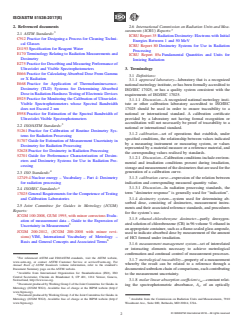
4.1 The ECB dosimetry system provides a reliable means of measuring absorbed dose to water. It is based on a process of radiolytic formation of hydrochloric acid (HCl) in aqueous ethanolic solutions of chlorobenzene by ionizing radiation ((7, 8) , ICRU 80).
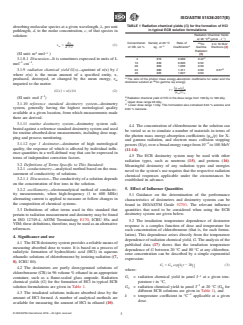
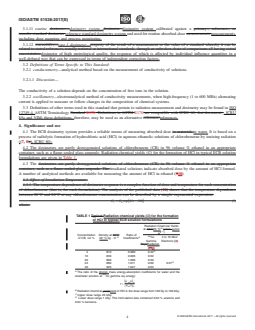
4.2 The dosimeters are partly deoxygenated solutions of chlorobenzene (CB) in 96 volume % ethanol in an appropriate container, such as a flame-sealed glass ampoule. Radiation chemical yields (G) for the formation of HCl in typical ECB solution formulations are given in Table 1. (A) The ratio of the photon mass energy-absorption coefficients for water and the dosimeter solution at 60Co gamma ray energy:
(B) Radiation chemical yield of HCl in the dose range from 100 Gy to 100 kGy.(C) Upper dose range 20 kGy.(D) Lower dose range 1 kGy. This formulation also contained 0.04 % acetone and 0.04 % benzene.
4.3 The irradiated solutions indicate absorbed dose by the amount of HCl formed. A number of analytical methods are available for measuring the amount of HCl in ethanol (10) .
4.4 The concentration of chlorobenzene in the solution can be varied so as to simulate a number of materials in terms of the photon mass energy-absorption coefficients (μen/ρ) for X- and gamma radiation, and electron mass collision stopping powers (S/ρ), over a broad energy range from 10−2 to 100 MeV (11-14).
4.5 The ECB dosimetry system may be used with other radiation types, such as neutrons (15) , and protons (16). Meaningful dosimetry of any radiation types and energies novel to the system's use requires that the respective radiation chemical responses applicable under the circumstances be established in advance.
SCOPE
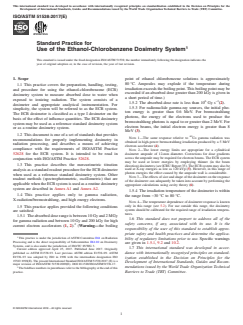
1.1 This practice covers the preparation, handling, testing, and procedure for using the ethanol-chlorobenzene (ECB) dosimetry system to measure absorbed dose to water when exposed to ionizing radiation. The system consists of a dosimeter and appropriate analytical instrumentation. For simplicity, the system will be referred to as the ECB system. The ECB dosimeter is classified as a type I dosimeter on the basis of the effect of influence quantities. The ECB dosimetry system may be used as a reference standard dosimetry system or as a routine dosimetry system.
1.2 This document is one of a set of standards that provides recommendations for properly implementing dosimetry in radiation processing, and describes a means of achieving compliance with the requirements of ISO/ASTM Practice 52628 for the ECB system. It is intended to be read in conjunction with ISO/ASTM Practice 52628.
1.3 This practice describes the mercurimetric titration analysis as a standard readout procedure for the ECB dosimeter when used as a reference standard dosimetry system. Other readout methods (spectrophotometric, oscillometric) that are applicable when the ECB system is used as a routine dosimetry system are described in Annex A1 and Annex A2.
1.4 This practice applies only to gamma radiation, X-radiation/bremsstrahlung, and high energy electrons.
1.5 This practice applies provided the following conditions are satisfied:
1.5.1 The absorbed dose range is between 10 Gy and 2 MGy for gamma radiation and between 10 Gy and 200 kGy for high current electron accelerators (1, 2).2 (Warning—the boiling point of ethanol chlorobenzene solutions is approximately 80 °C. Ampoules may explode if the temperature during irradiation exceeds the boiling point. This boiling point may be exceeded if an absorbed dose greater than 200 kGy is given in a short period of time.)
1.5.2 The absorbed-dose rate is less than 106 Gy s−1(2).
1.5.3 For radionuclide gamma-ray sources, the initial photon energy is greater than 0.6 MeV. For bremsstrahlung photons, the energy of the electrons used to produce the bremsstrahlung photons is equal to or greater than 2 MeV. For electron beams, the initial electron energy is greater than 8 MeV (3).
Note 1: The same response r...
- Status
- Published
- Publication Date
- 30-Sep-2016
- Technical Committee
- E61 - Radiation Processing
- Drafting Committee
- E61.02 - Dosimetry Systems
Buy Documents
ASTM ISO/ASTM51538-17 - Standard Practice for Use of the Ethanol-Chlorobenzene Dosimetry System
REDLINE ASTM ISO/ASTM51538-17 - Standard Practice for Use of the Ethanol-Chlorobenzene Dosimetry System
Overview
ASTM ISO/ASTM51538-17: Standard Practice for Use of the Ethanol-Chlorobenzene Dosimetry System sets out guidelines for the preparation, handling, and utilization of the ethanol-chlorobenzene (ECB) dosimetry system to measure absorbed dose to water from ionizing radiation, such as gamma rays, X-rays (bremsstrahlung), and high-energy electrons. This practice ensures the accuracy and reliability of radiation dose measurements in scientific, medical, and industrial settings, supporting compliance with broader standards for radiation processing.
This standard serves as a critical document for laboratories, calibration facilities, and processing plants that require precise dose measurement and traceability to national or international standards. The ECB dosimeter is recognized as a reference-standard dosimeter meeting rigorous quality and reproducibility requirements.
Key Topics
- Absorbed Dose Measurement: The ECB dosimetry system quantifies the absorbed dose by detecting the amount of hydrochloric acid (HCl) formed in a partly deoxygenated solution of chlorobenzene in ethanol following exposure to ionizing radiation.
- Analytical Methods: Standard procedures include mercurimetric titration as the default readout for reference applications. Alternative analytical methods (such as spectrophotometric or oscillometric analysis) are recommended for routine dose measurement scenarios.
- Dosimeter Preparation and Handling: Emphasizes the use of high-purity reagents, preparation of 96% ethanol solutions containing chlorobenzene, and storage in sealed glass ampoules under controlled temperature conditions.
- Calibration and Traceability: Stresses the importance of periodic calibration against traceable standards in accredited laboratories to ensure consistent and accurate dosimetry performance.
- Operational Ranges: Specifies operating dose ranges (10 Gy–2 MGy for gamma radiation, 10 Gy–200 kGy for high-current electron beams), absorbed-dose rate (below 10^6 Gy/s), and temperature limits (-30 °C to 80 °C for irradiation).
- Influence Factors and Interferences: Discusses correction for temperature dependencies, effects of solution composition, and procedures to account for physical dosimeter variations.
- Measurement Uncertainty: Provides guidance on evaluating, documenting, and reporting the uncertainty budget associated with absorbed dose measurements.
Applications
The ECB dosimetry system is widely used across several sectors:
- Radiation Processing: Serves as a primary or routine dosimetry system in facilities processing materials with gamma, X-ray, or electron beams, such as sterilization of medical devices, food irradiation, and material testing.
- Calibration Laboratories: Used in accredited laboratories for calibrating other dosimetry systems and establishing traceability to international standards.
- Dosimetry Quality Assurance: Provides reliable benchmarking and quality control in environments where accurate absorbed dose quantification is critical, including research laboratories and manufacturing plants utilizing ionizing radiation.
- Cross-Comparison: By varying chlorobenzene concentration, the system can simulate the dose absorption properties of different materials, supporting inter-comparison studies between various matrices and radiation types.
Related Standards
For optimal implementation and compliance, ASTM ISO/ASTM51538-17 references and should be used in conjunction with the following key standards:
- ISO/ASTM 52628: Practice for dosimetry in radiation processing - provides guidance for implementing and qualifying dosimetry systems.
- ISO/ASTM 51261: Guide for selection and calibration of routine dosimetry systems.
- ASTM E666 & E668: Practices for calculating absorbed dose from gamma, X radiation, and electron beam sources.
- ISO/IEC 17025: General requirements for the competence of testing and calibration laboratories.
- ISO/ASTM 51707: Guide for estimation of measurement uncertainty in dosimetry for radiation processing.
Practical Value
Implementing the ECB dosimetry system in accordance with ASTM ISO/ASTM51538-17 ensures:
- Reliable, repeatable, and traceable absorbed dose measurements
- Compliance with national and international requirements for radiation processing
- Enhanced quality assurance in radiation-based applications
- Safe, validated methods for routine and reference dosimetry in regulated industries
Keywords: ECB dosimetry system, ethanol-chlorobenzene dosimeter, absorbed dose measurement, ionizing radiation, gamma radiation, electron beam dosimetry, radiation processing, reference-standard dosimeter, calibration, measurement uncertainty, ASTM51538-17, ISO/ASTM standards.
Relations
- Replaces
ASTM ISO/ASTM51538-09 - Standard Practice for Use of the Ethanol-Chlorobenzene Dosimetry System - Effective Date
- 01-Oct-2016
- Effective Date
- 01-Jul-2020
- Effective Date
- 01-Jun-2017
- Effective Date
- 01-Oct-2016
- Effective Date
- 15-Feb-2016
- Effective Date
- 01-Sep-2015
- Effective Date
- 15-Mar-2015
- Effective Date
- 15-Oct-2014
- Effective Date
- 01-Sep-2014
- Effective Date
- 01-Oct-2013
- Effective Date
- 01-Jan-2013
- Effective Date
- 01-Jun-2010
- Effective Date
- 01-Jun-2010
- Effective Date
- 01-Oct-2009
- Effective Date
- 15-Aug-2009
Buy Documents
ASTM ISO/ASTM51538-17 - Standard Practice for Use of the Ethanol-Chlorobenzene Dosimetry System
REDLINE ASTM ISO/ASTM51538-17 - Standard Practice for Use of the Ethanol-Chlorobenzene Dosimetry System
Get Certified
Connect with accredited certification bodies for this standard

BSMI (Bureau of Standards, Metrology and Inspection)
Taiwan's standards and inspection authority.
Sponsored listings
Frequently Asked Questions
ASTM ISO/ASTM51538-17 is a standard published by ASTM International. Its full title is "Standard Practice for Use of the Ethanol-Chlorobenzene Dosimetry System". This standard covers: SIGNIFICANCE AND USE 4.1 The ECB dosimetry system provides a reliable means of measuring absorbed dose to water. It is based on a process of radiolytic formation of hydrochloric acid (HCl) in aqueous ethanolic solutions of chlorobenzene by ionizing radiation ((7, 8) , ICRU 80). 4.2 The dosimeters are partly deoxygenated solutions of chlorobenzene (CB) in 96 volume % ethanol in an appropriate container, such as a flame-sealed glass ampoule. Radiation chemical yields (G) for the formation of HCl in typical ECB solution formulations are given in Table 1. (A) The ratio of the photon mass energy-absorption coefficients for water and the dosimeter solution at 60Co gamma ray energy: (B) Radiation chemical yield of HCl in the dose range from 100 Gy to 100 kGy.(C) Upper dose range 20 kGy.(D) Lower dose range 1 kGy. This formulation also contained 0.04 % acetone and 0.04 % benzene. 4.3 The irradiated solutions indicate absorbed dose by the amount of HCl formed. A number of analytical methods are available for measuring the amount of HCl in ethanol (10) . 4.4 The concentration of chlorobenzene in the solution can be varied so as to simulate a number of materials in terms of the photon mass energy-absorption coefficients (μen/ρ) for X- and gamma radiation, and electron mass collision stopping powers (S/ρ), over a broad energy range from 10−2 to 100 MeV (11-14). 4.5 The ECB dosimetry system may be used with other radiation types, such as neutrons (15) , and protons (16). Meaningful dosimetry of any radiation types and energies novel to the system's use requires that the respective radiation chemical responses applicable under the circumstances be established in advance. SCOPE 1.1 This practice covers the preparation, handling, testing, and procedure for using the ethanol-chlorobenzene (ECB) dosimetry system to measure absorbed dose to water when exposed to ionizing radiation. The system consists of a dosimeter and appropriate analytical instrumentation. For simplicity, the system will be referred to as the ECB system. The ECB dosimeter is classified as a type I dosimeter on the basis of the effect of influence quantities. The ECB dosimetry system may be used as a reference standard dosimetry system or as a routine dosimetry system. 1.2 This document is one of a set of standards that provides recommendations for properly implementing dosimetry in radiation processing, and describes a means of achieving compliance with the requirements of ISO/ASTM Practice 52628 for the ECB system. It is intended to be read in conjunction with ISO/ASTM Practice 52628. 1.3 This practice describes the mercurimetric titration analysis as a standard readout procedure for the ECB dosimeter when used as a reference standard dosimetry system. Other readout methods (spectrophotometric, oscillometric) that are applicable when the ECB system is used as a routine dosimetry system are described in Annex A1 and Annex A2. 1.4 This practice applies only to gamma radiation, X-radiation/bremsstrahlung, and high energy electrons. 1.5 This practice applies provided the following conditions are satisfied: 1.5.1 The absorbed dose range is between 10 Gy and 2 MGy for gamma radiation and between 10 Gy and 200 kGy for high current electron accelerators (1, 2).2 (Warning—the boiling point of ethanol chlorobenzene solutions is approximately 80 °C. Ampoules may explode if the temperature during irradiation exceeds the boiling point. This boiling point may be exceeded if an absorbed dose greater than 200 kGy is given in a short period of time.) 1.5.2 The absorbed-dose rate is less than 106 Gy s−1(2). 1.5.3 For radionuclide gamma-ray sources, the initial photon energy is greater than 0.6 MeV. For bremsstrahlung photons, the energy of the electrons used to produce the bremsstrahlung photons is equal to or greater than 2 MeV. For electron beams, the initial electron energy is greater than 8 MeV (3). Note 1: The same response r...
SIGNIFICANCE AND USE 4.1 The ECB dosimetry system provides a reliable means of measuring absorbed dose to water. It is based on a process of radiolytic formation of hydrochloric acid (HCl) in aqueous ethanolic solutions of chlorobenzene by ionizing radiation ((7, 8) , ICRU 80). 4.2 The dosimeters are partly deoxygenated solutions of chlorobenzene (CB) in 96 volume % ethanol in an appropriate container, such as a flame-sealed glass ampoule. Radiation chemical yields (G) for the formation of HCl in typical ECB solution formulations are given in Table 1. (A) The ratio of the photon mass energy-absorption coefficients for water and the dosimeter solution at 60Co gamma ray energy: (B) Radiation chemical yield of HCl in the dose range from 100 Gy to 100 kGy.(C) Upper dose range 20 kGy.(D) Lower dose range 1 kGy. This formulation also contained 0.04 % acetone and 0.04 % benzene. 4.3 The irradiated solutions indicate absorbed dose by the amount of HCl formed. A number of analytical methods are available for measuring the amount of HCl in ethanol (10) . 4.4 The concentration of chlorobenzene in the solution can be varied so as to simulate a number of materials in terms of the photon mass energy-absorption coefficients (μen/ρ) for X- and gamma radiation, and electron mass collision stopping powers (S/ρ), over a broad energy range from 10−2 to 100 MeV (11-14). 4.5 The ECB dosimetry system may be used with other radiation types, such as neutrons (15) , and protons (16). Meaningful dosimetry of any radiation types and energies novel to the system's use requires that the respective radiation chemical responses applicable under the circumstances be established in advance. SCOPE 1.1 This practice covers the preparation, handling, testing, and procedure for using the ethanol-chlorobenzene (ECB) dosimetry system to measure absorbed dose to water when exposed to ionizing radiation. The system consists of a dosimeter and appropriate analytical instrumentation. For simplicity, the system will be referred to as the ECB system. The ECB dosimeter is classified as a type I dosimeter on the basis of the effect of influence quantities. The ECB dosimetry system may be used as a reference standard dosimetry system or as a routine dosimetry system. 1.2 This document is one of a set of standards that provides recommendations for properly implementing dosimetry in radiation processing, and describes a means of achieving compliance with the requirements of ISO/ASTM Practice 52628 for the ECB system. It is intended to be read in conjunction with ISO/ASTM Practice 52628. 1.3 This practice describes the mercurimetric titration analysis as a standard readout procedure for the ECB dosimeter when used as a reference standard dosimetry system. Other readout methods (spectrophotometric, oscillometric) that are applicable when the ECB system is used as a routine dosimetry system are described in Annex A1 and Annex A2. 1.4 This practice applies only to gamma radiation, X-radiation/bremsstrahlung, and high energy electrons. 1.5 This practice applies provided the following conditions are satisfied: 1.5.1 The absorbed dose range is between 10 Gy and 2 MGy for gamma radiation and between 10 Gy and 200 kGy for high current electron accelerators (1, 2).2 (Warning—the boiling point of ethanol chlorobenzene solutions is approximately 80 °C. Ampoules may explode if the temperature during irradiation exceeds the boiling point. This boiling point may be exceeded if an absorbed dose greater than 200 kGy is given in a short period of time.) 1.5.2 The absorbed-dose rate is less than 106 Gy s−1(2). 1.5.3 For radionuclide gamma-ray sources, the initial photon energy is greater than 0.6 MeV. For bremsstrahlung photons, the energy of the electrons used to produce the bremsstrahlung photons is equal to or greater than 2 MeV. For electron beams, the initial electron energy is greater than 8 MeV (3). Note 1: The same response r...
ASTM ISO/ASTM51538-17 is classified under the following ICS (International Classification for Standards) categories: 17.240 - Radiation measurements. The ICS classification helps identify the subject area and facilitates finding related standards.
ASTM ISO/ASTM51538-17 has the following relationships with other standards: It is inter standard links to ASTM ISO/ASTM51538-09, ASTM E668-20, ASTM E170-17, ASTM E170-16a, ASTM E170-16, ASTM E170-15a, ASTM E170-15, ASTM E170-14a, ASTM E170-14, ASTM C912-93(2013), ASTM E668-13, ASTM E668-10, ASTM E170-10, ASTM E925-09, ASTM E170-09a. Understanding these relationships helps ensure you are using the most current and applicable version of the standard.
ASTM ISO/ASTM51538-17 is available in PDF format for immediate download after purchase. The document can be added to your cart and obtained through the secure checkout process. Digital delivery ensures instant access to the complete standard document.
Standards Content (Sample)
This international standard was developed in accordance with internationally recognized principles on standardization established in the Decision on Principles for the
Development of International Standards, Guides and Recommendations issued by the World Trade Organization Technical Barriers to Trade (TBT) Committee.
ISO/ASTM 51538:2017(E)
Standard Practice for
Use of the Ethanol-Chlorobenzene Dosimetry System
This standard is issued under the fixed designation ISO/ASTM 51538; the number immediately following the designation indicates the
year of original adoption or, in the case of revision, the year of last revision.
1. Scope point of ethanol chlorobenzene solutions is approximately
80 °C. Ampoules may explode if the temperature during
1.1 This practice covers the preparation, handling, testing,
irradiation exceeds the boiling point. This boiling point may be
and procedure for using the ethanol-chlorobenzene (ECB)
exceeded if an absorbed dose greater than 200 kGy is given in
dosimetry system to measure absorbed dose to water when
a short period of time.)
exposed to ionizing radiation. The system consists of a
6 −1
1.5.2 The absorbed-dose rate is less than 10 Gy s (2).
dosimeter and appropriate analytical instrumentation. For
1.5.3 For radionuclide gamma-ray sources, the initial pho-
simplicity, the system will be referred to as the ECB system.
ton energy is greater than 0.6 MeV. For bremsstrahlung
The ECB dosimeter is classified as a type I dosimeter on the
photons, the energy of the electrons used to produce the
basis of the effect of influence quantities. The ECB dosimetry
bremsstrahlung photons is equal to or greater than 2 MeV. For
system may be used as a reference standard dosimetry system
electron beams, the initial electron energy is greater than 8
or as a routine dosimetry system.
MeV (3).
1.2 This document is one of a set of standards that provides
NOTE 1—The same response relative to Co gamma radiation was
recommendations for properly implementing dosimetry in
obtained in high-power bremsstrahlung irradiation produced bya5MeV
radiation processing, and describes a means of achieving
electron accelerator (4).
compliance with the requirements of ISO/ASTM Practice
NOTE 2—The lower energy limits are appropriate for a cylindrical
52628 for the ECB system. It is intended to be read in dosimeter ampoule of 12-mm diameter. Corrections for dose gradients
across the ampoule may be required for electron beams. The ECB system
conjunction with ISO/ASTM Practice 52628.
may be used at lower energies by employing thinner (in the beam
1.3 This practice describes the mercurimetric titration
direction) dosimeters (see ICRU Report 35). The ECB system may also be
used at X-ray energies as low as 120 kVp (5). However, in this range of
analysis as a standard readout procedure for the ECB dosimeter
photon energies the effect caused by the ampoule wall is considerable.
when used as a reference standard dosimetry system. Other
NOTE 3—The effects of size and shape of the dosimeter on the response
readout methods (spectrophotometric, oscillometric) that are
of the dosimeter can adequately be taken into account by performing the
applicable when the ECB system is used as a routine dosimetry
appropriate calculations using cavity theory (6).
system are described in Annex A1 and Annex A2.
1.5.4 The irradiation temperature of the dosimeter is within
1.4 This practice applies only to gamma radiation,
the range from −30 °C to 80 °C.
X-radiation/bremsstrahlung, and high energy electrons.
NOTE 4—The temperature dependence of dosimeter response is known
only in this range (see 5.2). For use outside this range, the dosimetry
1.5 This practice applies provided the following conditions
system should be calibrated for the required range of irradiation tempera-
are satisfied:
tures.
1.5.1 The absorbed dose range is between 10 Gy and 2 MGy
1.6 This standard does not purport to address all of the
for gamma radiation and between 10 Gy and 200 kGy for high
2 safety concerns, if any, associated with its use. It is the
current electron accelerators (1, 2). (Warning—the boiling
responsibility of the user of this standard to establish appro-
priate safety and health practices and determine the applica-
This practice is under the jurisdiction of ASTM Committee E61 on Radiation bility of regulatory limitations prior to use. Specific warnings
Processing and is the direct responsibility of Subcommittee E61.02 on Dosimetry
are given in 1.5.1, 9.2 and 10.2.
Systems, and is also under the jurisdiction of ISO/TC 85/WG 3.
1.7 This international standard was developed in accor-
Current edition approved April 25, 2017. Published June 2017. Originally
dance with internationally recognized principles on standard-
published as ASTM E1538-93. Last previous ASTM edition E1538–99. ASTM
E1538–93 was adopted by ISO in 1998 with the intermediate designation ISO
ization established in the Decision on Principles for the
15563:1998(E). The present International Standard ISO/ASTM 51538:2017 (E) is a
Development of International Standards, Guides and Recom-
major revision of ISO/ASTM 51538:2009(E). DOI:10.1520/ISOASTM51538-17.
2 mendations issued by the World Trade Organization Technical
The boldface numbers in parentheses refer to the bibliography at the end of this
practice. Barriers to Trade (TBT) Committee.
© ISO/ASTM International 2018 – All rights reserved
ISO/ASTM 51538:2017(E)
2. Referenced documents 2.6 International Commission on Radiation Units and Mea-
surements (ICRU) Reports:
2.1 ASTM Standards:
ICRU Report 35 Radiation Dosimetry: Electrons with Initial
C912 Practice for Designing a Process for Cleaning Techni-
Energies Between 1 and 50 MeV
cal Glasses
ICRU Report 80 Dosimetry Systems for Use in Radiation
D1193 Specification for Reagent Water
Processing
E170 Terminology Relating to Radiation Measurements and
ICRU Report 85a Fundamental Quantities and Units for
Dosimetry
Ionizing Radiation
E275 Practice for Describing and Measuring Performance of
Ultraviolet and Visible Spectrophotometers 3. Terminology
E666 Practice for Calculating Absorbed Dose From Gamma
3.1 Definitions:
or X Radiation
3.1.1 approved laboratory—laboratory that is a recognized
E668 Practice for Application of Thermoluminescence-
national metrology institute, or has been formally accredited to
Dosimetry (TLD) Systems for Determining Absorbed
ISO/IEC 17025, or has a quality system consistent with the
Dose in Radiation-Hardness Testing of Electronic Devices
requirements of ISO/IEC 17025.
E925 Practice for Monitoring the Calibration of Ultraviolet-
3.1.1.1 Discussion—A recognized national metrology insti-
Visible Spectrophotometers whose Spectral Bandwidth
tute or other calibration laboratory accredited to ISO/IEC
does not Exceed 2 nm 17025 should be used in order to ensure traceability to a
national or international standard. A calibration certificate
E958 Practice for Estimation of the Spectral Bandwidth of
provided by a laboratory not having formal recognition or
Ultraviolet-Visible Spectrophotometers
accreditation will not necessarily be proof of traceability to a
2.2 ISO/ASTM Standards:
national or international standard.
51261 Practice for Calibration of Routine Dosimetry Sys-
3.1.2 calibration—set of operations that establish, under
tems for Radiation Processing
specified conditions, the relationship between values indicated
51707 Guide for Estimation of Measurement Uncertainty in
by a measuring instrument or measuring system, or values
Dosimetry for Radiation Processing
represented by a material measure or a reference material, and
52628 Practice for Dosimetry in Radiation Processing
the corresponding values realised by standards.
52701 Guide for Performance Characterization of Dosim-
3.1.2.1 Discussion—Calibration conditions include environ-
eters and Dosimetry Systems for Use in Radiation Pro-
mental and irradiation conditions present during irradiation,
cessing
storage and measurement of the dosimeters that are used for the
generation of a calibration curve.
2.3 ISO Standards:
12749-4 Nuclear energy – Vocabulary – Part 4: Dosimetry
3.1.3 calibration curve—expression of the relation between
for radiation processing
indication and corresponding measured quantity value.
3.1.3.1 Discussion—In radiation processing standards, the
2.4 ISO/IEC Standards:
term “dosimeter response” is generally used for “indication”.
17025 General Requirements for the Competence of Testing
3.1.4 dosimetry system—system used for determining ab-
and Calibration Laboratories
sorbed dose, consisting of dosimeters, measurement instru-
2.5 Joint Committee for Guides in Metrology (JCGM)
ments and their associated reference standards, and procedures
Reports:
for the system’s use.
JCGM 100:2008, GUM 1995, with minor correctons Evalu-
3.1.5 ethanol-chlorobenzene dosimeter—partly deoxygen-
ation of measurement data – Guide to the Expression of
ated solution of chlorobenzene (CB) in 96 volume % ethanol in
Uncertainty in Measurement
an appropriate container, such as a flame-sealed glass ampoule,
JCGM 200:2012, (JCGM 200:2008 with minor revi-
used to indicate absorbed dose by measurement of the amount
sions) VIM, International Vocabulary of Metrology –
of HCl formed under irradiation.
Basis and General Concepts and Associated Terms
3.1.6 measurement management system—set of interrelated
or interacting elements necessary to achieve metrological
confirmation and continual control of measurement processes.
For referenced ASTM and ISO/ASTM standards, visit the ASTM website,
3.1.7 metrological traceability—property of a measurement
www.astm.org, or contact ASTM Customer Service at service@astm.org. For
whereby the result can be related to a reference through a
Annual Book of ASTM Standards volume information, refer to the standard’s
Document Summary page on the ASTM website. documented unbroken chain of comparisons, each contributing
Available from International Organization for Standardization (ISO), ISO
to the measurement uncertainty.
Central Secretariat, Chemin de Blandonnet 8, CP 401, 1214 Vernier, Geneva,
3.1.8 molar linear absorption coeffıcient ε —constant relat-
Switzerland, http://www.iso.org.
m
Document produced by Working Group I of the Joint Committee for Guides in
ing the spectrophotometric absorbance, A , of an optically
λ
Metrology (JCGM WG1). Available free of charge at the BIPM website (http://
www.bipm.org).
Document produced by Working Group 2 of the Joint Committee for Guides in
Metrology (JCGM WG2). Available free of charge at the BIPM website (http:// Available from the Commission on Radiation Units and Measurements, 7910
www.bipm.org). Woodmont Ave., Suite 800, Bethesda, MD 20814, USA.
© ISO/ASTM International 2018 – All rights reserved
ISO/ASTM 51538:2017(E)
TABLE 1 Radiation chemical yields (G) for the formation of HCl
absorbing molecular species at a given wavelength, λ, per unit
in typical ECB solution formulations
pathlength, d, to the molar concentration, c, of that species in
Radiation Chemical Yields
solution:
B −1
at 20 °C (µmol · J )
A
Concentration Density at 20 °C Ratio of
λ Co 4to10MeV
ϵ 5 (1)
−3 A
m
of CB, vol % kg · m Coefficients
d 3c Gamma Electrons (3)
Radiation
2 −1
(SI unit: m mol ) (9)
C
4 819 0.989 0.42
3.1.8.1 Discussion—It is sometimes expressed in units of L
−1 −1
10 839 0.995 0.52
mol cm .
20 869 1.006 0.59
D
3.1.9 radiation chemical yield G(x)—quotient of n(x) by ε 24 880 1.011 0.60 0.57
¯
40 925 1.027 0.63
where n(x) is the mean amount of a specified entity, x,
A
The ratio of the photon mass energy-absorption coefficients for water and the
produced, destroyed, or changed by the mean energy, ε
¯
m
dosimeter solution at Co gamma ray energy:
imparted to the matter.
µ /ρ
s d
en
w
f5
G~x! 5 n~x!/ε¯ (2)
µ /ρ
s d
en
D
−1
B
(SI unit: mol J )
Radiation chemical yield of HCl in the dose range from 100 Gy to 100 kGy.
C
Upper dose range 20 kGy.
3.1.10 reference standard dosimetry system—dosimetry
D
Lower dose range 1 kGy. This formulation also contained 0.04 % acetone and
system, generally having the highest metrological quality
0.04 % benzene.
available at a given location, from which measurements made
there are derived.
3.1.11 routine dosimetry system—dosimetry system cali-
4.4 The concentration of chlorobenzene in the solution can
brated against a reference standard dosimetry system and used
be varied so as to simulate a number of materials in terms of
for routine absorbed-dose measurements, including dose map-
the photon mass energy-absorption coefficients (µ /ρ) for X-
en
ping and process monitoring.
and gamma radiation, and electron mass collision stopping
−2
3.1.12 type 1 dosimeter—dosimeter of high metrological
powers (S/ρ), over a broad energy range from 10 to 100 MeV
quality, the response of which is affected by individual influ-
(11-14).
ence quantities in a well-defined way that can be expressed in
4.5 The ECB dosimetry system may be used with other
terms of independent correction factors.
radiation types, such as neutrons (15), and protons (16).
3.2 Definitions of Terms Specific to This Standard:
Meaningful dosimetry of any radiation types and energies
3.2.1 conductometry—analytical method based on the mea-
novel to the system’s use requires that the respective radiation
surement of conductivity of solutions.
chemical responses applicable under the circumstances be
3.2.1.1 Discussion—The conductivity of a solution depends
established in advance.
on the concentration of free ions in the solution.
5. Effect of Influence Quantities
3.2.2 oscillometry—electroanalytical method of conductiv-
ity measurements, when high-frequency (1 to 600 MHz)
5.1 Guidance on the determination of the performance
alternating current is applied to measure or follow changes in
characteristics of dosimeters and dosimetry systems can be
the composition of chemical systems.
found in ISO/ASTM Guide 52701. The relevant influence
quantities that need to be considered when using the ECB
3.3 Definitions of other terms used in this standard that
dosimetry system are given below.
pertain to radiation measurement and dosimetry may be found
in ISO 12749-4, ASTM Terminology E170, ICRU 85a and
5.2 The irradiation temperature dependence of dosimeter
VIM; these definitions, therefore, may be used as an alternative
response is a complex function of dose and temperature for
references.
each concentration of chlorobenzene (that is, for each formu-
lation). This dependence arises directly from the temperature
4. Significance and use
dependence of radiation chemical yield, G. The analysis of the
4.1 The ECB dosimetry system provides a reliable means of
published data (17) shows that the irradiation temperature
measuring absorbed dose to water. It is based on a process of
dependence of G between 20 °C and 80 °C at any chloroben-
radiolytic formation of hydrochloric acid (HCl) in aqueous
zene concentration can be described by a simple exponential
ethanolic solutions of chlorobenzene by ionizing radiation ((7,
expression:
8), ICRU 80).
G 5 G exp k t 2 20 (3)
@ ~ !#
t 0
4.2 The dosimeters are partly deoxygenated solutions of
where:
chlorobenzene (CB) in 96 volume % ethanol in an appropriate
−1
container, such as a flame-sealed glass ampoule. Radiation G = radiation chemical yield in µmol J at a given tem-
t
chemical yields (G) for the formation of HCl in typical ECB perature t in °C,
−1
G = radiation chemical yield in µmol J at 20 °C (G for
solution formulations are given in Table 1.
0 0
different ECB solutions are given in Table 1), and
4.3 The irradiated solutions indicate absorbed dose by the
−1
k = temperature coefficient in °C applicable at a given
amount of HCl formed. A number of analytical methods are
dose.
available for measuring the amount of HCl in ethanol (10).
© ISO/ASTM International 2018 – All rights reserved
ISO/ASTM 51538:2017(E)
5.2.1 The values of k are given in Table 2. ness of such material depends on the energy of the photon (see
ASTM Practices E666 and E668).
6. Interferences
NOTE 5—The dosimetric ampoule commonly used has a capacity of
6.1 The ECB dosimetric solution response is not particu-
about 5 mL. Quick-break, glass ampoules or “Type 1 glass” colorbreak
ampoules or equivalent containers, may be used. Commercially available
larly sensitive to impurities which occur in commercially
pharmaceutical ampoules have been found to give reproducible results
available components, chlorobenzene and ethanol of the ana-
without requiring additional cleaning.
lytical reagent (AR) grade purity or equivalent (pro analysi,
p.a., and puriss). For high-accuracy results, organic materials
8. Reagents
of technical grade purity (or purum) can be purified by
8.1 Analytical reagent grade chemicals shall be used in this
distillation.
practice for preparing all solutions.
6.2 Care should be exercised in filling ampoules to avoid
8.2 Triply distilled water from coupled all-glass stills or
depositing solution in the ampoule neck. Subsequent heating
water from a high-quality commercial purification unit capable
during sealing of the ampoule may cause an undesirable
of achieving Total Oxidizable Carbon (T.O.C.) content below 5
chemical change in the dosimetric solution remaining inside
ppb should be used. Type II reagent water as specified in
the ampoule neck. Test tubes with ground-glass stoppers are
ASTM Specification D1193 is also considered to be of suffi-
therefore preferred to sealed ampoules for measuring doses
cient quality for use in preparing solutions and 96 volume %
below 100 Gy. For the same reason, care should be given to
ethanol.
avoid heating the body of the ampoule during sealing.
NOTE 6—High-purity water is commercially available from some
6.3 The dosimetric solution is somewhat sensitive to ultra-
suppliers. Such water, labelled HPLC (high-pressure liquid chromatogra-
violet light and should be kept in the dark for long-term
phy) grade, is usually sufficiently free of impurities to be used in this
storage. No special precautions are required during routine
practice.
handling under normal laboratory lighting conditions, but
strong ultraviolet (UV) sources such as sunlight should be
9. Preparation of dosimeters
avoided (18).
9.1 Dosimetric solutions may contain any concentration of
CB. For practical reasons, only a few characteristic formula-
7. Apparatus
tions have been thoroughly characterized. Table 1 lists these
7.1 This practice describes mercurimetric titration of radi-
typical formulations in terms of CB concentrations and radia-
−
olytically formed Cl ions as a standard readout procedure for
tion chemical yields pertaining to these concentrations.
the ECB system when used as a reference-standard dosimetry
9.2 Prepare 96 volume % aqueous ethanol first by adding
system.
absolute ethanol into a volumetric flask containing the appro-
7.2 For the analysis of the dosimetric solution, use a
priate amount of water. (Warning—Ethanol is flammable.)
precision burette capable of measuring volumes with 0.01 mL
Use this aqueous ethanol for making the dosimetric solutions
resolution. If necessary, check the original calibration of
of the desired concentrations by adding it into volumetric flasks
volumetric glassware and, if necessary, recalibrate to attain
containing appropriate amounts of CB. Store the dosimetric
0.1 % relative uncertainty. Control the temperature of all
solution in the dark. (Warning—Chlorobenzene is toxic and a
solutions during handling at 20 6 2 °C to ensure correct
skin irritant. Appropriate precaution should be taken to avoid
measurement of volumes.
contact with the solution during preparation and analysis of the
7.3 Use borosilicate glass or equivalent chemically resistant
dosimeters. Used solutions should be disposed of as hazardous
glass to store the reagents and the prepared dosimetric solution,
waste.)
and to perform the titration. Clean all apparatus thoroughly
9.3 Fill the dosimeter ampoules with the dosimetric solu-
before use (see ASTM Practice C912).
tion. Bubble the solution in the ampoule with nitrogen for
7.4 Use a sealed glass ampoule or other appropriate glass
about 1 min at about 1 bubble per second through a 1-mm
container to hold the dosimetric solution during irradiation. For
capillary. Flame-seal immediately after bubbling. Exercise care
photons, surround the container with material of thickness
to avoid depositing solution in the ampoule neck. Store
sufficient to produce approximate electron equilibrium condi-
dosimeters in the dark.
tions during calibration irradiations. For measurement of ab-
sorbed dose in water, use materials that have radiation-
absorption properties essentially equivalent to water, for 8
Reagent specifications are available from the American Chemical Society, 1115
example, polystyrene and polyethylene. The appropriate thick- 16th Street, NW, Washington, DC 20036, USA.
−1
TABLE 2 Temperature coefficients k (°C) for typical ECB solution formulations as derived from Ref (17)
Concentration of CB, vol % 2.5 kGy 5 kGy 10 kGy 15 kGy 20 kGy 25 kGy
4 −0.0002 −0.0004 −0.0007 −0.0011 −0.0015 −0.0019
10 0.0018 0.0014 0.0009 0.0002 0.0 0.0
20, 25, 40 0.0037 0.0031 0.0020 0.0013 0.0008 0.0
NOTE 1— For intermediate doses interpolation should be made.
© ISO/ASTM International 2018 – All rights reserved
ISO/ASTM 51538:2017(E)
NOTE 7—To minimize the removal of the vapor above the dosimetic
11.2 Calibration Irradiation of Dosimeters—Irradiation is a
solution in the ampoules, the nitrogen is saturated with the vapors of the
critical component of the calibration of the dosimetry system.
dosimetric solution by passing it through ECB solution of the same
Calibration irradiations shall be performed at an approved
composition before the bubbling of the dosimeter ampoules.
laboratory.
11.2.1 Specify the dose in terms of absorbed dose to water.
10. Calibration of the mercuric nitrate solution
11.2.2 When the ECB dosimeter is used as a routine
10.1 The dosimeter measurement procedure is based on the
dosimeter, the calibration irradiation may be performed by
titration of chloride ions formed by irradiation. Free chloride is
irradiating the dosimeters at (a) an approved laboratory using
precipitated with mercuric ions as insoluble HgCl , where-
2 criteria specified in ISO/ASTM Practice 51261,(b) an in-house
2+
upon the excess of Hg ions gives a violet-red coloration with
calibration facility that provides an absorbed dose (or an
the indicator diphenylcarbazone in acid medium (19).
absorbed-dose rate) having traceability to nationally or inter-
−4 −3
nationally recognized standards, or (c) a production irradiator
10.2 Prepare approximately5×10 mol dm Hg(NO ) in
3 2
under actual production irradiation conditions, together with
acidic aqueous ethanol. First dissolve an appropriate amount of
reference- or transfer-standard dosimeters issued and read by
Hg(NO ) in water acidified with sufficient HNO to attain the
3 2 3
−3
an approved laboratory.
concentration of the acid in the final solution, 0.05 mol dm .
(Warning—Mercuric (II) nitrate is highly toxic. Acute expo-
NOTE 9—If the procedures outlined in Sections 5–10 are followed, the
sure of skin and mucous membranes produces violent corrosive radiation chemical yield for the ethanol-chlorobenzene dosimetric solution
is expected to be in agreement with the values shown in Table 1 or in the
effects. Chronic exposure causes many pathological changes.
literature and to be approximately constant over the dose range. Quality
Appropriate precautions should be exercised in handling it.
control testing of the dosimetric solution can be performed by comparing
Used solutions should be disposed of as hazardous waste.
dosimetric solution parameters such as the radiation chemical yield of HCl
Hazards of mercury poisoning can be avoided by using some of
with accepted values. If the radiation chemical yield is significantly
different from that in Table 1 or in the literature, there is an indication of
the alternative readout methods described in Annex A2 and
possible contamination of the solution, or some other problem that needs
Table A3.1 in Annex A3.)
to be resolved.
10.2.1 Prepare standard solutions of NaCl in water. Make
11.2.3 Calibration shall be performed for all new dosimetric
several concentrations to enable cross-checking. Suitable
−3 −2 −2
solutions. If the preparation procedure has been demonstrated
concentrations are5×10 ,1.0×10 ,1.5×10 , and 2.0 ×
−2 −3
to give consistently the same radiation chemical yield, the
10 mol dm . If kept properly in ground-glass stoppered
number of absorbed-dose levels required for the calibration
bottles, these solutions are stable for years. Avoid contamina-
irradiations can be reduced to the minimum needed to check
tion of the standard solutions by using for daily work small
the response and to demonstrate its linearity with dose.
portions of these solutions kept in small ground-glass stop-
pered flasks. Replenish standard solutions in the small flasks as
11.3 Measurement Instrument Calibration and Performance
necessary.
Verification—For the calibration of the instruments, and for the
−3
10.2.2 Prepare 0.2 mol dm HNO in ethanol and 1 % verification of instrument performance between calibrations,
ethanolic solutions of diphenylcarbazone (DPC). see ISO/ASTM Practice 51261 and/or instrument-specific
operating manuals.
10.3 Distribute technical grade ethanol to beakers for
11.4 Dosimeter Measurement by Mercurimetric Titration:
titration, 10 mL into each. Pipet standard NaCl solution
11.4.1 Transfer the irradiated dosimetric solution into a
quantitatively to beakers with ethanol. Add 1 mL of 0.2 mol
−3
beaker for titration. Rinse the dosimeter ampoule several times
dm HNO and 7 drops of 1 % DPC and shake. Titrate with
with a total volume of 5 mL of technical grade ethanol, so that
Hg(NO ) solution from the burette. The solution in the beaker,
the final volume in the beaker is 10 mL. Add 1 mL of 0.2 mol
which is initially yellow-orange, turns to reddish-violet at the
−3
dm HNO and 7 drops of DPC and titrate to the same color
end point.
change as that observed during calibration of the mercuric
10.4 Construct or calculate the best straight line through the
nitrate solution.
points: (consumption of Hg(NO ) ) versus (milliequivalents of
3 2
NOTE 10—If high absorbed doses are to be measured, use appropriate
NaCl). The small positive intercept represents the blank;
portions of irradiated dosimetric solution, taking care that total volume in
inverse slope gives concentration of Hg(NO ) solution.
3 2
the beaker is 10 mL.
NOTE 8—Volumes of the standard NaCl solutions should be such that
11.5 Analysis:
the consumptions of the titrant solution on calibration are similar to the
11.5.1 Subtract the blank (as defined in 10.4) from the
consumptions when analyzing irradiated dosimetric solutions. Take two
−
amounts of Hg(NO ) solutions consumed and calculate [Cl ],
3 2
different volumes of each stand
...
This document is not an ASTM standard and is intended only to provide the user of an ASTM standard an indication of what changes have been made to the previous version. Because
it may not be technically possible to adequately depict all changes accurately, ASTM recommends that users consult prior editions as appropriate. In all cases only the current version
of the standard as published by ASTM is to be considered the official document.
ISO/ASTM 51538:2009(E)
ISO/ASTM 51538 − 2017(E)
Standard Practice for
Use of the Ethanol-Chlorobenzene Dosimetry System
This standard is issued under the fixed designation ISO/ASTM 51538; the number immediately following the designation indicates the
year of original adoption or, in the case of revision, the year of last revision.
1. Scope
1.1 This practice covers the procedure for preparation, handling, testing, and use of procedure for using the ethanol-
chlorobenzene (ECB) dosimetry system to determinemeasure absorbed dose (in terms of absorbed dose to water) in materials
irradiated by photons (gamma radiation or X-radiation/bremsstrahlung) or high energy electrons. to water when exposed to
ionizing radiation. The system consists of a dosimeter and appropriate analytical instrumentation. For simplicity, the system will
be referred to as the ECB system. It The ECB dosimeter is classified as a reference-standard dosimetry system and is also type
I dosimeter on the basis of the effect of influence quantities. The ECB dosimetry system may be used as a routine reference
standard dosimetry system (see ISO/ASTM Guideor as a 51261). routine dosimetry system.
1.2 This document is one of a set of standards that provides recommendations for properly implementing dosimetry in radiation
processing, and describes a means of achieving compliance with the requirements of ISO/ASTM Practice 52628 for the ECB
system. It is intended to be read in conjunction with ISO/ASTM Practice 52628.
1.3 This practice describes the mercurimetric titration analysis as a standard readout procedure for the ECB dosimeter when
used as a reference standard dosimetry system. Other readout methods (spectrophotometric, oscillometric) that are applicable when
the ECB system is used as a routine dosimetry system are described in Annex A1 and Annex A2Annex A1 and Annex A2.
1.4 This practice applies only to gamma radiation, X-radiation/bremsstrahlung, and high energy electrons.
1.5 This practice applies provided the following conditions are satisfied:
1.5.1 The absorbed dose range is between 10 Gy and 2 MGy for gamma radiation and between 10 Gy and 200 kGy for high
current electron accelerators (1, 2). (Warning—the boiling point of ethanol chlorobenzene solutions is approximately
80°C.80 °C. Ampoules may explode if the temperature during irradiation exceeds the boiling point. This boiling point may be
exceeded if an absorbed dose greater than 200 kGy is given in a short period of time.)
6 −1
1.5.2 The absorbed-dose rate is less than 10 Gy s (2).
1.5.3 For radionuclide gamma-ray sources, the initial photon energy is greater than 0.6 MeV. For bremsstrahlung photons, the
energy of the electrons used to produce the bremsstrahlung photons is equal to or greater than 2 MeV. For electron beams, the initial
electron energy is equal to or greater than 48 MeV (3)). (see ICRU Reports 34 and 35).
NOTE 1—The same response relative to Co gamma radiation was obtained in high-power bremsstrahlung irradiation produced by a 5 MeV electron
accelerator (4).
NOTE 2—The same response relative to Co gamma radiation was obtained in high-power bremsstrahlung irradiation produced by a 5 MeV electron
accelerator (4). The lower limits of energy givenlimits are appropriate for a cylindrical dosimeter ampoule of 12-mm diameter. Corrections for dose
gradients across an ampoule of that diameter or less are not required. the ampoule may be required for electron beams. The ECB system may be used
at energies of incident electrons lower than 4 MeV lower energies by employing thinner (in the beam direction) dosimeters. dosimeters (see ICRU Report
35). The ECB system may also be used at X-ray energies as low as 120 kVp (5). However, in this range of photon energies the effect caused by the
ampoule wall is considerable.
NOTE 3—The effects of size and shape of the dosimeter on the response of the dosimeter can adequately be taken into account by performing the
appropriate calculations using cavity theory (6).
1.5.4 The irradiation temperature of the dosimeter is within the range from −40°C to 80°C.−30 °C to 80 °C.
NOTE 4—The temperature dependence of dosimeter response is known only in this range (see 4.35.2). For use outside this range, the dosimetry system
should be calibrated for the required range of irradiation temperatures.
This practice is under the jurisdiction of ASTM Committee E61 on Radiation Processing and is the direct responsibility of Subcommittee E61.02 on Dosimetry Systems,
and is also under the jurisdiction of ISO/TC 85/WG 3.
Current edition approved June 18, 2008.April 25, 2017. Published June 2009.2017. Originally published as ASTM E1538-93. Last previous ASTM edition E1538–99.
ASTM E1538–93 was adopted by ISO in 1998 with the intermediate designation ISO 15563:1998(E). The present International Standard ISO/ASTM 51538:200951538:2017
(E) is a major revision of ISO/ASTM 51538:2002(E), which replaced ISO 15563.51538:2009(E). DOI:10.1520/ISOASTM51538-17.
The boldface numbers in parentheses refer to the bibliography at the end of this practice.
© ISO/ASTM International 2017 – All rights reserved
ISO/ASTM 51538:2017(E)
1.4 The effects of size and shape of the dosimeter on the response of the dosimeter can adequately be taken into account by
performing the appropriate calculations using cavity theory (6).
1.6 This standard does not purport to address all of the safety concerns, if any, associated with its use. It is the responsibility
of the user of this standard to establish appropriate safety and health practices and determine the applicability of regulatory
limitations prior to use. Specific warnings are given in 1.5.1, 8.29.2 and 9.210.2.
1.7 This international standard was developed in accordance with internationally recognized principles on standardization
established in the Decision on Principles for the Development of International Standards, Guides and Recommendations issued
by the World Trade Organization Technical Barriers to Trade (TBT) Committee.
2. Referenced documents
2.1 ASTM Standards:
C912 Practice for Designing a Process for Cleaning Technical Glasses
D1193 Specification for Reagent Water
E170 Terminology Relating to Radiation Measurements and Dosimetry
E275 Practice for Describing and Measuring Performance of Ultraviolet and Visible Spectrophotometers
E666 Practice for Calculating Absorbed Dose From Gamma or X Radiation
E668 Practice for Application of Thermoluminescence-Dosimetry (TLD) Systems for Determining Absorbed Dose in
Radiation-Hardness Testing of Electronic Devices
E925 Practice for Monitoring the Calibration of Ultraviolet-Visible Spectrophotometers whose Spectral Bandwidth does not
Exceed 2 nm
E958 Practice for Estimation of the Spectral Bandwidth of Ultraviolet-Visible Spectrophotometers
2.2 ISO/ASTM Standards:
51261 GuidePractice for Selection and Calibration of Routine Dosimetry Systems for Radiation Processing
51707 Guide for Estimation of Measurement Uncertainty in Dosimetry for Radiation Processing
5140052628 Practice for Characterization and Performance of a High-Dose Gamma-Radiation Dosimetry Calibration Labora-
toryDosimetry in Radiation Processing
5170752701 Guide for Estimating Uncertainties in Dosimetry for Performance Characterization of Dosimeters and Dosimetry
Systems for Use in Radiation Processing
2.3 ISO Standards:
12749-4 Nuclear energy – Vocabulary – Part 4: Dosimetry for radiation processing
2.4 ISO/IEC Standards:
17025 General Requirements for the Competence of Testing and Calibration Laboratories
2.5 Joint Committee for Guides in Metrology (JCGM) Reports:
JCGM 100:2008, GUM 1995, with minor correctons Evaluation of measurement data – Guide to the Expression of Uncertainty
in Measurement
JCGM 200:2012, (JCGM 200:2008 with minor revisions) VIM, International Vocabulary of Metrology – Basis and General
Concepts and Associated Terms
2.6 International Commission on Radiation Units and Measurements (ICRU) Reports:
ICRU Report 14 Radiation Dosimetry: X-Rays and Gamma Rays with Maximum Photon Energies Between 0.6 and 60 MeV
ICRU Report 17 Radiation Dosimetry: X-Rays Generated at Potentials of 5 to 150 kV
ICRU Report 34 The Dosimetry of Pulsed Radiation
ICRU Report 35 Radiation Dosimetry: Electrons with Initial Energies Between 1 and 50 MeV
ICRU Report 3780 Stopping Powers for Electrons and PositronsDosimetry Systems for Use in Radiation Processing
ICRU Report 6085a Fundamental Quantities and Units for Ionizing Radiation
3. Terminology
3.1 Definitions:
3.1.1 approved laboratory—laboratory that is a recognized national metrology institute, or has been formally accredited to
ISO/IEC 17025, or has a quality system consistent with the requirements of ISO/IEC 17025.
For referenced ASTM and ISO/ASTM standards, visit the ASTM website, www.astm.org, or contact ASTM Customer Service at service@astm.org. For Annual Book
of ASTM Standards volume information, refer to the standard’s Document Summary page on the ASTM website.
Available from International Organization for Standardization (ISO), ISO Central Secretariat, Chemin de Blandonnet 8, CP 401, 1214 Vernier, Geneva, Switzerland,
http://www.iso.org.
Document produced by Working Group I of the Joint Committee for Guides in Metrology (JCGM WG1). Available free of charge at the BIPM website
(http://www.bipm.org).
Document produced by Working Group 2 of the Joint Committee for Guides in Metrology (JCGM WG2). Available free of charge at the BIPM website
(http://www.bipm.org).
Available from the Commission on Radiation Units and Measurements, 7910 Woodmont Ave., Suite 800, Bethesda, MD 20814, USA.
© ISO/ASTM International 2017 – All rights reserved
ISO/ASTM 51538:2017(E)
3.1.1.1 Discussion—
A recognized national metrology institute or other calibration laboratory accredited to ISO/IEC 17025 should be used in order to
ensure traceability to a national or international standard. A calibration certificate provided by a laboratory not having formal
recognition or accreditation will not necessarily be proof of traceability to a national or international standard.
3.1.2 calibration—set of operations that establish, under specified conditions, which establishes the relationship between values
indicated by a measuring instrument or measuring system, and the corresponding values realised by standards traceable to a
nationally or internationally recognized laboratory. or values represented by a material measure or a reference material, and the
corresponding values realised by standards.
3.1.2.1 Discussion—
Calibration conditions include environmental and irradiation conditions present during irradiation, storage and measurement of the
dosimeters that are used for the generation of a calibration curve. To achieve stable environmental conditions, it may be necessary
to condition the dosimeters before performing the calibration procedure.
3.1.3 calibration curve—graphical representation of the dosimetry system’s response function.expression of the relation
between indication and corresponding measured quantity value.
3.1.3.1 Discussion—
In radiation processing standards, the term “dosimeter response” is generally used for “indication”.
3.1.4 dosimetry system—system used for determining absorbed dose, consisting of dosimeters, measurement instruments and
their associated reference standards, and procedures for the system’s use.
3.1.5 ethanol-chlorobenzene dosimeter—partly deoxygenated solution of chlorobenzene (CB) in 96 volume % ethanol in an
appropriate container, such as a flame-sealed glass ampoule, used to indicate absorbed dose by measurement of the amount of HCl
formed under irradiation.
3.1.6 measurement management system—set of interrelated or interacting elements necessary to achieve metrological
confirmation and continual control of measurement processes.
3.1.7 measurement quality assurance plan—metrological traceability—documented program for the measurement process that
ensures that the expanded uncertainty consistently meets the requirements of the specific application. This plan requires traceability
to nationally or internationally recognized standards. property of a measurement whereby the result can be related to a reference
through a documented unbroken chain of comparisons, each contributing to the measurement uncertainty.
3.1.8 molar linear absorption coeffıcient ε —constant relating the spectrophotometric absorbance, A , of an optically absorbing
m λ
molecular species at a given wavelength, λ, per unit pathlength, d, to the molar concentration, c, of that species in solution:
A
λ
ε 5 (1)
m
d 3c
A
λ
ϵ 5 (1)
m
d 3c
2 −1
(SI unit: m mol )
3.1.8.1 Discussion—
−1 −1
It is sometimes expressed in units of L mol cm .
3.1.9 radiation chemical yield G(x)—quotient of n(x)n(x) by ε where n(x)n(x) is the mean amount of a specified entity, x,
¯
produced, destroyed, or changed by the mean energy, ε¯ imparted to the matter.
m
G~x! 5 n~x!/¯ε (2)
−1
(SI unit: mol J )
3.1.10 reference-standard dosimeter—reference standard dosimetry system—dosimeter of high metrological quality used as a
standard to provide measurements traceable to measurements made using primary-standard dosimeters.dosimetry system,
generally having the highest metrological quality available at a given location, from which measurements made there are derived.
3.1.9 response function—mathematical representation of the relationship between dosimeter response and absorbed dose, for a
given dosimetry system.
© ISO/ASTM International 2017 – All rights reserved
ISO/ASTM 51538:2017(E)
3.1.11 routine dosimeter—dosimetry system—dosimeter dosimetry system calibrated against a primary-, reference-, or
transfer-standard dosimeter reference standard dosimetry system and used for routine absorbed-dose measurements.measurements,
including dose mapping and process monitoring.
3.1.12 traceability—type 1 dosimeter—property of the result of a measurement or the value of a standard whereby it can be
related to stated references, usually national or international standards, through an unbroken chain of comparisons all having stated
uncertainties.dosimeter of high metrological quality, the response of which is affected by individual influence quantities in a
well-defined way that can be expressed in terms of independent correction factors.
3.2 Definitions of Terms Specific to This Standard:
3.2.1 conductometry—analytical method based on the measurement of conductivity of solutions.
3.2.1.1 Discussion—
The conductivity of a solution depends on the concentration of free ions in the solution.
3.2.2 oscillometry—electroanalytical method of conductivity measurements, when high-frequency (1 to 600 MHz) alternating
current is applied to measure or follow changes in the composition of chemical systems.
3.3 Definitions of other terms used in this standard that pertain to radiation measurement and dosimetry may be found in ISO
12749-4, ASTM Terminology Standard E170. Definitions in ASTM E170 are compatible with ICRU 60; that document, , ICRU
85a and VIM; these definitions, therefore, may be used as an alternative reference.references.
4. Significance and use
4.1 The ECB dosimetry system provides a reliable means of measuring absorbed dose in materials.to water. It is based on a
process of radiolytic formation of hydrochloric acid (HCl) in aqueous ethanolic solutions of chlorobenzene by ionizing radiation
((7, 8).), ICRU 80).
4.2 The dosimeters are partly deoxygenated solutions of chlorobenzene (CB) in 96 volume % ethanol in an appropriate
container, such as a flame-sealed glass ampoule. Radiation chemical yields (G) for the formation of HCl in typical ECB solution
formulations are given in Table 1.
4.3 The dosimeters are partly deoxygenated solutions of chlorobenzene (CB) in 96 volume % ethanol in an appropriate
container, such as a flame-sealed glass ampoule. The irradiated solutions indicate absorbed dose by the amount of HCl formed.
A number of analytical methods are available for measuring the amount of HCl in ethanol (910).
4.3 Effect of Irradiation Temperature:
4.3.1 The temperature dependence of dosimeter response is a complex function of dose and temperature for each concentration
of chlorobenzene (that is, for each formulation). The analysis of the published data (10) shows that the temperature dependence
between 20°C and 80°C at any chlorobenzene concentration can be described by a simple exponential expression:
G 5 G exp k t 2 20 (3)
@ ~ !#
t 0
where:
TABLE 1 Typical Radiation chemical yields (G) for the formation
of HCl in typical ECB solution formulations
Radiation Chemical Yields
B
at 20°C20 °C (μmol· (μmol
−1
· J )
Concentration Density at 20°C Ratio of
Co 4 to 10 MeV
−3 A
of CB, vol % 20 °C kg · m Coefficients
Gamma Electrons (3)
RaysRadiation
(119)
C
4 819 0.989 0.42
10 839 0.995 0.52
20 869 1.006 0.59
D
24 880 1.011 0.60 0.57
40 925 1.027 0.63
A
The ratio of the photon mass energy-absorption coefficients for water and the
dosimeter solution at Co gamma ray energy:
μ /ρ
s d
en
w
f 5
sμ /ρd
en D
B
Radiation chemical yieldsyield of HCl in the dose range from 100 Gy to 100 kGy.
C
Upper dose range 20 kGy.
D
Lower dose range 1 kGy. This formulation also contained 0.04 % acetone and
0.04 % benzene.
© ISO/ASTM International 2017 – All rights reserved
ISO/ASTM 51538:2017(E)
−1
G = the radiation chemical yield in μmol J at a given temperature t in °C,
t
−1
G = the radiation chemical yield in μmol J at 20°C (G for different ECB solutions are given in Table 1), and
0 0
−1
k = the temperature coefficient in (°C) applicable at a given dose.
4.3.2 The values of k are given in Table 2.
4.3.3 Between −30°C and 50°C the temperature coefficient 0.015 kGy/°C applies at 30 kGy dose (12). Information on the
temperature dependence of dosimeter response during irradiation between 20 and 80°C is found in Ref (10), and between −40 and
20°C in Ref (13).
4.4 The concentration of chlorobenzene in the solution can be varied so as to simulate a number of materials in terms of the
photon mass energy-absorption coefficients (μ /ρ) for X- and gamma radiation, and electron mass collision stopping powers (S/ρ),
en
−2
over a broad energy range from 10 to 100 MeV (14-11-1714).
4.5 The absorbed dose that is determined is the dose absorbed in the water. Absorbed dose in other materials irradiated under
equivalent conditions may be calculated. Procedures for making such calculations are given in ASTM Practices E666 and E668
and ISO/ASTM Guide 51261.
NOTE 3—For a comprehensive discussion of various dosimetry methods applicable to the radiation types and energies discussed in this practice, see
ICRU Reports 14, 17, 34, 35, and 37.
4.5 The ECB dosimetry system may be used with other radiation types, such as neutrons (1815), and protons (1916).
Meaningful dosimetry of any radiation types and energies novel to the system’s use requires that the respective radiation chemical
responses applicable under the circumstances be established in advance.
5. Effect of Influence Quantities
5.1 Guidance on the determination of the performance characteristics of dosimeters and dosimetry systems can be found in
ISO/ASTM Guide 52701. The relevant influence quantities that need to be considered when using the ECB dosimetry system are
given below.
5.2 The irradiation temperature dependence of dosimeter response is a complex function of dose and temperature for each
concentration of chlorobenzene (that is, for each formulation). This dependence arises directly from the temperature dependence
of radiation chemical yield, G. The analysis of the published data (17) shows that the irradiation temperature dependence of G
between 20 °C and 80 °C at any chlorobenzene concentration can be described by a simple exponential expression:
G 5 G exp@k t 2 20 # (3)
~ !
t 0
where:
−1
G = radiation chemical yield in μmol J at a given temperature t in °C,
t
−1
G = radiation chemical yield in μmol J at 20 °C (G for different ECB solutions are given in Table 1), and
0 0
−1
k = temperature coefficient in °C applicable at a given dose.
5.2.1 The values of k are given in Table 2.
6. Interferences
6.1 The ECB dosimetric solution response is not particularly sensitive to impurities which occur in commercially available
components, chlorobenzene and ethanol of the analytical reagent (AR) grade purity or equivalent (pro analysi, p.a., and puriss).
For high-accuracy results, organic materials of technical grade purity (or purum) can be purified by distillation.
6.2 Care should be exercised in filling ampoules to avoid depositing solution in the ampoule neck. Subsequent heating during
sealing of the ampoule may cause an undesirable chemical change in the dosimetric solution remaining inside the
ampoule’sampoule neck. Test tubes with ground-glass stoppers are therefore preferred to sealed ampoules for measuring doses
below 100 Gy. For the same reason, care should be given to avoid heating the body of the ampoule during sealing.
6.3 The dosimetric solution is somewhat sensitive to ultraviolet light and should be kept in the dark for long-term storage. No
special precautions are required during routine handling under normal laboratory lighting conditions, but strong ultraviolet (UV)
sources such as sunlight should be avoided (2018).
−1
TABLE 2 Temperature coefficients k (°C) for typical ECB solution formulations as derived from Ref (17)
Concentration of CB, Vol % 2.5 kGy 5 kGy 10 kGy 15 kGy 20 kGy 25 kGy
Concentration of CB, vol % 2.5 kGy 5 kGy 10 kGy 15 kGy 20 kGy 25 kGy
4 −0.0002 −0.0004 −0.0007 −0.0011 −0.0015 −0.0019
10 0.0018 0.0014 0.0009 0.0002 0.0 0.0
20, 25, 40 0.0037 0.0031 0.0020 0.0013 0.0008 0.0
© ISO/ASTM International 2017 – All rights reserved
ISO/ASTM 51538:2017(E)
NOTE 1—For For intermediate doses interpolation should be made.
7. Apparatus
−
7.1 This practice describes mercurimetric titration of radiolytically formed Cl ions as a standard readout procedure for the ECB
system when used as a reference-standard dosimetry system.
7.2 For the analysis of the dosimetric solution, use a precision burette capable of measuring volumes with 0.01 mL resolution.
If necessary, check the original calibration of volumetric glassware and, if necessary, recalibrate to attain 0.1 % relative uncertainty.
Control the temperature of all solutions during handling at 20 6 2°C. 2 °C to ensure correct measurement of volumes.
7.3 Use borosilicate glass or equivalent chemically resistant glass to store the reagents and the prepared dosimetric solution, and
to perform the titration. Clean all apparatus thoroughly before use (see ASTM Practice C912).
7.4 Use a sealed glass ampoule or other appropriate glass container to hold the dosimetric solution during irradiation. For
photons, surround the container with material of thickness sufficient to produce approximate electron equilibrium conditions during
calibration irradiations. For measurement of absorbed dose in water, use materials that have radiation-absorption properties
essentially equivalent to water, for example, polystyrene and polyethylene. The appropriate thickness of such material depends on
the energy of the photon (see ASTM Practices E666 and E668).
NOTE 5—The dosimetric ampoule commonly used has a capacity of about 5 mL. Quick-break, glass ampoules or “Type 1 glass” colorbreak ampoules
or equivalent containers, may be used. Commercially available pharmaceutical ampoules have been found to give reproducible results without requiring
additional cleaning.
8. Reagents
8.1 Analytical reagent grade chemicals shall be used in this practice for preparing all solutions.
8.2 Use of triply Triply distilled water from coupled all-glass stills is recommended. or water from a high-quality commercial
purification unit capable of achieving Total Oxidizable Carbon (T.O.C.) content below 5 ppb should be used. Type II reagent water
as specified in ASTM Specification D1193 is also considered to be of sufficient quality for use in preparing solutions and 96 volume
% ethanol.
NOTE 6—High-purity water is commercially available from some suppliers. Such water, labelled HPLC (high-pressure liquid chromatography) grade,
is usually sufficiently free of impurities to be used in this practice.
9. Preparation of dosimeters
9.1 Dosimetric solutions may contain any concentration of CB. For practical reasons, only a few characteristic formulations
have been thoroughly characterized. Table 1 lists these typical formulations in terms of CB concentrations and radiation chemical
yields pertaining to these concentrations.
9.2 Prepare 96 volume % aqueous ethanol first by adding absolute ethanol into a volumetric flask containing the appropriate
amount of water. (Warning—Ethanol is flammable.) Use this aqueous ethanol for making the dosimetric solutions of the desired
concentrations by adding it into volumetric flasks containing appropriate amounts of CB. Store the dosimetric solution in the dark.
(Warning—Chlorobenzene is toxic and a skin irritant. Appropriate precaution should be taken to avoid contact with the solution
during preparation and analysis of the dosimeters. Used solutions should be disposed of as hazardous waste.)
9.3 Fill the dosimeter ampoules with the dosimetric solution. Bubble the solution in the ampoule with nitrogen for about 1 min
at about 1 bubble per second through a 1-mm capillary. Flame-seal immediately after bubbling. Exercise care to avoid depositing
solution in the ampoule neck. Store dosimeters in the dark.
NOTE 7—To minimize the removal of the vapor above the dosimetic solution in the ampoules, the nitrogen is saturated with the vapors of the dosimetric
solution by passing it through ECB solution of the same composition before the bubbling of the dosimeter ampoules.
10. Calibration of the mercuric nitrate solution
10.1 The dosimeter measurement procedure is based on the titration of chloride ions formed by irradiation. Free chloride is
2+
precipitated with mercuric ions as insoluble HgCl , where-upon the excess of Hg ions gives a violet-red coloration with the
indicator diphenylcarbazone in acid medium (2119).
−4 −3
10.2 Prepare approximately 5 × 10 mol dm Hg(NO ) in acidic aqueous ethanol. First dissolve an appropriate amount of
3 2
−3
Hg(NO ) in water acidified with sufficient HNO to attain the concentration of the acid in the final solution, 0.05 mol dm .
3 2 3
(Warning—Mercuric (II) nitrate is highly toxic. Acute exposure of skin and mucous membranes produces violent corrosive
effects. Chronic exposure causes many pathological changes. Appropriate precautions should be exercised in handling it. Used
solutions should be disposed of as hazardous waste. Hazards of mercury poisoning can be avoided by using some of the alternative
readout methods described in Annex A2 and Table A3.1 in Annex A3.)
Reagent specifications are available from the American Chemical Society, 1115 16th Street, NW, Washington, DC 20036, USA.
© ISO/ASTM International 2017 – All rights reserved
ISO/ASTM 51538:2017(E)
10.2.1 Prepare standard solutions of NaCl in water. Make several concentrations to enable cross-checking. Suitable
−3 −2 −2 −2 −3
concentrations are 5 × 10 , 1.0 × 10 , 1.5 × 10 , and 2.0 × 10 mol dm . If kept properly in ground-glass stoppered bottles,
these solutions are stable for years. Avoid contamination of the standard solutions by using for daily work small portions of these
solutions kept in small ground-glass stoppered flasks. Replenish standard solutions in the small flasks as necessary.
−3
10.2.2 Prepare 0.2 mol dm HNO in ethanol and 1 % ethanolic solutions of diphenylcarbazone (DPC).
10.3 Distribute technical grade ethanol to beakers for titration, 10 mL into each. Pipet standard NaCl solution quantitatively to
−3
beakers with ethanol. Add 1 mL of 0.2 mol dm HNO and 7 drops of 1 % DPC and shake. Titrate with Hg(NO ) solution from
3 3 2
the burette. The solution in the beaker, which is initially yellow-orange, turns to reddish-violet at the end point.
10.4 Construct or calculate the best straight line through the points: (consumption of Hg(NO ) ) versus (milliequivalents of
3 2
NaCl). The small positive intercept represents the blank; inverse slope gives concentration of Hg(NO ) solution.
3 2
NOTE 8—Volumes of the standard NaCl solutions should be such that the consumptions of the titrant solution on calibration are similar to the
consumptions when analyzing irradiated dosimetric solutions. Take two different volumes of each standard solution to enable cross-checking. The
concentration of mercuric nitrate solution should be calibrated daily.
11. Calibration of the dosimetry system
11.1 The dosimetry system shall be calibrated prior to use and at intervals thereafter in accordance with the user’s documented
procedure that specifies details of the calibration process and quality assurance requirements. Calibration requirements are given
in ISO/ASTM GuidePractice 51261.
11.2 Calibration Irradiation of Dosimeters—Irradiation is a critical component of the calibration of the dosimetry system.
Calibration irradiations shall be performed at a national or accredited laboratory using criteria specified in ISO/ASTM Practice an
approved laboratory.51400.
11.2.1 Specify the dose in terms of absorbed dose to water.
11.2.2 When the ECB dosimeter is used as a routine dosimeter, the calibration irradiation may be performed by irradiating the
dosimeters at (a) a national or accredited an approved laboratory using criteria specified in ISO/ASTM Practice 5140051261, (b)
an in-house calibration facility that provides an absorbed dose (or an absorbed-dose rate) having traceability to nationally or
internationally recognized standards, or (c) a production irradiator under actual production irradiation conditions, together with
reference- or transfer-standard dosimeters that have traceability to nationally or internationally recognized standards.issued and
read by an approved laboratory.
NOTE 9—If the procedures outlined in Sections 5 – 910 are followed, the radiation chemical yield for the ethanol-chlorobenzene dosimetric solution
is expected to be in agreement with the values shown in Table 1 or in the literature and to be approximately constant over the dose range. Quality control
testing of the dosimetric solution can be performed by comparing dosimetric solution parameters such as the radiation chemical yield of HCl with
acceptableaccepted values. If the radiation chemical yield is significantly different from that in Table 1 or in the literature, there is an indication of possible
contamination of the solution, or some other problem that needs to be resolved.
11.2.3 Calibration shall be performed for all new dosimetric solutions. If the preparation procedure has been demonstrated to
give consistently the same radiation chemical yield, the number of absorbed-dose levels required for the calibration irradiations
can be reduced to the minimum needed to check the response and to demonstrate its linearity with dose.
11.3 Measurement Instrument Calibration and Performance Verification—For the calibration of the instruments, and for the
verification of instrument performance between calibrations, see ISO/ASTM 51261Practice 51261 and/or instrument-specific
operating manuals.
11.4 Dosimeter Measurement by Mercurimetric Titration:
11.4.1 Transfer the irradiated dosimetric solution into a beaker for titration. Rinse the dosimeter ampoule several times with a
−3
total volume of 5 mL of technical grade ethanol, so that the final volume in the beaker is 10 mL. Add 1 mL of 0.2 mol dm HNO
and 7 drops of DPC and titrate to the same color change as that observed during calibration of the mercuric nitrate solution.
NOTE 10—If high absorbed doses are to be measured, use appropriate portions of irradiated dosimetric solution, taking care that total volume in the
beaker is 10 mL.
11.5 Analysis:
−
11.5.1 Subtract the blank (as defined in 10.4) from the amounts of Hg(NO ) solutions consumed and calculate [Cl ], the
3 2
−
concentration of radiolytically formed Cl ions in each dosimeter:
2 21
~equivalents of Cl !5 ~equivalents of Hg !3 (4)
~mL of titrant!2 ~blank!
mL of dosimetric solution
11.5.2 Correct response for the irradiation temperature by using Eq 3 (see 5.2).
−
11.5.3 Obtain a calibration curve for [Cl ] as a function of the absorbed dose, D. Fit the data by means of a least-squares method
with an appropriate analytical form that best fits the data.
© ISO/ASTM International 2017 – All rights reserved
ISO/ASTM 51538:2017(E)
11.6 Analysis: Quality control:
−
10.5.1 Subtract the blank (as defined in 9.4) from the amounts of Hg(NO ) solutions consumed and calculate [Cl ], the
3 2
−
concentration of radiolytically formed Cl ions in each dosimeter:
2 21
~equivalents of Cl !5 ~equivalents of Hg !3 (4)
mL of titrant 2 blank
~ ! ~ !
mL of dosimetric solution
−
10.5.2 Obtain a response function for [Cl ] as a function of the absorbed dose, D. Fit the data by means of a least-squares
method with an appropriate analytical form that best fits the data.
11.6.1 For quality control of the dosimetric solution calculate the radiation chemical yield as follows:
Cl
@ #
G~Cl !5 (5)
Dρ
where:
D = known absorbed dose to the dosimetric solution, Gy
−3
ρ = density of the dosimetric solution, kg m
−
11.6.2 Published values of G(Cl ) and ρ are found in Table 1 or in the literature (3, 119, 2220). The calculated radiation chemical
yield should agree with the published values within the measurement uncertainty. If the calculated radiation chemical yield differs
from the published value by more than the expanded uncertainty with a coverage factor k = 2, there is an indication of possible
contamination of the solution or some other problem that needs to be resolved.
NOTE 11—Eq 5 is only to be used for the purpose of quality control of the dosimetric solution, and not for calculating an unknown dose from the
–
dosimeter response [Cl ]. The calibration curve obtained in 11.5.3 should be used for determining dose.
12. Application of dosimetry system
12.1 For use as a transfer-standard dosimeter, use a minimum of two dosimeters should be used for each absorbed-dose
measurement. The number of dosimeters required for the measurement of absorbed dose on or within a material is determined by
the estimated uncertainty ofreproducibility associated with the dosimetry system and the required measurement uncertainty
associated with the application. Appendix X3 of ASTM Practice E668 describes a statistical method for determining this number.
12.2 Use the The measurement and analysis procedures should be performed in accordance with 10.411.4 and 10.511.5.
12.3 Determine the The absorbed dose from to water is determined from the analysis results and the response function.cali-
bration curve.
NOTE 12—The absorbed dose to materials other than water irradiated under equivalent conditions may be calculated using the procedure given in
ASTM Practices E666 and E668.
12.4 Record Requirements for recording the calculated absorbed dose values and all other relevant data asare outlined in Section
1213.
13. Minimum documentation requirements
13.1 Calibration of the Dosimetry System:
13.1.1 Record the dosimeter type and batch number (code).
13.1.2 Record or reference the date, irradiation temperature, temperature variation (if any), dose range, radiation source
(including dose rate and energy), and associated instrumentation used to calibrate and analyze the dosimeters.
13.2 Application:
13.2.1 Record the date and temperature of irradiation, temperature variation (if any), and the date and temperature of absorbance
measurement, for each dosimeter.
13.2.2 Record or reference the radiation source type and characteristics.
13.2.3 Record the consumption of the titrant, net consumption value, temperature correction (if applicable), and resulting
absorbed dose for each dosimeter. Reference the calibration curve or the response function used to obtain the absorbed-dose values.
13.2.4 Record or reference the components of uncertainty in the value of the absorbed dose.
13.2.5 Record or reference the measurement quality assurance plan used for the dosimetry system application.
14. Measurement Uncertainty
14.1 To be meaningful, a measurement of absorbed dose shall All dose measurements need to be accompanied by an estimate
of uncertainty. Appropriate procedures are recommended in ISO/ASTM Guide 51707 (see also GUM).
13.2 Components of uncertainty shall be identified as belonging to one of two categories:
13.2.1 Type A—those evaluated by statistical methods, or
13.2.2 Type B—those evaluated by other means.
© ISO/ASTM International 2017 – All rights reserved
ISO/ASTM 51538:2017(E)
14.2 Other waysAll components of categorizing uncertainty have been widely used and may be useful for reporting uncertainty.
For example, the terms uncertainty should be included in the estimate, including those arising from calibration dosimeter
reproducibility, instrument reproducibility, and the effect of influence quantities. A full quantitative analysis of components of
uncertainty may be referred to as an uncertainty budget, precisionand biasis orthen randomoften andpresented systematicin
(non-random) are used to describe different categories of uncertainty.the form of a table. Typically, the uncertainty budget will
identify all significant components of uncertainty, together with their methods of estimation, statistical distributions and
magnitudes.
14.3 If this practice is followed, the estimate of the expanded uncertainty of an absorbed dose determined by this dosimetry
system should be less than 3 % for a coverage factor k = 2 (which corresponds approximately to a 95 % level of confidence for
normally distributed data) data).(22).
NOTE 10—The identification of Type A and Type B uncertainties is based on the methodology published in 1995 by the International Organization for
Standardization (ISO) in the Guide to the Expression of Uncertainty in Measurement (23). The purpose of using this kind of characterization is to promote
an understanding of how uncertainty statements are arrived at and to provide a basis for the international comparison of measurement results.
NOTE 11—ISO/ASTM Guide 51707 defines possible sources of error in dosimetry performed in radiation processing facilities and offers procedures
for estimating the magnitude of the resulting uncertainties in the measurement of absorbed dose using a dosimetry system. The document defines and
discusses basic concepts of measurement, including estimation of the measured value of a quantity, “true” value, error and uncertainty. Components of
uncertainty are discussed and methods are provided for estimating their values. Methods are also given for calculating the combined standard uncertainty
and estimating expanded (overall) uncertainty.
15. Keywords
15.1 absorbed dose; dose; dose measurement; dosimeter; dosimetry system; ECB; electron beam; ethanol-chlorobenzene
dosimeter; gamma radiation; ionizing radiation; irradiation; photons; radiation; radiation processing; reference-standard dosimeter;
X-radiation; ICS 17.240
© ISO/ASTM International 2017 – All rights reserved
ISO/ASTM 51538:2017(E)
ANNEXES
(informative)
A1. SPECTROPHOTOMETRIC READOUT
A1.1 Apparatus
A1.1.1 For the analysis of the dosimetric solution, use a high-precision spectrophotometer capable of measuring absorbance values
up to 2 with an uncertainty of no more than 61 % in the region of 400 to 500 nm. Use quartz cuvettes with 10 to 100-mm
pathlength for spectrophotometric measurements of the solution. The cuvette capacity must be small enough to allow it to be
thoroughly rinsed by the solution of secondary complex and still leave an adequate amount of that solution to fill the cuvette to
the appropriate level for the absorbance measurement. Control the temperature of all reagent solutions, of the glassware and
solvents, and of the dosimetric solution at 20 6 2°C 2 °C during absorbance measurements.
A1.2 Spectrophotometer calibration
A1.2.1 Check the wavelength scale of the spectrophotometer. Appropriate wavelength standards are holmium-oxide filters or
solutions, and may be obtained from the spectrophotometer manufacturer or other scientific laboratory instrument suppliers. For
more details see ASTM Practices E275, E925, and E958.
NOTE A1.1—For example, holmium-oxide solutions in sealed cuvettes are available as certified wavelength standards (SRM 2034) for use in the
wavelength region of 240 to 650 nm from the National Institute of Standards and Technology (NIST) (formerly the National Bureau of Standards).(NIST).
A1.2.2 Check the accuracy of the photometric (absorbance) scale of the spectrophotometer. Certified absorbance standard filters
or solutions are available for this purpose (2421).
NOTE A1.2—Examples of absorbance standards are solutions of various concentrations such as SRM 931d and SRM 935 and metal-on-quartz filters such
as SRM 2031. These standards are available from the NIST.
A1.3 Irradiation and measurement procedures
A1.3.1 Calibration Irradiation of Dosimeters—Separate five dosimeters from the remainder of the batch and do not irradiate them.
Use them in determining A . Follow 10.211.2 for the remainder of the procedure.
o
A1.3.2 Development of the Colored Secondary Complex—Transfer the irradiated dosimetric solution quantitatively into a 25-mL
−3 –3
volumetric flask. Add 1.5 mL of 5.25 mol dm aqueous HClO , 50 μL of 0.37 mol dm aqueous Fe(NO ) , and 0.5 mL of
4 3 3
saturated alcoholic solution of Hg(SCN) , in that order, followed by 96 volume % ethanol to the mark. The color develops for 5
min in the dark and is measured against solution prepared in the same way but using unirradiated dosimetric solution (blank) in
a 5-cm cuvette.
NOTE A1.3—Choice of the cuvette pathlength depends on the maximum absorbance that can be measured accurately by the spectrophotometer and on
the dose range and dosimeter formulation chosen for a given calibration.
A1.3.3 Measurement:
A1.3.3.1 Set the spectral bandwidth of the spectrophotometer at no more than 1 nm, and maintain the room temperature during
measurement at 20 6 2°C. 2 °C. Determine the exact wavelength of the absorbance peak of the solution by making a spectral scan
of an irradiated sample. The peak wevelength is about 485 nm.
A1.3.3.2 Set the balance of the spectrophotometer to zero with air only (no cuvette) in the light path(s).
© ISO/ASTM International 2017 – All rights reserved
ISO/ASTM 51538:2017(E)
A1.3.3.3 Fill a clean cuvette of 5-cm pathlength with 96 volume % ethanol. Carefully wipe the cuvette exterior windows through
which the light beam passes with a clean, lint-free tissue or cloth. Measure the absorbance with air only in the reference beam of
the spectrophotometer. Record this value (A ).
∞
A1.3.3.4 Empty the 96 volume % ethanol from the cuvette and rinse it at least once with the solution from a volumetric flask.
Discard the rinse solution and fill the cuvette to the appropriate level with more solution from the same flask. Carefully wipe off
any solution on the exterior surfaces of the cuvette as instructed in A1.3.3.3. Place the cuvette in the sample holder and measure
the absorbance.
NOTE A1.4—Inadequate rinsing of the cuvette between dosimetric solutions can lead to errors due to solution carryover (cross-contamination). Techniques
for minimizing this effect are discussed in Ref (2421).
A1.3.3.5 Check the zero balance after each solution is measured with air only in the light beam(s). Periodically during the
measurement process, remeasure the absorbance of 96 volume % ethanol, first rinsing the cuvette with the solvent to detect any
drift in the zero balance of the spectrophotometer or contamination of the cuvette, and take appropriate corrective actions if
required.
A1.3.4 Analysis:
A1.3.4.1 Calculate the mean absorbance of the unirradiated dosimeters, A (see A1.3.1). Calculate the net absorbance, ΔA, for
o
each irradiated dosimeter by subtracting A from its absorbance, A, as follows:
o
ΔA 5 A 2 A (A1.1)
o
A1.3.4.2 Correct respo
...