

ASTM F3174/F3174M-21
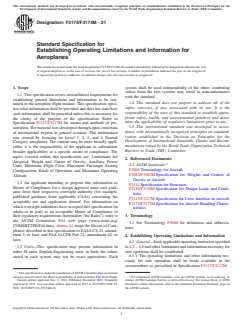
(Specification)Standard Specification for Establishing Operating Limitations and Information for Aeroplanes
General Information
- Abstract
ABSTRACT
This specification prescribes airworthiness design requirements for the establishment of operating limitations and information for the operation of aeroplanes. It addresses the general limitations and information to be contained in the aeroplane flight manual. The applicant for a design approval shall seek the individual guidance of their respective civil aviation authority (CAA) body concerning the use of this specification as part of a certification plan.
The requirements described in this specification cover: airspeed limitations, operating maneuvering speed, flap extended speed, minimum control speed, weight and center of gravity, auxiliary power unit limitations, minimum flight crew, maximum passenger seating configuration, kinds of operation, and maximum operating altitude.
SCOPE
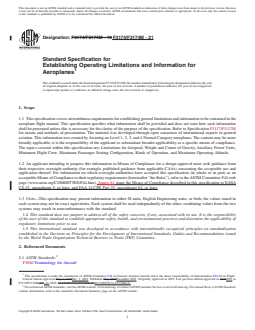
1.1 This specification covers airworthiness requirements for establishing general limitations and information to be contained in the aeroplane flight manual. This specification specifies what information shall be provided and does not state how such information shall be presented unless this is necessary for the clarity of the purpose of the specification. Refer to Specification F3117/F3117M for means and methods of presentation. The material was developed through open consensus of international experts in general aviation. This information was created by focusing on Level 1, 2, 3, and 4 Normal Category aeroplanes. The content may be more broadly applicable; it is the responsibility of the applicant to substantiate broader applicability as a specific means of compliance. The topics covered within this specification are: Limitations for Airspeed, Weight and Center of Gravity, Auxiliary Power Units, Minimum Flight Crew, Maximum Passenger Seating Configuration, Kinds of Operation, and Maximum Operating Altitude.
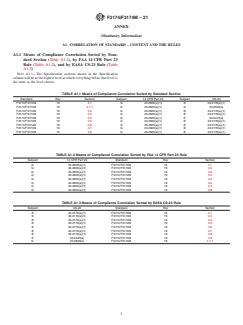
1.2 An applicant intending to propose this information as Means of Compliance for a design approval must seek guidance from their respective oversight authority (for example, published guidance from applicable CAAs) concerning the acceptable use and application thereof. For information on which oversight authorities have accepted this specification (in whole or in part) as an acceptable Means of Compliance to their regulatory requirements (hereinafter “the Rules”), refer to the ASTM Committee F44 web page (www.astm.org/COMMITTEE/F44.htm). Annex A1 maps the Means of Compliance described in this specification to EASA CS-23, amendment 5, or later, and FAA 14 CFR Part 23, amendment 64, or later.
1.3 Units—This specification may present information in either SI units, English Engineering units, or both; the values stated in each system may not be exact equivalents. Each system shall be used independently of the other; combining values from the two systems may result in nonconformance with the standard.
1.4 This standard does not purport to address all of the safety concerns, if any, associated with its use. It is the responsibility of the user of this standard to establish appropriate safety, health, and environmental practices and determine the applicability of regulatory limitations prior to use.
1.5 This international standard was developed in accordance with internationally recognized principles on standardization established in the Decision on Principles for the Development of International Standards, Guides and Recommendations issued by the World Trade Organization Technical Barriers to Trade (TBT) Committee.
- Status
- Published
- Publication Date
- 30-Nov-2021
- Technical Committee
- F44 - General Aviation Aircraft
- Drafting Committee
- F44.20 - Flight
Buy Documents
ASTM F3174/F3174M-21 - Standard Specification for Establishing Operating Limitations and Information for Aeroplanes
REDLINE ASTM F3174/F3174M-21 - Standard Specification for Establishing Operating Limitations and Information for Aeroplanes
Overview
ASTM F3174/F3174M-21 provides a standardized framework for establishing operating limitations and essential information regarding the operation of aeroplanes. Issued by ASTM International, this specification supports airworthiness by outlining the required content for the aeroplane flight manual. It ensures operators, manufacturers, and regulators have clear criteria for aircraft performance and operational boundaries, thus promoting safety and regulatory compliance in general aviation.
ASTM F3174/F3174M-21 primarily applies to Level 1-4 Normal Category aeroplanes, but may be used more broadly as substantiated by the applicant. The specification was developed through international consensus and aligns with regulatory frameworks such as EASA CS-23 and FAA 14 CFR Part 23.
Key Topics
The standard covers critical operating limitations and required information, including:
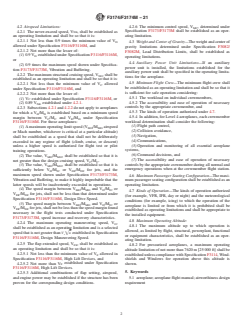
- Airspeed Limitations: Definition of never-exceed speed, maximum structural cruising speed, maximum operating limit speed, operating maneuvering speed, flap extended speed, and minimum control speed.
- Weight and Center of Gravity: Requirements for determining and stating permissible weight and center of gravity ranges.
- Auxiliary Power Unit Limitations: Specification of operational restrictions for auxiliary power units where fitted.
- Minimum Flight Crew: Requirements for establishing the minimum crew necessary for safe operation and factors influencing this determination.
- Maximum Passenger Seating Configuration: Stipulation of allowable seating arrangements as an operating limitation.
- Kinds of Operation: Definition of approved operation types (such as VFR, IFR, day, night) and meteorological conditions.
- Maximum Operating Altitude: Criteria and restrictions for altitude limits, including special considerations for pressurized aircraft.
Applications
ASTM F3174/F3174M-21 is a practical tool for several stakeholders in aviation:
- Aircraft Manufacturers: Provides clear guidelines on the information and limitations required for inclusion in flight manuals, supporting aircraft certification processes.
- Regulatory Authorities: Offers an internationally recognized means of compliance for airworthiness and operational standards, mapped directly to EASA CS-23 and FAA 14 CFR Part 23.
- Design Approval Applicants: Serves as a reference for establishing compliance with relevant rules when seeking civil aviation design approval. Applicants are advised to consult their respective Civil Aviation Authority (CAA) for specific guidance on use and acceptance.
- Aviation Operators: Ensures that aircraft are operated within defined, safe limits as specified in clearly documented flight manuals.
Information provided by this standard supports safe flight operations, efficient certification processes, and international regulatory harmonization.
Related Standards
To achieve full compliance and robust operational documentation, the following ASTM standards are commonly referenced alongside ASTM F3174/F3174M-21:
- ASTM F3060: Terminology for Aircraft
- ASTM F3082/F3082M: Specification for Weights and Centers of Gravity of Aircraft
- ASTM F3114: Specification for Structures
- ASTM F3116/F3116M: Specification for Design Loads and Conditions
- ASTM F3117/F3117M: Specification for Crew Interface in Aircraft
- ASTM F3173/F3173M: Specification for Aircraft Handling Characteristics
Refer to these standards for details on terminology, structural requirements, performance definitions, and methods for presenting information within the flight manual.
Keywords: ASTM F3174/F3174M-21, aeroplane flight manual, airworthiness, operating limitations, airspeed, center of gravity, crew requirements, aircraft certification, aviation safety, general aviation standards.
Relations
- Effective Date
- 01-Oct-2023
- Effective Date
- 01-Jan-2020
- Effective Date
- 01-Nov-2018
- Effective Date
- 01-Nov-2018
- Effective Date
- 01-Sep-2017
- Effective Date
- 01-Nov-2016
- Effective Date
- 01-Apr-2016
- Effective Date
- 01-Feb-2016
- Effective Date
- 01-Dec-2015
- Effective Date
- 01-Nov-2015
- Effective Date
- 15-Sep-2015
- Effective Date
- 01-May-2015
- Effective Date
- 01-May-2015
- Effective Date
- 01-Mar-2015
- Effective Date
- 01-Dec-2014
Buy Documents
ASTM F3174/F3174M-21 - Standard Specification for Establishing Operating Limitations and Information for Aeroplanes
REDLINE ASTM F3174/F3174M-21 - Standard Specification for Establishing Operating Limitations and Information for Aeroplanes
Get Certified
Connect with accredited certification bodies for this standard

BSI Group
BSI (British Standards Institution) is the business standards company that helps organizations make excellence a habit.

Bureau Veritas
Bureau Veritas is a world leader in laboratory testing, inspection and certification services.

DNV
DNV is an independent assurance and risk management provider.
Sponsored listings
Frequently Asked Questions
ASTM F3174/F3174M-21 is a technical specification published by ASTM International. Its full title is "Standard Specification for Establishing Operating Limitations and Information for Aeroplanes". This standard covers: ABSTRACT This specification prescribes airworthiness design requirements for the establishment of operating limitations and information for the operation of aeroplanes. It addresses the general limitations and information to be contained in the aeroplane flight manual. The applicant for a design approval shall seek the individual guidance of their respective civil aviation authority (CAA) body concerning the use of this specification as part of a certification plan. The requirements described in this specification cover: airspeed limitations, operating maneuvering speed, flap extended speed, minimum control speed, weight and center of gravity, auxiliary power unit limitations, minimum flight crew, maximum passenger seating configuration, kinds of operation, and maximum operating altitude. SCOPE 1.1 This specification covers airworthiness requirements for establishing general limitations and information to be contained in the aeroplane flight manual. This specification specifies what information shall be provided and does not state how such information shall be presented unless this is necessary for the clarity of the purpose of the specification. Refer to Specification F3117/F3117M for means and methods of presentation. The material was developed through open consensus of international experts in general aviation. This information was created by focusing on Level 1, 2, 3, and 4 Normal Category aeroplanes. The content may be more broadly applicable; it is the responsibility of the applicant to substantiate broader applicability as a specific means of compliance. The topics covered within this specification are: Limitations for Airspeed, Weight and Center of Gravity, Auxiliary Power Units, Minimum Flight Crew, Maximum Passenger Seating Configuration, Kinds of Operation, and Maximum Operating Altitude. 1.2 An applicant intending to propose this information as Means of Compliance for a design approval must seek guidance from their respective oversight authority (for example, published guidance from applicable CAAs) concerning the acceptable use and application thereof. For information on which oversight authorities have accepted this specification (in whole or in part) as an acceptable Means of Compliance to their regulatory requirements (hereinafter “the Rules”), refer to the ASTM Committee F44 web page (www.astm.org/COMMITTEE/F44.htm). Annex A1 maps the Means of Compliance described in this specification to EASA CS-23, amendment 5, or later, and FAA 14 CFR Part 23, amendment 64, or later. 1.3 Units—This specification may present information in either SI units, English Engineering units, or both; the values stated in each system may not be exact equivalents. Each system shall be used independently of the other; combining values from the two systems may result in nonconformance with the standard. 1.4 This standard does not purport to address all of the safety concerns, if any, associated with its use. It is the responsibility of the user of this standard to establish appropriate safety, health, and environmental practices and determine the applicability of regulatory limitations prior to use. 1.5 This international standard was developed in accordance with internationally recognized principles on standardization established in the Decision on Principles for the Development of International Standards, Guides and Recommendations issued by the World Trade Organization Technical Barriers to Trade (TBT) Committee.
ABSTRACT This specification prescribes airworthiness design requirements for the establishment of operating limitations and information for the operation of aeroplanes. It addresses the general limitations and information to be contained in the aeroplane flight manual. The applicant for a design approval shall seek the individual guidance of their respective civil aviation authority (CAA) body concerning the use of this specification as part of a certification plan. The requirements described in this specification cover: airspeed limitations, operating maneuvering speed, flap extended speed, minimum control speed, weight and center of gravity, auxiliary power unit limitations, minimum flight crew, maximum passenger seating configuration, kinds of operation, and maximum operating altitude. SCOPE 1.1 This specification covers airworthiness requirements for establishing general limitations and information to be contained in the aeroplane flight manual. This specification specifies what information shall be provided and does not state how such information shall be presented unless this is necessary for the clarity of the purpose of the specification. Refer to Specification F3117/F3117M for means and methods of presentation. The material was developed through open consensus of international experts in general aviation. This information was created by focusing on Level 1, 2, 3, and 4 Normal Category aeroplanes. The content may be more broadly applicable; it is the responsibility of the applicant to substantiate broader applicability as a specific means of compliance. The topics covered within this specification are: Limitations for Airspeed, Weight and Center of Gravity, Auxiliary Power Units, Minimum Flight Crew, Maximum Passenger Seating Configuration, Kinds of Operation, and Maximum Operating Altitude. 1.2 An applicant intending to propose this information as Means of Compliance for a design approval must seek guidance from their respective oversight authority (for example, published guidance from applicable CAAs) concerning the acceptable use and application thereof. For information on which oversight authorities have accepted this specification (in whole or in part) as an acceptable Means of Compliance to their regulatory requirements (hereinafter “the Rules”), refer to the ASTM Committee F44 web page (www.astm.org/COMMITTEE/F44.htm). Annex A1 maps the Means of Compliance described in this specification to EASA CS-23, amendment 5, or later, and FAA 14 CFR Part 23, amendment 64, or later. 1.3 Units—This specification may present information in either SI units, English Engineering units, or both; the values stated in each system may not be exact equivalents. Each system shall be used independently of the other; combining values from the two systems may result in nonconformance with the standard. 1.4 This standard does not purport to address all of the safety concerns, if any, associated with its use. It is the responsibility of the user of this standard to establish appropriate safety, health, and environmental practices and determine the applicability of regulatory limitations prior to use. 1.5 This international standard was developed in accordance with internationally recognized principles on standardization established in the Decision on Principles for the Development of International Standards, Guides and Recommendations issued by the World Trade Organization Technical Barriers to Trade (TBT) Committee.
ASTM F3174/F3174M-21 is classified under the following ICS (International Classification for Standards) categories: 49.020 - Aircraft and space vehicles in general. The ICS classification helps identify the subject area and facilitates finding related standards.
ASTM F3174/F3174M-21 has the following relationships with other standards: It is inter standard links to ASTM F3116/F3116M-23a, ASTM F3060-20, ASTM F3116/F3116M-18, ASTM F3117/F3117M-18c, ASTM F3173/F3173M-17, ASTM F3060-16a, ASTM F3060-16, ASTM F3082/F3082M-16, ASTM F3173/F3173M-15, ASTM F3114-15, ASTM F3060-15b, ASTM F3116/F3116M-15, ASTM F3060-15a, ASTM F3060-15, ASTM F3060-14. Understanding these relationships helps ensure you are using the most current and applicable version of the standard.
ASTM F3174/F3174M-21 is available in PDF format for immediate download after purchase. The document can be added to your cart and obtained through the secure checkout process. Digital delivery ensures instant access to the complete standard document.
Standards Content (Sample)
This international standard was developed in accordance with internationally recognized principles on standardization established in the Decision on Principles for the
Development of International Standards, Guides and Recommendations issued by the World Trade Organization Technical Barriers to Trade (TBT) Committee.
Designation: F3174/F3174M −21
Standard Specification for
Establishing Operating Limitations and Information for
Aeroplanes
ThisstandardisissuedunderthefixeddesignationF3174/F3174M;thenumberimmediatelyfollowingthedesignationindicatestheyear
of original adoption or, in the case of revision, the year of last revision. A number in parentheses indicates the year of last reapproval.
A superscript epsilon (´) indicates an editorial change since the last revision or reapproval.
1. Scope system shall be used independently of the other; combining
values from the two systems may result in nonconformance
1.1 This specification covers airworthiness requirements for
with the standard.
establishing general limitations and information to be con-
1.4 This standard does not purport to address all of the
tained in the aeroplane flight manual. This specification speci-
safety concerns, if any, associated with its use. It is the
fies what information shall be provided and does not state how
responsibility of the user of this standard to establish appro-
such information shall be presented unless this is necessary for
priate safety, health, and environmental practices and deter-
the clarity of the purpose of the specification. Refer to
mine the applicability of regulatory limitations prior to use.
Specification F3117/F3117M for means and methods of pre-
1.5 This international standard was developed in accor-
sentation.The material was developed through open consensus
dance with internationally recognized principles on standard-
of international experts in general aviation. This information
ization established in the Decision on Principles for the
was created by focusing on Level 1, 2, 3, and 4 Normal
Development of International Standards, Guides and Recom-
Category aeroplanes. The content may be more broadly appli-
mendations issued by the World Trade Organization Technical
cable; it is the responsibility of the applicant to substantiate
Barriers to Trade (TBT) Committee.
broader applicability as a specific means of compliance. The
topics covered within this specification are: Limitations for
2. Referenced Documents
Airspeed, Weight and Center of Gravity, Auxiliary Power
2.1 ASTM Standards:
Units, Minimum Flight Crew, Maximum Passenger Seating
F3060 Terminology for Aircraft
Configuration, Kinds of Operation, and Maximum Operating
F3082/F3082M Specification for Weights and Centers of
Altitude.
Gravity of Aircraft
1.2 An applicant intending to propose this information as
F3114 Specification for Structures
Means of Compliance for a design approval must seek guid-
F3116/F3116M Specification for Design Loads and Condi-
ance from their respective oversight authority (for example,
tions
published guidance from applicable CAAs) concerning the
F3117/F3117M Specification for Crew Interface in Aircraft
acceptable use and application thereof. For information on
F3173/F3173M Specification for Aircraft Handling Charac-
which oversight authorities have accepted this specification (in
teristics
whole or in part) as an acceptable Means of Compliance to
their regulatory requirements (hereinafter “the Rules”), refer to 3. Terminology
the ASTM Committee F44 web page (www.astm.org/
3.1 See Terminology F3060 for definitions and abbrevia-
COMMITTEE/F44.htm). Annex A1 maps the Means of Com-
tions.
pliance described in this specification to EASACS-23, amend-
ment 5, or later, and FAA 14 CFR Part 23, amendment 64, or 4. Establishing Operating Limitations and Information
later.
4.1 General—Each applicable operating limitation specified
in 4.2 – 4.8 and other limitations and information necessary for
1.3 Units—This specification may present information in
safe operation shall be established.
either SI units, English Engineering units, or both; the values
4.1.1 The operating limitations and other information nec-
stated in each system may not be exact equivalents. Each
essary for safe operation shall be made available to the
crewmembers as prescribed in Specification F3117/F3117M.
ThisspecificationisunderthejurisdictionofASTMCommitteeF44onGeneral
AviationAircraft and is the direct responsibility of Subcommittee F44.20 on Flight. For referenced ASTM standards, visit the ASTM website, www.astm.org, or
Current edition approved Dec. 1, 2021. Published December 2021. Originally contact ASTM Customer Service at service@astm.org. For Annual Book of ASTM
approved in 2015. Last previous edition approved in 2019 as F3174/F3174M–19. Standards volume information, refer to the standard’s Document Summary page on
DOI: 10.1520/F3174_F3174M-21. the ASTM website.
Copyright © ASTM International, 100 Barr Harbor Drive, PO Box C700, West Conshohocken, PA 19428-2959. United States
F3174/F3174M − 21
4.2 Airspeed Limitations: 4.2.6 The minimum control speed, V , determined under
MC
4.2.1 The never-exceed speed, V , shall be established as Specification F3173/F3173M shall be established as an oper-
NE
an operating limitation and shall be so that it is: ating limitation.
4.2.1.1 Not less than 0.9 times the minimum value of V
D
4.3 Weight and Center of Gravity—Theweightandcenterof
allowed under Specification F3116/F3116M, and
gravity limitations determined under Specification F3082/
4.2.1.2 Not more than the lesser of:
F3082M, Load Distribution Limits, shall be established as
(1) 0.9 V established under Specification F3116/F3116M,
D
operating limitations.
or
4.4 Auxiliary Power Unit Limitations—If an auxiliary
(2) 0.9 times the maximum speed shown under Specifica-
power unit is installed, the limitations established for the
tion F3173/F3173M, Vibration and Buffering.
auxiliary power unit shall be specified in the operating limita-
4.2.2 The maximum structural cruising speed,V , shall be
NO
tions for the aeroplane.
established as an operating limitation and shall be so that it is:
4.5 Minimum Flight Crew—The minimum flight crew shall
4.2.2.1 Not less than the minimum value of V allowed
C
be established as an operating limitation and shall be so that it
under Specification F3116/F3116M, and
is sufficient for safe operation considering:
4.2.2.2 Not more than the lesser of:
4.5.1 The workload on individual crewmembers,
(1) V established under Specification F3116/F3116M,or
C
4.5.2 The accessibility and ease of operation of necessary
(2) 0.89 V established under 4.2.1.
NE
controls by the appropriate crewmember, and
4.2.3 Subsections 4.2.1 and 4.2.2 do not apply to aeroplanes
4.5.3 The kinds of operation authorized under 4.7.
for which a V /M is established based on a minimum speed
D D
4.5.4 In addition, for Level 4 aeroplanes, each crewmember
margin between V /M and V /M under Specification
C C D D
workload determination shall consider the following:
F3116/F3116M. For those aeroplanes:
(1) Flight path control,
(1) Amaximum operating limit speed (V /M airspeed
MO MO
(2) Collision avoidance,
or Mach number, whichever is critical at a particular altitude)
(3) Navigation,
shall be established as a speed that shall not be deliberately
(4) Communications,
exceeded in any regime of flight (climb, cruise, or descent)
(5) Operation and monitoring of all essential aeroplane
unless a higher speed is authorized for flight test or pilot
systems,
training operations.
(6) Command decisions, and
(2) The value, V /M , shall be established so that it is
MO MO
(7) The accessibility and ease of operation of necessary
not greater than the design cruising speed, V /M .
C C
controls by the appropriate crewmember during all normal and
(3) The value, V /M , shall be established so that it is
MO MO
emergency operations when at the crewmember flight station.
sufficiently below V /M,or V /M for jets, and the
D D DF DF
maximum speed shown under Specification F3173/F3173M,
4.6 Maximum Passenger Seating Configuration—The maxi-
Vibration and Buffeting, to make it highly improbable that the
mum passenger seating configuration shall be established as an
latter speeds will be inadvertently exceeded in operations.
operating limitation.
(4) The speed margin between V /M and V /M ,or
MO MO D D
4.7 Kinds of Operation—The kinds of operation authorized
V /M for jets, shall not be less than that determined under
DF DF
(for example, VFR, IFR, day or night) and the meteorological
Specification F3116/F3116M, Design Dive Speed.
conditions (for example, icing) to which the operation of the
(5) The speed margin between V /M and V /M ,or
MO MO D D
aeroplane is limited or from which it is prohibited shall be
V /M for jets, shall not be less than the speed margin found
DF DF
established as operating limitations and shall be appropriate to
necessary in the flight tests conducted under Specification
the installed equipment.
F3173/F3173M, speed increase and recovery characteristics.
4.8 Maximum Operating Altitude:
4.2.4 The maximum operating maneuvering speed, V ,
O
4.8.1 The maximum altitude up to which operation is
shall be established as an operating limitation and is a selected
allowed, as limited by flight, structural, powerplant, functional
speed that is not greater than V =n established in
...
This document is not an ASTM standard and is intended only to provide the user of an ASTM standard an indication of what changes have been made to the previous version. Because
it may not be technically possible to adequately depict all changes accurately, ASTM recommends that users consult prior editions as appropriate. In all cases only the current version
of the standard as published by ASTM is to be considered the official document.
Designation: F3174/F3174M − 19 F3174/F3174M − 21
Standard Specification for
Establishing Operating Limitations and Information for
Aeroplanes
This standard is issued under the fixed designation F3174/F3174M; the number immediately following the designation indicates the year
of original adoption or, in the case of revision, the year of last revision. A number in parentheses indicates the year of last reapproval.
A superscript epsilon (´) indicates an editorial change since the last revision or reapproval.
1. Scope
1.1 This specification covers airworthiness requirements for establishing general limitations and information to be contained in the
aeroplane flight manual. This specification specifies what information shall be provided and does not state how such information
shall be presented unless this is necessary for the clarity of the purpose of the specification. Refer to Specification F3117/F3117M
for means and methods of presentation. The material was developed through open consensus of international experts in general
aviation. This information was created by focusing on Level 1, 2, 3, and 4 Normal Category aeroplanes. The content may be more
broadly applicable; it is the responsibility of the applicant to substantiate broader applicability as a specific means of compliance.
The topics covered within this specification are: Limitations for Airspeed, Weight and Center of Gravity, Auxiliary Power Units,
Minimum Flight Crew, Maximum Passenger Seating Configuration, Kinds of Operation, and Maximum Operating Altitude.
1.2 An applicant intending to propose this information as Means of Compliance for a design approval must seek guidance from
their respective oversight authority (for example, published guidance from applicable CAAs) concerning the acceptable use and
application thereof. For information on which oversight authorities have accepted this specification (in whole or in part) as an
acceptable Means of Compliance to their regulatory requirements (hereinafter “the Rules”), refer to the ASTM Committee F44 web
page (www.astm.org/COMMITTEE/F44.htm). Annex A1 maps the Means of Compliance described in this specification to EASA
CS-23, amendment 5, or later, and FAA 14 CFR Part 23, amendment 64, or later.
1.3 Units—This specification may present information in either SI units, English Engineering units, or both; the values stated in
each system may not be exact equivalents. Each system shall be used independently of the other; combining values from the two
systems may result in nonconformance with the standard.
1.4 This standard does not purport to address all of the safety concerns, if any, associated with its use. It is the responsibility
of the user of this standard to establish appropriate safety, health, and environmental practices and determine the applicability of
regulatory limitations prior to use.
1.5 This international standard was developed in accordance with internationally recognized principles on standardization
established in the Decision on Principles for the Development of International Standards, Guides and Recommendations issued
by the World Trade Organization Technical Barriers to Trade (TBT) Committee.
2. Referenced Documents
2.1 ASTM Standards:
F3060 Terminology for Aircraft
This specification is under the jurisdiction of ASTM Committee F44 on General Aviation Aircraft and is the direct responsibility of Subcommittee F44.20 on Flight.
Current edition approved May 1, 2019Dec. 1, 2021. Published May 2019December 2021. Originally approved in 2015. Last previous edition approved in 20182019 as
F3174/F3174M–18.–19. DOI: 10.1520/F3174_F3174M–19.10.1520/F3174_F3174M-21.
For referenced ASTM standards, visit the ASTM website, www.astm.org, or contact ASTM Customer Service at service@astm.org. For Annual Book of ASTM Standards
volume information, refer to the standard’s Document Summary page on the ASTM website.
Copyright © ASTM International, 100 Barr Harbor Drive, PO Box C700, West Conshohocken, PA 19428-2959. United States
F3174/F3174M − 21
F3082/F3082M Specification for Weights and Centers of Gravity of Aircraft
F3114 Specification for Structures
F3116/F3116M Specification for Design Loads and Conditions
F3117/F3117M Specification for Crew Interface in Aircraft
F3173/F3173M Specification for Aircraft Handling Characteristics
3. Terminology
3.1 See Terminology F3060 for definitions and abbreviations.
4. Establishing Operating Limitations and Information
4.1 General—Each applicable operating limitation specified in 4.2 – 4.8 and other limitations and information necessary for safe
operation shall be established.
4.1.1 The operating limitations and other information necessary for safe operation shall be made available to the crewmembers
as prescribed in Specification F3117/F3117M.
F3174/F3174M − 21
4.2 Airspeed Limitations:
4.2.1 The never-exceed speed, V , shall be established as an operating limitation and shall be so that it is:
NE
4.2.1.1 Not less than 0.9 times the minimum value of V allowed under Specification F3116/F3116M, and
D
4.2.1.2 Not more than the lesser of:
(1) 0.9 V established under Specification F3116/F3116M, or
D
(2) 0.9 times the maximum speed shown under Specification F3173/F3173M, Vibration and Buffering.
4.2.2 The maximum structural cruising speed, V , shall be established as an operating limitation and shall be so that it is:
NO
4.2.2.1 Not less than the minimum value of V allowed under Specification F3116/F3116M, and
C
4.2.2.2 Not more than the lesser of:
(1) V established under Specification F3116/F3116M, or
C
(2) 0.89 V established under 4.2.1.
NE
4.2.3 Subsections 4.2.1 and 4.2.2 do not apply to aeroplanes for which a V /M is established based on a minimum speed margin
D D
between V /M and V /M under Specification F3116/F3116M. For those aeroplanes:
C C D D
(1) A maximum operating limit speed (V /M airspeed or Mach number, whichever is critical at a particular altitude) shall
MO MO
be established as a speed that shall not be deliberately exceeded in any regime of flight (climb, cruise, or descent) unless a higher
speed is authorized for flight test or pilot training operations.
(2) The value, V /M , shall be established so that it is not greater than the design cruising speed, V /M .
MO MO C C
(3) The value, V /M , shall be established so that it is sufficiently below V /M , or V /M for jets, and the maximum
MO MO D D DF DF
speed shown under Specification F3173/F3173M, Vibration and Buffeting, to make it highly improbable that the latter speeds will
be inadvertently exceeded in operations.
(4) The speed margin between V /M and V /M , or V /M for jets, shall not be less than that determined under
MO MO D D DF DF
Specification F3116/F3116M, Design Dive Speed.
(5) The speed margin between V /M and V /M , or V /M for jets, shall not be less than the speed margin found
MO MO D D DF DF
necessary in the flight tests conducted under Specification F3173/F3173M, speed increase and recovery characteristics.
4.2.4 The maximum operating maneuvering speed, V , shall be established as an operating limitation and is a selected speed that
O
=
is not greater than V n established in Specification F3116/F3116M, Design Maneuvering Speed.
s
4.2.5 The flap extended speed, V , shall be established as an operating limitation and shall be so that it is:
FE
4.2.5.1 Not less than the minimum value of V allowed in Specification F3116/F3116M, High Lift Devices, and
F
4.2.5.2 Not more than V established under Specification F3116/F3116M, High Lift Devices.
F
4.2.5.3 Additional combinations of flap setting, airspeed, and engine power may be established if the structure has been proven
for the corresponding design conditions.
4.2.6 The minimum control speed, V , determined under Specification F3173/F3173M shall be established as an operating
MC
limitation.
4.3 Weight and Center of Gravity—The weight and center of gravity limitations determined under Specification F3082/F3082M,
Load Distribution Limits, shall be established as operating limitations.
4.4 Auxiliary Power Unit Limitations—If an auxiliary power unit is installed, the limitations established for the auxiliary power
unit shall be specified in the operating limitations for the aeroplane.
4.5 Minimum Flight Crew—The minimum flight crew shall be established as an operating limitation and shall be so that it is
sufficient for safe operation considering:
F3174/F3174M − 21
4.5.1 The workload on individual crewmembers,
4.5.2 The accessibility and ease of operation of necessary controls by the appropriate crewmember, and
4.5.3 The kinds of operation authorized under 4.7.
4.5.4 In addition, for Level 4 aeroplanes, each crewmember workload determination shall consider the following:
(1) Flight path control,
(2) Collision avoidance,
(3) Navigation,
(4) Communications,
(5) Operation and monitoring of all essential aeroplane systems,
(6) Command decisions, and
(7) The accessibility and ease of operation of necessary controls by the appropriate crewmember during all normal and
emergency operation
...