


ASTM E1282-11(2016)
(Guide)Standard Guide for Specifying the Chemical Compositions and Selecting Sampling Practices and Quantitative Analysis Methods for Metals, Ores, and Related Materials
Standard Guide for Specifying the Chemical Compositions and Selecting Sampling Practices and Quantitative Analysis Methods for Metals, Ores, and Related Materials
SIGNIFICANCE AND USE
4.1 This guide is intended to assist those writing or revising compositional specifications, sampling practices, and test methods for ferrous and non-ferrous metals, ores, and related materials. It is directed toward those areas that must be addressed to properly coordinate compositional specification, sampling practice, and test methods. Its use will help ensure that compositional requirements are clearly defined and that sampling practices and test methods are available to meet product specifications.
4.2 This guide does not attempt to define which elements should be controlled, where samples should be taken, or how they should be analyzed. These items are addressed in standards such as Specification A276, Methods, Practices and Terminology A751, Test Method E34, Practice E255, Test Method E342, and Test Methods E350.
4.3 A primary purpose for ASTM sampling practices and test methods is to provide widely-accepted and tested methodology for use in meeting ASTM product specifications. Although it is recognized that individual laboratories are free to use other methods, the availability of ASTM approved methodology is essential for referee purposes and to demonstrate that properly equipped laboratories can make the required measurements.
4.4 Sampling practices and test methods to be recommended for use in testing a given product are most easily selected cooperatively by the specification-writing and the methods-writing committees that have jurisdiction over the product. When existing sampling or test methods do not meet the needs of the new product specification standard, the specification-writing committee should request that the methods-writing committee develop the required standards. ASTM Committee E01 is responsible for test methods and practices covering the sampling and analysis of most metals, ores, and related materials.
SCOPE
1.1 This guide covers procedures for specifying compositional requirements and identifying appropriate sampling and quantitative analysis test methods to be referenced in product specification standards for metals, ores, and related materials. It is not intended to replace or conflict with either individual product specifications or standards covering broad classifications of products such as Test Methods A751.
1.2 This standard does not purport to address all of the safety concerns, if any, associated with its use. It is the responsibility of the user of this standard to establish appropriate safety and health practices and determine the applicability of regulatory limitations prior to use.
General Information
Buy Standard
Standards Content (Sample)
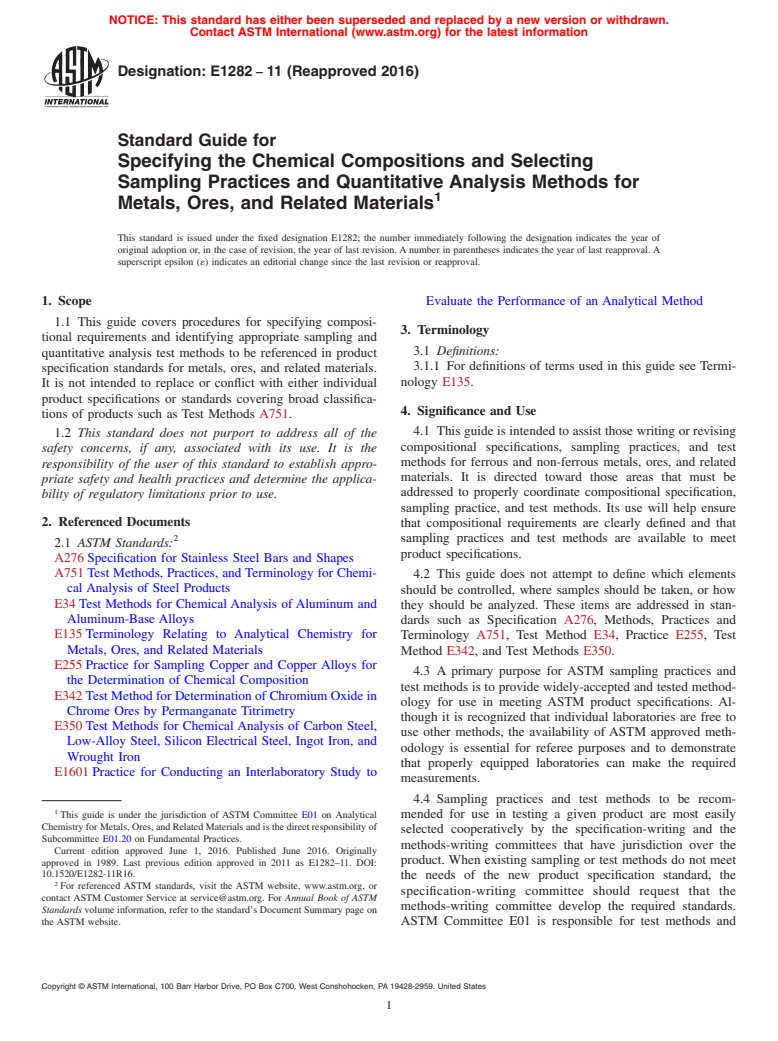
NOTICE: This standard has either been superseded and replaced by a new version or withdrawn.
Contact ASTM International (www.astm.org) for the latest information
Designation: E1282 − 11 (Reapproved 2016)
Standard Guide for
Specifying the Chemical Compositions and Selecting
Sampling Practices and Quantitative Analysis Methods for
Metals, Ores, and Related Materials
This standard is issued under the fixed designation E1282; the number immediately following the designation indicates the year of
original adoption or, in the case of revision, the year of last revision. A number in parentheses indicates the year of last reapproval. A
superscript epsilon (´) indicates an editorial change since the last revision or reapproval.
1. Scope Evaluate the Performance of an Analytical Method
1.1 This guide covers procedures for specifying composi-
3. Terminology
tional requirements and identifying appropriate sampling and
3.1 Definitions:
quantitative analysis test methods to be referenced in product
3.1.1 For definitions of terms used in this guide see Termi-
specification standards for metals, ores, and related materials.
nology E135.
It is not intended to replace or conflict with either individual
product specifications or standards covering broad classifica-
4. Significance and Use
tions of products such as Test Methods A751.
4.1 This guide is intended to assist those writing or revising
1.2 This standard does not purport to address all of the
compositional specifications, sampling practices, and test
safety concerns, if any, associated with its use. It is the
methods for ferrous and non-ferrous metals, ores, and related
responsibility of the user of this standard to establish appro-
materials. It is directed toward those areas that must be
priate safety and health practices and determine the applica-
addressed to properly coordinate compositional specification,
bility of regulatory limitations prior to use.
sampling practice, and test methods. Its use will help ensure
2. Referenced Documents that compositional requirements are clearly defined and that
sampling practices and test methods are available to meet
2.1 ASTM Standards:
product specifications.
A276 Specification for Stainless Steel Bars and Shapes
A751 Test Methods, Practices, and Terminology for Chemi-
4.2 This guide does not attempt to define which elements
cal Analysis of Steel Products
should be controlled, where samples should be taken, or how
E34 Test Methods for Chemical Analysis of Aluminum and
they should be analyzed. These items are addressed in stan-
Aluminum-Base Alloys
dards such as Specification A276, Methods, Practices and
E135 Terminology Relating to Analytical Chemistry for
Terminology A751, Test Method E34, Practice E255, Test
Metals, Ores, and Related Materials
Method E342, and Test Methods E350.
E255 Practice for Sampling Copper and Copper Alloys for
4.3 A primary purpose for ASTM sampling practices and
the Determination of Chemical Composition
test methods is to provide widely-accepted and tested method-
E342 Test Method for Determination of Chromium Oxide in
ology for use in meeting ASTM product specifications. Al-
Chrome Ores by Permanganate Titrimetry
though it is recognized that individual laboratories are free to
E350 Test Methods for Chemical Analysis of Carbon Steel,
use other methods, the availability of ASTM approved meth-
Low-Alloy Steel, Silicon Electrical Steel, Ingot Iron, and
odology is essential for referee purposes and to demonstrate
Wrought Iron
that properly equipped laboratories can make the required
E1601 Practice for Conducting an Interlaboratory Study to
measurements.
4.4 Sampling practices and test methods to be recom-
This guide is under the jurisdiction of ASTM Committee E01 on Analytical
mended for use in testing a given product are most easily
Chemistry for Metals, Ores, and Related Materials and is the direct responsibility of
selected cooperatively by the specification-writing and the
Subcommittee E01.20 on Fundamental Practices.
methods-writing committees that have jurisdiction over the
Current edition approved June 1, 2016. Published June 2016. Originally
product. When existing sampling or test methods do not meet
approved in 1989. Last previous edition approved in 2011 as E1282–11. DOI:
10.1520/E1282-11R16.
the needs of the new product specification standard, the
For referenced ASTM standards, visit the ASTM website, www.astm.org, or
specification-writing committee should request that the
contact ASTM Customer Service at service@astm.org. For Annual Book of ASTM
methods-writing committee develop the required standards.
Standards volume information, refer to the standard’s Document Summary page on
the ASTM website. ASTM Committee E01 is responsible for test methods and
Copyright © ASTM International, 100 Barr Harbor Drive, PO Box C700, West Conshohocken, PA 19428-2959. United States
E1282 − 11 (2016)
practices covering the sampling and analysis of most metals, 5.2.3 If compositional requirements differ among various
ores, and related materials. applications for a given alloy, it may be necessary to specify
composition by application within a grade, or to create a
5. Procedure
separate grade for those applications.
5.2.4 RefertoTable1asanexampleofapossibleformatfor
5.1 Listthoseelementswhicheitherpositivelyornegatively
influence the product’s processing, properties, or performance. presenting compositional specifications.
Do not list elements for which no justification exists for
5.3 Identify standard sampling practices that can be used at
exercising compositional control or for which no test methods
each processing step or for each product form for which
exist. Nonessential compositional specifications increase test-
compositional requirements are identified as described below.
ing costs with no benefit to producer or consumer.
5.3.1 Ensure that each selected sampling practice can be
conducted without unacceptably interrupting production, inter-
5.2 Establish the compositional requirements for each ele-
ment identified in 5.1 as a composition range, a maximum or a fering with product quality, or risking the health or safety of
employees.
minimum. Where possible, it is desirable to express composi-
tion in mass fraction percent. Always list the element in the 5.3.2 Ensure that the selected sampling hardware and prac-
stoichiometric form in which the composition is to be reported. tices are reliable. For example, in heat analysis sampling,
For example, depending on the material, calcium might be ensure that the ratio of successful (solid, non-porous, com-
specified and reported as Ca, CaCO , or CaO. Occasionally, it pletely filled mold) to unsuccessful samplings is acceptable.
may be necessary to specify that the sum of a limited number Also, provision should be made for resampling when needed.
of specific element compositions must not exceed some maxi-
5.3.3 Ensure that the composition of each element to be
mum value or must remain above some minimum value. determined in the sample is representative of the bulk material.
Ensure that measurement uncertainties, particularly at the
For example, many commercially available molten-metal sam-
lower quantitation limits, do not contribute significantly to pling devices used in the steel industry contain deoxidizing
calculated sums. elements, such as aluminum, which alloy with th
...
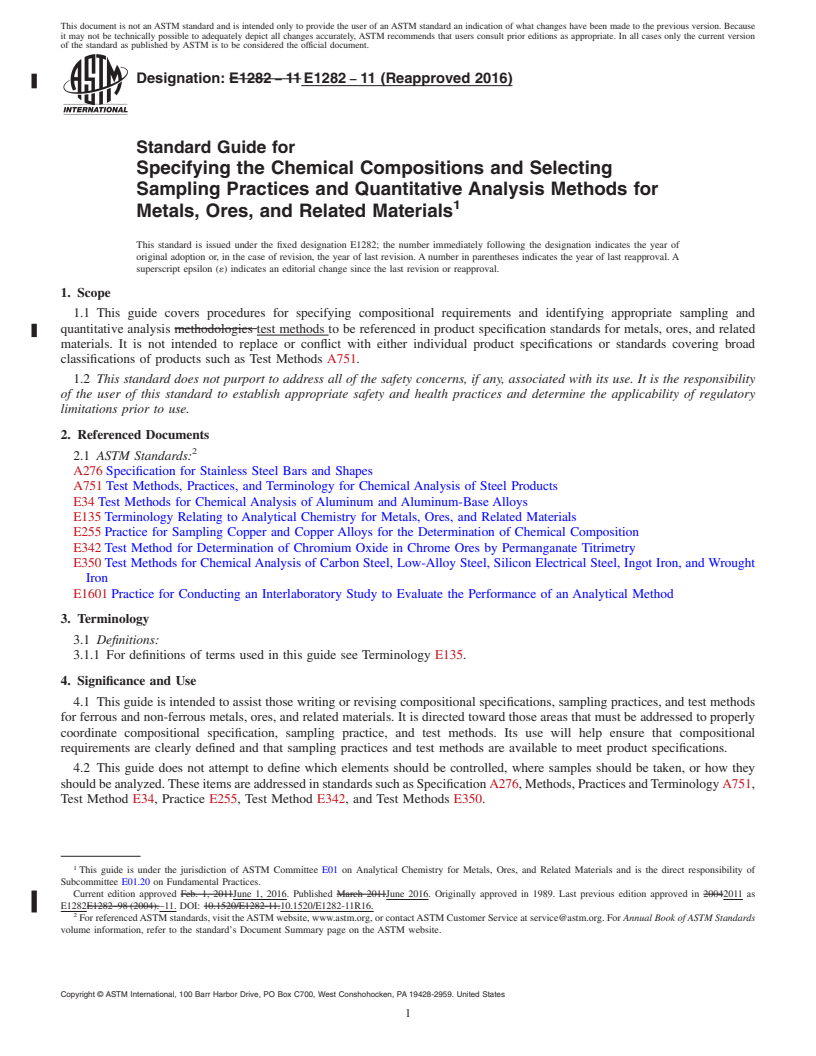
This document is not an ASTM standard and is intended only to provide the user of an ASTM standard an indication of what changes have been made to the previous version. Because
it may not be technically possible to adequately depict all changes accurately, ASTM recommends that users consult prior editions as appropriate. In all cases only the current version
of the standard as published by ASTM is to be considered the official document.
Designation: E1282 − 11 E1282 − 11 (Reapproved 2016)
Standard Guide for
Specifying the Chemical Compositions and Selecting
Sampling Practices and Quantitative Analysis Methods for
Metals, Ores, and Related Materials
This standard is issued under the fixed designation E1282; the number immediately following the designation indicates the year of
original adoption or, in the case of revision, the year of last revision. A number in parentheses indicates the year of last reapproval. A
superscript epsilon (´) indicates an editorial change since the last revision or reapproval.
1. Scope
1.1 This guide covers procedures for specifying compositional requirements and identifying appropriate sampling and
quantitative analysis methodologies test methods to be referenced in product specification standards for metals, ores, and related
materials. It is not intended to replace or conflict with either individual product specifications or standards covering broad
classifications of products such as Test Methods A751.
1.2 This standard does not purport to address all of the safety concerns, if any, associated with its use. It is the responsibility
of the user of this standard to establish appropriate safety and health practices and determine the applicability of regulatory
limitations prior to use.
2. Referenced Documents
2.1 ASTM Standards:
A276 Specification for Stainless Steel Bars and Shapes
A751 Test Methods, Practices, and Terminology for Chemical Analysis of Steel Products
E34 Test Methods for Chemical Analysis of Aluminum and Aluminum-Base Alloys
E135 Terminology Relating to Analytical Chemistry for Metals, Ores, and Related Materials
E255 Practice for Sampling Copper and Copper Alloys for the Determination of Chemical Composition
E342 Test Method for Determination of Chromium Oxide in Chrome Ores by Permanganate Titrimetry
E350 Test Methods for Chemical Analysis of Carbon Steel, Low-Alloy Steel, Silicon Electrical Steel, Ingot Iron, and Wrought
Iron
E1601 Practice for Conducting an Interlaboratory Study to Evaluate the Performance of an Analytical Method
3. Terminology
3.1 Definitions:
3.1.1 For definitions of terms used in this guide see Terminology E135.
4. Significance and Use
4.1 This guide is intended to assist those writing or revising compositional specifications, sampling practices, and test methods
for ferrous and non-ferrous metals, ores, and related materials. It is directed toward those areas that must be addressed to properly
coordinate compositional specification, sampling practice, and test methods. Its use will help ensure that compositional
requirements are clearly defined and that sampling practices and test methods are available to meet product specifications.
4.2 This guide does not attempt to define which elements should be controlled, where samples should be taken, or how they
should be analyzed. These items are addressed in standards such as Specification A276, Methods, Practices and Terminology A751,
Test Method E34, Practice E255, Test Method E342, and Test Methods E350.
This guide is under the jurisdiction of ASTM Committee E01 on Analytical Chemistry for Metals, Ores, and Related Materials and is the direct responsibility of
Subcommittee E01.20 on Fundamental Practices.
Current edition approved Feb. 1, 2011June 1, 2016. Published March 2011June 2016. Originally approved in 1989. Last previous edition approved in 20042011 as
E1282E1282–98 (2004).–11. DOI: 10.1520/E1282-11.10.1520/E1282-11R16.
For referenced ASTM standards, visit the ASTM website, www.astm.org, or contact ASTM Customer Service at service@astm.org. For Annual Book of ASTM Standards
volume information, refer to the standard’s Document Summary page on the ASTM website.
Copyright © ASTM International, 100 Barr Harbor Drive, PO Box C700, West Conshohocken, PA 19428-2959. United States
E1282 − 11 (2016)
4.3 A primary purpose for ASTM sampling practices and test methods is to provide widely-accepted and tested methodology
for use in meeting ASTM product specifications. Although it is recognized that individual laboratories are free to use other
methods, the availability of ASTM approved methodology is essential for referee purposes and to demonstrate that properly
equipped laboratories can make the required measurements.
4.4 Sampling practices and test methods to be recommended for use in testing a given product are most easily selected
cooperatively by the specification-writing and the methods-writing committees that have jurisdiction over the product. When
existing sampling or test methods do not meet the needs of the new product specification standard, the specification-writing
committee should request that the methods-writing committee develop the required standards. ASTM Committee E01 is
responsible for test methods and practices covering the sampling and analysis of most metals, ores, and related materials.
5. Procedure
5.1 List those elements which either positively or negatively influence the product’s processing, properties, or performance. Do
not list elements for which no justification exists for exercising compositional control or for which no test methods exist.
Nonessential compositional specifications increase testing costs with no benefit to producer or consumer.
5.2 Establish the compositional requirements for each element identified in 5.1 as a concentrationcomposition range, a
maximum or a minimum. Where possible, it is desirable to express concentrationscomposition in mass fraction percent. Always
list the element in the stoichiometric form in which the composition is to be reported. For example, depending on the material,
calcium might be specified and reported as Ca, CaCO , or CaO. Occasionally, it may be necessary to specify that the sum of a
limited number of specific element concentrationscompositions must not exceed some maximum value or must remain above some
minimum value. Ensure that measurement uncertainties, particularly at the lower quantitation limits, do not contribute significantly
to calculated sums.
5.2.1 Nonspecific phrases such as balance or remainder may be listed for informational purposes only, but must have an
accompanying footnote stating that quantitative measurement is not required. An example of an acceptable footnote is: “For
information only. Quantitative determination of this element is not required.” Avoid assigning quantitative compositional
specifications to nonspecific items such as “all other elements” or “all residuals.” It is not possible to use element-specific test
methods to meet a non-element-specific compositional specification (Note 1).
NOTE 1—The purity of high purity metals is often best ascertained by the determination of residual elements. In these cases, each element to be
determined must be listed with either a maximum concentrationcomposition for each element or a minimum concentrationcomposition for the sum of
the listed determinations. See Table 1.
5.2.2 When specifying the composition of components in a composite, define the components consistent with both commercial
requirements and testing capabilities. For example, if a specification requires that both the coating and base metal be analyzed
separately, ensure that
...
Questions, Comments and Discussion
Ask us and Technical Secretary will try to provide an answer. You can facilitate discussion about the standard in here.