

ASTM A1032-15(2019)
(Test Method)Standard Test Method for Hydrogen Embrittlement Resistance for Steel Wire Hard-Drawn Used for Prestressed Concrete Pipe
General Information
- Abstract
SIGNIFICANCE AND USE
4.1 Hard-drawn steel wire as used in prestressed concrete pipe may be exposed to elemental hydrogen favorable to hydrogen induced embrittlement and cracking. Resistance to hydrogen embrittlement is necessary for prestressing wire to provide long-term performance to installed pipe.
4.2 The length of time that a stressed wire specimen resists failure while exposed to a heated solution of NH4SCN, is an indication of the specimen's resistance to hydrogen embrittlement.
SCOPE
1.1 This test method describes procedures to determine the hydrogen embrittlement (HE) resistance of hard-drawn steel wire used for prestressed concrete pipe.
1.2 HE resistance is reported as time-to-failure of specimens tested in a laboratory.
1.3 The values stated in SI units are to be regarded as standard. The values given in parentheses after SI units are provided for information only and are not considered standard.
1.4 This standard does not purport to address all of the safety concerns, if any, associated with its use. It is the responsibility of the user of this standard to establish appropriate safety, health, and environmental practices and determine the applicability of regulatory limitations prior to use.
1.5 This international standard was developed in accordance with internationally recognized principles on standardization established in the Decision on Principles for the Development of International Standards, Guides and Recommendations issued by the World Trade Organization Technical Barriers to Trade (TBT) Committee.
- Status
- Published
- Publication Date
- 31-Oct-2019
- Technical Committee
- A01 - Steel, Stainless Steel and Related Alloys
- Drafting Committee
- A01.05 - Steel Reinforcement


Overview
ASTM A1032-15(2019): Standard Test Method for Hydrogen Embrittlement Resistance for Steel Wire, Hard-Drawn, Used for Prestressed Concrete Pipe provides a comprehensive laboratory procedure to determine the resistance of hard-drawn steel wire against hydrogen embrittlement. This standard is critical for manufacturers and users of prestressed concrete pipe, where long-term structural performance depends on the wire’s ability to withstand exposure to elemental hydrogen and resist embrittlement and cracking.
Hydrogen embrittlement is a significant concern in steel wires under tension, as it can lead to premature failure. By adhering to ASTM A1032, industries can assess and ensure the durability and service life of prestressed concrete pipes, which are widely used in infrastructure and civil engineering projects.
Key Topics
- Test Method: The standard details a laboratory test where hard-drawn steel wire specimens are subjected to a constant tensile force while immersed in a heated ammonium thiocyanate (NH4SCN) solution. The "time-to-failure" under these conditions indicates the wire's hydrogen embrittlement resistance.
- Significance of Resistance: The method reflects how well the steel wire can withstand hydrogen-induced cracking under simulated conditions relevant to real-world environments in prestressed concrete pipe.
- Specimen Identification: Each specimen must be properly identified with wire diameter, class, heat number, and relevant manufacturing data to ensure test traceability.
- Reporting Requirements: The standard outlines the critical details that must be included in test reports, such as test date, wire properties, identification, number of hours-to-failure, and the description of test apparatus and methods.
- Safety and Compliance: Users are reminded of their responsibility to establish appropriate safety, health, and environmental practices related to the testing procedure.
Applications
- Quality Assurance: The ASTM A1032 test method is integral to quality control for manufacturers of hard-drawn steel wire used in prestressed concrete pipe. It ensures that wire products meet the necessary resistance to hydrogen embrittlement before being installed in critical infrastructure.
- Product Development and Research: Metallurgical laboratories and research institutions utilize this standard to evaluate new wire compositions and coatings for enhanced durability.
- Infrastructure Longevity: Utility companies, water authorities, and construction firms use the standard to certify that the materials used in projects like water transmission lines, bridge decks, and tunnel linings comply with rigorous performance standards.
- Failure Analysis: In the event of premature pipe or structural failure, this test method aids in determining if hydrogen embrittlement of the wire played a contributing role.
Related Standards
- ASTM A648: Specification for steel wire, hard-drawn, specifically for prestressed concrete pipe. This standard outlines material requirements for the wire that is subsequently tested using ASTM A1032.
- ASTM D1193: Specification for reagent water, ensuring proper water quality for test solutions in laboratory procedures.
- International Principles: ASTM A1032 was developed pursuant to globally recognized standardization principles as outlined by the World Trade Organization’s Technical Barriers to Trade (TBT) Committee.
Keywords: ASTM A1032, hydrogen embrittlement, hard-drawn steel wire, prestressed concrete pipe, wire testing, durability, quality assurance, infrastructure, cracking, tensile strength
Implementing ASTM A1032-15(2019) ensures that steel wire products achieve the necessary hydrogen embrittlement resistance, supporting safer and more reliable infrastructure worldwide.
Relations
- Effective Date
- 01-Nov-2019
- Refers
ASTM A648-18 - Standard Specification for Steel Wire, Hard-Drawn for Prestressed Concrete Pipe - Effective Date
- 01-Mar-2018
- Refers
ASTM A648-12 - Standard Specification for Steel Wire, Hard-Drawn for Prestressed Concrete Pipe - Effective Date
- 01-Mar-2012
- Refers
ASTM A648-11 - Standard Specification for Steel Wire, Hard Drawn for Prestressing Concrete Pipe - Effective Date
- 01-Jan-2011
- Effective Date
- 01-Mar-2006
- Refers
ASTM A648-04a - Standard Specification for Steel Wire, Hard Drawn for Prestressing Concrete Pipe - Effective Date
- 01-Sep-2004
- Refers
ASTM A648-04 - Standard Specification for Steel Wire, Hard Drawn for Prestressing Concrete Pipe - Effective Date
- 01-Mar-2004
- Effective Date
- 01-Jan-2000
- Effective Date
- 10-Feb-1999
- Effective Date
- 10-Feb-1999
Get Certified
Connect with accredited certification bodies for this standard

Element Materials Technology
Materials testing and product certification.

Inštitut za kovinske materiale in tehnologije
Institute of Metals and Technology. Materials testing, metallurgical analysis, NDT.
Sponsored listings
Frequently Asked Questions
ASTM A1032-15(2019) is a standard published by ASTM International. Its full title is "Standard Test Method for Hydrogen Embrittlement Resistance for Steel Wire Hard-Drawn Used for Prestressed Concrete Pipe". This standard covers: SIGNIFICANCE AND USE 4.1 Hard-drawn steel wire as used in prestressed concrete pipe may be exposed to elemental hydrogen favorable to hydrogen induced embrittlement and cracking. Resistance to hydrogen embrittlement is necessary for prestressing wire to provide long-term performance to installed pipe. 4.2 The length of time that a stressed wire specimen resists failure while exposed to a heated solution of NH4SCN, is an indication of the specimen's resistance to hydrogen embrittlement. SCOPE 1.1 This test method describes procedures to determine the hydrogen embrittlement (HE) resistance of hard-drawn steel wire used for prestressed concrete pipe. 1.2 HE resistance is reported as time-to-failure of specimens tested in a laboratory. 1.3 The values stated in SI units are to be regarded as standard. The values given in parentheses after SI units are provided for information only and are not considered standard. 1.4 This standard does not purport to address all of the safety concerns, if any, associated with its use. It is the responsibility of the user of this standard to establish appropriate safety, health, and environmental practices and determine the applicability of regulatory limitations prior to use. 1.5 This international standard was developed in accordance with internationally recognized principles on standardization established in the Decision on Principles for the Development of International Standards, Guides and Recommendations issued by the World Trade Organization Technical Barriers to Trade (TBT) Committee.
SIGNIFICANCE AND USE 4.1 Hard-drawn steel wire as used in prestressed concrete pipe may be exposed to elemental hydrogen favorable to hydrogen induced embrittlement and cracking. Resistance to hydrogen embrittlement is necessary for prestressing wire to provide long-term performance to installed pipe. 4.2 The length of time that a stressed wire specimen resists failure while exposed to a heated solution of NH4SCN, is an indication of the specimen's resistance to hydrogen embrittlement. SCOPE 1.1 This test method describes procedures to determine the hydrogen embrittlement (HE) resistance of hard-drawn steel wire used for prestressed concrete pipe. 1.2 HE resistance is reported as time-to-failure of specimens tested in a laboratory. 1.3 The values stated in SI units are to be regarded as standard. The values given in parentheses after SI units are provided for information only and are not considered standard. 1.4 This standard does not purport to address all of the safety concerns, if any, associated with its use. It is the responsibility of the user of this standard to establish appropriate safety, health, and environmental practices and determine the applicability of regulatory limitations prior to use. 1.5 This international standard was developed in accordance with internationally recognized principles on standardization established in the Decision on Principles for the Development of International Standards, Guides and Recommendations issued by the World Trade Organization Technical Barriers to Trade (TBT) Committee.
ASTM A1032-15(2019) is classified under the following ICS (International Classification for Standards) categories: 77.140.15 - Steels for reinforcement of concrete. The ICS classification helps identify the subject area and facilitates finding related standards.
ASTM A1032-15(2019) has the following relationships with other standards: It is inter standard links to ASTM A1032-15, ASTM A648-18, ASTM A648-12, ASTM A648-11, ASTM D1193-06, ASTM A648-04a, ASTM A648-04, ASTM A648-95(2000), ASTM D1193-99, ASTM D1193-99e1. Understanding these relationships helps ensure you are using the most current and applicable version of the standard.
ASTM A1032-15(2019) is available in PDF format for immediate download after purchase. The document can be added to your cart and obtained through the secure checkout process. Digital delivery ensures instant access to the complete standard document.
Standards Content (Sample)
This international standard was developed in accordance with internationally recognized principles on standardization established in the Decision on Principles for the
Development of International Standards, Guides and Recommendations issued by the World Trade Organization Technical Barriers to Trade (TBT) Committee.
Designation: A1032 − 15 (Reapproved 2019)
Standard Test Method for
Hydrogen Embrittlement Resistance for Steel Wire Hard-
Drawn Used for Prestressed Concrete Pipe
This standard is issued under the fixed designation A1032; the number immediately following the designation indicates the year of
original adoption or, in the case of revision, the year of last revision. A number in parentheses indicates the year of last reapproval. A
superscript epsilon (´) indicates an editorial change since the last revision or reapproval.
1. Scope (NH SCN). The tensile force, the solution temperature, and
length of time in the test are continuously monitored.
1.1 This test method describes procedures to determine the
hydrogen embrittlement (HE) resistance of hard-drawn steel
4. Significance and Use
wire used for prestressed concrete pipe.
4.1 Hard-drawn steel wire as used in prestressed concrete
1.2 HEresistanceisreportedastime-to-failureofspecimens
pipe may be exposed to elemental hydrogen favorable to
tested in a laboratory.
hydrogen induced embrittlement and cracking. Resistance to
1.3 The values stated in SI units are to be regarded as
hydrogen embrittlement is necessary for prestressing wire to
standard. The values given in parentheses after SI units are
provide long-term performance to installed pipe.
provided for information only and are not considered standard.
4.2 The length of time that a stressed wire specimen resists
1.4 This standard does not purport to address all of the
failure while exposed to a heated solution of NH SCN, is an
safety concerns, if any, associated with its use. It is the
indication of the specimen’s resistance to hydrogen embrittle-
responsibility of the user of this standard to establish appro-
ment.
priate safety, health, and environmental practices and deter-
mine the applicability of regulatory limitations prior to use.
5. Apparatus
1.5 This international standard was developed in accor-
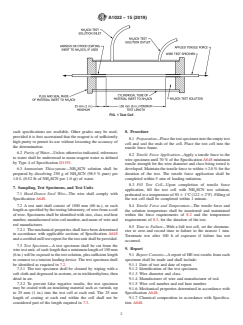
5.1 Test Cell—The test cell shall contain the test solution
dance with internationally recognized principles on standard-
and the wire specimen and be constructed of material which is
ization established in the Decision on Principles for the
inert to NH SCN (as shown in Fig. 1). The test cell shall be
Development of International Standards, Guides and Recom-
cylindrical with an inside diameter sufficient to provide a
mendations issued by the World Trade Organization Technical
2 3 2
minimum of 5 mL of solution per 100 mm (2 in. per in.)of
Barriers to Trade (TBT) Committee.
wire specimen surface area in contact with the solution. The
test cell length shall allow the exposure of a minimum test
2. Referenced Documents
specimen length of 150 mm (6 in.) to the test solution. The test
2.1 ASTM Standards:
cell shall be so designed that the wire specimen passes through
A648 Specification for Steel Wire, Hard-Drawn for Pre-
it and is sufficiently exposed outside the end of the cell as to
stressed Concrete Pipe
allow application of a tensile force to the specimen.
D1193 Specification for Reagent Water
5.2 Chronometer—A chronometer with a precision of at
3. Summary of Test Method
least 61 min. and capable of being stopped automatically on
fracture of the specimen shall be used.
3.1 Characterization of HE resistance of hard-drawn steel
wire is accomplished by determining the time-to-failure of a
5.3 Tensile Force Frame—A closed stiff frame, in either
wire specimen under a maintained constant tensile force, while
horizontal or vertical orientation, shall be used to position the
immersed in a heated solution of ammonium thiocyanate
test cell such that a constant tensile force shall be applied to the
test specimen and maintained. The tensile force shall be
applied through use of a dead weight, or hydraulic loading
This test method is under the jurisdiction of ASTM Committee A01 on Steel,
Stainless Steel and Related Alloys and is the direct responsibility of Subcommittee system equipped with a force indicator.
A01.05 on Steel Reinforcement.
Current edition approved Nov. 1, 2019. Published November 2019. Originally
6. Reagents and Materials
approved in 2004. Last previous edition approved in 2015 as A1032 – 15. DOI:
10.1520/A1032-15R19.
6.1 Purity of Reagents—Reagent grade chemicals shall be
For referenced ASTM standards, visit the ASTM website, www.astm.org, or
used in all tests. Unless otherwise indicated, it is intended that
contact ASTM Customer Service at service@astm.org. For Annual Book of ASTM
all reagents conform to the specifications of the Committee on
Standards volume information, refer to the standard’s Document Summary page on
the ASTM website. Analytical Reagents of the American Chemical Society where
Copyright © ASTM International, 100 Barr Harbor Drive, PO Box C700, West Conshohocken, PA 19428-2959. United States
A1032 − 15 (2019)
FIG. 1 Test Cell
such specifications are available. Other grades may be used, 8. Procedure
provided it is first ascertained that the reagent is of sufficiently
8.1 Preparation—Placethetestspecimenintotheemptytest
high purity to permit its use without lessening the accuracy of
cell and seal the ends of the cell. Place the test cell into the
the determination.
te
...