


ASTM D2057-05(2015)
(Test Method)Standard Test Method for Colorfastness of Zippers to Laundering
Standard Test Method for Colorfastness of Zippers to Laundering
SIGNIFICANCE AND USE
5.1 Test Method D2057 is useful for testing to determine if the degree of alteration in shade is satisfactory for the intended end-use and for determining if unacceptable staining of color into adjacent fabric will occur.
Note 1: For guidance in evaluating the results of this method, refer to Practice D3692.
5.2 This test method is considered satisfactory for acceptance testing of commercial shipments because the method has been used extensively in the trade for acceptance testing.
5.2.1 If there are differences of practical significance between reported test results for two laboratories (or more), comparative tests should be performed to determine if their is a statistical bias between them, using competent statistical assistance. As a minimum, the test samples should be used that are as homogeneous as possible, that are drawn from the material from which the disparate test results were obtained, and that are randomly assigned in equal numbers to each laboratory for testing. Other materials with established test values may be used for this purpose. The test results from the two laboratories should be compared using a statistical test for unpaired data, at a probability level chosen prior to the testing series. If a bias is found, either its cause must be found and corrected, or future test results must be adjusted in consideration of the known bias.
5.3 The method(s) in this standard along with those in D2051, D2052, D2053, D2054, D2058, D2059, D2060, D2061, and D2062 are a collection of proven zipper test methods. They can be used as aids in the evaluation of zippers without the need for a thorough knowledge of zippers. The enumerated test methods do not provide for the evaluation of all zipper properties. Besides those properties measured by means of the enumerated test methods there are other properties that may be important for the satisfactory performance of a zipper. Test methods for measuring those properties have not been published either because...
SCOPE
1.1 This test method covers the determination of alteration in shade and of staining under conditions similar to that experienced in domestic washing of zipper stringers. This test method is applicable to the textile portion of zipper stringers that utilize tapes made of cotton, linen, or manufactured organic fibers, and to combinations thereof.
1.2 The values stated in either SI units or inch-pound units are to be regarded separately as the standard. Within the text, the inch-pound units are shown in parentheses. The values stated in each system are not exact equivalents; therefore, each system shall be used independently of the other. combining values from the two systems may result in nonconformance with this test method.
1.3 This standard does not purport to address all of the safety concerns, if any, associated with its use. It is the responsibility of the user of this standard to establish appropriate safety and health practices and determine the applicability of regulatory limitations prior to use.
General Information
Buy Standard
Standards Content (Sample)
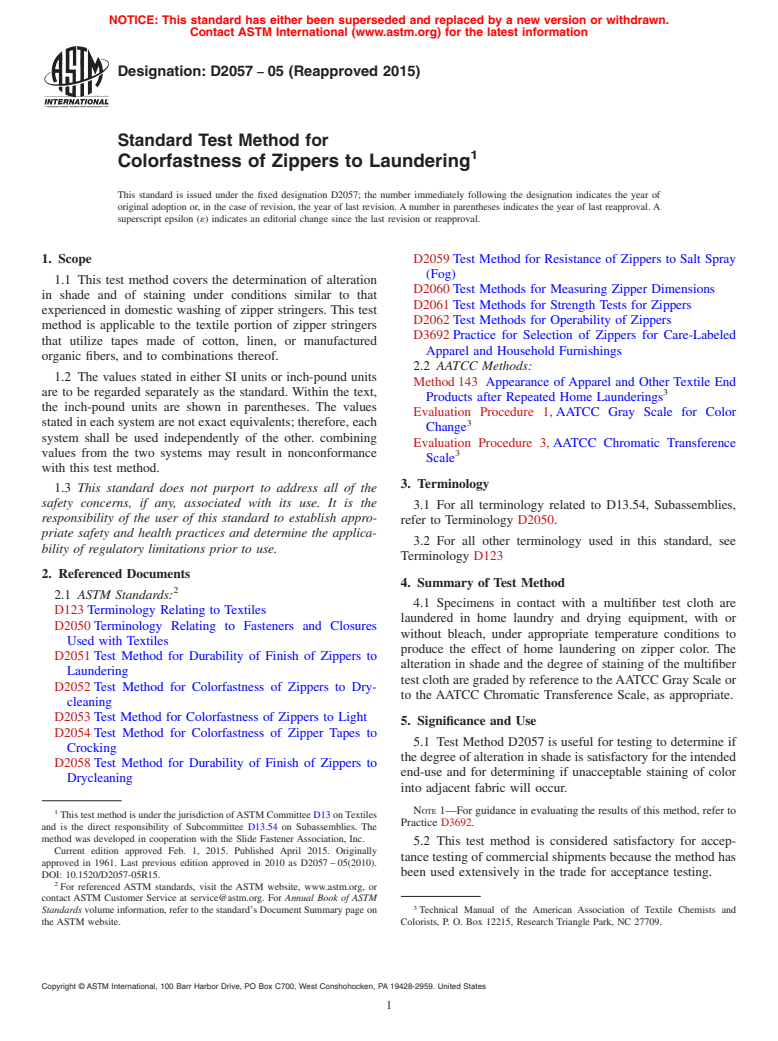
NOTICE: This standard has either been superseded and replaced by a new version or withdrawn.
Contact ASTM International (www.astm.org) for the latest information
Designation: D2057 − 05 (Reapproved 2015)
Standard Test Method for
Colorfastness of Zippers to Laundering
This standard is issued under the fixed designation D2057; the number immediately following the designation indicates the year of
original adoption or, in the case of revision, the year of last revision. A number in parentheses indicates the year of last reapproval. A
superscript epsilon (´) indicates an editorial change since the last revision or reapproval.
1. Scope D2059 Test Method for Resistance of Zippers to Salt Spray
(Fog)
1.1 This test method covers the determination of alteration
D2060 Test Methods for Measuring Zipper Dimensions
in shade and of staining under conditions similar to that
D2061 Test Methods for Strength Tests for Zippers
experienced in domestic washing of zipper stringers. This test
D2062 Test Methods for Operability of Zippers
method is applicable to the textile portion of zipper stringers
D3692 Practice for Selection of Zippers for Care-Labeled
that utilize tapes made of cotton, linen, or manufactured
Apparel and Household Furnishings
organic fibers, and to combinations thereof.
2.2 AATCC Methods:
1.2 The values stated in either SI units or inch-pound units
Method 143 Appearance of Apparel and Other Textile End
are to be regarded separately as the standard. Within the text,
Products after Repeated Home Launderings
the inch-pound units are shown in parentheses. The values
Evaluation Procedure 1, AATCC Gray Scale for Color
stated in each system are not exact equivalents; therefore, each
Change
system shall be used independently of the other. combining
Evaluation Procedure 3, AATCC Chromatic Transference
values from the two systems may result in nonconformance
Scale
with this test method.
3. Terminology
1.3 This standard does not purport to address all of the
safety concerns, if any, associated with its use. It is the
3.1 For all terminology related to D13.54, Subassemblies,
responsibility of the user of this standard to establish appro-
refer to Terminology D2050.
priate safety and health practices and determine the applica-
3.2 For all other terminology used in this standard, see
bility of regulatory limitations prior to use.
Terminology D123
2. Referenced Documents
4. Summary of Test Method
2.1 ASTM Standards:
4.1 Specimens in contact with a multifiber test cloth are
D123 Terminology Relating to Textiles
laundered in home laundry and drying equipment, with or
D2050 Terminology Relating to Fasteners and Closures
without bleach, under appropriate temperature conditions to
Used with Textiles
produce the effect of home laundering on zipper color. The
D2051 Test Method for Durability of Finish of Zippers to
alteration in shade and the degree of staining of the multifiber
Laundering
test cloth are graded by reference to theAATCC Gray Scale or
D2052 Test Method for Colorfastness of Zippers to Dry-
to the AATCC Chromatic Transference Scale, as appropriate.
cleaning
D2053 Test Method for Colorfastness of Zippers to Light
5. Significance and Use
D2054 Test Method for Colorfastness of Zipper Tapes to
5.1 Test Method D2057 is useful for testing to determine if
Crocking
the degree of alteration in shade is satisfactory for the intended
D2058 Test Method for Durability of Finish of Zippers to
end-use and for determining if unacceptable staining of color
Drycleaning
into adjacent fabric will occur.
NOTE 1—For guidance in evaluating the results of this method, refer to
This test method is under the jurisdiction ofASTM Committee D13 on Textiles
Practice D3692.
and is the direct responsibility of Subcommittee D13.54 on Subassemblies. The
method was developed in cooperation with the Slide Fastener Association, Inc.
5.2 This test method is considered satisfactory for accep-
Current edition approved Feb. 1, 2015. Published April 2015. Originally
tance testing of commercial shipments because the method has
approved in 1961. Last previous edition approved in 2010 as D2057 – 05(2010).
been used extensively in the trade for acceptance testing.
DOI: 10.1520/D2057-05R15.
For referenced ASTM standards, visit the ASTM website, www.astm.org, or
contact ASTM Customer Service at service@astm.org. For Annual Book of ASTM
Standards volume information, refer to the standard’s Document Summary page on Technical Manual of the American Association of Textile Chemists and
the ASTM website. Colorists, P. O. Box 12215, Research Triangle Park, NC 27709.
Copyright © ASTM International, 100 Barr Harbor Drive, PO Box C700, West Conshohocken, PA 19428-2959. United States
D2057 − 05 (2015)
5.2.1 If there are differences of practical significance be- 7.4 Anydry,nonchlorinehouseholdbleachbasedonsodium
tween reported test results for two laboratories (or more), perborate/sodium carbonate (pH of a 1 % solution should be
comparative tests should be performed to determine if their is 10.7 to 11.3).
a statistical bias between them, using competent statistical
8. Sampling
assistance.As a minimum, the test samples should be used that
are as homogeneous as possible, that are drawn from the
8.1 Lot Sample—Asalotsampleforacceptancetesting,take
material from which the disparate test results were obtained,
at random the number of individual containers from each
and that are randomly assigned in equal numbers to each
shipping carton as directed in an applicable material specifi-
laboratory for testing. Other materials with established test
cation or other agreement between the purchaser and the
values may be used for this purpose. The test results from the
supplier. Consider individual containers from each shipping
two laboratories should be compared using a statistical test for
carton to be the primary sampling units.
unpaired data, at a probability level chosen prior to the testing
NOTE 2—An adequate specification or other agreement between the
series. If a bias is found, either its cause must be found and
purchaserandsupplierrequirestakingintoaccountthevariabilitybetween
corrected, or future test results must be adjusted in consider-
shipping cartons and between zippers in a container to provide a sampling
ation of the known bias.
plan with a meaningful producer’s risk, consumer’s risk, acceptable
quality level, and limiting quality level.
5.3 The method(s) in this standard along with those in
8.2 Laboratory Sample and Test Specimens—As a labora-
D2051, D2052, D2053, D2054, D2058, D2059, D2060,
tory sample for acceptance testing, take the number of zippers
D2061, and D2062 are a collection of proven zipper test
specified in Section 9 at random from each container in the lot
methods. They can be used as aids in the evaluation of zippers
sample. Consider the zippers as both the laboratory sample and
without the need for a thorough knowledge of zippers. The
the test specimens.
enumerated test methods do not provide for the evaluation of
all zipper properties. Besides those properties measured by
9. Number of Specimens
means of the enumerated test methods there are other proper-
ties that may be important for the satisfactory performance of 9.1 Unless otherwise agreed upon, as when specified in an
applicable material specification, take one zipper at random
a zipper. Test methods for measuring those properties have not
been publ
...
This document is not an ASTM standard and is intended only to provide the user of an ASTM standard an indication of what changes have been made to the previous version. Because
it may not be technically possible to adequately depict all changes accurately, ASTM recommends that users consult prior editions as appropriate. In all cases only the current version
of the standard as published by ASTM is to be considered the official document.
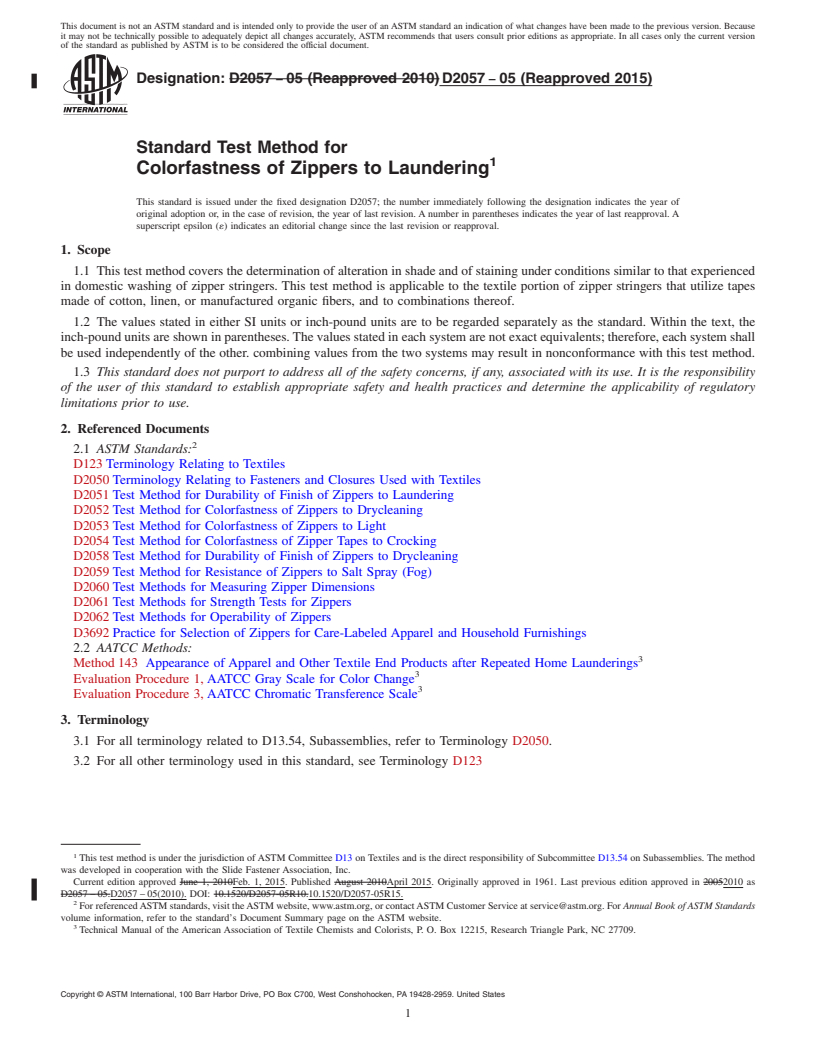
Designation: D2057 − 05 (Reapproved 2010) D2057 − 05 (Reapproved 2015)
Standard Test Method for
Colorfastness of Zippers to Laundering
This standard is issued under the fixed designation D2057; the number immediately following the designation indicates the year of
original adoption or, in the case of revision, the year of last revision. A number in parentheses indicates the year of last reapproval. A
superscript epsilon (´) indicates an editorial change since the last revision or reapproval.
1. Scope
1.1 This test method covers the determination of alteration in shade and of staining under conditions similar to that experienced
in domestic washing of zipper stringers. This test method is applicable to the textile portion of zipper stringers that utilize tapes
made of cotton, linen, or manufactured organic fibers, and to combinations thereof.
1.2 The values stated in either SI units or inch-pound units are to be regarded separately as the standard. Within the text, the
inch-pound units are shown in parentheses. The values stated in each system are not exact equivalents; therefore, each system shall
be used independently of the other. combining values from the two systems may result in nonconformance with this test method.
1.3 This standard does not purport to address all of the safety concerns, if any, associated with its use. It is the responsibility
of the user of this standard to establish appropriate safety and health practices and determine the applicability of regulatory
limitations prior to use.
2. Referenced Documents
2.1 ASTM Standards:
D123 Terminology Relating to Textiles
D2050 Terminology Relating to Fasteners and Closures Used with Textiles
D2051 Test Method for Durability of Finish of Zippers to Laundering
D2052 Test Method for Colorfastness of Zippers to Drycleaning
D2053 Test Method for Colorfastness of Zippers to Light
D2054 Test Method for Colorfastness of Zipper Tapes to Crocking
D2058 Test Method for Durability of Finish of Zippers to Drycleaning
D2059 Test Method for Resistance of Zippers to Salt Spray (Fog)
D2060 Test Methods for Measuring Zipper Dimensions
D2061 Test Methods for Strength Tests for Zippers
D2062 Test Methods for Operability of Zippers
D3692 Practice for Selection of Zippers for Care-Labeled Apparel and Household Furnishings
2.2 AATCC Methods:
Method 143 Appearance of Apparel and Other Textile End Products after Repeated Home Launderings
Evaluation Procedure 1, AATCC Gray Scale for Color Change
Evaluation Procedure 3, AATCC Chromatic Transference Scale
3. Terminology
3.1 For all terminology related to D13.54, Subassemblies, refer to Terminology D2050.
3.2 For all other terminology used in this standard, see Terminology D123
This test method is under the jurisdiction of ASTM Committee D13 on Textiles and is the direct responsibility of Subcommittee D13.54 on Subassemblies. The method
was developed in cooperation with the Slide Fastener Association, Inc.
Current edition approved June 1, 2010Feb. 1, 2015. Published August 2010April 2015. Originally approved in 1961. Last previous edition approved in 20052010 as
D2057 – 05.D2057 – 05(2010). DOI: 10.1520/D2057-05R10.10.1520/D2057-05R15.
For referenced ASTM standards, visit the ASTM website, www.astm.org, or contact ASTM Customer Service at service@astm.org. For Annual Book of ASTM Standards
volume information, refer to the standard’s Document Summary page on the ASTM website.
Technical Manual of the American Association of Textile Chemists and Colorists, P. O. Box 12215, Research Triangle Park, NC 27709.
Copyright © ASTM International, 100 Barr Harbor Drive, PO Box C700, West Conshohocken, PA 19428-2959. United States
D2057 − 05 (2015)
4. Summary of Test Method
4.1 Specimens in contact with a multifiber test cloth are laundered in home laundry and drying equipment, with or without
bleach, under appropriate temperature conditions to produce the effect of home laundering on zipper color. The alteration in shade
and the degree of staining of the multifiber test cloth are graded by reference to the AATCC Gray Scale or to the AATCC Chromatic
Transference Scale, as appropriate.
5. Significance and Use
5.1 Test Method D2057 is useful for testing to determine if the degree of alteration in shade is satisfactory for the intended
end-use and for determining if unacceptable staining of color into adjacent fabric will occur.
NOTE 1—For guidance in evaluating the results of this method, refer to Practice D3692.
5.2 This test method is considered satisfactory for acceptance testing of commercial shipments because the method has been
used extensively in the trade for acceptance testing.
5.2.1 If there are differences of practical significance between reported test results for two laboratories (or more), comparative
tests should be performed to determine if their is a statistical bias between them, using competent statistical assistance. As a
minimum, the test samples should be used that are as homogeneous as possible, that are drawn from the material from which the
disparate test results were obtained, and that are randomly assigned in equal numbers to each laboratory for testing. Other materials
with established test values may be used for this purpose. The test results from the two laboratories should be compared using a
statistical test for unpaired data, at a probability level chosen prior to the testing series. If a bias is found, either its cause must be
found and corrected, or future test results must be adjusted in consideration of the known bias.
5.3 The method(s) in this standard along with those in D2051, D2052, D2053, D2054, D2058, D2059, D2060, D2061, and
D2062 are a collection of proven zipper test methods. They can be used as aids in the evaluation of zippers without the need for
a thorough knowledge of zippers. The enumerated test methods do not provide for the evaluation of all zipper properties. Besides
those properties measured by means of the enumerated test methods there are other properties that may be important for the
satisfactory performance of a zipper. Test methods for measuring those properties have not been published either because no
practical methods have yet been developed or because a valid evaluation of the information resulting from existing unpublished
methods requires an intimate and thorough knowledge of zippers.
6. Apparatus
6.1 Automatic Washing Machine, with “normal setting” agitator speed of 179 6 2 spm, washing time of 12 min, spin speed of
645 6 15 rpm, final spin cycle of 6 min and rinse temperature less than 29 °C (85°F).
6.2 Automatic Tumble Dryer, with controlled exhaust temperature that cycles from 61 to 71°C (140 to 160°F) and a cooling
period while tumbling 10 min at the end of the drying cycle.
6.3 AATCC Chromatic Transference Scale.
6.4 Gray Scale for Color Change.
7. Reagents and Materials
7.1 Multifiber Test Fabric No. 10.
7.2 Any household detergent.
7.3 Any liquid chlorine household bleach containing 5.25 % sodium hypochlorite.
7.4 Any dry, nonchlorine household bleach based on sodium perborate/sodium carbonate (pH of a 1 % solution should be 10.7
to 11.3).
8. Sampling
8.1 Lot Sample—As a lot sample for acceptance testing, take at random the number of individual containers fro
...
Questions, Comments and Discussion
Ask us and Technical Secretary will try to provide an answer. You can facilitate discussion about the standard in here.