


ASTM D3990-12(2016)
(Terminology)Standard Terminology Relating to Fabric Defects
Standard Terminology Relating to Fabric Defects
SCOPE
1.1 This terminology covers defects in both woven and knit fabrics. Descriptions of the defects, illustrations, and related material are given under the most frequently used terms; synonym(s) are listed in parentheses and cross referenced.
General Information
Buy Standard
Standards Content (Sample)
NOTICE: This standard has either been superseded and replaced by a new version or withdrawn.
Contact ASTM International (www.astm.org) for the latest information
Designation: D3990 − 12 (Reapproved 2016)
Standard Terminology Relating to
Fabric Defects
This standard is issued under the fixed designation D3990; the number immediately following the designation indicates the year of
original adoption or, in the case of revision, the year of last revision. A number in parentheses indicates the year of last reapproval. A
superscript epsilon (´) indicates an editorial change since the last revision or reapproval.
This standard has been approved for use by agencies of the U.S. Department of Defense.
1. Scope
1.1 This terminology covers defects in both woven and knit
fabrics. Descriptions of the defects, illustrations, and related
material are given under the most frequently used terms;
synonym(s) are listed in parentheses and cross referenced.
2. Referenced Documents
2.1 ASTM Standards:
D1776 Practice for Conditioning and Testing Textiles
3. Terminology
3.1 Definitions:
abrasion mark, n—an area damaged by friction. (Syn. chafe
beaded selvage—See loopy selvage.
mark)
bias—See skew.
apron mark—See decating mark. birdseye, n—in knitted fabrics, an unintentional tuck stitch.
baggy cloth—See wavy cloth.
blanket mark—See sanforizing mark.
baggy selvage—See slack selvage.
blotch, n—an offcolored area of any shape caused by grease or
balling up—See fuzz ball.
oil. (Syn. oil spot)
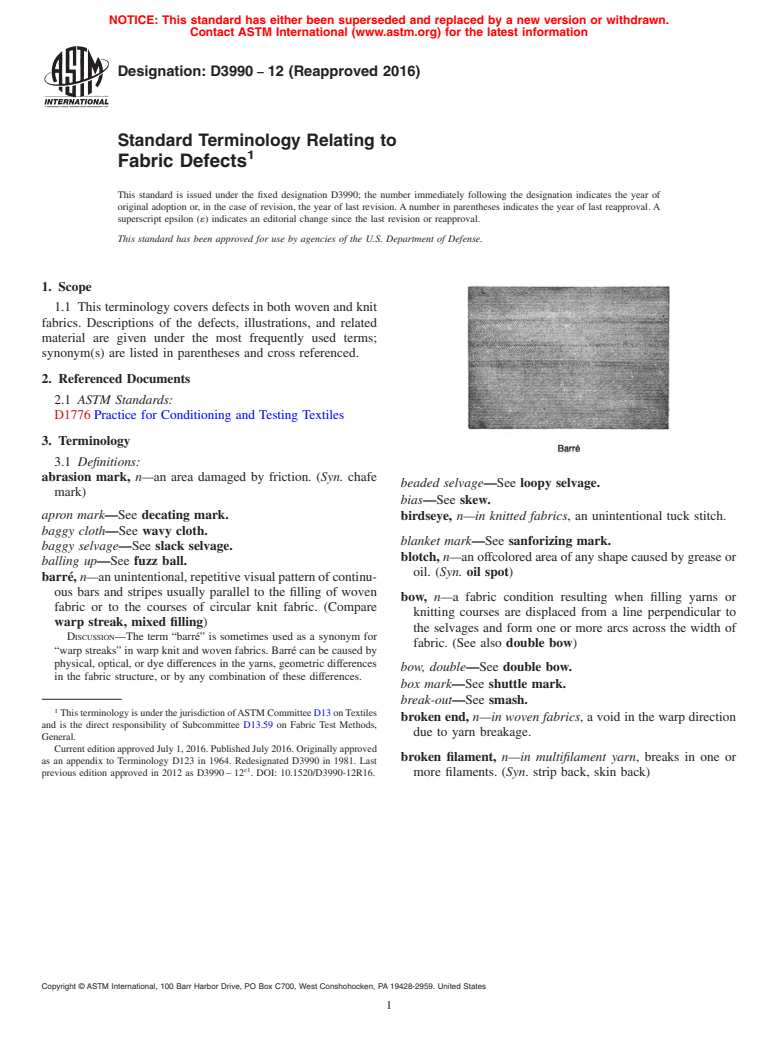
barré, n—anunintentional,repetitivevisualpatternofcontinu-
ous bars and stripes usually parallel to the filling of woven
bow, n—a fabric condition resulting when filling yarns or
fabric or to the courses of circular knit fabric. (Compare
knitting courses are displaced from a line perpendicular to
warp streak, mixed filling)
the selvages and form one or more arcs across the width of
DISCUSSION—The term “barré” is sometimes used as a synonym for
fabric. (See also double bow)
“warp streaks” in warp knit and woven fabrics. Barré can be caused by
physical, optical, or dye differences in the yarns, geometric differences
bow, double—See double bow.
in the fabric structure, or by any combination of these differences.
box mark—See shuttle mark.
break-out—See smash.
ThisterminologyisunderthejurisdictionofASTMCommitteeD13onTextiles
broken end, n—in woven fabrics, a void in the warp direction
and is the direct responsibility of Subcommittee D13.59 on Fabric Test Methods,
due to yarn breakage.
General.
Current edition approved July 1, 2016. Published July 2016. Originally approved
broken filament, n—in multifilament yarn, breaks in one or
as an appendix to Terminology D123 in 1964. Redesignated D3990 in 1981. Last
ɛ1
previous edition approved in 2012 as D3990 – 12 . DOI: 10.1520/D3990-12R16. more filaments. (Syn. strip back, skin back)
Copyright © ASTM International, 100 Barr Harbor Drive, PO Box C700, West Conshohocken, PA 19428-2959. United States
D3990 − 12 (2016)
broken pick, n— in woven fabrics,adiscontinuityinthefilling
direction caused by a break or cut in the filling yarn.
crease, n—a fabric defect evidenced by a break, line, or mark
generally caused by a sharp fold. (Syn. mill wrinkle)
broken selvage—See cut selvage.
crease mark, n—a visible deformation left in a fabric after a
bruise, n—in fabrics, an area that has been subjected to impact
creasehasbeenincompletelyremovedduringfabricprocess-
or pressure, that differs from the adjacent normal fabric.
ing.
(Syn. pressure mark.)
crocking, n—a transfer of color from the surface of a colored
bunch—See slug.
fabric to an adjacent area of the same fabric or to another
chafe mark—See abrasion mark.
surface principally by rubbing action. (Compare color stain-
clip mark, n—a visual deformation near the edge of a fabric
ing)
parallel with the lengthwise direction caused by pressure
exerted by a clasping device on a clip tenter frame. (See also
pin mark.)
coarse end, n—a larger than normal diameter warp end. (Syn.
heavy end) (Compare fine end)
coarse filling—See coarse pick.
coarse pick, n— in woven fabrics, one or more picks of larger
diameterthanthenormalfillingyarninthefabric.(Syn.thick
filling)
cockles, n—in yarns, irregular thick, uneven, lumps.
color bleeding, n—the loss of color from a dyed fabric when
crowsfeet, n—in fabrics, fine wrinkles of varying degrees of
immersed in water, dry-cleaning solvent, or similar liquid
intensity, size, and shape.
medium, with consequent coloring of the liquid medium.
DISCUSSION—Crowsfeet may occur during wet processing and on
(Compare color staining.)
finished goods after folding.
color staining, n—the undesired pickup of color by a fabric:
curl—See kink.
(1) when immersed in water, dry-cleaning solvent, or similar
curled selvage, n—self-descriptive. (Syn. rolled selvage,
liquid medium, that contains dyestuffs or coloring material
turned-over edge)
not intended for coloring the fabric, or (2) by direct contact
with other dyed material from which color is transferred by cut pick—See broken pick.
bleeding or sublimation. (Compare crocking, color bleed- cut selvage, n—cuts or breaks that occur in the selvage only.
ing) (Syn. broken selvage, damaged selvage)
corded selvage—See loopy selvage. damaged selvage—See cut selvage.
crack mark, n—an open place causing a streak of variable dead cotton, n—a small nep of cotton fibers which is gathered
length approximately parallel to the length or width. (Syn. on the surface of the fabric and which is different in color
open place, thin spot) from the surrounding fabric.
D3990 − 12 (2016)
decating mark, n—a crease mark or impression extending
across the cloth near the beginning or end of a piece due to
the thickness of the fabric leader seam. (Syn. apron mark,
leader mark)
doctor streak, n—in printed cloth, a wavy white or colored
streak in the warp direction of printed cloth caused by a
defective doctor blade.
double bow, n—two fabric bows, arcing in the same direction,
as in a flattened M or W depending on the viewing angle.
(See also bow) (Compare double reverse bow)
DISCUSSION—In tubular knits, there may be differential bowing
between the top and bottom of the tube.
filling run-out—See broken pick.
fine end, n.—a smaller than normal diameter warp end. (Syn.
double hooked bow, n—one hooked bow at each side of the
light end, thin end) (Compare coarse end)
fabric that arc in opposite directions. (See also hooked bow)
fine filling—See thin filling.
double pick, n— in woven fabrics, two picks wrongly placed
fine pick—See thin filling.
in the same shed. (See also mispick) (Compare jerk-in )
finger mark, n—an irregular spot showing variation in picks
per inch for a limited width.
double reverse bow, n—two fabric bows arcing in opposite
directions. (See also bow and double hooked bow) (Com-
pare double bow)
draw-back, n—a weave distortion characterized by tight and
slack places in the same warp yarn. (Syn. hitch-back)
dropped stitch, n—in knitted fabrics, an unknitted stitch.
dye spot—See dyestain.
dyestain, n—anareaofunintendeddiscolorationduetouneven
absorption of a colorant.
dye streak, n—an unintended irregular stripe in a fabric due to
uneven absorption of a colorant. finishing bar, n—anunevenappearanceacrosstheentirefabric
width.
end out, n—a void caused by a missing warp yarn. (Syn.
float, n—in woven fabrics, that portion of a warp or filling yarn
missing end)
that extends unbound over two or more warp or filling yarns;
in knitted fabrics, that portion of a yarn that is not knitted
into loops.
filling band, n— in woven fabrics, a visual defect across the
width due to a change occurring in the yarn for a large
number of picks. (Compare filling bar)
D4850
filling bar, n— in woven fabrics, a visual defect across the
DISCUSSION—If intentionally introduced, floats are a constructional
width which contains a limited number of picks of different
characteristic of knit or woven fabrics. If unintentionally present, they
appearance than normal. (Compare filling band) are considered to be defects.
D3990 − 12 (2016)
flyer—See loom fly. hard end—See tight twist end.
frosting, n—a change in color in a limited area of a fabric hard size, n—sections of cloth containing an excessive quan-
caused by abrasive wear.
tity of sizing. (Syn. starch lump)
DISCUSSION—Frosting may be the result of differential wear, as in
harness skip—See float.
multicomponent blends in which the fibers do not match in shade, or of
the abrasion of single-fiber constructions in which there is some heavy end—See coarse end.
variation in penetration, or incomplete penetration, of dye-stuff. The
heavy filling—See coarse pick.
use of the terms “differential wear” and “fibrillation” as substitutes for
heavy pick—See coarse pick.
the concept of frosting is undesirable.
hitch-back—See draw-back.
fuzz ball, n—loose and frayed fibers that have formed into a
hole, n—in fabric, an imperfection where one or more yarns
ball and have then been woven or knitted into the fabric.
are sufficiently damaged to create an aperture.
(Syn. lint ball, snow ball) (Compare pills)
hooked bow, n—a fabric condition in which the filling yarns or
fuzzy, adj—characterized by a hairy appearance due to pro-
knitted courses are in the proper position for most of the
truding broken fibers or filaments. (Syn. hairy)
fabricwidthbutarepulledoutofalignmentatonesideofthe
fabric. (See also double hooked bow)
jerk-in, n—in woven fabric,anextrafillingthreaddraggedinto
the shed with the regular pick and extending only part of the
way across the cloth. (Syn. lash-in, pull-in) (Compare
double pick)
kink, n—in fabric, a short length of yarn that has spontane-
ously doubled back on itself to form a loop. (Syn. curl, kinky
thread, looped yarn, snarl)
gout, n—foreign matter trapped in a fabric by accident, usually
lint or waste. (See also slug)
kinky thread—See kink.
knitted fabric, n—a structure produced by interlooping one or
more ends of yarn or comparable materials.
ladder—See run.
lash-in—See jerk-in.
hairy—See fuzzy. leader mark—See decating mark.
hang pick, n—a pick, caught on a warp yarn knot for a short let-off mark, n— in woven fabrics, a corrugated defect pattern
distance, producing a triangular-shaped hole in the fabric.
distributed across the fabric width. (Compare shier)
(Syn. hang shot) DISCUSSION—Let-off marks are caused by badly adjusted let-off
motions of a loom.
light end—See fine end.
light filling—See thin filling.
light pick—See thin filling.
lint ball—See fuzz ball.
long knot, n—in raw silk, knots which have loose ends from 3
to 25 mm in length.
long slug, n—in raw silk, a slug which exceeds 10 mm ( ⁄2 in.)
in length or which is very much larger in diameter than the
yarn.
loom fly, n—waste fibers created during weaving that are
hang shot—See hang pick. woven into a fabric. (Syn. flyer)
D3990 − 12 (2016)
looped yarn—See kink. mote trash—See trash.
loopy edge—See loopy selvage.
mussiness, n—surface distortion in a fabric characterized by
loopy selvage, n—an improperly woven selvage of uneven
objectionable uneveness due to many minor deformations.
width or a selvage containing irregular filling loops extend-
nep, n—a tightly tangled knot-like mass of unorganized fibers.
ing beyond the outside edges. (Syn. beaded selvage, corded
(Compare pills.)
selvage, loopy edge, rough selvage)
open place—See crack mark.
loose course, n— in knitted fabrics, a row of loops in the
overshot—See float.
widthwise direction that is larger, looser, or longer than the
pick-out mark, n—a fillingwise band or bar characterized by
stitches in the main body of the fabric.
a chafed or fuzzy appearance.
loose edge—See slack selvage.
loose pick—See slack pick.
pick-out place—See temple mark.
lump—See slub, slug.
piecing, n—a thick place in a spun yarn caused by poor
mill wrinkle—See crease.
splicing.
misclip—See scalloped selvage.
pills, n—bunches or balls of tangled fibers which are held to
misdraw—See wrong draw.
the surface of a fabric by one or more fibers. (Compare fuzz
mispick, n—in woven fabrics, a pick not properly interlaced
ball)
which causes a break in the weave pattern. (Syn. wrong pick)
(See also double pick)
pin hole, n—in fabrics, a very small hole, approximately the
size of the cross section of a pin.
pin mark, n—a series of holes near the edge parallel with the
lengthwise direction of a fabric caused by the holding device
on a pin tenter frame. (See also clip mark.)
press-off, n—in knitted fabrics, a condition in which the yarn
fails to knit and either the fabric falls off the needles or the
design is distorted or incomplete.
pressure mark, n—See bruise.
pull-in—See jerk-in.
reed mark, n—in woven fabrics, a crack between groups of
warp ends, either continuous or at intervals.
misprint, n—in printed fabric, colors or patterns, or both,
either missed, or partially missed, or incorrectly positioned
reedy warp—See reed mark.
relative to each other.
ring, n—in hosiery, a narrow, visually different horizontal
band.
misregister, n— in printed fabric, colors or patterns not
correctly positioned. (Compare misprint.)
ripped selvage—See cut selvage.
missing end—See end out.
rolled selvage—See curled selvage.
missing pick—See broken pick.
rope mark, n—in dyed or finished fabrics, a long irregularly
miss-knit, n—in knitted fabrics, a deviation from the desig-
shifting longitudinal mechanically induced streak.
nated knitting pattern.
rough, adj—a descriptive term for a fabric surface which has
mixed end, n—in woven fabrics, a warp yarn differing from
the feel of sandpaper.
that normally being used in the fabric.
mixed filling, n—in woven fabrics, a filling yarn differing from
that normally being used in the fabric. (See also filling
band) (Compare barré)
rough selvage—See loopy selvage.
run, n—in knitted fabrics, a series of dropped stitches. (See
dropped stitch)(Syn. ladder)
D3990 − 12 (2016)
sanforizing mark, n—a crimped, rippled, wavy, pebbled, or slack thread—See slack end.
cockled place showing distortion of the texture. (Syn. blan- slack warp—See slack end.
ket mark) slam-off, n—in woven fabrics, a distortion due to the entrap-
ment of the filling carrier in the shed. (Compare smash)
scalloped selvage, n—an abrupt, narrow indentation in the
slough-off, n—in woven fabrics, a defect caused by several
selvage. (Syn. misclip)
coils of yarn slipping off the filling bobbin simultaneously
seam mark, n—in finished cloth, a pressure mark caused by
and being woven into the fabric in a group.
the thickness of the seam being pressed against the cloth.
slub, n—an abruptly thickened place in a yarn. (Syn. lump,
section mark, n— in woven fabrics, warp bands of different
piecing, slough-off, slug) (Compare cockles)
color, texture, or luster.
slug, n—in glass, unattenuated particles of glass of substan-
selvage mar
...
This document is not an ASTM standard and is intended only to provide the user of an ASTM standard an indication of what changes have been made to the previous version. Because
it may not be technically possible to adequately depict all changes accurately, ASTM recommends that users consult prior editions as appropriate. In all cases only the current version
of the standard as published by ASTM is to be considered the official document.
´1
Designation: D3990 − 12 D3990 − 12 (Reapproved 2016)
Standard Terminology Relating to
Fabric Defects
This standard is issued under the fixed designation D3990; the number immediately following the designation indicates the year of
original adoption or, in the case of revision, the year of last revision. A number in parentheses indicates the year of last reapproval. A
superscript epsilon (´) indicates an editorial change since the last revision or reapproval.
This standard has been approved for use by agencies of the U.S. Department of Defense.
ε NOTE—Terms from Test Method D7811 were added editorially in August 2013.
1. Scope
1.1 This terminology covers defects in both woven and knit fabrics. Descriptions of the defects, illustrations, and related
material are given under the most frequently used terms; synonym(s) are listed in parentheses and cross referenced.
2. Referenced Documents
2.1 ASTM Standards:
D1776 Practice for Conditioning and Testing Textiles
D7811 Test Method For Bow and Skew using a Measuring Tool
3. Terminology
3.1 Definitions:
abrasion mark, n—an area damaged by friction. (Syn. chafe mark)
apron mark—See decating mark.
baggy cloth—See wavy cloth.
baggy selvage—See slack selvage.
balling up—See fuzz ball.
barré, n—an unintentional, repetitive visual pattern of continuous bars and stripes usually parallel to the filling of woven fabric
or to the courses of circular knit fabric. (Compare warp streak, mixed filling)
This terminology is under the jurisdiction of ASTM Committee D13 on Textiles and is the direct responsibility of Subcommittee D13.59 on Fabric Test Methods, General.
Current edition approved July 1, 2012July 1, 2016. Published August 2012July 2016. Originally approved as an appendix to Terminology D123 in 1964. Redesignated
ɛ1
D3990 in 1981. Last previous edition approved in 2012 as D3990 – 12.D3990 – 12 . DOI: 10.1520/D3990-12E01.10.1520/D3990-12R16.
DISCUSSION—
The term “barré” is sometimes used as a synonym for “warp streaks” in warp knit and woven fabrics. Barré can be caused by physical, optical, or dye
differences in the yarns, geometric differences in the fabric structure, or by any combination of these differences.
beaded selvage—See loopy selvage.
bias—See skew.
Copyright © ASTM International, 100 Barr Harbor Drive, PO Box C700, West Conshohocken, PA 19428-2959. United States
D3990 − 12 (2016)
birdseye, n—in knitted fabrics, an unintentional tuck stitch.
blanket mark—See sanforizing mark.
blotch, n—an offcolored area of any shape caused by grease or oil. (Syn.oil spot)
bow, n—a fabric condition resulting when filling yarns or knitting courses are displaced from a line perpendicular to the selvages
and form one or more arcs across the width of fabric. (See also double bow)
bow, double—See double bow.
box mark—See shuttle mark.
break-out—See smash.
broken end, n—in woven fabrics, a void in the warp direction due to yarn breakage.
broken filament, n—in multifilament yarn, breaks in one or more filaments. (Syn. strip back, skin back)
broken pick, n— in woven fabrics, a discontinuity in the filling direction caused by a break or cut in the filling yarn.
broken selvage—See cut selvage.
bruise, n—in fabrics, an area that has been subjected to impact or pressure, that differs from the adjacent normal fabric.
(Syn.pressure mark.)
bunch—See slug.
chafe mark—See abrasion mark.
clip mark, n—a visual deformation near the edge of a fabric parallel with the lengthwise direction caused by pressure exerted by
a clasping device on a clip tenter frame. (See also pin mark.)
coarse end, n—a larger than normal diameter warp end. (Syn. heavy end) (Compare fine end)
coarse filling—See coarse pick.
coarse pick, n— in woven fabrics, one or more picks of larger diameter than the normal filling yarn in the fabric. (Syn. thick filling)
cockles, n—in yarns, irregular thick, uneven, lumps.
color bleeding, n—the loss of color from a dyed fabric when immersed in water, dry-cleaning solvent, or similar liquid medium,
with consequent coloring of the liquid medium. (Compare color staining.)
color staining, n—the undesired pickup of color by a fabric: (1) when immersed in water, dry-cleaning solvent, or similar liquid
medium, that contains dyestuffs or coloring material not intended for coloring the fabric, or (2) by direct contact with other dyed
material from which color is transferred by bleeding or sublimation. (Compare crocking, color bleeding)
corded selvage—See loopy selvage.
crack mark, n—an open place causing a streak of variable length approximately parallel to the length or width. (Syn. open place,
thin spot)
D3990 − 12 (2016)
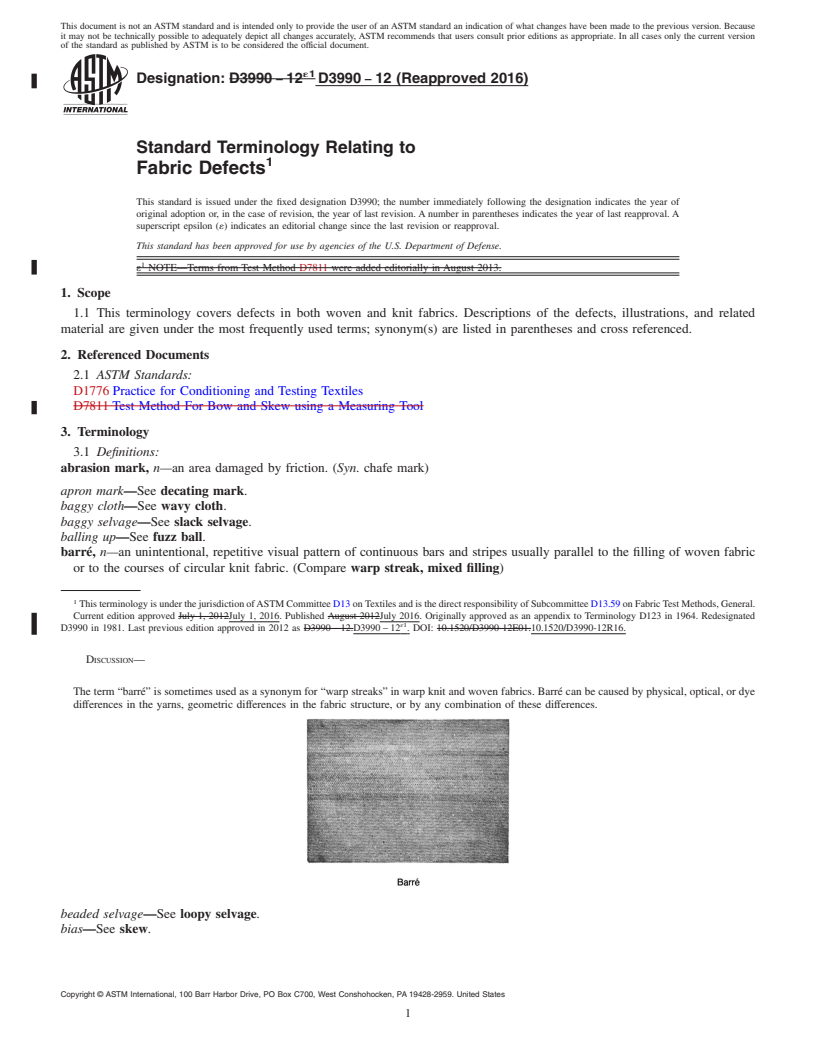
crease, n—a fabric defect evidenced by a break, line, or mark generally caused by a sharp fold. (Syn. mill wrinkle)
crease mark, n—a visible deformation left in a fabric after a crease has been incompletely removed during fabric processing.
crocking, n—a transfer of color from the surface of a colored fabric to an adjacent area of the same fabric or to another surface
principally by rubbing action. (Compare color staining)
crowsfeet, n—in fabrics, fine wrinkles of varying degrees of intensity, size, and shape.
DISCUSSION—
Crowsfeet may occur during wet processing and on finished goods after folding.
curl—See kink.
curled selvage, n—self-descriptive. (Syn. rolled selvage, turned-over edge)
cut pick—See broken pick.
cut selvage, n—cuts or breaks that occur in the selvage only. (Syn. broken selvage, damaged selvage)
damaged selvage—See cut selvage.
dead cotton, n—a small nep of cotton fibers which is gathered on the surface of the fabric and which is different in color from
the surrounding fabric.
decating mark, n—a crease mark or impression extending across the cloth near the beginning or end of a piece due to the thickness
of the fabric leader seam. (Syn. apron mark, leader mark)
doctor streak, n—in printed cloth, a wavy white or colored streak in the warp direction of printed cloth caused by a defective
doctor blade.
double bow, n—two fabric bows, arcing in the same direction, as in a flattened M or W depending on the viewing angle. (See also
bow) (Compare double reverse bow)
DISCUSSION—
In tubular knits, there may be differential bowing between the top and bottom of the tube.
double hooked bow, n—one hooked bow at each side of the fabric that arc in opposite directions. (See also hooked bow)
double pick, n— in woven fabrics, two picks wrongly placed in the same shed. (See also mispick) (Compare jerk-in )
D3990 − 12 (2016)
double reverse bow, n—two fabric bows arcing in opposite directions. (See also bow and double hooked bow) (Compare double
bow)
draw-back, n—a weave distortion characterized by tight and slack places in the same warp yarn. (Syn. hitch-back)
dropped stitch, n—in knitted fabrics, an unknitted stitch.
dye spot—See dyestain.
dyestain, n—an area of unintended discoloration due to uneven absorption of a colorant.
dye streak, n—an unintended irregular stripe in a fabric due to uneven absorption of a colorant.
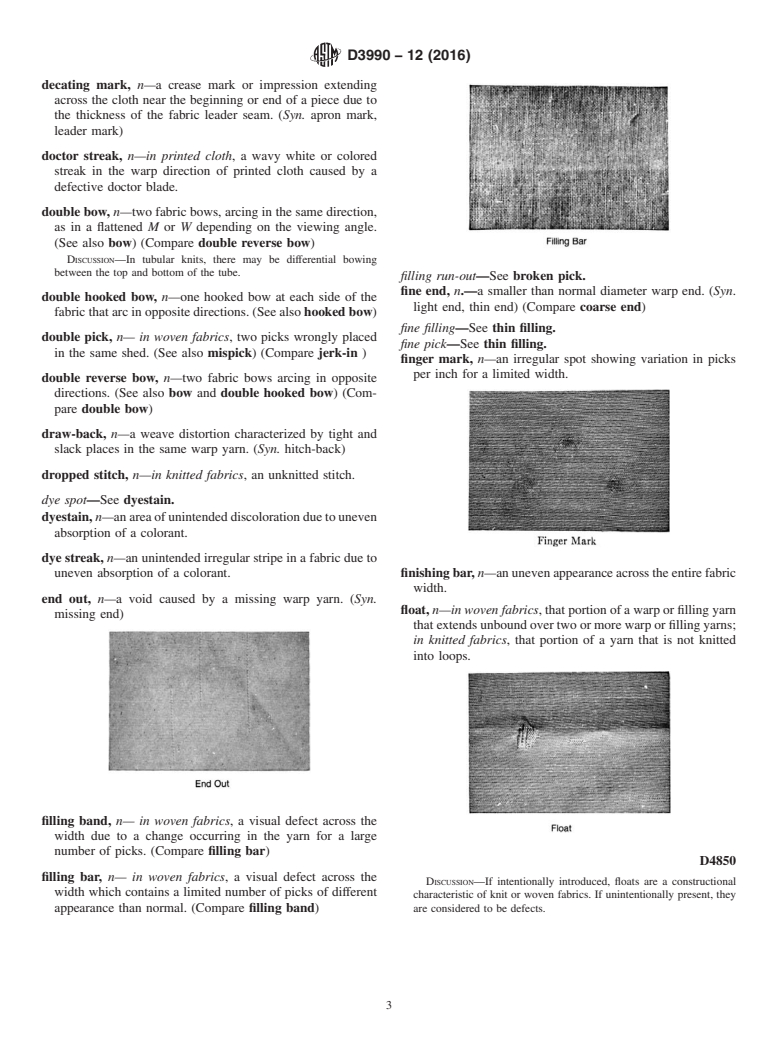
end out, n—a void caused by a missing warp yarn. (Syn. missing end)
filling band, n— in woven fabrics, a visual defect across the width due to a change occurring in the yarn for a large number of
picks. (Compare filling bar)
filling bar, n— in woven fabrics, a visual defect across the width which contains a limited number of picks of different appearance
than normal. (Compare filling band)
filling run-out—See broken pick.
fine end, n.—a smaller than normal diameter warp end. (Syn. light end, thin end) (Compare coarse end)
fine filling—See thin filling.
fine pick—See thin filling.
finger mark, n—an irregular spot showing variation in picks per inch for a limited width.
finishing bar, n—an uneven appearance across the entire fabric width.
D3990 − 12 (2016)
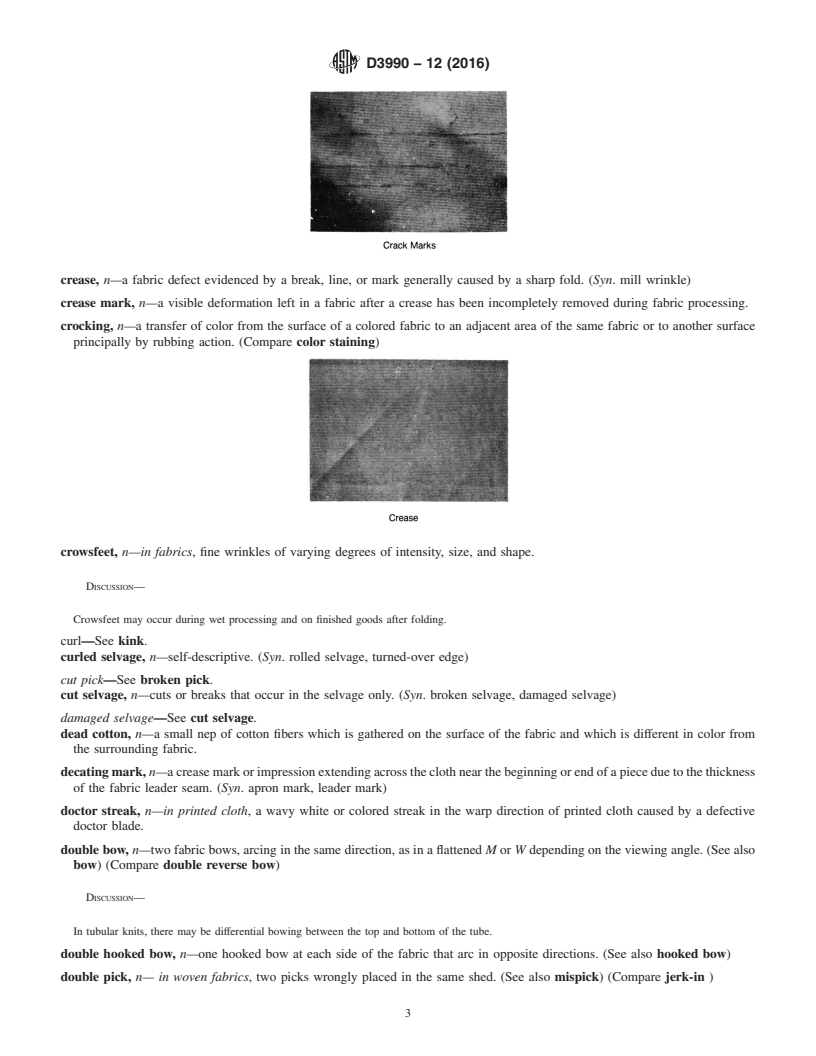
float, n—in woven fabrics, that portion of a warp or filling yarn that extends unbound over two or more warp or filling yarns; in
knitted fabrics, that portion of a yarn that is not knitted into loops.
D4850
DISCUSSION—
If intentionally introduced, floats are a constructional characteristic of knit or woven fabrics. If unintentionally present, they are considered to be
defects.
flyer—See loom fly.
frosting, n—a change in color in a limited area of a fabric caused by abrasive wear.
DISCUSSION—
Frosting may be the result of differential wear, as in multicomponent blends in which the fibers do not match in shade, or of the abrasion of single-fiber
constructions in which there is some variation in penetration, or incomplete penetration, of dye-stuff. The use of the terms “differential wear” and
“fibrillation” as substitutes for the concept of frosting is undesirable.
fuzz ball, n—loose and frayed fibers that have formed into a ball and have then been woven or knitted into the fabric. (Syn. lint
ball, snow ball) (Compare pills)
fuzzy, adj—characterized by a hairy appearance due to protruding broken fibers or filaments. (Syn. hairy)
gout, n—foreign matter trapped in a fabric by accident, usually lint or waste. (See also slug)
D3990 − 12 (2016)
hairy—See fuzzy.
hang pick, n—a pick, caught on a warp yarn knot for a short distance, producing a triangular-shaped hole in the fabric. (Syn. hang
shot)
hang shot—See hang pick.
hard end—See tight twist end.
hard size, n—sections of cloth containing an excessive quantity of sizing. (Syn. starch lump)
harness skip—See float.
heavy end—See coarse end.
heavy filling—See coarse pick.
heavy pick—See coarse pick.
hitch-back—See draw-back.
hole, n—in fabric, an imperfection where one or more yarns are sufficiently damaged to create an aperture.
hooked bow, n—a fabric condition in which the filling yarns or knitted courses are in the proper position for most of the fabric
width but are pulled out of alignment at one side of the fabric. (See also double hooked bow)
jerk-in, n—in woven fabric, an extra filling thread dragged into the shed with the regular pick and extending only part of the way
across the cloth. (Syn. lash-in, pull-in) (Compare double pick)
kink, n—in fabric, a short length of yarn that has spontaneously doubled back on itself to form a loop. (Syn. curl, kinky thread,
looped yarn, snarl)
kinky thread—See kink.
knitted fabric, n—a structure produced by interlooping one or more ends of yarn or comparable materials.
ladder—See run.
lash-in—See jerk-in.
leader mark—See decating mark.
let-off mark, n— in woven fabrics, a corrugated defect pattern distributed across the fabric width. (Compare shier)
DISCUSSION—
Let-off marks are caused by badly adjusted let-off motions of a loom.
light end—See fine end.
light filling—See thin filling.
light pick—See thin filling.
D3990 − 12 (2016)
lint ball—See fuzz ball.
long knot, n—in raw silk, knots which have loose ends from 3 to 25 mm in length.
long slug, n—in raw silk, a slug which exceeds 10 mm ( ⁄2 in.) in length or which is very much larger in diameter than the yarn.
loom fly, n—waste fibers created during weaving that are woven into a fabric. (Syn. flyer)
looped yarn—See kink.
loopy edge—See loopy selvage.
loopy selvage, n—an improperly woven selvage of uneven width or a selvage containing irregular filling loops extending beyond
the outside edges. (Syn. beaded selvage, corded selvage, loopy edge, rough selvage)
loose course, n— in knitted fabrics, a row of loops in the widthwise direction that is larger, looser, or longer than the stitches in
the main body of the fabric.
loose edge—See slack selvage.
loose pick—See slack pick.
lump—See slub, slug.
mill wrinkle—See crease.
misclip—See scalloped selvage.
misdraw—See wrong draw.
mispick, n—in woven fabrics, a pick not properly interlaced which causes a break in the weave pattern. (Syn. wrong pick) (See
also double pick)
misprint, n—in printed fabric, colors or patterns, or both, either missed, or partially missed, or incorrectly positioned relative to
each other.
misregister, n— in printed fabric, colors or patterns not correctly positioned. (Compare misprint.)
missing end—See end out.
missing pick—See broken pick.
miss-knit, n—in knitted fabrics, a deviation from the designated knitting pattern.
mixed end, n—in woven fabrics, a warp yarn differing from that normally being used in the fabric.
mixed filling, n—in woven fabrics, a filling yarn differing from that normally being used in the fabric. (See also filling band)
(Compare barré)
mote trash—See trash.
mussiness, n—surface distortion in a fabric characterized by objectionable uneveness due to many minor deformations.
D3990 − 12 (2016)
nep, n—a tightly tangled knot-like mass of unorganized fibers. (Compare pills.)
open place—See crack mark.
overshot—See float.
pick-out mark, n—a fillingwise band or bar characterized by a chafed or fuzzy appearance.
pick-out place—See temple mark.
piecing, n—a thick place in a spun yarn caused by poor splicing.
pills, n—bunches or balls of tangled fibers which are held to the surface of a fabric by one or more fibers. (Compare fuzz ball)
pin hole, n—in fabrics, a very small hole, approximately the size of the cross section of a pin.
pin mark, n—a series of holes near the edge parallel with the lengthwise direction of a fabric caused by the holding device on
a pin tenter frame. (See also clip mark.)
press-off, n—in knitted fabrics, a condition in which the yarn fails to knit and either the fabric falls off the needles or the design
is distorted or incomplete.
pressure mark,n—See bruise.
pull-in—See jerk-in.
reed mark, n—in woven fabrics, a crack between groups of warp ends, either continuous or at intervals.
reedy warp—See reed mark.
ring, n—in hosiery, a narrow, visually different horizontal band.
ripped selvage—See cut selvage.
rolled selvage—See curled selvage.
rope mark, n—in dyed or finished fabrics, a long irregularly shifting longitudinal mechanically induced streak.
rough, adj—a descriptive term for a fabric surface which has the feel of sandpaper.
rough selvage—See loopy selvage.
run, n—in knitted fabrics, a series of dropped stitches. (See dropped stitch) (Syn. ladder)
sanforizing mark, n—a crimped, rippled, wavy, pebbled, or cockled place showing distortion of the texture. (Syn. blanket mark)
scalloped selvage, n—an abrupt, narrow indentation in the selvage. (Syn. misclip)
seam mark, n—in finished
...
Questions, Comments and Discussion
Ask us and Technical Secretary will try to provide an answer. You can facilitate discussion about the standard in here.