

ASTM F962-04(2023)
(Specification)Standard Specification for Oil Spill Response Boom Connection: Z-Connector
General Information
- Abstract
ABSTRACT
This specification covers design criteria requirements, design geometry, material characteristics, and desirable features for oil spill response boom connections. These criteria are intended to define minimum mating characteristics and are not intended to be restrictive to a specific configuration. Any material is acceptable for construction of the boom connector provided consideration is given to such factors as weight, mechanical strength, chemical resistance, flexibility, and conditions of the environment in which it is to be used. End connector and cross pin materials shall be corrosion resistant in sea water and such other environments as the intended service may require. If dissimilar metals are used, care shall be used in design to avoid galvanic corrosion. The minimum tensile strength of a boom-to-boom connection shall equal or exceed the minimum fabric tensile strength specified. When the connector is designed as an integral part of the boom, it shall ensure distribution or transfer of the tension member loads from one boom section to the next through or around the end connector in such a manner that the integrity of the joint is not broken. The connector shall be of the hook engagement design. The geometry of single hook engagement end connectors shall be compatible with the requirements specified. Desirable features of the connector design include the following: speed and ease of connection, light weight, connectable in the water, readily cleaned of sand and debris, inherently safe to personnel, and easy to install or replace.
SIGNIFICANCE AND USE
5.1 The general design geometry herein defined applies to both a separate adaptor accessory mating two booms of different geometry as well as boom end connectors (see Terminology F818).
5.2 Interconnectibility is intended to facilitate mating of oil spill response booms of various sizes, strengths, design, and manufacture.
5.3 The use of this general design geometry in no way guarantees the effective performance of the linked boom sections, since each boom's design and the environmental conditions at each incident govern overall performance.
SCOPE
1.1 This specification covers design criteria requirements, design geometry, material characteristics, and desirable features for oil spill response boom connections. These criteria are intended to define minimum mating characteristics and are not intended to be restrictive to a specific configuration.
1.2 The values stated in inch-pound units are to be regarded as standard. The values given in parentheses are mathematical conversions to SI units that are provided for information only and are not considered standard.
1.3 This international standard was developed in accordance with internationally recognized principles on standardization established in the Decision on Principles for the Development of International Standards, Guides and Recommendations issued by the World Trade Organization Technical Barriers to Trade (TBT) Committee.
- Status
- Published
- Publication Date
- 30-Apr-2023
- Technical Committee
- F20 - Hazardous Substances and Oil Spill Response
- Drafting Committee
- F20.11 - Control
Overview
ASTM F962-04(2023) - Standard Specification for Oil Spill Response Boom Connection: Z-Connector provides the key requirements for the design, material selection, geometry, and desirable features of connectors used for joining oil spill response booms. Effective and reliable boom connections are essential for environmental protection efforts during oil spill incidents, as they ensure secure linkage and operational flexibility for containment booms deployed in a range of marine and freshwater environments.
This ASTM standard defines minimum mating characteristics for boom connectors, ensuring compatibility without restricting innovation or unique configurations. It emphasizes critical factors such as material corrosion resistance, mechanical strength, and design features that promote safety, ease of use, and field versatility.
Key Topics
Design Criteria and Geometry
- Defines the minimum requirements for connector design to ensure secure boom-to-boom mating.
- Specifies that hook engagement designs and self-locking cross-pin assemblies are required for reliable and fast connection.
- Mandates sufficient tensile strength to match or exceed the boom material's strength, preserving the structural integrity of the boom system.
Material Requirements
- Requires corrosion-resistant materials for connectors and cross pins, particularly suitable for use in seawater and harsh environments.
- Allows for various construction materials, provided they meet requirements for weight, mechanical strength, flexibility, and environmental durability.
- Addresses the need to avoid galvanic corrosion through careful selection of dissimilar metals.
Desirable Features
- Connector designs should be quick and easy to assemble or disassemble, lightweight, and safe for operators.
- Connectors must allow for in-water connection, be easily cleaned of sand and debris, and be simple to install or replace.
- No special tools should be needed for assembly, and the design should not impact the freeboard or stability of the boom.
Compatibility and Adaptation
- Establishes guidelines for adaptors used to mate booms of different geometries, supporting interoperability among various boom types, designs, and manufacturers.
- Stipulates that connectors should minimize oil leakage, be of full boom height, and not reduce the boom’s operational capability.
Applications
Oil spill response booms with Z-Connectors designed under ASTM F962-04(2023) are widely used in:
- Marine and coastal spill containment: Connecting sections of floating booms to create continuous barriers for oil containment and recovery operations.
- Inland water spill response: Facilitating effective boom deployment in rivers, lakes, and industrial sites.
- Multi-vendor integration: Enabling rapid connection of booms supplied by different manufacturers or response agencies during large or complex spill events.
- Permanent and temporary deployments: Ensuring reliable performance for both short-term emergency responses and long-term installations.
The focus on standardized boom connector design optimizes operational readiness, speeds up response times, and reduces training and maintenance challenges for spill response teams.
Related Standards
- ASTM F818 – Terminology Relating to Spill Response Booms and Barriers: Provides definitions and standard terms related to boom systems.
- ASTM F1523 – Guide for Selection of Booms in Accordance with Water Body Classifications: Assists in selecting appropriate boom types for specific water environments.
- Further guidance and regulations from organizations such as the International Maritime Organization (IMO) and national authorities often reference ASTM standards for oil spill response equipment.
Keywords: oil spill response, boom connection, Z-connector, ASTM F962, oil containment boom, marine environmental protection, spill response standard, boom connector specification, corrosion-resistant connector, emergency response equipment.
Relations
- Effective Date
- 01-Apr-2020
- Effective Date
- 01-Apr-2013
- Effective Date
- 01-Apr-2009
- Effective Date
- 01-Apr-2007
- Effective Date
- 01-Jan-2001
- Refers
ASTM F1523-94 - Standard Guide for Selection of Booms in Accordance With Water Body Classifications - Effective Date
- 01-Jan-2001
- Effective Date
- 10-Nov-1998
- Effective Date
- 15-May-1993
Get Certified
Connect with accredited certification bodies for this standard

CIS Institut d.o.o.
Personal Protective Equipment (PPE) certification body. Notified Body NB-2890 for EU Regulation 2016/425 PPE.

Kiwa BDA Testing
Building and construction product certification.
Kmetijski inštitut Slovenije
Agricultural Institute of Slovenia. Soil testing, plant health, agricultural product analysis.
Sponsored listings
Frequently Asked Questions
ASTM F962-04(2023) is a technical specification published by ASTM International. Its full title is "Standard Specification for Oil Spill Response Boom Connection: Z-Connector". This standard covers: ABSTRACT This specification covers design criteria requirements, design geometry, material characteristics, and desirable features for oil spill response boom connections. These criteria are intended to define minimum mating characteristics and are not intended to be restrictive to a specific configuration. Any material is acceptable for construction of the boom connector provided consideration is given to such factors as weight, mechanical strength, chemical resistance, flexibility, and conditions of the environment in which it is to be used. End connector and cross pin materials shall be corrosion resistant in sea water and such other environments as the intended service may require. If dissimilar metals are used, care shall be used in design to avoid galvanic corrosion. The minimum tensile strength of a boom-to-boom connection shall equal or exceed the minimum fabric tensile strength specified. When the connector is designed as an integral part of the boom, it shall ensure distribution or transfer of the tension member loads from one boom section to the next through or around the end connector in such a manner that the integrity of the joint is not broken. The connector shall be of the hook engagement design. The geometry of single hook engagement end connectors shall be compatible with the requirements specified. Desirable features of the connector design include the following: speed and ease of connection, light weight, connectable in the water, readily cleaned of sand and debris, inherently safe to personnel, and easy to install or replace. SIGNIFICANCE AND USE 5.1 The general design geometry herein defined applies to both a separate adaptor accessory mating two booms of different geometry as well as boom end connectors (see Terminology F818). 5.2 Interconnectibility is intended to facilitate mating of oil spill response booms of various sizes, strengths, design, and manufacture. 5.3 The use of this general design geometry in no way guarantees the effective performance of the linked boom sections, since each boom's design and the environmental conditions at each incident govern overall performance. SCOPE 1.1 This specification covers design criteria requirements, design geometry, material characteristics, and desirable features for oil spill response boom connections. These criteria are intended to define minimum mating characteristics and are not intended to be restrictive to a specific configuration. 1.2 The values stated in inch-pound units are to be regarded as standard. The values given in parentheses are mathematical conversions to SI units that are provided for information only and are not considered standard. 1.3 This international standard was developed in accordance with internationally recognized principles on standardization established in the Decision on Principles for the Development of International Standards, Guides and Recommendations issued by the World Trade Organization Technical Barriers to Trade (TBT) Committee.
ABSTRACT This specification covers design criteria requirements, design geometry, material characteristics, and desirable features for oil spill response boom connections. These criteria are intended to define minimum mating characteristics and are not intended to be restrictive to a specific configuration. Any material is acceptable for construction of the boom connector provided consideration is given to such factors as weight, mechanical strength, chemical resistance, flexibility, and conditions of the environment in which it is to be used. End connector and cross pin materials shall be corrosion resistant in sea water and such other environments as the intended service may require. If dissimilar metals are used, care shall be used in design to avoid galvanic corrosion. The minimum tensile strength of a boom-to-boom connection shall equal or exceed the minimum fabric tensile strength specified. When the connector is designed as an integral part of the boom, it shall ensure distribution or transfer of the tension member loads from one boom section to the next through or around the end connector in such a manner that the integrity of the joint is not broken. The connector shall be of the hook engagement design. The geometry of single hook engagement end connectors shall be compatible with the requirements specified. Desirable features of the connector design include the following: speed and ease of connection, light weight, connectable in the water, readily cleaned of sand and debris, inherently safe to personnel, and easy to install or replace. SIGNIFICANCE AND USE 5.1 The general design geometry herein defined applies to both a separate adaptor accessory mating two booms of different geometry as well as boom end connectors (see Terminology F818). 5.2 Interconnectibility is intended to facilitate mating of oil spill response booms of various sizes, strengths, design, and manufacture. 5.3 The use of this general design geometry in no way guarantees the effective performance of the linked boom sections, since each boom's design and the environmental conditions at each incident govern overall performance. SCOPE 1.1 This specification covers design criteria requirements, design geometry, material characteristics, and desirable features for oil spill response boom connections. These criteria are intended to define minimum mating characteristics and are not intended to be restrictive to a specific configuration. 1.2 The values stated in inch-pound units are to be regarded as standard. The values given in parentheses are mathematical conversions to SI units that are provided for information only and are not considered standard. 1.3 This international standard was developed in accordance with internationally recognized principles on standardization established in the Decision on Principles for the Development of International Standards, Guides and Recommendations issued by the World Trade Organization Technical Barriers to Trade (TBT) Committee.
ASTM F962-04(2023) is classified under the following ICS (International Classification for Standards) categories: 13.060.99 - Other standards related to water quality. The ICS classification helps identify the subject area and facilitates finding related standards.
ASTM F962-04(2023) has the following relationships with other standards: It is inter standard links to ASTM F818-16(2020), ASTM F1523-94(2013), ASTM F818-93(2009), ASTM F1523-94(2007), ASTM F1523-94(2001), ASTM F1523-94, ASTM F818-93(1998)e1, ASTM F818-93(2003). Understanding these relationships helps ensure you are using the most current and applicable version of the standard.
ASTM F962-04(2023) is available in PDF format for immediate download after purchase. The document can be added to your cart and obtained through the secure checkout process. Digital delivery ensures instant access to the complete standard document.
Standards Content (Sample)
This international standard was developed in accordance with internationally recognized principles on standardization established in the Decision on Principles for the
Development of International Standards, Guides and Recommendations issued by the World Trade Organization Technical Barriers to Trade (TBT) Committee.
Designation: F962 − 04 (Reapproved 2023)
Standard Specification for
Oil Spill Response Boom Connection: Z-Connector
This standard is issued under the fixed designation F962; the number immediately following the designation indicates the year of original
adoption or, in the case of revision, the year of last revision. A number in parentheses indicates the year of last reapproval. A superscript
epsilon (´) indicates an editorial change since the last revision or reapproval.
1. Scope 4. Design Requirements
4.1 The minimum tensile strength of a boom-to-boom
1.1 This specification covers design criteria requirements,
connection shall equal or exceed the minimum fabric tensile
design geometry, material characteristics, and desirable fea-
tures for oil spill response boom connections. These criteria are strength specified in Table 1 of Guide F1523.
intended to define minimum mating characteristics and are not
4.2 When the connector is designed as an integral part of the
intended to be restrictive to a specific configuration.
boom, it shall ensure distribution or transfer of the tension
member loads from one boom section to the next through or
1.2 The values stated in inch-pound units are to be regarded
around the end connector in such a manner that the integrity of
as standard. The values given in parentheses are mathematical
the joint is not broken.
conversions to SI units that are provided for information only
and are not considered standard.
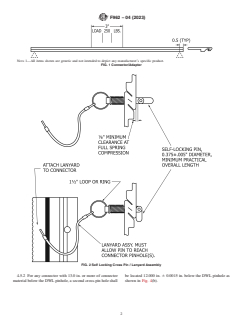
4.3 The connector or adapter shall not take more than 0.04
in. permanent set when a 250 lb load, distributed over 3 in., is
1.3 This international standard was developed in accor-
applied. The load shall be applied at the location that results in
dance with internationally recognized principles on standard-
maximum deflection and shall be resisted by supports placed
ization established in the Decision on Principles for the
⁄2 in. from each end as shown in Fig. 1.
Development of International Standards, Guides and Recom-
mendations issued by the World Trade Organization Technical
4.4 In addition to the dimensional requirements shown in
Barriers to Trade (TBT) Committee.
Fig. 2, the self-locking cross-pin/lanyard assembly shall have
the following characteristics:
2. Referenced Documents
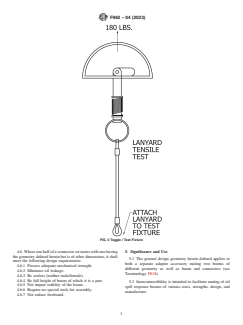
4.4.1 Its assembled strength shall resist a tensile load of 180
2.1 ASTM Standards: lbs placed upon the closed toggle by the test fixture to which
the cross pin’s lanyard is attached without deformation as
F818 Terminology Relating to Spill Response Booms and
Barriers shown in Fig. 3.
4.4.2 It shall have a ring or lanyard loop of a minimum
F1523 Guide for Selection of Booms in Accordance With
Water Body Classifications diameter of 1 ⁄2 in. for the convenience of pulling the pin from
the boom connectors.
3. Material Characteristics
4.4.3 The toggle shall turn freely and shall latch in either
direction.
3.1 End connector and cross pin materials shall be corrosion
4.4.4 The cross-pin’s spring shall be captured or locked to
resistant in sea water and such other environments as the
the assembly and shall exert a force on the toggle of between
intended service may require. If dissimilar metals are used,
16 and 22 lbs when connectors are assembled.
care shall be used in design to avoid galvanic corrosion.
4.4.5 When the cross-pin’s spring is compressed fully, there
3.2 Any material is acceptable for construction of the boom
shall be a clearance of ⁄8 in. between the short end of the toggle
connector provided consideration is given to such factors as
and the mated connector as shown in Fig. 2.
weight, mechanical strength, chemical resistance, flexibility,
4.4.6 The cross-pin’s overall length shall be minimized and
and conditions of the environment in which it is to be used.
its ends rounded or chamfered so as to minimize wear and tear
on adjacent stored booms or injury to boom handlers.
1 3
This specification is under the jurisdiction of ASTM Committee F20 on
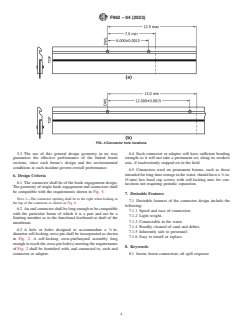
4.5 Pinholes, designed to accommodate the ⁄8 in. diameter
Hazardous Substances and Oil Spill Response and is the direct responsibility of
self-locking pin, shall be incorporated at the design water line
Subcommittee F20.11 on Control.
(DWL) and, if required, a location as determined in 4.5.1 or
Current edition approved May 1, 2023. Published May 2023. Originally
4.5.2 and shown in Fig. 4.
approved in 1986. Last previous edition approved in 2018 as F962 – 04 (2018).
DOI: 10.1520/F0962-04R23.
4.5.1 For any connector with 7.0 in. to 12.9 in. of connector
For referenced ASTM standards, visit the ASTM website, www.astm.org, or
material below the DWL pinhole, a second pinhole shall be
contact ASTM Customer Service at service@astm.org. For Annual Book of ASTM
located 6.000 in. 6 0.0015 in. below the DWL pinhole as
Standards volume information, refer to the standard’s Document Summary page on
the ASTM website. shown in Fig. 4(a).
Copyright © ASTM International, 100 Barr Harbor Drive, PO Box C700, West Conshohocken, PA 19428-2959. United States
F962 − 04 (2023)
NOTE 1—All items shown are generic and not intended to depict any manufacturer’s specific product.
FIG. 1 Connector/Adapter
FIG. 2 Self Locking Cross Pin / Lanyard Assembly
4.5.2 For any connecto
...