


ASTM C1453-19
(Test Method)Standard Test Method for the Determination of Uranium by Ignition and the Oxygen to Uranium (O/U) Atomic Ratio of Nuclear Grade Uranium Dioxide Powders and Pellets
Standard Test Method for the Determination of Uranium by Ignition and the Oxygen to Uranium (O/U) Atomic Ratio of Nuclear Grade Uranium Dioxide Powders and Pellets
SIGNIFICANCE AND USE
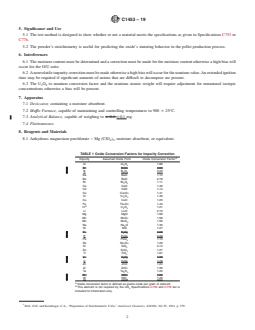
5.1 The test method is designed to show whether or not a material meets the specifications as given in Specifications C753 or C776.
5.2 The powder’s stoichiometry is useful for predicting the oxide's sintering behavior in the pellet production process.
SCOPE
1.1 This test method covers the determination of uranium and the oxygen to uranium atomic ratio in nuclear grade uranium dioxide powder and pellets.
1.2 This test method does not include provisions for preventing criticality accidents or requirements for health and safety. Observance of this test method does not relieve the user of the obligation to be aware of and conform to all international, national, or federal, state and local regulations pertaining to possessing, shipping, processing, or using source or special nuclear material.
1.3 This test method also is applicable to UO3 and U3O8 powder.
1.4 This standard does not purport to address all of the safety concerns, if any, associated with its use. It is the responsibility of the user of this standard to establish appropriate safety, health, and environmental practices and determine the applicability of regulatory limitations prior to use.
1.5 This international standard was developed in accordance with internationally recognized principles on standardization established in the Decision on Principles for the Development of International Standards, Guides and Recommendations issued by the World Trade Organization Technical Barriers to Trade (TBT) Committee.
General Information
- Status
- Published
- Publication Date
- 30-Jun-2019
- Technical Committee
- C26 - Nuclear Fuel Cycle
- Drafting Committee
- C26.05 - Methods of Test
Relations
- Effective Date
- 01-Jul-2019
- Effective Date
- 01-Jan-2024
- Effective Date
- 01-Jan-2018
- Effective Date
- 01-Feb-2016
- Effective Date
- 15-Jun-2014
- Effective Date
- 15-Jan-2014
- Effective Date
- 01-Jun-2013
- Effective Date
- 01-May-2013
- Effective Date
- 01-Sep-2011
- Effective Date
- 01-Jun-2011
- Effective Date
- 01-Jun-2011
- Effective Date
- 01-Nov-2010
- Effective Date
- 01-Aug-2010
- Effective Date
- 01-Jun-2010
- Effective Date
- 01-Feb-2010
Overview
ASTM C1453-19 is the Standard Test Method for the Determination of Uranium by Ignition and the Oxygen to Uranium (O/U) Atomic Ratio of Nuclear Grade Uranium Dioxide Powders and Pellets. Issued by ASTM International, this standard outlines procedures for accurately measuring uranium content and the O/U atomic ratio in uranium compounds used in the nuclear fuel cycle. It applies primarily to uranium dioxide (UO₂) powders and pellets but is also applicable to uranium trioxide (UO₃) and triuranium octoxide (U₃O₈) powders.
This test method is critical for quality control and specification testing during the fabrication of nuclear fuel. Understanding the precise stoichiometry and oxygen-to-uranium ratio is essential for predicting the sintering behavior of uranium dioxide, ensuring material consistency, and verifying compliance with nuclear-material specifications such as ASTM C753 or C776.
Key Topics
Scope and Applicability:
- Determination of uranium content and oxygen-to-uranium (O/U) atomic ratio in nuclear-grade uranium dioxide, UO₃, and U₃O₈.
- Does not provide safety, health, or criticality accident prevention measures; users must follow all relevant regulations.
Significance and Usefulness:
- Results indicate compliance with powder and pellet specifications (C753 and C776).
- Stoichiometric measurements are crucial for predicting sintering performance and the behavior of uranium oxide during pellet production.
Test Method Overview:
- Utilizes gravimetric analysis by ignition of uranium compounds at controlled high temperatures.
- Measures weight changes, making corrections for impurities and moisture, to accurately calculate uranium content and O/U atomic ratio.
Interferences and Corrections:
- Correction for moisture content is mandatory to prevent skewed (high) O/U ratios.
- Nonvolatile impurities must be identified and corrected for accurate uranium values.
- Conversion factors and atomic weights may need adjustment for samples with non-natural uranium isotopic compositions.
Applications
ASTM C1453-19 is mainly applied within the nuclear materials and fuel fabrication sectors:
Fuel Pellet Fabrication:
- Ensures uranium dioxide powders and sintered pellets meet precise chemical specifications.
- Accurate O/U ratio aids in optimizing sintering and achieving desired pellet density and microstructure.
Nuclear Quality Control:
- Routine quality assurance for incoming materials and finished products.
- Detects deviations in stoichiometry or impurity levels that could affect reactor performance.
Regulatory and Safety Compliance:
- Supports compliance with nuclear industry material specifications and traceability requirements.
- Facilitates documentation for audits and regulatory reviews.
Material Research:
- Provides a standardized method for research laboratories investigating uranium dioxide chemistry or developing new nuclear fuel materials.
Related Standards
ASTM C696: Test Methods for Chemical, Mass Spectrometric, and Spectrochemical Analysis of Nuclear-Grade Uranium Dioxide Powders and Pellets
- Reference method for impurity determinations.
ASTM C753: Specification for Nuclear-Grade, Sinterable Uranium Dioxide Powder
- Material specification referenced for compliance.
ASTM C776: Specification for Sintered Uranium Dioxide Pellets for Light Water Reactors
- Pellet specification for finished fuel.
ASTM C859: Terminology Relating to Nuclear Materials
- Standardized definitions for terms used in nuclear material testing.
ASTM C1267: Test Method for Uranium by Iron (II) Reduction in Phosphoric Acid Followed by Chromium (VI) Titration in the Presence of Vanadium
- Alternative method for precise uranium determination.
ASTM C1287: Test Method for Determination of Impurities in Nuclear Grade Uranium Compounds by Inductively Coupled Plasma Mass Spectrometry
- Modern technique for impurity analysis.
Keywords: uranium determination, ignition method, oxygen to uranium ratio, O/U atomic ratio, uranium dioxide powder, nuclear fuel pellets, ASTM C1453-19, nuclear materials analysis, uranium quality control, nuclear-grade specifications
Buy Documents

ASTM C1453-19 - Standard Test Method for the Determination of Uranium by Ignition and the Oxygen to Uranium (O/U) Atomic Ratio of Nuclear Grade Uranium Dioxide Powders and Pellets
REDLINE ASTM C1453-19 - Standard Test Method for the Determination of Uranium by Ignition and the Oxygen to Uranium (O/U) Atomic Ratio of Nuclear Grade Uranium Dioxide Powders and Pellets
Get Certified
Connect with accredited certification bodies for this standard

DNV
DNV is an independent assurance and risk management provider.

Lloyd's Register
Lloyd's Register is a global professional services organisation specialising in engineering and technology.
DNV Energy Systems
Energy and renewable energy certification.
Sponsored listings
Frequently Asked Questions
ASTM C1453-19 is a standard published by ASTM International. Its full title is "Standard Test Method for the Determination of Uranium by Ignition and the Oxygen to Uranium (O/U) Atomic Ratio of Nuclear Grade Uranium Dioxide Powders and Pellets". This standard covers: SIGNIFICANCE AND USE 5.1 The test method is designed to show whether or not a material meets the specifications as given in Specifications C753 or C776. 5.2 The powder’s stoichiometry is useful for predicting the oxide's sintering behavior in the pellet production process. SCOPE 1.1 This test method covers the determination of uranium and the oxygen to uranium atomic ratio in nuclear grade uranium dioxide powder and pellets. 1.2 This test method does not include provisions for preventing criticality accidents or requirements for health and safety. Observance of this test method does not relieve the user of the obligation to be aware of and conform to all international, national, or federal, state and local regulations pertaining to possessing, shipping, processing, or using source or special nuclear material. 1.3 This test method also is applicable to UO3 and U3O8 powder. 1.4 This standard does not purport to address all of the safety concerns, if any, associated with its use. It is the responsibility of the user of this standard to establish appropriate safety, health, and environmental practices and determine the applicability of regulatory limitations prior to use. 1.5 This international standard was developed in accordance with internationally recognized principles on standardization established in the Decision on Principles for the Development of International Standards, Guides and Recommendations issued by the World Trade Organization Technical Barriers to Trade (TBT) Committee.
SIGNIFICANCE AND USE 5.1 The test method is designed to show whether or not a material meets the specifications as given in Specifications C753 or C776. 5.2 The powder’s stoichiometry is useful for predicting the oxide's sintering behavior in the pellet production process. SCOPE 1.1 This test method covers the determination of uranium and the oxygen to uranium atomic ratio in nuclear grade uranium dioxide powder and pellets. 1.2 This test method does not include provisions for preventing criticality accidents or requirements for health and safety. Observance of this test method does not relieve the user of the obligation to be aware of and conform to all international, national, or federal, state and local regulations pertaining to possessing, shipping, processing, or using source or special nuclear material. 1.3 This test method also is applicable to UO3 and U3O8 powder. 1.4 This standard does not purport to address all of the safety concerns, if any, associated with its use. It is the responsibility of the user of this standard to establish appropriate safety, health, and environmental practices and determine the applicability of regulatory limitations prior to use. 1.5 This international standard was developed in accordance with internationally recognized principles on standardization established in the Decision on Principles for the Development of International Standards, Guides and Recommendations issued by the World Trade Organization Technical Barriers to Trade (TBT) Committee.
ASTM C1453-19 is classified under the following ICS (International Classification for Standards) categories: 27.120.30 - Fissile materials and nuclear fuel technology. The ICS classification helps identify the subject area and facilitates finding related standards.
ASTM C1453-19 has the following relationships with other standards: It is inter standard links to ASTM C1453-00(2011), ASTM C859-24, ASTM C1287-18, ASTM C753-16, ASTM C859-14a, ASTM C859-14, ASTM C859-13a, ASTM C859-13, ASTM C696-11, ASTM C1267-11, ASTM C776-06(2011), ASTM C859-10b, ASTM C859-10a, ASTM C1287-10, ASTM C859-10. Understanding these relationships helps ensure you are using the most current and applicable version of the standard.
ASTM C1453-19 is available in PDF format for immediate download after purchase. The document can be added to your cart and obtained through the secure checkout process. Digital delivery ensures instant access to the complete standard document.
Standards Content (Sample)
This international standard was developed in accordance with internationally recognized principles on standardization established in the Decision on Principles for the
Development of International Standards, Guides and Recommendations issued by the World Trade Organization Technical Barriers to Trade (TBT) Committee.
Designation: C1453 − 19
Standard Test Method for
the Determination of Uranium by Ignition and the Oxygen to
Uranium (O/U) Atomic Ratio of Nuclear Grade Uranium
Dioxide Powders and Pellets
This standard is issued under the fixed designation C1453; the number immediately following the designation indicates the year of
original adoption or, in the case of revision, the year of last revision.Anumber in parentheses indicates the year of last reapproval.A
superscript epsilon (´) indicates an editorial change since the last revision or reapproval.
1. Scope C753Specification for Nuclear-Grade, Sinterable Uranium
Dioxide Powder
1.1 This test method covers the determination of uranium
C776SpecificationforSinteredUraniumDioxidePelletsfor
and the oxygen to uranium atomic ratio in nuclear grade
Light Water Reactors
uranium dioxide powder and pellets.
C859Terminology Relating to Nuclear Materials
1.2 This test method does not include provisions for pre-
C1267Test Method for Uranium by Iron (II) Reduction in
venting criticality accidents or requirements for health and
PhosphoricAcid Followed by Chromium (VI)Titration in
safety.Observanceofthistestmethoddoesnotrelievetheuser
the Presence of Vanadium
of the obligation to be aware of and conform to all
C1287Test Method for Determination of Impurities in
international, national, or federal, state and local regulations
Nuclear Grade Uranium Compounds by Inductively
pertaining to possessing, shipping, processing, or using source
Coupled Plasma Mass Spectrometry
or special nuclear material.
3. Terminology
1.3 This test method also is applicable to UO and U O
3 3 8
powder.
3.1 For definitions of terms used in this test method but not
1.4 This standard does not purport to address all of the defined herein, refer to Terminology C859.
safety concerns, if any, associated with its use. It is the
4. Summary of Test Method
responsibility of the user of this standard to establish appro-
priate safety, health, and environmental practices and deter-
4.1 A weighed portion of UO is converted to U O by
2 3 8
mine the applicability of regulatory limitations prior to use.
repeated ignition at 900°C in air, to a constant weight.
1.5 This international standard was developed in accor-
Corrections are made for nonvolatile and volatile impurities
dance with internationally recognized principles on standard-
including moisture, based on independent determinations de-
3,4
ization established in the Decision on Principles for the
scribed in Test Methods C696 and C1287.
Development of International Standards, Guides and Recom-
mendations issued by the World Trade Organization Technical
5. Significance and Use
Barriers to Trade (TBT) Committee.
5.1 The test method is designed to show whether or not a
material meets the specifications as given in Specifications
2. Referenced Documents
C753 or C776.
2.1 ASTM Standards:
5.2 The powder’s stoichiometry is useful for predicting the
C696Test Methods for Chemical, Mass Spectrometric, and
oxide’s sintering behavior in the pellet production process.
SpectrochemicalAnalysis of Nuclear-Grade Uranium Di-
oxide Powders and Pellets
6. Interferences
6.1 The moisture content must be determined and a correc-
tion must be made for the moisture content otherwise a high
This test method is under the jurisdiction ofASTM committee C26 on Nuclear
Fuel Cycle and is the direct responsibility of Subcommittee C26.05 on Methods of
bias will occur for the O/U ratio.
Test.
Current edition approved July 1, 2019. Published August 2019. Originally
approved in 2000. Last previous edition approved in 2011 as C1453–00 (2011).
DOI: 10.1520/C1453-19. Jones, R.J., Ed., “Selected Measurement Methods for Plutonium and Uranium
For referenced ASTM standards, visit the ASTM website, www.astm.org, or in the Nuclear Fuel Cycle,” USAEC Document TID-7029, 1963, AERDB, pp.
contact ASTM Customer Service at service@astm.org. For Annual Book of ASTM 91–93.
Standards volume information, refer to the standard’s Document Summary page on Petit, G.D. and Keinberger, C.A., “Preparation of Stoichiometric U O ,”
3 8
the ASTM website. Analytical Chemistry, ANCHA, Vol 25, 1961, p. 579.
Copyright © ASTM International, 100 Barr Harbor Drive, PO Box C700, West Conshohocken, PA 19428-2959. United States
C1453 − 19
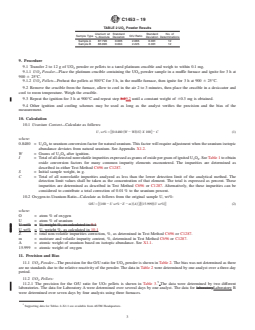
TABLE 2 UO Powder Results
6.2 A nonvolatile impurity correction must be made other-
wiseahighbiaswilloccurfortheuraniumvalue.Anextended Uranium wt Standard Standard No. of
Sample Type O/U Ratio
% Absolute Deviation Deviation Determinations
ignition time may be required if significant amounts of anions
Sample A 87.796 0.005 2.065 0.001 12
that are difficult to decompose are present.
Sample B 86.996 0.004 2.225 0.001 12
6.3 TheU O touraniumconversionfactorandtheuranium
3 8
atomic weight will require adjustment for nonnatural isotopic
concentrations otherwise a bias will be present.
9.2 Remove the crucible from the furnace, allow to cool in
7. Apparatus
the air 2 to 3 minutes, then place the crucible in a desiccator
7.1 Desiccator, containing a moisture absorbent.
and cool to room temperature. Weigh the crucible.
7.2 Muffle Furnace, capable of maintaining and controlling
9.3 Repeat the ignition for 3 h at 900°C and repeat step 9.2
temperatures to 900 6 25°C.
until a constant weight of 60.3 mg is obtained.
7.3 Analytical Balance, capable of weighing to 60.1 mg.
9.4 Otherignitionandcoolingschemesmaybeusedaslong
as the analyst verifies the precision and the bias of the
7.4 Platinumware.
measurement.
8. Reagents and Materials
10. Calculation
8.1 Anhydrousmagnesiumperchlorate−Mg(ClO ) ,mois-
4 2
10.1 Uranium Content—Calculate as follows:
ture absorbent, or equivalent.
U, wt% 5 0.8480 W 2 WI /S X 100 2 C (1)
@~ ~ ! ! #
9. Procedure
where:
9.1 Transfer 2 to 12 g of UO powder or pellets to a tared
0.8480 = U O to uranium conversion factor for natural
3 8
platinum crucible and weigh to within 0.1 mg.
uranium. This factor will require adjustment when
9.1.1 UO Powder—Place the platinum crucible containing
the uranium isotopic abundance deviates from
the UO powder sample in a muffle furnace and ignite for 3 h
natural uranium. See Appendix X1.2.
at 900 6 25°C.
W = Grams of U O after ignition.
3 8
9.1.2 UO Pellets—Preheat the pellets at 500°C for 3 h, in
I = Total of all detected nonvolatile impurities ex-
the muffle furnace, then ignite for3hat900 6 25°C.
pressed as grams
...
This document is not an ASTM standard and is intended only to provide the user of an ASTM standard an indication of what changes have been made to the previous version. Because
it may not be technically possible to adequately depict all changes accurately, ASTM recommends that users consult prior editions as appropriate. In all cases only the current version
of the standard as published by ASTM is to be considered the official document.
Designation: C1453 − 00 (Reapproved 2011) C1453 − 19
Standard Test Method for
the Determination of Uranium by Ignition and the Oxygen to
Uranium (O/U) Atomic Ratio of Nuclear Grade Uranium
Dioxide Powders and Pellets
This standard is issued under the fixed designation C1453; the number immediately following the designation indicates the year of
original adoption or, in the case of revision, the year of last revision. A number in parentheses indicates the year of last reapproval. A
superscript epsilon (´) indicates an editorial change since the last revision or reapproval.
1. Scope
1.1 This test method covers the determination of uranium and the oxygen to uranium atomic ratio in nuclear grade uranium
dioxide powder and pellets.
1.2 This test method does not include provisions for preventing criticality accidents or requirements for health and safety.
Observance of this test method does not relieve the user of the obligation to be aware of and conform to all international, national,
or federal, state and local regulations pertaining to possessing, shipping, processing, or using source or special nuclear material.
1.3 This test method also is applicable to UO and U O powder.
3 3 8
1.4 This standard does not purport to address all of the safety concerns, if any, associated with its use. It is the responsibility
of the user of this standard to establish appropriate safety safety, health, and healthenvironmental practices and determine the
applicability of regulatory limitations prior to use.
1.4 This test method also is applicable to UO and U O powder.
3 3 8
1.5 This international standard was developed in accordance with internationally recognized principles on standardization
established in the Decision on Principles for the Development of International Standards, Guides and Recommendations issued
by the World Trade Organization Technical Barriers to Trade (TBT) Committee.
2. Referenced Documents
2.1 ASTM Standards:
C696 Test Methods for Chemical, Mass Spectrometric, and Spectrochemical Analysis of Nuclear-Grade Uranium Dioxide
Powders and Pellets
C753 Specification for Nuclear-Grade, Sinterable Uranium Dioxide Powder
C776 Specification for Sintered Uranium Dioxide Pellets for Light Water Reactors
C859 Terminology Relating to Nuclear Materials
C1267 Test Method for Uranium by Iron (II) Reduction in Phosphoric Acid Followed by Chromium (VI) Titration in the
Presence of Vanadium
C1287 Test Method for Determination of Impurities in Nuclear Grade Uranium Compounds by Inductively Coupled Plasma
Mass Spectrometry
3. Terminology
3.1 For definitions of terms used in this test method but not defined herein, refer to Terminology C859.
4. Summary of Test Method
4.1 A weighed portion of UO is converted to U O by repeated ignition at 900°C in air, to a constant weight. Corrections are
2 3 8
made for nonvolatile and volatile impurities including moisture, based on independent determinations described in Test Methods
3,4
C696 and C1287.
This test method is under the jurisdiction of ASTM committee C26 on Nuclear Fuel Cycle and is the direct responsibility of Subcommittee C26.05 on Methods of Test.
Current edition approved July 1, 2011July 1, 2019. Published July 2011August 2019. Originally approved in 2000. Last previous edition approved in 20062011 as
C1453 – 00 (2011).R06. DOI: 10.1520/C1453-00R11.10.1520/C1453-19.
For referenced ASTM standards, visit the ASTM website, www.astm.org, or contact ASTM Customer Service at service@astm.org. For Annual Book of ASTM Standards
volume information, refer to the standard’s Document Summary page on the ASTM website.
Jones, R.J., Ed., “Selected Measurement Methods for Plutonium and Uranium in the Nuclear Fuel Cycle,” USAEC Document TID-7029, 1963, AERDB, pp. 91–93.
Copyright © ASTM International, 100 Barr Harbor Drive, PO Box C700, West Conshohocken, PA 19428-2959. United States
C1453 − 19
5. Significance and Use
5.1 The test method is designed to show whether or not a material meets the specifications as given in Specifications C753 or
C776.
5.2 The powder’s stoichiometry is useful for predicting the oxide’s sintering behavior in the pellet production process.
6. Interferences
6.1 The moisture content must be determined and a correction must be made for the moisture content otherwise a high bias will
occur for the O/U ratio.
6.2 A nonvolatile impurity correction must be made otherwise a high bias will occur for the uranium value. An extended ignition
time may be required if significant amounts of anions that are difficult to decompose are present.
6.3 The U O to uranium conversion factor and the uranium atomic weight will require adjustment for nonnatural isotopic
3 8
concentrations otherwise a bias will be present.
7. Apparatus
7.1 Desiccator, containing a moisture absorbent.
7.2 Muffle Furnace, capable of maintaining and controlling temperatures to 900 6 25°C.
7.3 Analytical Balance, capable of weighing to 6 0.1 60.1 mg.
7.4 Platinumware.
8. Reagents and Materials
8.1 Anhydrous magnesium perchlorate − Mg (ClO ) , moisture absorbent, or equivalent.
4 2
TABLE 1 Oxide Conversion Factors for Impurity Correction
A
Impurity Assumed Oxide Form Oxide Conversion Factor
Al Al O 1.89
2 3
B B O 3.23
2 3
B B O 3.23
2 3
Ba BaO 1.12
Be BeO 2.78
Bi Bi O 1.11
2 3
Ca CaO 1.40
Cd CdO 1.14
Co Co O 1.41
2 3
Cr Cr O 1.46
2 3
Cu CuO 1.25
Fe Fe O 1.43
2 3
B
In In O 1.21
2 3
Li Li O 2.15
Mg MgO 1.66
Mn MnO 1.58
Mo MoO 1.50
Na Na O 1.35
Ni NiO 1.27
P P O 2.29
2 5
P P O 2.29
2 5
Pb PbO 1.15
Sb Sb O 1.26
2 4
Si SiO 2.14
Sn SnO 1.27
Ti TiO 1.67
V V O 1.79
2 5
V V O 1.79
2 5
Zn ZnO 1.24
Zr ZrO 1.35
Ta Ta O 1.22
2 5
W WO 1.26
W WO 1.26
A
Oxide conversion factor is defined as grams oxide per gram of element.
B
This element is not required by the UO Specifications C753 and C776 but is
included for information only.
Petit, G.D. and Keinberger, C.A., “Preparation of Stoichiometric U O ,” Analytical Chemistry, ANCHA, Vol 25, 1961, p. 579.
3 8
C1453 − 19
TABLE 2 UO Powder Results
Uranium wt Standard Standard No. of
Sample Type O/U Ratio
% Absolute Deviation Deviation Determinations
Sample A 87.796 0.005 2.065 0.001 12
Sample B 86.996 0.004 2.225 0.001 12
9. Procedure
9.1 Transfer 2 to 12 g of UO powder or pellets to a tared platinum crucible and weigh to within 0.1 mg.
9.1.1 UO Powder—Place the platinum crucible containing the UO powder sample in a muffle furnace and ignite for 3 h at
2 2
900 6 25°C.
9.1.2 UO Pellets—Preheat the pellets at 500°C for 3 h, in the muffle furnace, then ignite for 3
...
Questions, Comments and Discussion
Ask us and Technical Secretary will try to provide an answer. You can facilitate discussion about the standard in here.
Loading comments...