

ASTM F939-19
(Practice)Standard Practice for Selection of Release Torque Values for Alpine Ski Bindings
General Information
- Abstract
ABSTRACT
This practice establishes procedures for the selection of release torque values for Alpine ski/boot/binding systems. The recommended release torque is chosen based on skier type, age, and other factors such as adjustments for normal, discretionary, and release/retention settings. Also discussed are methods of selecting skier type, determining skier code, and determining release torque value. Procedures discussed in this practice may be used by ski binding manufacturers in their instructions for installation and use and by ski shops for making adjustments on already mounted ski bindings. However, this practice does not cover nonmechanical bindings or bindings used with boots that reach more than halfway up the lower leg.
SCOPE
1.1 This practice provides procedures for the selection of release torque values for Alpine ski/boot/bindings systems. These procedures may be used by ski binding manufacturers in their instructions for installation and use and by ski shops for the adjustment of already mounted ski bindings.
1.2 This practice is applicable to releasable Alpine ski/boot/binding systems.
1.3 Release torque values selected using this practice may not be appropriate for circumstances in which:
1.3.1 The skier carries an object that significantly increases the skier's effective body weight,
1.3.2 The skier grasps or in some manner controls an object such as a sled, or
1.3.3 The skier encounters exceptional snow or terrain conditions not commonly found on developed ski slopes.
1.4 This practice may be inappropriate for non-mechanical bindings or bindings used with boots that reach more than half way up the lower leg.
1.5 Release torque values outside the recommendations of this practice may increase the risk of injury to the skier. However, skiers who are informed of this potential risk may request such settings and have them provided, subject to any guidelines and limitations specified by the binding manufacturer.
1.6 These values refer to recommended release torque for initial adjustment of a ski binding and subsequent readjustment of the binding during routine maintenance or following a suspected malfunction. However, these values are not intended to apply to the condition of the equipment at any time after it is put into use.
1.6.1 For information concerning applicable tolerances to be used for the adjustment and inspection of releasable Alpine ski bindings in retail operations consult Practice F1063; for rental applications consult Practice F1064.
1.7 This standard does not purport to address all of the safety concerns, if any, associated with its use. It is the responsibility of the user of this standard to establish appropriate safety, health, and environmental practices and determine the applicability of regulatory limitations prior to use.
1.8 This international standard was developed in accordance with internationally recognized principles on standardization established in the Decision on Principles for the Development of International Standards, Guides and Recommendations issued by the World Trade Organization Technical Barriers to Trade (TBT) Committee.
- Status
- Published
- Publication Date
- 31-Dec-2018
- Technical Committee
- F27 - Snow and Water Sports
- Drafting Committee
- F27.10 - Binding Test Procedures
Buy Documents

ASTM F939-19 - Standard Practice for Selection of Release Torque Values for Alpine Ski Bindings
REDLINE ASTM F939-19 - Standard Practice for Selection of Release Torque Values for Alpine Ski Bindings
Overview
ASTM F939-19 establishes standardized procedures for selecting release torque values for Alpine ski/boot/binding systems. Released by ASTM International, this practice helps manufacturers, ski technicians, and retailers determine appropriate ski binding settings to support skier safety and equipment functionality. These guidelines are applicable to mechanically releasable Alpine bindings and highlight key factors such as skier type, age, weight, height, and specific adjustments for different skiing situations.
Correct release torque settings are essential to promote releasability in case of a fall, while also minimizing unintended binding release during regular on-slope activity. The goal of this standard is to reduce the risk of injury related to improper binding adjustment, though it cannot guarantee absolute safety due to inherent risks in skiing.
Key Topics
- Release Torque Selection: Details the selection process for release torque values based on skier-related factors including mass, age, skier type, and discretionary adjustments.
- Skier Type Classification: Differentiates between Type I (cautious or entry-level), Type II (average recreational), and Type III (aggressive or advanced) skiers, with corresponding impact on recommended torque settings.
- Adjustment Methods:
- Normal settings are derived from standard skier type.
- Discretionary settings are for skiers requiring lower or higher than typical release values, following informed consent.
- Age Adjustments: Recommends lower torque values for children (age 9 and under) and older adults (age 50 and above) to improve releasability.
- Application Limits: The standard is not intended for non-mechanical bindings or boots that extend past halfway up the lower leg and may not apply in extreme or unusual skiing scenarios (e.g., atypical snow, carrying heavy objects, or controlling sleds).
- Responsibilities: Outlines that final safety, health, and environmental practice decisions rest with users and operators.
Applications
ASTM F939-19 serves multiple practical uses in the alpine ski equipment sector:
- Ski Binding Manufacturers: Applies to the development of user manuals and recommended procedures for new product installations and adjustments.
- Ski Shop Technicians: Provides a reliable reference for adjusting mounted ski bindings during equipment setup, customer fitting, and periodic maintenance.
- Rental Operations: Informs safe and standardized adjustment protocols for rental bindings when paired with other ASTM practices.
- Safety and Injury Reduction: By standardizing release torque selection, this document aims to align binding settings more accurately with skier characteristics, potentially reducing injury from both premature release and non-release during falls.
Users must be aware that compliance contributes to injury risk reduction but does not eliminate risk entirely due to the variable nature of skiing accidents.
Related Standards
The ASTM F939-19 standard references several related documents essential for a comprehensive safety and performance approach in Alpine skiing:
- ASTM F504: Test Method for Measuring the Quasi-Static Release Moments of Alpine Ski Bindings
- ASTM F1061: Specification for Ski Binding Test Devices
- ASTM F1063: Practice for Functional Inspections and Adjustments of Alpine Ski/Binding/Boot Systems (especially relevant for retail settings)
- ASTM F1064: Practice for Sampling and Inspection of Complete and Incomplete Alpine Ski/Binding/Boot Systems in Rental Applications
- ISO 8061: Method for the Selection of Release Torque Values (international alignment)
Adhering to these related standards in conjunction with ASTM F939-19 contributes to harmonized quality, safety, and performance for Alpine ski bindings across manufacturers and service providers.
Keywords
- Release torque
- Alpine ski bindings
- Ski binding adjustment
- Skier type
- Binding safety
- Ski equipment standards
- ASTM F939-19
Relations
- Replaces
ASTM F939-18 - Standard Practice for Selection of Release Torque Values for Alpine Ski Bindings - Effective Date
- 01-Jan-2019
- Effective Date
- 01-Jul-2014
- Effective Date
- 01-Jul-2013
- Effective Date
- 01-Jun-2012
- Effective Date
- 01-Jun-2011
- Effective Date
- 01-Jun-2009
- Effective Date
- 01-Jan-2008
- Effective Date
- 01-Aug-2006
- Effective Date
- 01-Oct-2005
- Effective Date
- 01-Oct-2005
- Effective Date
- 01-Oct-2005
- Effective Date
- 01-Feb-2005
- Effective Date
- 01-Sep-2004
- Effective Date
- 01-Aug-2004
- Effective Date
- 10-Jul-2003
Buy Documents
ASTM F939-19 - Standard Practice for Selection of Release Torque Values for Alpine Ski Bindings
REDLINE ASTM F939-19 - Standard Practice for Selection of Release Torque Values for Alpine Ski Bindings
Frequently Asked Questions
ASTM F939-19 is a standard published by ASTM International. Its full title is "Standard Practice for Selection of Release Torque Values for Alpine Ski Bindings". This standard covers: ABSTRACT This practice establishes procedures for the selection of release torque values for Alpine ski/boot/binding systems. The recommended release torque is chosen based on skier type, age, and other factors such as adjustments for normal, discretionary, and release/retention settings. Also discussed are methods of selecting skier type, determining skier code, and determining release torque value. Procedures discussed in this practice may be used by ski binding manufacturers in their instructions for installation and use and by ski shops for making adjustments on already mounted ski bindings. However, this practice does not cover nonmechanical bindings or bindings used with boots that reach more than halfway up the lower leg. SCOPE 1.1 This practice provides procedures for the selection of release torque values for Alpine ski/boot/bindings systems. These procedures may be used by ski binding manufacturers in their instructions for installation and use and by ski shops for the adjustment of already mounted ski bindings. 1.2 This practice is applicable to releasable Alpine ski/boot/binding systems. 1.3 Release torque values selected using this practice may not be appropriate for circumstances in which: 1.3.1 The skier carries an object that significantly increases the skier's effective body weight, 1.3.2 The skier grasps or in some manner controls an object such as a sled, or 1.3.3 The skier encounters exceptional snow or terrain conditions not commonly found on developed ski slopes. 1.4 This practice may be inappropriate for non-mechanical bindings or bindings used with boots that reach more than half way up the lower leg. 1.5 Release torque values outside the recommendations of this practice may increase the risk of injury to the skier. However, skiers who are informed of this potential risk may request such settings and have them provided, subject to any guidelines and limitations specified by the binding manufacturer. 1.6 These values refer to recommended release torque for initial adjustment of a ski binding and subsequent readjustment of the binding during routine maintenance or following a suspected malfunction. However, these values are not intended to apply to the condition of the equipment at any time after it is put into use. 1.6.1 For information concerning applicable tolerances to be used for the adjustment and inspection of releasable Alpine ski bindings in retail operations consult Practice F1063; for rental applications consult Practice F1064. 1.7 This standard does not purport to address all of the safety concerns, if any, associated with its use. It is the responsibility of the user of this standard to establish appropriate safety, health, and environmental practices and determine the applicability of regulatory limitations prior to use. 1.8 This international standard was developed in accordance with internationally recognized principles on standardization established in the Decision on Principles for the Development of International Standards, Guides and Recommendations issued by the World Trade Organization Technical Barriers to Trade (TBT) Committee.
ABSTRACT This practice establishes procedures for the selection of release torque values for Alpine ski/boot/binding systems. The recommended release torque is chosen based on skier type, age, and other factors such as adjustments for normal, discretionary, and release/retention settings. Also discussed are methods of selecting skier type, determining skier code, and determining release torque value. Procedures discussed in this practice may be used by ski binding manufacturers in their instructions for installation and use and by ski shops for making adjustments on already mounted ski bindings. However, this practice does not cover nonmechanical bindings or bindings used with boots that reach more than halfway up the lower leg. SCOPE 1.1 This practice provides procedures for the selection of release torque values for Alpine ski/boot/bindings systems. These procedures may be used by ski binding manufacturers in their instructions for installation and use and by ski shops for the adjustment of already mounted ski bindings. 1.2 This practice is applicable to releasable Alpine ski/boot/binding systems. 1.3 Release torque values selected using this practice may not be appropriate for circumstances in which: 1.3.1 The skier carries an object that significantly increases the skier's effective body weight, 1.3.2 The skier grasps or in some manner controls an object such as a sled, or 1.3.3 The skier encounters exceptional snow or terrain conditions not commonly found on developed ski slopes. 1.4 This practice may be inappropriate for non-mechanical bindings or bindings used with boots that reach more than half way up the lower leg. 1.5 Release torque values outside the recommendations of this practice may increase the risk of injury to the skier. However, skiers who are informed of this potential risk may request such settings and have them provided, subject to any guidelines and limitations specified by the binding manufacturer. 1.6 These values refer to recommended release torque for initial adjustment of a ski binding and subsequent readjustment of the binding during routine maintenance or following a suspected malfunction. However, these values are not intended to apply to the condition of the equipment at any time after it is put into use. 1.6.1 For information concerning applicable tolerances to be used for the adjustment and inspection of releasable Alpine ski bindings in retail operations consult Practice F1063; for rental applications consult Practice F1064. 1.7 This standard does not purport to address all of the safety concerns, if any, associated with its use. It is the responsibility of the user of this standard to establish appropriate safety, health, and environmental practices and determine the applicability of regulatory limitations prior to use. 1.8 This international standard was developed in accordance with internationally recognized principles on standardization established in the Decision on Principles for the Development of International Standards, Guides and Recommendations issued by the World Trade Organization Technical Barriers to Trade (TBT) Committee.
ASTM F939-19 is classified under the following ICS (International Classification for Standards) categories: 97.220.20 - Winter sports equipment. The ICS classification helps identify the subject area and facilitates finding related standards.
ASTM F939-19 has the following relationships with other standards: It is inter standard links to ASTM F939-18, ASTM F1063-09(2014), ASTM F1061-08(2013), ASTM F504-05(2012), ASTM F1064-11, ASTM F1063-09, ASTM F1061-08, ASTM F1064-06, ASTM F1063-05e1, ASTM F1063-05, ASTM F1064-05, ASTM F504-05, ASTM F504-04, ASTM F1063-04, ASTM F1063-03. Understanding these relationships helps ensure you are using the most current and applicable version of the standard.
ASTM F939-19 is available in PDF format for immediate download after purchase. The document can be added to your cart and obtained through the secure checkout process. Digital delivery ensures instant access to the complete standard document.
Standards Content (Sample)
This international standard was developed in accordance with internationally recognized principles on standardization established in the Decision on Principles for the
Development of International Standards, Guides and Recommendations issued by the World Trade Organization Technical Barriers to Trade (TBT) Committee.
Designation: F939 − 19
Standard Practice for
Selection of Release Torque Values for Alpine Ski Bindings
ThisstandardisissuedunderthefixeddesignationF939;thenumberimmediatelyfollowingthedesignationindicatestheyearoforiginal
adoptionor,inthecaseofrevision,theyearoflastrevision.Anumberinparenthesesindicatestheyearoflastreapproval.Asuperscript
epsilon (´) indicates an editorial change since the last revision or reapproval.
INTRODUCTION
Adheringtotheseguidelinesmayhelptoreducetheriskofinjuriesresultingfromimproperrelease
torque selection. However, skiing involves inherent risks. Injury can result from simply falling down,
impact with another object, or from many other actions. Many injuries are unrelated to binding
release/retention characteristics. Furthermore, even a properly adjusted binding cannot release under
all injury-producing loads or retain at all times when retention is desired.Therefore, it is to be clearly
understood that compliance with these guidelines in no way guarantees that injury can be prevented.
1. Scope of the binding during routine maintenance or following a
suspectedmalfunction.However,thesevaluesarenotintended
1.1 This practice provides procedures for the selection of
to apply to the condition of the equipment at any time after it
release torque values for Alpine ski/boot/bindings systems.
is put into use.
Theseproceduresmaybeusedbyskibindingmanufacturersin
1.6.1 For information concerning applicable tolerances to
their instructions for installation and use and by ski shops for
be used for the adjustment and inspection of releasableAlpine
the adjustment of already mounted ski bindings.
ski bindings in retail operations consult Practice F1063; for
1.2 ThispracticeisapplicabletoreleasableAlpineski/boot/
rental applications consult Practice F1064.
binding systems.
1.7 This standard does not purport to address all of the
1.3 Release torque values selected using this practice may
safety concerns, if any, associated with its use. It is the
not be appropriate for circumstances in which:
responsibility of the user of this standard to establish appro-
1.3.1 The skier carries an object that significantly increases
priate safety, health, and environmental practices and deter-
the skier’s effective body weight,
mine the applicability of regulatory limitations prior to use.
1.3.2 Theskier graspsor insomemanner controlsanobject
1.8 This international standard was developed in accor-
such as a sled, or
dance with internationally recognized principles on standard-
1.3.3 The skier encounters exceptional snow or terrain
ization established in the Decision on Principles for the
conditions not commonly found on developed ski slopes.
Development of International Standards, Guides and Recom-
mendations issued by the World Trade Organization Technical
1.4 This practice may be inappropriate for non-mechanical
Barriers to Trade (TBT) Committee.
bindings or bindings used with boots that reach more than half
way up the lower leg.
2. Referenced Documents
1.5 Release torque values outside the recommendations of
2.1 ASTM Standards:
this practice may increase the risk of injury to the skier.
F504Test Method for Measuring the Quasi-Static Release
However, skiers who are informed of this potential risk may
Moments of Alpine Ski Bindings
request such settings and have them provided, subject to any
F1061Specification for Ski Binding Test Devices
guidelines and limitations specified by the binding manufac-
F1063Practice for Functional Inspections and Adjustments
turer.
of Alpine Ski/Binding/Boot Systems
1.6 These values refer to recommended release torque for
F1064Practice for Sampling and Inspection of Complete
initialadjustmentofaskibindingandsubsequentreadjustment
and Incomplete Alpine Ski/Binding/Boot Systems in
Rental Applications
This practice is under the jurisdiction ofASTM Committee F27 on Snow and
Water Sports and is the direct responsibility of Subcommittee F27.10 on Binding
Test Procedures. For referenced ASTM standards, visit the ASTM website, www.astm.org, or
Current edition approved Jan. 1, 2019. Published February 2019. Originally contact ASTM Customer Service at service@astm.org. For Annual Book of ASTM
approved in 1985. Last previous edition approved in 2018 as F939–18. DOI: Standards volume information, refer to the standard’s Document Summary page on
10.1520/F0939-19. the ASTM website.
Copyright © ASTM International, 100 Barr Harbor Drive, PO Box C700, West Conshohocken, PA 19428-2959. United States
F939 − 19
2.2 ISO Standard: 5. Procedures
8061Method for the Selection of Release Torque Values
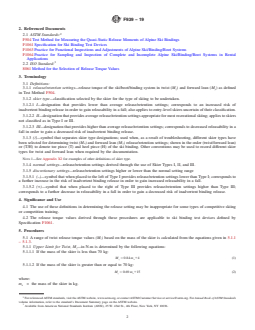
5.1 Arange of twist release torque values (M ) based on the
z
massoftheskieriscalculatedfromtheequationsgivenin5.1.1
3. Terminology
– 5.1.3.
3.1 Definitions:
5.1.1 Upper Limit for Twist, M —in N-m is determined by
z
3.1.1 release/retention settings—release torque of the ski/
the following equations:
boot/binding system in twist (M ) and forward lean (M)as
z y
5.1.1.1 If the mass of the skier is less than 70 kg:
defined in Test Method F504.
M 50.84 m 14 (1)
z s
3.1.2 skier type—classification selected by the skier for the
type of skiing to be undertaken.
5.1.1.2 If the mass of the skier is greater than or equal to 70
kg:
3.1.2.1 I—designation that provides lower than average
release/retention settings; corresponds to an increased risk of
M 50.69 m 115 (2)
z s
inadvertent binding release in order to gain releasability in a
where:
fall; also applies to entry-level skiers uncertain of their
m = the mass of the skier in kg.
classification. s
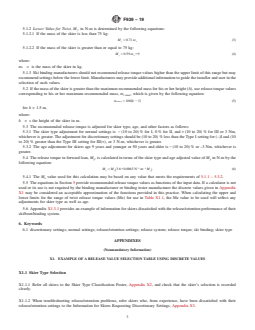
5.1.2 Lower Value for Twist, M , in N-m is determined by
3.1.2.2 II—designation that provides average release/
z
the following equations:
retention settings appropriate for most recreational skiing;
applies to skiers not classified as in Type I or III. 5.1.2.1 If the mass of the skier is less than 75 kg:
3.1.2.3 III—designation that provides higher than average
M 50.71 m (3)
z s
release/retention settings; corresponds to decreased releasabil-
5.1.2.2 If the mass of the skier is greater than or equal to 75
ity in a fall in order to gain a decreased risk of inadvertent
kg:
binding release.
M 50.59 m 19 (4)
z s
3.1.3 (/)—symbol that separates skier type designations;
used when, as a result of troubleshooting, different skier types
where:
havebeenselectedfordeterminingtwist (M )andforwardlean
x
m = is the mass of the skier in kg.
s
(M ) release/retention settings; shown in the order (twist/
y
5.1.3 Ski binding manufacturers should not recommend
forward lean) or (T/H) to denote toe piece (T) and heel piece
release torque values higher than the upper limit of this range
(H) of the ski binding. Other conventions may be used to
but may recommend settings below the lower limit. Manufac-
record different skier types for twist and forward lean when
turersmayprovideadditionalinformationtoguidetheinstaller
required by the documentation.
and user in the selection of such values.
NOTE 1—See Appendix X2 for examples of other definitions of skier
type. 5.2 If the mass of the skier is greater than the maximum
recommendedmassforhisorherheight(h),usereleasetorque
3.1.4 normal settings—release/retention settings derived
values corresponding to his or her maximum recommended
through the use of Skier Types I, II, and III.
mass, m , which is given by the following equation:
rmax
3.1.5 discretionary settings—release/retention settings
m 5100 h 21 (5)
higher or lower than the normal setting range ~ !
rma
...
This document is not an ASTM standard and is intended only to provide the user of an ASTM standard an indication of what changes have been made to the previous version. Because
it may not be technically possible to adequately depict all changes accurately, ASTM recommends that users consult prior editions as appropriate. In all cases only the current version
of the standard as published by ASTM is to be considered the official document.
Designation: F939 − 18 F939 − 19
Standard Practice for
Selection of Release Torque Values for Alpine Ski Bindings
This standard is issued under the fixed designation F939; the number immediately following the designation indicates the year of original
adoption or, in the case of revision, the year of last revision. A number in parentheses indicates the year of last reapproval. A superscript
epsilon (´) indicates an editorial change since the last revision or reapproval.
INTRODUCTION
Adhering to these guidelines may help to reduce the risk of injuries resulting from improper release
torque selection. However, skiing involves inherent risks. Injury can result from simply falling down,
impact with another object, or from many other actions. Many injuries are unrelated to binding
release/retention characteristics. Furthermore, even a properly adjusted binding cannot release under
all injury-producing loads or retain at all times when retention is desired. Therefore, it is to be clearly
understood that compliance with these guidelines in no way guarantees that injury can be prevented.
1. Scope
1.1 This practice provides procedures for the selection of release torque values for Alpine ski/boot/bindings systems. These
procedures may be used by ski binding manufacturers in their instructions for installation and use and by ski shops for the
adjustment of already mounted ski bindings.
1.2 This practice is applicable to releasable Alpine ski/boot/binding systems.
1.3 Release torque values selected using this practice may not be appropriate for circumstances in which:
1.3.1 The skier carries an object that significantly increases the skier’s effective body weight,
1.3.2 The skier grasps or in some manner controls an object such as a sled, or
1.3.3 The skier encounters exceptional snow or terrain conditions not commonly found on developed ski slopes.
1.4 This practice may be inappropriate for non-mechanical bindings or bindings used with boots that reach more than half way
up the lower leg.
1.5 Release torque values outside the recommendations of this practice may increase the risk of injury to the skier. However,
skiers who are informed of this potential risk may request such settings and have them provided, subject to any guidelines and
limitations specified by the binding manufacturer.
1.6 These values refer to recommended release torque for initial adjustment of a ski binding and subsequent readjustment of
the binding during routine maintenance or following a suspected malfunction. However, these values are not intended to apply to
the condition of the equipment at any time after it is put into use.
1.6.1 For information concerning applicable tolerances to be used for the adjustment and inspection of releasable Alpine ski
bindings in retail operations consult Practice F1063; for rental applications consult Practice F1064.
1.7 This standard does not purport to address all of the safety concerns, if any, associated with its use. It is the responsibility
of the user of this standard to establish appropriate safety, health, and environmental practices and determine the applicability of
regulatory limitations prior to use.
1.8 This international standard was developed in accordance with internationally recognized principles on standardization
established in the Decision on Principles for the Development of International Standards, Guides and Recommendations issued
by the World Trade Organization Technical Barriers to Trade (TBT) Committee.
This practice is under the jurisdiction of ASTM Committee F27 on Snow and Water Sports and is the direct responsibility of Subcommittee F27.10 on Binding Test
Procedures.
Current edition approved Jan. 1, 2018Jan. 1, 2019. Published March 2018February 2019. Originally approved in 1985. Last previous edition approved in 20122018 as
F939 – 12.F939 – 18. DOI: 10.1520/F0939-18.10.1520/F0939-19.
Copyright © ASTM International, 100 Barr Harbor Drive, PO Box C700, West Conshohocken, PA 19428-2959. United States
F939 − 19
2. Referenced Documents
2.1 ASTM Standards:
F504 Test Method for Measuring the Quasi-Static Release Moments of Alpine Ski Bindings
F1061 Specification for Ski Binding Test Devices
F1063 Practice for Functional Inspections and Adjustments of Alpine Ski/Binding/Boot Systems
F1064 Practice for Sampling and Inspection of Complete and Incomplete Alpine Ski/Binding/Boot Systems in Rental
Applications
2.2 ISO Standard:
8061 Method for the Selection of Release Torque Values
3. Terminology
3.1 Definitions:
3.1.1 release/retention settings—release torque of the ski/boot/binding system in twist (M ) and forward lean (M ) as defined
z y
in Test Method F504.
3.1.2 skier type—classification selected by the skier for the type of skiing to be undertaken.
3.1.2.1 I—designation that provides lower than average release/retention settings; corresponds to an increased risk of
inadvertent binding release in order to gain releasability in a fall; also applies to entry-level skiers uncertain of their classification.
3.1.2.2 II—designation that provides average release/retention settings appropriate for most recreational skiing; applies to skiers
not classified as in Type I or III.
3.1.2.3 III—designation that provides higher than average release/retention settings; corresponds to decreased releasability in a
fall in order to gain a decreased risk of inadvertent binding release.
3.1.3 (/)—symbol that separates skier type designations; used when, as a result of troubleshooting, different skier types have
been selected for determining twist (M ) and forward lean (M ) release/retention settings; shown in the order (twist/forward lean)
x y
or (T/H) to denote toe piece (T) and heel piece (H) of the ski binding. Other conventions may be used to record different skier
types for twist and forward lean when required by the documentation.
NOTE 1—See Appendix X2 for examples of other definitions of skier type.
3.1.4 normal settings—release/retention settings derived through the use of Skier Types I, II, and III.
3.1.5 discretionary settings—release/retention settings higher or lower than the normal setting range
3.1.5.1 (–)—symbol that when placed to the left of Type I provides release/retention settings lower than Type I; corresponds to
a further increase in the risk of inadvertent binding release in order to gain increased releasability in a fall.
3.1.5.2 (+)—symbol that when placed to the right of Type III provides release/retention settings higher than Type III;
corresponds to a further decrease in releasability in a fall in order to gain a decreased risk of inadvertent binding release.
4. Significance and Use
4.1 The use of these definitions in determining the release setting may be inappropriate for some types of competitive skiing
or competition training.
4.2 The release torque values derived through these procedures are applicable to ski binding test devices defined by
Specification F1061.
5. Procedures
5.1 A range of twist release torque values (M ) based on the mass of the skier is calculated from the equations given in 5.1.1
z
– 5.1.3.
5.1.1 Upper Limit for Twist, M —in N-m is determined by the following equations:
z
5.1.1.1 If the mass of the skier is less than 70 kg:
M 5 0.84 m 14 (1)
z s
5.1.1.2 If the mass of the skier is greater than or equal to 70 kg:
M 5 0.69 m 115 (2)
z s
where:
m = the mass of the skier in kg.
s
For referenced ASTM standards, visit the ASTM website, www.astm.org, or contact ASTM Customer Service at service@astm.org. For Annual Book of ASTM Standards
volume information, refer to the standard’s Docum
...