


ASTM D6400-23
(Specification)Standard Specification for Labeling of Plastics Designed to be Aerobically Composted in Municipal or Industrial Facilities
Standard Specification for Labeling of Plastics Designed to be Aerobically Composted in Municipal or Industrial Facilities
ABSTRACT
This specification covers plastics and products made from plastics that are designed to be composted in municipal and industrial aerobic composting facilities. The properties in this specification are those required to determine if plastics and products made from plastics will compost satisfactorily, including biodegrading at a rate comparable to known compostable materials. The purpose of this specification is to establish standards for identifying products and materials that will compost satisfactorily in commercial and municipal composting facilities.
SCOPE
1.1 This specification covers plastics and products made from plastics that are designed to be composted under aerobic conditions in municipal and industrial aerobic composting facilities, where thermophilic conditions are achieved.
1.2 This specification is intended to establish the requirements for labeling of materials and products, including packaging made from plastics, as “compostable in aerobic municipal and industrial composting facilities.”
1.3 The properties in this specification are those required to determine if end items (including packaging), which use plastics and polymers as coatings or binders will compost satisfactorily, in large scale aerobic municipal or industrial composting facilities. Maximum throughput is a high priority to composters and the intermediate stages of plastic disintegration and biodegradation not be visible to the end user for aesthetic reasons.
1.4 The following safety hazards caveat pertains to the test methods portion of this standard: This standard does not purport to address all of the safety concerns, if any, associated with its use. It is the responsibility of the user of this standard to establish appropriate safety, health, and environmental practices and determine the applicability of regulatory limitations prior to use.
Note 1: This test method is equivalent to ISO 17088.
1.5 This international standard was developed in accordance with internationally recognized principles on standardization established in the Decision on Principles for the Development of International Standards, Guides and Recommendations issued by the World Trade Organization Technical Barriers to Trade (TBT) Committee.
General Information
- Status
- Published
- Publication Date
- 31-Jan-2023
- Technical Committee
- D20 - Plastics
- Drafting Committee
- D20.96 - Environmentally Degradable Plastics and Biobased Products
Relations
- Effective Date
- 01-Feb-2024
- Effective Date
- 01-Feb-2024
- Effective Date
- 01-Nov-2023
- Effective Date
- 01-Jan-2020
- Effective Date
- 01-Aug-2019
- Effective Date
- 15-Apr-2019
- Effective Date
- 01-Feb-2019
- Effective Date
- 01-Dec-2018
- Effective Date
- 01-Nov-2018
- Effective Date
- 01-Mar-2018
- Effective Date
- 15-Aug-2017
- Effective Date
- 15-Mar-2017
- Effective Date
- 01-Jun-2016
- Effective Date
- 15-Nov-2012
- Effective Date
- 01-Apr-2012
Overview
ASTM D6400-23 is the internationally recognized standard specification for labeling plastics and plastic products as "compostable in municipal or industrial aerobic composting facilities." Developed by ASTM International (Committee D20), this standard enables manufacturers, regulators, and composting facility operators to assess and communicate the compostability of plastic materials, including packaging and other end-use items. It ensures that plastics claiming compostability biodegrade at rates comparable to known compostable materials and leave no visible or toxic residue in finished compost.
As sustainability and circular economy initiatives gain traction, ASTM D6400-23 supports responsible labeling, clearer communication with consumers, and protection of large-scale composting operations.
Key Topics
Scope and Applicability
- Covers all plastics and plastic products designed for aerobic composting in municipal or industrial facilities.
- Applies to items including films, containers, packaging, and polymer-coated products.
Compostability Criteria
- Disintegration: Product must break down such that no more than 10% of original dry weight remains after 12 weeks in a controlled composting test.
- Biodegradation: At least 90% of organic carbon must convert to CO₂ within 180 days under controlled aerobic composting conditions.
- Safety and Environmental Impact: No negative effect on compost’s ability to support plant growth; products must not introduce unacceptably high levels of regulated metals or hazardous substances.
Labeling Requirements
- Products may be labeled “compostable in municipal or industrial aerobic facilities” only if they meet specified performance benchmarks.
- Labeling must comply with applicable regulations and clearly indicate compostability is dependent on access to adequate facilities.
Testing and Compliance
- Relies on established test methods such as ASTM D5338 (aerobic biodegradation), ISO 14855 (biodegradability), ISO 16929 and ISO 20200 (disintegration), and others.
- Requires sampling and specimen preparation per referenced methods for repeatable results.
Alignment with International Standards
- Equivalent to ISO 17088 and harmonized with EN 13432 for compostable packaging, supporting global harmonization of compostability certification.
Applications
Product Development
- Guides manufacturers in designing and verifying compostable plastics-including packaging materials, food service items, and films-that can be safely diverted from landfill to composting, closing the loop on resource use.
Regulatory Compliance
- Assists brand owners, importers, and regulatory agencies in assessing claims for compostable plastics, promoting transparency and credibility in the market.
Composting Operations
- Supports facility operators by defining plastics that will not disrupt composting processes, ensuring maximum throughput and high-quality finished compost without visible plastic fragments or toxic residues.
Environmental Claims and Consumer Communication
- Ensures environmental labeling accurately reflects a product’s end-of-life profile, helping consumers make informed purchasing decisions.
Related Standards
- ASTM D883: Terminology Relating to Plastics
- ASTM D5338: Test Method for Aerobic Biodegradation of Plastics Under Controlled Composting Conditions
- ASTM D6866: Determining Biobased Content of Samples Using Radiocarbon Analysis
- ASTM D6868: Labeling of End Items Incorporating Plastics/Polymers Designed for Composting with Paper or Other Substrates
- ISO 17088: Specifications for Compostable Plastics
- EN 13432: European requirements for Packaging Recoverable through Composting and Biodegradation
- OECD Guideline 208: Terrestrial Plant Test for Ecotoxicity
- 40 CFR Part 503.13: U.S. EPA Standards for Disposal of Sewage Sludge (regulated metals content)
- Canadian Council of Ministers of the Environment Guidelines for Compost Quality
Keywords: compostable plastics, ASTM D6400, biodegradable plastics, labeling, municipal composting, industrial composting, packaging standards, aerobic biodegradation, sustainability, regulatory compliance, biobased plastics.
Buy Documents

ASTM D6400-23 - Standard Specification for Labeling of Plastics Designed to be Aerobically Composted in Municipal or Industrial Facilities
REDLINE ASTM D6400-23 - Standard Specification for Labeling of Plastics Designed to be Aerobically Composted in Municipal or Industrial Facilities
Get Certified
Connect with accredited certification bodies for this standard

Smithers Quality Assessments
US management systems and product certification.

DIN CERTCO
DIN Group product certification.
Sponsored listings
Frequently Asked Questions
ASTM D6400-23 is a technical specification published by ASTM International. Its full title is "Standard Specification for Labeling of Plastics Designed to be Aerobically Composted in Municipal or Industrial Facilities". This standard covers: ABSTRACT This specification covers plastics and products made from plastics that are designed to be composted in municipal and industrial aerobic composting facilities. The properties in this specification are those required to determine if plastics and products made from plastics will compost satisfactorily, including biodegrading at a rate comparable to known compostable materials. The purpose of this specification is to establish standards for identifying products and materials that will compost satisfactorily in commercial and municipal composting facilities. SCOPE 1.1 This specification covers plastics and products made from plastics that are designed to be composted under aerobic conditions in municipal and industrial aerobic composting facilities, where thermophilic conditions are achieved. 1.2 This specification is intended to establish the requirements for labeling of materials and products, including packaging made from plastics, as “compostable in aerobic municipal and industrial composting facilities.” 1.3 The properties in this specification are those required to determine if end items (including packaging), which use plastics and polymers as coatings or binders will compost satisfactorily, in large scale aerobic municipal or industrial composting facilities. Maximum throughput is a high priority to composters and the intermediate stages of plastic disintegration and biodegradation not be visible to the end user for aesthetic reasons. 1.4 The following safety hazards caveat pertains to the test methods portion of this standard: This standard does not purport to address all of the safety concerns, if any, associated with its use. It is the responsibility of the user of this standard to establish appropriate safety, health, and environmental practices and determine the applicability of regulatory limitations prior to use. Note 1: This test method is equivalent to ISO 17088. 1.5 This international standard was developed in accordance with internationally recognized principles on standardization established in the Decision on Principles for the Development of International Standards, Guides and Recommendations issued by the World Trade Organization Technical Barriers to Trade (TBT) Committee.
ABSTRACT This specification covers plastics and products made from plastics that are designed to be composted in municipal and industrial aerobic composting facilities. The properties in this specification are those required to determine if plastics and products made from plastics will compost satisfactorily, including biodegrading at a rate comparable to known compostable materials. The purpose of this specification is to establish standards for identifying products and materials that will compost satisfactorily in commercial and municipal composting facilities. SCOPE 1.1 This specification covers plastics and products made from plastics that are designed to be composted under aerobic conditions in municipal and industrial aerobic composting facilities, where thermophilic conditions are achieved. 1.2 This specification is intended to establish the requirements for labeling of materials and products, including packaging made from plastics, as “compostable in aerobic municipal and industrial composting facilities.” 1.3 The properties in this specification are those required to determine if end items (including packaging), which use plastics and polymers as coatings or binders will compost satisfactorily, in large scale aerobic municipal or industrial composting facilities. Maximum throughput is a high priority to composters and the intermediate stages of plastic disintegration and biodegradation not be visible to the end user for aesthetic reasons. 1.4 The following safety hazards caveat pertains to the test methods portion of this standard: This standard does not purport to address all of the safety concerns, if any, associated with its use. It is the responsibility of the user of this standard to establish appropriate safety, health, and environmental practices and determine the applicability of regulatory limitations prior to use. Note 1: This test method is equivalent to ISO 17088. 1.5 This international standard was developed in accordance with internationally recognized principles on standardization established in the Decision on Principles for the Development of International Standards, Guides and Recommendations issued by the World Trade Organization Technical Barriers to Trade (TBT) Committee.
ASTM D6400-23 is classified under the following ICS (International Classification for Standards) categories: 83.080.01 - Plastics in general. The ICS classification helps identify the subject area and facilitates finding related standards.
ASTM D6400-23 has the following relationships with other standards: It is inter standard links to ASTM D883-24, ASTM D6866-24, ASTM D883-23, ASTM D883-20, ASTM D883-19c, ASTM D883-19a, ASTM D883-19, ASTM D883-18a, ASTM D883-18, ASTM D6866-18, ASTM D883-17, ASTM D6868-17, ASTM D6866-16, ASTM D883-12e1, ASTM D6866-12. Understanding these relationships helps ensure you are using the most current and applicable version of the standard.
ASTM D6400-23 is available in PDF format for immediate download after purchase. The document can be added to your cart and obtained through the secure checkout process. Digital delivery ensures instant access to the complete standard document.
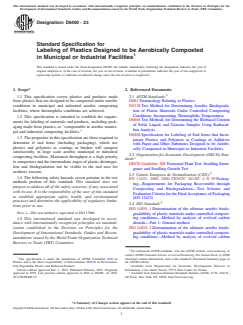
Standards Content (Sample)
This international standard was developed in accordance with internationally recognized principles on standardization established in the Decision on Principles for the
Development of International Standards, Guides and Recommendations issued by the World Trade Organization Technical Barriers to Trade (TBT) Committee.
Designation: D6400 − 23
Standard Specification for
Labeling of Plastics Designed to be Aerobically Composted
in Municipal or Industrial Facilities
This standard is issued under the fixed designation D6400; the number immediately following the designation indicates the year of
original adoption or, in the case of revision, the year of last revision. A number in parentheses indicates the year of last reapproval. A
superscript epsilon (´) indicates an editorial change since the last revision or reapproval.
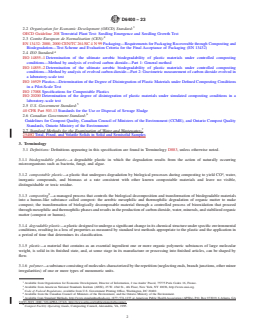
1. Scope* 2. Referenced Documents
1.1 This specification covers plastics and products made 2.1 ASTM Standards:
from plastics that are designed to be composted under aerobic D883 Terminology Relating to Plastics
conditions in municipal and industrial aerobic composting D5338 Test Method for Determining Aerobic Biodegrada-
facilities, where thermophilic conditions are achieved. tion of Plastic Materials Under Controlled Composting
Conditions, Incorporating Thermophilic Temperatures
1.2 This specification is intended to establish the require-
D6866 Test Methods for Determining the Biobased Content
ments for labeling of materials and products, including pack-
of Solid, Liquid, and Gaseous Samples Using Radiocar-
aging made from plastics, as “compostable in aerobic munici-
bon Analysis
pal and industrial composting facilities.”
D6868 Specification for Labeling of End Items that Incor-
1.3 The properties in this specification are those required to
porate Plastics and Polymers as Coatings or Additives
determine if end items (including packaging), which use
with Paper and Other Substrates Designed to be Aerobi-
plastics and polymers as coatings or binders will compost
cally Composted in Municipal or Industrial Facilities
satisfactorily, in large scale aerobic municipal or industrial
2.2 Organization for Economic Development (OECD) Stan-
composting facilities. Maximum throughput is a high priority
dard:
to composters and the intermediate stages of plastic disintegra-
OECD Guideline 208 Terrestrial Plant Test: Seedling Emer-
tion and biodegradation not be visible to the end user for
gence and Seedling Growth Test
aesthetic reasons.
2.3 Comite Europeen de Normalisation (CEN):
1.4 The following safety hazards caveat pertains to the test
EN 13432: 2000, 2000 CEN/TC 261/SC 4 N 99 Packag-
methods portion of this standard: This standard does not
ing—Requirements for Packaging Recoverable through
purport to address all of the safety concerns, if any, associated
Composting and Biodegradation—Test Scheme and
with its use. It is the responsibility of the user of this standard
Evaluation Criteria for the Final Acceptance of Packaging
to establish appropriate safety, health, and environmental
(EN 13432)
practices and determine the applicability of regulatory limita-
2.4 ISO Standard:
tions prior to use.
ISO 14855–1 Determination of the ultimate aerobic biode-
NOTE 1—This test method is equivalent to ISO 17088.
gradability of plastic materials under controlled compost-
ing conditions—Method by analysis of evolved carbon
1.5 This international standard was developed in accor-
dioxide—Part 1: General method
dance with internationally recognized principles on standard-
ISO 14855–2 Determination of the ultimate aerobic biode-
ization established in the Decision on Principles for the
gradability of plastic materials under controlled compost-
Development of International Standards, Guides and Recom-
ing conditions—Method by analysis of evolved carbon
mendations issued by the World Trade Organization Technical
Barriers to Trade (TBT) Committee.
For referenced ASTM standards, visit the ASTM website, www.astm.org, or
contact ASTM Customer Service at service@astm.org. For Annual Book of ASTM
This specification is under the jurisdiction of ASTM Committee D20 on Standards volume information, refer to the standard’s Document Summary page on
Plastics and is the direct responsibility of Subcommittee D20.96 on Environmen- the ASTM website.
tally Degradable Plastics and Biobased Products. Available from Organization for Economic Development, Director of
Current edition approved Feb. 1, 2023. Published February 2023. Originally Information, 2 rue Andre' Pascal, 75775 Paris Cedex 16, France.
approved in 1999. Last previous edition approved in 2022 as D6400 - 22. DOI: Available from American National Standards Institute (ANSI), 25 W. 43rd St.,
10.1520/D6400-23. 4th Floor, New York, NY 10036, http://www.ansi.org.
*A Summary of Changes section appears at the end of this standard
Copyright © ASTM International, 100 Barr Harbor Drive, PO Box C700, West Conshohocken, PA 19428-2959. United States
D6400 − 23
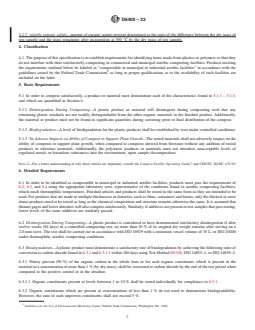
dioxide—Part 2: Gravimetric measurement of carbon 3.1.5 plastic—a material that contains as an essential ingre-
dioxide evolved in a laboratory-scale test dient one or more organic polymeric substances of large
ISO 16929 Plastics—Determination of the Degree of Disin- molecular weight, is solid in its finished state, and, at some
tegration of Plastic Materials under Defined Composting stage in its manufacture or processing into finished articles, can
Conditions in a Pilot-Scale Test be shaped by flow.
ISO 17088 Specifications for Compostable Plastics
3.1.6 polymer—a substance consisting of molecules charac-
ISO 20200 Determination of the degree of disintegration of
terized by the repetition (neglecting ends, branch junctions,
plastic materials under simulated composting conditions
other minor irregularities) of one or more types of monomeric
in a laboratory-scale test
units.
2.5 U.S. Government Standard:
3.1.7 volatile organic solids—amount of organic matter
40 CFR Part 503.13 Standards for the Use or Disposal of
present determined as the ratio of the difference between the
Sewage Sludge
dry mass of test sample and the mass remaining after incin-
2.6 Canadian Government Standard:
eration at 550 °C by the dry mass of test sample.
Guidelines for Compost Quality, Canadian Council of
Ministers of the Environment (CCME), and Ontario Com-
4. Classification
post Quality Standards, Ontario Ministry of the Environ-
4.1 The purpose of this specification is to establish require-
ment
ments for identifying items made from plastics or polymers so
2.7 Standard Methods for the Examination of Water and
that they do not interfere with their satisfactorily composting in
Wastewater:
commercial and municipal aerobic composting facilities. Prod-
2540G Total, Fixed, and Volatile Solids in Solid and Semi-
ucts meeting the requirements outlined below be labeled as
solid Samples
“compostable in municipal or industrial aerobic facilities” in
accordance with the guidelines issued by the Federal Trade
3. Terminology
Commission as long as proper qualifications as to the avail-
3.1 Definitions: Definitions appearing in this specification
ability of such facilities are included on the label.
are found in Terminology D883, unless otherwise noted.
5. Basic Requirements
3.1.1 biodegradable plastic—a degradable plastic in which
the degradation results from the action of naturally occurring
5.1 In order to compost satisfactorily, a product or material
microorganisms such as bacteria, fungi, and algae.
must demonstrate each of the characteristics found in 5.1.1 –
3.1.2 compostable plastic—a plastic that undergoes degra- 5.1.3, and which are quantified in Section 6.
5.1.1 Disintegration During Composting—A plastic product
dation by biological processes during composting to yield CO ,
water, inorganic compounds, and biomass at a rate consistent or material will disintegrate during composting such that any
remaining plastic residuals are not readily distinguishable from
with other known compostable materials and leave no visible,
distinguishable or toxic residue. the other organic materials in the finished product.
Additionally, the material or product must not be found in
3.1.3 composting —a managed process that controls the
significant quantities during screening prior to final distribution
biological decomposition and transformation of biodegradable
of the compost.
materials into a humus-like substance called compost: the
5.1.2 Biodegradation—A level of biodegradation for the
aerobic mesophilic and thermophilic degradation of organic
plastic products shall be established by tests under controlled
matter to make compost; the transformation of biologically
conditions.
decomposable material through a controlled process of biooxi-
5.1.3 No Adverse Impacts on Ability of Compost to Support
dation that proceed through mesophilic and thermophilic
Plant Growth—The tested materials shall not adversely impact
phases and results in the production of carbon dioxide, water,
on the ability of composts to support plant growth, when
minerals, and stabilized organic matter (compost or humus).
compared to composts derived from biowaste without any
3.1.4 degradable plastic—a plastic designed to undergo a
addition of tested products or reference materials. Additionally,
significant change in its chemical structure under specific
the polymeric product
...
This document is not an ASTM standard and is intended only to provide the user of an ASTM standard an indication of what changes have been made to the previous version. Because
it may not be technically possible to adequately depict all changes accurately, ASTM recommends that users consult prior editions as appropriate. In all cases only the current version
of the standard as published by ASTM is to be considered the official document.
Designation: D6400 − 22 D6400 − 23
Standard Specification for
Labeling of Plastics Designed to be Aerobically Composted
in Municipal or Industrial Facilities
This standard is issued under the fixed designation D6400; the number immediately following the designation indicates the year of
original adoption or, in the case of revision, the year of last revision. A number in parentheses indicates the year of last reapproval. A
superscript epsilon (´) indicates an editorial change since the last revision or reapproval.
1. Scope*
1.1 This specification covers plastics and products made from plastics that are designed to be composted under aerobic conditions
in municipal and industrial aerobic composting facilities, where thermophilic conditions are achieved.
1.2 This specification is intended to establish the requirements for labeling of materials and products, including packaging made
from plastics, as “compostable in aerobic municipal and industrial composting facilities.”
1.3 The properties in this specification are those required to determine if end items (including packaging), which use plastics and
polymers as coatings or binders will compost satisfactorily, in large scale aerobic municipal or industrial composting facilities.
Maximum throughput is a high priority to composters and the intermediate stages of plastic disintegration and biodegradation not
be visible to the end user for aesthetic reasons.
1.4 The following safety hazards caveat pertains to the test methods portion of this standard: This standard does not purport
to address all of the safety concerns, if any, associated with its use. It is the responsibility of the user of this standard to establish
appropriate safety, health, and environmental practices and determine the applicability of regulatory limitations prior to use.
NOTE 1—This test method is equivalent to ISO 17088.
1.5 This international standard was developed in accordance with internationally recognized principles on standardization
established in the Decision on Principles for the Development of International Standards, Guides and Recommendations issued
by the World Trade Organization Technical Barriers to Trade (TBT) Committee.
2. Referenced Documents
2.1 ASTM Standards:
D883 Terminology Relating to Plastics
D5338 Test Method for Determining Aerobic Biodegradation of Plastic Materials Under Controlled Composting Conditions,
Incorporating Thermophilic Temperatures
D6866 Test Methods for Determining the Biobased Content of Solid, Liquid, and Gaseous Samples Using Radiocarbon Analysis
D6868 Specification for Labeling of End Items that Incorporate Plastics and Polymers as Coatings or Additives with Paper and
Other Substrates Designed to be Aerobically Composted in Municipal or Industrial Facilities
This specification is under the jurisdiction of ASTM Committee D20 on Plastics and is the direct responsibility of Subcommittee D20.96 on Environmentally Degradable
Plastics and Biobased Products.
Current edition approved Dec. 1, 2022Feb. 1, 2023. Published December 2022February 2023. Originally approved in 1999. Last previous edition approved in 20212022
as D6400 - 21.D6400 - 22. DOI: 10.1520/D6400-22.10.1520/D6400-23.
For referenced ASTM standards, visit the ASTM website, www.astm.org, or contact ASTM Customer Service at service@astm.org. For Annual Book of ASTM Standards
volume information, refer to the standard’s Document Summary page on the ASTM website.
*A Summary of Changes section appears at the end of this standard
Copyright © ASTM International, 100 Barr Harbor Drive, PO Box C700, West Conshohocken, PA 19428-2959. United States
D6400 − 23
2.2 Organization for Economic Development (OECD) Standard:
OECD Guideline 208 Terrestrial Plant Test: Seedling Emergence and Seedling Growth Test
2.3 Comite Europeen de Normalisation (CEN):
EN 13432: 2000, 2000 CEN/TC 261/SC 4 N 99 Packaging—Requirements for Packaging Recoverable through Composting and
Biodegradation—Test Scheme and Evaluation Criteria for the Final Acceptance of Packaging (EN 13432)
2.4 ISO Standard:
ISO 14855–1 Determination of the ultimate aerobic biodegradability of plastic materials under controlled composting
conditions—Method by analysis of evolved carbon dioxide—Part 1: General method
ISO 14855–2 Determination of the ultimate aerobic biodegradability of plastic materials under controlled composting
conditions—Method by analysis of evolved carbon dioxide—Part 2: Gravimetric measurement of carbon dioxide evolved in
a laboratory-scale test
ISO 16929 Plastics—Determination of the Degree of Disintegration of Plastic Materials under Defined Composting Conditions
in a Pilot-Scale Test
ISO 17088 Specifications for Compostable Plastics
ISO 20200 Determination of the degree of disintegration of plastic materials under simulated composting conditions in a
laboratory-scale test
2.5 U.S. Government Standard:
40 CFR Part 503.13 Standards for the Use or Disposal of Sewage Sludge
2.6 Canadian Government Standard:
Guidelines for Compost Quality, Canadian Council of Ministers of the Environment (CCME), and Ontario Compost Quality
Standards, Ontario Ministry of the Environment
2.7 Standard Methods for the Examination of Water and Wastewater:
2540G Total, Fixed, and Volatile Solids in Solid and Semisolid Samples
3. Terminology
3.1 Definitions: Definitions appearing in this specification are found in Terminology D883, unless otherwise noted.
3.1.1 biodegradable plastic—a degradable plastic in which the degradation results from the action of naturally occurring
microorganisms such as bacteria, fungi, and algae.
3.1.2 compostable plastic—a plastic that undergoes degradation by biological processes during composting to yield CO , water,
inorganic compounds, and biomass at a rate consistent with other known compostable materials and leave no visible,
distinguishable or toxic residue.
3.1.3 composting —a managed process that controls the biological decomposition and transformation of biodegradable materials
into a humus-like substance called compost: the aerobic mesophilic and thermophilic degradation of organic matter to make
compost; the transformation of biologically decomposable material through a controlled process of biooxidation that proceed
through mesophilic and thermophilic phases and results in the production of carbon dioxide, water, minerals, and stabilized organic
matter (compost or humus).
3.1.4 degradable plastic—a plastic designed to undergo a significant change in its chemical structure under specific environmental
conditions, resulting in a loss of properties as measured by standard test methods appropriate to the plastic and the application in
a period of time that determines its classification.
3.1.5 plastic—a material that contains as an essential ingredient one or more organic polymeric substances of large molecular
weight, is solid in its finished state, and, at some stage in its manufacture or processing into finished articles, can be shaped by
flow.
3.1.6 polymer—a substance consisting of molecules characterized by the repetition (neglecting ends, branch junctions, other minor
irregularities) of one or more types of monomeric units.
Available from Organization for Economic Development, Director of Information, 2 rue Andre' Pascal, 75775 Paris Cedex 16, France.
Available from American National Standards Institute (ANSI), 25 W. 43rd St., 4th Floor, New York, NY 10036, http://www.ansi.org.
Code of Federal Regulations, available from U.S. Government Printing Office, Washington, DC 20402.
Available from the Canadian Council of Ministers of the Environment, and the Ontario Ministry of the Environment.
Available from Standard Methods, http://www.standardmethods.org, (877) 574-1233 or American Public Health Association (APHA), P.O. Box 933019, 6 Atlanta, GA
31193-3019, (888) 320-APHA (2742), http://www.apha.org/publications/pubscontact.
Compost Facility Operating Guide, Composting Council, Alexandria, VA, 1995.
D6400 − 23
3.1.7 volatile organic solids—amount of organic matter present determined as the ratio of the difference between the dry mass of
test sample and the mass remaining after incineration at 550 °C by the dry mass of test sample.
4. Classification
4.1 The purpose of this specification is to establish requirements for identifying items made from plastics or polymers so that they
do not interfere with their satisfactorily composting in commercial and municipal aerobic composting facilities. Products meeting
the requirements outlined below be labeled as “compostable in municipal or industrial aerobic facilities” in accordance with the
guidelines issued by the Federal Trade Commission as long as proper qualifications as to the availability of such facilities are
included on the label.
5. Basic Requirements
5.1 In order to compost satisfactorily, a product or material must demonstrate each of the characteristics found in 5.1.1 – 5.1.3,
and which are quantified in Section 6.
5.1.1
...
Questions, Comments and Discussion
Ask us and Technical Secretary will try to provide an answer. You can facilitate discussion about the standard in here.
Loading comments...