

ASTM C1693-11(2017)
(Specification)Standard Specification for Autoclaved Aerated Concrete (AAC)
General Information
- Abstract
SCOPE
1.1 This specification covers autoclaved aerated concrete (AAC), a cementitious product based on calcium silicate hydrates in which low density is attained by the inclusion of an agent resulting in macroscopic voids, and in which curing is carried out using high-pressure steam.
1.2 The raw materials used in the production of autoclaved aerated concrete are portland cement or blended cements, quartz sand, water, lime, gypsum or anhydrite, and an agent resulting in macroscopic voids. The quartz sand used as a raw material may be replaced by a siliceous fine aggregate other than sand, and usually is ground to a fine powder before use. Fly ash may be used as a sand replacement. The batched raw materials are mixed thoroughly together to form a slurry. The slurry is cast into steel molds. Due to the chemical reactions that take place within the slurry, the volume expands. After setting, and before hardening, the mass is machine cut into units of various sizes. The units then are steam-cured under pressure in autoclaves where the material is transformed into a hard calcium silicate.
1.3 The values stated in inch-pound units are to be regarded as standard. The values given in parentheses are mathematical conversions to SI units that are provided for information only and are not considered standard.
1.4 This standard does not purport to address all of the safety concerns, if any, associated with its use. It is the responsibility of the user of this standard to establish appropriate safety and health practices and determine the applicability of regulatory limitations prior to use. See Section 6, 7, and 8.
1.5 This international standard was developed in accordance with internationally recognized principles on standardization established in the Decision on Principles for the Development of International Standards, Guides and Recommendations issued by the World Trade Organization Technical Barriers to Trade (TBT) Committee.
- Status
- Published
- Publication Date
- 31-May-2017
- Technical Committee
- C27 - Precast Concrete Products
- Drafting Committee
- C27.60 - Precast Autoclaved Aerated Concrete
Overview
ASTM C1693-11(2017) is the internationally recognized standard specification for Autoclaved Aerated Concrete (AAC), published by ASTM International. This standard covers the requirements for AAC, a unique cementitious product characterized by low density, light weight, and improved thermal properties. Autoclaved aerated concrete is produced by using high-pressure steam curing (autoclaving), which results in the formation of hard calcium silicate materials with macroscopic voids for enhanced performance.
The standard outlines the essential raw materials such as portland or blended cements, quartz sand or siliceous fine aggregates, water, lime, gypsum or anhydrite, and a foaming agent. It further details the production process, including mixing, casting, cutting, and autoclaving, to ensure AAC products meet desired quality parameters.
Key Topics
- Material Composition: Specifies acceptable raw materials, including alternatives like fly ash as a sand replacement to meet sustainability goals.
- Physical Requirements: Defines performance benchmarks for compressive strength, dry bulk density, and drying shrinkage, classified into strength classes.
- Test Methods: Describes standardized procedures for determining compressive strength, bulk density, moisture content, drying shrinkage, and modulus of elasticity in AAC units.
- Quality Assurance: Emphasizes precise sample preparation, uniform moisture distribution, and accurate measurement techniques using regulated equipment.
- Safety and Compliance: Users are responsible for establishing suitable safety, health, and regulatory practices in accordance with national and international guidelines.
Applications
Autoclaved aerated concrete, compliant with ASTM C1693-11(2017), is widely used in the construction industry for a variety of building and infrastructure applications:
- Wall and Partition Systems: The low density, light weight, and strong thermal insulation properties make AAC blocks ideal for interior and exterior wall construction in commercial, residential, and industrial buildings.
- Floor and Roof Panels: The robust mechanical performance and fire resistance qualify AAC panels for use in floors and roofs where structural integrity and insulation are required.
- Prefabricated Elements: The precise manufacturing methods enable the production of custom-sized AAC components, facilitating modular and efficient building practices.
- Energy-Efficient Building Design: AAC is favored in sustainable building projects due to its thermal efficiency, reduced weight, and potential for recycled material content.
The standard ensures that AAC products possess predictable properties (strength, density, and shrinkage) essential for durability, safety, and code compliance.
Related Standards
Several ASTM standards are referenced alongside ASTM C1693-11(2017) to ensure a comprehensive approach to AAC material testing and application:
- ASTM C22/C22M: Specification for Gypsum
- ASTM C33: Specification for Concrete Aggregates
- ASTM C39/C39M: Test Method for Compressive Strength of Cylindrical Concrete Specimens
- ASTM C144: Specification for Aggregate for Masonry Mortar
- ASTM C150: Specification for Portland Cement
- ASTM C332: Specification for Lightweight Aggregates for Insulating Concrete
- ASTM C595/C595M: Specification for Blended Hydraulic Cements
- ASTM C618: Specification for Coal Fly Ash and Raw or Calcined Natural Pozzolan for Use in Concrete
- ASTM C1692: Practice for Construction and Testing of Autoclaved Aerated Concrete Masonry
- ASTM E4: Practices for Force Verification of Testing Machines
- ASTM E575: Practice for Reporting Data from Structural Tests of Building Constructions
These related documents support accurate raw material assessment, product evaluation, structural testing, and consistent quality assurance in AAC manufacturing and application.
By adhering to ASTM C1693-11(2017), manufacturers, engineers, and constructors can ensure the safe, reliable, and efficient use of autoclaved aerated concrete in modern building systems, contributing to cost-effective and sustainable construction practices.
Relations
- Effective Date
- 01-Jun-2017
- Refers
ASTM C39/C39M-23 - Standard Test Method for Compressive Strength of Cylindrical Concrete Specimens - Effective Date
- 01-Dec-2023
- Effective Date
- 01-Jul-2018
- Effective Date
- 15-Dec-2017
- Effective Date
- 01-Oct-2017
- Refers
ASTM C39/C39M-17b - Standard Test Method for Compressive Strength of Cylindrical Concrete Specimens - Effective Date
- 01-Aug-2017
- Effective Date
- 01-Apr-2017
- Refers
ASTM C39/C39M-16b - Standard Test Method for Compressive Strength of Cylindrical Concrete Specimens - Effective Date
- 01-Aug-2016
- Refers
ASTM C39/C39M-16a - Standard Test Method for Compressive Strength of Cylindrical Concrete Specimens - Effective Date
- 01-Jul-2016
- Effective Date
- 01-Jul-2015
- Refers
ASTM C39/C39M-14a - Standard Test Method for Compressive Strength of Cylindrical Concrete Specimens - Effective Date
- 01-Jun-2014
- Effective Date
- 01-Jun-2014
- Effective Date
- 01-May-2014
- Refers
ASTM C39/C39M-14 - Standard Test Method for Compressive Strength of Cylindrical Concrete Specimens - Effective Date
- 01-Feb-2014
- Effective Date
- 01-Mar-2013
Get Certified
Connect with accredited certification bodies for this standard

DIBt (Deutsches Institut für Bautechnik)
German Institute for Building Technology.
DIN CERTCO
DIN Group product certification.

Aboma Certification B.V.
Specialized in construction, metal, and transport sectors.
Sponsored listings
Frequently Asked Questions
ASTM C1693-11(2017) is a technical specification published by ASTM International. Its full title is "Standard Specification for Autoclaved Aerated Concrete (AAC)". This standard covers: SCOPE 1.1 This specification covers autoclaved aerated concrete (AAC), a cementitious product based on calcium silicate hydrates in which low density is attained by the inclusion of an agent resulting in macroscopic voids, and in which curing is carried out using high-pressure steam. 1.2 The raw materials used in the production of autoclaved aerated concrete are portland cement or blended cements, quartz sand, water, lime, gypsum or anhydrite, and an agent resulting in macroscopic voids. The quartz sand used as a raw material may be replaced by a siliceous fine aggregate other than sand, and usually is ground to a fine powder before use. Fly ash may be used as a sand replacement. The batched raw materials are mixed thoroughly together to form a slurry. The slurry is cast into steel molds. Due to the chemical reactions that take place within the slurry, the volume expands. After setting, and before hardening, the mass is machine cut into units of various sizes. The units then are steam-cured under pressure in autoclaves where the material is transformed into a hard calcium silicate. 1.3 The values stated in inch-pound units are to be regarded as standard. The values given in parentheses are mathematical conversions to SI units that are provided for information only and are not considered standard. 1.4 This standard does not purport to address all of the safety concerns, if any, associated with its use. It is the responsibility of the user of this standard to establish appropriate safety and health practices and determine the applicability of regulatory limitations prior to use. See Section 6, 7, and 8. 1.5 This international standard was developed in accordance with internationally recognized principles on standardization established in the Decision on Principles for the Development of International Standards, Guides and Recommendations issued by the World Trade Organization Technical Barriers to Trade (TBT) Committee.
SCOPE 1.1 This specification covers autoclaved aerated concrete (AAC), a cementitious product based on calcium silicate hydrates in which low density is attained by the inclusion of an agent resulting in macroscopic voids, and in which curing is carried out using high-pressure steam. 1.2 The raw materials used in the production of autoclaved aerated concrete are portland cement or blended cements, quartz sand, water, lime, gypsum or anhydrite, and an agent resulting in macroscopic voids. The quartz sand used as a raw material may be replaced by a siliceous fine aggregate other than sand, and usually is ground to a fine powder before use. Fly ash may be used as a sand replacement. The batched raw materials are mixed thoroughly together to form a slurry. The slurry is cast into steel molds. Due to the chemical reactions that take place within the slurry, the volume expands. After setting, and before hardening, the mass is machine cut into units of various sizes. The units then are steam-cured under pressure in autoclaves where the material is transformed into a hard calcium silicate. 1.3 The values stated in inch-pound units are to be regarded as standard. The values given in parentheses are mathematical conversions to SI units that are provided for information only and are not considered standard. 1.4 This standard does not purport to address all of the safety concerns, if any, associated with its use. It is the responsibility of the user of this standard to establish appropriate safety and health practices and determine the applicability of regulatory limitations prior to use. See Section 6, 7, and 8. 1.5 This international standard was developed in accordance with internationally recognized principles on standardization established in the Decision on Principles for the Development of International Standards, Guides and Recommendations issued by the World Trade Organization Technical Barriers to Trade (TBT) Committee.
ASTM C1693-11(2017) is classified under the following ICS (International Classification for Standards) categories: 91.100.30 - Concrete and concrete products. The ICS classification helps identify the subject area and facilitates finding related standards.
ASTM C1693-11(2017) has the following relationships with other standards: It is inter standard links to ASTM C1693-11, ASTM C39/C39M-23, ASTM E575-05(2018), ASTM C144-17, ASTM C618-17, ASTM C39/C39M-17b, ASTM C595/C595M-17, ASTM C39/C39M-16b, ASTM C39/C39M-16a, ASTM C595/C595M-15, ASTM C39/C39M-14a, ASTM E4-14, ASTM C595/C595M-14, ASTM C39/C39M-14, ASTM C595/C595M-13. Understanding these relationships helps ensure you are using the most current and applicable version of the standard.
ASTM C1693-11(2017) is available in PDF format for immediate download after purchase. The document can be added to your cart and obtained through the secure checkout process. Digital delivery ensures instant access to the complete standard document.
Standards Content (Sample)
This international standard was developed in accordance with internationally recognized principles on standardization established in the Decision on Principles for the
Development of International Standards, Guides and Recommendations issued by the World Trade Organization Technical Barriers to Trade (TBT) Committee.
Designation: C1693 −11 (Reapproved 2017)
Standard Specification for
Autoclaved Aerated Concrete (AAC)
This standard is issued under the fixed designation C1693; the number immediately following the designation indicates the year of
original adoption or, in the case of revision, the year of last revision. A number in parentheses indicates the year of last reapproval. A
superscript epsilon (´) indicates an editorial change since the last revision or reapproval.
1. Scope 2. Referenced Documents
1.1 This specification covers autoclaved aerated concrete 2.1 ASTM Standards:
(AAC), a cementitious product based on calcium silicate C22/C22M Specification for Gypsum
hydrates in which low density is attained by the inclusion of an C33 Specification for Concrete Aggregates
agent resulting in macroscopic voids, and in which curing is C39/C39M Test Method for Compressive Strength of Cylin-
carried out using high-pressure steam. drical Concrete Specimens
C144 Specification for Aggregate for Masonry Mortar
1.2 The raw materials used in the production of autoclaved
C150 Specification for Portland Cement
aerated concrete are portland cement or blended cements,
C332 Specification for Lightweight Aggregates for Insulat-
quartz sand, water, lime, gypsum or anhydrite, and an agent
ing Concrete
resulting in macroscopic voids. The quartz sand used as a raw
C595/C595M Specification for Blended Hydraulic Cements
material may be replaced by a siliceous fine aggregate other
C618 Specification for Coal Fly Ash and Raw or Calcined
than sand, and usually is ground to a fine powder before use.
Natural Pozzolan for Use in Concrete
Fly ash may be used as a sand replacement. The batched raw
C1692 Practice for Construction and Testing of Autoclaved
materials are mixed thoroughly together to form a slurry. The
Aerated Concrete (AAC) Masonry
slurry is cast into steel molds. Due to the chemical reactions
E4 Practices for Force Verification of Testing Machines
that take place within the slurry, the volume expands. After
E575 Practice for Reporting Data from Structural Tests of
setting, and before hardening, the mass is machine cut into
Building Constructions, Elements, Connections, and As-
units of various sizes. The units then are steam-cured under
semblies
pressure in autoclaves where the material is transformed into a
hard calcium silicate.
3. Classification
1.3 The values stated in inch-pound units are to be regarded
3.1 AAC units manufactured in accordance with this speci-
as standard. The values given in parentheses are mathematical
fication are classified according to their strength class.
conversions to SI units that are provided for information only
and are not considered standard.
4. Materials and Manufacture
1.4 This standard does not purport to address all of the
4.1 Raw Materials—Materials shall conform to the follow-
safety concerns, if any, associated with its use. It is the
ing applicable specifications:
responsibility of the user of this standard to establish appro-
4.1.1 Portland Cement, Specification C150.
priate safety and health practices and determine the applica-
4.1.2 Blended Cements, Specification C595/C595M.
bility of regulatory limitations prior to use. See Section 6, 7,
4.1.3 Pozzolan, Specification C618.
and 8.
4.1.4 Gypsum, Specification C22/C22M.
1.5 This international standard was developed in accor-
4.1.5 Aggregates, Specifications C33, C144,or C332.
dance with internationally recognized principles on standard-
ization established in the Decision on Principles for the
5. Physical Requirements
Development of International Standards, Guides and Recom-
mendations issued by the World Trade Organization Technical
5.1 Compressive Strength—The compressive strength shall
Barriers to Trade (TBT) Committee.
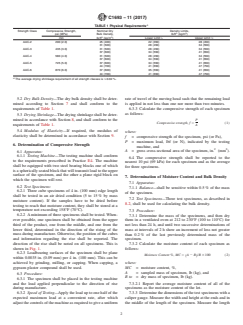
be determined according to Section 6 and shall conform to the
requirements of Table 1.
This specification is under the jurisdiction ofASTM Committee C27 on Precast
Concrete Products and is the direct responsibility of Subcommittee C27.60 on
Precast Autoclaved Aerated Concrete. For referenced ASTM standards, visit the ASTM website, www.astm.org, or
CurrenteditionapprovedJune1,2017.PublishedJuly2017.Originallyapproved contact ASTM Customer Service at service@astm.org. For Annual Book of ASTM
in 2009. Last previous edition approved in 2011 as C1693 – 11. DOI: 10.1520/ Standards volume information, refer to the standard’s Document Summary page on
C1693-11R17. the ASTM website.
Copyright © ASTM International, 100 Barr Harbor Drive, PO Box C700, West Conshohocken, PA 19428-2959. United States
C1693 − 11 (2017)
A
TABLE 1 Physical Requirements
Strength Class Compressive Strength, Nominal Dry Density Limits,
3 3
psi (MPa) Bulk Density, lb/ft (kg/m )
3 3
min lb/ft (kg/m ) Lower Limit > Upper Limit#
AAC-2 290 (2.0) 25 (400) 22 (350) 28 (450)
31 (500) 28 (450) 34 (550)
AAC-3 435 (3.0) 31 (500) 28 (450) 34 (550)
37 (600) 34 (550) 41 (650)
AAC-4 580 (4.0) 31 (500) 28 (450) 34 (550)
37 (600) 34 (550) 41 (650)
AAC-5 725 (5.0) 37 (600) 34 (550) 41 (650)
44 (700) 41 (650) 47 (750)
AAC-6 870 (6.0) 37 (600) 35 (550) 41 (650)
44 (700) 41 (650) 47 (750)
A
The average drying shrinkage requirement of all strength classes is#0.02 %.
5.2 Dry Bulk Density—The dry bulk density shall be deter- rate of travel of the moving head such that the remaining load
mined according to Section 7 and shall conform to the is applied in not less than one nor more than two minutes.
requirements of Table 1.
6.3.3 Calculate the compressive strength of each specimen
as follows:
5.3 Drying Shrinkage—The drying shrinkage shall be deter-
mined in accordance with Section 8, and shall conform to the P
Compressivestrength, f 5 (1)
requirements of Table 1. A
5.4 Modulus of Elasticity—If required, the modulus of
where:
elasticity shall be determined in accordance with Section 9.
f = compressive strength of the specimen, psi (or Pa),
P = maximum load, lbf (or N), indicated by the testing
6. Determination of Compressive Strength
machine, and
2 2
A = gross cross-sectional area of the specimen, in. (mm ).
6.1 Apparatus:
6.1.1 Testing Machine—The testing machine shall conform
6.4 The compressive strength shall be reported to the
to the requirements prescribed in Practice E4. The machine
nearest 10 psi (69 kPa) for each specimen and as the average
shall be equipped with two steel bearing blocks one of which
for three specimens.
is a spherically seated block that will transmit load to the upper
surface of the specimen, and the other a plane rigid block on
7. Determination of Moisture Content and Bulk Density
which the specimen will rest.
7.1 Apparatus:
6.2 Test Specimens:
7.1.1 Balance—shall be sensitive within 0.5 % of the mass
6.2.1 Three cube specimens of 4 in. (100 mm) edge length
of the specimen.
shall be tested in an air dried condition (5 to 15 % by mass
7.2 Test Specimens—Three test specimens, as described in
moisture content). If the samples have to be dried before
8.2, shall be used for calculating the bulk density.
testing to reach that moisture content, they shall be stored at a
temperature not exceeding 158°F (70°C).
7.3 Procedure:
6.2.2 Aminimum of three specimens shall be tested. When- 7.3.1 Determine the mass of the specimens, and then dry
ever possible, one specimen shall be obtained from the upper
them in a ventilated oven at 212 to 230°F (100 to 110°C) for
third of the product, one from the middle, and one from the
not less than 24 h, and until two successive determinations of
lower third, determined in the direction of the rising of the
mass at intervals of 2 h show an increment of loss not greater
mass during manufacture. Otherwise, the position of the cubes
than 0.2 % of the last previously determined mass of the
and information regarding the rise shall be reported. The
specimen.
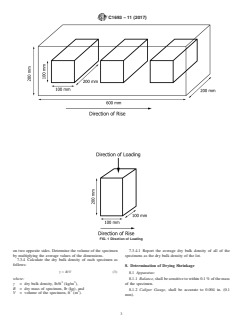
direction of the rise shall be noted on all specimens. This is
7.3.2 Calculate the moisture content of each specimen as
shown in Fig. 1.
follows:
6.2.3 Loadbearing surfaces of the specimen shall be plane
Moisture Content%, MC 5 A 2 B /B 3100 (2)
~ !
within 0.0035 in. (0.09 mm) per 4 in. (100 mm). This can be
where:
achieved by grinding, milling, or capping. When capping, a
gypsum plaster compound shall be used.
MC = moisture content, %,
A = sampled mass of specimen, lb (kg), and
6.3 Procedure:
Bto = dry mass of specimen, lb (kg).
6.3.1 The specimen shall be placed in the testing machine
and the load applied perpendicular to the direction of rise 7.3.2.1 Report the average moisture content of all of the
specimens as the moisture content of the lot.
during manufacture.
6.3.2 Speed of Testing—Apply the load up to one half of the 7.3.3 Determine the dimensions of the test specimens with a
expected maximum load at a convenient rate, after which caliper gauge. Measure the width and height at the ends and in
adjust the controls of the machine as required to give a uniform the middle of the length of the specimen. Measure the length
C1693 − 11 (2017)
FIG. 1 Direction of Loading
on two opposite sides. Determine the volume of the specimen 7.3.4.1 Report the average dry bulk density of all of the
by multiplying the average values of the dimensions. specimens as the dry bulk density of the lot.
7.3.4 Calculate the dry bulk density of each specimen as
follows:
8. Determination of Drying Shrinkage
γ 5 B/V (3)
8.1 Apparatus:
where:
8.1.1 Balance, shall be sensitive to within 0.1 % of the mass
3 3
γ = dry bulk density, lb/ft (kg/m ), of the specimen.
B = dry mass of specimen, lb (kg), and
8.1.2 Caliper Gauge, shall be accurate to 0.004 in. (0.1
3 3
V = volume of the specimen, ft (m ).
mm).
C1693 − 11 (2017)
8.1.3 Temperature Regulated Environment, capable of regu- 8.4 Determination of Drying Shrinkage:
lating the temperature to 68 6 4°F (20 6 2°C) and a minimum
8.4.1 Clean the measurement marks before each reading.
relative humidity of 45 % in which the samples are stored
Make the first determination of length and mass immediately
during drying and while the measurements in the change in
after removing the specimen from the plastic enclosure. Then
length are performed.
storethespecimenonagridtoallowsufficientmovementofair
8.1.4 Measuring Instrument, used to determine the change
around the specimens in an atmosphere of 68 6 4°F (20 6
in length of the test samples. Any suitable device shall be
2°C) and a minimum relative humidity of 45 %. Determine
permitted to be used provided it meets the following require-
each specimen’s mass and length at regular intervals until the
ments:
moisture content has decreased to below 4 %. At least five
8.1.4.1 Theinstrumentshallmeasurechangeinlengthalong determinations shall be made.
the longitudinal axis of the sample.
8.4.2 The test specimens shall be stored in a drying cabinet
8.1.4.2 The instrument shall be able to make contact with
at 220 6 8°F (105 6 5°C) until the mass at two determinations
the measurement marks fastened to the face of the samples.
does not change by more than 0.2 %. After a constant mass is
8.1.4.3 The measurements shall be made with an accuracy
reached, the measurement marks shall be removed, and the
-6
of ∆L/L ≤ 10 , where L is
...