


ASTM D1708-18
(Test Method)Standard Test Method for Tensile Properties of Plastics by Use of Microtensile Specimens
Standard Test Method for Tensile Properties of Plastics by Use of Microtensile Specimens
SIGNIFICANCE AND USE
4.1 This test method provides data for quality control and acceptance or rejection under specifications.
4.2 Before proceeding with this test method, reference the ASTM specification of the material being tested. Any test specimen preparation, conditioning, dimensions, or testing parameters, or combination thereof, covered in the materials specification takes precedence over those mentioned in this test method. If there are no material specifications, then the default conditions herein apply. Table 1 of Classification System D4000 lists the ASTM materials standards that currently exist.
SCOPE
1.1 This test method covers certain material specifications for which a history of data has been obtained using the standard microtensile specimen. In general, this test method is superseded for general use by either Test Method D882 or Test Method D638. The very small Type V specimen in Test Method D638 is the recommended specimen when limited amounts of material are available.
1.2 This test method covers the determination of the comparative tensile strength and elongation properties of plastics in the form of standard microtensile test specimens when tested under defined conditions of pretreatment, temperature, humidity, and testing machine speed. This method is applicable when using specimens of any thickness up to 3.2 mm (1/8 in.), including thin films.
1.3 This test method cannot be used for the determination of modulus of elasticity. For the determination of modulus, see Test Method D638 or Test Methods D882.
1.4 Data obtained by this test method are relevant and appropriate for use in engineering design.
Note 1: Tensile properties provide useful data for plastics engineering design purposes. However, because of the high degree of sensitivity exhibited by many plastics to rate of straining and environmental conditions, data obtained by this test method cannot be considered valid for applications involving load-time scales or environments widely different from those of this test method. In cases of such dissimilarity, no reliable estimation of the limit of usefulness can be made for most plastics. This sensitivity to rate of straining and environment necessitates testing over a broad load-time scale (including impact and creep) and range of environmental conditions if tensile properties are to suffice for engineering design purposes.
1.5 The values stated in SI units are to be regarded as standard. The values given in parentheses are for information only.
1.6 This standard does not purport to address all of the safety concerns, if any, associated with its use. It is the responsibility of the user of this standard to establish appropriate safety, health, and environmental practices and determine the applicability of regulatory limitations prior to use.
Note 2: There is no known ISO equivalent to this standard.
1.7 This international standard was developed in accordance with internationally recognized principles on standardization established in the Decision on Principles for the Development of International Standards, Guides and Recommendations issued by the World Trade Organization Technical Barriers to Trade (TBT) Committee.
General Information
- Status
- Published
- Publication Date
- 30-Sep-2018
- Technical Committee
- D20 - Plastics
- Drafting Committee
- D20.10 - Mechanical Properties
Relations
- Effective Date
- 01-Oct-2018
- Effective Date
- 01-Feb-2024
- Effective Date
- 01-Nov-2023
- Effective Date
- 01-Jan-2020
- Effective Date
- 01-Aug-2019
- Effective Date
- 15-Apr-2019
- Effective Date
- 01-Feb-2019
- Effective Date
- 01-Dec-2018
- Effective Date
- 01-Nov-2018
- Refers
ASTM E2935-17 - Standard Practice for Conducting Equivalence Testing in Laboratory Applications - Effective Date
- 01-Oct-2017
- Effective Date
- 15-Aug-2017
- Refers
ASTM E2935-16 - Standard Practice for Conducting Equivalence Testing in Laboratory Applications - Effective Date
- 15-Nov-2016
- Refers
ASTM E2935-15 - Standard Practice for Conducting Equivalence Testing in Laboratory Applications - Effective Date
- 01-Oct-2015
- Refers
ASTM E2935-14 - Standard Practice for Conducting Equivalence Testing in Laboratory Applications - Effective Date
- 01-Oct-2014
- Refers
ASTM E2935-13 - Standard Practice for Conducting Equivalence Testing in Laboratory Applications - Effective Date
- 01-Aug-2013
Overview
ASTM D1708-18 is the Standard Test Method for Tensile Properties of Plastics by Use of Microtensile Specimens, developed by ASTM International. This test method is specifically designed to determine the tensile strength and elongation properties of plastics using standard microtensile specimens under controlled conditions of temperature, humidity, and testing speed. The method is applicable to plastic specimens of any thickness up to 3.2 mm, including thin films.
ASTM D1708 is valuable for cases where only limited material is available or when traditional tensile tests (such as ASTM D638 or ASTM D882) are not practical. Data gathered according to this method are used primarily for quality control, specification compliance, and engineering design.
Key Topics
Scope and Applicability
- Covers the measurement of tensile properties of plastics when tested with microtensile specimens.
- Suitable for specimens up to 3.2 mm thick, including thin films.
- Not recommended for determining modulus of elasticity.
Testing Conditions
- Requires defined specimen preparation and conditioning as per relevant material specifications or default conditions specified in D1708.
- Testing parameters, including temperature, humidity, and speed, must be consistent with either the material’s specification or established defaults.
- Specifies the use of multiple testing speeds (A, B, C, D) depending on material type and available data.
Test Procedures
- Procedures outlined for specimen preparation, including handling and conditioning as per ASTM D618.
- Testing conducted with apparatus as specified in ASTM D638, with adaptations for microtensile samples.
- Measurement and recording of yield stress, tensile strength, elongation at break, and related statistical data.
Data Interpretation
- Results are significant for material comparison and engineering design, but sensitivity to loading rate and environment requires careful analysis.
- Data are not suitable for modulus of elasticity - Refer to ASTM D638 or D882 for modulus determination.
Reporting Requirements
- Full disclosure of test specimen identity, preparation, conditioning, testing speed, results, and conditions is required for consistency and traceability.
Applications
Quality Control and Material Acceptance
- Used for confirming material properties in production and procurement, allowing acceptance or rejection under specified requirements.
Engineering Design
- Provides comparative tensile property data supporting plastics component design, especially when material amounts are limited.
Specimen-Limited Testing
- Ideal when it is not feasible to use full-size specimens due to limited sample quantity or geometry restrictions.
Thin Film and Micro-Specimen Analysis
- Widely used in sectors requiring precision measurement on thin plastics, such as packaging, microelectronics, and advanced materials research.
Research and Development
- Facilitates characterization of new plastic materials and validation of modified formulations.
Related Standards
For optimal use and comprehensive understanding, ASTM D1708-18 should be referenced alongside related ASTM standards:
- ASTM D638 - Test Method for Tensile Properties of Plastics
- ASTM D882 - Test Method for Tensile Properties of Thin Plastic Sheeting
- ASTM D618 - Practice for Conditioning Plastics for Testing
- ASTM D883 - Terminology Relating to Plastics
- ASTM D4000 - Classification System for Specifying Plastic Materials
- ASTM D5947 - Test Methods for Physical Dimensions of Solid Plastics Specimens
- ASTM D6988 - Guide for Determination of Thickness of Plastic Film Test Specimens
- ASTM E691 - Practice for Conducting an Interlaboratory Study to Determine Precision of a Test Method
- ASTM E2935 - Practice for Conducting Equivalence Testing in Laboratory Applications
Note: There is no ISO equivalent to ASTM D1708-18 at this time.
Keywords: ASTM D1708, microtensile specimens, tensile properties of plastics, plastic testing standard, tensile strength, elongation, quality control, engineering design, plastics industry standards
Buy Documents
ASTM D1708-18 - Standard Test Method for Tensile Properties of Plastics by Use of Microtensile Specimens
REDLINE ASTM D1708-18 - Standard Test Method for Tensile Properties of Plastics by Use of Microtensile Specimens
Get Certified
Connect with accredited certification bodies for this standard

Smithers Quality Assessments
US management systems and product certification.

DIN CERTCO
DIN Group product certification.
Sponsored listings
Frequently Asked Questions
ASTM D1708-18 is a standard published by ASTM International. Its full title is "Standard Test Method for Tensile Properties of Plastics by Use of Microtensile Specimens". This standard covers: SIGNIFICANCE AND USE 4.1 This test method provides data for quality control and acceptance or rejection under specifications. 4.2 Before proceeding with this test method, reference the ASTM specification of the material being tested. Any test specimen preparation, conditioning, dimensions, or testing parameters, or combination thereof, covered in the materials specification takes precedence over those mentioned in this test method. If there are no material specifications, then the default conditions herein apply. Table 1 of Classification System D4000 lists the ASTM materials standards that currently exist. SCOPE 1.1 This test method covers certain material specifications for which a history of data has been obtained using the standard microtensile specimen. In general, this test method is superseded for general use by either Test Method D882 or Test Method D638. The very small Type V specimen in Test Method D638 is the recommended specimen when limited amounts of material are available. 1.2 This test method covers the determination of the comparative tensile strength and elongation properties of plastics in the form of standard microtensile test specimens when tested under defined conditions of pretreatment, temperature, humidity, and testing machine speed. This method is applicable when using specimens of any thickness up to 3.2 mm (1/8 in.), including thin films. 1.3 This test method cannot be used for the determination of modulus of elasticity. For the determination of modulus, see Test Method D638 or Test Methods D882. 1.4 Data obtained by this test method are relevant and appropriate for use in engineering design. Note 1: Tensile properties provide useful data for plastics engineering design purposes. However, because of the high degree of sensitivity exhibited by many plastics to rate of straining and environmental conditions, data obtained by this test method cannot be considered valid for applications involving load-time scales or environments widely different from those of this test method. In cases of such dissimilarity, no reliable estimation of the limit of usefulness can be made for most plastics. This sensitivity to rate of straining and environment necessitates testing over a broad load-time scale (including impact and creep) and range of environmental conditions if tensile properties are to suffice for engineering design purposes. 1.5 The values stated in SI units are to be regarded as standard. The values given in parentheses are for information only. 1.6 This standard does not purport to address all of the safety concerns, if any, associated with its use. It is the responsibility of the user of this standard to establish appropriate safety, health, and environmental practices and determine the applicability of regulatory limitations prior to use. Note 2: There is no known ISO equivalent to this standard. 1.7 This international standard was developed in accordance with internationally recognized principles on standardization established in the Decision on Principles for the Development of International Standards, Guides and Recommendations issued by the World Trade Organization Technical Barriers to Trade (TBT) Committee.
SIGNIFICANCE AND USE 4.1 This test method provides data for quality control and acceptance or rejection under specifications. 4.2 Before proceeding with this test method, reference the ASTM specification of the material being tested. Any test specimen preparation, conditioning, dimensions, or testing parameters, or combination thereof, covered in the materials specification takes precedence over those mentioned in this test method. If there are no material specifications, then the default conditions herein apply. Table 1 of Classification System D4000 lists the ASTM materials standards that currently exist. SCOPE 1.1 This test method covers certain material specifications for which a history of data has been obtained using the standard microtensile specimen. In general, this test method is superseded for general use by either Test Method D882 or Test Method D638. The very small Type V specimen in Test Method D638 is the recommended specimen when limited amounts of material are available. 1.2 This test method covers the determination of the comparative tensile strength and elongation properties of plastics in the form of standard microtensile test specimens when tested under defined conditions of pretreatment, temperature, humidity, and testing machine speed. This method is applicable when using specimens of any thickness up to 3.2 mm (1/8 in.), including thin films. 1.3 This test method cannot be used for the determination of modulus of elasticity. For the determination of modulus, see Test Method D638 or Test Methods D882. 1.4 Data obtained by this test method are relevant and appropriate for use in engineering design. Note 1: Tensile properties provide useful data for plastics engineering design purposes. However, because of the high degree of sensitivity exhibited by many plastics to rate of straining and environmental conditions, data obtained by this test method cannot be considered valid for applications involving load-time scales or environments widely different from those of this test method. In cases of such dissimilarity, no reliable estimation of the limit of usefulness can be made for most plastics. This sensitivity to rate of straining and environment necessitates testing over a broad load-time scale (including impact and creep) and range of environmental conditions if tensile properties are to suffice for engineering design purposes. 1.5 The values stated in SI units are to be regarded as standard. The values given in parentheses are for information only. 1.6 This standard does not purport to address all of the safety concerns, if any, associated with its use. It is the responsibility of the user of this standard to establish appropriate safety, health, and environmental practices and determine the applicability of regulatory limitations prior to use. Note 2: There is no known ISO equivalent to this standard. 1.7 This international standard was developed in accordance with internationally recognized principles on standardization established in the Decision on Principles for the Development of International Standards, Guides and Recommendations issued by the World Trade Organization Technical Barriers to Trade (TBT) Committee.
ASTM D1708-18 is classified under the following ICS (International Classification for Standards) categories: 83.080.01 - Plastics in general. The ICS classification helps identify the subject area and facilitates finding related standards.
ASTM D1708-18 has the following relationships with other standards: It is inter standard links to ASTM D1708-13, ASTM D883-24, ASTM D883-23, ASTM D883-20, ASTM D883-19c, ASTM D883-19a, ASTM D883-19, ASTM D883-18a, ASTM D883-18, ASTM E2935-17, ASTM D883-17, ASTM E2935-16, ASTM E2935-15, ASTM E2935-14, ASTM E2935-13. Understanding these relationships helps ensure you are using the most current and applicable version of the standard.
ASTM D1708-18 is available in PDF format for immediate download after purchase. The document can be added to your cart and obtained through the secure checkout process. Digital delivery ensures instant access to the complete standard document.
Standards Content (Sample)
This international standard was developed in accordance with internationally recognized principles on standardization established in the Decision on Principles for the
Development of International Standards, Guides and Recommendations issued by the World Trade Organization Technical Barriers to Trade (TBT) Committee.
Designation: D1708 − 18
Standard Test Method for
Tensile Properties of Plastics by Use of Microtensile
Specimens
This standard is issued under the fixed designation D1708; the number immediately following the designation indicates the year of
original adoption or, in the case of revision, the year of last revision. A number in parentheses indicates the year of last reapproval. A
superscript epsilon (´) indicates an editorial change since the last revision or reapproval.
This standard has been approved for use by agencies of the U.S. Department of Defense.
1. Scope* 1.6 This standard does not purport to address all of the
safety concerns, if any, associated with its use. It is the
1.1 This test method covers certain material specifications
responsibility of the user of this standard to establish appro-
forwhichahistoryofdatahasbeenobtainedusingthestandard
priate safety, health, and environmental practices and deter-
microtensile specimen. In general, this test method is super-
mine the applicability of regulatory limitations prior to use.
seded for general use by either Test Method D882 or Test
NOTE 2—There is no known ISO equivalent to this standard.
Method D638. The very small Type V specimen in Test
Method D638 is the recommended specimen when limited
1.7 This international standard was developed in accor-
amounts of material are available.
dance with internationally recognized principles on standard-
ization established in the Decision on Principles for the
1.2 This test method covers the determination of the com-
Development of International Standards, Guides and Recom-
parativetensilestrengthandelongationpropertiesofplasticsin
mendations issued by the World Trade Organization Technical
the form of standard microtensile test specimens when tested
Barriers to Trade (TBT) Committee.
under defined conditions of pretreatment, temperature,
humidity,andtestingmachinespeed.Thismethodisapplicable
2. Referenced Documents
when using specimens of any thickness up to 3.2 mm ( ⁄8 in.),
including thin films. 2.1 ASTM Standards:
D618 Practice for Conditioning Plastics for Testing
1.3 Thistestmethodcannotbeusedforthedeterminationof
D638 Test Method for Tensile Properties of Plastics
modulus of elasticity. For the determination of modulus, see
D882 Test Method for Tensile Properties of Thin Plastic
Test Method D638 or Test Methods D882.
Sheeting
1.4 Data obtained by this test method are relevant and D883 Terminology Relating to Plastics
appropriate for use in engineering design. D4000 Classification System for Specifying Plastic Materi-
als
NOTE 1—Tensile properties provide useful data for plastics engineering
D5947 Test Methods for Physical Dimensions of Solid
design purposes. However, because of the high degree of sensitivity
Plastics Specimens
exhibited by many plastics to rate of straining and environmental
conditions, data obtained by this test method cannot be considered valid D6988 GuideforDeterminationofThicknessofPlasticFilm
for applications involving load-time scales or environments widely
Test Specimens
different from those of this test method. In cases of such dissimilarity, no
E691 Practice for Conducting an Interlaboratory Study to
reliableestimationofthelimitofusefulnesscanbemadeformostplastics.
Determine the Precision of a Test Method
This sensitivity to rate of straining and environment necessitates testing
E2935 Practice for Conducting Equivalence Testing in
over a broad load-time scale (including impact and creep) and range of
environmentalconditionsiftensilepropertiesaretosufficeforengineering Laboratory Applications
design purposes.
3. Terminology
1.5 The values stated in SI units are to be regarded as
standard. The values given in parentheses are for information
3.1 Definitions—Definitions of terms applying to this test
only.
method appear in Terminology D883 and Test Method D638,
Annex A2.
This test method is under the jurisdiction ofASTM Committee D20 on Plastics
and is the direct responsibility of Subcommittee D20.10 on Mechanical Properties. For referenced ASTM standards, visit the ASTM website, www.astm.org, or
Current edition approved Oct. 1, 2018. Published October 2018. Originally contact ASTM Customer Service at service@astm.org. For Annual Book of ASTM
approved in 1959. Last previous edition approved in 2013 as D1708 - 13. DOI: Standards volume information, refer to the standard’s Document Summary page on
10.1520/D1708-18. the ASTM website.
*A Summary of Changes section appears at the end of this standard
Copyright © ASTM International, 100 Barr Harbor Drive, PO Box C700, West Conshohocken, PA 19428-2959. United States
D1708 − 18
4. Significance and Use 6.2 All surfaces of the specimen are to be free of visible
flaws, scratches, or imperfections. Carefully remove marks left
4.1 This test method provides data for quality control and
by coarse machining operations with a fine file or abrasive.
acceptance or rejection under specifications.
Smooth the filed surfaces with abrasive paper (No. 00 or finer).
4.2 Before proceeding with this test method, reference the
Make the finishing sanding strokes in the direction parallel to
ASTM specification of the material being tested. Any test
the long axis of the test specimen.
specimen preparation, conditioning, dimensions, or testing
NOTE 4—Tabs shown in Fig. 1 are minimum size for adequate gripping.
parameters, or combination thereof, covered in the materials
Shims may be required with thicker specimens to keep grips from
specificationtakesprecedenceoverthosementionedinthistest
cocking.Handlingisfacilitatedandgrippingimprovedbytheuseoflarger
method. If there are no material specifications, then the default
tabs wherever possible.
conditions herein apply. Table 1 of Classification System
7. Number of Test Specimens
D4000 lists theASTM materials standards that currently exist.
7.1 For isotropic materials, test at least five specimens for
5. Apparatus each sample.
7.2 When testing anisotropic materials, test ten specimens,
5.1 The apparatus shall be as specified in Test Method
D638, with the following exceptions: five normal to and five parallel to the principal axis of
anisotropy.
5.1.1 Grips—Use serrated grips faces with care, since yield-
ing or tearing at the grips may interfere with measurement of
7.3 Disregard results obtained on test specimens that break
elongation even when the specimen breaks in the reduced
at some obvious fortuitous flaw or at the edge of the grips.
section. Grips with rubber coated faces are recommended for
Unless such flaws constitute a variable, the effect of which it is
thin specimens. Self-tightening grips that move as they tighten
desired to be studied, retest using fresh specimens.
and result in a change in the grip separation between upper and
8. Speed of Testing
lower grips are not satisfactory for this test method. If the
specimen tab is not long enough to prevent the grip faces from
8.1 Speed of testing is the velocity of separation of the two
cocking, use shims to provide more uniform clamping.
members (or grips) of the testing machine when running idle
5.1.2 Drive Mechanism—Regulate the velocity of the drive
(under no load).
mechanism as specified in Section 8.
8.2 The speed of testing shall be chosen such that the rate of
5.1.3 Construct the fixed and movable members, drive
straining shall be approximately the same as the rate of
mechanism, and grips of such materials and in such propor-
straining obtained when the material is tested at the designated
tions that, after grip slack is taken up, the total elastic
speed according to Test Method D638. Speeds giving rates of
longitudinal deformation of the system constituted by these
straining approximating those given in Test Method D638 are
parts does not exceed 1 % of the total longitudinal deformation
as follows:
between the grips at any time during the test. If this is not
Speed A 0.25 mm (0.01 in.)/min
possible, appropriate corrections shall be made in the calcula-
Speed B 1 to 1.3 mm (0.04 to 0.05 in.)/min
tion of strain values.
Speed C 10 to 13 mm (0.4 to 0.5 in.)/min
Speed D 100 to 130 mm (4 to 5 in.)/min
5.1.4 Extension Indicator—Use an extension indicator ca-
pable of determining the distance between grips at any time These speeds are 0.20 to 0.25 times the speeds designated in
during the test, essentially free of inertia lag at the specified Test Method D638, since the effective gauge length of bars
speed of testing, and accurate to 61 % of extension or better. specifiedinthelattertestmethodisfourtofivetimesthatofthe
microtensile test specimens. When the speed of testing is not
NOTE 3—It is desirable that the load indicator and the extension
specified, use Speed B.
indicator be combined into one instrument, which automatically records
theload as a function oftheextensionorasafunctionoftime.Inthelatter
9. Conditioning
case, the conversion to a load-extension record can readily be made
because extension is proportional to time after the take-up of the initial
9.1 Conditioning—Condition the test specimens in accor-
grip slack.
dance with Procedure A of Practice D618, unless otherwise
5.1.5 Micrometers—Use apparatus for measuring the width
specified by contract or the relevantASTM material specifica-
and thickness of the test specimen that complies with the
tion. Temperature and humidity tolerances shall be in accor-
requirements of Test Method D5947 and shall read to 0.0025
dance with Section 7 of Practice D618 unless specified
mm (0.0001 in.) or less. Measure film thickness in accordance
differently by contract or material specification.
with Guide D6988.
9.2 Test Conditions—Conduct the tests at the same tempera-
ture and humidity used for conditioning with tolerances in
6. Test Specimens
accordance with Section 7 of Practice D618 unless other
...
This document is not an ASTM standard and is intended only to provide the user of an ASTM standard an indication of what changes have been made to the previous version. Because
it may not be technically possible to adequately depict all changes accurately, ASTM recommends that users consult prior editions as appropriate. In all cases only the current version
of the standard as published by ASTM is to be considered the official document.
Designation: D1708 − 13 D1708 − 18
Standard Test Method for
Tensile Properties of Plastics by Use of Microtensile
Specimens
This standard is issued under the fixed designation D1708; the number immediately following the designation indicates the year of
original adoption or, in the case of revision, the year of last revision. A number in parentheses indicates the year of last reapproval. A
superscript epsilon (´) indicates an editorial change since the last revision or reapproval.
This standard has been approved for use by agencies of the U.S. Department of Defense.
1. Scope*
1.1 This test method covers certain material specifications for which a history of data has been obtained using the standard
microtensile specimen. In general, this test method is superseded for general use by either Test MethodsMethod D882 or Test
Method D638. The very small Type V specimen in Test Method D638 is the recommended specimen when limited amounts of
material are available.
1.2 This test method covers the determination of the comparative tensile strength and elongation properties of plastics in the
form of standard microtensile test specimens when tested under defined conditions of pretreatment, temperature, humidity, and
testing machine speed. This method is applicable when using specimens of any thickness up to 3.2 mm ( ⁄8 in.), including thin
films.
1.3 This test method cannot be used for the determination of modulus of elasticity. For the determination of modulus, see Test
Method D638 or Test Methods D882.
1.4 Test data Data obtained by this test method are relevant and appropriate for use in engineering design.
NOTE 1—Tensile properties provide useful data for plastics engineering design purposes. However, because of the high degree of sensitivity exhibited
by many plastics to rate of straining and environmental conditions, data obtained by this test method cannot be considered valid for applications involving
load-time scales or environments widely different from those of this test method. In cases of such dissimilarity, no reliable estimation of the limit of
usefulness can be made for most plastics. This sensitivity to rate of straining and environment necessitates testing over a broad load-time scale (including
impact and creep) and range of environmental conditions if tensile properties are to suffice for engineering design purposes.
1.5 The values stated in SI units are to be regarded as standard. The values given in parentheses are for information only.
1.6 This standard does not purport to address all of the safety concerns, if any, associated with its use. It is the responsibility
of the user of this standard to establish appropriate safety safety, health, and healthenvironmental practices and determine the
applicability of regulatory limitations prior to use.
NOTE 2—There is no known ISO equivalent to this standard.
1.7 This international standard was developed in accordance with internationally recognized principles on standardization
established in the Decision on Principles for the Development of International Standards, Guides and Recommendations issued
by the World Trade Organization Technical Barriers to Trade (TBT) Committee.
2. Referenced Documents
2.1 ASTM Standards:
D618 Practice for Conditioning Plastics for Testing
D638 Test Method for Tensile Properties of Plastics
D882 Test Method for Tensile Properties of Thin Plastic Sheeting
D883 Terminology Relating to Plastics
D4000 Classification System for Specifying Plastic Materials
D5947 Test Methods for Physical Dimensions of Solid Plastics Specimens
This test method is under the jurisdiction of ASTM Committee D20 on Plastics and is the direct responsibility of Subcommittee D20.10 on Mechanical Properties.
Current edition approved Sept. 1, 2013Oct. 1, 2018. Published September 2013October 2018. Originally approved in 1959. Last previous edition approved in 20102013
as D1708 - 10.D1708 - 13. DOI: 10.1520/D1708-13.10.1520/D1708-18.
For referenced ASTM standards, visit the ASTM website, www.astm.org, or contact ASTM Customer Service at service@astm.org. For Annual Book of ASTM Standards
volume information, refer to the standard’s Document Summary page on the ASTM website.
*A Summary of Changes section appears at the end of this standard
Copyright © ASTM International, 100 Barr Harbor Drive, PO Box C700, West Conshohocken, PA 19428-2959. United States
D1708 − 18
D6988 Guide for Determination of Thickness of Plastic Film Test Specimens
E691 Practice for Conducting an Interlaboratory Study to Determine the Precision of a Test Method
E2935 Practice for Conducting Equivalence Testing in Laboratory Applications
3. Terminology
3.1 Definitions—Definitions of terms applying to this test method appear in Terminology D883 and Test Method D638, Annex
A2.
4. Significance and Use
4.1 This test method provides data for quality control and acceptance or rejection under specifications.
4.2 Before proceeding with this test method, reference should be made to the ASTM specification of the material being tested.
Any test specimen preparation, conditioning, dimensions, or testing parameters, or combination thereof, covered in the materials
specification shall take takes precedence over those mentioned in this test method. If there are no material specifications, then the
default conditions herein apply. Table 1Table 1 of Classification System D4000 lists the ASTM materials standards that currently
exist.
5. Apparatus
5.1 The apparatus shall be as specified in Test Method D638, with the following exceptions:
5.1.1 Grips—Use serrated grips faces with care, since yielding or tearing at the grips may interfere with measurement of
elongation even when the specimen breaks in the reduced section. Grips with rubber coated faces are recommended for thin
specimens. Self-tightening grips that move as they tighten and result in a change in the grip separation between upper and lower
grips are not satisfactory for this test method. If the specimen tab is not long enough to prevent the grip faces from cocking, use
shims to provide more uniform clamping.
5.1.2 Drive Mechanism—The Regulate the velocity of the drive mechanism shall be regulated as specified in Section 8.
5.1.3 The Construct the fixed and movable members, drive mechanism, and grips shall be constructed of such materials and in
such proportions that, after grip slack is taken up, the total elastic longitudinal deformation of the system constituted by these parts
does not exceed 1 % of the total longitudinal deformation between the grips at any time during the test. If this is not possible,
appropriate corrections shall be made in the calculation of strain values.
5.1.4 Extension Indicator—The Use an extension indicator shall be capable of determining the distance between grips at any
time during the test. The instrument shall be test, essentially free of inertia lag at the specified speed of testing, and shall be accurate
to 61 % of extension or better.
NOTE 3—It is desirable that the load indicator and the extension indicator be combined into one instrument, which automatically records the load as
a function of the extension or as a function of time. In the latter case, the conversion to a load-extension record can readily be made because extension
is proportional to time after the take-up of the initial grip slack.
5.1.5 Micrometers—Apparatus Use apparatus for measuring the width and thickness of the test specimen shall complythat
complies with the requirements of Test Method D5947 and shall read to 0.0025 mm (0.0001 in.) or less. Measure film thickness
in accordance with Guide D6988.
6. Test Specimens
6.1 Microtensile Use microtensile test specimens shallthat conform to the dimensions shown in Fig. 1. This specimen shall be
prepared Prepare specimens by injection molding, compression molding, die-cutting or machining from sheet, plate, slab, or
finished article. Dimensions of a die suitable for preparing die-cut specimens are also shown in Fig. 1. Specimens may also be
prepared by injection molding or compression molding.
TABLE 1 Tensile StrengthStress at Break for Seven Laboratories
and Two Materials, MPa
Test
A B C D
Material Speed, Average S S r R
r R
mm/min
Polyamide(imide) 1.3 193.6 1.60 5.48 4.48 15.3
Polybutylene 12.7 31.3 0.80 2.75 9.12 9.12
A
S is the within-laboratory standard deviation for the indicated material. It is
r
obtained by pooling the within-laboratory standard deviations of the test results
from all of the participating laboratories:
2 2 2 1/2
S 5 ffsS d 1sS d 1{1sS d g/ng . (1)
r 1 2 n
B
S is the between-laboratories reproducibility, expressed as a standard deviation,
R
for the indicated material.
C
r is the within-laboratory repeatability limit, r = 2.8 × S .
r
D
R is the between-laboratory reproducibility limit, R = 2.8 × S .
R
D1708 − 18
NOTE 1—All dimensions are in millimetres.
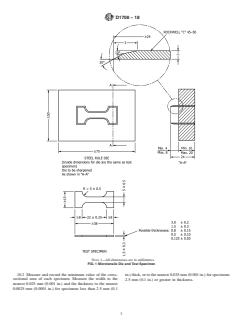
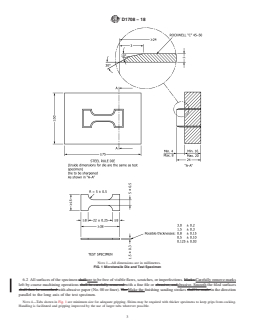
FIG. 1 Microtensile Die and Test Specimen
6.2 All surfaces of the specimen shall are to be free of visible flaws, scratches, or imperfections. Marks Carefully remove marks
left by coarse machining operations shall be carefully removed with a fine file or abrasive, andabrasive. Smooth the filed surfaces
shall then be smoothed with abrasive paper (No. 00 or finer). The Make the finishing sanding strokes shall be made in the direction
parallel to the long axis of the test specimen.
NOTE 4—Tabs shown in Fig. 1 are minimum size for adequate gripping. Shims may be required with thicker specimens to keep grips from cocking.
Handling is facilitated and gripping improved by the use of larger tabs wherever possible.
D1708 − 18
7. Number of Test Specimens
7.1 At least five test specimens shall be tested for each sample in the case of isotropic materials.For isotropic materials, test at
least five specimens for each sample.
7.2 Ten test When testing anisotropic materials, test ten specimens, five normal to and five parallel to the principal axis of
anisotropy, shall be tested for each sample in the case of anisotropic materials.anisotropy.
7.3 Results Disregard results obtained on test specimens that break at some obvious fortuitous flaw or at the edge of the grips
shall be discarded and retests made, unless grips. Unless such flaws constitute a variable, the effect of which it is desired to study.be
studied, retest using fresh specimens.
8. Speed of Testing
8.1 Speed of testing is the velocity of separation of the two members (or grips) of the testing machine when running idle (under
no load).
8.2 The speed of testing shall be chosen such that the rate of straining shall be approximately the same as the rate of straining
obtained when the material is tested at the designated speed according to Test Method D638. Speeds giving rates of straining
approximating those given in Test Method D638 are as follows:
Speed A 0.25 mm (0.01 in.)/min
Speed B 1 to 1.3 mm (0.04 to 0.05 in.)/min
Speed C 10 to 13 mm (0.4 to 0.5 in.)/min
Speed D 100 to 130 mm (4 to 5 in.)/min
These speeds are 0.20 to 0.25 time
...
Questions, Comments and Discussion
Ask us and Technical Secretary will try to provide an answer. You can facilitate discussion about the standard in here.
Loading comments...