

ASTM C593-19
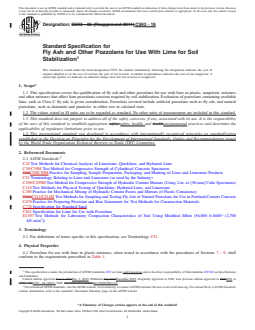
(Specification)Standard Specification for Fly Ash and Other Pozzolans for Use With Lime for Soil Stabilization
General Information
- Abstract
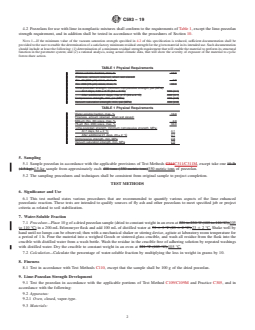
ABSTRACT
This specification covers the qualification of fly ash and other pozzolans for use with lime in plastic, nonplastic mixtures and other mixtures that affect lime pozzolanic reaction required by soil stabilization. Evaluation of pozzolans containing available lime, such as Class C fly ash, is given consideration. Pozzolans covered include artificial pozzolans such as fly ash, and natural pozzolans, such as diatomite and pumicite, in either raw or calcined state. Various procedures are recommended to quantify various aspects of the lime enhanced pozzolanic reaction. The tests shall qualify sources of fly ash and other pozzolans to meet specified job or project criteria as related to soil stabilization. The following shall be peformed on the pozzolan: water-soluble fraction, fineness, and lime-pozzolan strength development. For the nonplastic mixtures, compressive strength development and freeze-thaw resistance tests shall be performed. The materials shall be subjected to vacuum saturation strength testing.
SIGNIFICANCE AND USE
6.1 This test method states various procedures that are recommended to quantify various aspects of the lime enhanced pozzolanic reaction. These tests are intended to qualify sources of fly ash and other pozzolans to meet specified job or project criteria as related to soil stabilization.
SCOPE
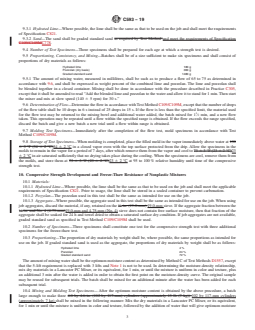
1.1 This specification covers the qualification of fly ash and other pozzolans for use with lime in plastic, nonplastic mixtures and other mixtures that affect lime pozzolanic reaction required by soil stabilization. Evaluation of pozzolans containing available lime, such as Class C fly ash, is given consideration. Pozzolans covered include artificial pozzolans such as fly ash, and natural pozzolans, such as diatomite and pumicite, in either raw or calcined state.
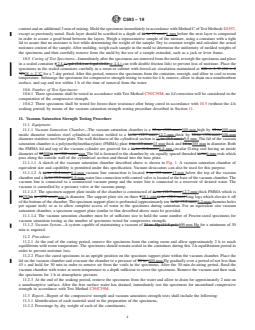
1.2 The values stated in SI units are to be regarded as standard. No other units of measurement are included in this standard.
1.3 This standard does not purport to address all of the safety concerns, if any, associated with its use. It is the responsibility of the user of this standard to establish appropriate safety, health, and environmental practices and determine the applicability of regulatory limitations prior to use.
1.4 This international standard was developed in accordance with internationally recognized principles on standardization established in the Decision on Principles for the Development of International Standards, Guides and Recommendations issued by the World Trade Organization Technical Barriers to Trade (TBT) Committee.
- Status
- Published
- Publication Date
- 30-Nov-2019
- Technical Committee
- C07 - Lime and Limestone
- Drafting Committee
- C07.02 - Specifications and Guidelines
Buy Documents
ASTM C593-19 - Standard Specification for Fly Ash and Other Pozzolans for Use With Lime for Soil Stabilization
REDLINE ASTM C593-19 - Standard Specification for Fly Ash and Other Pozzolans for Use With Lime for Soil Stabilization
Overview
ASTM C593-19: Standard Specification for Fly Ash and Other Pozzolans for Use With Lime for Soil Stabilization defines requirements for qualifying both artificial and natural pozzolans, such as fly ash, diatomite, and pumicite, for use with lime in soil stabilization projects. Applicable to both plastic and nonplastic soil-lime-pozzolan mixtures, the standard ensures that materials meet the performance criteria necessary for improving soil properties. The specification addresses key physical and chemical properties as well as performance characteristics critical for the success of lime-pozzolan soil stabilization applications.
Key Topics
- Pozzolanic Material Types: Covers artificial pozzolans (e.g., fly ash such as ASTM Class C) and natural pozzolans (e.g., diatomite, pumicite), in raw or calcined forms.
- Lime-Pozzolan Reaction: Evaluates materials based on their contribution to strength and durability when combined with lime.
- Material Qualification: Outlines tests to ensure pozzolan sources meet project-specific requirements, including:
- Water-soluble fraction content
- Fineness through sieving
- Minimum compressive and vacuum saturation strengths
- Strength development under controlled temperature and humidity
- Freeze-thaw resistance for durability assessment
- Testing Practices: Specifies standardized methods for mixing, molding, curing, and testing specimens to evaluate performance (referencing ASTM C109/C109M, C39/C39M, C110, and others).
Applications
The practical value of ASTM C593-19 lies in its guidance for qualifying materials that improve soil stability and support infrastructure longevity. Typical applications include:
- Roadbed and Pavement Construction: Stabilized subgrades for highways, roads, and airports where improved load-bearing capacity and resistance to environmental cycling are needed.
- Embankment and Foundation Projects: Strengthening weak or expansive soils to support embankments, bridge abutments, and earthworks.
- Land Reclamation and Erosion Control: Enhancing soil structure for environmental remediation, landfills, or slope stabilization.
- General Civil Engineering Projects: Any project where soil stabilization using lime and pozzolanic materials is required to reduce settlement, increase compressive strength, and improve durability.
Contractors and engineers use ASTM C593-19 to specify, sample, and evaluate pozzolans in combination with lime, ensuring the soil stabilization mixture meets engineering and regulatory demands. Adherence helps prevent failures caused by insufficient strength or poor resistance to environmental stresses, such as freeze-thaw cycles.
Related Standards
ASTM C593-19 references and is used alongside several other key ASTM standards that ensure the effective use of lime and pozzolanic materials in construction:
- ASTM C25: Chemical analysis of lime products, relevant for evaluating hydrated lime.
- ASTM C39/C39M: Testing compressive strength of concrete specimens, methods are adapted for stabilized soil testing.
- ASTM C51: Terminology related to lime and limestone for industry clarity.
- ASTM C109/C109M: Compressive strength testing for cement mortars, basis for lime-pozzolan strength tests.
- ASTM C110: Physical testing for quicklime, hydrated lime, and limestone.
- ASTM C305: Standard practice for mechanically mixing cement and mortar specimens.
- ASTM C311/C311M: Sampling and testing fly ash or natural pozzolans for use in concrete.
- ASTM C821: Specification for lime suitable for use with pozzolans in soil stabilization.
- ASTM D1557: Methods for determining soil compaction characteristics.
Summary
ASTM C593-19 serves as an essential specification for engineers, material suppliers, and contractors seeking reliable performance in soil stabilization projects using fly ash and natural pozzolans with lime. Through rigorous qualification procedures and reference to established ASTM test methods, the standard helps deliver safer, longer-lasting infrastructure across varied civil engineering and construction scenarios.
Keywords: ASTM C593-19, fly ash, pozzolan, lime, soil stabilization, compressive strength, freeze-thaw resistance, civil engineering standards, construction material testing.
Relations
- Effective Date
- 01-Dec-2019
- Effective Date
- 01-Feb-2024
- Effective Date
- 01-Jan-2024
- Effective Date
- 01-Jan-2024
- Effective Date
- 15-Dec-2023
- Refers
ASTM C39/C39M-23 - Standard Test Method for Compressive Strength of Cylindrical Concrete Specimens - Effective Date
- 01-Dec-2023
- Effective Date
- 01-Oct-2023
- Effective Date
- 15-Jul-2020
- Effective Date
- 01-Dec-2019
- Effective Date
- 01-May-2019
- Effective Date
- 01-Dec-2018
- Refers
ASTM C39/C39M-17b - Standard Test Method for Compressive Strength of Cylindrical Concrete Specimens - Effective Date
- 01-Aug-2017
- Effective Date
- 01-Aug-2017
- Effective Date
- 15-Dec-2016
- Refers
ASTM C110-16 - Standard Test Methods for Physical Testing of Quicklime, Hydrated Lime, and Limestone - Effective Date
- 01-Dec-2016
Buy Documents
ASTM C593-19 - Standard Specification for Fly Ash and Other Pozzolans for Use With Lime for Soil Stabilization
REDLINE ASTM C593-19 - Standard Specification for Fly Ash and Other Pozzolans for Use With Lime for Soil Stabilization
Get Certified
Connect with accredited certification bodies for this standard

DIBt (Deutsches Institut für Bautechnik)
German Institute for Building Technology.
DIN CERTCO
DIN Group product certification.

Aboma Certification B.V.
Specialized in construction, metal, and transport sectors.
Sponsored listings
Frequently Asked Questions
ASTM C593-19 is a technical specification published by ASTM International. Its full title is "Standard Specification for Fly Ash and Other Pozzolans for Use With Lime for Soil Stabilization". This standard covers: ABSTRACT This specification covers the qualification of fly ash and other pozzolans for use with lime in plastic, nonplastic mixtures and other mixtures that affect lime pozzolanic reaction required by soil stabilization. Evaluation of pozzolans containing available lime, such as Class C fly ash, is given consideration. Pozzolans covered include artificial pozzolans such as fly ash, and natural pozzolans, such as diatomite and pumicite, in either raw or calcined state. Various procedures are recommended to quantify various aspects of the lime enhanced pozzolanic reaction. The tests shall qualify sources of fly ash and other pozzolans to meet specified job or project criteria as related to soil stabilization. The following shall be peformed on the pozzolan: water-soluble fraction, fineness, and lime-pozzolan strength development. For the nonplastic mixtures, compressive strength development and freeze-thaw resistance tests shall be performed. The materials shall be subjected to vacuum saturation strength testing. SIGNIFICANCE AND USE 6.1 This test method states various procedures that are recommended to quantify various aspects of the lime enhanced pozzolanic reaction. These tests are intended to qualify sources of fly ash and other pozzolans to meet specified job or project criteria as related to soil stabilization. SCOPE 1.1 This specification covers the qualification of fly ash and other pozzolans for use with lime in plastic, nonplastic mixtures and other mixtures that affect lime pozzolanic reaction required by soil stabilization. Evaluation of pozzolans containing available lime, such as Class C fly ash, is given consideration. Pozzolans covered include artificial pozzolans such as fly ash, and natural pozzolans, such as diatomite and pumicite, in either raw or calcined state. 1.2 The values stated in SI units are to be regarded as standard. No other units of measurement are included in this standard. 1.3 This standard does not purport to address all of the safety concerns, if any, associated with its use. It is the responsibility of the user of this standard to establish appropriate safety, health, and environmental practices and determine the applicability of regulatory limitations prior to use. 1.4 This international standard was developed in accordance with internationally recognized principles on standardization established in the Decision on Principles for the Development of International Standards, Guides and Recommendations issued by the World Trade Organization Technical Barriers to Trade (TBT) Committee.
ABSTRACT This specification covers the qualification of fly ash and other pozzolans for use with lime in plastic, nonplastic mixtures and other mixtures that affect lime pozzolanic reaction required by soil stabilization. Evaluation of pozzolans containing available lime, such as Class C fly ash, is given consideration. Pozzolans covered include artificial pozzolans such as fly ash, and natural pozzolans, such as diatomite and pumicite, in either raw or calcined state. Various procedures are recommended to quantify various aspects of the lime enhanced pozzolanic reaction. The tests shall qualify sources of fly ash and other pozzolans to meet specified job or project criteria as related to soil stabilization. The following shall be peformed on the pozzolan: water-soluble fraction, fineness, and lime-pozzolan strength development. For the nonplastic mixtures, compressive strength development and freeze-thaw resistance tests shall be performed. The materials shall be subjected to vacuum saturation strength testing. SIGNIFICANCE AND USE 6.1 This test method states various procedures that are recommended to quantify various aspects of the lime enhanced pozzolanic reaction. These tests are intended to qualify sources of fly ash and other pozzolans to meet specified job or project criteria as related to soil stabilization. SCOPE 1.1 This specification covers the qualification of fly ash and other pozzolans for use with lime in plastic, nonplastic mixtures and other mixtures that affect lime pozzolanic reaction required by soil stabilization. Evaluation of pozzolans containing available lime, such as Class C fly ash, is given consideration. Pozzolans covered include artificial pozzolans such as fly ash, and natural pozzolans, such as diatomite and pumicite, in either raw or calcined state. 1.2 The values stated in SI units are to be regarded as standard. No other units of measurement are included in this standard. 1.3 This standard does not purport to address all of the safety concerns, if any, associated with its use. It is the responsibility of the user of this standard to establish appropriate safety, health, and environmental practices and determine the applicability of regulatory limitations prior to use. 1.4 This international standard was developed in accordance with internationally recognized principles on standardization established in the Decision on Principles for the Development of International Standards, Guides and Recommendations issued by the World Trade Organization Technical Barriers to Trade (TBT) Committee.
ASTM C593-19 is classified under the following ICS (International Classification for Standards) categories: 91.100.10 - Cement. Gypsum. Lime. Mortar. The ICS classification helps identify the subject area and facilitates finding related standards.
ASTM C593-19 has the following relationships with other standards: It is inter standard links to ASTM C593-06(2011), ASTM C670-24a, ASTM C670-24, ASTM C311/C311M-24, ASTM C109/C109M-23, ASTM C39/C39M-23, ASTM C51-23, ASTM C305-20, ASTM C50/C50M-13(2019), ASTM C25-19e1, ASTM C51-18, ASTM C39/C39M-17b, ASTM C311/C311M-17, ASTM C311/C311M-16, ASTM C110-16. Understanding these relationships helps ensure you are using the most current and applicable version of the standard.
ASTM C593-19 is available in PDF format for immediate download after purchase. The document can be added to your cart and obtained through the secure checkout process. Digital delivery ensures instant access to the complete standard document.
Standards Content (Sample)
This international standard was developed in accordance with internationally recognized principles on standardization established in the Decision on Principles for the
Development of International Standards, Guides and Recommendations issued by the World Trade Organization Technical Barriers to Trade (TBT) Committee.
Designation:C593 −19
Standard Specification for
Fly Ash and Other Pozzolans for Use With Lime for Soil
Stabilization
This standard is issued under the fixed designation C593; the number immediately following the designation indicates the year of
original adoption or, in the case of revision, the year of last revision. A number in parentheses indicates the year of last reapproval. A
superscript epsilon (´) indicates an editorial change since the last revision or reapproval.
1. Scope* C51 Terminology Relating to Lime and Limestone (as used
by the Industry)
1.1 This specification covers the qualification of fly ash and
C109/C109M Test Method for Compressive Strength of
other pozzolans for use with lime in plastic, nonplastic mix-
Hydraulic Cement Mortars (Using 2-in. or [50-mm] Cube
tures and other mixtures that affect lime pozzolanic reaction
Specimens)
required by soil stabilization. Evaluation of pozzolans contain-
C110 Test Methods for Physical Testing of Quicklime,
ing available lime, such as Class C fly ash, is given consider-
Hydrated Lime, and Limestone
ation. Pozzolans covered include artificial pozzolans such as
C305 Practice for Mechanical Mixing of Hydraulic Cement
fly ash, and natural pozzolans, such as diatomite and pumicite,
Pastes and Mortars of Plastic Consistency
in either raw or calcined state.
C311/C311M Test Methods for Sampling and Testing Fly
1.2 The values stated in SI units are to be regarded as
Ash or Natural Pozzolans for Use in Portland-Cement
standard. No other units of measurement are included in this
Concrete
standard.
C670 Practice for Preparing Precision and Bias Statements
1.3 This standard does not purport to address all of the
for Test Methods for Construction Materials
safety concerns, if any, associated with its use. It is the
C778 Specification for Standard Sand
responsibility of the user of this standard to establish appro-
C821 Specification for Lime for Use with Pozzolans
priate safety, health, and environmental practices and deter-
D1557 Test Methods for Laboratory Compaction Character-
mine the applicability of regulatory limitations prior to use.
istics of Soil Using Modified Effort (56,000 ft-lbf/ft
1.4 This international standard was developed in accor-
(2,700 kN-m/m ))
dance with internationally recognized principles on standard-
ization established in the Decision on Principles for the
3. Terminology
Development of International Standards, Guides and Recom-
mendations issued by the World Trade Organization Technical
3.1 For definitions of terms specific to this specification, see
Barriers to Trade (TBT) Committee.
Terminology C51.
2. Referenced Documents
4. Physical Properties
2.1 ASTM Standards:
4.1 Pozzolans for use with lime in plastic mixtures, when
C25 Test Methods for Chemical Analysis of Limestone,
tested in accordance with the procedures of Sections7–9,
Quicklime, and Hydrated Lime
shall conform to the requirements prescribed in Table 1.
C39/C39M Test Method for Compressive Strength of Cylin-
drical Concrete Specimens
4.2 Pozzolans for use with lime in nonplastic mixtures shall
C50/C50M Practice for Sampling, Sample Preparation,
conform to the requirements of Table 1, except the lime-
Packaging, and Marking of Lime and Limestone Products
pozzolan strength requirement, and in addition shall be tested
in accordance with the procedures of Section 10.
This specification is under the jurisdiction of ASTM Committee C07 on Lime
NOTE 1—If the minimum value of the vacuum saturation strength
and Limestone and is the direct responsibility of Subcommittee C07.02 on
specified in 4.2 of this specification is reduced, sufficient documentation
Specifications and Guidelines.
shall be provided to the user to enable the determination of a satisfactory
Current edition approved Dec. 1, 2019. Published December 2019. Originally
minimum residual strength for the given material in its intended use. Such
approved in 1966. Last previous edition approved in 2011 as C593 – 06 (2011).
documentation should include at least the following: (1) determination of
DOI: 10.1520/C0593-19.
2 a minimum residual strength requirement that will enable the material to
For referenced ASTM standards, visit the ASTM website, www.astm.org, or
perform its structural function in the pavement system; and (2) a rational
contact ASTM Customer Service at service@astm.org. For Annual Book of ASTM
analysis,usingactualclimaticdata,thatwillshowtheseverityofexposure
Standards volume information, refer to the standard’s Document Summary page on
the ASTM website. of the material to cyclic freeze-thaw action.
*A Summary of Changes section appears at the end of this standard
Copyright © ASTM International, 100 Barr Harbor Drive, PO Box C700, West Conshohocken, PA 19428-2959. United States
C593−19
TABLE 1 Physical Requirements
9.3.2 Sand—The sand shall be graded standard sand and
Water-soluble fraction, max, % 10.0 meet the requirements of Specification C778.
Fineness, amount retained, when wet sieved:
9.4 Number of Test Specimens—Three specimens shall be
600-µm (No. 30) sieve, max, % 2.0
75-µm (No. 200) sieve, max, % 30.0
prepared for each age at which a strength test is desired.
Lime-pozzolan strength, minimum compressive strength, MPa:
9.5 Proportioning, Consistency, and Mixing—Batches shall
At 7 days, 54±2°C 4.1
After additional 21 days, 23±2°C 4.1
be of a size sufficient to make six specimens and shall consist
Compressive strength, min, MPa 2.8
of proportions of dry materials as follows:
Vacuum saturation strength, min, MPa 2.8
Hydrated lime 180 g
Pozzolan (dry basis) 360 g
Graded standard sand 1480 g
9.5.1 The amount of mixing water, measured in millilitres,
5. Sampling
shall be such as to produce a flow of 65 to 75 as determined in
5.1 Sample pozzolan in accordance with the applicable
accordance with 9.6, and shall be expressed as weight percent
provisions of Test Methods C311/C311M, except take one
of the combined lime and pozzolan. The lime and pozzolan
4.5-kg sample from approximately each 350 metric tons of
shall be blended together in a closed container. Mixing shall be
pozzolan.
done in accordance with the procedure described in Practice
5.2 The sampling procedures and techniques shall be con-
C305, except that it shall be amended to read “Add the blended
sistent from original sample to project completion.
lime and pozzolan to the water and allow it to stand for 1 min.
Then start the mixer and mix at slow speed (140 6 5 rpm) for
TEST METHODS
30 s.”
6. Significance and Use 9.6 Determination of Flow—Determine the flow in accor-
dance with Test Method C109/C109M, except that the number
6.1 This test method states various procedures that are
of drops of the flow table shall be 10 drops in 6 s instead of 25
recommended to quantify various aspects of the lime enhanced
drops in 15 s. If the flow is less than the specified limit, the
pozzolanic reaction.These tests are intended to qualify sources
material used for the flow test may be returned to the mixing
of fly ash and other pozzolans to meet specified job or project
bowl and additional water added, the batch mixed for 1 ⁄2 min,
criteria as related to soil stabilization.
and a new flow taken. This operation may be repeated until a
flow within the specified range is obtained. If the flow exceeds
7. Water-Soluble Fraction
the range specified, discard the batch and give a new batch a
7.1 Procedure—Place 10 g of a dried pozzolan sample
new trial until a flow within range is obtained.
(dried to constant weight in an oven at 105 to 110 °C) in a
9.7 Molding Test Specimens—Immediately after the
200-mL Erlenmeyer flask and add 100 mL of distilled water at
completion of the flow test, mold specimens in accordance
23 62°C.Shakewellbyhanduntilnolumpscanbeobserved;
with Test Method C109/C109M.
then with a mechanical shaker or stirring device, agitate at
laboratory room temperature for a period of 1 h. Pour the
9.8 Storage of Test Specimens—When molding is
material into a weighed Gooch or sintered-glass crucible, and
completed, place the filled mold in the vapor immediately
wash all residue from the flask into the crucible with distilled
above water at 54 6 2 °C in a closed vapor oven with the top
water from a wash bottle. Wash the residue in the crucible free
surface protected from the drip. Allow the specimens in the
of adhering solution by repeated washings with distilled water.
molds to remain in the vapor for a period of 7 days, after which
Dry the crucible to constant weight in an oven at 105 °C.
remove them from the vapor and cool to 23 62°Cinair
saturated sufficiently that no drying takes place during the
7.2 Calculation—Calculate the percentage of water-soluble
cooling. When the specimens are cool, remove them from the
fraction by multiplying the loss in weight in grams by 10.
molds, and store them at 23 6 2 °C at 95 to 100 % relative
8. Fineness humidity until time of the compressive strength test.
8.1 Test in accordance with Test Methods C110, except that
10. Compressive Strength Development and Freeze-Thaw
the sample shall be 100 g of the dried pozzolan.
Resistance of Nonplastic Mixtures
9. Lime-Pozzolan Strength Development 10.1 Materials:
10.1.1 Hydrated Lime—Where possible, the lime shall be
9.1 Test the pozzolan in accordance with the applicable
the same as that to be used on the job and shall meet the
portions of Test Method C109/C109M and Practice C305, and
applicable requirements of Specification C821. Prior to usage,
in accordance with the following:
the lime shall be stored in a sealed container to prevent
9.2 Apparatus:
carbonation.
9.2.1 Oven, closed, vapor-type.
10.1.2 Pozzolan—The pozzolan used in this test shall be the
9.3 Materials: same as intended for use on the job.
9.3.1 Hydrated Lime—Where possible, the lime shall be the 10.1.3 Aggregate—Where possible, the aggregate used in
same as that to be used on the job and shall meet the this test shall be the same as intended for use on the job. When
requirements of Specification C821. using job aggregates, discard the material, if any, retained on
C593−19
the 19.0-mm sieve. If the aggregate fraction between the Submerge the specimens for compressive strength testing in
19.0-mm and 4.75-mm (No. 4) sieve does not contain free water for 4 h, remove, allow to drain on a nonabsorbent
surface moisture, then that fraction of the aggregate shall be surface,andcapandtestwithin1hofthetimeofremovalfrom
soaked for 24 h and towel dried to obtain a saturated surface the water.
dry condition. If job aggregates are not available, graded
10.6 Number of Test Specimens:
standard sand as specified in Test Method C109/C109M shall
10.6.1 Three specimens shall be tested in accordance with
be used.
Test Method C39/C39M;no l/d correction will be considered
in the computation of the compressive strength.
10.2 Number of Specimens—Three specimens shall consti-
10.6.2 Three specimens shall be tested for freeze-thaw
tute one test for the compressive strength test with three
resistance after being cured in accordance with 10.5 (withou
...
This document is not an ASTM standard and is intended only to provide the user of an ASTM standard an indication of what changes have been made to the previous version. Because
it may not be technically possible to adequately depict all changes accurately, ASTM recommends that users consult prior editions as appropriate. In all cases only the current version
of the standard as published by ASTM is to be considered the official document.
Designation: C593 − 06 (Reapproved 2011) C593 − 19
Standard Specification for
Fly Ash and Other Pozzolans for Use With Lime for Soil
Stabilization
This standard is issued under the fixed designation C593; the number immediately following the designation indicates the year of
original adoption or, in the case of revision, the year of last revision. A number in parentheses indicates the year of last reapproval. A
superscript epsilon (´) indicates an editorial change since the last revision or reapproval.
1. Scope*
1.1 This specification covers the qualification of fly ash and other pozzolans for use with lime in plastic, nonplastic mixtures
and other mixtures that affect lime pozzolanic reaction required by soil stabilization. Evaluation of pozzolans containing available
lime, such as Class C fly ash, is given consideration. Pozzolans covered include artificial pozzolans such as fly ash, and natural
pozzolans, such as diatomite and pumicite, in either raw or calcined state.
1.2 The values stated in SI units are to be regarded as standard. No other units of measurement are included in this standard.
1.3 This standard does not purport to address all of the safety concerns, if any, associated with its use. It is the responsibility
of the user of this standard to establish appropriate safety safety, health, and healthenvironmental practices and determine the
applicability of regulatory limitations prior to use.
1.4 This international standard was developed in accordance with internationally recognized principles on standardization
established in the Decision on Principles for the Development of International Standards, Guides and Recommendations issued
by the World Trade Organization Technical Barriers to Trade (TBT) Committee.
2. Referenced Documents
2.1 ASTM Standards:
C25 Test Methods for Chemical Analysis of Limestone, Quicklime, and Hydrated Lime
C39/C39M Test Method for Compressive Strength of Cylindrical Concrete Specimens
C50C50/C50M Practice for Sampling, Sample Preparation, Packaging, and Marking of Lime and Limestone Products
C51 Terminology Relating to Lime and Limestone (as used by the Industry)
C109/C109M Test Method for Compressive Strength of Hydraulic Cement Mortars (Using 2-in. or [50-mm] Cube Specimens)
C110 Test Methods for Physical Testing of Quicklime, Hydrated Lime, and Limestone
C305 Practice for Mechanical Mixing of Hydraulic Cement Pastes and Mortars of Plastic Consistency
C311C311/C311M Test Methods for Sampling and Testing Fly Ash or Natural Pozzolans for Use in Portland-Cement Concrete
C670 Practice for Preparing Precision and Bias Statements for Test Methods for Construction Materials
C778 Specification for Standard Sand
C821 Specification for Lime for Use with Pozzolans
D1557 Test Methods for Laboratory Compaction Characteristics of Soil Using Modified Effort (56,000 ft-lbf/ft (2,700
kN-m/m ))
3. Terminology
3.1 For definitions of terms specific to this specification, see Terminology C51.
4. Physical Properties
4.1 Pozzolans for use with lime in plastic mixtures, when tested in accordance with the procedures of Sections 7 – 9, shall
conform to the requirements prescribed in Table 1.
This specification is under the jurisdiction of ASTM Committee C07 on Lime and Limestone and is the direct responsibility of Subcommittee C07.02 on Specifications
and Guidelines.
Current edition approved June 1, 2011Dec. 1, 2019. Published July 2011December 2019. Originally approved in 1966. Last previous edition approved in 20062011 as
C593 – 06.C593 – 06 (2011). DOI: 10.1520/C0593-06R11.10.1520/C0593-19.
For referenced ASTM standards, visit the ASTM website, www.astm.org, or contact ASTM Customer Service at service@astm.org. For Annual Book of ASTM Standards
volume information, refer to the standard’s Document Summary page on the ASTM website.
*A Summary of Changes section appears at the end of this standard
Copyright © ASTM International, 100 Barr Harbor Drive, PO Box C700, West Conshohocken, PA 19428-2959. United States
C593 − 19
4.2 Pozzolans for use with lime in nonplastic mixtures shall conform to the requirements of Table 1, except the lime-pozzolan
strength requirement, and in addition shall be tested in accordance with the procedures of Section 10.
NOTE 1—If the minimum value of the vacuum saturation strength specified in 4.2 of this specification is reduced, sufficient documentation shall be
provided to the user to enable the determination of a satisfactory minimum residual strength for the given material in its intended use. Such documentation
should include at least the following: (1) determination of a minimum residual strength requirement that will enable the material to perform its structural
function in the pavement system; and (2) a rational analysis, using actual climatic data, that will show the severity of exposure of the material to cyclic
freeze-thaw action.
TABLE 1 Physical Requirements
Water-soluble fraction, max, % 10.0
Fineness, amount retained, when wet sieved:
No. 30 (600-μm) sieve, max, % 2.0
No. 200 (75-μm) sieve, max, % 30.0
Lime-pozzolan strength, minimum compressive strength, psi (MPa):
At 7 days, 130 ± 3 °F (54 ± 2 °C) 600 (4.1)
After additional 21 days, 73± 3 °F (23 ± 2 °C) 600 (4.1)
Compressive strength, min, psi (MPa) 400 (2.8)
Vacuum saturation strength, min, psi (MPa) 400 (2.8)
TABLE 1 Physical Requirements
Water-soluble fraction, max, % 10.0
Fineness, amount retained, when wet sieved:
600-μm (No. 30) sieve, max, % 2.0
75-μm (No. 200) sieve, max, % 30.0
Lime-pozzolan strength, minimum compressive strength, MPa:
At 7 days, 54 ± 2 °C 4.1
After additional 21 days, 23 ± 2 °C 4.1
Compressive strength, min, MPa 2.8
Vacuum saturation strength, min, MPa 2.8
5. Sampling
5.1 Sample pozzolan in accordance with the applicable provisions of Test Methods C311C311/C311M, except take one 10-lb
(4.5-kg) 4.5-kg sample from approximately each 400 tons (350 metric tons)350 metric tons of pozzolan.
5.2 The sampling procedures and techniques shall be consistent from original sample to project completion.
TEST METHODS
6. Significance and Use
6.1 This test method states various procedures that are recommended to quantify various aspects of the lime enhanced
pozzolanic reaction. These tests are intended to qualify sources of fly ash and other pozzolans to meet specified job or project
criteria as related to soil stabilization.
7. Water-Soluble Fraction
7.1 Procedure—Place 10 g of a dried pozzolan sample (dried to constant weight in an oven at 221 to 230 °F (105 to 110 °C))105
to 110 °C) in a 200-mL Erlenmeyer flask and add 100 mL of distilled water at 73 6 3 °F (23 6 2 °C).23 6 2 °C. Shake well by
hand until no lumps can be observed; then with a mechanical shaker or stirring device, agitate at laboratory room temperature for
a period of 1 h. Pour the material into a weighed Gooch or sintered-glass crucible, and wash all residue from the flask into the
crucible with distilled water from a wash bottle. Wash the residue in the crucible free of adhering solution by repeated washings
with distilled water. Dry the crucible to constant weight in an oven at 221 °F (105 °C).105 °C.
7.2 Calculation—Calculate the percentage of water-soluble fraction by multiplying the loss in weight in grams by 10.
8. Fineness
8.1 Test in accordance with Test Methods C110, except that the sample shall be 100 g of the dried pozzolan.
9. Lime-Pozzolan Strength Development
9.1 Test the pozzolan in accordance with the applicable portions of Test Method C109/C109M and Practice C305, and in
accordance with the following:
9.2 Apparatus:
9.2.1 Oven, closed, vapor-type.
9.3 Materials:
C593 − 19
9.3.1 Hydrated Lime—Where possible, the lime shall be the same as that to be used on the job and shall meet the requirements
of Specification C821.
9.3.2 Sand—The sand shall be graded standard sand as required by Test Method and meet the requirements of Specification
C109/C109MC778.
9.4 Number of Test Specimens—Three specimens shall be prepared for each age at which a strength test is desired.
9.5 Proportioning, Consistency, and Mixing—Batches shall be of a size sufficient to make six specimens and shall consist of
proportions of dry materials as follows:
Hydrated lime 180 g
Pozzolan (dry basis) 360 g
Graded standard sand 1480 g
9.5.1 The amount of mixing water, measured in millilitres, shall be such as to produce a flow of 65 to 75 as determined in
accordance with 9.6, and shall be expressed as weight percent of the combined lime and pozzolan. The lime and pozzolan shall
be blended together in a closed container. Mixing shall be done in accordance with the procedure described in Practice C305,
except that it shall be amended to read “Add the blended lime and pozzolan to the water and allow it to stand for 1 min. Then start
the mixer and mix at slow speed (140 6 5 rpm) for 30 s.”
9.6 Determination of Flow—Determine the flow in accordance with Test Method C109/C109M, except that the number of drops
of the flow table shall be 10 drops in 6 s instead of 25 drops in 15 s. If the flow is less than the specified limit, the material used
for the flow test may be returned to the mixing bowl and additional water added, the batch mixed for 1 ⁄2 min, and a new flow
taken. This operation may be repeated until a flow within the specified range is obtained. If the flow exceeds the range specified,
discard the batch and give a new batch a new trial until a flow within range is obtained.
9.7 Molding Test Specimens—Immediately after the completion of the flow test, mold specimens in accordance with Test
Method C109/C109M.
9.8 Storage of Test Specimens—When molding is completed, place the filled mold in the vapor immediately above water at 130
6 3 °F (54 6 2 °C)54 6 2 °C in a closed vapor oven with the top surface protected from the drip. Allow the specimens in the
molds to remain in the vapor for a period of 7 days, after which remove them from the vapor and cool to 73 6 3 °F (23 6 2 °C)23
6 2 °C in air saturated sufficiently that no drying takes place during the cooling. When the specimens are cool, remove them from
the molds, and store them at 73 6 3 °F (23 6 2 °C)23 6 2 °C at 95 to 100 % relative humidity until time of the compressive
strength test.
10. Compressive Strength Development and Freeze-Thaw Resistance of Nonplastic Mixtures
10.1 Materials:
10.1.1 Hydrated Lime—Where possible, the lime shall be the same as that to be used on the job and shall meet the applicable
requirements of Specification C821. Prior to usage, the lime shall be stored in a sealed container to prevent carbonation.
10.1.2 Pozzolan—The pozzolan used in this test shall be the same as intended for use on the job.
10.1.3 Aggregate—Where possible, the aggregate used in this test shall be the same as intended for use on the job. When using
job aggregates, discard the material, if any, retained on the ⁄4-in. (19.0-mm) 19.0-mm sieve. If the aggregate fraction between the
⁄4-in. and No. 4 (4.75-mm)19.0-mm and 4.75-mm (No. 4) sieve does not contain free surface moisture, then that fraction of the
aggregate shall be soaked for 24 h and towel dried to obtain a saturated surface dry condition. If job aggregates are not available,
graded standard sand as specified in Test Method C109/C109M shall be used.
10.2 Number of Specimens—Three specimens shall constitute one test for the compressive strength test with three additional
specimens for the freeze-thaw test.
10.3 Proportioning—The proportion of dry materials by weight shall be, where possible, the same proportions as intended for
use on the job. If graded standard sand is used as the aggregate, the proportions of dry materials by weight shall be as follows:
Hydrated lime 4 %
Pozzolan 24 %
Graded standard sand 72 %
The amount of mixing water shall be the optimum moisture content as determined by Method C of Test Methods D1557, except
that the 5-lift requirement is replaced with 3 lifts and Note 1 is not to be used. In determining the moisture-density relationship,
mix dry materials in a Lancaster PC Mixer, or it
...