


ASTM C1343-16
(Test Method)Standard Test Method for Determination of Low Concentrations of Uranium in Oils and Organic Liquids by X-ray Fluorescence
Standard Test Method for Determination of Low Concentrations of Uranium in Oils and Organic Liquids by X-ray Fluorescence
SIGNIFICANCE AND USE
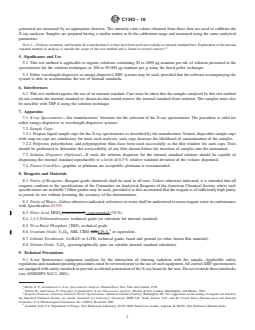
5.1 This test method is applicable to organic solutions containing 20 to 2000 μg uranium per mL of solution presented to the spectrometer for the solution techniques or 200 to 50 000 μg uranium per g using the fused pellet technique.
5.2 Either wavelength-dispersive or energy-dispersive XRF systems may be used, provided that the software accompanying the system is able to accommodate the use of internal standards.
SCOPE
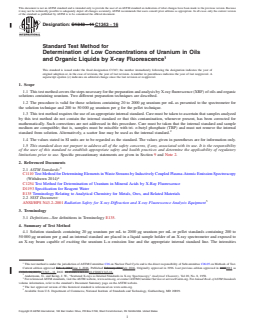
1.1 This test method covers the steps necessary for the preparation and analysis by X-ray fluorescence (XRF) of oils and organic solutions containing uranium. Two different preparation techniques are described.
1.2 The procedure is valid for those solutions containing 20 to 2000 μg uranium per mL as presented to the spectrometer for the solution technique and 200 to 50 000 μg uranium per g for the pellet technique.
1.3 This test method requires the use of an appropriate internal standard. Care must be taken to ascertain that samples analyzed by this test method do not contain the internal standard or that this contamination, whenever present, has been corrected for mathematically. Such corrections are not addressed in this procedure. Care must be taken that the internal standard and sample medium are compatible; that is, samples must be miscible with tri- n-butyl phosphate (TBP) and must not remove the internal standard from solution. Alternatively, a scatter line may be used as the internal standard.2
1.4 The values stated in SI units are to be regarded as the standard. The values given in parentheses are for information only.
1.5 This standard does not purport to address all of the safety concerns, if any, associated with its use. It is the responsibility of the user of this standard to establish appropriate safety and health practices and determine the applicability of regulatory limitations prior to use. Specific precautionary statements are given in Section 9 and Note 2.
General Information
- Status
- Published
- Publication Date
- 31-May-2016
- Technical Committee
- C26 - Nuclear Fuel Cycle
- Drafting Committee
- C26.05 - Methods of Test
Relations
- Effective Date
- 01-Jun-2016
- Effective Date
- 01-Jan-2020
- Effective Date
- 15-May-2019
- Effective Date
- 01-Oct-2018
- Effective Date
- 15-May-2016
- Effective Date
- 01-Jul-2015
- Effective Date
- 15-May-2015
- Effective Date
- 15-Aug-2014
- Effective Date
- 01-Apr-2014
- Effective Date
- 15-Feb-2014
- Effective Date
- 01-Dec-2013
- Effective Date
- 01-Jan-2013
- Effective Date
- 15-Sep-2011
- Effective Date
- 15-Jun-2011
- Effective Date
- 15-Jan-2011
Overview
ASTM C1343-16 is the established standard test method for determining low concentrations of uranium in oils and organic liquids using X-ray fluorescence (XRF) analysis. Developed by ASTM International, this standard provides guidelines for both sample preparation and analytical procedures to quantify uranium in organic matrices. The method is applicable to a range of uranium concentrations and supports both solution and pellet preparation techniques, accommodating a variety of laboratory and industrial applications.
Key Topics
Sample Preparation: Procedures are detailed for preparing oils and organic liquids containing uranium, describing both a solution technique and a fused pellet technique.
- Solution Technique: Valid for concentrations of 20 to 2000 µg uranium per mL.
- Fused Pellet Technique: Applicable for concentrations of 200 to 50,000 µg uranium per g.
Internal Standards: The use of an internal standard (e.g., 1,3,5-tribromobenzene, yttrium oxide, or scatter lines) is mandatory to ensure analytical accuracy. Care must be taken to avoid contamination and to ensure compatibility with the sample matrix.
Detection Systems: Both wavelength-dispersive and energy-dispersive XRF instruments are permitted, as long as the system software supports internal standard correction.
Calibration and Quality Control: The method outlines steps for preparing calibration standards, using master and secondary master standards, and emphasizes maintenance of rigorous quality control protocols in line with laboratory best practices.
Safety and Instrument Care: Attention is given to safety guidelines for handling uranium, chemical reagents, and X-ray spectrometers. The standard highlights the importance of proper equipment operation, fume control, and following manufacturer recommendations.
Applications
ASTM C1343-16 is widely used in the following areas:
- Nuclear Fuel Cycle: Supports quality assurance and regulatory compliance in the processing and analysis of uranium-bearing oils and organic solutions.
- Environmental Monitoring: Facilitates trace detection of uranium contamination in organic matrices, essential for environmental safety assessments.
- Industrial Quality Control: Enables manufacturers to monitor and control uranium levels in lubricants or process fluids to meet industry specifications.
- Research Laboratories: Offers standardized methodology for academic and applied research focusing on uranium analysis by XRF.
Laboratories implementing this standard can expect improved accuracy, reproducibility, and comparability of uranium measurements in organic liquids, contributing to reliable decision-making and regulatory compliance.
Related Standards
For best practices and comprehensive analytical strategies, users may reference these connected standards:
- ASTM C1254: Standard Test Method for Determination of Uranium in Mineral Acids by X-Ray Fluorescence
- ASTM D1193: Specification for Reagent Water
- ASTM E135: Terminology Relating to Analytical Chemistry for Metals, Ores, and Related Materials
- ANSI/HPS N43.2: Radiation Safety for X-ray Diffractometry and X-ray Fluorescence Analysis Equipment
Summary
By following ASTM C1343-16, laboratories and industries gain access to a validated, internationally-recognized method for the determination of uranium in oils and organic liquids by X-ray fluorescence. Compliance with this standard ensures consistent, safe, and precise uranium measurements, supporting environmental, industrial, and regulatory requirements.
Keywords: ASTM C1343-16, uranium analysis, oils, organic liquids, X-ray fluorescence, XRF, internal standard, calibration, nuclear fuel cycle, environmental monitoring.
Buy Documents
ASTM C1343-16 - Standard Test Method for Determination of Low Concentrations of Uranium in Oils and Organic Liquids by X-ray Fluorescence
REDLINE ASTM C1343-16 - Standard Test Method for Determination of Low Concentrations of Uranium in Oils and Organic Liquids by X-ray Fluorescence
Get Certified
Connect with accredited certification bodies for this standard

BSMI (Bureau of Standards, Metrology and Inspection)
Taiwan's standards and inspection authority.
Sponsored listings
Frequently Asked Questions
ASTM C1343-16 is a standard published by ASTM International. Its full title is "Standard Test Method for Determination of Low Concentrations of Uranium in Oils and Organic Liquids by X-ray Fluorescence". This standard covers: SIGNIFICANCE AND USE 5.1 This test method is applicable to organic solutions containing 20 to 2000 μg uranium per mL of solution presented to the spectrometer for the solution techniques or 200 to 50 000 μg uranium per g using the fused pellet technique. 5.2 Either wavelength-dispersive or energy-dispersive XRF systems may be used, provided that the software accompanying the system is able to accommodate the use of internal standards. SCOPE 1.1 This test method covers the steps necessary for the preparation and analysis by X-ray fluorescence (XRF) of oils and organic solutions containing uranium. Two different preparation techniques are described. 1.2 The procedure is valid for those solutions containing 20 to 2000 μg uranium per mL as presented to the spectrometer for the solution technique and 200 to 50 000 μg uranium per g for the pellet technique. 1.3 This test method requires the use of an appropriate internal standard. Care must be taken to ascertain that samples analyzed by this test method do not contain the internal standard or that this contamination, whenever present, has been corrected for mathematically. Such corrections are not addressed in this procedure. Care must be taken that the internal standard and sample medium are compatible; that is, samples must be miscible with tri- n-butyl phosphate (TBP) and must not remove the internal standard from solution. Alternatively, a scatter line may be used as the internal standard.2 1.4 The values stated in SI units are to be regarded as the standard. The values given in parentheses are for information only. 1.5 This standard does not purport to address all of the safety concerns, if any, associated with its use. It is the responsibility of the user of this standard to establish appropriate safety and health practices and determine the applicability of regulatory limitations prior to use. Specific precautionary statements are given in Section 9 and Note 2.
SIGNIFICANCE AND USE 5.1 This test method is applicable to organic solutions containing 20 to 2000 μg uranium per mL of solution presented to the spectrometer for the solution techniques or 200 to 50 000 μg uranium per g using the fused pellet technique. 5.2 Either wavelength-dispersive or energy-dispersive XRF systems may be used, provided that the software accompanying the system is able to accommodate the use of internal standards. SCOPE 1.1 This test method covers the steps necessary for the preparation and analysis by X-ray fluorescence (XRF) of oils and organic solutions containing uranium. Two different preparation techniques are described. 1.2 The procedure is valid for those solutions containing 20 to 2000 μg uranium per mL as presented to the spectrometer for the solution technique and 200 to 50 000 μg uranium per g for the pellet technique. 1.3 This test method requires the use of an appropriate internal standard. Care must be taken to ascertain that samples analyzed by this test method do not contain the internal standard or that this contamination, whenever present, has been corrected for mathematically. Such corrections are not addressed in this procedure. Care must be taken that the internal standard and sample medium are compatible; that is, samples must be miscible with tri- n-butyl phosphate (TBP) and must not remove the internal standard from solution. Alternatively, a scatter line may be used as the internal standard.2 1.4 The values stated in SI units are to be regarded as the standard. The values given in parentheses are for information only. 1.5 This standard does not purport to address all of the safety concerns, if any, associated with its use. It is the responsibility of the user of this standard to establish appropriate safety and health practices and determine the applicability of regulatory limitations prior to use. Specific precautionary statements are given in Section 9 and Note 2.
ASTM C1343-16 is classified under the following ICS (International Classification for Standards) categories: 17.240 - Radiation measurements. The ICS classification helps identify the subject area and facilitates finding related standards.
ASTM C1343-16 has the following relationships with other standards: It is inter standard links to ASTM C1343-11, ASTM E135-20, ASTM E135-19, ASTM C1254-18, ASTM E135-16, ASTM E135-15a, ASTM E135-15, ASTM E135-14b, ASTM E135-14a, ASTM E135-14, ASTM E135-13a, ASTM C1254-13, ASTM E135-11b, ASTM E135-11a, ASTM E135-11. Understanding these relationships helps ensure you are using the most current and applicable version of the standard.
ASTM C1343-16 is available in PDF format for immediate download after purchase. The document can be added to your cart and obtained through the secure checkout process. Digital delivery ensures instant access to the complete standard document.
Standards Content (Sample)
This international standard was developed in accordance with internationally recognized principles on standardization established in the Decision on Principles for the
Development of International Standards, Guides and Recommendations issued by the World Trade Organization Technical Barriers to Trade (TBT) Committee.
Designation: C1343 − 16
Standard Test Method for
Determination of Low Concentrations of Uranium in Oils
and Organic Liquids by X-ray Fluorescence
This standard is issued under the fixed designation C1343; the number immediately following the designation indicates the year of
original adoption or, in the case of revision, the year of last revision. A number in parentheses indicates the year of last reapproval. A
superscript epsilon (´) indicates an editorial change since the last revision or reapproval.
1. Scope 2. Referenced Documents
1.1 This test method covers the steps necessary for the 2.1 ASTM Standards:
C1110 Test Method for Determining Elements in Waste
preparation and analysis by X-ray fluorescence (XRF) of oils
andorganicsolutionscontaininguranium.Twodifferentprepa- StreamsbyInductivelyCoupledPlasma-AtomicEmission
Spectroscopy (Withdrawn 2014)
ration techniques are described.
C1254 Test Method for Determination of Uranium in Min-
1.2 The procedure is valid for those solutions containing 20
eral Acids by X-Ray Fluorescence
to2000µguraniumpermLaspresentedtothespectrometerfor
D1193 Specification for Reagent Water
the solution technique and 200 to 50 000 µg uranium per g for
E135 Terminology Relating to Analytical Chemistry for
the pellet technique.
Metals, Ores, and Related Materials
1.3 This test method requires the use of an appropriate
2.2 NIST Document:
internal standard. Care must be taken to ascertain that samples
ANSI/HPS N43.2–2001 Radiation Safety for X-ray Diffrac-
analyzed by this test method do not contain the internal
tion and X-ray Fluorescence Analysis Equipment
standardorthatthiscontamination,wheneverpresent,hasbeen
3. Terminology
corrected for mathematically. Such corrections are not ad-
dressed in this procedure. Care must be taken that the internal 3.1 Definitions—See definitions in Terminology E135.
standard and sample medium are compatible; that is, samples
4. Summary of Test Method
must be miscible with tri- n-butyl phosphate (TBP) and must
4.1 Solution standards containing 20 µg uranium per mL to
not remove the internal standard from solution.Alternatively, a
2000 µg uranium per mL or pellet standards containing 200 to
scatter line may be used as the internal standard.
50 000 µg uranium per g and an internal standard are placed in
1.4 The values stated in SI units are to be regarded as the
aliquidsampleholderofanX-rayspectrometerandexposedto
standard. The values given in parentheses are for information
an X-ray beam capable of exciting the uranium L-α emission
only.
line and the appropriate internal standard line. The intensities
1.5 This standard does not purport to address all of the
generated are measured by an appropriate detector. The inten-
safety concerns, if any, associated with its use. It is the
sity ratio values obtained from these data are used to calibrate
responsibility of the user of this standard to establish appro-
the X-ray analyzer. Samples are prepared having a similar
priate safety and health practices and determine the applica-
matrix to fit the calibration range and measured using the same
bility of regulatory limitations prior to use. Specific precau-
analytical parameters.
tionary statements are given in Section 9 and Note 2.
NOTE 1—Yttrium, strontium, and bromine K-α and thorium L-α lines
have been used successfully as internal standard lines. Explanation of the
1 3
This test method is under the jurisdiction ofASTM Committee C26 on Nuclear For referenced ASTM standards, visit the ASTM website, www.astm.org, or
Fuel Cycle and is the direct responsibility of Subcommittee C26.05 on Methods of contact ASTM Customer Service at service@astm.org. For Annual Book of ASTM
Test. Standards volume information, refer to the standard’s Document Summary page on
CurrenteditionapprovedJune1,2016.PublishedJuly2016.Originallyapproved the ASTM website.
in 1996. Last previous edition approved in 2011 as C1343 – 11. DOI: 10.1520/ The last approved version of this historical standard is referenced on
C1343-16. www.astm.org.
2 5
Andermann, G., and Kemp, J. W., “Scattered X-rays as Internal Standards in Available from U.S. Department of Commerce, National Institute of Standards
X-ray Spectroscopy,” Analytical Chemistry, Vol 20, No. 8, 1958. and Technology, Gaithersburg, MD 20899.
Copyright © ASTM International, 100 Barr Harbor Drive, PO Box C700, West Conshohocken, PA 19428-2959. United States
C1343 − 16
internal standard method of analysis is outside the scope of this test
provided it is first ascertained that the reagent is of sufficiently
6,7
method and is found in several sources.
high purity to permit its use without lessening the accuracy of
the determination.
5. Significance and Use
8.2 Purity of Water—Unless otherwise indicated, references
5.1 This test method is applicable to organic solutions
to water shall be understood to mean reagent water in confor-
containing20to2000µguraniumpermLofsolutionpresented
mance with Specification D1193.
tothespectrometerforthesolutiontechniquesor200to50 000
8.3 Nitric Acid, HNO , concentrated (70 %).
µg uranium per g using the fused pellet technique. 3
8.4 1,3,5-Tribromobenzene, technical grade (or substitute
5.2 Either wavelength-dispersive or energy-dispersive XRF
for internal standard).
systems may be used, provided that the software accompany-
ing the system is able to accommodate the use of internal
8.5 Tri-n-Butyl Phosphate (TBP), technical grade.
standards.
8.6 Uranium Oxide, U O , NBL CRM 129-A, or equiva-
3 8
lent.
6. Interferences
8.7 Lithium Tetraborate, Li B O or LiTB, technical grade,
2 4 7
6.1 Thistestmethodrequirestheuseofaninternalstandard.
fused and ground (or other fusion flux material).
Care must be taken that the samples analyzed by this test
method do not contain the internal standard or chemicals that 8.8 Yttrium Oxide, Y O , spectrographically pure (or suit-
2 3
wouldremovetheinternalstandardfromsolution.Thesamples able internal standard substitute).
mustalsobemisciblewithTBPifusingthesolutiontechnique.
9. Technical Precautions
7. Apparatus
9.1 X-ray fluorescence equipment analyzes by the interac-
7.1 X-ray Spectrometer—See manufacturers’ literature for
tion of ionizing radiation with the sample. Applicable safety
the selection of the X-ray spectrometer. The procedure is valid
regulations and standard operating procedures must be re-
for either energy-dispersive or wavelength-dispersive systems.
viewed prior to the use of such equipment. All current XRF
spectrometers are equipped with safety interlock to prevent
7.2 Sample Cups:
accidental penetration of the X-ray beam by the user. Do not
7.2.1 Prepare liquid sample cups for the X-ray spectrometer
override these interlocks (see ANSI/HPS N43.2–2001).
as described by the manufacturer. Vented, disposable sample
cups with snap-on caps are satisfactory for most such analyses;
9.2 Instrument performance may be influenced by environ-
such cups decrease the likelihood of contamination of the
mental factors such as heat, vibration, humidity, dust, stray
samples.
electronic noise, and line voltage stability. These factors and
7.2.2 Polyester, polyethylene, and polypropylene films have
performancecharacteristicsshouldbereviewedpriortotheuse
been used successfully as the film window for such cups.Tests
of this test method.
shouldbeperformedtodeterminetheserviceabilityofanyfilm
chosen before the insertion of samples into the instrument.
10. Preparation of Apparatus
7.3 Solution Dispenser (Optional)—If used, the solution
10.1 Chamber Environment—The standards and samples
dispenser for the internal standard solution should be capable
used in this test method are corrosive liquids. Some fumes will
of dispensing the internal standard reproducibly to a level of
be emitted from the sample cups. These fumes may be
0.5 % relative standard deviation of the volume dispensed.
detrimental to the spectrometer chamber. It is desirable to flush
this chamber with an inert gas (usually helium) before and
7.4 Fusion Crucibles—graphite or platinum are acceptable;
during analysis. Some X-ray spectrometers control the change
platinum is recommended.
of sample chamber environment (air, vacuum, and helium)
automatically through the software; in others, it must be done
8. Reagents and Materials
manually. Follow the instrument manufacturer’s recommenda-
8.1 Purity of Reagents—Reagent grade chemicals shall be
tions to achieve the inert gas environment.
used in all tests. Unless otherwise indicated, it is intended that
all reagents conform to the specifications of the Committee on
NOTE 2—Caution: Allow sufficient stabilization time before analysis.
Care must be taken to ensure that a vacuum environment is not chosen
Analytical Reagents of the American Chemical Society where
with liquid samples. Standards and samples must be counted in same
such specifications are available. Other grades may be used,
environment.
10.2 X-ray Power Supply—If the power to the X-ray tube is
not controlled by the instrument software, set the proper
Bertin, E. P., Introduction to X-ray Spectrometric Analysis, Plenum Press, New
York and London, 1978.
combination of voltage and current for the instrument in use.
Tertian, R., and Claisse, F., Principles of Quantitative X-ray Fluorescence
These settings must be ascertained by the user for his instru-
Analysis, Heyden & Son, London, Philadelphia, and Rheine, 1982.
ment and choice of X-ray tube. Rhodium, gold, tungsten, and
Reagent Chemicals, American Chemical Society Specifications, American
Chemical Society, Washington, DC. For suggestions on the testing of reagents not
listed by the American Chemical Society, see Analar Standards for Laboratory
Chemicals, BDH Ltd., Poole, Dorset, U.K., and the United States Pharmacopeia
and National Formulary, U.S. Pharmacopeial Convention, Inc. (USPC), Rockville, Available from U.S. Department of Energy, New Brunswick Laboratory, D350,
MD. 9800 South Cass Avenue, Argonne, IL 60439, Attn: Reference Material Sales.
C1343 − 16
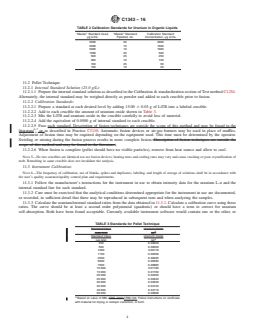
TABLE 2 Calibration Standards for Uranium in Organic Liquids
molybdenum target X-ray tubes have been used successfully
for this analysis. Allow sufficient stabilization time prior to “Master” Standard Used, “Master” Standard Calibration Standard
µg U/mL Pipetted, mL Concentration, µg U/mL
analysis.
5000 20 2000
5000 15 1500
11. Calibration and Standardization
5000 10 1000
1000 25 500
11.1 Solution Technique
500 25 250
11.1.1 Internal Standard Solution:
500 10 100
11.1.1.1 Weigh 65.64 g of 1,3,5-tribromobenzene to the
100 25 50
100 10 20
nearest 0.1 mg. Transfer the material to a 400-mL beaker; add
200 mL of TBP.
11.1.1.2 Dissolve the material inTBP; heat on a hot plate, if
ensure that no adjustment to the dispenser is made between use for
necessary.
standards and use for samples.
11.1.1.3 Transfer the dissolved material to a 1000-mL
11.2 Pellet Technique
volumetric flask, and dilute to volume with TBP. (Storage of
11.2.1 Internal Standard Solution (25.0 g/L):
the solution in an opaque container with a screw cap is
11.2.1.1 Prepare the internal standa
...
This document is not an ASTM standard and is intended only to provide the user of an ASTM standard an indication of what changes have been made to the previous version. Because
it may not be technically possible to adequately depict all changes accurately, ASTM recommends that users consult prior editions as appropriate. In all cases only the current version
of the standard as published by ASTM is to be considered the official document.
Designation: C1343 − 11 C1343 − 16
Standard Test Method for
Determination of Low Concentrations of Uranium in Oils
and Organic Liquids by X-ray Fluorescence
This standard is issued under the fixed designation C1343; the number immediately following the designation indicates the year of
original adoption or, in the case of revision, the year of last revision. A number in parentheses indicates the year of last reapproval. A
superscript epsilon (´) indicates an editorial change since the last revision or reapproval.
1. Scope
1.1 This test method covers the steps necessary for the preparation and analysis by X-ray fluorescence (XRF) of oils and organic
solutions containing uranium. Two different preparation techniques are described.
1.2 The procedure is valid for those solutions containing 20 to 2000 μg uranium per mL as presented to the spectrometer for
the solution technique and 200 to 50 000 μg uranium per g for the pellet technique.
1.3 This test method requires the use of an appropriate internal standard. Care must be taken to ascertain that samples analyzed
by this test method do not contain the internal standard or that this contamination, whenever present, has been corrected for
mathematically. Such corrections are not addressed in this procedure. Care must be taken that the internal standard and sample
medium are compatible; that is, samples must be miscible with tri- n-butyl phosphate (TBP) and must not remove the internal
standard from solution. Alternatively, a scatter line may be used as the internal standard.
1.4 The values stated in SI units are to be regarded as the standard. The values given in parentheses are for information only.
1.5 This standard does not purport to address all of the safety concerns, if any, associated with its use. It is the responsibility
of the user of this standard to establish appropriate safety and health practices and determine the applicability of regulatory
limitations prior to use. Specific precautionary statements are given in Section 9 and Note 2.
2. Referenced Documents
2.1 ASTM Standards:
C1110 Test Method for Determining Elements in Waste Streams by Inductively Coupled Plasma-Atomic Emission Spectroscopy
(Withdrawn 2014)
C1254 Test Method for Determination of Uranium in Mineral Acids by X-Ray Fluorescence
D1193 Specification for Reagent Water
E135 Terminology Relating to Analytical Chemistry for Metals, Ores, and Related Materials
2.2 NIST Document:
ANSI/HPS N43.2–2001 Radiation Safety for X-ray Diffraction and X-ray Fluorescence Analysis Equipment
3. Terminology
3.1 Definitions—See definitions in Terminology E135.
4. Summary of Test Method
4.1 Solution standards containing 20 μg uranium per mL to 2000 μg uranium per mL or pellet standards containing 200 to
50 000 μg uranium per g and an internal standard are placed in a liquid sample holder of an X-ray spectrometer and exposed to
an X-ray beam capable of exciting the uranium L-α emission line and the appropriate internal standard line. The intensities
This test method is under the jurisdiction of ASTM Committee C26 on Nuclear Fuel Cycle and is the direct responsibility of Subcommittee C26.05 on Methods of Test.
Current edition approved Feb. 1, 2011June 1, 2016. Published February 2011July 2016. Originally approved in 1996. Last previous edition approved in 20072011 as
C1343–96(2007).C1343 – 11. DOI: 10.1520/C1343-11.10.1520/C1343-16.
Andermann, G., and Kemp, J. W., “Scattered X-rays as Internal Standards in X-ray Spectroscopy,” Analytical Chemistry, Vol 20, No. 8, 1958.
For referenced ASTM standards, visit the ASTM website, www.astm.org, or contact ASTM Customer Service at service@astm.org. For Annual Book of ASTM Standards
volume information, refer to the standard’s Document Summary page on the ASTM website.
The last approved version of this historical standard is referenced on www.astm.org.
Available from U.S. Department of Commerce, National Institute of Standards and Technology, Gaithersburg, MD 20899.
Copyright © ASTM International, 100 Barr Harbor Drive, PO Box C700, West Conshohocken, PA 19428-2959. United States
C1343 − 16
generated are measured by an appropriate detector. The intensity ratio values obtained from these data are used to calibrate the
X-ray analyzer. Samples are prepared having a similar matrix to fit the calibration range and measured using the same analytical
parameters.
NOTE 1—Yttrium, strontium, and bromine K-α and thorium L-α lines have been used successfully as internal standard lines. Explanation of the internal
6,7
standard method of analysis is outside the scope of this test method and is found in several sources.
5. Significance and Use
5.1 This test method is applicable to organic solutions containing 20 to 2000 μg uranium per mL of solution presented to the
spectrometer for the solution techniques or 200 to 50 000 μg uranium per g using the fused pellet technique.
5.2 Either wavelength-dispersive or energy-dispersive XRF systems may be used, provided that the software accompanying the
system is able to accommodate the use of internal standards.
6. Interferences
6.1 This test method requires the use of an internal standard. Care must be taken that the samples analyzed by this test method
do not contain the internal standard or chemicals that would remove the internal standard from solution. The samples must also
be miscible with TBP if using the solution technique.
7. Apparatus
7.1 X-ray Spectrometer—See manufacturers’ literature for the selection of the X-ray spectrometer. The procedure is valid for
either energy-dispersive or wavelength-dispersive systems.
7.2 Sample Cups:
7.2.1 Prepare liquid sample cups for the X-ray spectrometer as described by the manufacturer. Vented, disposable sample cups
with snap-on caps are satisfactory for most such analyses; such cups decrease the likelihood of contamination of the samples.
7.2.2 Polyester, polyethylene, and polypropylene films have been used successfully as the film window for such cups. Tests
should be performed to determine the serviceability of any film chosen before the insertion of samples into the instrument.
7.3 Solution Dispenser (Optional)—If used, the solution dispenser for the internal standard solution should be capable of
dispensing the internal standard reproducibly to a level of 0.5 % relative standard deviation of the volume dispensed.
7.4 Fusion Crucibles—graphite or platinum are acceptable; platinum is recommended.
8. Reagents and Materials
8.1 Purity of Reagents—Reagent grade chemicals shall be used in all tests. Unless otherwise indicated, it is intended that all
reagents conform to the specifications of the Committee on Analytical Reagents of the American Chemical Society where such
specifications are available. Other grades may be used, provided it is first ascertained that the reagent is of sufficiently high purity
to permit its use without lessening the accuracy of the determination.
8.2 Purity of Water—Unless otherwise indicated, references to water shall be understood to mean reagent water in conformance
with Specification D1193.
8.3 Nitric Acid, HNO ,concentrated , concentrated (70 %).
8.4 1,3,5-Tribromobenzene, technical grade (or substitute for internal standard).
8.5 Tri-n-Butyl Phosphate (TBP), technical grade.
8.6 Uranium Oxide, U O , NBL CRM 129,129-A, or equivalent.
3 8
8.7 Lithium Tetraborate, Li B O or LiTB, technical grade, fused and ground (or other fusion flux material).
2 4 7
8.8 Yttrium Oxide, Y O , spectrographically pure (or suitable internal standard substitute).
2 3
9. Technical Precautions
9.1 X-ray fluorescence equipment analyzes by the interaction of ionizing radiation with the sample. Applicable safety
regulations and standard operating procedures must be reviewed prior to the use of such equipment. All current XRF spectrometers
are equipped with safety interlock to prevent accidental penetration of the X-ray beam by the user. Do not override these interlocks
(see ANSI/HPS N43.2–2001).
Bertin, E. P., Introduction to X-ray Spectrometric Analysis, Plenum Press, New York and London, 1978.
Tertian, R., and Claisse, F., Principles of Quantitative X-ray Fluorescence Analysis, Heyden & Son, London, Philadelphia, and Rheine, 1982.
Reagent Chemicals, American Chemical Society Specifications, American Chemical Society, Washington, DC. For suggestions on the testing of reagents not listed by
the American Chemical Society, see Analar Standards for Laboratory Chemicals, BDH Ltd., Poole, Dorset, U.K., and the United States Pharmacopeia and National
Formulary, U.S. Pharmacopeial Convention, Inc. (USPC), Rockville, MD.
Available from U.S. Department of Energy, New Brunswick Laboratory, D350, 9800 South Cass Avenue, Argonne, IL 60439, Attn: Reference Material Sales.
C1343 − 16
9.2 Instrument performance may be influenced by environmental factors such as heat, vibration, humidity, dust, stray electronic
noise, and line voltage stability. These factors and performance characteristics should be reviewed prior to the use of this test
method.
10. Preparation of Apparatus
10.1 Chamber Environment—The standards and samples used in this test method are corrosive liquids. Some fumes will be
emitted from the sample cups. These fumes may be detrimental to the spectrometer chamber. It is desirable to flush this chamber
with an inert gas (usually helium) before and during analysis. Some X-ray spectrometers control the change of sample chamber
environment (air, vacuum, and helium) automatically through the software; in others, it must be done manually. Follow the
instrument manufacturer’s recommendations to achieve the inert gas environment.
NOTE 2—Caution: Allow sufficient stabilization time before analysis. Care must be taken to ensure that a vacuum environment is not chosen with liquid
samples. Standards and samples must be counted in same environment.
10.2 X-ray Power Supply—If the power to the X-ray tube is not controlled by the instrument software, set the proper
combination of voltage and current for the instrument in use. These settings must be ascertained by the user for his instrument and
choice of X-ray tube. Rhodium, gold, tungsten, and molybdenum target X-ray tubes have been used successfully for this analysis.
Allow sufficient stabilization time prior to analysis.
11. Calibration and Standardization
11.1 Solution Technique
11.1.1 Internal Standard Solution:
11.1.1.1 Weigh 65.64 g of 1,3,5-tribromobenzene to the nearest 0.1 mg. Transfer the material to a 400-mL beaker; add 200 mL
of TBP.
11.1.1.2 Dissolve the material in TBP; heat on a hot plate, if necessary.
11.1.1.3 Transfer the dissolved material to a 1000-mL volumetric flask, and dilute to volume with TBP. (Storage of the solution
in an opaque container with a screw cap is recommended.)
11.1.2 “Master” Standards:
NOTE 3—Because of the difficulty of accurately weighing the small amounts of uranium oxide necessary for low-concentration standards, calibration
standards are made by dilution from “master” standards. The total volume of the standard prepared may be adjusted to meet the user’s analytical
throughput if the weights are adjusted appropriately.
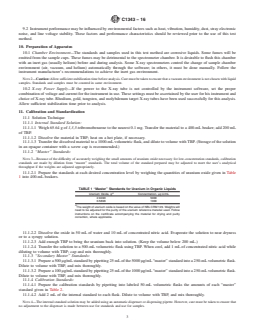
11.1.2.1 Prepare the standards at each desired concentration level by weighing the quantities of uranium oxide given in Table
1 into 400-mL beakers.
TABLE 1 “Master” Standards for Uranium in Organic Liquids
A
Uranium Oxide, g Concentration, μg U/mL
2.9490 5000
0.5898 1000
A
The weight of uranium
...
Questions, Comments and Discussion
Ask us and Technical Secretary will try to provide an answer. You can facilitate discussion about the standard in here.
Loading comments...