


ASTM C912-93(2008)
(Practice)Standard Practice for Designing a Process for Cleaning Technical Glasses
Standard Practice for Designing a Process for Cleaning Technical Glasses
SIGNIFICANCE AND USE
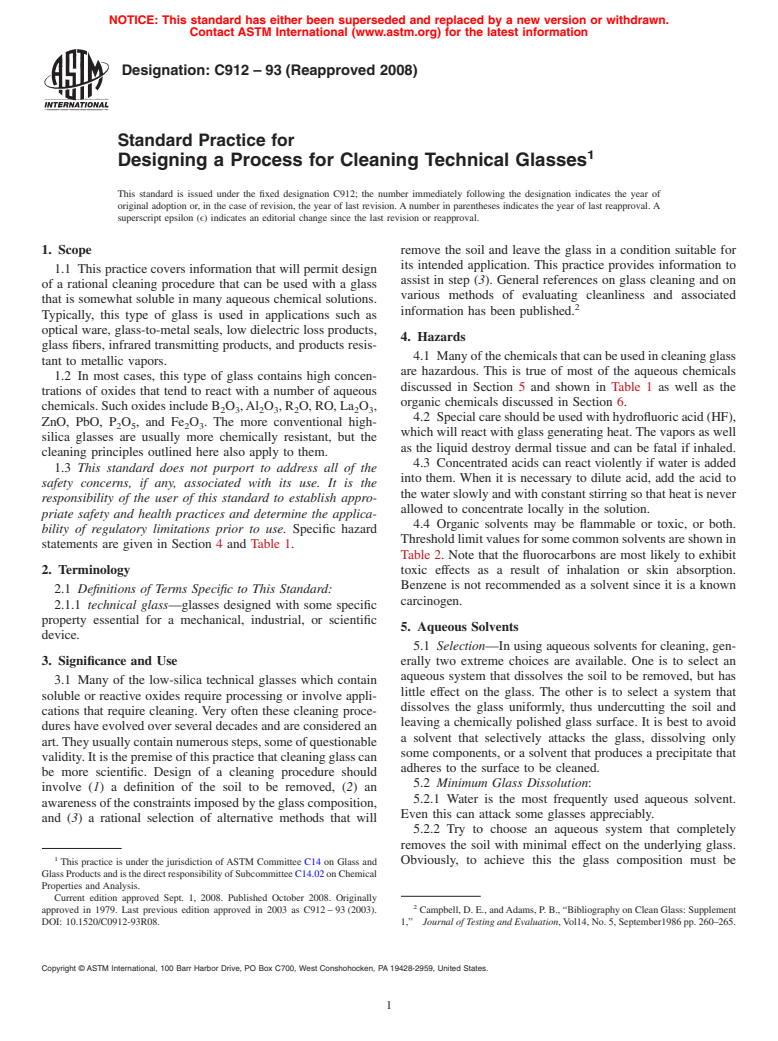
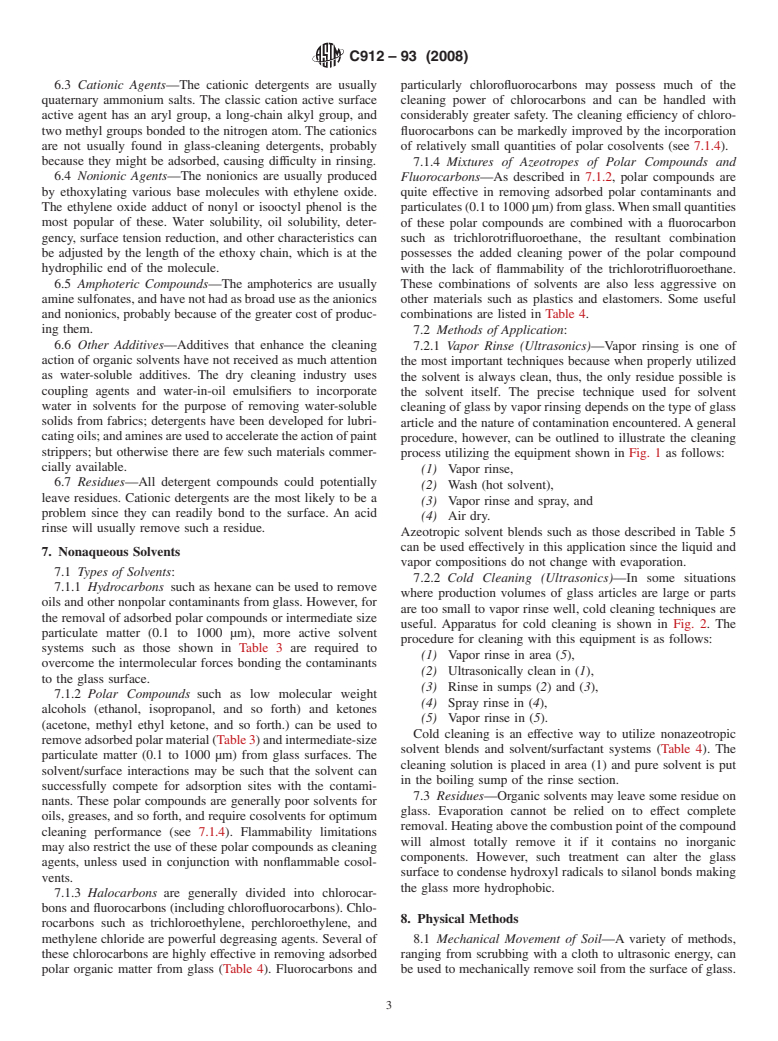
Many of the low-silica technical glasses which contain soluble or reactive oxides require processing or involve applications that require cleaning. Very often these cleaning procedures have evolved over several decades and are considered an art. They usually contain numerous steps, some of questionable validity. It is the premise of this practice that cleaning glass can be more scientific. Design of a cleaning procedure should involve (1) a definition of the soil to be removed, (2) an awareness of the constraints imposed by the glass composition, and (3) a rational selection of alternative methods that will remove the soil and leave the glass in a condition suitable for its intended application. This practice provides information to assist in step (3). General references on glass cleaning and on various methods of evaluating cleanliness and associated information has been published.
SCOPE
1.1 This practice covers information that will permit design of a rational cleaning procedure that can be used with a glass that is somewhat soluble in many aqueous chemical solutions. Typically, this type of glass is used in applications such as optical ware, glass-to-metal seals, low dielectric loss products, glass fibers, infrared transmitting products, and products resistant to metallic vapors.
1.2 In most cases, this type of glass contains high concentrations of oxides that tend to react with a number of aqueous chemicals. Such oxides include B2O3, Al2O3, R2O, RO, La2O3, ZnO, PbO, P2O5, and Fe2O3. The more conventional high-silica glasses are usually more chemically resistant, but the cleaning principles outlined here also apply to them.
1.3 This standard does not purport to address all of the safety concerns, if any, associated with its use. It is the responsibility of the user of this standard to establish appropriate safety and health practices and determine the applicability of regulatory limitations prior to use. Specific hazard statements are given in Section 4 and Table 1.
General Information
Relations
Standards Content (Sample)
NOTICE: This standard has either been superseded and replaced by a new version or withdrawn.
Contact ASTM International (www.astm.org) for the latest information
Designation:C912–93(Reapproved 2008)
Standard Practice for
Designing a Process for Cleaning Technical Glasses
This standard is issued under the fixed designation C912; the number immediately following the designation indicates the year of
original adoption or, in the case of revision, the year of last revision. A number in parentheses indicates the year of last reapproval. A
superscript epsilon (ϵ) indicates an editorial change since the last revision or reapproval.
1. Scope remove the soil and leave the glass in a condition suitable for
its intended application. This practice provides information to
1.1 This practice covers information that will permit design
assist in step (3). General references on glass cleaning and on
of a rational cleaning procedure that can be used with a glass
various methods of evaluating cleanliness and associated
that is somewhat soluble in many aqueous chemical solutions.
information has been published.
Typically, this type of glass is used in applications such as
optical ware, glass-to-metal seals, low dielectric loss products,
4. Hazards
glass fibers, infrared transmitting products, and products resis-
4.1 Manyofthechemicalsthatcanbeusedincleaningglass
tant to metallic vapors.
are hazardous. This is true of most of the aqueous chemicals
1.2 In most cases, this type of glass contains high concen-
discussed in Section 5 and shown in Table 1 as well as the
trations of oxides that tend to react with a number of aqueous
organic chemicals discussed in Section 6.
chemicals. Such oxides include B O ,Al O ,R O, RO, La O ,
2 3 2 3 2 2 3
4.2 Specialcareshouldbeusedwithhydrofluoricacid(HF),
ZnO, PbO, P O , and Fe O . The more conventional high-
2 5 2 3
which will react with glass generating heat. The vapors as well
silica glasses are usually more chemically resistant, but the
as the liquid destroy dermal tissue and can be fatal if inhaled.
cleaning principles outlined here also apply to them.
4.3 Concentrated acids can react violently if water is added
1.3 This standard does not purport to address all of the
into them. When it is necessary to dilute acid, add the acid to
safety concerns, if any, associated with its use. It is the
the water slowly and with constant stirring so that heat is never
responsibility of the user of this standard to establish appro-
allowed to concentrate locally in the solution.
priate safety and health practices and determine the applica-
4.4 Organic solvents may be flammable or toxic, or both.
bility of regulatory limitations prior to use. Specific hazard
Thresholdlimitvaluesforsomecommonsolventsareshownin
statements are given in Section 4 and Table 1.
Table 2. Note that the fluorocarbons are most likely to exhibit
2. Terminology toxic effects as a result of inhalation or skin absorption.
Benzene is not recommended as a solvent since it is a known
2.1 Definitions of Terms Specific to This Standard:
carcinogen.
2.1.1 technical glass—glasses designed with some specific
property essential for a mechanical, industrial, or scientific
5. Aqueous Solvents
device.
5.1 Selection—In using aqueous solvents for cleaning, gen-
3. Significance and Use erally two extreme choices are available. One is to select an
aqueous system that dissolves the soil to be removed, but has
3.1 Many of the low-silica technical glasses which contain
little effect on the glass. The other is to select a system that
soluble or reactive oxides require processing or involve appli-
dissolves the glass uniformly, thus undercutting the soil and
cations that require cleaning. Very often these cleaning proce-
leaving a chemically polished glass surface. It is best to avoid
dures have evolved over several decades and are considered an
a solvent that selectively attacks the glass, dissolving only
art.Theyusuallycontainnumeroussteps,someofquestionable
some components, or a solvent that produces a precipitate that
validity.Itisthepremiseofthispracticethatcleaningglasscan
adheres to the surface to be cleaned.
be more scientific. Design of a cleaning procedure should
5.2 Minimum Glass Dissolution:
involve (1) a definition of the soil to be removed, (2)an
5.2.1 Water is the most frequently used aqueous solvent.
awareness of the constraints imposed by the glass composition,
Even this can attack some glasses appreciably.
and (3) a rational selection of alternative methods that will
5.2.2 Try to choose an aqueous system that completely
removes the soil with minimal effect on the underlying glass.
Obviously, to achieve this the glass composition must be
This practice is under the jurisdiction of ASTM Committee C14 on Glass and
GlassProductsandisthedirectresponsibilityofSubcommitteeC14.02onChemical
Properties and Analysis.
Current edition approved Sept. 1, 2008. Published October 2008. Originally
approved in 1979. Last previous edition approved in 2003 as C912 – 93 (2003). Campbell, D. E., andAdams, P. B., “Bibliography on Clean Glass: Supplement
DOI: 10.1520/C0912-93R08. 1,” Journal of Testing and Evaluation,Vol14, No. 5, September1986 pp. 260–265.
Copyright © ASTM International, 100 Barr Harbor Drive, PO Box C700, West Conshohocken, PA 19428-2959, United States.
C912–93 (2008)
known. However, one cannot simply calculate glass solubility 5.5.1 Any reaction between a solvent and a complex mix-
in a specific reagent. Reference to Table 1 will then help ture of oxides affects the possibility of formation of some
determine if an aqueous solvent exists that will not attack the insoluble reaction products. Agitation may help prevent their
glass. The table provides guidance in selecting a solvent, but adherence to the glass. Additionally, the reagent itself is
trial and error will usually be necessary also. Individual glass potentially a “residue.”
components do not act independently with specific solvents, in 5.5.2 Reaction with the glass may also leave a roughened
most cases, as described in 5.2.3.
surface (selective reaction with certain glass components),
streaks (selective reaction with nonhomogeneous “cords”), or
5.2.3 It is not necessary that the glass contain absolutely
with latent grinding marks hidden by a previous polishing step.
none of the components that are soluble in the chosen reagent.
For instance, a glass containing 80 % SiO and 5 % Na O
2 2
6. Detergents
could be cleaned in H SO without appreciable glass attack
2 4
even though Na O is very soluble in H SO ; however a glass
2 2 4
6.1 Surface Active Agents:
containing 50 % SiO and 25 % Na O would probably show
2 2
6.1.1 Surface active agents accelerate the cleaning action of
considerable attack by H SO . Often this can only be deter-
2 4
aqueous solutions and provide mechanisms of cleaning that
mined by trial.
water does not have by itself. Many compounds are available,
5.3 Uniform Glass Dissolution:
usually under trade names that give no hint of their chemical
nature. Selection of the best compound for a particular use is
5.3.1 It may be necessary to select a system that uniformly
usually a matter of experimentation, since the available litera-
attacks the glass either because there is no other solvent for the
ture gives few clues to aid in prediction.
soil or there is no solvent available that does not attack the
6.1.2 Generally, however, such “agents” consist of long-
glass. For glasses containing substantial concentrations of
chain organic molecules, one end of which is attracted to the
silica,HForHFplussomeotherreagentmaybeagoodchoice.
soil or the substrate, or both, the other end of which is “water
HF can often be used for cleaning provided there are no glass
soluble.” They “wet” the glass surface by lowering the surface
components that form insoluble fluorides. For non-silicate
glasses, some other reagent would probably be appropriate. tension of water; thus decreasing the contact angle between
solvent and glass and between solvent and soil. The net effect
Table 1 is a general guide to selection of such reagents.
is that the particle or oily film is dislodged. They “surround”
5.3.2 There are two further modifications that can allow the
the particle or droplet to suspend or emulsify and prevent its
successful use of HF even if insoluble products form. One is to
redeposition.
combinechemicalcleaningwithamechanicalcleaningprocess
6.1.3 The activity of surface active agents is usually en-
either simultaneously or sequentially. The other is to mix the
hanced by the blending of two or more and by the addition of
HF with another acid to achieve complete solution of all
non-surface active agents (called “builders”). A compound
products.
with good emulsification will be blended with a good wetter,
5.3.3 Alkali solutions can be used as a glass solvent for
and built with a polyphosphate for water softening, dispersion,
cleaning, but, in most cases, it will be necessary to use them
and micelle formation. EDTAand similar compounds are used
hot to achieve a sufficiently rapid reaction.
for water softening and solubilization of inorganic compounds,
5.3.4 Many glasses can be cleaned by the uniform dissolu-
soda ash, and ammonia for pH regulation and sodium silicates
tion process without the use of HF or alkali. Reference toTable
for achieving high alkalinity while inhibiting attack on the
1 will suggest the types of glasses to which this approach is
glass.
applicable. For instance, a glass containing 60 % PbO and less
6.1.4 The builders can either promote or inhibit solution of
than 15 % SiO could probably be cleaned in this way with
glasses, depending on whether the reaction products or the
HNO , particularly if mechanical action by polishing or
builder and the glass components are soluble or insoluble.
rubbing is used.
Polyphosphates and EDTA, in particular, will chelate with and
5.4 Other Possibilities:
solubilize metallic ions, promoting a preferential leaching and
5.4.1 When all else fails, organic complexing agents, either
leaving a porous or etched surface on the glass.
alone or in combination with other chemicals, may succeed in
6.1.5 Water-soluble surface active agents are usually long-
removing soil without damaging the glass. For instance,
chain organic molecules with a hydrophobic end and a hydro-
alkaline EDTAis a powerful complexing agent for a number of
philic end. The ionic nature of the hydrophilic end determines
elements, such as calcium, magnesium, silicon, aluminum,
the broad basic classification of the material—if negative, it is
lead, zinc, and barium.
anionic, if positive, cationic, and if the material is not ionized,
5.4.2 Sometimes it is necessary to use a multicomponent
it is nonionic. There are a few amphoteric materials available,
aqueous system to achieve the desired results. Obviously,
and these hybrids can be either cationic or anionic, depending
concentrations of various reagents and temperatures at which
on the pH of the solution.
the process can be carried out are important. It is not the intent
6.2 Anionic Agents—The oldest, and one of the most
of this practice to explore all these possibilities, but, by
effective anionic detergents if used in “soft” water, is soap.The
knowing the glass composition, the correct solvent-
largest class of synthetic anionic detergents is the sulfonated
concentration-temperature-time conditions to effect the desired
hydrocarbons such as sodium dodecyl benzene sulfonate.
result can be devised.
Sulfatedalcoholsandpolyethers,suchassodiumlaurylsulfate,
5.5 Residues and Defects: are also used extensively.
C912–93 (2008)
6.3 Cationic Agents—The cationic detergents are usually particularly chlorofluorocarbons may possess much of the
quaternary ammonium salts. The classic cation active surface cleaning power of chlorocarbons and can be handled with
active agent has an aryl group, a long-chain alkyl group, and considerably greater safety. The cleaning efficiency of chloro-
two methyl groups bonded to the nitrogen atom. The cationics fluorocarbons can be markedly improved by the incorporation
are not usually found in glass-cleaning detergents, probably of relatively small quantities of polar cosolvents (see 7.1.4).
because they might be adsorbed, causing difficulty in rinsing. 7.1.4 Mixtures of Azeotropes of Polar Compounds and
6.4 Nonionic Agents—The nonionics are usually produced Fluorocarbons—As described in 7.1.2, polar compounds are
by ethoxylating various base molecules with ethylene oxide. quite effective in removing adsorbed polar contaminants and
The ethylene oxide adduct of nonyl or isooctyl phenol is the particulates(0.1to1000µm)fromglass.Whensmallquantities
most popular of these. Water solubility, oil solubility, deter- of these polar compounds are combined with a fluorocarbon
gency, surface tension reduction, and other characteristics can such as trichlorotrifluoroethane, the resultant combination
be adjusted by the length of the ethoxy chain, which is at the possesses the added cleaning power of the polar compound
hydrophilic end of the molecule. with the lack of flammability of the trichlorotrifluoroethane.
6.5 Amphoteric Compounds—The amphoterics are usually These combinations of solvents are also less aggressive on
aminesulfonates,andhavenothadasbroaduseastheanionics other materials such as plastics and elastomers. Some useful
and nonionics, probably because of the greater cost of produc-
combinations are listed in Table 4.
ing them.
7.2 Methods of Application:
6.6 Other Additives—Additives that enhance the cleaning
7.2.1 Vapor Rinse (Ultrasonics)—Vapor rinsing is one of
action of organic solvents have not received as much attention
the most important techniques because when properly utilized
as water-soluble additives. The dry cleaning industry uses
the solvent is always clean, thus, the only residue possible is
coupling agents and water-in-oil emulsifiers to incorporate
the solvent itself. The precise technique used for solvent
water in solvents for the purpose of removing water-soluble
cleaning of glass by vapor rinsing depends on the type of glass
solids from fabrics; detergents have been developed for lubri-
article and the nature of contamination encountered.Ageneral
catingoils;andaminesareusedtoacceleratetheactionofpaint
procedure, however, can be outlined to illustrate the cleaning
strippers; but otherwise there are few such materials commer-
process utilizing the equipment shown in Fig. 1 as follows:
cially available.
(1) Vapor rinse,
6.7 Residues—All detergent compounds could potentially
(2) Wash (hot solvent),
leave residues. Cationic detergents are the most likely to be a
(3) Vapor rinse and spray, and
problem since they can readily bond to the surface. An acid
(4) Air dry.
rinse will usually remove such a residue.
Azeotropic solvent blends such as those described in Table 5
can be used effectively in this application si
...
Questions, Comments and Discussion
Ask us and Technical Secretary will try to provide an answer. You can facilitate discussion about the standard in here.