

ASTM C1788-20
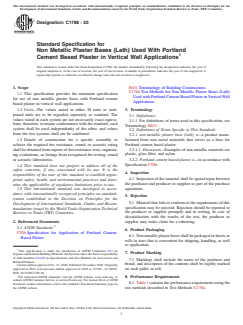
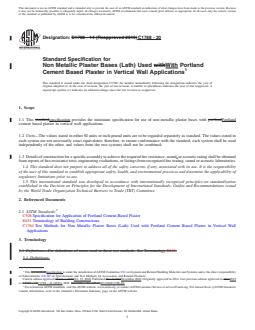
(Specification)Standard Specification for Non Metallic Plaster Bases (Lath) Used With Portland Cement Based Plaster in Vertical Wall Applications
General Information
- Abstract
ABSTRACT
This standard covers the use of non-metallic plaster bases with portland cement-based plaster in vertical wall applications and provides details of requirements with respect to inspection of the material as well as rejection, product packaging and marking, and performance.
SCOPE
1.1 This specification provides the minimum specification for use of non metallic plaster bases with Portland cement based plaster in vertical wall applications.
1.2 Units—The values stated in either SI units or inch-pound units are to be regarded separately as standard. The values stated in each system are not necessarily exact equivalents; therefore, to ensure conformance with the standard, each system shall be used independently of the other, and values from the two systems shall not be combined.
1.3 Details of construction for a specific assembly to achieve the required fire resistance, sound, or acoustic rating shall be obtained from reports of fire-resistance tests, engineering evaluations, or listings from recognized fire testing, sound or acoustic laboratories.
1.4 This standard does not purport to address all of the safety concerns, if any, associated with its use. It is the responsibility of the user of this standard to establish appropriate safety, health, and environmental practices and determine the applicability of regulatory limitations prior to use.
1.5 This international standard was developed in accordance with internationally recognized principles on standardization established in the Decision on Principles for the Development of International Standards, Guides and Recommendations issued by the World Trade Organization Technical Barriers to Trade (TBT) Committee.
- Status
- Published
- Publication Date
- 14-Oct-2020
- Technical Committee
- C11 - Gypsum and Related Building Materials and Systems
Buy Documents


ASTM C1788-20 - Standard Specification for Non Metallic Plaster Bases (Lath) Used With Portland Cement Based Plaster in Vertical Wall Applications


REDLINE ASTM C1788-20 - Standard Specification for Non Metallic Plaster Bases (Lath) Used With Portland Cement Based Plaster in Vertical Wall Applications
Overview
ASTM C1788-20 provides a comprehensive specification for non-metallic plaster bases (lath) used with Portland cement-based plaster specifically in vertical wall applications. Published and maintained by ASTM International, this standard outlines minimum requirements to ensure that non-metallic lath products perform properly when incorporated in building envelopes. It addresses important considerations such as inspection, product rejection policies, packaging and marking requirements, and essential performance criteria.
By adhering to ASTM C1788-20, manufacturers, suppliers, and construction professionals can help ensure safe, reliable, and standardized installation of plaster bases, which supports durability and performance in both residential and commercial construction. This standard contributes to the overall quality, fire safety, and acoustical integrity of wall assemblies using Portland cement-based plaster.
Key Topics
- Scope of Use: Specifies the use of non-metallic plaster bases with Portland cement-based plaster in all types of vertical wall applications.
- Material Definitions: Clarifies key terms including non-metallic plaster base, Portland cement-based plaster, and acceptable materials like plastic, glass fiber, and nylon.
- Performance Requirements: Outlines crucial properties such as:
- Transverse and vertical load capacity
- Embedment requirements for optimal adhesion and structural integrity
- Fastener pull-through resistance to guard against mechanical failure
- Alkali resistance (for glass fiber lath) to ensure material longevity when exposed to cement
- Unit Measurement Compliance: Establishes that both SI and inch-pound units are acceptable, but each must be used independently for consistency and compliance.
- Packaging and Marking: Details for product labeling and packaging to ensure clear identification and traceability.
- Inspection and Rejection: Guidance on purchase agreements and procedures for handling non-compliant materials.
Applications
- Building Construction: Widely applicable in new builds, renovations, and commercial construction projects where Portland cement-based plasters are specified for vertical walls.
- Fire and Sound Rated Assemblies: Supports assemblies requiring specific fire resistance and acoustical ratings-details are to be determined via separate laboratory tests or engineering evaluations.
- Lightweight and Corrosion-Resistant Installations: Ideal for environments where non-metallic lath is preferred over metallic options, providing advantages such as lightweight handling and resistance to rust or corrosion.
Related Standards
- ASTM C926: Specification for Application of Portland Cement-Based Plaster - governs plaster application practices.
- ASTM C1764: Test Methods for Non-Metallic Plaster Bases (Lath) - defines methods for evaluating performance properties referenced in C1788-20.
- ASTM E631: Terminology Relating to Building Constructions - standardizes terms used throughout the specification.
Practical Value
Using ASTM C1788-20 ensures that non-metallic lath products used with Portland cement-based plaster in vertical wall assemblies meet rigorous quality and performance criteria. This reduces the risk of product failure, aligns with building safety requirements, eases inspection processes, and supports the creation of high-quality, code-compliant structures. Adopting this standard can help industry professionals meet both regulatory expectations and customer needs for durable, safe, and efficient construction practices.
Keywords: ASTM C1788-20, non-metallic plaster base, non-metallic lath, Portland cement-based plaster, vertical wall applications, building standards, construction specification, performance requirements, fire resistance, acoustical rating.
Relations
- Effective Date
- 15-Nov-2023
- Effective Date
- 01-Jan-2020
- Effective Date
- 01-Jun-2019
- Effective Date
- 01-Jun-2019
- Effective Date
- 01-May-2019
- Effective Date
- 01-Aug-2018
- Effective Date
- 01-Mar-2018
- Effective Date
- 01-Jan-2018
- Effective Date
- 01-Jan-2017
- Effective Date
- 01-Dec-2016
- Effective Date
- 01-Sep-2016
- Effective Date
- 01-Sep-2016
- Effective Date
- 01-Mar-2016
- Effective Date
- 01-Jan-2016
- Effective Date
- 15-Jul-2015
Buy Documents
ASTM C1788-20 - Standard Specification for Non Metallic Plaster Bases (Lath) Used With Portland Cement Based Plaster in Vertical Wall Applications
REDLINE ASTM C1788-20 - Standard Specification for Non Metallic Plaster Bases (Lath) Used With Portland Cement Based Plaster in Vertical Wall Applications
Get Certified
Connect with accredited certification bodies for this standard

DIBt (Deutsches Institut für Bautechnik)
German Institute for Building Technology.
DIN CERTCO
DIN Group product certification.

Aboma Certification B.V.
Specialized in construction, metal, and transport sectors.
Sponsored listings
Frequently Asked Questions
ASTM C1788-20 is a technical specification published by ASTM International. Its full title is "Standard Specification for Non Metallic Plaster Bases (Lath) Used With Portland Cement Based Plaster in Vertical Wall Applications". This standard covers: ABSTRACT This standard covers the use of non-metallic plaster bases with portland cement-based plaster in vertical wall applications and provides details of requirements with respect to inspection of the material as well as rejection, product packaging and marking, and performance. SCOPE 1.1 This specification provides the minimum specification for use of non metallic plaster bases with Portland cement based plaster in vertical wall applications. 1.2 Units—The values stated in either SI units or inch-pound units are to be regarded separately as standard. The values stated in each system are not necessarily exact equivalents; therefore, to ensure conformance with the standard, each system shall be used independently of the other, and values from the two systems shall not be combined. 1.3 Details of construction for a specific assembly to achieve the required fire resistance, sound, or acoustic rating shall be obtained from reports of fire-resistance tests, engineering evaluations, or listings from recognized fire testing, sound or acoustic laboratories. 1.4 This standard does not purport to address all of the safety concerns, if any, associated with its use. It is the responsibility of the user of this standard to establish appropriate safety, health, and environmental practices and determine the applicability of regulatory limitations prior to use. 1.5 This international standard was developed in accordance with internationally recognized principles on standardization established in the Decision on Principles for the Development of International Standards, Guides and Recommendations issued by the World Trade Organization Technical Barriers to Trade (TBT) Committee.
ABSTRACT This standard covers the use of non-metallic plaster bases with portland cement-based plaster in vertical wall applications and provides details of requirements with respect to inspection of the material as well as rejection, product packaging and marking, and performance. SCOPE 1.1 This specification provides the minimum specification for use of non metallic plaster bases with Portland cement based plaster in vertical wall applications. 1.2 Units—The values stated in either SI units or inch-pound units are to be regarded separately as standard. The values stated in each system are not necessarily exact equivalents; therefore, to ensure conformance with the standard, each system shall be used independently of the other, and values from the two systems shall not be combined. 1.3 Details of construction for a specific assembly to achieve the required fire resistance, sound, or acoustic rating shall be obtained from reports of fire-resistance tests, engineering evaluations, or listings from recognized fire testing, sound or acoustic laboratories. 1.4 This standard does not purport to address all of the safety concerns, if any, associated with its use. It is the responsibility of the user of this standard to establish appropriate safety, health, and environmental practices and determine the applicability of regulatory limitations prior to use. 1.5 This international standard was developed in accordance with internationally recognized principles on standardization established in the Decision on Principles for the Development of International Standards, Guides and Recommendations issued by the World Trade Organization Technical Barriers to Trade (TBT) Committee.
ASTM C1788-20 is classified under the following ICS (International Classification for Standards) categories: 91.100.10 - Cement. Gypsum. Lime. Mortar. The ICS classification helps identify the subject area and facilitates finding related standards.
ASTM C1788-20 has the following relationships with other standards: It is inter standard links to ASTM C926-23a, ASTM C926-20, ASTM C926-19a, ASTM C926-19ae1, ASTM C926-19, ASTM C926-18b, ASTM C926-18a, ASTM C926-18, ASTM C926-17, ASTM C926-16c, ASTM C1764-12(2016), ASTM C926-16b, ASTM C926-16a, ASTM C926-16, ASTM C926-15b. Understanding these relationships helps ensure you are using the most current and applicable version of the standard.
ASTM C1788-20 is available in PDF format for immediate download after purchase. The document can be added to your cart and obtained through the secure checkout process. Digital delivery ensures instant access to the complete standard document.
Standards Content (Sample)
This international standard was developed in accordance with internationally recognized principles on standardization established in the Decision on Principles for the
Development of International Standards, Guides and Recommendations issued by the World Trade Organization Technical Barriers to Trade (TBT) Committee.
Designation:C1788 −20
Standard Specification for
Non Metallic Plaster Bases (Lath) Used With Portland
Cement Based Plaster in Vertical Wall Applications
This standard is issued under the fixed designation C1788; the number immediately following the designation indicates the year of
original adoption or, in the case of revision, the year of last revision. A number in parentheses indicates the year of last reapproval. A
superscript epsilon (´) indicates an editorial change since the last revision or reapproval.
1. Scope E631 Terminology of Building Constructions
C1764 Test Methods for Non Metallic Plaster Bases (Lath)
1.1 This specification provides the minimum specification
Used with Portland Cement Based Plaster in Vertical Wall
for use of non metallic plaster bases with Portland cement
Applications
based plaster in vertical wall applications.
3. Terminology
1.2 Units—The values stated in either SI units or inch-
pound units are to be regarded separately as standard. The
3.1 Definitions:
values stated in each system are not necessarily exact equiva-
3.1.1 For definitions of terms used in this specification, see
lents; therefore, to ensure conformance with the standard, each
Terminology E631.
system shall be used independently of the other, and values
3.2 Definitions of Terms Specific to This Standard:
from the two systems shall not be combined.
3.2.1 non metallic plaster base (lath), n—a product manu-
factured from non metal materials that serves as a base for
1.3 Details of construction for a specific assembly to
Portland cement based plaster.
achieve the required fire resistance, sound, or acoustic rating
3.2.1.1 Discussion—Examples of non metallic materials are
shall be obtained from reports of fire-resistance tests, engineer-
plastic, glass fiber, and nylon.
ing evaluations, or listings from recognized fire testing, sound
or acoustic laboratories.
3.2.2 Portland cement based plaster, n—in accordance with
Specification C926.
1.4 This standard does not purport to address all of the
safety concerns, if any, associated with its use. It is the
4. Inspection
responsibility of the user of this standard to establish appro-
4.1 Inspection of the material shall be agreed upon between
priate safety, health, and environmental practices and deter-
the purchaser and producer or supplier as part of the purchase
mine the applicability of regulatory limitations prior to use.
agreement.
1.5 This international standard was developed in accor-
dance with internationally recognized principles on standard-
5. Rejection
ization established in the Decision on Principles for the
5.1 Material that fails to conform to the requirements of this
Development of International Standards, Guides and Recom-
specification may be rejected. Rejection should be reported to
mendations issued by the World Trade Organization Technical
the producer or supplier promptly and in writing. In case of
Barriers to Trade (TBT) Committee.
dissatisfaction with the results of the test, the producer or
2. Referenced Documents
supplier may make claim for a rehearing.
2.1 ASTM Standards:
6. Product Packaging
C926 Specification for Application of Portland Cement-
6.1 Nonmetallicplasterbasesshallbepackagedinsheetsor
Based Plaster
rolls in sizes that is convenient for shipping, handling, as well
as application.
This specification is under the jurisdiction of ASTM Committee C11 on
7. Product Marking
Gypsum and Related Building Materials and Systems and is the direct responsibility
...
This document is not an ASTM standard and is intended only to provide the user of an ASTM standard an indication of what changes have been made to the previous version. Because
it may not be technically possible to adequately depict all changes accurately, ASTM recommends that users consult prior editions as appropriate. In all cases only the current version
of the standard as published by ASTM is to be considered the official document.
Designation: C1788 − 14 (Reapproved 2019) C1788 − 20
Standard Specification for
Non Metallic Plaster Bases (Lath) Used withWith Portland
Cement Based Plaster in Vertical Wall Applications
This standard is issued under the fixed designation C1788; the number immediately following the designation indicates the year of
original adoption or, in the case of revision, the year of last revision. A number in parentheses indicates the year of last reapproval. A
superscript epsilon (´) indicates an editorial change since the last revision or reapproval.
1. Scope
1.1 This standardspecification provides the minimum specification for use of non metallic plaster bases with portlandPortland
cement based plaster in vertical wall applications.
1.2 Units—The values stated in either SI units or inch-pound units are to be regarded separately as standard. The values stated in
each system are not necessarily exact equivalents; therefore, to ensure conformance with the standard, each system shall be used
independently of the other, and values from the two systems shall not be combined.
1.3 Details of construction for a specific assembly to achieve the required fire resistance, sound, or acoustic rating shall be obtained
from reports of fire-resistance tests, engineering evaluations, or listings from recognized fire testing, sound or acoustic laboratories.
1.4 This standard does not purport to address all of the safety concerns, if any, associated with its use. It is the responsibility
of the user of this standard to establish appropriate safety, health, and environmental practices and determine the applicability of
regulatory limitations prior to use.
1.5 This international standard was developed in accordance with internationally recognized principles on standardization
established in the Decision on Principles for the Development of International Standards, Guides and Recommendations issued
by the World Trade Organization Technical Barriers to Trade (TBT) Committee.
2. Referenced Documents
2.1 ASTM Standards:
C926 Specification for Application of Portland Cement-Based Plaster
E631 Terminology of Building Constructions
C1764 Test Methods for Non Metallic Plaster Bases (Lath) Used with Portland Cement Based Plaster in Vertical Wall
Applications
3. Terminology
3.1 Definitions—For definitions of terms used in these test methods, See Terminology E631.
3.1 Definitions:
This test method specification is under the jurisdiction of ASTM Committee C11 on Gypsum and Related Building Materials and Systems and is the direct responsibility
of Subcommittee C11.02 on Specifications and Test Methods for Accessories and Related Products.
Current edition approved March 1, 2019Oct. 15, 2020. Published March 2019November 2020. Originally approved in 2014. Last previous edition approved in 20142019
as C1788 – 14.C1788 – 14 (2019). DOI: 10.1520/C1788-14R19.10.1520/C1788-20.
For referenced ASTM standards, visit the ASTM website, www.astm.org, or contact ASTM Customer Service at service@astm.org. For Annual Book of ASTM Standards
volume information, refer to the standard’s Document Summary page on the ASTM website.
Copyright © ASTM International, 100 Barr Harbor Drive, PO Box C700, West Conshohocken, PA 19428-2959. United States
C1788 − 20
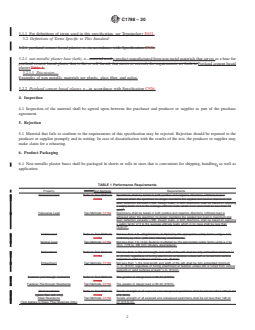
3.1.1 For definitions of terms used in this specification, see Terminology E631.
3.2 Definitions of Terms Specific to This Standard:
3.2.1 portland cement based plaster, n—in accordance with Specification C926.
3.2.1 non metallic plaster base (lath), n—material used a product manufactured from non metal materials that serves as a base for
portland cement based plaster that is flat or self furred, that meets or exceeds the requirements set forth in Portland cement based
plaster.Table 1.
3.2.1.1 Discussion—
Examples of non metallic materials are plastic, glass fiber, and nylon.
3.2.2 Portland cement based plaster, n—in accordance with Specification C926.
4. Inspection
4.1 Inspection of the material shall be agreed upon between the purchaser and producer or supplier as part of the purchase
agreement.
5. Rejection
5.1 Material that fails to conform to the requirements of this specification may be rejected. Rejection should be reported to the
pro
...